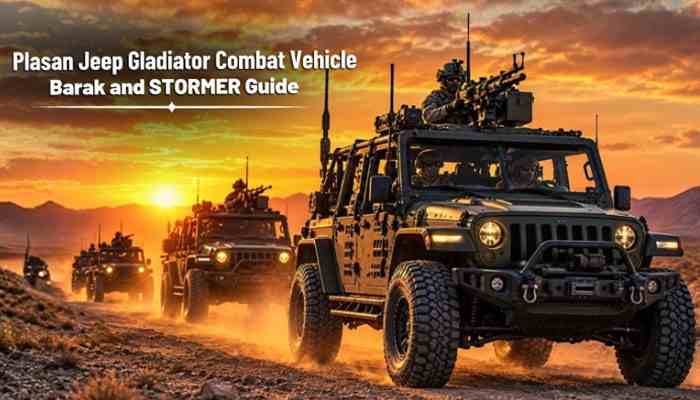

The plasan jeep gladiator combat vehicle takes a familiar pickup truck and adapts it for military transport. Developed by Plasan and ASFIR, this approach combines a commercial Jeep platform with changes for carrying people and equipment. However, two names appear in public coverage: Barak and STORMER. Understanding that distinction helps explain what the vehicle actually offers.
Ynet describes Barak as a nine-seat Gladiator-based vehicle. Meanwhile, an October 2026 company announcement describes STORMER as a special operations vehicle designed for up to 12 personnel. Their exact relationship has not been publicly explained in the sources reviewed. Readers should therefore avoid treating every specification as belonging to one identical model.
This guide explains the known features, the purpose of the conversion, and the questions that remain unanswered. It also separates manufacturer claims from proven performance. For anyone interested in military vehicles, the main story is practical: How much can a modified pickup carry, how easily can it be supported, and what protection does it provide?
What is the Plasan Jeep Gladiator Combat Vehicle?
The search phrase describes a military conversion of the Jeep Gladiator developed by Plasan and its off-road engineering partner, ASFIR.
A light tactical vehicle moves personnel and supplies where an ordinary road vehicle may struggle. Depending on its layout, it can also support communications, evacuation, or other tasks. The word “combat” describes its intended setting; it does not automatically mean the vehicle has heavy armor.
Three terms make this topic easier to understand:
- Platform: The underlying vehicle and its main mechanical structure.
- Conversion: Changes made to suit a different purpose.
- Configuration: A particular arrangement of seats, equipment, and cargo space.
A pickup conversion involves more than attaching military accessories. Designers must consider how passengers sit, how equipment is secured, and how added weight affects driving.
Barak vs. STORMER: Why the Names Matter
The available descriptions should be kept separate.
Ynet reports that Barak starts with a Gladiator Rubicon and includes a troop layout for nine soldiers, with up to 11 described for emergencies. Its report also identifies evacuation and equipment-carrying arrangements. The reported mechanical changes include a strengthened frame and axles, revised suspension, and larger tires.
The October STORMER announcement uses different headline figures. It describes a Gladiator-based vehicle with capacity for up to 12 personnel and more than 1,000 kilograms of payload. Defence Blog notes that Plasan had not explained how this vehicle relates to Barak.
| Feature | Barak reporting | STORMER announcement |
| Development partners | Plasan and ASFIR | Plasan and ASFIR 4X4 |
| Starting platform | Jeep Gladiator Rubicon | Jeep Gladiator-based commercial platform |
| Advertised seating | Nine; emergency capacity reported separately | Up to 12 personnel |
| Reported payload | One metric ton | More than 1,000 kg |
| Engine output stated | 285 horsepower | 280 horsepower |
| Transmission | Eight-speed automatic | Eight-speed automatic |
| Relationship between names | Not established in reviewed sources | Not established in reviewed sources |
These figures are source-specific. They should not be merged into a new specification sheet.
Sources: Ynet’s Barak report and Plasan/ASFIR’s STORMER announcement.
Who Are Plasan and ASFIR?
Plasan develops vehicle protection and survivability systems. Its official website also presents the SandCat armored vehicle family and related mission vehicles. That background explains why its name appears in discussions of military conversions.
ASFIR makes off-road vehicle components, including underbody protection and other accessories. Its involvement brings a different part of the engineering picture: Adapting vehicles for demanding terrain.
Sources: Plasan’s official website and ASFIR’s official website.
The partnership brings together protection-related engineering and off-road experience. Still, company experience and model-specific proof are different things.
A manufacturer may have successful products in service while a new vehicle remains at the announcement stage. Readers should look for evidence about the exact model, such as completed trials, customer orders, and published specifications.
Why Use a Jeep Gladiator Platform?
The main appeal of a commercial platform is that designers do not have to invent every component from scratch.
Commercial off-the-shelf, often shortened to COTS, means using an existing commercial product as the starting point. For a vehicle, that can include an established engine, transmission, and other mechanical parts.
Potential advantages include:
- Familiar service procedures for some components
- Existing suppliers for standard replacement parts
- A starting point for maintenance training
- Less dependence on completely unique mechanical designs
These are possible benefits, not a guarantee of lower costs everywhere.
A military conversion may introduce special parts that ordinary dealerships do not stock. Its frame, seats, electrical equipment, or suspension may require separate support. Commercial parts availability also varies by country.
Engine and Transmission: What the Numbers Mean
Both published descriptions identify a 3.6-liter gasoline engine and an eight-speed automatic transmission, although their stated horsepower differs.
Engine size tells readers the total working volume of the cylinders. Horsepower describes power output. Neither figure, on its own, tells you how well a loaded vehicle performs across rough ground.
For a useful evaluation, ask:
- How does the vehicle perform when fully loaded?
- How much fuel does it use under representative conditions?
- Can its cooling system manage long periods of hard work?
- What maintenance does the converted drivetrain require?
Do not use civilian Gladiator acceleration or fuel-economy figures as military conversion results. Changing the body, tires, equipment, and weight can change both.
The most useful figures would come from repeatable tests of the actual conversion.
Frame, Axles, Suspension, and Tires
Ynet’s Barak reporting describes a reinforced ladder frame, stronger axles, Eibach springs, Bilstein shock absorbers, and 35-inch tires on 17-inch wheels. It also reports Rubicon features such as locking differentials and low-range gearing.
Source: Ynet.
Here is what those components do in plain language.
Frame and Axles
The frame supports the vehicle’s main structure. Axles help carry weight and transfer drive to the wheels.
Adding passengers and equipment increases the forces passing through these parts. Rough terrain adds changing loads as the vehicle moves over bumps and uneven surfaces.
Springs and Shock Absorbers
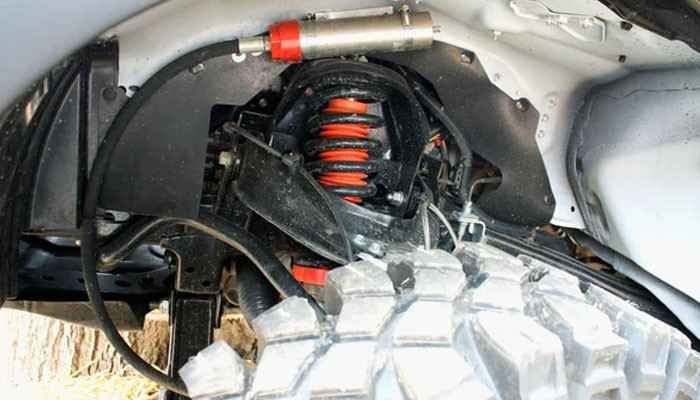
Springs support the load and allow movement. Shock absorbers control that movement so the vehicle does not keep bouncing after every bump.
A good suspension setup must balance support, ride comfort, and control. A setup suited to an empty truck may behave differently with a full team aboard.
Tires and Gearing
Tires affect grip, clearance, steering, and braking. Larger tires can change several aspects of vehicle behavior at once.
Low-range gearing helps a four-wheel-drive vehicle move slowly with greater control. Locking differentials can help maintain drive when available grip differs between wheels.
These features support mobility, but no equipment list proves that a vehicle can cross every type of terrain.
Seating and Payload Need to Be Read Together
The plasan jeep gladiator combat vehicle attracts attention because of its advertised passenger capacity. Yet seat count is only one part of the story.
Payload generally means the weight carried in addition to the vehicle’s own operating weight, under the manufacturer’s stated definition. Buyers need to confirm exactly what that definition includes.
People, personal equipment, supplies, and installed systems can all affect the load.
Consider a simple example. If 12 people average 90 kilograms each with their personal equipment, their combined weight is 1,080 kilograms. That is an illustration, not a STORMER loading limit.
It shows why readers should not assume that maximum seating and maximum equipment capacity are available at the same time.
Questions worth asking include:
- Does the payload figure include all occupants?
- Is the seating limit for fully equipped personnel?
- How is weight distributed between the axles?
- Which equipment is included in the quoted vehicle weight?
- Does every configuration have the same load rating?
A clear loading chart would be more useful than a headline number alone. Seating, restraints, axle ratings, and total vehicle weight must work together.
Is It Armored or Bulletproof?
The available reporting describes STORMER as unarmored. Its roll-over protection system should not be confused with ballistic protection.
A roll-over structure is intended to help protect occupants if the vehicle overturns. Armor addresses different hazards, such as projectiles or fragments. Blast protection is another separate engineering challenge.
The word “bulletproof” is too broad to describe military vehicles accurately. Protection should be tied to a tested threat, a defined area, and a stated vehicle configuration.
Useful protection information would include:
- Which parts of the vehicle are protected
- What threat the protection was tested against
- The relevant test standard
- Whether the results apply to the offered configuration
Defence Blog identifies STORMER as unarmored and distinguishes it from SandCat. Its report also notes that the relationship to Barak remains unclear.
Source: Defence Blog.
Do not assume Plasan’s other armor products are installed here. A company’s ability to build armor does not mean every vehicle it develops carries it.
What Missions Could the Vehicle Support?
The STORMER announcement lists troop transport, logistics, medical evacuation, and mission equipment integration. It also identifies a folding rear door, a 24-volt electrical system, and mounting provisions for communications and other equipment.
Source: Company announcement published by Armada International.
These proposed roles involve different needs.
Personnel Transport
A troop layout needs more than enough seats. Space for personal equipment, suitable restraints, and comfortable travel matter too.
Logistics
A cargo layout needs secure attachment points and clear loading limits. Equipment must remain controlled when the vehicle brakes or crosses uneven ground.
Medical Evacuation
A stretcher arrangement can support casualty movement, but it does not automatically make the vehicle a fully equipped ambulance. Medical staff, patient access, and onboard equipment determine what care is possible.
Communications and Specialist Equipment
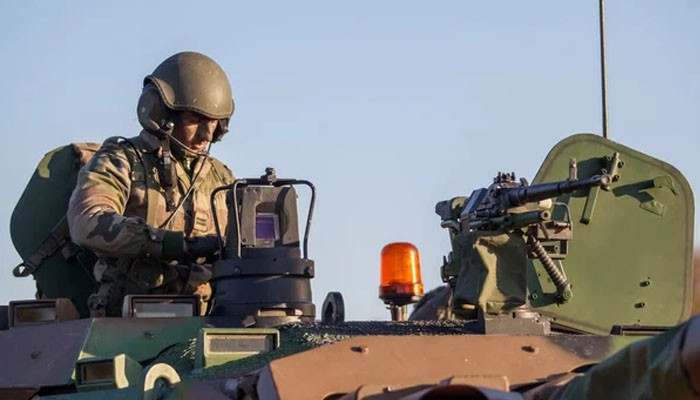
Mounting a system is only the beginning. It may also need power, cooling, wiring, and testing to ensure it works alongside other electronics.
A modular design aims to support different arrangements. Buyers still need to know how quickly each change can be made, who can perform it, and which parts are required.
Air Transport: A Claim That Needs Detail
STORMER is advertised as designed for airborne transport. That is useful context, but it is not a complete transport specification.
Air transport can mean different arrangements, including carrying a vehicle inside an aircraft or lifting it externally. Each method has its own limits.
A practical assessment should establish:
- The approved aircraft and transport method
- The permitted vehicle weight and dimensions
- Which parts must be removed
- The preparation and reassembly requirements
- The testing or approval behind the claim
Without those details, it would be premature to describe compatibility with every military helicopter or transport aircraft.
“Designed for” also differs from “qualified for.” The first describes an engineering aim; the second should be supported by evidence of completed assessment.
How Does It Compare With an Armored Vehicle?
An open light vehicle and an enclosed armored vehicle solve different problems.
| Question | Open light tactical vehicle | Enclosed armored vehicle |
| Main design emphasis | Mobility and adaptable transport | Protected movement |
| Passenger exposure | Open surroundings | Enclosed compartment |
| Equipment planning | Load space and weight remain critical | Armor weight also shapes capacity |
| Protection assessment | Must check the exact configuration | Must check the exact configuration |
| Best comparison method | Match the vehicle to the task | Match the vehicle to the task |
This table describes general design differences, not a tested head-to-head comparison.
Adding armor increases weight. Removing enclosure may improve access and visibility, but leaves occupants exposed. Neither approach removes all risk.
A responsible comparison explains those trade-offs without claiming that speed replaces protection.
Price, Orders, and Service Status
The reviewed announcement coverage does not provide a confirmed STORMER purchase price, production schedule, or named customer.
That means there is no reliable public figure to present as the cost of this conversion. The price of a civilian Gladiator is not an adequate substitute.
A military purchase may include:
- Vehicle engineering and configuration
- Installed equipment
- Spare parts and tools
- Training and technical manuals
- Transport, testing, and support
Likewise, an exhibition announcement does not establish operational service. Demonstrations, trials, orders, deliveries, and field use are different milestones.
Readers should be cautious with claims that the vehicle has already been widely deployed or selected by a particular army unless a current announcement supports them.
Future reporting may fill these gaps. Until then, leaving the answer open is more useful than publishing an estimate that looks official.
What Evidence Would Show Its Real Value?
The strongest next step would be documented testing of the finished vehicle in representative conditions.
A complete assessment should cover loaded mobility, braking, structural durability, passenger safety, and service requirements. Results need enough detail to show which configuration was tested.
Long-term cost should include fuel, maintenance, training, and downtime. A lower initial price does not always produce a cheaper fleet.
For this platform, the key question is whether the commercial foundation delivers useful support benefits after the military conversion. That needs evidence from the converted vehicle, rather than assumptions based on the original pickup.
Conclusion
The plasan jeep gladiator combat vehicle is an interesting example of adapting a commercial pickup for military transport. Its appeal rests on practical goals: carrying teams, supporting different equipment layouts, and using familiar mechanical components.
The details still matter. Barak and STORMER should be described separately, seating must be considered alongside payload, and roll-over protection must not be presented as armor. Clear pricing, customer announcements, and documented testing would make future assessments stronger.
For now, the fairest conclusion is that this platform offers a proposed solution to light tactical transport needs. Its lasting value will depend on how the finished configurations perform and how easily their operators can support them.
Plasan Jeep Gladiator Combat Vehicle FAQs
1. What is the Plasan Jeep Gladiator combat vehicle called?
Public coverage uses Barak and STORMER. The names appear with different seating figures and specifications, and their exact relationship remains unconfirmed in the reviewed material.
2. How many people can it carry?
Barak reporting describes nine seats, while STORMER is advertised for up to 12 personnel. The applicable layout and loading limits must be confirmed for each configuration.
3. Does it use a diesel engine?
The reviewed descriptions identify a 3.6-liter gasoline engine. They do not establish a diesel option for these configurations.
4. Is STORMER the same as SandCat?
Readers should not treat them as the same vehicle. SandCat is Plasan’s armored family, while the newly announced Gladiator-based STORMER is described as a light, unarmored platform.
5. Can civilians buy it?
The reviewed sources do not establish civilian sales, retail availability, or road registration status. Those questions would require direct confirmation from the manufacturer and the relevant authorities.
6. Has it proven its reliability?
A commercial starting point may offer practical advantages, but the reviewed sources do not provide enough independent, long-term test evidence to establish the conversion’s reliability.