




A Startup India certificate gives eligible Indian businesses official recognition under the government’s Startup India initiative. Issued by the Department for Promotion of Industry and Internal Trade (DPIIT), it can help startups access intellectual property support, government procurement opportunities, and selected tax and funding benefits.
Applying for a Startup India certificate is free, but not every newly registered company qualifies. Founders must meet the latest DPIIT eligibility criteria, submit valid business documents, and explain how their company contributes to innovation or scalability.
This guide explains how to apply for a Startup India certificate online, check eligibility, track application status, download and verify the certificate, and understand the benefits available under the revised 2026 rules.
Quick Answer: How to Get a Startup India Certificate
To get a Startup India certificate, first register an eligible business in India. Visit the official National Single Window System (NSWS), create an account, and select Registration as a Startup under Central Approvals.
Complete the application, upload the incorporation or registration certificate, explain the company’s innovation or scalability, and submit it for DPIIT review. Once approved, download and verify your Startup India certificate through the official Startup India certificate portal.
Key Takeaways
- A Startup India certificate is officially called the DPIIT Certificate of Recognition.
- The government charges no fee for recognition, downloading, or verification.
- Regular startups have a ten-year recognition limit and a ₹200 crore turnover ceiling.
- Recognised Deep Tech Startups have a twenty-year limit and a ₹300 crore turnover ceiling.
- Eligible businesses include private limited companies, registered partnerships, LLPs, and qualifying cooperative societies.
- Applications are submitted online through the National Single Window System.
- A Startup India certificate may support access to government schemes, intellectual property benefits, and procurement opportunities.
- DPIIT recognition does not automatically guarantee tax deductions, government loans, or funding.
What Is a Startup India Certificate?
A Startup India certificate is an official document issued by DPIIT confirming that an eligible Indian business has been recognised under the Government of India’s Startup India initiative.
The certificate is also known as:
- DPIIT Recognition Certificate
- Startup India Registration Certificate
- Startup Recognition Certificate
- DPIIT Startup Certificate
- Certificate of Recognition (COR)
The Startup India initiative was launched in January 2016 to encourage innovation, entrepreneurship, investment, and employment creation. DPIIT recognition helps distinguish eligible innovation-driven businesses from companies that are simply newly incorporated. A recognised startup may become eligible to apply for selected government programs, subject to their specific rules.
Is a Startup India Certificate the Same as Company Registration?
No. Company incorporation and DPIIT recognition are separate processes.
A Certificate of Incorporation confirms the legal establishment of a company. A Startup India certificate confirms that the company has obtained recognition under the applicable startup definition.
For example, registering a private limited software company through the Ministry of Corporate Affairs does not automatically provide DPIIT recognition. The company must submit a separate application and satisfy the recognition requirements.
Startup India Certificate Eligibility Criteria in 2026
Before applying for a Startup India certificate, founders should review the revised eligibility rules introduced through DPIIT Notification G.S.R. 108(E), dated February 4, 2026.
The notification increased the general startup turnover ceiling and introduced additional provisions for qualifying Deep Tech Startups.
Regular Startup vs Deep Tech Startup Eligibility
| Eligibility Criteria | Regular Startup | Deep Tech Startup |
|---|---|---|
| Maximum recognition period | 10 years | 20 years |
| Turnover ceiling | ₹200 crore | ₹300 crore |
| Registered in India | Required | Required |
| Eligible legal structure | Required | Required |
| Innovation or scalability | Required | Required |
| Deep technology evidence | Not required | Required |
| Formed by splitting an existing business | Not eligible | Not eligible |
| DPIIT approval | Required | Required |
The turnover condition applies to financial years since incorporation or registration. An entity generally ceases to qualify as a startup when it reaches the applicable age limit or exceeds the relevant turnover ceiling.
The revised framework is explained in the Government of India’s February 2026 announcement.
Which Businesses Can Apply for a Startup India Certificate?
The following legal structures may qualify:
- Private limited companies
- Registered partnership firms
- Limited Liability Partnerships (LLPs)
- Multi-State Cooperative Societies
- Cooperative societies registered under applicable state or union territory laws
One Person Companies may also qualify as private companies, subject to the recognition conditions.
However, sole proprietorships and unregistered partnerships are not eligible.
Does Every Newly Registered Business Qualify?
No. A business does not qualify merely because it was recently established.
DPIIT considers whether the entity is working toward innovation, development, or improvement of products, processes, or services. A scalable business model with significant potential for employment generation or wealth creation may also qualify.
For example, a conventional retail store does not automatically qualify for a Startup India certificate. However, a retail technology business developing an innovative inventory management system may potentially meet the recognition requirements.
The decision depends on the company’s actual business activities.
What Changed in Startup India Certificate Rules in 2026?
The government revised the startup recognition framework in February 2026, replacing the earlier 2019 notification.
The major changes include:
- Increasing the standard startup turnover ceiling from ₹100 crore to ₹200 crore.
- Introducing a separate ₹300 crore turnover limit for Deep Tech Startups.
- Extending Deep Tech recognition eligibility from ten years to twenty years.
- Expanding eligibility to qualifying cooperative societies.
- Introducing additional conditions concerning the use of startup funds.
These changes make Startup India recognition accessible to a wider range of qualifying companies, especially growing businesses and research-intensive ventures.
What Qualifies as a Deep Tech Startup?
A Deep Tech Startup develops solutions based on significant scientific or engineering advances. DPIIT considers characteristics such as substantial research and development activity, novel intellectual property, extended development periods, and technical uncertainty.
Potential examples include:
- Semiconductor research
- Advanced biotechnology
- Robotics and autonomous systems
- Scientific hardware
- Advanced materials
- Research-intensive healthcare technologies
Using artificial intelligence or running a technology website does not automatically qualify a business as Deep Tech. The company must demonstrate that its technology and development activities satisfy the applicable recognition requirements.
Startup India Certificate Eligibility Examples
The following examples help explain which businesses may qualify for DPIIT recognition.
| Business Example | Potential Eligibility | Main Consideration |
|---|---|---|
| AI product development company | Potentially eligible | Innovation and scalability |
| Biotechnology research startup | Potentially eligible | Scientific development |
| Traditional retail store | Not automatically | Evidence of qualifying innovation |
| Agricultural technology company | Potentially eligible | Product or process improvements |
| Sole proprietorship | Not eligible | Ineligible legal structure |
| Advanced robotics startup | Potentially Deep Tech | Technical and R&D evidence |
For example, a food manufacturing company developing a new process that improves production efficiency may potentially qualify for a Startup India certificate. The important factor is whether the registered entity meets the government’s startup definition.
Documents Required for a Startup India Certificate
The documents required for a Startup India certificate depend on the business structure, application details, and recognition category. The core requirements include proof of incorporation or registration and a description explaining the business’s innovation or scalability.
The NSWS application may request additional company information and supporting documents.
| Document or Information | Purpose |
|---|---|
| Incorporation or registration certificate | Confirms legal establishment |
| Innovation or scalability write-up | Demonstrates recognition eligibility |
| Company PAN, where applicable | Identifies the entity |
| CIN, LLPIN, or registration details | Confirms business registration |
| Registered business address | Establishes location information |
| Authorised representative details | Identifies the applicant |
| Product description or pitch deck | Supports business claims |
| Prototype or development evidence | Demonstrates actual business activities |
| Deep Tech technical documentation | Supports additional category requirements |
A patent, external investment, or completed product is not universally mandatory for standard DPIIT recognition. However, supporting evidence can make the startup’s business description more informative.
How to Prepare a Strong Innovation Description
The innovation write-up is one of the most important parts of a Startup India certificate application.
A useful description should explain:
- Problem: What customer or industry problem does the company address?
- Solution: What product, service, or process is being developed?
- Innovation: What is new or meaningfully improved?
- Business model: How does the startup plan to operate commercially?
- Scalability: How could the business expand, generate employment, or create economic value?
Avoid unsupported statements such as being India’s leading startup or offering revolutionary technology. Describe actual development work and business activities.
Example of a Startup Innovation Description
Consider an agricultural technology company.
A suitable explanation could be:
“Our company is developing a sensor-based irrigation monitoring system that combines soil measurements with software recommendations. The technology is designed to help agricultural businesses manage water usage more efficiently. We are testing the system with participating farms and plan to expand through partnerships with agricultural equipment suppliers.”
This is an illustrative example. Applicants should provide accurate information about their own company rather than copying generic descriptions.
How to Apply for a Startup India Certificate Online for Free
The official Startup India certificate application is completed through the National Single Window System. Founders can submit the application themselves without hiring a consultant.
Step 1: Visit the Official Startup India Website
- Open the Startup India recognition page.
- Navigate to the DPIIT recognition section and select the application option.
- The government directs applicants to NSWS.
Step 2: Create an NSWS Account
- Visit nsws.gov.in and create an account.
- Enter the required contact details and complete account verification.
- Use the email address and mobile number associated with the startup or its authorised representative.
Step 3: Select Registration as a Startup
After signing in:
- Open the NSWS dashboard.
- Select Add Approvals.
- Choose Central Approvals.
- Search for Registration as a Startup.
- Add the approval to your dashboard.
Open the application to continue.
Step 4: Enter Your Company Details
Provide the legal entity name, incorporation date, business sector, registered address, and relevant identification numbers. Ensure that the details match official records.
If your company operates under a brand name that differs from its registered entity name, use the legal name wherever the application requests it.
Step 5: Explain Your Business Innovation
Describe the company’s product, service, process, or scalable business model.
Focus on the business’s actual activities.
Include relevant information about:
- Customer or industry problems
- Product development
- Technology or process improvements
- Research and testing
- Commercial potential
- Scalability and employment opportunities
Step 6: Upload the Required Documents
- Upload the incorporation or registration certificate and other documents requested by the portal.
- If applying under the Deep Tech category, provide additional technical information where required.
- Check that every document is readable and follows the current file upload requirements.
Step 7: Review and Submit Your Application
Before submitting the Startup India certificate application, confirm that:
- The legal entity name is accurate.
- Incorporation details match official records.
- Identification numbers are correct.
- The innovation description reflects actual activities.
- Supporting documents are complete.
- All declarations are truthful.
Submit the application and retain the acknowledgement or reference number.
DPIIT may approve the application, request additional information, or reject it with reasons.
How Much Does a Startup India Certificate Cost?
The government charges ₹0 for a Startup India certificate.
There is no government fee for DPIIT recognition or issuance of the recognition certificate.
| Service | Government Fee |
|---|---|
| DPIIT recognition application | Free |
| Recognition certificate issuance | Free |
| Startup India certificate download | Free |
| Certificate verification | Free |
| Company or LLP incorporation | Separate costs may apply |
| Optional professional assistance | Depends on provider |
The Ministry of Commerce and Industry states that it has not appointed private agencies, representatives, or franchises to issue DPIIT recognition certificates. Founders can complete the recognition process directly through official government channels.
However, establishing a company or LLP may involve separate registration and professional expenses.
How Long Does Startup India Certificate Approval Take?
Startup India’s published FAQ states that a recognition certificate is typically issued within two working days after successful submission of a complete application.
- However, approval within two days is not guaranteed.
- Incomplete documents, incorrect information, or requests for clarification may increase processing time.
- Separate certification for income tax benefits can also require additional review.
How to Check Startup India Certificate Application Status
Applicants can monitor their Startup India certificate status through the relevant government account.
Follow these steps:
- Sign in to the account used for the application.
- Open the NSWS application dashboard.
- Locate Registration as a Startup.
- Review the displayed application status.
- Respond to any pending clarification or document request.
The exact status labels may vary as the government portal is updated. If the application is incomplete, follow the correction instructions rather than creating unnecessary duplicate applications.
How to Download a Startup India Certificate Online
After DPIIT approves the application, the Startup India certificate download is available through official government services. Applicants can retrieve the approved certificate through Startup India, NSWS, or supported DigiLocker services.
Method 1: Startup India Certificate Download Through the Official Portal
Visit the Startup India certificate verification and download page.
Follow these steps:
- Select Certificate of Recognition.
- Enter the recognition number or the complete registered entity name.
- Submit the search.
- Review the available certificate record.
- Download the certificate.
Keep a secure PDF copy for future business applications.
Method 2: Download Through NSWS
- Sign in to the NSWS account associated with the approved application.
- Open the startup registration approval and access the available certificate document.
- The exact navigation options may change as the portal is updated.
Method 3: Download Through DigiLocker
- The Startup India certificate can also be accessed through supported DigiLocker services.
- Sign in and locate the relevant government-issued certificate service.
- Follow the instructions to retrieve the document.
Can Existing Startups Download Updated Certificates?
Yes.
Following the February 2026 recognition changes, Startup India advised previously recognised businesses to log in with their registered credentials and download updated certificates.
Founders should check that their current certificate contains the correct recognition details.
How to Verify a Startup India Certificate Online
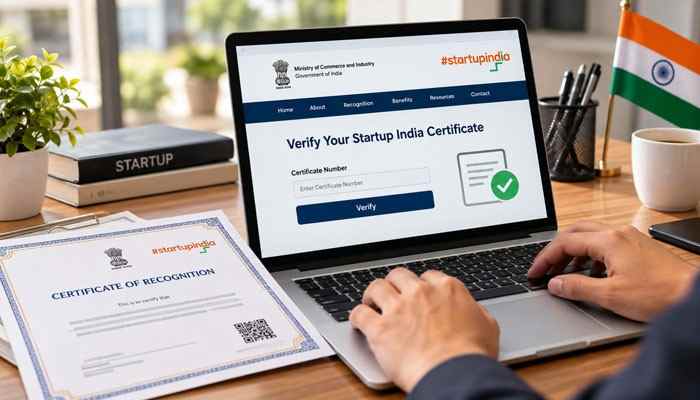
Startup India certificate verification helps establish whether a recognition document corresponds to an official DPIIT record.
This is useful for founders, government buyers, investors, lenders, and business partners.
Step-by-Step Startup India Certificate Verification
- Visit the official DPIIT certificate verification portal.
- Select Certificate of Recognition.
- Enter the certificate number or registered entity name.
- Submit the verification request.
- Compare the available result with the certificate presented.
Some recognition numbers begin with DIPP, reflecting DPIIT’s former departmental name. Always verify the legal entity name and recognition details.
Why Is My Startup India Certificate Not Showing?
A missing verification result does not automatically mean that the certificate is invalid.
Common reasons include:
- Incorrect recognition number
- Wrong certificate category
- Searching with a brand name instead of the legal entity name
- Typographical errors
- Temporary portal problems
- An application that has not yet been approved
Try the exact registered name and recognition number. If the issue continues, contact the official Startup India helpdesk.
Startup India Certificate vs Certificate of Eligibility
The government uses two different certificate categories.
| Certificate | Purpose |
|---|---|
| Certificate of Recognition (COR) | Confirms DPIIT startup recognition |
| Certificate of Eligibility (COE) | Confirms separate certification for the relevant startup income tax deduction |
A company may have a valid Startup India certificate without obtaining a Certificate of Eligibility.
This distinction is important because DPIIT recognition alone does not establish eligibility for startup profit deductions.
Benefits of a Startup India Certificate
A Startup India certificate may help eligible businesses access government programs designed to encourage innovation and entrepreneurship.
However, the specific advantages depend on the eligibility requirements of each program.
| Benefit | Potential Advantage |
|---|---|
| Intellectual property support | Patent and trademark assistance |
| Income tax benefits | Separate eligibility |
Benefits of a Startup India Certificate
A Startup India certificate may make an eligible business able to apply for several government benefits.
However, recognition does not automatically activate every incentive.
| Benefit | Potential Advantage |
|---|---|
| Intellectual property support | Patent and trademark facilitation |
| Income tax provisions | Separate eligibility-based deductions |
| Public procurement | Relaxations in specified tender requirements |
| Compliance support | Self-certification under selected laws |
| Funding programs | Access to qualifying schemes |
| Mentorship | Participation in eligible startup initiatives |
| Government networking | Opportunities to connect with ecosystem participants |
| State startup policies | Additional state-specific incentives |
Intellectual Property Benefits
DPIIT-recognised startups may qualify for intellectual property support under applicable government arrangements. Benefits can include patent facilitation, accelerated examination, and eligible fee rebates.
Startup India guidance identifies an 80% rebate on eligible patent filing fees under the relevant framework. The actual benefit depends on the patent or trademark rules applicable to the applicant.
Simplified Compliance
Recognised startups may use self-certification arrangements under specified labour and environmental laws. These mechanisms can reduce certain administrative burdens. However, companies must continue to comply with applicable legal obligations.
Public Procurement Opportunities
Eligible recognised startups may obtain relaxations concerning prior experience, turnover, and earnest money deposits in government procurement. The rules and exemptions vary by procurement arrangement. Recognition does not eliminate technical requirements or guarantee a government contract.
Can a Startup India Certificate Help You Sell on GeM?
Yes. Eligible startups can register as sellers on the Government e-Marketplace (GeM), which connects businesses with government buyers. DPIIT recognition can support access to startup-specific procurement arrangements.
How to Register on GeM
- Visit gem.gov.in.
- Open the seller registration process.
- Prepare the company identification and authorised representative details.
- Enter the DPIIT recognition number where requested.
- Complete the seller profile.
- Add eligible products or services.
- Review available procurement opportunities.
The official Startup India procurement guidance identifies DPIIT recognition number, PAN, Aadhaar, and the mobile number used for recognition among the relevant details.
GeM participation can provide market access, but sellers must satisfy platform requirements and applicable procurement conditions.
For further information, visit the Startup India public procurement guide.
Startup India Certificate Funding Benefits and Schemes
DPIIT recognition may help a business meet the initial eligibility requirements for government funding programs.
However, a certificate does not guarantee grants, loans, or investments.
Government Funding Options
| Scheme | Support Available | Important Condition |
|---|---|---|
| Startup India Seed Fund Scheme | Up to ₹20 lakh grant and ₹50 lakh through specified debt or convertible instruments | New applications closed May 31, 2026 |
| Credit Guarantee Scheme for Startups | Guarantee coverage for eligible debt up to ₹20 crore per borrower | Lending through participating institutions |
| Fund of Funds for Startups | Investment support through participating funds | Not a direct grant to founders |
| Startup India Fund of Funds 2.0 | ₹10,000 crore government-backed fund-of-funds corpus | Investments channelled through eligible funds |
| State startup programs | Grants, reimbursements, and other incentives | State-specific conditions |
Startup India Seed Fund Scheme
The Startup India Seed Fund Scheme was designed to support proof-of-concept development, prototypes, product testing, market entry, and commercialisation.
The program provides for:
- Grants of up to ₹20 lakh for eligible early-stage development activities.
- Support of up to ₹50 lakh through qualifying debt or convertible instruments.
According to the government’s June 2026 Startup Schemes Playbook, the last date for new startup applications under SISFS was May 31, 2026. Disbursements for approved support were continuing.
Therefore, founders should not assume that fresh applications remain open.
Credit Guarantee Scheme for Startups
The Credit Guarantee Scheme for Startups (CGSS) helps participating lenders provide credit to eligible DPIIT-recognised businesses. The revised scheme permits a maximum debt amount eligible for guarantee coverage of ₹20 crore per borrower.
The guarantee is provided through the relevant institutional framework, not handed directly to the startup as a government payment. Borrowers must still satisfy lender and scheme requirements.
Startup India Fund of Funds 2.0
In April 2026, the government approved Startup India Fund of Funds 2.0 with a corpus of ₹10,000 crore. The initiative aims to strengthen access to venture capital, including support for innovation-led manufacturing and technologies requiring longer development periods.
Funding is channelled through eligible investment funds. Startups seeking investment must approach relevant investors or participating funds and satisfy their selection criteria.
State-Wise Benefits of a Startup India Certificate
In addition to central government programs, recognised startups may qualify for incentives offered by individual states and union territories.
These policies can differ significantly.
Depending on the state, available support may include:
- Incubation assistance
- Product development funding
- Patent filing reimbursements
- Research and testing support
- Mentorship programs
- Startup events and market access
- Office space or infrastructure assistance
For example, founders operating in Karnataka, Telangana, Kerala, Maharashtra, or other states should review their respective startup policies. Eligibility may depend on local registration, operational presence, industry, age, and other criteria. Startup India provides an official State and UT Startup Policies directory.
Startup India Certificate and Income Tax Exemption
- DPIIT recognition and income tax eligibility are separate matters.
- A startup may hold a valid recognition certificate without qualifying for a profit deduction.
- The applicable provisions also changed with the Income-tax Act, 2025 and the Finance Act, 2026.
Section 80-IAC and Section 140 Explained
Section 80-IAC was the relevant startup profit-deduction provision under the Income-tax Act, 1961. From April 1, 2026, the corresponding provision is Section 140 of the Income-tax Act, 2025.
Under Section 140, qualifying businesses may claim a deduction of 100% of eligible business profits for three consecutive tax years within the prescribed ten-year period.
Importantly, the Finance Act, 2026 increased the relevant turnover ceiling under Section 140 from ₹100 crore to ₹300 crore, effective April 1, 2026.
DPIIT Recognition vs Startup Tax Deduction
| Requirement | DPIIT Recognition | Section 140 Tax Deduction |
|---|---|---|
| Main purpose | Official startup recognition | Profit deduction for eligible startups |
| Eligible structures | Companies, registered partnerships, LLPs, eligible cooperatives | Companies and LLPs |
| Turnover limit | ₹200 crore regular, ₹300 crore Deep Tech | ₹300 crore in the relevant tax year |
| Age period | 10 years regular, 20 years Deep Tech | Deduction within prescribed 10-year period |
| Incorporation dates | Determined by applicable recognition age criteria | April 1, 2016 to March 31, 2030 |
| Separate certification | DPIIT recognition required | Inter-Ministerial Board certification required |
| Automatic profit deduction | No | No |
The ₹100 crore figure still appears on some government pages describing the older Section 80-IAC rules.
For tax years governed by the Income-tax Act, 2025 as amended by the Finance Act, 2026, the revised Section 140 threshold must be considered.
Does a ₹250 Crore Company Automatically Qualify?
No.
For example, an ordinary startup with turnover of ₹250 crore would exceed the general DPIIT recognition ceiling of ₹200 crore. A company recognised as a qualifying Deep Tech Startup could potentially remain within the ₹300 crore recognition ceiling.
However, Section 140 tax eligibility requires additional conditions, including the applicable incorporation window, eligible business activities, certification, and other statutory requirements.
A tax professional should review the company’s specific circumstances before any deduction is claimed. The relevant legislation is available through the Income Tax Department’s amended Income-tax Act, 2025.
Startup India Certificate vs Udyam, GST and Company Registration
A Startup India certificate does not replace other business registrations.
| Registration | Main Purpose |
|---|---|
| Certificate of Incorporation | Legally establishes a company |
| DPIIT Recognition Certificate | Confirms eligibility for startup recognition |
| Udyam Registration | Registers an eligible MSME |
| GST Registration | Registers an entity under applicable GST rules |
| Tax Eligibility Certificate | Supports the relevant startup tax deduction |
A technology company may hold several of these registrations simultaneously.
DPIIT recognition is not a substitute for GST compliance, income tax obligations, or industry-specific licences.
What to Do After Getting a Startup India Certificate
Obtaining a Startup India certificate is the beginning of accessing eligible opportunities, rather than the end of the process.
Founders should take the following actions after approval:
- Download the certificate and keep a secure copy.
- Verify the registered entity details and recognition number.
- Confirm the certificate is linked to the correct company profile.
- Review relevant tax certification requirements.
- Explore procurement opportunities through GeM.
- Examine currently available funding and incubation programs.
- Check central and state startup incentives.
- Maintain updated company records and financial documentation.
Keep clear records of incorporation documents, recognition details, tax filings, investments, and significant business changes.
How to Fix Startup India Certificate Mapping Errors
Some founders can verify their certificates but cannot access recognition details through the expected account. This may happen when the record is associated with another registered email address or when company details do not match.
Startup India provides a DPIIT Recognition Mapping Verification service.
How to Check Certificate Mapping
The official service requests details such as:
- DIPP recognition number
- Company Incorporation Number (CIN)
- PAN
- Authorised representative’s mobile number
After OTP verification, the service can display the account email associated with the recognition record.
If necessary, sign in with the appropriate email address or use the official password recovery process.
Mapping verification is different from ordinary certificate verification.
How to Correct Details on a Startup India Certificate
Businesses may need to update registered information following a legal name change or other significant modification.
- The Startup India certificate verification page includes guidance for modifying recognition details.
- Depending on the correction, supporting documents may be required.
- For example, a company name change should be supported by updated corporate registration records.
- Always use the official update procedure instead of modifying the certificate PDF manually.
Common Startup India Certificate Application Mistakes
Avoiding basic application errors can reduce delays and improve the quality of the submission.
Common mistakes include:
- Applying before establishing an eligible legal entity
- Entering a brand name instead of the registered entity name
- Uploading incomplete or unreadable documents
- Providing vague explanations of innovation
- Claiming technology or intellectual property that cannot be verified
- Selecting the Deep Tech category without adequate evidence
- Confusing DPIIT recognition with income tax certification
- Assuming approval guarantees government funding
- Using incorrect or inaccessible contact details
- Paying unofficial agents for government recognition
The strongest application is accurate, specific, and supported by genuine business documentation.
What Happens if a Startup India Certificate Application Is Rejected?
DPIIT can reject an application when the eligibility criteria are not met or the information is insufficient. Startup India’s published FAQ distinguishes applications marked incomplete from rejected applications.
If an application is incomplete, founders should follow the correction instructions shown in the government account. The FAQ states that an application marked incomplete three times may be rejected.
It also states that a rejected application cannot be edited and that a fresh application may be submitted after three months from the communication of rejection. Applicants should check the current instructions relevant to their NSWS application before resubmitting.
How to Improve a Rejected Application
Start by reviewing the reason for rejection. If the problem concerns missing documents, prepare the correct records. If the innovation explanation was insufficient, rewrite it using specific information about the company’s products, development activities, or scalable business model.
If the underlying business does not meet the legal definition, changing the description alone will not make it eligible.
Does a Startup India Certificate Expire?
DPIIT recognition does not provide permanent startup status. Ordinary startups remain within the recognition framework for up to ten years from incorporation or registration, subject to other eligibility conditions.
- Recognised Deep Tech Startups have an extended twenty-year period.
- Recognition eligibility can also cease when the relevant turnover ceiling is exceeded.
- A previously issued certificate does not override these statutory limits.
Can DPIIT Cancel Startup Recognition?
Recognition and related certifications may be affected by false declarations, incorrect information, or failure to satisfy applicable requirements.
The 2026 notification specifically provides for revocation of relevant tax eligibility certification obtained on the basis of false information. A business may also cease to qualify as a recognised startup because of age or turnover limits.
These situations should not be confused. A business becoming too old for the startup definition is different from an approval being withdrawn because of misrepresentation. Founders should provide accurate information and comply with applicable recognition conditions throughout the relevant period.
Restrictions on Using Startup Funds
The February 2026 notification introduced conditions on how recognised startups deploy their funds. The rules emphasise using funds primarily for genuine business activities, including operations, research, development, innovation, and expansion. Certain investments may be restricted unless they are integral to normal business activities.
Examples include specified investments involving:
- Unrelated real estate
- Loans and advances outside normal business activities
- Capital contributions to other entities
- Shares and securities
- Luxury assets
- Speculative or non-productive activities
The notification includes exceptions for legitimate business uses. For example, a vehicle purchased for genuine transportation services may be treated differently from a luxury vehicle unrelated to a startup’s activities. Businesses should review the exact legal provisions before making unusual investments.
Can You Use the Startup India Logo After Recognition?
DPIIT recognition does not automatically provide unrestricted permission to use the government’s Startup India logo. Businesses should review the official logo-use guidelines and approval requirements.
Startup India maintains a logo request service. A company should not use official branding in a way that falsely suggests government endorsement, investment, or approval of its commercial products.
Startup India Certificate Customer Support
Applicants experiencing recognition, download, verification, or account issues can contact the official Startup India helpdesk.
| Contact Detail | Information |
|---|---|
| Official website | startupindia.gov.in |
| Toll-free number | 1800 115 565 |
| Published hours | 10:00 AM to 5:30 PM IST |
| Recognition application | nsws.gov.in |
| Certificate verification | Startup India verification portal |
| Mapping verification | DPIIT Recognition Mapping service |
Before contacting support, keep the registered company name, recognition number, application reference, and relevant documents available.
Do not share account passwords or OTPs with unofficial agents.
Startup India Certificate Application Checklist
Before submitting your application, confirm the following:
- The business has an eligible legal structure.
- The company is within the relevant age and turnover limits.
- The business meets the innovation or scalability criteria.
- The incorporation or registration certificate is available.
- The entity’s name and identification numbers are accurate.
- The innovation description is clear and factual.
- Supporting documents are readable.
- The authorised representative can access the registered contact details.
- The application is being submitted through the official government portal.
Completing these checks helps reduce preventable application errors.
Conclusion
A Startup India certificate provides official recognition to eligible businesses working on innovation, product development, process improvements, or scalable business models in India. The application is free and available through the National Single Window System. Founders should review the latest DPIIT eligibility rules, prepare accurate documents, and clearly explain their business activities before applying.
After approval, the certificate can be downloaded and verified through government-supported services. The February 2026 recognition changes also provide broader opportunities for eligible growing businesses, cooperative societies, and research-intensive Deep Tech Startups.
However, recognition is only the first step. Funding, public procurement benefits, tax deductions, and other incentives have their own requirements. Founders who understand these distinctions can use their DPIIT recognition more effectively while avoiding unnecessary fees, application mistakes, and compliance problems.
Startup India Certificate FAQS
1. Can I get a Startup India certificate without GST registration?
Yes. GST registration is not a universal prerequisite for DPIIT recognition. However, businesses must register for GST when required under applicable tax laws.
2. Can I apply for a Startup India certificate without revenue?
Yes. An eligible pre-revenue startup can apply if it meets the legal criteria and provides sufficient information about its innovation or scalable business model.
3. Can a sole proprietor obtain a Startup India certificate?
No. Sole proprietorships are not included among the eligible legal structures for DPIIT recognition.
4. Is a patent mandatory for a Startup India certificate?
No. A patent is not a universal recognition requirement. Applicants must demonstrate qualifying innovation or scalability through relevant information and evidence.
5. Can I download a lost Startup India certificate again?
Yes. An approved recognition certificate can generally be retrieved again through the official government download and verification services.
6. Can a Startup India certificate guarantee a government loan?
No. DPIIT recognition may help satisfy eligibility requirements, but lending decisions depend on the financial institution, applicable scheme, and business assessment.
7. Can a foreign founder apply for a Startup India certificate?
A company or LLP registered in India with foreign participation may potentially qualify, subject to applicable business, investment, and recognition requirements.
8. Is Startup India recognition mandatory for every new company?
No. DPIIT recognition is not mandatory for every business. It is intended for entities that meet the government’s startup definition and wish to access relevant recognition-linked opportunities.
