



Introduction
Choosing the right software development partner has never been more important.
In 2026, businesses are increasingly relying on custom software to automate operations, improve customer experiences, leverage artificial intelligence, and gain a competitive advantage. At the same time, the number of agencies, development firms, freelancers, and offshore providers continues to grow, making the selection process more challenging than ever.
The wrong partner can lead to missed deadlines, budget overruns, technical debt, security vulnerabilities, and products that fail to meet business objectives. The right partner, however, becomes a strategic extension of your team and helps transform ideas into scalable digital products.
This guide explains how to evaluate, compare, and select a bespoke software development company that aligns with your goals, budget, and long-term vision.
What Is a Bespoke Software Development Company?
A bespoke software development company specializes in designing, developing, and maintaining software solutions tailored to the unique requirements of a business.
Unlike off-the-shelf platforms, bespoke software is built specifically around an organization’s workflows, processes, users, and objectives.
Examples include:
- SaaS platforms
- Mobile applications
- Enterprise systems
- Healthcare software
- Logistics platforms
- Marketplace solutions
- CRM systems
- AI-powered applications
- Internal operational tools
Working with an experienced bespoke software development company enables organizations to create solutions that precisely match their operational requirements rather than adapting business processes to generic software limitations.
Why More Businesses Are Choosing Custom Software in 2026
Several factors are accelerating demand for custom software development.
Artificial Intelligence Integration
Companies increasingly require proprietary AI solutions integrated into their internal processes, customer experiences, and business operations.
Generic software rarely offers the flexibility needed to implement custom AI workflows effectively.
Competitive Differentiation
Businesses seek technology advantages that competitors cannot easily replicate.
Custom software creates unique capabilities that are unavailable through standard SaaS products.
Scalability Requirements
As organizations grow, many off-the-shelf tools become restrictive.
Custom solutions provide greater control over architecture, performance, integrations, and future expansion.
Process Optimization
Companies often discover that manual tasks, disconnected systems, and inefficient workflows create significant operational costs.
Bespoke software can eliminate these inefficiencies through automation and seamless integrations.
Signs Your Business Needs a Bespoke Software Development Partner

Not every project requires custom software.
However, several indicators suggest that working with a bespoke development company may be the right decision.
You Use Multiple Disconnected Systems
When employees constantly switch between different tools, productivity suffers and data silos emerge.
Your Team Relies on Manual Processes
Manual data entry, spreadsheet management, and repetitive administrative tasks often signal opportunities for automation.
Existing Software Cannot Support Growth
Scalability limitations frequently become a major obstacle for growing organizations.
You Have Unique Operational Requirements
Businesses with specialized workflows often struggle to find software that adequately supports their processes.
Customer Experience Is a Competitive Priority
Custom applications enable organizations to create differentiated digital experiences that strengthen customer retention and engagement.
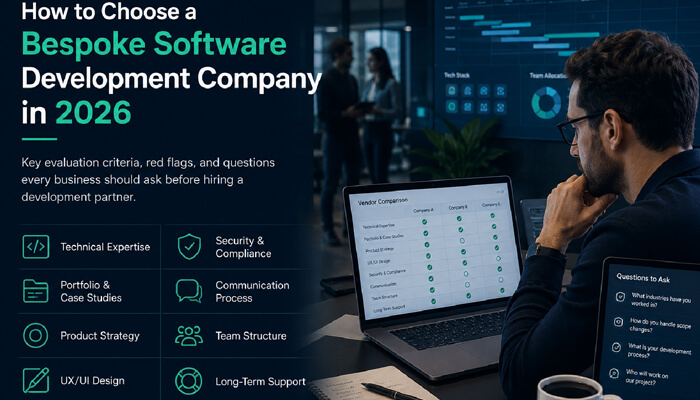
Key Factors to Evaluate When Choosing a Bespoke Software Development Company
1. Industry Experience
Industry knowledge can significantly accelerate project success.
A development partner familiar with your market understands common challenges, compliance requirements, user expectations, and competitive dynamics.
For example:
- Healthcare software requires regulatory awareness.
- Fintech applications require robust security practices.
- E-commerce platforms require expertise in conversion optimization.
- SaaS products require scalable architecture and subscription management.
Ask potential partners about similar projects they have completed and request relevant case studies.
2. Technical Expertise
Technology evolves rapidly.
Your chosen partner should demonstrate expertise in modern development frameworks, cloud infrastructure, security standards, and emerging technologies.
Key capabilities may include:
- Web application development
- Mobile app development
- Cloud architecture
- API integrations
- DevOps practices
- AI implementation
- Database optimization
- Cybersecurity
A capable bespoke software development company should be able to explain technology decisions in business terms rather than relying solely on technical jargon.
3. Product Thinking
Many development firms simply execute specifications.
The best partners contribute strategic thinking throughout the product lifecycle.
Look for companies that challenge assumptions, identify risks, suggest improvements, and focus on business outcomes rather than merely delivering code.
Questions to ask:
- How do you validate product ideas?
- How do you prioritize features?
- How do you reduce development risk?
- How do you measure success?
Strong product thinking often leads to better outcomes and lower development costs.
4. UX/UI Design Capabilities
User experience directly influences adoption, retention, and customer satisfaction.
An effective development partner should offer:
- User research
- Wireframing
- Interactive prototyping
- UX strategy
- Visual design
- Accessibility considerations
Even technically excellent software can fail if users find it confusing or difficult to navigate.
5. Communication and Transparency
Poor communication remains one of the most common reasons software projects fail.
Evaluate:
- Response times
- Reporting processes
- Project visibility
- Meeting structure
- Collaboration tools
- Stakeholder involvement
A transparent development process helps prevent misunderstandings and ensures alignment throughout the project lifecycle.
6. Development Methodology
Modern software projects typically benefit from Agile methodologies.
Agile development enables:
- Faster feedback loops
- Incremental delivery
- Greater flexibility
- Better risk management
- Continuous improvement
Ask how the company structures sprint planning, backlog management, testing, and release cycles.
7. Security and Compliance
Security should never be treated as an afterthought.
Important considerations include:
- Secure coding practices
- Vulnerability testing
- Access control systems
- Data encryption
- Backup strategies
- Compliance requirements
This becomes particularly critical for healthcare, financial, and enterprise applications.
8. Scalability and Architecture
Many organizations focus exclusively on launching quickly.
However, long-term scalability is equally important.
A robust architecture should support:
- Increased user traffic
- New integrations
- Additional features
- Geographic expansion
- Performance optimization
Scalable systems reduce future redevelopment costs and support sustainable growth.
Questions to Ask Before Hiring a Bespoke Software Development Company
Before signing a contract, consider asking:
- What projects similar to ours have you delivered?
- How do you estimate project timelines and budgets?
- What technologies do you recommend and why?
- How do you manage changing requirements?
- What testing processes do you follow?
- Who owns the source code?
- How do you ensure software security?
- What post-launch support do you provide?
- How do you measure project success?
- Can we speak with previous clients?
Their answers often reveal more about their capabilities than a portfolio alone.
Common Mistakes Businesses Make When Selecting a Development Partner
Choosing Based Solely on Price
The lowest proposal often becomes the most expensive solution in the long run.
Poor quality development frequently results in:
- Rework
- Delays
- Technical debt
- Security issues
- Increased maintenance costs
Ignoring Strategic Fit
Technical expertise matters, but cultural alignment and communication style are equally important.
Focusing Only on Delivery
Software development should be viewed as an ongoing partnership rather than a one-time transaction.
Neglecting Future Growth
Solutions designed only for current requirements may become obstacles as the business expands.
Why Long-Term Partnerships Deliver Better Results
The most successful software initiatives rarely end after launch.
Continuous improvement enables organizations to:
- Add new functionality
- Improve performance
- Address user feedback
- Integrate emerging technologies
- Enhance security
Many businesses achieve greater value by partnering with a trusted bespoke software development company that can support the product throughout its lifecycle.
Final Thoughts
Selecting the right software development partner is one of the most important technology decisions a business can make.
The ideal company combines technical expertise, product strategy, user-centered design, transparent communication, and long-term scalability planning.
Rather than focusing solely on development costs, organizations should evaluate how effectively a partner can help achieve business objectives, reduce operational inefficiencies, and create sustainable competitive advantages.
For companies seeking tailored digital solutions, partnering with an experienced bespoke software development company can provide the expertise and strategic guidance needed to turn ambitious ideas into successful software products.
