




Most AI video stalls do not start with a bad model. They start when a producer opens three vendor tabs, burns separate wallets, and loses the one draft that almost passed review. A desk that routes work through Viddo AI is not chasing a prettier first frame. It is trying to keep credits, seeds, and finish rules in one place so unfinished clips stop leaking across accounts.
The claim worth testing is operational. If failed renders can return credits, and another page can stay open while a long job runs, less of the week is spent babysitting tools.

The Tab Tax Shows Up Before Any Frame Does
A typical week looks ordinary until someone audits it.
One social cut sits in Vendor A. A “sharper” second take sits in Vendor B. The approved still lives in chat. The almost-working prompt is buried in a private note.
By Thursday the team has motion assets, but no trail that explains why Take 2 replaced Take 1.
That scatter never appears on a model comparison chart. The first repair is not another model trial. It is a map: one place for the brief, one place for the discard reason, one place for the credit result.
Hidden Rework Burns The Same Scene Twice
Someone rewrites the same motion prompt. Someone asks which account still has balance.
Two editors may regenerate the same scene on different sites because neither can see the other’s discard reasons. The team pays twice for one soft miss.
Meetings Turn Into File Archaeology
Separate wallets make a shared kill list optional. Optional kill lists do not survive deadline pressure. The rework looks like production activity, but it is mostly map repair.
Half the status call is spent reconstructing which tab held the almost-approved take. Nobody argues about story. Everybody argues about file location.
People then pick the clip that is easiest to find, not the clip that best supports the claim. Scatter quietly lowers the quality of the final choice.
One Ledger Changes Fixed Costs, Not Taste
The platform positions itself as one workspace for video and image routes. The production value is the missing fixed cost, not a promise that every clip will look better.
| Fixed cost | Multi-vendor path | Single workspace |
| Login and billing | Repeated per vendor | One account surface |
| Failed generation | Policy differs by vendor | Credits can be restored on failure |
| Parallel work | Copy prompts between tabs | Multiple pages can stay open |
| Finish rules | Easy to forget per tool | Same watermark and commercial gate |
Keep-rate still depends on clear prompts and ruthless discard of warped faces. What changes is how often the desk reconstructs context.
Editors also stop translating one brief into three vendor dialects. Ratio, length, and reference uploads live on one create surface. Lite routes and heavier multimodal routes are still not interchangeable, and rights for uploaded faces stay with the producer.
Assign Credits To Briefs Not Curiosity
Credits still vary by model, length, and resolution. A reckless “generate again” habit can empty a plan inside one account.
If Brief A has three retries left, those retries stay on Brief A’s page. Borrowing Brief B’s balance recreates scatter inside a single account.
Viddo AI helps only when the create panel is treated as a job ticket: brief, ratio, kill rule, and credit outcome together.
Close One Brief Before Opening Another Page
Write the finish rule before the first generate. Pick a model for that job only. Do not collect logos while the brief is still vague.
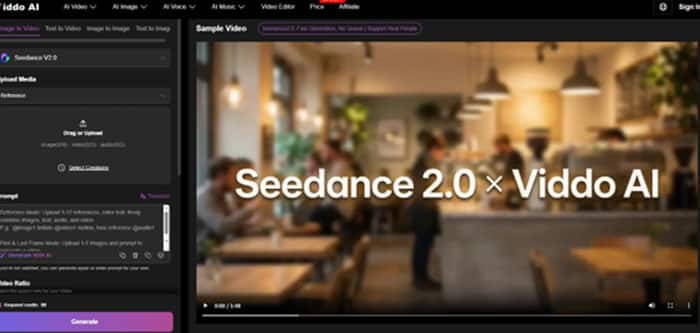
Set Video Ratio and length first. Write the prompt. Upload a reference still before chasing adjectives. Hit Generate and wait for a real preview.
Failed creations can return credits. That protects budget. It does not rescue a pretty frame that fails identity or text.
Name exports by brief and take number, not by model nickname. Freeze the prompt text once Take 1 passes identity. Later takes may change camera motion in one clause; they should not rewrite the character from scratch.
A producer evaluating Viddo AI should ask whether the workspace keeps the brief, the credit outcome, and the kill rule beside each other.
Write Hard Fails And Label Parallel Pages
Hard fails come first: unreadable words, a face that changes mid-shot, a product silhouette that no longer matches, or a watermark that blocks a paid placement.
If a second brief arrives while the first is still generating, label the second page before typing anything. Anonymous parallelism is scatter with better branding.
Stop Paying For Lost Context
Viddo AI fits when the weekly pain is scattered drafts more than a missing model badge.
Keep credits, seeds, and finish rules beside the brief. Keep a second vendor only for a specialty job the desk cannot host. The week improves when fewer clips are lost between tabs.
