


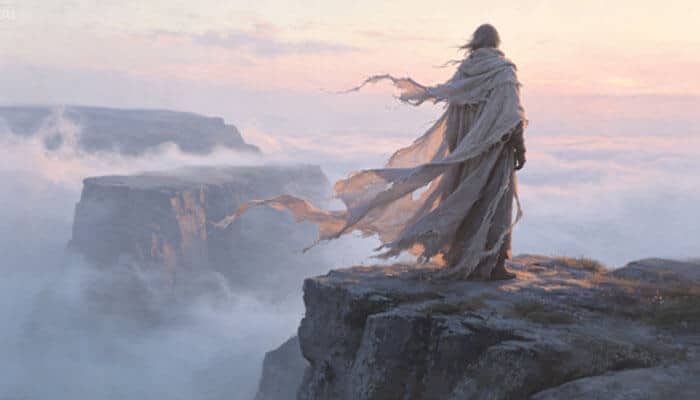

A poem rarely tells you exactly what to picture — it gives you fragments, feelings, and images layered just enough to leave room for interpretation. That’s part of what makes poetry powerful, but it also means a poem’s atmosphere often stays trapped on the page, experienced only in the reader’s head.
A free AI image generator tool gives that atmosphere a visible form, and Dreamina is particularly skilled at interpreting the mood and imagery buried inside a stanza rather than just illustrating its literal words. Here’s how to give your favorite poem a second life as art.
Why a poem’s mood matters more than its literal words
Illustrating a poem word for word often produces something flat and overly literal, missing the emotional undercurrent that made the poem resonate in the first place. The stronger approach is translating tone and feeling — longing, quiet grief, restless hope — into visual choices like color, light, and composition.
Finding the single image at a poem’s emotional center
Most poems, even long ones, tend to circle one core image or feeling. Before writing a prompt, ask what that central image actually is — a closed door, an open field, a hand reaching for something just out of frame. That single image becomes the anchor for your entire visual composition.
- Identify the poem’s dominant emotion in one or two words
- Find a concrete image the poem returns to or implies
- Decide whether the mood is quiet and still, or urgent and restless
Choose light and color to match a stanza’s tone
Color and lighting do enormous emotional work in atmospheric art. A poem about loss might call for cool, desaturated tones and soft fading light, while a poem about renewal might call for warm, rising light and gentle color gradients.
Dreamina: a creative tool with multiple image generation models

Dreamina gives creators access to several distinct image generation models, and for poetry-inspired work, Seedream 5.0 Pro stands out as the strongest choice. As the newest model in the lineup, it keeps its deep-thinking, reasoning-first approach to generation, working through a complex or abstract prompt before rendering rather than reacting to keywords in isolation — a real advantage when translating something as interpretive as poetry into a coherent scene.
It also offers precise editing, letting you adjust a single emotional detail, like a character’s posture or the direction of falling light, without disturbing the rest of the composition you’ve already gotten right.
Nano Banana works well for quickly testing a few different mood directions before settling on a final interpretation, while GPT Image 2 handles longer, descriptive prompts closely, useful when a poem’s imagery requires more explanation to translate clearly.
Turn verse into visual art in three moves
Dreamina makes translating poetry into imagery feel surprisingly intuitive, even for abstract or metaphor-heavy text.
Step 1: Write a text prompt
Head to Dreamina and describe the scene inspired by your poem’s central image and emotional tone, including setting, lighting, and color palette. Add a reference image if you have mood board inspiration already gathered.
For instance: An atmospheric illustration of a person dressed as a grieving figure standing beneath a bare winter tree at dusk, cold blue-gray palette, falling snow, melancholic painterly style, highly detailed.
Step 2: Adjust parameters and generate
Choose Image 5.0 Pro, powered by Seedream 5.0 Pro, for rich atmospheric depth and consistent emotional tone across the composition, then set your aspect ratio, canvas size, and resolution — 1K for a quick draft, 2K for a framed or printed final piece. Click Dreamina’s generate icon to render your scene.
Step 3: Customize and download
Polish the result with Dreamina’s editing tools: inpaint to adjust specific details or expressions, expand to widen the atmospheric setting, remove to eliminate anything that breaks the mood, and retouch for a final cohesive finish. Click Download once it captures the feeling you were after.
Balancing literal imagery with metaphor
The most compelling poem-inspired art usually blends a touch of literal imagery with metaphorical elements — a figure who is literally present in the poem, surrounded by a slightly surreal or symbolic environment that reflects the poem’s deeper meaning rather than its surface description.
Pairing text excerpts with the finished artwork
Once your image is generated, consider leaving space for a short excerpt of the poem itself, placed thoughtfully rather than crowding the composition. This pairing often deepens the emotional impact of both the text and the image together.
Building a visual series from a full poem collection
For a full collection or chapbook, generating a consistent visual thread — shared color logic, a recurring stylistic choice — across each poem’s artwork creates a cohesive visual companion to the written work rather than a set of disconnected illustrations.
Where this artwork finds its audience
Poetry-inspired visual art tends to resonate in several specific spaces:
- Published poetry collections and chapbook covers
- Social media accounts sharing original or favorite poems
- Gallery-style prints for personal or gift use
- Spoken word event promotional materials
Letting negative space carry meaning
Empty space in a composition isn’t wasted space — in atmospheric art, it often carries as much emotional weight as the subject itself. A small figure surrounded by a vast, quiet sky can express isolation or freedom far more powerfully than a tightly cropped, detail-packed scene. Describing generous open space in your prompt gives a poem’s quieter moments room to breathe visually.
Choosing between realism and abstraction for different poems
Not every poem calls for the same visual approach. A narrative-driven poem with concrete imagery often suits a more realistic, painterly rendering, while a highly abstract or fragmented poem might call for a looser, more impressionistic treatment where shapes and colors matter more than literal detail. Matching this choice to the poem’s own style keeps the artwork feeling true to the source.
Letting a poem be seen as well as read
Some poems ask to be felt more than understood literally, and that feeling deserves a visual home too. With Dreamina and the interpretive depth of AI algorithms, your favorite stanza can finally become something you can look at as well as read — and it’s free to try with the next poem that moves you.
