


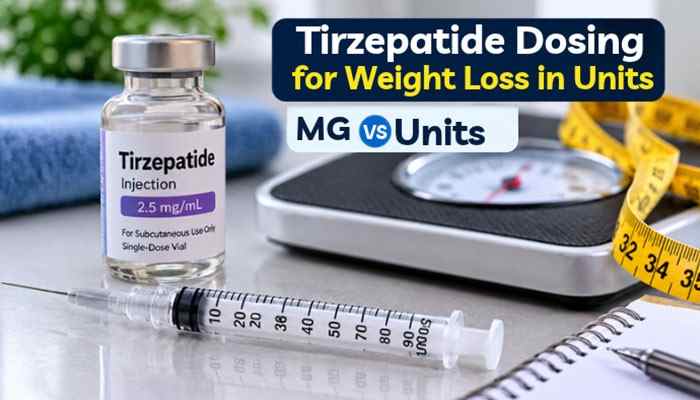

Tirzepatide dosing for weight loss in units can be confusing when a prescription lists milligrams (mg), but an injection syringe displays measurements in units. Although these measurements are related, they are not interchangeable. Misunderstanding the difference can result in administering too much or too little medication.
Tirzepatide, the active ingredient in Zepbound and Mounjaro, is administered through a once-weekly injection. FDA-approved dosing is prescribed in milligrams, while certain vial-based presentations require patients to measure a specific volume of liquid. The appropriate measurement depends on the medication’s concentration and the administration device.
Understanding tirzepatide dosing for weight loss in units is particularly important for patients using injectable vials, changing pharmacies, or comparing different medication presentations. This guide explains the FDA-approved dosage schedule, the difference between mg and syringe units, how to read concentration labels, injection safety, side effects, and important FDA updates for 2026.
Quick Answer: Tirzepatide Dosing for Weight Loss in Units
Tirzepatide dosing for weight loss in units depends on the medication’s concentration and syringe calibration. FDA-approved Zepbound treatment starts at 2.5 mg once weekly for four weeks, followed by gradual increases. The approved maintenance doses for weight management are 5 mg, 10 mg, and 15 mg weekly. There is no universal mg-to-units conversion, so patients must follow verified, product-specific injection instructions.
Key Takeaways
- Starting dose: Zepbound treatment begins at 2.5 mg once weekly for four weeks.
- Maintenance doses: The approved weight-management strengths are 5 mg, 10 mg, and 15 mg weekly.
- MG vs units: Milligrams measure the active medication, while syringe units represent calibrated liquid volume.
- Dosage conversion: No universal syringe-unit chart applies to every tirzepatide formulation.
- Maximum dosage: The highest FDA-approved Zepbound dose is 15 mg once weekly.
- Injection safety: Patients must confirm their medication concentration, syringe type, and prescribed instructions before injecting.
What Is Tirzepatide, and How Does It Work for Weight Loss?
Tirzepatide is a prescription medication that activates two hormone receptors involved in appetite regulation and blood glucose control: glucose-dependent insulinotropic polypeptide (GIP) and glucagon-like peptide-1 (GLP-1).
These actions help reduce appetite, influence feelings of fullness, and improve blood glucose regulation. When combined with nutritional changes and increased physical activity, tirzepatide can support substantial weight reduction over time.
In the United States, tirzepatide is marketed under two principal brand names:
- Zepbound: FDA-approved for long-term weight management in eligible adults and for moderate-to-severe obstructive sleep apnea in adults with obesity.
- Mounjaro: FDA-approved for type 2 diabetes within its labeled indications.
Although both products contain tirzepatide, patients should follow the prescription and administration instructions for their particular medication.
Who Qualifies for Tirzepatide Weight-Loss Treatment?
Zepbound is approved for long-term weight management in eligible adults with obesity or overweight accompanied by at least one weight-related medical condition.
The eligibility criteria generally include:
- BMI of 30 or higher: Adults with obesity.
- BMI of 27 or higher: Adults with overweight and at least one related health condition, such as high blood pressure, type 2 diabetes, or abnormal cholesterol levels.
A healthcare professional must also evaluate medical history, contraindications, concurrent medications, and treatment goals before prescribing tirzepatide.
The standard starting dose is not directly calculated according to body weight. Eligible adults generally begin with the same FDA-approved starting strength, followed by individualized adjustments when appropriate.
Tirzepatide Dosing for Weight Loss in Units: FDA Dosage Chart
The official tirzepatide weight-loss dosing schedule is prescribed in milligrams rather than universal syringe units.
According to the FDA-approved Zepbound prescribing information, treatment begins with 2.5 mg injected subcutaneously once weekly for four weeks.
After the initial four weeks, the dosage increases to 5 mg once weekly. Additional increases may occur in 2.5 mg increments after at least four weeks at the current dose.
FDA-Approved Tirzepatide Weekly Dosing Schedule
| Treatment period | Weekly dosage | Treatment stage |
| Weeks 1–4 | 2.5 mg | Starting dosage |
| Weeks 5–8 | 5 mg | First increase; possible maintenance dose |
| Weeks 9–12 | 7.5 mg | Optional intermediate increase |
| Weeks 13–16 | 10 mg | Possible maintenance dose |
| Weeks 17–20 | 12.5 mg | Optional intermediate increase |
| Week 21 onward | 15 mg | Maximum approved weekly dose |
Important: This table illustrates the earliest typical progression when every increase occurs after four weeks. It is not a mandatory treatment schedule, and not every patient needs to progress to 15 mg.
Patients may remain at a lower strength longer, depending on clinical response and medication tolerability.
The FDA-approved maintenance doses for weight reduction and long-term management are 5 mg, 10 mg, and 15 mg once weekly.
Why Does Tirzepatide Start at 2.5 mg?
The 2.5 mg dose is intended to introduce the medication gradually before moving to higher strengths.
Tirzepatide can cause gastrointestinal symptoms, including nausea, vomiting, diarrhea, and abdominal discomfort. These effects may become more noticeable when treatment begins or the dosage increases.
Gradual escalation helps improve medication tolerability and reduces the likelihood of significant gastrointestinal adverse reactions.
The 2.5 mg strength is intended for treatment initiation and is not an FDA-approved maintenance dosage.
Is 7.5 mg a Maintenance Dose?
For FDA-approved Zepbound weight management, 7.5 mg and 12.5 mg are intermediate escalation strengths.
The specified maintenance doses are 5 mg, 10 mg, and 15 mg once weekly.
A healthcare professional should determine whether an increase is appropriate based on treatment response and side effects.
What Is the Maximum Tirzepatide Dose?
The maximum FDA-approved Zepbound dosage is 15 mg once weekly.
However, the highest available dose is not automatically the best option for everyone.
Some patients may achieve meaningful weight reduction at 5 mg or 10 mg while experiencing fewer adverse effects.
The appropriate maintenance dose depends on clinical response, tolerability, and the prescribing clinician’s assessment.
MG vs Units: Understanding Tirzepatide Injection Measurements
One of the most important parts of tirzepatide dosing for weight loss in units is understanding the difference between medication amount, liquid volume, and syringe markings.
Milligrams describe the amount of active tirzepatide. Milliliters describe the volume of injectable liquid, while syringe units represent markings on a calibrated syringe.
These measurements are connected through the concentration of the medication, but they are not equivalent.
MG, ML, and Syringe Units Comparison
| Measurement | Meaning | Purpose |
| Milligrams (mg) | Amount of active tirzepatide | Defines the prescribed medication dose |
| Milliliters (mL) | Liquid volume | Describes how much solution is administered |
| Concentration (mg/mL) | Medication amount per milliliter | Connects drug quantity with liquid volume |
| Syringe units | Calibrated markings on a syringe | Indicate volume according to the syringe scale |
For example, a U-100 insulin syringe uses a calibration in which 100 marked units correspond to 1 mL of liquid.
However, that does not mean 100 syringe units equal 100 mg of tirzepatide.
The quantity of medication contained in any given volume depends on the concentration of the specific formulation.
Are Tirzepatide Units the Same as MG?
No. Tirzepatide milligrams and syringe units are different measurements.
Milligrams specify how much active medication is being administered. Syringe units describe a liquid volume according to the syringe’s calibration.
Two tirzepatide formulations may contain the same number of milligrams in different liquid volumes.
Therefore, syringe measurements cannot be copied safely from another patient’s instructions or a different medication product.
Why Does Tirzepatide Concentration Matter?
The concentration tells healthcare professionals how much active medication is present in each milliliter of liquid.
A more concentrated solution contains a greater amount of medication per milliliter than a less concentrated solution.
Consequently, the same volume of two differently concentrated products may contain different quantities of tirzepatide.
This is why a prescription written in milligrams cannot be translated into syringe markings without confirming the actual formulation.
How to Convert Tirzepatide MG to Units Safely
Patients researching tirzepatide dosing for weight loss in units frequently want to know how many syringe units correspond to 2.5 mg, 5 mg, 7.5 mg, or 10 mg.
The answer depends on the product’s concentration and the measuring device.
The mathematical relationship between medication amount and liquid volume is:
Volume (mL) = Medication amount (mg) ÷ Concentration (mg/mL)
This formula explains why concentration is essential. It does not independently verify the prescription or establish a safe injection measurement.
The prescribed milligram dose, exact medication concentration, syringe calibration, and administration instructions must be confirmed by the dispensing pharmacist.
Why Is There No Universal Tirzepatide Units Chart?
Different tirzepatide products may be supplied in different concentrations.
The same prescribed milligram amount can therefore occupy different liquid volumes.
A universal chart claiming that a particular number of syringe units always equals a specific tirzepatide strength could be misleading.
Common Tirzepatide MG-to-Units Questions
| Prescribed tirzepatide strength | Universal syringe-unit equivalent? | Important information |
| 2.5 mg | No | FDA-approved starting strength |
| 5 mg | No | Approved maintenance strength |
| 7.5 mg | No | Intermediate escalation strength |
| 10 mg | No | Approved maintenance strength |
| 12.5 mg | No | Intermediate escalation strength |
| 15 mg | No | Maximum FDA-approved weekly strength |
This does not mean the medication cannot be measured accurately. It means the correct measurement must be established for the exact prescribed product.
Are Online Tirzepatide Units Calculators Reliable?
Online calculators may illustrate how concentration and volume relate mathematically.
However, they cannot independently verify the contents of a vial, identify a dispensing error, or determine whether a particular syringe is appropriate.
A calculator may also assume a concentration that differs from the patient’s actual medication.
For these reasons, patients should not rely on an online calculator as the sole source of injection instructions.
How to Read Tirzepatide Vial Concentration Labels
Correctly interpreting vial labels is another essential part of tirzepatide dosing for weight loss in units.
A medication vial may display several numbers describing its total medication amount, liquid volume, concentration, and intended number of injections.
One important distinction is whether the printed strength refers to the entire container or an individual weekly dose.
For example, an FDA-approved Zepbound single-dose vial labeled 10 mg/0.5 mL contains one intended 10 mg dose.
By comparison, an FDA-approved multidose vial labeled 10 mg/2.4 mL contains four intended weekly doses of 2.5 mg.
Although both labels contain the number 10 mg, they describe different product presentations.
Total Vial Contents vs Weekly Injection Dose
| Label detail | What it describes |
| Total milligrams | Medication contained in the complete vial |
| Total milliliters | Liquid volume in the complete vial |
| Concentration | Amount of medication per milliliter |
| Milligrams per dose | Medication intended for one injection |
| Number of doses | Intended number of administrations |
This distinction is particularly important for multidose products.
Patients should never assume that the largest milligram number printed on a container represents the amount intended for a single weekly injection.
Can Tirzepatide Concentrations Change Between Pharmacies?
A new prescription or refill may involve a different formulation, concentration, or injection device.
If the product changes, the correct administration instructions may also change, even when the prescribed weekly milligram dose remains the same.
Patients should request updated instructions whenever a pharmacy changes the medication presentation or measuring equipment.
Zepbound Pens vs Vials vs KwikPens
FDA-approved Zepbound is supplied in different injection presentations.
Understanding the available devices helps explain why tirzepatide dosing for weight loss in units cannot be based on a single universal conversion.
Some presentations deliver a premeasured dose, while others require product-specific syringe instructions.
Tirzepatide Injection Device Comparison
| Product presentation | Labeled volume per dose | Administration method |
| Single-dose pen | 0.5 mL | Premeasured injection |
| Single-dose vial | 0.5 mL | Appropriate syringe and needle |
| Multidose vial | 0.6 mL | Product-specific syringe instructions |
| Single-patient-use KwikPen | 0.6 mL | Manufacturer’s dose-selection mechanism |
These volumes apply to the corresponding FDA-approved Zepbound presentations. They are not universal measurements for compounded tirzepatide.
Why Do Some Zepbound Products Use 0.5 mL and Others Use 0.6 mL?
Single-dose Zepbound pens and vials contain their labeled milligram strengths in 0.5 mL.
Approved multidose vials and KwikPens provide each labeled weekly dose in 0.6 mL.
Different product concentrations and device designs explain why the same milligram strength may be supplied in different liquid volumes.
Patients should follow the manufacturer’s Instructions for Use for their specific presentation.
Can You Split a Tirzepatide Pen Dose?
Zepbound injection pens are designed to administer medication according to their approved instructions.
Patients should not attempt to divide doses by counting KwikPen clicks or withdrawing leftover medication with a syringe.
The KwikPen is intended to provide four weekly doses, and remaining liquid should not be used to create an additional injection.
Detailed device instructions are available through the official Zepbound administration guide.
How to Confirm the Correct Tirzepatide Injection Dose
Safe tirzepatide dosing for weight loss in units requires more than reading a syringe marking.
Patients must confirm that the prescribed milligram dose, supplied concentration, and administration device match the instructions provided by their healthcare professional or pharmacist.
Before using an injectable tirzepatide product, patients should check:
- The medication name and prescribed weekly dose
- The concentration printed on the vial or product label
- The syringe or injection device supplied
- The expiration date and applicable discard date
- The appearance and condition of the medication
FDA-approved Zepbound solution should appear clear and colorless to slightly yellow.
Medication containing visible particles or unexpected discoloration should not be used.
Important Questions to Ask Your Pharmacist
Patients who are uncertain about their instructions should ask:
- What is my prescribed weekly dose in milligrams?
- What concentration does my vial contain?
- Which syringe or injection device should I use?
- What exact measurement applies to my prescription?
- Have my administration instructions changed since my previous refill?
If a prescription lists only syringe units without clearly identifying the formulation or syringe calibration, the patient should request clarification before injecting.
Safe Syringe and Needle Practices
Patients should use sterile injection equipment and follow the manufacturer’s or pharmacist’s instructions.
Needles, syringes, and injection pens must not be shared.
Used needles should be disposed of in an appropriate sharps container according to local requirements.
Where and How Often Should Tirzepatide Be Injected?
Zepbound is administered through a subcutaneous injection once weekly.
It may be taken at any time of day, with or without food.
Approved injection sites include the abdomen, thigh, and back of the upper arm when another person administers the injection.
Patients should rotate injection sites rather than repeatedly injecting into exactly the same location.
The appropriate preparation and injection technique depend on the product presentation.
What Happens If You Miss a Tirzepatide Dose?
According to the FDA-approved instructions, a missed Zepbound dose may be administered within four days (96 hours) of the scheduled time.
If more than four days have passed, the missed dose should be skipped, and the next injection should be taken on the regularly scheduled day.
The weekly administration day may be changed when necessary, provided at least three days (72 hours) separate the doses.
Patients should never administer extra injections to compensate for missed medication.
Anyone who misses several consecutive doses should contact their prescribing healthcare professional before restarting treatment.
How Long Does Tirzepatide Stay in Your Body?
Tirzepatide has an elimination half-life of approximately five to six days in patients with overweight or obesity.
A medication’s half-life describes the approximate time required for the amount of medication in the body to decrease by half.
It does not mean that the drug disappears completely after five or six days.
This relatively long half-life supports once-weekly administration.
Steady-state tirzepatide concentrations are generally reached after approximately four weeks of weekly treatment.
Taking additional injections too close together can increase medication exposure and the likelihood of adverse effects.
How Much Weight Can You Lose With Tirzepatide?
Clinical studies have shown substantial average weight reduction among eligible adults receiving tirzepatide alongside dietary and lifestyle interventions.
In the SURMOUNT-1 clinical trial, researchers evaluated weekly tirzepatide treatment over 72 weeks in adults with obesity or overweight without diabetes.
Tirzepatide Weight-Loss Results After 72 Weeks
| Treatment group | Average body-weight reduction |
| Placebo | 3.1% |
| Tirzepatide 5 mg | 15.0% |
| Tirzepatide 10 mg | 19.5% |
| Tirzepatide 15 mg | 20.9% |
These findings were published in the New England Journal of Medicine.
The percentages represent average results in a specific clinical-trial population, not guaranteed outcomes for every patient.
Individual weight-loss results depend on factors including medical history, treatment adherence, nutrition, physical activity, medication tolerability, and biological response.
Does a Higher Tirzepatide Dose Produce More Weight Loss?
In SURMOUNT-1, higher maintenance doses produced greater average weight reduction.
However, higher doses may also increase the likelihood of certain adverse effects.
Treatment should not be escalated solely to reach the maximum available dose.
A healthcare professional should select the appropriate maintenance strength based on clinical response and tolerability.
How Quickly Does Tirzepatide Start Working?
Tirzepatide begins affecting appetite regulation and glucose metabolism after administration, but measurable weight reduction develops at different rates.
Some patients notice appetite changes early, while meaningful body-weight trends generally become clearer over weeks or months.
The first four weeks should not be considered a reliable measure of long-term effectiveness because the 2.5 mg dose is intended for treatment initiation.
What Happens When Weight Loss Plateaus on Tirzepatide?
A weight-loss plateau occurs when body weight remains relatively stable after an earlier period of reduction.
This does not necessarily mean that the medication has stopped working.
As body weight decreases, the body’s energy requirements may change. Food intake, physical activity, sleep, medical conditions, and temporary fluid fluctuations can also influence progress.
A healthcare professional may review weight trends, nutritional habits, treatment adherence, and medication tolerability before recommending changes.
Patients should not increase their dose or shorten the weekly injection interval to overcome a plateau.
Common Side Effects of Tirzepatide
Tirzepatide commonly causes gastrointestinal symptoms, particularly when treatment begins or during dosage escalation.
Frequently reported adverse reactions include:
- Nausea and vomiting.
- Diarrhea or constipation.
- Abdominal discomfort and indigestion.
- Fatigue.
- Injection-site reactions.
- Acid reflux.
- Hair loss.
The severity and duration of symptoms vary between individuals.
Some patients experience improvement as their bodies adjust to treatment, while others may require additional medical evaluation.
Why Can Higher Doses Cause More Side Effects?
Tirzepatide influences gastrointestinal function and delays gastric emptying.
Increasing the dose can intensify digestive symptoms in some patients.
This is why the FDA-approved schedule uses gradual increases rather than beginning immediately at a high maintenance strength.
How Can Mild Nausea Be Managed?
For mild digestive discomfort, a healthcare professional may recommend smaller meals, slower eating, avoiding unusually fatty foods, and maintaining adequate hydration.
However, repeated vomiting, persistent diarrhea, or difficulty maintaining fluid intake requires medical attention.
Significant dehydration can contribute to kidney complications.
Serious Risks and FDA Safety Warnings
Although tirzepatide can be effective for weight management, it carries important risks.
Patients should understand the relevant contraindications and warning signs before beginning treatment.
Thyroid C-Cell Tumor Warning
Zepbound carries an FDA boxed warning because tirzepatide caused thyroid C-cell tumors in rats.
It is unknown whether tirzepatide causes these tumors, including medullary thyroid carcinoma, in humans.
Zepbound is contraindicated in patients with a personal or family history of medullary thyroid carcinoma or Multiple Endocrine Neoplasia syndrome type 2 (MEN 2).
Pancreatitis and Gallbladder Problems
Acute pancreatitis and gallbladder complications are important potential risks.
Severe or persistent abdominal pain, especially when radiating toward the back, requires prompt medical evaluation.
Patients should not assume that significant abdominal pain is a normal part of weight-loss treatment.
Kidney Injury and Dehydration
Persistent vomiting or diarrhea can result in dehydration.
In some cases, severe dehydration can contribute to acute kidney injury, particularly in patients with existing kidney problems.
Low Blood Sugar
Tirzepatide lowers blood glucose and may increase hypoglycemia risk, especially when combined with insulin or certain diabetes medications, including sulfonylureas.
Patients using these medications may require additional glucose monitoring or adjustments prescribed by their healthcare professional.
Severe Allergic Reactions
Serious hypersensitivity reactions, including anaphylaxis and angioedema, have been reported.
Breathing difficulties, throat swelling, or other signs of a severe allergic reaction require emergency medical care.
Delayed Gastric Emptying
Zepbound is not recommended for patients with severe gastroparesis.
Patients should also inform their healthcare team about tirzepatide before procedures involving general anesthesia or deep sedation because delayed gastric emptying may increase the risk of retained stomach contents.
Tirzepatide Drug Interactions and Special Considerations
Some medical conditions and concurrent medications may affect treatment monitoring, even when the standard dosage schedule remains unchanged.
Oral Medicines and Contraception
Because tirzepatide delays gastric emptying, it may influence the absorption of certain oral medications.
Patients taking medicines requiring carefully controlled blood concentrations, such as warfarin, may need additional monitoring.
Tirzepatide can also reduce the effectiveness of oral hormonal contraceptives.
The FDA-approved labeling recommends switching to a non-oral contraceptive method or adding barrier contraception for four weeks after starting treatment and four weeks after each dosage increase.
Kidney and Liver Conditions
The official prescribing information does not recommend routine Zepbound dosage adjustments solely because of kidney or liver impairment.
However, patients with kidney problems may require additional monitoring when gastrointestinal adverse effects cause significant fluid loss.
Older Adults
Age alone does not automatically require a different Zepbound starting dose.
Healthcare professionals should nevertheless consider existing conditions, concurrent medications, hydration, and the patient’s ability to administer injections correctly.
Pregnancy and Breastfeeding
Zepbound should be discontinued when pregnancy is recognized because weight loss during pregnancy offers no benefit and the medication may cause fetal harm.
Information about tirzepatide exposure during breastfeeding remains limited. Patients should discuss the potential risks and benefits with their healthcare professional.
Children and Adolescents
The safety and effectiveness of Zepbound have not been established in pediatric patients.
Adult weight-management dosing instructions should not be applied to children or adolescents.
Compounded Tirzepatide in 2026: FDA Safety Updates
Compounded tirzepatide is different from FDA-approved Zepbound.
Compounded medications do not undergo the same FDA premarket review for safety, effectiveness, and quality as commercially approved prescription products.
This distinction is important for patients researching tirzepatide dosing for weight loss in units, because compounded formulations may have different concentrations, labeling, and administration instructions.
Is Compounded Tirzepatide FDA-Approved?
No. Individual compounded tirzepatide products are not FDA-approved.
The FDA determined that the national shortage of tirzepatide injection products was resolved on December 19, 2024.
In April 2026, the agency reiterated restrictions on compounding medications that are essentially copies of commercially available FDA-approved drugs.
Compounding may still be lawful under particular circumstances, but it is not a general substitute for FDA drug approval.
What Are the FDA’s Concerns About Compounded Tirzepatide?
The FDA has identified several concerns involving unapproved GLP-1 medications, including:
- Dosing errors involving syringe measurements.
- Inappropriate or unusually rapid dose escalation.
- Misleading or inaccurate product labels.
- Fraudulent suppliers and questionable product quality.
- Improper medication handling or shipping conditions.
As of May 31, 2026, the FDA had received more than 730 adverse-event reports associated with compounded tirzepatide.
These reports do not establish that compounded tirzepatide caused every event, and the agency notes that reporting is likely incomplete.
Patients should obtain prescription medications through appropriately licensed healthcare professionals and pharmacies.
For more information, review the FDA’s concerns about unapproved GLP-1 medications.
What About Tirzepatide Mixed With Vitamin B12?
Some compounded formulations are marketed with additional ingredients, including vitamin B12.
However, adding a vitamin does not establish that the formulation provides better weight-loss results or is equivalent to FDA-approved Zepbound.
Patients should ask their healthcare professional about the medical reason for any added ingredient and the evidence supporting the combination.
How Long Can Compounded Tirzepatide Vials Be Used?
The FDA generally recommends discarding multidose vials of compounded sterile GLP-1 medication within 28 days after first use because repeated access can increase contamination risks.
Patients should not continue using these vials beyond that period merely because medication remains.
This guidance differs from the specific labeled storage instructions for approved Zepbound multidose products.
How Should Tirzepatide Be Stored?
Correct medication storage helps preserve product quality.
FDA-approved Zepbound storage requirements differ depending on whether the medication is supplied in a single-dose or multidose presentation.
Zepbound Storage and Discard Guide
| Product presentation | Refrigeration | Important discard rule |
| Single-dose pen | 36°F–46°F (2°C–8°C) | Discard after a total of 21 days at room temperature |
| Single-dose vial | 36°F–46°F (2°C–8°C) | Same 21-day limit; single use only |
| Multidose vial | Refrigerate according to labeling | Follow the 30-day and four-dose limits |
| KwikPen | Refrigerate according to labeling | Follow the 30-day and four-dose limits |
Single-dose Zepbound pens and vials may be kept at temperatures not exceeding 86°F (30°C) for up to a total of 21 days.
Unopened multidose vials and KwikPens may be refrigerated until their labeled expiration date. If stored at room temperature, they must be discarded after 30 days.
After first use, multidose vials and KwikPens must be discarded at the earliest applicable limit: 30 days after first use, a total of 30 days at room temperature, or after four weekly doses.
Zepbound should be protected from heat and light and must not be frozen.
Compounded formulations may have different storage and beyond-use requirements, so patients should verify the instructions for their specific product.
What Should You Do If You Inject the Wrong Tirzepatide Dose?
An incorrect injection measurement may result in receiving too much or too little tirzepatide.
An overdose can cause significant nausea, vomiting, diarrhea, abdominal discomfort, dehydration, and other complications.
If a dosing error is suspected, patients should seek medical advice promptly, even if symptoms have not yet appeared.
Do not attempt to correct the mistake by injecting additional medication or independently adjusting the next scheduled dose.
In the United States, the Poison Help Line is available at 1-800-222-1222 for overdose-related guidance.
Severe symptoms or medical emergencies require immediate emergency care.
Can Weight Return After Stopping Tirzepatide?
Weight regain is possible after tirzepatide treatment ends.
Clinical research has shown that participants who discontinued treatment after initially losing weight experienced weight regain on average.
Participants who continued treatment generally maintained or increased their weight reduction.
These findings highlight the importance of long-term weight-management planning.
Medication decisions should be made with a healthcare professional and supported by sustainable nutrition, physical activity, and appropriate medical follow-up.
Common Mistakes to Avoid With Tirzepatide Dosing
Understanding tirzepatide dosing for weight loss in units also means recognizing the mistakes that can occur when patients misunderstand prescription terminology or switch between products.
Important errors to avoid include:
- Confusing mg with syringe units: These measurements are not interchangeable.
- Using an unverified conversion chart: Medication concentration determines the relationship between drug amount and liquid volume.
- Increasing the dosage too quickly: The approved schedule requires gradual escalation.
- Reusing old pharmacy instructions: A new concentration or syringe may require different measurements.
- Attempting to split pen doses: Unapproved administration methods can result in inaccurate dosing.
- Using medication beyond its discard date: Storage limits differ by product presentation.
- Purchasing medication from unidentified suppliers: Fraudulent or improperly prepared injections can pose serious health risks.
Accurate administration depends on a valid prescription, clear pharmacy instructions, proper injection technique, and ongoing medical supervision.
Conclusion: Tirzepatide Dosing for Weight Loss in Units
Understanding Tirzepatide Dosing for Weight Loss in Units is essential for safe and effective weight management. Tirzepatide is prescribed in milligrams (mg), while syringe units indicate liquid volume. Since medication concentrations vary, there is no universal mg-to-units conversion. Patients should always verify their prescribed dosage, vial concentration, and injection instructions with a healthcare professional.
The FDA-approved tirzepatide weight-loss treatment starts at 2.5 mg once weekly for four weeks, followed by gradual dose increases when appropriate. Recommended maintenance doses include 5 mg, 10 mg, and 15 mg weekly. Following the prescribed schedule, understanding potential side effects, and avoiding incorrect syringe measurements can help reduce medication errors and support long-term weight management.
Ultimately, Tirzepatide Dosing for Weight Loss in Units requires careful attention to medication strength, syringe calibration, and individual treatment needs. Patients should avoid unverified dosage charts, never adjust injections without medical guidance, and consult their pharmacist when switching formulations. Combining accurate dosing with balanced nutrition, regular physical activity, and medical supervision can support sustainable weight-loss results.
Tirzepatide Dosing for Weight Loss in Units FAQs
1. What Is Tirzepatide Dosing for Weight Loss in Units?
Tirzepatide Dosing for Weight Loss in Units refers to measuring injection volume using syringe markings. The correct units depend on the medication’s concentration and prescribed milligram dose.
2. How Many Units of Tirzepatide Equal 2.5 mg?
There is no universal conversion for 2.5 mg of tirzepatide. The correct syringe units depend on the vial concentration and syringe calibration. Always confirm with your pharmacist.
3. What Is the Difference Between Tirzepatide MG and Units?
Milligrams (mg) measure the amount of tirzepatide medication, while syringe units measure liquid volume. Converting between them requires knowing the medication’s concentration.
4. What Is the Recommended Tirzepatide Dosage for Weight Loss?
FDA-approved Zepbound starts at 2.5 mg once weekly for four weeks. The approved weight-management maintenance doses are 5 mg, 10 mg, and 15 mg weekly.
5. Can You Convert Tirzepatide MG to Syringe Units?
Yes, but conversion requires the exact medication concentration and syringe calibration. Never use a universal conversion chart without verifying your prescription and injection instructions.
