


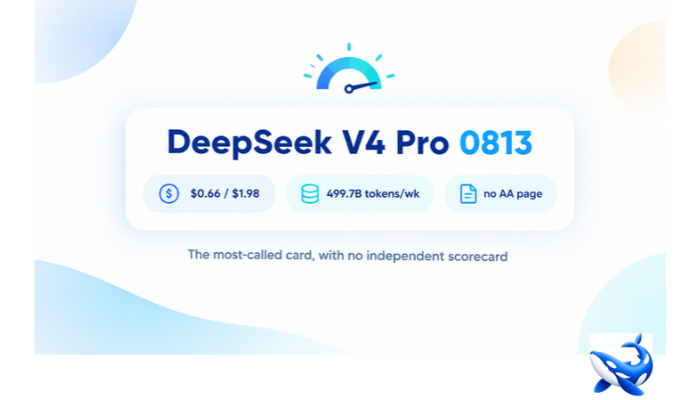
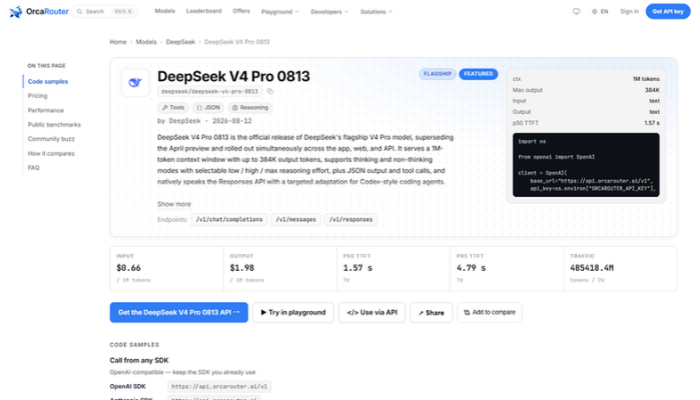
On OrcaRouter we host the DeepSeek V4 Pro 0813 model — DeepSeek’s general-purpose Pro card, shipped on August 12, 2026, priced at $0.66 per million input tokens and $1.98 per million output, with a 1M-token context window and a 384K maximum output. It has no page on Artificial Analysis, the independent benchmark site that tracks most of the models we serve — unusual for a model this heavily used. In production its seven-day token volume is 499.7 billion, the highest of any card on the linked platform. It is carried at list price on the same key as every other DeepSeek model, with the live telemetry on the linked page.
The interesting question is not why the market calls this card so much — it is why the most-called model in the fleet has no independent scorecard, and this article is about what that silence does and does not mean.
The most-called card without a scorecard
The paradox is worth stating twice: the model on the linked page moved 499.7 billion tokens in seven days — the highest weekly volume of any card we serve — and it has no page on Artificial Analysis, the independent benchmark site that covers most of the models in this fleet. Usually the models without independent scorecards are the obscure ones. Here the most-called card in the building is the one the scoreboards skipped.
Why the absence exists is not something anyone outside that benchmark site can assert, and this article will not guess. The honest statement is the observable one: for a card carrying this much production traffic, there is no independent index reading, no independently measured per-task cost and no third-party latency figure to quote. The only numbers on the record are the vendor’s and ours.
The absence is also the article’s reminder about what scorecards actually do. An index score is a triangulation aid — it lets a buyer check a vendor’s claims against a third party before committing. Its quiet value is that when a card *has* one, buying decisions get faster and budgets get defended. The Pro card’s blank column does not mean the model is worse; it means the buyer has to do the triangulating themselves, with the two legs that do exist: DeepSeek’s own numbers and the production record on the linked page.
The numbers we do have
| model | context | input / output | AA index | 7-day tokens | p50 TTFT |
| DeepSeek V4 Pro 0813 | 1M | $0.66 / $1.98 | no page on AA | 499.7B | 1.54 s |
| DeepSeek V4 Flash Vision (Exp) | 1M | $0.22 / $0.66 | 35 (max) | 1.76B | 0.83 s |
Context windows and rate cards are what DeepSeek lists; the seven-day token volumes and TTFT figures are production telemetry from the linked pages; the one independent reading in the table belongs to the sibling card. The table is honest about its own shape: the Pro card’s column for an independent score is empty because no independent score exists. That is not an editing choice — it is the state of the record, and the article will not fill it with a number borrowed from a relative.

What a 499.7-billion-token week is
Scale makes the number legible: 499.7 billion tokens in seven days is roughly 71 billion a day — and at $0.66 per million input, every billion tokens carries a $660 line item at list price, which this card clears within hours. Nothing about usage at that size is sample-sized. A workload running at that volume has been through production incidents, load it did not ask for and cost reviews, and it is still running. The volume is the strongest evidence available that the card’s quality is not in question — the scorecard simply has not caught up.
The same number is also the article’s most useful differentiator, because it is the kind of evidence no benchmark site can produce. A 499.7-billion-token week is not a model claim and not a measurement under lab conditions; it is the accumulated calling pattern of every team that has already put this endpoint in production. For a buyer deciding between the Pro card and its cheaper sibling, that volume says which one the market actually runs at scale.
The scale has a second lesson worth drawing out: what the volume says about the *composition* of the fleet. At $0.66 / $1.98 this is not the cheapest card DeepSeek ships — its vision sibling costs a third as much — and the fact that the premium card moves two hundred times the tokens of the cheap one is a statement about workload shape. The Pro rung’s traffic is built from long, high-value runs: agents, coding work, document-scale processing, the workloads that sit on a general-purpose flagship because they need its output quality on every token. A card’s weekly volume is never just a count; it is the fleet’s judgment of where the expensive tokens are worth it.
The missing number, honestly
An absent independent score is not a doubt. The model is real, shipped, heavily used and priced; its production record on the linked page is public and current. What the absence does change is the discipline of buying it: with no third-party index to triangulate, the buyer’s evidence stack is the vendor’s claims plus our telemetry, and both are on the table here. The 1.54-second p50 first token and the 499.7-billion-token week are ours, measured on the real endpoint; the context and the rate card are what DeepSeek lists.
That is enough to buy on — the market clearly has — but the missing scorecard leaves one question genuinely open. The 35 (max) reading on the sibling vision card is not transferable to the Pro card, and anyone who quotes an index number for V4 Pro 0813 is quoting something that does not exist. When the benchmark site catches up, this is the card to re-check first, because it is the one whose absence is loudest relative to its traffic.
The takeaway
DeepSeek V4 Pro 0813 is DeepSeek’s general-purpose Pro card: $0.66 / $1.98, a 1M context window, a 384K maximum output, and a p50 first token of 1.54 seconds on our production record. It moved 499.7 billion tokens in seven days — the highest weekly volume of any model we serve — and it has no page on Artificial Analysis, so no independent score exists to quote. The absence is a gap in the record, named plainly here, not a doubt about the model. If your workload already runs on DeepSeek’s API, this card is live at list price on the same key, and the linked page shows the telemetry behind the most-called number in this fleet.
Sourcing note: release date, context window and rate card are what DeepSeek lists and have not been independently reproduced. DeepSeek V4 Pro 0813 has no page on Artificial Analysis as of 2026-10-08, so no independent index, output speed or per-task cost is cited; the sibling card’s 35 (max) reading is from Artificial Analysis’ live page, read 2026-10-08. The p50 time-to-first-token and seven-day token volume are OrcaRouter production telemetry from the linked model page. All checked 2026-10-08.
