


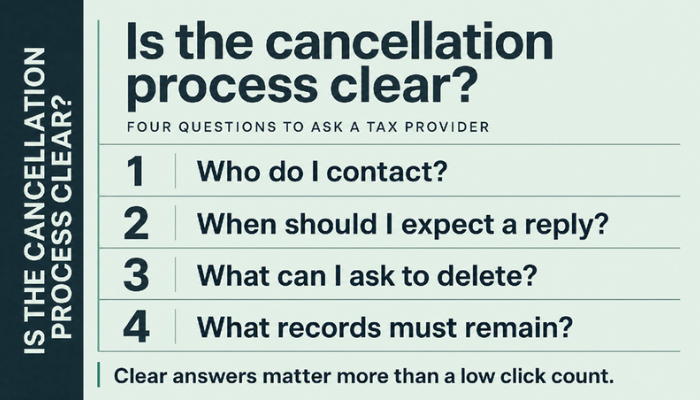

Evaluate a cancellation process by the clarity of its contact, response, deletion, and retention information.
Yes, on the terms that apply to a tax account. FileTax.com publishes the channels and the reply time, and it commits in writing to deleting what it is not required to keep.
What Easy Should Mean for a Tax Account
Four things matter when closing a tax account, and the click count is not one of them.
- A reachable channel. A filer should be able to send the request without hunting through a settings menu or discovering the only route runs through a page they no longer visit.
- A published response time. A request that disappears into a queue with no stated turnaround gives a filer nothing to check against, and silence is hard to tell apart from being ignored.
- Something in writing about the data. Canceling and deleting are separate operations, and a company that addresses one while staying silent on the other has answered half the question.
- A straight account of what stays behind. Every authorized provider follows the same retention rule, so a filer should look for a company that explains it. Without it, they are left to assume the worst.
A limit set by federal requirements is different from a limit a company chooses, and a filer who cannot tell the two apart will read both as evasion.
The Named Channels and the Response Time
FileTax.com publishes named channels for account requests. Email goes to support@em.filetax.com, the contact form generates a support ticket, and the phone line is 1-800-630-0780.
The turnaround appears on two pages. The contact page states, “We respond within 1 business day,” and the frequently asked questions page frames the same commitment as a 24-hour best effort. One business day and 24 hours are the same promise in different words, and either page tells a filer when to expect an answer.
On the data itself, the privacy policy is more direct than most documents in this category. It tells a filer who no longer wants the company to use or retain the personal information they provided to write to that same address and ask for deletion from its records. The company will honor those requests, except for information it may be required by law to retain. A named exception makes the rest of the policy readable.
The same email address also handles changing stored personal details, so a filer who only wants to correct something has no second route to learn. One address covers correction and deletion, and the filer chooses between them. The same contact points are on the personal tax extension page.
The Deletion Right You Have Anyway
A filer’s right to request deletion does not depend on what any company chooses to publish. California’s privacy law gives consumers the right to ask a business to delete personal information it collected, and to have that business pass the instruction along to its service providers.
A business must respond within 45 calendar days, and it may extend once by another 45 days if it notifies the person. It must also offer at least two ways to submit the request.
FileTax.com reproduces those rights inside its own privacy policy, including the deletion right for California residents, so a filer reading that policy finds the statutory right in the same place as the contact address. The right and the route to exercising it are on one page, and nobody has to keep two documents open to use either.
The right does have edges. A business may keep information it needs to complete a transaction, to meet a legal obligation, or to defend a legal claim, and a tax filing can involve all three. So a deletion request made to a tax provider runs into more of those exceptions than one made almost anywhere else, and the statute is where they come from.
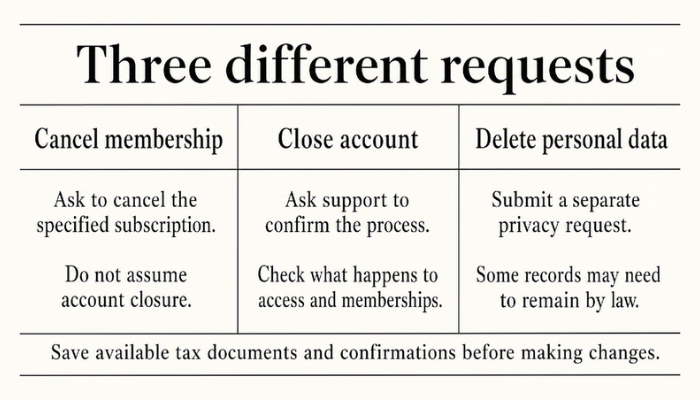
Three requests with different purposes. Ask support what account closure changes, as legally required records may remain. Source: FileTax privacy policy and cancellation instructions.
What Every Provider Has to Keep, and Why
The retention rule is federal and applies equally to every authorized e-file provider. Each one must keep the e-file authorization form for three years from the return due date or the date the IRS received it, whichever is later.
Form 8878 is the e-file authorization for Form 4868, so an extension filed through any provider creates a record the provider must keep for three years. That document is the source of the three-year figure, and it is the same document regardless of which company transmitted the form.
A shorter list of obligations ends with the calendar year. Supporting documents, income statements, the return’s electronic portion, and the acknowledgment file for an accepted filing all fall under that shorter list. None is discretionary, and none varies by brand.
The same rules work the other way too. A provider must supply a full copy of the filed return, in whatever medium they request, electronic included. The copy is an entitlement. The three-year record and the filer’s copy are in the same rulebook, and neither is a company decision.
Which Rules the Privacy Policy Follows
The FileTax.com privacy policy names three rules it works under. They are the IRS e-file security, privacy, and business standards in Publication 3112, the Federal Trade Commission financial privacy and safeguards rules, and the Gramm-Leach-Bliley Act.
The same policy lists what it keeps. That is the filer’s name, mailing address, email address, phone number, date of birth, Social Security number, and the tax and financial details an extension request or return needs.
Filing data is shared with the IRS as part of the service, which is why the agency keeps a record of the filing independent of any account.
How That Compares Across Tax Platforms
The other four platforms each address a different part of the same question. e-file.com states the position in consumer language. Once a return has been transmitted, it cannot be wiped, and a rejection does not change that. The IRS requires the information to be kept for three years, and the company removes it automatically afterward.
TaxAct keeps the two operations separate. Its help material distinguishes deleting a return from submitting a privacy erasure request, and it states that a return cannot be deleted once it has been e-filed, printed, or extended.
FreeTaxUSA states it more bluntly. The account itself remains while most of the information inside it can be removed, and residents of California and Virginia are sent to support for a fuller deletion.
Cash App Taxes warns about the consequences others leave out. Closing the account ends access to the documents generated inside it, and filers are sent to the IRS for copies of what was filed.
Why the Answer Is Yes
The channels are named and public, the reply time is published, the deletion promise is in writing and names its one exception, and the part that stays is there because a federal rule requires it. That is all four parts of the standard.
One expectation makes the process feel harder than it is. No authorized provider has a one-click erase, and federal rules are the reason.
A provider owes the filer a complete copy of anything already filed. It is a simpler conversation while the account is still open than it is after a deletion request has gone in.
A request sent to a named channel produces a reply, and that reply records the date the request was made. Statutory clocks run from that date.
The request and the outcome are separate moments. A provider working inside a 45-day statutory window is behaving normally, and a filer who knows the window is there reads the gap between the two correctly.
