Do you need some help to get started with your social media marketing plan?
If you want to attract and engage social media marketing strategy fans and followers—and convert them into paying customers — you need to map out a clear, goal-oriented social media plan. If you don’t, it will be obvious to your fans and target market that you are disorganized. In addition to damaging your brand, you’ll risk losing sales by sending your audience to your competitors.
If you’re starting from scratch, it can feel overwhelming.
You know that others have been successful at social media marketing, but there are so many moving parts that creating a plan of your own can be daunting. If you are brand new to social media and looking for a straightforward way to start, follow the advice below.
12 Steps to Social Media Marketing Success
1. Research and know your audience.
What topics and interests are they most social about? What problems are they trying to solve? What are their pain points?
2. Use the same social networks as your audience.
Are Facebook and Twitter their platforms of choice? Do most of them use Pinterest and Instagram? Go where your target audience is to create awareness, engagement, and brand ambassadors.
3. Identify your KPIs (key performance indicators).
They measure progress toward your goals. What do you want your social media efforts to accomplish? What does success look like in quantifiable terms?
4. Write a social media marketing playbook.
The playbook should detail your KPIs, audience profiles, brand personas, campaign concepts, promotional events, contests, content themes, crisis management plan, etc. Make sure to tailor strategies that are unique to each of your social media channels.
5. Align the people at your company with the plan.
Get everyone on board with your strategy. Divide responsibilities among your team, such as who is in charge of posting to your blog and each social media network, who will respond to comments and @mentions, and who will own metrics tracking and reporting.
6. Set aside some time at the beginning of each week to prepare.
Take 30-60 minutes to schedule tweets, Facebook posts, LinkedIn posts, Pinterest pins, and other social media content. Come up with some original ideas, links to your content, and links to outside content that is useful or interesting to your audience.
7. Develop a content marketing calendar.
Use one of the example spreadsheets I’ve created as a starting point to plan content topics, headlines, related links, desired scheduling, names of authors, etc.
8. Post content that is relevant to newsworthy topics and events.
As soon as breaking news comes out about anything related to your brand or industry, you should share your opinion and become part of the conversation.
9. Treat all of your social channels differently.
Don’t post the same message everywhere; remember who the audience is on each platform and how they interact. What works on Facebook will fall flat on Twitter, and vice versa.
10. Assign someone to act as a customer service rep.
It’s vital to be responsive to user-generated content, comments, and feedback (positive or not). CRM (customer relationship management) is one of the core Marketing Fundamentals that supports long-term social media marketing success.
11. Schedule metrics reporting.
Reporting metrics can occur weekly, monthly, or bimonthly depending on your goals and desired outcomes.
12. Reanalyze your plan regularly.
If something in your plan isn’t working, switch it up or do some A/B testing to determine what your audience responds to better. Use 2 versions of your content simultaneously and measure to see which one is more successful and use it going forward.
All of us wish to feel a sense of purpose in our careers and make a meaningful contribution to society, but it can be hard to know where to start. Social entrepreneurs offer a fascinating model. They combine compassion and business acumen to scale solutions that are needed now more than ever. More than a year in the making, this video series featuring leading Schwab Foundation Social Entrepreneurs talking about their journeys is packed full of surprising insights, powerful ideas, and lessons For Global Impact learned the hard way.
Whether you are an established social entrepreneur, a corporate executive considering your next career move, or a recent graduate launching a start-up, these videos constitute essential viewing.
Lesson 1. Leverage partnerships for scale
Martin Burt draws on decades of experience to explain why the era of the lone social entrepreneur is over. And he should know: he is the widely celebrated founder of Fundacion Paraguaya, Teach a Man to Fish, and most recently, the Poverty Stoplight, a diagnostic tool that allows families to diagnose their level of poverty and create an action plan to overcome it.
In Paraguay alone, dozens of companies are using the tool to eliminate poverty among their labor force. “We are seeing businesses talking to the government about the housing needs in the slums near their factories,” he says, “and they are finding they have something nobody else has: the power of leverage.”
Martin Burt also draws on his experience in the public sector as the Mayor of Asunción and later as the Chief of Cabinet in the previous administration. The keys to success? Start by recognizing that government officials face structural and legal limitations, then strive to identify and empower elected officials who genuinely want to create change.
Lesson 2. Combine Focus with Flexibility
Mark Ruiz was an executive at Unilever in the Philippines when he had an insight that led him to create the social enterprise Hapinoy with his co-founder, Bam Aquino. Why can Coke products find their way to every rural village, but medicines and financial services do not?
Rather than create a new distribution network from scratch, Mark and Bam decided to piggyback off of existing infrastructure – tiny “hole in the wall” stores called sari-sari shops – by formalizing them into a network, thereby creating a channel to get much-needed services such as mobile banking into rural communities.
His advice to other social entrepreneurs? Never lose sight of your social mission. Make sure your investors have the same values as you. Find ways to create economies of scale to attract large companies as partners. And most importantly, follow your passion. “You cannot be the best at everything,” he says. “Ultimately, you have to decide what you’re going to be the best at, and that entails a certain focus.”
Lesson 3. Design Is important, distribution Is key
D-Rev is a non-profit social enterprise that designs and develops medical devices for poor people such as prosthetic knees for amputees and phototherapy units to treat jaundiced babies. d.light is a for-profit social enterprise that has distributed more than 50 million solar lights and power solutions to off-grid households.
Both organizations are widely respected as market leaders in human-centered design, and both Krista Donaldson, a mechanical engineer and CEO of D-Rev, and Ned Tozun, a co-founder of d.light, offer surprising insights about the design process.
Given both social enterprises are so famous for their product design, it is telling both Ned Tozun and Krista Donaldson emphasize distribution as the toughest nut to crack. “We thought if you have a great product at a great value for money, it’s just going to sell,” said Ned Tozun. “But distribution, marking, and branding required even more innovation than on the product side.”
“We realized early on we can’t do everything, so we work with partners – NGOs, faith-based groups, and for-profits – to achieve our mission, which means getting our products to our target users,” says Krista Donaldson.
“Once the product hits the market, it needs to be entirely economically self-sustaining with profit margins built-in so that if D-Rev disappears tomorrow, the product will continue to be sold.”
Lesson 4. Use technology everywhere you can
Dr. Shannon May, an anthropologist, and Jay Kimmelman, a tech entrepreneur, founded Bridge International Academies in Kenya in 2008 with the goal of providing affordable world-class education to families living on $2 a day.
In less than seven years, Bridge International Academies has opened 400 schools serving 120,000 students and aims to reach 10 million students in the near future.
They have achieved such staggering scale by using technology at every step, from how they process school fees and assess student performance on a weekly basis to how they distribute daily lesson plans to every one of their 5000 teachers and even monitor teacher arrival and departure times.
Shannon May’s advice to social entrepreneurs is simple, though executing it is anything but. “Leverage technology everywhere you can to make the radical disruption you are seeking,” she advises, and she would know.
Mark Zuckerberg of Facebook was so impressed with Bridge’s use of technology he invested $10 million in them after a meeting in Davos.
Lesson 5. Scale your solution, not your organization
All social entrepreneurs, even those who by any objective measure have reached significant scale, are frustrated by the staggering gap between the people they can reach through their direct service model and the size of the global need. Kovin Naidoo movingly described this phenomenon as “being responsible for an island of success in a sea of despair.”
Solving the social problem you are passionate about at massive scale is the dream of every social entrepreneur. The question is, how do you get there? The insights of Sébastien Marot and Elizabeth Hausler start to offer some answers.
Sébastien Marot founded Friends-International in Cambodia to rebuild the futures of homeless and marginalized children. Even working with such a deeply challenging population, Sébastien found a way to improve the sustainability and scalability of his intervention by turning all of their vocational programs into social businesses that now generate 40% of the organization’s overall operating budget.
Even so, the numbers of marginalized youth Friends-International can reach directly – 50,000 in eight countries – pale in comparison to the half a billion marginalized children and youth worldwide.
Rather than expand his organization, Sébastien is spreading his market-based approach through the CYTI Alliance, a network of 51 organizations working with homeless and marginalized children in 11 countries.
A skilled mason with a doctorate in civil engineering, Elizabeth Hausler founded Build Change in 2004 to change the way post-disaster reconstruction is done.
“We started small and on the ground,” she says. “We got our hands dirty figuring out how to actually build an earthquake-resistant house.”
Recognizing she would never been able to hire enough engineers and builders to respond to disasters, Elizabeth instead open-sourced the Build Change methodology.
Build Change’s design and safe construction guidelines are now used by dozens of other NGOs and have been adopted by seven major relief agencies.
“We’ve expanded our model from a direct service approach to a system change approach,” Elizabeth Hausler explained.
Ned Tozun of d.light offers one final piece of advice to social entrepreneurs. “To all of the social entrepreneurs out there, persevere and keep at it,” he said.
“If you’re thinking about taking the plunge, I really encourage you to do it. It’s the most fulfilling thing I could imagine doing.”
If you have decided to be an entrepreneur, then you should be warned that your journey ahead is not going to be an easy one at all. Entrepreneurship implies starting your own business right from scratch and with all the success stories all around it might seem like a glamorous line to enter. However, the fact is that in reality this career path is one that has very little glamour, a great deal of hard work and some luck as well. To help you here are some harsh realities of entrepreneurship.
How to Survive The Dark Side Of Entrepreneurship
1. You will find it difficult to make two ends meet initially:
Being an entrepreneur does not imply that overnight you will be making a lot of money and you can start living life on your own terms. Rather, initially, things are going to be so tough that you might find it tough to make two ends meet and keep your head above water. So much so that many times along the way you might think that you ought to forget about this dream of yours and move on. However, if you have your heart and mindset on this career path then you should not allow money to deter you in any way. If you work hard, things will work out.
2. Your family won’t properly comprehend what you do:
Deciding to become an entrepreneur is a big decision indeed which you should only take if you think that you have the skill, ability and perseverance to go all the way. Be prepared for the fact that your family members might not understand what you are going through and if they find that after a year of struggle you hardly have anything to show for it, they may begin to demoralize you. It is only someone who is an entrepreneur that can really understand what you are going through and can really tell you that yes it is tough in the beginning but don’t give up.
3. Be prepared for things to take long. So be patient:
It has never been that a business has become a success in one day or overnight. It takes plenty of time and maybe even years of struggle. Just because you are in a hurry to get your business off the ground, that does not imply that everyone else you are working with is going to be cooperative and obliging. Whether it is getting the factories to make your products faster or whether it is getting permission from certain government bodies, be prepared that things are going to take possibly twice as long as you initially imagined that they would.
4. Never place all your trust and hopes in one place:
One of harsh realities of being an entrepreneur is that you cannot pin all your hopes and dreams in one place or in one contract. A deal or a contract which unofficially seemed to be signed and sealed might not work out the very next day. You should just accept this that something that was not meant to be and try your best to move on. Disappointments like this will not be easy to accept initially however over time you will realize that the only thing constant in the business world is change and anything can happen at any given moment, so don’t think it’s your fault.
5. Dealing with customers is more difficult than you ever thought:
You might have entered this career path as you thought yourself to be a people’s person that has a way with words. However once you actually enter this line and begin to converse with customers and get to know how they really are, you will be in for a rude shock. Since they are paying their hard earned money for products and services they will not be forgiving and the way they speak to you and make demands might not be something which you will be able to take lying down. However since your business depends on them, you should endure it all.
6. You are going to fail over and over again:
There is some truth in the common saying that failure is the stepping stone towards success, however once you decided to be an entrepreneur you have to realize that failure is not something that will take place once or twice in your career. If you do not want to be in a for a shock then you ought to mentally prepare yourself for the fact that you will be facing multiple failures on a daily basis and things will not go in your favor at all. Even then you should not let any of these things affect you physically, mentally or emotionally.
7. Working with friends is always a bad idea:
You might have thought that when you become an entrepreneur working with your friends is something that you will love doing as they will always be there to guide you and help you along the way. However working with friends is something that hardly works out and when even the best of friends are unable to see eye to eye on business decisions then their relationship could easily go sour. So this is indeed a harsh reality which is all part and parcel of becoming an entrepreneur. You might additionally also find it so challenging to pull up your friends for doing something wrong.
8. If the idea gets you no money, it’s not a good idea:
Entrepreneurs come up with ideas after a great deal of effort. Over time an idea which you conceived might become a part of you and no matter what, you would like to watch it succeed. One of the harsh realities of becoming an entrepreneur is that sometimes an idea may look good on paper but it just might not work out for reasons you might not be able to comprehend. Give it time, however you should be able to know when to let go and put the efforts to rest. Remember it may be a good idea, but if it’s not making you any money, then what’s the point?
9. If you start something you are not passionate about, it will end in failure:
A harsh reality about being an entrepreneur is that if you are not truly passionate about your business it will not take off. If you are genuinely passionate about something then only will you really be able to put your mind into trying to make it a success. Be an entrepreneur because it is your dream to become one, and not because someone is forcing you to become one. Things will never work out if you feel like it is a burden to you. If you are truly passionate about this line you will think of each day as a new adventure before you, waiting to be explored.
10. The work will always be never ending:
Being an entrepreneur implies that you will have no fixed hours of work. Be prepared for the fact that sometimes you will have sleepless nights as well. Just because one of your ideas has been a success that does not mean that you can take the next few weeks off and bask in your glory. The key to being a good entrepreneur is that you are constantly on your feet thinking of ways in which you can take your business to greater heights by looking into things like the services which you provide, the feedback of customers and the quality of the products which you sell.
11. Hiring loyal employees is a tough task indeed:
The task for hiring employees is something which you will find most challenging. There are many people who will tell you they are qualified and able, when they are actually not and there will be others who will leave you, the moment they realize that they have better options elsewhere. So what you must do as an entrepreneur is try your best to ensure that you employees are happy and content. The smaller the team you have, the better it is for you as you will be able to keep your expenditures to a minimum as well.
12. You cannot trust anyone:
When you are an entrepreneur initially you might find yourself at sea, yet one of the biggest mistakes you are likely to make is being too trusting whether it is with an employee or a partner. No matter what, you should never share too many business secrets with anyone because in the business world no one is your friends and they might betray your trust in a terrible manner at a time when you least expected it.
13. You will have to deal with a lot of criticism and various opinions:
The truth and hard reality of being an entrepreneur is that there will be many people who will always be trying to give you their opinions and criticisms whether you asked for their thoughts or not. Sometimes it is okay to take into account valuable criticism which is being given, yet sometimes since you are the captain of the ship, you ought to trust your own instincts and abilities because trying to cater to too many wants as well as needs will confuse you. Keeping things simple and not listening to those that are trying to tear you down will help you along the way.
14. Having a partner could be one of two things:
A harsh reality of being an entrepreneur is that choosing to have a partner could be one of two things. Either it could be the best decision or worst business related decision which you made. You should keep your mind when deciding on whether your business needs a partner or not.
15. Having a personal life is near impossible:
When you become an entrepreneur, be prepared to kiss your personal life good bye. Your primary focus in the initial years of your entrepreneurship should always be your business. You might have to put a number of things in your life on hold that is why you might find that when you choose to become an entrepreneur and start working towards achieving your dream you will lose some friends along the way. Yet those who want to be in your life will understand and try to find a way to always support you.
16. When you become successful people will grow jealous:
As you become successful many people who you thought would be happy for you will grow incredibly jealous of all that you have achieved. But you should not get such negativity get to you and when you have worked hard you should not feel bad about yielding rich dividends. However make sure that at no point in time do you let any of your success go to your head and change you to someone who is proud and egoistic.
17. It is unlikely that you will ever feel like retiring:
One harsh reality which you need not worry about when you are young is that once you have grown older and tasted entrepreneurial success it is unlikely that you will ever feel like retiring, Yet you should know when it is time to give up and when to pass on the torch to your prodigy.
So these are some of the most common harsh realities which you will face when you choose to become an entrepreneur. This list has not been compiled in order to make you feel discouraged or demoralized; rather its purpose is exactly the opposite. If you know exactly what problems and hurdles you will have to face, you can choose whether you will actually be willing to go through all this or not. Once you are familiar with all the problems that will come your way then you can have a distinct plan of action and be prepared so as to emerge victorious.
An unmanned Russian cargo space ship heading to the International Space Station broke up in the atmosphere over Siberia on Thursday due to an unspecified malfunction, the Russian space agency said.
The Progress MS-04 cargo craft broke up at an altitude of 190 kilometers (118 miles) over the remote Russian Tuva region in Siberia that borders Mongolia, Roscosmos said in a statement. It said most of spaceship’s debris burnt up as it entered the atmosphere but some fell to Earth over what it called an uninhabited area.
Local people reported seeing a flash of light and hearing a loud thud west of the regional capital of Kyzyl, more than 3,600 kilometers (2,200 miles) east of Moscow, the Tuva government was quoted as saying late Thursday by the Interfax news agency.
The Progress cargo ship had lifted off as scheduled at 8:51 p.m. (1451 GMT) from Russia’s space launch complex in Baikonur, Kazakhstan, to deliver 2.5 metric tons of fuel, water, food and other supplies. It was scheduled to dock with the space station on Saturday.
Roscosmos reported that the craft was operating normally before it stopped transmitting data 6 ½ minutes after the launch. The Russian space agency would not immediately describe the malfunction, saying its experts were looking into it.
This is the third botched launch of a Russian spacecraft in two years. A Progress cargo ship plunged into the Pacific Ocean in May 2015, and a Proton-M rocket carrying an advanced satellite broke up in the atmosphere in May 2014.
But both Roscosmos and NASA said the crash of the ship would have no impact on the operations of the orbiting space lab that is currently home to a six-member crew, including three cosmonauts from Russia, two NASA astronauts and one from the European Union.
Orbital ATK, NASA’s other shipper, successfully sent up supplies to the space station in October, and a Japanese cargo spaceship is scheduled to launch a full load in mid-December.
NASA supplier SpaceX, meanwhile, has been grounded since a rocket explosion in September on the launch pad at Cape Canaveral, Florida. The company hopes to resume launches in December to deliver communication satellites.
Launching a new business with little to no startup capital is easier today than ever before. Between do-it-yourself software options and social media, there’s never been a better time for starting a business and chasing down the dream of owning your own.
Getting started with a tiny budget is all about being disciplined—and making sure every penny you spend is being used in the most efficient way. That means doing your research to make sure you’re only spending as much as you absolutely need to.
In an effort to lighten that load, we’ve pulled together budget-friendly ways to take care of the must-haves on your business checklist.
The Legal Side
When you first start a new business, there are some legal items you’ll need to attend to…
Will your business be a sole proprietorship, a limited liability company (LLC), corporation, or something else? Your entity type can have a big impact on your business.
You’ll also need to make sure that your name and logo don’t infringe on someone else’s copyright or trademark. Plus, if you have an innovative new process, you might want to apply for patent protection.
Navigating all of the laws surrounding new business formation is one of the more complicated parts of launching a business.
Then, when you’re ready to start registering your business and filing for the licenses and permits you might need, LegalZoom is also a great resource. You can take care of most things online—and even chat with an attorney who can answer your questions.
Where to Work
Renting out the corner office in a downtown high-rise can seem glamorous, but as a company that’s just getting its start, a dedicated office is a luxury—and an unnecessary one, at that.
If you have the space, your best option is to work from your home. You won’t incur any rent or other additional costs, and you can even deduct home office expenses from your annual taxes.
If working from your home isn’t an option, look around for local coworking spaces instead.
At most coworking spaces, you can rent a desk or a small office for an affordable monthly fee, so you’ll have a place to go while the kids are out of school for the summer. Coworking is also an amazing way to meet like-minded people who you can bounce ideas off of—they might even become partners in your business.
It’s no secret that bookkeeping is no one’s favorite part of starting and running a business.
But as much as we dislike numbers and accounting, keeping up-to-date and accurate books is a big part of being fiscally responsible and ensuring financial success. Thankfully, there are tons of online software options, so you don’t need to go out and hire a full-time accountant to do your books.
With tools like FreshBooks or QuickBooks from Intuit, you can track expenses, sync with your bank account, and create professional invoices for as little as $5-10 per month. Another option is Wave Accounting: it’s totally free and you can even consult with accounting professionals online.
Communication
Streamlined communication is a big factor when starting a new business. Current and potential customers should be able to get in touch with you with ease so you can answer questions about products, give directions to your brick & mortar, and take new orders.
You don’t need a traditional phone system with expensive hardware anymore—you can get a cloud-based phone system like Grasshopper and have a business line right on your mobile or smartphone.
When you need to contact partners, mentors, or—down the line—employees, a tool like Slack makes it easy to communicate in real-time and even send and receive documents.
Building a Website
It used to be that designing and building an attractive and functional website was better left to the design and development pros…
Not anymore.
With so many website-building platforms, you have your pick of where to host your company’s website. Sites like WordPress and Wix do most of the heavy lifting for you, either for free or for a manageable monthly cost.
If there’s one thing that can make or break a website, it’s beautiful and compelling images. You can find original and high-quality photographs for free on websites like Unsplash and Pixabay.
The best websites aren’t just attractive—they’re easy to navigate and use, too. You can use tools like UserTesting sparingly to make sure potential customers can find what they’re looking for on your site.
When you’re just starting a new business, marketing is one of the most important tasks. It’s how you let the market know about your company and product and attract customers.
Luckily, it also has some of the most budget-friendly solutions.
Social media ushered in a whole new age of marketing… And you have access to it for free.
That means you can reach more people with $0 than ever before.
Set up pages for your business on the big social media sites—Facebook, Twitter, LinkedIn—and anywhere else your target audience hangs out, like Pinterest, Reddit, Google+, and so on.
You can get even more free publicity by participating on sites like Help A Reporter Out(HARO), where journalists are looking for knowledgeable sources to include in articles and other publications.
Work Your Budget
Gone are the days when limited startup funding was a barrier to launching your dream business. Today, you can use online solutions, lots of research, and a commitment to efficiency to overcome a shoestring budget.
I have been asked by several folks about my experiences building Skoop and the sacrifices I made to get here. I still don’t know what “here” is as we have just begun our journey but nevertheless, I always tell my story with the good and the bad. Here are some of the points in The Dark Side of Being an Entrepreneur.
Life as a new or budding entrepreneur is one of the most challenging and lonely journeys you will ever take. Here’s my story:
1. Depression is ever-present and threatens to sneak in every day. I have intense highs on good days and intense lows on bad days. But when your blood, sweat, and mind is tied to your baby, this is unavoidable.
2. You work longer hours than anybody else because there is a constant threat that someone out there is working harder than you to take it all. Until you are an established startup, always assume that someone is doing it 2x as fast and better than you. If you stop, you lose.
3. Entrepreneurship complicates family life in a way you never imagined. I have a wife and a young daughter. I am a workaholic by nature. But I had to learn and learn again that you must manage time for both every day. If you don’t, you will lose one or the other.
4. Failures are a common and necessary part of your growth. Learn how to move past them with new knowledge. Our first product failed miserably. I was devastated because we had put so much into launching it. But I had to make a choice: blame the world for not accepting my product or blame myself for not studying my market enough. In any case, we dug into our failure and made our next version better.
5. Do not be swayed by massive valuations and round raises. Big numbers are certainly enticing but the #1 question each founder should ask himself or herself is: at what cost to my company am I raising x? The cash infusions aren’t cheap. I had to learn the game here as I raised my seed round and chose my investors. I’ve had to deal with some pretty bad term sheets from investors since I walked out. Know your worth, stay true to your vision, and only raise enough to get you going in that direction.
These are the musings of a 31-year-old entrepreneur who left 9 years in corporate life to build something unique. Along the way, I have been through every possible emotion and then some.
In every well-managed organization, sales commission plans change regularly. To outsiders, this is often surprising. Why, the finance person wonders, is it that we need yet another new sales commission plan this year?
The reality is that commission plans must change to reflect new business priorities. Although the mission and vision are (ideally) constant in any good business, they do not undertake the initiatives to fulfill that vision.
If a business intends to execute three new strategic initiatives in the new financial year, does it really make sense to retain the commission plan that was built around last year’s goals?
If, for whatever reason, you should find yourself in a position to have to restructure your incentive, commission, or bonus plan (call it what you will), the questions become:
How do you make sure that you get the plan right?
How do you ensure an effective rollout?
1. Set expectations well in advance
The single most critical component of an effective plan rollout is communication.
Ideally, everyone on the sales team knows that they are evaluating changes to their commission plan at least one quarter (if not six months) before the plan changes.
When you communicate that changes are coming, you should be clear on a) why the plan is changing and b) what the key behaviors are that you want to reward moving forward.
If we do it successfully, the team won’t have any surprises when we share the new sales plan.
2. Build a roundtable
When designing a commission structure or even just brainstorming ideas it’s easy to fall into the trap of allocating all of your time to decision-makers (VP of Sales, CFO) and financial models. This is a great way to design a plan that underutilizes or completely ignores the collective wisdom of your sales team.
To tap into that knowledge, you should recruit a small group of top-performing salespeople and assemble them into a feedback roundtable. This becomes a great source of ideas and feedback. Perhaps most importantly, when it is time to roll out the plan, this group will become the plan’s biggest cheerleaders, as the new commission structure is something they genuinely helped create.
3. Identify potential plans
With a feedback group in place, it’s time to narrow down the commission plan options from a universe of possibilities to just a handful of options, ideally no more than three. Getting to that list shouldn’t be hard; lay out the strategic priorities for the business over the next year and cross-reference them against the initial suggestions you’ve received from the roundtable. It should be clear to you what your best options are.
At this time, it’s also appropriate to float those ideas by the people who will eventually have to sign off on the plan including the CFO, SVP of Sales, and potentially the CEO. There is no point in running the numbers or sharing these options with a feedback group if the top-level executives aren’t on board at the concept phase.
4. Backtest, backtest, backtest!
Once you have finalized a few potential commission plans, you then need to decide what quotas you want to set; what the accelerators should be; and how most reps would fare under the new system.
To answer these questions effectively, you’ll need to set up a financial model for each of the plans you’re considering. The model should tell you not only what any rep would earn under some hypothetical attainment level, but what they would have earned during any previous period, going back about (ideally) as long as each rep has been working at the company.
The results of that analysis should be compared against each other as well as historical actuals. You want to make sure you have a clear sense of how every plan impacts each member of the team. In particular, you should focus on the following questions:
• How do underperformers and over-performers fare under the new plans? Generally, you want the reps who are contributing the most to the company to earn more and the reps who are contributing the least to earn less.
• Is the average rep able to achieve their on-target earnings under the new plan? Commission targets must be attainable and in line with the rep’s expectations.
• For sales reps who earn much more or much less under the new plans, do you feel that those outcomes are appropriate? For those earning more, is the company comfortable with the added cost? For those earning less, will you be able to provide them with an honest, logical, and thoughtful explanation as to why? And if that doesn’t assuage them, is that something you can live with?
5. Socialize
After a lot of thoughtful modeling, tuning, and tweaking, you now have a handful of viable plans with back-tested historical results. It’s time to run that by your decision makers, roundtable, and a few members of the sales organization.
At this stage of the process, it is important to make sure that you a) haven’t lost conceptual buy-in from important parties, and b) you want the team to be generally supportive of the impact of the plan both to their teams and to them individually.
6. Finalize
In the socialization process, you’ll get feedback about the plan and, ideally, identify any sales reps that are affected (favorably or unfavorably) by the new plan in a surprising way. Now the name of the game is to use that feedback to make whatever tweaks to the model are necessary to resolve all concerns and get the finalized commission plan out the door.
Sometimes adjustments can be as simple as adjusting a quota or a payout rate. Alternatively, if you need to address some edge cases, you may need to introduce qualifying criteria to safeguard against extreme overpayment or underpayment.
7. Over-communicate and roll-out
Now that you’ve invested all of that time and effort into building, socializing, and finalizing the plan, you need to make sure that you have an effective rollout. Be sure to:
• Present the new plan to the sales team. Ideally, this should be done in a team meeting with a slide deck.
• Provide everyone with a plan calculator that will empower them to calculate their potential earnings.
• Share a side-by-side comparison of commission earnings under the new plan against any old plans. Reps should have a clear understanding of how they’ll be impacted by the new plan. If they’re going to be impacted unfavorably, this is a great time to tell them why and to share what they need to do to be successful in the future.
• Be available. Set time aside to allow reps to meet with you 1:1 to ask questions about the plan.
8. Hold the line
As you start to run commissions on the new plan, you’ll invariably hear some grumbling and/or negative feedback. This will include sentiments like:
• “Isn’t it strange that the commission plan doesn’t incentivize this type of behavior?”
• “I made twice as much on this same deal last year.”
• “This person is making more than me, even though they’ve hardly been here any time”
It’s often tempting to dig into those concerns, to go back and look at the model and see if you can’t tweak the numbers, add another qualifier, etc. One or more sales managers will likely say that the plan really needs to change for these reasons.
Regardless of the pressure on you to change the plan, don’t do it.
You just went through a multi-week design, analysis, and vetting process with all stakeholders, right? Why would you make a snap decision to throw all that out the window now?
Changes to any compensation structure must be well thought out, managed, and not impulsive. So stick to your guns.
You’ve probably seen it on a salesperson’s business card. Or used in the context of creating partnerships. Don’t let its ambiguity undermine its importance— “business development”, as the name suggests, is about creating and maintaining long-term relationships that help you grow your business.
It includes everything from sourcing a supplier to building strategic partnerships to finding influencers who are willing to endorse your product.
When it comes to business development, your phone, email, and eye for opportunity are the most important weapons in your arsenal.
But combine that with some clever tools and you’ll be able to unearth more strategic partnerships, conduct conversations with confidence, and manage your relationships better.
From research to outreach to following up, here are 6 free tools that’ll help you take your business development skills to the next level.
#1. Sidekick: Email Tracking in Real-Time
Email is naturally one of the most important weapons in your business development arsenal.
The problem is, unless you’re using some sort of email marketing software, you usually have no idea whether your emails are getting opened or the links you’re sharing are getting clicked.
Sidekick is a plugin that gives you that advantage in any email correspondence.
Instead of crossing your fingers every time you hit send, unsure of your email’s fate in a contact’s inbox, you can get notifications in real-time when they open it and when they click on your links.
Should you send a friendly reminder? Or should you try a different pitch entirely? Use these insights from Sidekick to inform how you follow up and send your response now or schedule it for later.
#2. SimilarWeb: Evaluate Websites as Opportunities
You can’t judge a website by its design. If it’s not being marketed effectively, if it’s not bringing in traffic, then it might not be able to do much for your business.
SimilarWeb is a great tool for a lot of different reasons: SEO, competitor analysis and, in the context of this post, analyzing the potential of a partnership, affiliate, or blogging opportunity.
Whether a potential opportunity comes to you or you reach out to them, being able to evaluate a website by the numbers, from traffic over the last month to social sources, will help you make more well-informed decisions before going forward and negotiating the nature of the relationship.
Does the thought of cold emailing someone put you on edge?
Do you stress over whether to end a sentence in your email with a “:)” or whether you use one too many exclamation marks?
If there’s a particular opportunity that you have to win, it can help to understand your prospect’s preferred communication style—their quirks and habits, likes and dislikes.
Crystal Knows scrapes all public data about contacts and renders a detailed personality profile about them, including advice on how to email them or the best way for you to work together.
The more established your prospect’s online presence, the more accurate the information.
While the free version will notify your contact that you’re using the tool, the real value of Crystal, in my opinion, is that it teaches you how to adapt your communication style according to your prospect.
#4. Discover.ly: See Mutual Connections at a Glance
Sometimes it’s not what you know, but who you know.
The easiest way to get your foot in the door of a valuable conversation is to get a mutual connection to make the introduction on your behalf.
Discover.ly is a tool that lets you see what connections you have in common at a glance—not just on LinkedIn, but Facebook and Twitter too. From there you can reach out to your mutual contact and ask if they can give you an “in” with your lead.
The number of contacts you’ll be managing for a given opportunity can get overwhelming at times.
In these scenarios, it’s best to systematize your outreach to streamline the entire process.
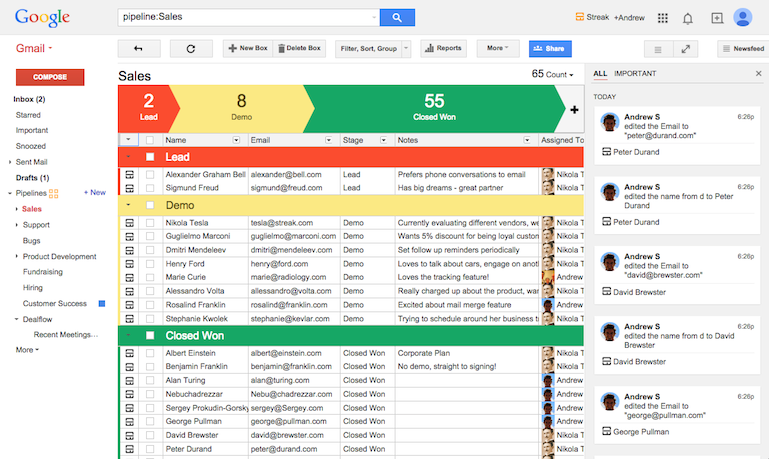
Streak turns your Gmail inbox into a CRM that lets you build simple pipelines for different purposes and track opportunities as they flow through it. You can also save canned responses that you can reuse later.
You can start by sending one mass email, populating fields based on certain contact information, like First Name and Company (almost like a barebones email marketing software), before drilling down and taking a more personalized approach with each one.
You can tell a lot about a website by the technology that’s powering it: How sophisticated the business is, company size, what marketing channels they’re using, how much they’ve invested in it, and more.
Datanyze Insider is a Chrome extension that lets you pull the curtain back and see what a website is built with. From there you can reverse engineer their technology stack to get insight into how they’re running their website.
While this tool is typically used for prospecting in software sales, it can lead to some interesting insights if you’re familiar with today’s tech and understand how specific solutions fit into the big picture of running the website.
The more you know, the better off you are.
Create Your Own Opportunities
Business development is about creating strategic relationships that let you leverage what someone else has already established—whether it’s a brand, a large audience, or exclusive resources.
It can get hectic managing so many different relationships and conversations, as well as identifying fruitful opportunities in the first place. But these connections are necessary to grow any business.
After all, no enterprise is an island, complete on its own.
And you can wait for Opportunity to knock, or you can go to her door.
The hardest thing about get more clients today is that they don’t need you the way they used to. Clients today have more businesses to choose from, with so many different companies popping left and right. Because the Internet is also rich with all the information clients are seeking, these prospective customers are now pickier with their decisions. They know how to be very prudent and wise with their decisions. That’s tough to hear since the lifeblood of your business is your clients.
Whether your company is just starting out, mid-cycle, or established, you need a repeatable and consistent process to get more clients. But how exactly is this done? Beyond just the quantity of prospective clients, you want to be able to balance this out with quality. This means you have clients under your belt who you are certain will become potential loyalists.
If you Google this question, you’ll find a lot of advice online but the vast majority lacks substance. Rather than advice, which you most likely wouldn’t take action on, this blog post is a 30,000-foot view listing 30+ tactics that will make an impact. Here, you’ll get insights on a single and specific step-by-step system for getting more clients.
That said, let’s dive right into the steps you must undertake to start winning more clients.
Step 1. Display Your Love For Your Clients In A Public Domain, i.e. A Website
The term “clients” suggests that your buyer is under your protection, whereas a customer is simply someone who buys a commodity or a service. Start referring to these customers as your clients, so that there’s the element of care and trustworthiness. Your buyers are going to feel more well-loved and even more appreciated, as they know that they’re under your care.
Your business is based on another person’s well-being. Therefore, they’re your clients. You must show them that their well-being is important to you in the public domain, somewhere they can see without interacting directly with you. The first place this should be is on a website. As you may know by now, your business website is one of the best assets that you can own. So, also make the most out of this by letting your clients know that you care about them and what they’ve got to say about your products and services.
I’m sure you have brand messaging, testimonials, photos of your team, and a list of all your services. But is it evident that you love those you serve?
Or is it, all about you?
Don’t be narcissistic with your website. Rather than being too focused on yourself and your business, show them how you can be of service to your clients, how much you value them, and what you went through to provide them with nothing short of the best products and services.
Today, you need a new approach to reach and engage clients. Start with the following strategies:
You need to build a strategic and buyer-focused website as the foundation of your system to get more clients.
You may be aware that you need to show that you’re an industry expert, an authority. But that method is still based on you.
If you love your clients, you MUST solve their problems before they would want to buy from you.
Coming from a place of love and care with the desire to educate, help, and solve their problems leads us to the next step.
Step 2. Provide Value To Your Clients Before They Buy
In the next step, you’ve got to learn how to be proactive when pampering your clients. Provide them with value, and show them that you care, even before they buy from you.This is the top value proposition that you must be able to show your clients.
Digital technology has changed how your clients search for information, interact with each other, and buy your services. The massive popularity of these technologies has made it possible for you to have a better understanding of your client’s decision journey, so make the most out of this. During this decision journey, your client is looking for various types of information to help them define your perceived value to them as it relates to their questions.
Proof: A CEB study of more than 1,400 B2B customers across industries revealed that 57% of a typical purchase decision is made before a customer even talks to a supplier.
Throughout this process, all decisions and transactions are based on perceived value.
If you are only providing “value” at the final stage of your client’s decision journey—the point of sale with your clients—you’ll have difficulties getting more clients. Sure, you might make money, but you won’t have a repeatable system for getting more clients.
If you’re happy with where you are, why are you reading an article about how to get more clients for your business?
You’ve completed step 1, so how can you provide value?
Through your website. Your website must provide this value exchange in many ways across the buyer’s journey.
You do this by creating noteworthy content that will attract clients.
Content should be in the form of Frequently Asked Questions, blog articles that teach and educate, videos that walk prospective clients through a step-by-step process or explanation, live webinars where you offer value and make yourself available to your prospective clients, etc.
With these value-creating activities in place, you can now move to step 3.
Step 3. Attract Prospects To Your Business
The two previous steps will position your prospective clients to come to you, attracting them rather than you having to go out and find them or wait for referrals.
To examine the links between the earlier steps and attracting prospective clients, a.k.a. lead generation, you must understand how a client-focused website and value-based content work together to bring you more clients.
When these steps are followed, it creates value not only for your prospective clients but it also shows Google and other search engines that your business is a source of knowledge to the users of their search engines who are looking for answers.
Search isn’t the only component impacted—all digital marketing is fueled by this effort.
Digital marketing:outbound marketing (search and display advertisements), inbound marketing, social media, and the mobile device revolution will provide channels for attracting prospects to your business.
For the content to attract prospects, it must align with the types of words your clients use during the various stages of the buying journey.
As a part of your planning, write out the Key Terms that potential clients use when searching. Take those terms and create questions that can be answered with helpful information that builds trust and brings the prospect through the buying process.
At this point, you have more prospective clients, a.k.a. Leads. Now move on to step 4.
Step 4. Capture Prospects At Earlier Stages In The Buyer’s Journey
Capturing prospects at the earlier stages means you have to get the right data at the beginning of the conversation.
You can’t track that which you don’t see. Therefore, to identify prospects at the various stages, you’ll need to capture important information that enables you to track them. In most cases online, you will use Leadin, HubSpot, Marketo, Kissmetrics, Pardot, etc. By feeding contacts to these systems of tracking, you will be able to bring them to sales readiness.
You need more than software—you need to think about Step 2, the value you’ve created.
You have a website that displays your love and understanding of your clients, and content that offers tons of value without having to buy. Now you need to put some of the content behind gates. Gates means the content will be provided when the person gives their email address or answers questions in a form.
These forms exist on a landing page. The landing page has a sole purpose: describe the value being provided in exchange for information about the person.
Once the form is filled out, you will be able to track the prospective client throughout their buying journey.
Step 5. Nurture Captured Leads
If capturing prospective buyers earlier in their decision process is new to your business compared to when you typically engage prospects who are ready to buy, these new leads are not. Leads who are not ready to buy must be nurtured.
The purpose of reaching out to these newly captured leads in the early stages of the buyer’s journey is to answer any remaining questions.
The nurturing emails are best deployed as an automated set of emails. Each email in the series will offer a helpful blog article addressing their common questions and provide resources that move them through the decision process.
Once the prospective buyer is in the final stage of the buying process, it’s appropriate to recommend your solution.
We call it a “workflow.” You may know it as a “drip campaign.”
Again, once you adequately answer these questions, the lead will be more likely to consider becoming your client.
Conclusion
This article focused on how to get more clients for your business with incremental and linear growth through a client acquisition program. Your business is already focused on growth by getting more clients, but let’s not forget that you can grow by increasing the size of the transaction and by increasing the frequency of each client’s purchase.
It’s not always about getting more volume, but getting more from the volume you do have. In short, it’s about nurturing even the current clients that you have for them to be also considered of quality. If you use the step program outlined above—a process that shows your love and care for them—you’ll position your business to get more clients in a repeatable and predictable way.
Toronto-based Dream Payments has secured a $1.5 million investment from the state of Connecticut through Connecticut Innovations, which supports Connecticut-based companies as they scale.
Dream Payments snagged the funding through CI’s $5 million VentureClash competition in October, which provides early-stage companies with the opportunity to grow their businesses in Connecticut. This year’s competition attracted 200 applicants, with Dream Payments winning the top $1.5 million investment prize.
“CI is excited to close this deal with the top investment award winner of VentureClash,” said Matt McCooe, CEO of Connecticut Innovations. “This company has a strong leadership team and we look forward to supporting the company’s expansion in the U.S. market.”
“The US market is experiencing a major shift toward mobile commerce, creating dramatic demand for Dream Payments’ platform,” said Brent Ho-Young, CEO of Dream Payments. With the funding, Dream Payments plans to open a 10-person Connecticut office for US expansion.
Ho-Young said that Connecticut is an ideal location to launch its US operations thanks to its proximity to Toronto.
“As Dream is a mobile payment network that partners with leading financial institutions, Connecticut would put us in close proximity on the east coast with our key current partners, as well as countless other financial institutions that we intend to collaborate with,” Ho-Young said about the benefits of setting up shop in Connecticut.
“Connecticut would provide Dream with access to a vast labor pool of financial services and software engineering university graduates and experienced professionals. Talent such as this is extremely difficult to find and Connecticut would be an exceptional area to recruit from and house such professionals.”
Ho-Young said that US-based VCs are waking up to the fact that many promising FinTechs are launching in Canada — though McCooe added that this interest in FinTech is a global trend.
“The massive disruption in the financial system is due to the introduction of mobile and cloud computing into a rickety antiquated financial infrastructure makes for an attractive investment thesis for VCs,” said McCooe. “With respect to Canada, the favourable exchange rates create an attractive arbitrage opportunity for VCs. And investing in Canada, due to legislative changes over the years, is virtually the same for us as investing anywhere in the US.”
McCoee said that CI plans to invest about USD $5 million in the Calgary, Toronto, and Vancouver markets.
“The US is currently migrating to both EMV / CHIP payment cards and contactless payments. Dream provides a turnkey mobile point of sale solutions and powers a payment network that enables merchants to accept these new forms of payments,” said Ho-Young. “US-based merchants and financial institutions are now actively seeking the solutions that Dream provides. With the demand there, as well as the financial support that we have obtained from our current investors and Connecticut Innovations, the timing couldn’t be better for Dream to expand to the US.”