


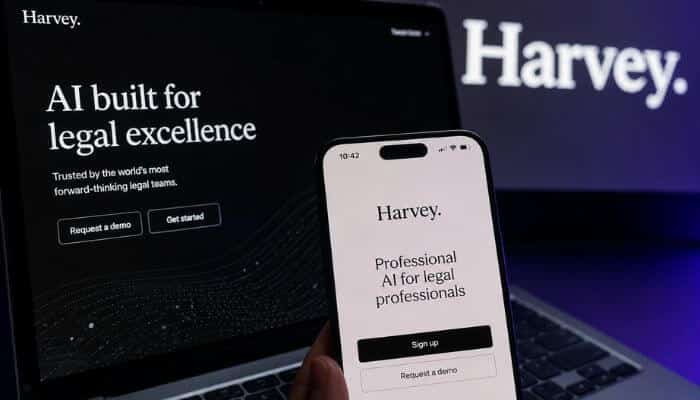

The Harvey AI legal startup has grown from an early GPT-3 experiment into one of the fastest-rising companies in legal technology.
Founded in 2022 by Winston Weinberg and Gabriel Pereyra, Harvey now says it serves more than 2,400 customers across 70+ countries and is used by more than 200,000 lawyers. In March 2026, the company raised $200 million at an $11 billion valuation.
But the bigger story is how Harvey is moving legal AI from simple assistance toward agents and workflow infrastructure.
With Harvey II, persistent matter context and Harvey Tenet, the Harvey AI legal startup is trying to become part of how modern legal work is researched, reviewed and managed.
Quick Answer: What Is Harvey AI?
The Harvey AI legal startup is an enterprise AI company building tools for law firms, corporate legal teams and other professional-services organizations.
Harvey can assist with:
- Legal research
- Contract review
- Drafting and redlining
- M&A due diligence
- Litigation analysis
- Document review
- Regulatory and compliance work
- Knowledge retrieval
- AI-powered legal agents
- Multi-step legal workflows
Harvey’s latest completed financing valued the company at $11 billion in March 2026.
Reports in August 2026 have also linked Harvey to a possible $15.5 billion valuation, but that remains a reported potential financing rather than a confirmed completed valuation.
Key Takeaways
- Harvey was founded in 2022 by Winston Weinberg and Gabriel Pereyra.
- Its initial $5 million financing was led by the OpenAI Startup Fund.
- Harvey’s valuation climbed from $715 million in 2023 to $11 billion in 2026.
- Harvey currently reports 2,400+ customers and 200,000+ lawyers using its platform.
- Harvey II adds persistent matter context and memory to legal AI workflows.
- Harvey Tenet represents Harvey’s push toward specialized legal models.
- Harvey’s biggest opportunity is becoming legal infrastructure rather than remaining only an AI assistant.
- Competition from Legora, Thomson Reuters, LexisNexis and other AI platforms is becoming increasingly intense.
What Is the Harvey AI Legal Startup?
The Harvey AI legal startup is a legal technology company building artificial intelligence for law firms, corporate legal teams and other professional-services organizations.
Harvey was initially described as an AI copilot for lawyers, but its role has expanded far beyond simple question answering. The platform now supports legal research, document analysis, drafting, AI agents, collaborative workspaces, enterprise integrations and firm-specific knowledge.
What makes Harvey different from a basic chatbot is the way it is being built around legal workflows. Instead of handling one isolated prompt at a time, Harvey is increasingly designed to work with broader matter context, documents, permissions and multi-step tasks.
That means a lawyer can move from asking the AI to summarize one document to using it across a larger workflow involving research, review, analysis and structured output.
This shift helps explain Harvey’s broader strategy. The company is not only trying to make legal work faster; it is trying to become part of the infrastructure through which legal work is completed.
Who Founded Harvey AI?
Harvey was founded by Winston Weinberg and Gabriel Pereyra, whose backgrounds combined legal practice with advanced artificial-intelligence research.
Weinberg previously worked as a securities and antitrust litigator at O’Melveny & Myers, giving him first-hand experience with the research, drafting and analytical workflows lawyers handle every day. Pereyra came from the AI research world, with experience at organizations including DeepMind, Google Brain and Meta AI.
The company’s origins trace back to experiments with OpenAI’s GPT-3. Weinberg and Pereyra tested whether large language models could answer real legal questions and assist with professional legal tasks.
Those early experiments helped shape the Harvey AI legal startup around a simple idea: combine legal-domain knowledge with powerful AI systems to make complex professional work faster and more efficient.
How OpenAI Helped Launch Harvey
Harvey came out of stealth in November 2022 with $5 million in funding led by the OpenAI Startup Fund, alongside early backing from Jeff Dean and Elad Gil.
The investment arrived at an important moment. Generative AI was only beginning to attract serious enterprise attention, and legal applications were still largely experimental.
Harvey used that early position to build specifically for law firms and professional legal work rather than trying to adapt a general consumer AI product later.
The company raised another $21 million in April 2023 in a Series A led by Sequoia, giving the Harvey AI legal startup more resources to expand its product and work with larger legal organizations.
OpenAI remained important to Harvey’s early development, but the company has since broadened its approach. Harvey now works with multiple AI models and is investing in specialized legal systems of its own.
Harvey AI Legal Startup Funding Timeline
The Harvey AI legal startup has experienced one of the fastest valuation climbs in legal technology.
| Date | Funding | Reported Valuation |
|---|---|---|
| November 2022 | $5 million | Not disclosed |
| April 2023 | $21 million Series A | Not disclosed |
| December 2023 | $80 million Series B | $715 million |
| July 2024 | $100 million Series C | $1.5 billion |
| February 2025 | $300 million Series D | $3 billion |
| June 2025 | $300 million Series E | $5 billion |
| December 2025 | $160 million investment | $8 billion |
| March 2026 | $200 million growth round | $11 billion |
Harvey’s valuation rose sharply after its 2023 Series B. The company moved from $715 million in December 2023 to $1.5 billion by July 2024, then reached $3 billion in February 2025, $5 billion in June, and $8 billion by December 2025.
The biggest jump came in March 2026, when Harvey raised another $200 million at an $11 billion valuation, with GIC and Sequoia co-leading the round.
In less than four years, Harvey had gone from a $5 million startup financing to an eleven-figure private-company valuation.
Could Harvey Already Be Heading Toward $15.5 Billion?
Harvey’s $11 billion valuation may not be the final number for 2026. Reports in August said the company was discussing another funding round of at least $500 million at a potential $15.5 billion valuation.
The same reporting placed Harvey’s annualized revenue above $350 million, adding to signs of rapid commercial growth.
For the Harvey AI legal startup, however, there is an important distinction between a completed financing and a valuation being discussed.
Latest confirmed valuation: $11 billion
Reported potential valuation: $15.5 billion
Until a new financing officially closes, $11 billion remains Harvey’s latest confirmed valuation.
Why Is Harvey AI Worth $11 Billion?
The Harvey AI legal startup is valued at $11 billion not because it has generated $11 billion in revenue, but because investors are betting on its growth, enterprise adoption and potential role in the future of legal work.
Several factors help explain that valuation.
Rapid Revenue Growth
Harvey reported more than $100 million in net-new annual recurring revenue during the second quarter of 2026.
External reporting in August also placed the company’s annualized revenue above $350 million.
ARR and annualized revenue are not the same as audited GAAP revenue, but both figures point to strong commercial momentum.
Customer Expansion
Harvey’s customer base has grown rapidly.
| Period | Harvey-Reported Scale |
|---|---|
| 2024 | 235 customers in 42 countries |
| March 2026 | 1,000+ customers in 60 countries |
| August 2026 | 2,400+ customers in 70+ countries |
| August 2026 | 200,000+ lawyers |
| August 2026 | 75+ AmLaw 100 firms |
The rapid increase also explains why older articles may show much smaller Harvey customer numbers. Those figures may have been accurate when published but became outdated quickly.
Growth of AI Agents
Harvey said customers were running more than 25,000 custom agents by March 2026, alongside hundreds of ready-to-use agents covering major legal practice areas.
This could be more important than simple user growth. If law firms begin building repeatable workflows around Harvey agents, the platform becomes more deeply integrated into daily legal operations.
How Does Harvey AI Work?
The Harvey AI legal startup combines foundation models, specialized legal systems, document retrieval, customer data, AI agents, matter context, enterprise permissions and integrations with legal software.
A lawyer can use Harvey for a simple research or drafting request, but the more valuable use cases often involve several connected steps.
For example, during M&A due diligence, Harvey can help review agreements, identify important provisions, extract clauses, compare contracts against a review framework, flag unusual terms and organize findings into a structured report for lawyer review.
A typical workflow might include:
- Reviewing agreements in a data room
- Identifying relevant provisions
- Extracting important clauses
- Comparing terms against a review framework
- Categorizing potential risks
- Linking findings back to source documents
- Preparing a structured review table
- Producing a first-pass diligence report
- Sending the results to a lawyer for final review
This illustrates the difference between simply generating text and supporting a broader professional workflow.
Harvey Agents Are Moving Legal AI Beyond Chat

Agents are becoming a central part of Harvey’s strategy because they can handle broader legal tasks rather than responding to a single prompt.
A traditional chatbot might be asked to summarize one agreement. An agent can be given a larger objective, such as reviewing a folder of contracts, identifying specific risks, comparing provisions against a firm’s playbook, creating a review table and flagging issues that need lawyer attention.
That makes agentic AI much closer to the way legal work is actually delegated. The Harvey AI legal startup is increasingly building around workflows that involve planning, document retrieval, analysis, comparison, organization and human review.
The key difference is that Harvey is moving beyond one-off AI assistance toward systems that can support several connected steps of professional legal work.
Harvey II Could Matter More Than the $11B Valuation
Harvey introduced Harvey II on August 18, 2026.
Its central idea is straightforward:
Legal AI should not have to relearn a matter every time a lawyer gives it another task.
Harvey II allows agents to work with broader context from the matter or project in which they operate.
That may include:
- Documents
- Parties
- Matter history
- Tasks
- Team members
- Permissions
- Existing instructions
- User preferences
Harvey organizes this context through collaborative environments called Spaces.
Instead of repeatedly uploading the same files and explaining the same facts, teams can work inside a persistent matter environment.
That could be one of Harvey’s most important product changes.
A chatbot understands a prompt.
A professional legal AI platform needs to understand the work surrounding that prompt.
Harvey Memory Makes Legal AI More Personal
Harvey II also introduces persistent Memory, allowing the platform to remember certain preferences about how a user works.
That can include things such as memo structure, citation style, drafting preferences, summary length, formatting choices and repeated corrections. Instead of explaining the same instructions every time, lawyers can potentially carry those preferences across future tasks.
For the Harvey AI legal startup, this makes the platform more personalized, but it also raises important governance questions. Legal teams need to understand what the system remembers, how long that information is retained, who can access it and whether memory can cross matter or client boundaries.
The more persistent legal AI becomes, the more important privacy, permissions and information governance become.
Harvey Is Moving Beyond Its OpenAI Origins
One common misconception about Harvey is that it is simply an OpenAI-powered tool for lawyers. That no longer reflects the company’s broader strategy.
Harvey increasingly uses a multi-model approach, allowing different AI systems to support different types of legal work. One model may perform better for research, another for drafting, long-context analysis or large-scale extraction.
For the Harvey AI legal startup, this reduces dependence on a single AI provider and gives the company more flexibility over performance, availability and cost.
Harvey’s real differentiation increasingly comes from what surrounds the underlying models: legal workflows, matter context, agents, firm knowledge, integrations, permissions, security and specialized post-training.
That makes Harvey’s strategy broader than simply giving lawyers access to a powerful large language model.
What Is Harvey Tenet?
On August 20, 2026, Harvey announced Harvey Tenet, its first post-trained open-weight model designed for long-horizon legal work.
Harvey says Tenet is based on Kimi K3 and was post-trained with Fireworks research. The model reflects a broader effort to build AI that is more closely optimized for complex legal workflows rather than relying only on general-purpose foundation models.
For the Harvey AI legal startup, Tenet is strategically important because it could reduce dependence on outside model providers while giving Harvey more control over performance, cost and legal specialization.
Harvey has reported promising benchmark and cost-efficiency results, but those findings should still be treated cautiously because much of the early evidence comes from the company itself. Independent testing will be important before concluding that Tenet consistently outperforms competing models in real-world legal work.
Even so, Tenet shows that Harvey wants to compete not only at the interface and workflow level, but increasingly at the model layer as well.
Why Specialized Legal Models Could Matter
Specialized or post-trained models could give Harvey more control over both performance and cost as legal AI becomes more deeply embedded in professional workflows.
For the Harvey AI legal startup, one advantage is reduced dependence on outside model providers. Harvey can potentially gain more flexibility over pricing, model availability, release schedules and long-context performance.
There is also a legal-specific performance benefit. A model optimized around professional legal work may handle research, review and complex workflows differently from a general-purpose consumer model.
The bigger opportunity may be firm-specific intelligence. Law firms differentiate themselves through precedents, playbooks, drafting practices, deal experience and internal know-how.
If Harvey can help firms turn that institutional knowledge into reusable AI workflows without compromising confidentiality, those systems could become much harder for competitors to replicate.
How Accurate Is Harvey AI?
Accuracy remains one of the biggest issues in legal AI.
Harvey’s own Legal Agent Benchmark, or LAB, provides an important reality check.
LAB is designed to test AI agents on difficult, long-horizon legal assignments rather than simple questions.
Under Harvey’s strict all-pass methodology, a task only counts as successful when every required criterion is satisfied.
Initial 2026 results showed frontier models completing less than 10% of demanding tasks perfectly from beginning to end under this scoring method.
Later evaluations improved.
Harvey reported:
- Claude Opus 4.7 at 7.1%
- Claude Opus 4.8 at 10.4%
- Claude Opus 5 at 11.7%
These figures do not mean Harvey itself is only 11.7% accurate.
The benchmark deliberately tests difficult assignments and requires every component of a task to succeed.
The more important lesson is this:
Frontier AI can already perform valuable legal work while still being far from perfectly autonomous on complex end-to-end assignments.
That makes human review essential.
What Can Lawyers Use Harvey AI For?
Harvey supports a wide range of legal work across transactional, litigation, regulatory and in-house teams.
For research, lawyers can use the platform to investigate legal questions, organize preliminary analysis and identify relevant material. In contract work, Harvey can help compare agreements, extract key provisions and support drafting or redlining.
The Harvey AI legal startup is also increasingly used for larger workflows such as M&A due diligence, where agents can review document sets, identify important terms and flag contracts that need closer attention.
Litigation use cases include case research, evidence analysis, document review, drafting, chronology building and court-record analysis. Harvey’s August 2026 partnership with PacerPro also reflects its push into docket intelligence for litigators.
In-house legal teams can use Harvey for regulatory and compliance work, while law firms can apply it to knowledge management by reusing precedents, playbooks, prior work product and internal expertise.
The broader value is not one single feature. It is the ability to apply AI across several parts of a legal workflow while keeping human review in the process.
Does Harvey AI Actually Save Lawyers Time?
Harvey says users save an average of 25+ hours per month, although that is a company-reported figure rather than an independent industry-wide benchmark.
Customer deployments suggest that adoption can still be significant. CMS, for example, reported strong usage after rolling Harvey out across thousands of lawyers.
For the Harvey AI legal startup, however, the more meaningful question is not simply how many licenses a firm buys. It is whether lawyers use the platform consistently and whether that usage improves real legal workflows.
Useful performance indicators include:
- Monthly active usage
- Repeat usage
- Hours saved
- Workflow completion
- Matter turnaround
- Quality improvement
- Reduction in manual review
- Client value
- Revenue impact
- Margin improvement
A firm can purchase thousands of AI licenses without achieving meaningful transformation if professionals rarely use them.
Real adoption matters more than procurement announcements.
How Does the Harvey AI Legal Startup Make Money?
The Harvey AI legal startup primarily operates as enterprise software.
Its customers include:
- Major law firms
- Corporate legal departments
- Professional-services organizations
- Financial institutions
- Asset managers
- Large enterprises
Harvey is therefore very different from a consumer AI service built around a simple monthly individual subscription.
Enterprise deployments can involve:
- User access
- Organization-wide contracts
- Different product capabilities
- AI usage
- Integrations
- Custom agents
- Workflow implementation
- Legal engineering
- Security requirements
- Governance controls
This makes Harvey’s commercial model closer to sophisticated enterprise SaaS combined with implementation support.
How Much Does Harvey AI Cost?
Harvey does not publish one universal public price for every customer. Pricing can vary depending on organization size, number of users, deployment scope, products used, integrations and other enterprise requirements.
For the Harvey AI legal startup, that makes pricing closer to a customized enterprise software agreement than a fixed consumer subscription.
Buyers should therefore be cautious with claims that Harvey always costs a specific amount per lawyer unless those figures come from a current, dated contract.
The more useful question is whether the value created by Harvey justifies the total cost of adoption.
A firm might consider:
- Attorney hours saved
- Faster matter completion
- Increased review capacity
- Reduced outside-counsel spending
- Better knowledge reuse
- New fixed-fee opportunities
- Higher margins
- Faster client response
- Better consistency
As legal AI adoption grows, measuring return on investment will become increasingly important for firms deciding whether tools like Harvey deliver meaningful business value.
Is Harvey AI Secure for Confidential Legal Work?
Security is especially important in legal AI because law firms routinely handle privileged communications, litigation strategy, corporate transactions, personal information, confidential contracts and other sensitive material.
Harvey’s current security program includes controls and certifications such as:
- SOC 2 Type II
- ISO 27001
- ISO 27701
- ISO 42001
- SAML SSO
- Audit logs
- IP allow-listing
- Data lifecycle controls
- Encryption
- Ethical-wall enforcement
- Regional data controls
For the Harvey AI legal startup, these protections are especially important because the platform can work with sensitive client documents and matter-level information.
Harvey also states that customer inputs, outputs and uploaded documents are not used to train underlying models.
Even with those safeguards, law firms should still conduct their own legal, security and contractual review before adopting any AI platform.
Why Ethical Walls Matter in Legal AI
Law firms cannot allow every employee to access every document or matter. Conflict rules may restrict certain lawyers from seeing information connected to specific clients, cases or transactions.
AI systems need to respect those same boundaries.
For the Harvey AI legal startup, ethical walls and matter-level permissions become increasingly important as the platform gains access to more firm knowledge and client information.
The key question is not only whether AI can answer a request. It is also whether the user is authorized to access the information needed to produce that answer.
As legal AI becomes more deeply integrated into firm workflows, strong permission controls will be essential for protecting confidentiality and preventing information from crossing restricted matter boundaries.
Harvey’s 2026 Acquisition Strategy
The Harvey AI legal startup has also used acquisitions to expand its technology, enterprise capabilities and reach beyond traditional law firms.
Three deals in 2026 help show where the company is heading.
| Acquisition | Date | Strategic Role |
|---|---|---|
| Hexus | January 2026 | Enterprise and in-house product development |
| Lume | March 2026 | Customer integrations |
| Benchmark | July 2026 | Asset-management decision infrastructure |
Hexus
Harvey brought Hexus into the company in January 2026. The team included engineers with experience at major technology companies and was expected to support Harvey’s expansion with in-house legal departments.
Lume
In March, Harvey acquired the team behind Lume, a Y Combinator-backed integration company.
The deal was strategically important because enterprise legal customers already rely on complex document, knowledge and productivity systems. Better integrations can make Harvey easier to embed into those existing workflows.
Benchmark
Harvey acquired Benchmark in July 2026 as part of a broader move into asset management.
Benchmark focuses on decision infrastructure for investment firms. Harvey said it was already working with more than 125 asset managers, while Benchmark customers represented more than $2 trillion in assets under management.
Taken together, the acquisitions reveal a clear pattern:
enterprise capabilities → deeper integrations → institutional knowledge → expansion beyond traditional legal services
Harvey Is Expanding Beyond Law Firms
Law firms remain central to Harvey’s business, but the company’s long-term market appears much broader.
Harvey increasingly works with corporate legal departments, professional-services firms, financial institutions, asset managers and large enterprises. Its Benchmark acquisition is one of the clearest signs that the company is looking beyond traditional legal software.
For the Harvey AI legal startup, the larger opportunity may be high-value professional knowledge work.
Law is an attractive starting point because it is text intensive, highly structured, information heavy and dependent on professional judgment. Those same characteristics also appear in other professional industries.
If Harvey can successfully apply its AI infrastructure to legal work, similar systems could eventually support adjacent areas where professionals handle complex documents, institutional knowledge and high-stakes decisions.
Harvey’s Enterprise Integration Strategy
Enterprise software becomes more useful when professionals do not need to constantly leave the tools they already use.
Harvey supports integrations with environments used heavily across legal organizations, including productivity and document-management systems.
Lawyers already spend much of their day inside:
- Microsoft Word
- Outlook
- Document management software
- Matter-management tools
- Internal knowledge systems
Bringing AI closer to those environments reduces friction.
That may sound less exciting than a new AI model, but it can be just as important commercially.
A technically impressive product that lawyers rarely open creates little value.
A system embedded into daily workflows has a much better chance of becoming habitual.
Harvey AI Legal Startup vs Legora
The Harvey AI legal startup faces strong competition from Legora, another fast-growing AI platform built for legal teams.
Legora reported surpassing $100 million in annual recurring revenue and 1,000 customer organizations in April 2026. Its expanded Series D later valued the company at about $5.6 billion post-money.
| Factor | Harvey | Legora |
|---|---|---|
| Core market | Legal and professional services | Legal teams |
| Latest confirmed valuation | $11 billion | $5.6 billion |
| Reported customers | 2,400+ | 1,000+ at April milestone |
| AI agents | Major focus | Major focus |
| Enterprise law firms | Strong presence | Strong presence |
| In-house teams | Growing | Growing |
| International expansion | Yes | Yes |
The comparison shows how quickly the legal AI market is developing. Harvey currently has the larger reported valuation and customer base, while Legora has also built significant momentum among legal teams.
More importantly, both companies are moving beyond simple AI assistance. Their long-term goal is to become a central workflow layer for research, drafting, document review and other legal work.
Harvey vs CoCounsel Legal vs Lexis+ with Protégé
Harvey also competes with established legal-information companies that bring decades of proprietary content, research tools and customer relationships into the AI market.
| Platform | Key Advantage | Strategic Position |
|---|---|---|
| Harvey | Agents, matter context, multi-model AI | AI-native legal platform |
| Legora | Collaborative agentic workflows | AI-native legal platform |
| CoCounsel Legal | Westlaw and Practical Law | AI plus authoritative legal information |
| Lexis+ with Protégé | Lexis content and Shepard’s | AI plus legal research ecosystem |
CoCounsel Legal
Thomson Reuters’ CoCounsel combines artificial intelligence with established legal resources such as Westlaw and Practical Law.
Its strength is not only AI capability. Thomson Reuters already has a large body of legal information, editorial expertise and long-standing relationships with law firms, giving CoCounsel a strong foundation for research-driven workflows.
Lexis+ with Protégé
LexisNexis follows a similar strategy with Protégé, combining generative AI with its legal-information ecosystem and Shepard’s citation tools.
For the Harvey AI legal startup, this creates a different competitive challenge. Harvey does not only need to outperform other AI startups; it must also compete with companies that already possess trusted legal databases, citation infrastructure and deeply established enterprise relationships.
That means Harvey’s differentiation increasingly depends on areas such as agents, matter context, workflow design, multi-model flexibility and specialized legal intelligence.
What Gives Harvey a Competitive Advantage?
The Harvey AI legal startup has several potential advantages that could help it maintain a strong position in the legal AI market.
- Legal-specific product design: Harvey was built around legal workflows rather than adapted from a general consumer chatbot.
- Enterprise adoption: Winning major law firms gives Harvey credibility and creates opportunities for wider organization-level deployment.
- Legal engineering: Harvey works with customers to build and refine AI workflows instead of only selling software access.
- Multi-model flexibility: The platform can use different AI models depending on performance, cost and customer requirements.
- Matter context: Harvey II allows AI to work with broader matter information, which can make the platform more useful over longer-running legal work.
- Specialized evaluations: Harvey’s Legal Agent Benchmark gives the company a way to test models against realistic legal assignments.
- Harvey Tenet: Specialized legal models could reduce Harvey’s dependence on general-purpose AI providers and improve control over performance.
- Strong funding position: More than $1 billion in funding gives Harvey resources for research, hiring, acquisitions, security, international expansion and infrastructure.
What Are Harvey’s Biggest Risks?
Despite its rapid growth, the Harvey AI legal startup still faces several important risks.
- Hallucinations: AI can produce incorrect legal information or fabricated citations.
- Incomplete agent work: Complex legal tasks still require human review.
- Confidentiality: Law firms must protect privileged and restricted client information.
- Competition: Harvey faces pressure from Legora, Thomson Reuters, LexisNexis, Clio and other AI platforms.
- Model commoditization: Better general-purpose AI could reduce the advantage of specialized legal platforms.
- Infrastructure costs: Large-scale agent workflows can require significant computing resources.
- Valuation pressure: An $11 billion valuation creates high expectations for continued revenue and customer growth.
Harvey’s long-term success will depend on whether it can manage these risks while maintaining trust, performance and a strong competitive position.
Is Harvey AI Safe for Legal Work?
The Harvey AI legal startup has invested heavily in enterprise security and governance, but no generative AI platform should be treated as completely risk-free.
Law firms still need to evaluate:
- Data retention
- Customer-data protections
- Access controls
- Encryption
- Ethical walls
- Model providers
- Citation reliability
- Human-review requirements
Safety also depends on how the platform is configured, what type of work it handles and whether lawyers verify important outputs.
Security is not a one-time certification. It is an ongoing governance process.
Lawyers Remain Responsible for AI-Assisted Work
Artificial intelligence can assist with professional work.
It does not transfer a lawyer’s responsibility to the software provider.
Lawyers still need to ask:
- Is the legal authority real?
- Is the citation accurate?
- Does the analysis fit the client’s facts?
- Is confidential information protected?
- Is the answer correct for the jurisdiction?
- Has the final work been reviewed appropriately?
This becomes even more important as AI gets faster.
Greater efficiency does not reduce the need for professional judgment.
Will Harvey AI Replace Lawyers?
The bigger question is not whether Harvey will replace lawyers, but which parts of legal work will require fewer human hours.
AI is well suited to tasks such as:
- Summarization
- Document review
- Research assistance
- First drafts
- Information extraction
- Large-document analysis
Lawyers still provide the judgment, strategy, negotiation, advocacy and accountability that complex legal work requires.
For the Harvey AI legal startup, the more realistic impact is likely to be a change in how legal work is divided between people and AI rather than the elimination of lawyers.
Smaller teams may be able to complete some matters with fewer manual hours, which could eventually affect staffing, training and pricing.
How Harvey Could Change the Law Firm Business Model
The traditional law-firm model is closely tied to billable hours, which creates a challenge as AI reduces the time needed for some legal tasks.
If work that once took five hours can be completed in one hour with AI assistance and lawyer review, firms may need to rethink how they price and deliver services.
Possible approaches include:
- Fixed fees
- Subscription services
- Portfolio pricing
- Outcome-based pricing
- Technology-enabled service packages
- Smaller teams handling larger workloads
For the Harvey AI legal startup, this could be one of the biggest long-term impacts of legal AI. The firms that benefit most may be those that redesign their pricing and service models around higher productivity.
That makes legal AI an economic shift as well as a technological one.
How Harvey Could Change Junior-Lawyer Training
Junior lawyers traditionally build experience through tasks such as research, first drafts, contract review, due diligence and document analysis.
As AI takes on more of this repetitive work, law firms may need new ways to develop professional judgment and practical skills.
For the Harvey AI legal startup, this creates an important long-term question: if AI handles more entry-level work, how will junior lawyers gain the experience those tasks once provided?
Future legal training may therefore need to focus on two skills:
- Performing legal analysis independently
- Reviewing and supervising AI-generated legal work
This could become one of the most important long-term effects of legal AI on law-firm training.
Is Harvey’s $11 Billion Valuation Justified?
There is no simple answer.
The Harvey AI legal startup becomes easier to justify at an $11 billion valuation if it succeeds in becoming infrastructure for legal work rather than remaining only an AI productivity tool.
The bullish case includes:
- 2,400+ customers
- 200,000+ lawyers
- 75+ AmLaw 100 firms
- Rapid reported revenue growth
- More than 25,000 custom agents
- Major enterprise adoption
- Harvey II and persistent memory
- Specialized legal models
- Enterprise integrations
- Expansion beyond traditional law firms
But the risks are substantial. Harvey operates in a market where AI capabilities change quickly, competitors are well funded, established legal-information companies control valuable data, and current AI agents are still imperfect.
If Harvey remains mainly a productivity tool, an $11 billion valuation could look aggressive. If it becomes deeply embedded infrastructure across law firms and professional-services organizations, the valuation becomes easier to understand.
Investors are clearly betting on the second outcome.
What’s Next for the Harvey AI Legal Startup?
The next phase of the Harvey AI legal startup is likely to focus on several major developments.
- More Autonomous Agents: Harvey is likely to push agents toward longer, more complex legal workflows with less manual intervention.
- Persistent Matter Intelligence: Harvey II creates a foundation for AI that can understand ongoing matters, documents and user context rather than isolated prompts.
- Specialized Legal Models: Harvey Tenet suggests the company wants greater control over the models powering its legal workflows.
- Deeper Enterprise Integration: Harvey is likely to become more closely connected with productivity, document-management and knowledge systems used by legal teams.
- Expansion Beyond Law: Its move into asset management suggests that Harvey may eventually target other areas of high-value professional work.
- Potential New Financing: Reports have linked Harvey to a possible $15.5 billion valuation, but until another transaction officially closes, $11 billion remains its latest confirmed valuation.
Conclusion
The Harvey AI legal startup has grown from a $5 million OpenAI-backed company into an $11 billion legal AI business in less than four years, with more than 2,400 customers, operations across 70+ countries and over 200,000 lawyers using its technology.
But Harvey’s biggest story is not its valuation. It is the company’s attempt to move legal AI through three stages:
Assistant → Agent → Infrastructure
The first stage helps lawyers answer questions. The second allows AI to handle multi-step workflows. The third embeds AI into matters, documents, permissions, institutional knowledge and the systems through which legal work is completed.
Harvey II, persistent memory, thousands of custom agents, multi-model infrastructure and Harvey Tenet all point toward that broader ambition.
The Harvey AI legal startup still faces serious competition from Legora, Thomson Reuters, LexisNexis and increasingly capable general-purpose AI platforms. Its own benchmarking also shows that fully autonomous legal work remains difficult.
If Harvey remains mainly a productivity tool, its $11 billion valuation could eventually look aggressive. If it becomes deeply embedded infrastructure for law firms and enterprises, its rapid rise may be easier to justify.
The bigger question is no longer simply whether lawyers will use AI.
It is how much of legal work will eventually be organized around it.
FAQs
1. Does the Harvey AI legal startup have a mobile app?
Yes. Harvey offers native iOS and Android apps that let users run queries, access Vault, scan documents and review previous work from mobile devices.
2. Can the Harvey AI legal startup work inside Microsoft 365?
Yes. Harvey can operate inside Microsoft 365 Copilot and Copilot Cowork, allowing legal teams to analyze documents and access Harvey without leaving familiar Microsoft workflows.
3. What software does the Harvey AI legal startup integrate with?
Harvey supports integrations with tools including Microsoft Word, Outlook, iManage, NetDocuments and Box, among other enterprise systems.
4. Can the Harvey AI legal startup support Indian legal research?
Yes. Harvey added an SCC Online integration in May 2026, providing access to Indian legal content for research, drafting and litigation preparation.
5. Does the Harvey AI legal startup support multilingual legal work?
Harvey provides multilingual capabilities through features such as language selection in review tables and models with multilingual capabilities, including Mistral.
6. Does the Harvey AI legal startup provide API access?
Harvey maintains developer APIs for certain enterprise functions, including usage-history data that organizations can use for analytics and administration.
7. Can the Harvey AI legal startup transcribe legal calls?
Yes. Harvey Mobile can transcribe multi-party calls or hearings and save transcripts to Vault for later review and follow-up work.
8. Can the Harvey AI legal startup analyze SEC filings?
Yes. Harvey’s knowledge tools include EDGAR data, allowing users to search and analyze SEC filing information as part of research workflows.
