

Have you ever searched for a page size checker online and ended up on the wrong page or got zero results, just because of a small spelling mistake? You are not alone. Thousands of people every single day search for the page size checker spellmistake topic because they have typed the tool name wrong and cannot find what they need. A page size checker is a very important tool for website owners, bloggers, developers, and SEO experts. It tells you how heavy or light your webpage is, and that directly affects how fast your site loads and how well it ranks on Google.
In 2026, Google’s latest algorithm updates have made page speed and page size more important than ever before. Google now uses Core Web Vitals as a major ranking factor, and if your page is too big, your website will rank lower in search results. This is exactly why tools like the page size checker have become so popular. But here is the funny part, many people search for this tool using wrong spellings, and that is what we call the page size checker spellmistake problem. Whether you type “page size checher,” “page size checker,” or “page size checker,” you are looking for the same thing.
In this complete guide, we will cover everything you need to know about the page size checker spell mistake, why it happens, what the correct spelling is, how the tool actually works, why page size matters for SEO in 2026, and which free tools you can use today. By the end of this article, you will never misspell page size checker again, and more importantly, you will know exactly how to use it to improve your website’s performance.
What Is a Page Size Checker?
A page size checker is an online tool that measures the total size of a webpage. This size is usually shown in kilobytes (KB) or megabytes (MB). Think of it like weighing a backpack; the heavier it is, the longer it takes to carry. The same goes for a webpage: the bigger the size, the longer it takes to load.
Here is what a page size checker actually measures:
- HTML size: The size of your webpage’s code
- CSS size: The size of your styling files
- JavaScript size: The size of all scripts on the page
- Image size: The total weight of all images on the page
- Font size: The weight of custom fonts loaded
- Total page weight: The combined size of everything above
Pro Tip: Google recommends keeping your total page size under 3 MB for best performance. Ideally, aim for under 1 MB for fast-loading pages that rank higher.
Now you know what a page size checker does. So why do so many people make a page size checker spellmistake? Let’s find out.
What Is the Page Size Checker Spell Mistake?
The page size checker spellmistake is simply when someone types the name of this tool incorrectly in a search engine. It is incredibly common and completely understandable. The phrase “page size checker” has 16 characters, and even one wrong letter can send you to the wrong place or show no results at all.
Most Common Page Size Checker Spell Mistakes
Here are the most popular misspellings people use when searching for this tool:
| Wrong Spelling | Correct Spelling | Why People Misspell It |
| page size checher | page size checker | Typo – missing ‘k’ |
| page siz checker | page size checker | Missing ‘e’ in size |
| pge size checker | page size checker | Missing ‘a’ in page |
| page size chekcer | page size checker | Swapped ‘k’ and ‘e’ |
| page sizechecker | page size checker | Missing space |
| pagge size checker | page size checker | Double ‘g’ typo |
| page size chaker | page size checker | Wrong vowel – ‘a’ instead of ‘e’ |
| page size cheker | page size checker | Missing ‘c’ in checker |
As you can see from the table above, the page size checker spellmistake comes in many forms. The most common one is typing “checher” instead of “checker.” This happens because people type fast and skip the letter “k.” Another very common page size checker spellmistake is forgetting the space between “size” and “checker,” making it “sizechecker.”
Why Does This Spell Mistake Happen?
There are a few simple reasons why the page size checker spellmistake is so common:
- Fast typing: When we type quickly, we often skip or swap letters
- Auto-correct: Phone keyboards sometimes change “checker” to something else
- Non-native English speakers: People searching from countries where English is a second language often make spelling errors
- Voice search errors: When using voice search, the tool might mishear “checker” as “checher” or “chaker”
- Phonetic spelling: Some people spell the word the way it sounds to them
Regardless of the reason, the solution is simple: The correct spelling is always page size checker three separate words, spelled exactly as shown.
Why Page Size Matters for SEO in 2026
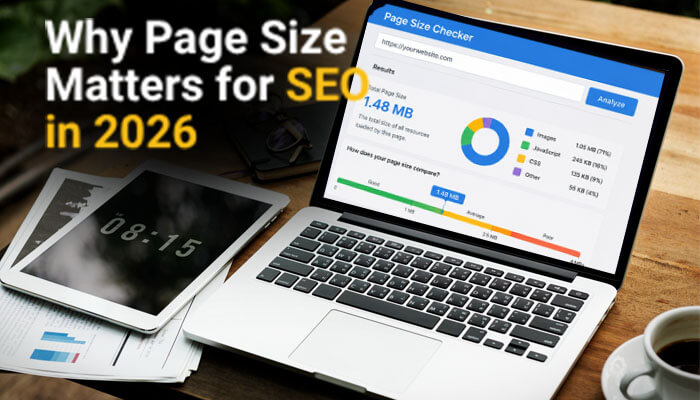
Before we go deeper into the page size checker spellmistake topic, let’s talk about why page size is so important. This will help you understand why millions of people are searching for a page size checker in the first place.
In 2026, Google’s algorithm cares deeply about three things:
1. Page speed: How fast your website loads
2. Core Web Vitals: Special speed metrics like LCP, FID, and CLS
3. User experience: How easy and pleasant is your site to use
All three of these are directly affected by your page size. If your page is too big, it loads slowly, which makes users leave and Google notices. That is why the page size checker has become one of the most searched-for SEO tools in 2026.
Page Size vs. Page Weight: What’s the Difference?
Many people confuse page size with page weight. Here is a clear comparison:
| Feature | Page Size Checker | Page Weight Checker |
| What it checks | HTML/CSS/JS file size in KB or MB | Total page weight with all assets |
| Focus | Code file dimensions | Overall page load data |
| Affects SEO? | Yes – directly impacts speed | Yes – slows down crawl & rank |
| Free Tools Available? | Yes – many online tools | Yes – GTmetrix, PageSpeed Insights |
| Ideal Page Size | Under 100 KB (HTML only) | Under 3 MB total |
What Is the Ideal Page Size for SEO? (2026 Standards)
After years of studying SEO and using a page size checker on hundreds of websites, here is what the data tells us about ideal page sizes in 2026:
- HTML file: Keep it under 100 KB. Ideally under 50 KB
- CSS files: Under 100 KB combined
- JavaScript files: Under 300 KB combined (minified)
- Images: Each image under 200 KB. Use WebP format whenever possible
- Total page weight: Under 3 MB. Ideally under 1 MB for mobile users
- Fonts: Limit to 2–3 font families, under 100 KB total
Important: Google’s 2026 algorithm update gives a significant ranking boost to pages that load in under 2.5 seconds (LCP score). A page size checker helps you find exactly what is making your page slow.
To check if your page meets these standards, you need to run it through a page size checker. And to do that, you first need to know how to spell it correctly, which brings us back to our main topic: the page size checker spellmistake and how to avoid them.
How to Use a Page Size Checker: Step-by-Step Guide
Using a page size checker is very simple, even if you are not a tech expert. Here is a step-by-step guide that even an 8th grader can follow:
1. Open your browser: Go to Google Chrome, Firefox, or any browser
2. Search correctly: Type “page size checker”, no page size checker spellmistake this time!
3. Choose a tool: Click on one of the trusted tools from the search results
4. Enter your URL: Copy and paste your website’s URL into the tool’s search box
5. Click ‘Check’ or ‘Analyze’: Hit the button to start the analysis
6. Read your results: The page size checker will show you the total page size, broken down by file type
7. Take action: If your page is too big, use the suggestions to reduce it (compress images, minify code, etc.)
That is all it takes! Once you get used to running your pages through a page size checker regularly, you will start to notice improvements in your page speed and your Google rankings.
Best Free Page Size Checker Tools in 2026
Now that you know how to use a page size checker, let’s look at the best free tools available in 2026:
| Tool Name | Best For | Free? | Speed Score |
| GTmetrix | Full page weight analysis | Yes (basic) | ⭐⭐⭐⭐⭐ |
| Google PageSpeed Insights | Core Web Vitals + size | Yes | ⭐⭐⭐⭐⭐ |
| Pingdom Tools | Page size + load time | Yes | ⭐⭐⭐⭐ |
| WebPageTest | Advanced size reports | Yes | ⭐⭐⭐⭐⭐ |
| SEOptimer | SEO + page size audit | Yes (basic) | ⭐⭐⭐⭐ |
| Varvy Page Speed Tool | Quick size snapshot | Yes | ⭐⭐⭐ |
| Dotcom-Tools | Multi-location size test | Yes | ⭐⭐⭐⭐ |
Our Top Pick: Google PageSpeed Insights
For most website owners, Google PageSpeed Insights is the best free page size checker available. Why? Because it comes directly from Google, the same search engine that ranks your website. It checks your page size, gives you a performance score from 0–100, and tells you exactly what to fix. Best of all, it is completely free and updated regularly to match Google’s 2026 algorithm standards.
Common Page Size Problems (And How to Fix Them)
Once you run your site through a page size checker, you might discover some problems. Here are the most common issues and how to fix them:
Problem 1: Images Are Too Large
Images are the number one cause of large page sizes. Here is how to fix it:
- Convert images to WebP format (much smaller than JPEG or PNG)
- Compress images using free tools like TinyPNG or Squoosh
- Use lazy loading so images only load when the user scrolls to them
- Remove any images that are not necessary
Problem 2: Too Much JavaScript
JavaScript files can add hundreds of KB to your page. Here is what to do:
- Minify your JavaScript using tools like UglifyJS or Terser
- Remove unused JavaScript (this is called “dead code”)
- Load JavaScript files asynchronously so they do not block the page from loading
- Use a Content Delivery Network (CDN) to serve JS files faster
Problem 3: Unminified CSS
CSS files often contain spaces, comments, and extra characters that add to your page size. Fix this by:
- Using a CSS minifier like CSSNano or PurgeCSS
- Combining multiple CSS files into one
- Removing unused CSS classes
Problem 4: No Caching
Without browser caching, every visitor downloads your entire page every time they visit. Fix this by:
- Setting up browser caching through your .htaccess file or hosting settings
- Using a caching plugin if you use WordPress (like WP Rocket or W3 Total Cache)
- Enabling server-side caching through your hosting provider
Quick Win: Just by compressing your images and minifying your CSS, most websites can reduce their page size by 30–50%. Run a page size checker before and after to see the difference!
Page Size Checker and Mobile SEO in 2026

In 2026, more than 65% of all web searches happen on mobile devices. This means Google primarily uses the mobile version of your website to decide your ranking. This is called mobile-first indexing. And here is the key point: mobile users have slower internet connections, so page size matters even MORE for mobile SEO.
When you use a page size checker, always check both the desktop and mobile versions of your page. A page that is 500 KB on desktop might feel very different on a slow mobile connection. Google PageSpeed Insights lets you check both versions in one report, making it the ideal page size checker for mobile SEO in 2026.
Here is what mobile-optimized page sizes should look like:
- Total page size: Under 1 MB for mobile
- First Contentful Paint (FCP): Under 1.8 seconds
- Largest Contentful Paint (LCP): Under 2.5 seconds
- Time to Interactive (TTI): Under 3.8 seconds
How the Page Size Checker SpellMistake Affects Your Search Results
Now let us circle back to the page size checker spellmistake issue one more time. You might be wondering: Does misspelling this keyword actually affect your search results? The answer is yes, and here is how:
- Wrong results: If you type “page size checher,” search engines might not show you the right tools
- Wasted time: You spend extra minutes trying to find the right page size checker because of the spelling error
- Misleading pages: Some websites use common misspellings to attract visitors, but their tools may not be reliable
- Missed optimization: If you cannot find the right tool, you cannot check and fix your page size, which hurts your SEO
The page size checker spellmistake is not just a funny error; it has real consequences for your website performance. The simple fix? Always remember: it is page size checker three words, correctly spelled, every single time.
Page Size Checker for WordPress Websites
If you use WordPress, which powers over 43% of all websites, then the page size checker is especially important for you. WordPress sites tend to get bloated over time because of plugins, themes, and unoptimized images. Here is how to use a page size checker specifically for WordPress:
1. Check your page size first: Run your homepage and key pages through Google PageSpeed Insights
2. Install a performance plugin: WP Rocket, LiteSpeed Cache, or W3 Total Cache can automatically optimize your page size
3. Use an image optimization plugin: Smush or ShortPixel can compress all images automatically
4. Remove unused plugins: Every plugin adds to your page size. Delete what you do not need
5. Choose a lightweight theme: Heavy themes like Divi or Avada can bloat your page size. Try GeneratePress or Astra for better performance
6. Re-check your page size: Run the page size checker again to see how much you have improved
Advanced Tips: Reduce Page Size Like a Pro
Once you have mastered the basics of the page size checker, here are some advanced tips that professional developers use to keep page sizes small:
Use HTTP/2 or HTTP/3
These newer versions of the internet protocol allow multiple files to be downloaded at the same time, which makes large pages load much faster, even when the page size is significant.
Enable GZIP or Brotli Compression
GZIP compression can reduce your page’s text-based content (HTML, CSS, JS) by up to 70%. Brotli (used by Google) is even more efficient. Most web hosts support this; just enable it in your settings.
Use a Content Delivery Network (CDN)
A CDN stores copies of your page in servers around the world. When someone visits your site, they download it from the server closest to them, making it faster regardless of page size.
Implement Critical CSS
Only load the CSS that is needed for the “above the fold” content first. Load the rest later. This makes your page appear to load faster, even if the total size is large.
Audit Third-Party Scripts
Analytics tools, chat widgets, ad scripts, and social media buttons can add hundreds of KB to your page. Use a page size checker to identify which third-party scripts are the biggest culprits, then remove the ones you do not need.
Conclusion: Never Make the Page Size Checker SpellMistake Again
Let us wrap everything up. The page size checker spellmistake is one of the most common search errors people make online, but now you know the correct spelling, the best tools to use, and exactly why page size matters so much for your website’s success in 2026.
Here is a quick recap of everything we covered:
- Page size checker: A tool that measures how big your webpage is in KB or MB
- Page size checker spell mistake: Common misspellings like “checher,” “cheker,” or “chaker” always use the correct spelling!
- Why it matters: Page size directly affects your loading speed, Core Web Vitals, and Google ranking in 2026
- Ideal page size: Under 1 MB for mobile, under 3 MB total
- Best tools: Google PageSpeed Insights, GTmetrix, WebPageTest
- How to fix large pages: Compress images, minify code, enable caching, use a CDN
The next time you want to check your website’s performance, remember: it is page size checker, spelled correctly, no mistakes. Use it regularly, act on what it tells you, and your website will be faster, leaner, and ranked higher on Google. That is the power of getting both the spelling and the strategy right.
Found this guide helpful? Bookmark it so you never make the page size checker spellmistake again and share it with someone who needs to improve their website speed in 2026!
Page Size Checker Spell Mistake FAQs
1. What is the correct spelling of “page size checker”?
The correct spelling is page size checker, three separate words. Many people make a page size checker spell mistake by typing “checher,” “cheker,” or “chaker.” Always double-check your spelling before searching.
2. Does Google still correct the page size checker in search?
Yes, Google’s search algorithm is smart enough to understand many common misspellings and show you results for the correct term. However, it is always better to type it correctly to get the most accurate and relevant results.
3. How often should I use a page size checker?
Ideally, you should run a page size checker every time you make significant changes to your website, like adding new images, installing a plugin, or updating your theme. At a minimum, check your page size once a month.
4. Is a page size checker free to use?
Yes! Most page size checker tools are completely free. Google PageSpeed Insights, GTmetrix (basic plan), and WebPageTest are all free to use and provide excellent data for improving your website.
5. What page size is too big for Google?
There is no official cutoff, but Google’s best practice guidelines suggest keeping your total page size under 3 MB. For mobile users on slower connections, aim for under 1 MB. Use a page size checker regularly to stay within these limits.
6. Can a large page size get my website penalized by Google?
Not directly penalized, but a large page size causes slow loading, which hurts your Core Web Vitals scores, which in turn lowers your Google rankings. So yes, indirectly, page size does affect your SEO ranking significantly in 2026.