


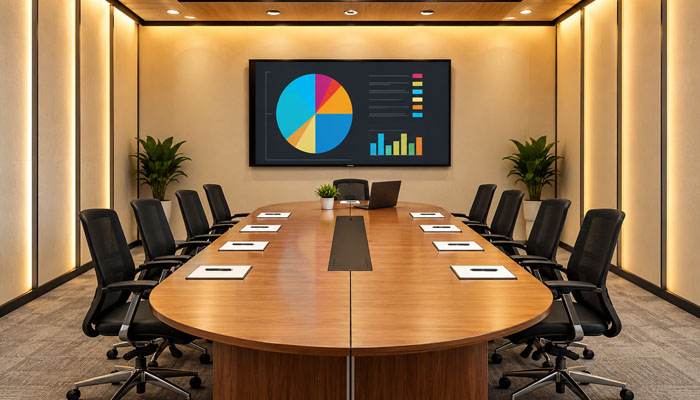

Choosing the right meeting table can make a significant difference to how an office functions. The table is often the centrepiece of a meeting room, influencing where employees sit, how easily they communicate and how comfortably they can use laptops, documents and presentation equipment.
Two of the most popular options are round and rectangular meeting tables. Both offer practical advantages, but they are suited to different room layouts, seating requirements and styles of working.
Round meeting tables are often associated with informal discussions and smaller collaborative spaces, while rectangular tables are commonly found in larger meeting rooms and executive boardrooms. However, the best choice isn’t always as straightforward as selecting a shape based on the number of people attending.
In this guide, we’ll compare round and rectangular meeting tables, exploring their advantages, disadvantages, space requirements, seating capacities and suitability for modern offices.
What Is the Difference Between Round and Rectangular Meeting Tables?
The main difference between round and rectangular meeting tables is how they organise seating and use the available floor space.
A round meeting table provides a circular working surface, with participants positioned around a shared centre. This arrangement makes it easy for people to face one another and avoids creating a clearly defined head of the table.
A rectangular meeting table has two longer sides and two shorter ends, providing a more linear seating arrangement. Its shape is particularly useful for accommodating larger groups and positioning attendees towards a presentation screen or meeting leader.
Both designs are available in different sizes, materials and finishes, with options suitable for everything from compact meeting rooms to large executive boardrooms.
Round vs Rectangular Meeting Tables: Quick Comparison
| Feature | Round Meeting Tables | Rectangular Meeting Tables |
| Best suited for | Smaller meetings and collaborative discussions | Larger meetings and formal presentations |
| Seating arrangement | Participants sit around a shared centre | Participants sit along two sides and potentially at each end |
| Typical capacity | Often 2–6 people, with larger options available | Commonly 4–12+ people depending on length |
| Communication | Encourages face-to-face discussion | Supports structured meetings and presentations |
| Space efficiency | Can work well in square rooms | Often better suited to long or narrow rooms |
| Room appearance | Softer, less formal design | Structured, traditional or executive appearance |
| Technology integration | Available, but central access may need planning | Can accommodate linear cable routes and multiple access points |
| Expansion | Larger diameters become less practical | Longer and modular configurations are available |
| Typical applications | Interviews, brainstorming and informal meetings | Boardrooms, client presentations and team meetings |
While this comparison provides a useful starting point, room dimensions and everyday meeting requirements should determine the final decision.
What Are the Advantages of Round Meeting Tables?
Round meeting tables are a popular choice for businesses that want to create welcoming, collaborative environments.
Their circular design removes the sharp corners and directional seating arrangements associated with rectangular tables, making them particularly suitable for smaller groups.
1. Encourages Face-to-Face Communication
One of the biggest advantages of a round meeting table is that everyone sits facing towards the centre.
This makes it easier for participants to maintain eye contact, follow conversations and engage with colleagues positioned around the table.
Round tables can work particularly well for:
- Creative brainstorming sessions.
- Small team meetings.
- One-to-one discussions and interviews.
- Collaborative workshops.
- Informal client consultations.
- Project planning sessions.
Although furniture shape alone doesn’t determine how collaborative a meeting will be, a circular arrangement can provide a useful setting for open discussion.
2. Creates a More Equal Seating Arrangement
Rectangular meeting tables often have clearly defined end positions, which can naturally become the seats occupied by senior managers or meeting leaders.
Round tables do not have an obvious head position.
This can help create a less formal atmosphere where participants occupy similar positions around the working surface.
For businesses that regularly hold team discussions rather than formal presentations, this arrangement may feel more relaxed and approachable.
3. Works Well in Square Meeting Rooms
Round tables can be a practical option for rooms with relatively equal length and width.
Their symmetrical shape allows chairs to be positioned around the entire perimeter, creating a balanced furniture arrangement.
They can also be visually less imposing than a rectangular table, particularly in smaller meeting rooms.
However, round tables are not automatically more space-efficient. The diameter of the table and the clearance needed for chairs still determine whether the layout will work.
4. Provides a Modern and Welcoming Appearance
Round tables are available in contemporary designs featuring timber finishes, laminate surfaces, metal bases and central pedestal supports.
Their curved shape can soften the appearance of an office, especially when combined with upholstered meeting chairs and modern lighting.
This makes them suitable for client-facing spaces where businesses want to create a professional but approachable environment.
What Are the Disadvantages of Round Meeting Tables?
Despite their benefits, round tables are not always the most practical option.
The main disadvantages include:
- Limited seating capacity: The diameter must increase significantly to accommodate larger groups comfortably.
- Greater reach distances: Large round tables can make it difficult to reach shared documents or equipment in the centre.
- Presentation challenges: Participants may need to turn their chairs to view a wall-mounted screen.
- Potentially inefficient in narrow rooms: A circular table may leave unused floor space at either end of a long room.
- Technology requirements: Larger round tables may need carefully positioned power connections, microphones and cameras.
For smaller meetings, these limitations are often manageable. However, businesses regularly hosting eight or more participants may find a rectangular or oval table more practical.
What Are the Advantages of Rectangular Meeting Tables?
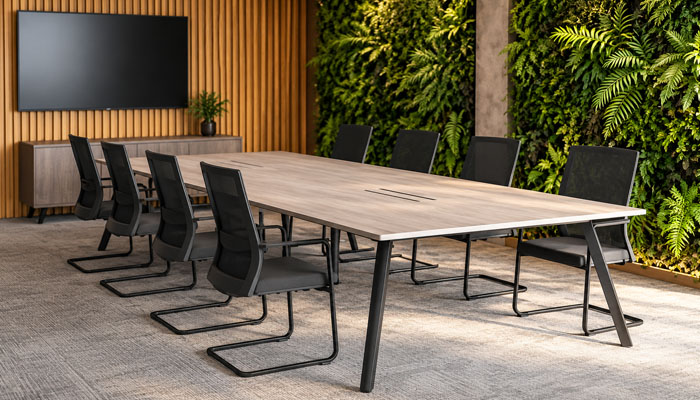
Rectangular meeting tables remain one of the most widely used options in commercial offices.
Their shape accommodates a range of seating capacities and provides a structured arrangement suitable for formal meetings, presentations and everyday team discussions.
1. Accommodates Larger Groups
Rectangular meeting tables can comfortably accommodate more people by increasing their length without requiring an equally large increase in width.
This makes them particularly suitable for businesses that regularly host meetings involving eight, ten, twelve or more participants.
Depending on the design, people can sit along both sides of the table and potentially at either end.
Longer boardroom tables may also be manufactured in multiple sections, allowing businesses to create configurations suited to their available space.
2. Makes Efficient Use of Rectangular Rooms
Many office meeting rooms are longer than they are wide.
Rectangular tables often complement this layout because they can be positioned along the length of the room while leaving space for chairs and circulation.
Their straight edges can also make furniture planning more straightforward when working around walls, windows and other architectural features.
However, a long table still needs adequate clearance at both ends, particularly when employees need to move behind occupied chairs.
3. Suitable for Formal Meetings and Presentations
Rectangular tables create a natural direction within the room.
For example, a presentation screen can be positioned on a short wall, with participants seated along the table facing towards it.
The end positions can also provide a clear seating arrangement for meeting leaders or presenters.
This makes rectangular tables particularly suitable for:
- Executive board meetings.
- Departmental performance reviews.
- Client presentations.
- Financial and planning meetings.
- Training sessions.
- Project progress meetings.
4. More Options for Power and Cable Management
Modern meetings frequently involve laptops, monitors, charging cables and video-conferencing equipment.
Rectangular meeting tables can accommodate cable management systems positioned along their central length.
Depending on the model, features may include:
- Integrated power sockets.
- USB charging connections.
- Cable access ports.
- Lift-out power modules.
- Under-table cable trays.
- Data connections for conferencing equipment.
These features can help keep meeting spaces tidy while ensuring participants have convenient access to the technology they need.
5. Available in a Wide Range of Sizes
Rectangular tables are available in compact designs for four people through to large executive boardroom arrangements.
This makes them versatile for businesses with different meeting requirements.
Some modular ranges also allow multiple table sections to be combined, providing flexibility when creating larger conference facilities.
What Are the Disadvantages of Rectangular Meeting Tables?
Although rectangular tables are versatile, they do have some limitations.
- Greater distance between participants: People sitting at opposite ends of a long table may find direct conversation more difficult.
- More formal atmosphere: The defined end positions can create a stronger sense of hierarchy.
- Less suitable for square rooms: Long tables may restrict movement in rooms without sufficient length.
- Potential visibility problems: Participants seated close to presentation screens may need to turn to view them.
- Large physical footprint: Longer tables require careful planning around chairs, access routes and surrounding furniture.
Some of these disadvantages can be addressed by selecting a suitable table length, positioning technology correctly or choosing an alternative shape such as an oval or barrel-shaped table.
Round vs Rectangular Meeting Table Sizes: How Many People Can Sit at Each?
One of the most important considerations when comparing meeting tables is seating capacity.
The table must provide sufficient personal space for everyone attending, while allowing room for chairs, equipment and movement.
As a general starting point, allow approximately 600–750mm of usable table edge per person. Wider executive meeting chairs may require additional space.
Round Meeting Table Size Guide
| Table Diameter | Indicative Seating Capacity | Typical Application |
| 800–900mm | 2–3 people | Interviews and informal discussions |
| 1000–1100mm | 3–4 people | Small team meetings |
| 1200mm | 4 people | Everyday collaborative meetings |
| 1400–1500mm | 5–6 people | Medium-sized meeting rooms |
| 1600–1800mm | 6–8 people | Larger group discussions |
These capacities are approximate and depend on chair dimensions, pedestal positioning and the amount of working space required.
Larger round tables can accommodate more employees, but the increased diameter may make it difficult for participants to reach the centre comfortably.
Rectangular Meeting Table Size Guide
| Table Dimensions | Indicative Seating Capacity | Typical Application |
| 1400 × 800mm | 4 people | Small meeting rooms |
| 1800 × 900mm | 4–6 people | Team discussions |
| 2400 × 1000mm | 6–8 people | Departmental meetings |
| 3000 × 1200mm | 8–10 people | Medium-sized boardrooms |
| 3600 × 1200mm | 10–12 people | Executive meetings |
| 4800 × 1400mm | 12–16 people | Large conference rooms |
These are illustrative dimensions rather than confirmed specifications for individual products. The final capacity depends on how chairs are arranged, whether the table ends can be used and the position of the supporting legs.
Which Table Shape Makes Better Use of Office Space?
Neither round nor rectangular meeting tables are automatically more space-efficient. The answer depends largely on the dimensions of the room and the number of people who need to be seated.
Round tables often work well in square rooms, where their symmetrical shape allows chairs to be distributed evenly.
Rectangular tables generally make better use of longer rooms because their shape follows the proportions of the available space.
Comparing Two Meeting Room Layouts
Consider the following examples:
| Measurement | Round Table | Rectangular Table |
| Table size | 1200mm diameter | 2400 × 1000mm |
| Illustrative seating | 4 people | 6–8 people |
| Clearance allowance | 1100mm on all sides | 1100mm on all sides |
| Minimum planning footprint | 3400 × 3400mm | 4600 × 3200mm |
| Approximate floor area | 11.6m² | 14.7m² |
These calculations demonstrate how table shape affects the overall space required.
The round table creates a comparatively compact arrangement for four people, while the rectangular table accommodates more participants within a longer footprint.
The measurements are illustrative furniture-planning allowances, not guaranteed minimum room sizes or building regulation requirements.
Additional space may be required for doors, cupboards, presentation screens, accessibility and circulation behind occupied chairs.
How Much Clearance Do Meeting Tables Need?
Choosing the right table size is only part of the process. Sufficient clearance around the furniture is essential for comfortable movement.
Employees need room to pull chairs away from the table, stand up and walk around without disturbing others.
As an initial design allowance, approximately 900–1200mm between a table edge and surrounding walls or furniture can provide a starting point for planning.
However, the amount of space required depends on chair dimensions, room usage and circulation requirements.
When measuring a room, consider:
- How far meeting chairs extend when occupied.
- Whether people need to walk behind seated participants.
- The position and opening direction of doors.
- Storage cupboards and other furniture.
- Access to presentation screens and whiteboards.
- Wheelchair access and emergency escape arrangements.
The final layout should be checked against applicable building, accessibility and fire safety requirements rather than relying on a universal clearance figure.
Which Is Better for a Small Meeting Room: Round or Rectangular?
For compact meeting rooms, the best table shape depends on whether the space is square, rectangular or irregular.
A round table may be preferable in a square room because it provides a central seating arrangement without long corners extending into circulation areas.
For example, a 1200mm diameter round table can provide a practical setting for four-person meetings.
However, a rectangular table may be better in a narrow room because it can accommodate several employees without requiring the same amount of width.
Choose a round table if:
- Your meeting room is relatively square.
- Most meetings involve two to four people.
- Face-to-face discussion is a priority.
- You want a less formal seating arrangement.
Choose a rectangular table if:
- Your room is long or narrow.
- You need to accommodate more participants.
- Employees regularly use laptops and paperwork.
- Meetings involve presentations or shared screens.
For particularly small rooms, a compact table with a central pedestal may also provide more usable legroom than a design with supporting legs at each corner.
Which Meeting Table Is Better for Collaboration?
Round meeting tables are often considered more collaborative because everyone sits around a common centre.
This arrangement can make discussions feel less formal and encourage participants to engage directly with one another.
For brainstorming sessions, interviews and smaller project meetings, this can be a useful advantage.
However, rectangular tables can also support effective collaboration.
For example, employees working on a shared project may benefit from sitting alongside one another with sufficient space for laptops, notes and other materials.
The most suitable arrangement depends on the type of collaboration taking place.
| Meeting Activity | Suggested Table Shape | Reason |
| Brainstorming session | Round | Supports face-to-face discussion |
| Small client consultation | Round | Creates a conversational setting |
| Departmental meeting | Rectangular | Accommodates several participants |
| Formal board meeting | Rectangular | Provides a structured arrangement |
| Creative workshop | Round or modular | Supports shared discussion and materials |
| Team presentation | Rectangular | Easier to organise seating around a screen |
| Interview | Round | Can create a less formal atmosphere |
| Hybrid video meeting | Depends on technology | Camera and microphone placement are crucial |
It’s worth remembering that table shape alone does not improve productivity or guarantee better communication. The surrounding environment, acoustics and way meetings are managed also play important roles.
Which Table Shape Works Better for Video Conferencing?
Video conferencing has become an important consideration when furnishing modern meeting rooms.
Whether employees are communicating with remote colleagues or hosting international client meetings, the table layout should support clear visibility and sound.
Video Conferencing with Round Tables
Round tables position participants around a shared centre, which can work well with centrally positioned microphones and suitable camera systems.
However, a single camera mounted on one wall may struggle to capture everyone equally, particularly if participants are seated with their backs towards the screen.
For larger round tables, businesses may need additional cameras or specialist conferencing equipment.
Video Conferencing with Rectangular Tables
Rectangular tables provide a clear direction towards a presentation screen or wall-mounted camera.
They can be suitable for hybrid meetings, particularly when the room’s technology is designed around a linear seating arrangement.
However, people sitting at the far end of a long table may appear smaller on camera or sit beyond the effective range of a microphone.
Before choosing either design, consider:
- Camera positions and viewing angles.
- Microphone coverage for every seat.
- Visibility of presentation screens.
- Access to charging and data connections.
- The position of windows and potential screen glare.
- Whether all participants can be heard clearly.
A suitable audio-visual layout is more important than assuming one table shape will automatically work better.
Are Round or Rectangular Meeting Tables More Expensive?
The price of a meeting table depends on considerably more than its shape.
Both round and rectangular designs are available in budget-friendly and premium ranges, with differences in manufacturing materials, frame construction, finishes and accessories.
Larger rectangular tables may cost more because they require additional materials and supporting structures. However, smaller round tables with premium finishes or specialist pedestal bases can also be expensive.
When comparing prices, consider:
- Table dimensions: Larger surfaces generally require more material.
- Construction: Frame design, supports and tabletop thickness can influence cost.
- Materials: Laminate, wood veneer and specialist finishes vary in price.
- Technology: Integrated power and data modules may add to the overall specification.
- Delivery and installation: Large or heavy tables may require professional assembly.
- Seating: The cost of suitable meeting chairs should be included in the overall budget.
For businesses furnishing several meeting rooms, consistency of finish and product availability may also influence purchasing decisions.
The most economical option is not necessarily the cheapest table, but the one that meets the room’s requirements without unnecessary features or wasted space.
What About Oval and Modular Meeting Tables?
Although round and rectangular tables are the most common options, other shapes may offer a useful alternative.
Oval and Barrel-Shaped Tables
Oval and barrel-shaped tables combine elements of both designs.
They retain the length needed for larger groups while introducing curved edges that create a softer appearance.
These tables can be particularly suitable for executive meeting rooms where businesses want a more contemporary alternative to a traditional rectangular boardroom table.
Their seating capacity still needs to be checked against the usable table edge, base positions and chair dimensions.
Modular Meeting Tables
Modular tables are useful for businesses that need to change their meeting room arrangement regularly.
Depending on the system, separate tables can be repositioned to create:
- Larger conference arrangements.
- Small collaborative groups.
- U-shaped training layouts.
- Classroom-style seating.
- Open floor space for presentations or workshops.
For multipurpose meeting rooms, this flexibility may be more valuable than choosing a single permanently positioned round or rectangular table.
How to Choose the Right Meeting Table for Your Office
Before purchasing a meeting table, it’s worth reviewing how the room will actually be used.
Rather than starting with appearance alone, consider the following questions.
1. How Many People Regularly Attend Meetings?
Choose a table based on normal meeting attendance rather than the maximum number of people who might occasionally use the room.
A business that usually holds four-person meetings may not need a table designed for twelve employees.
2. What Are the Dimensions of the Room?
Measure the room carefully, including doors, windows, radiators and any permanent furniture.
Consider the amount of space required when chairs are occupied rather than measuring the tabletop alone.
3. What Type of Meetings Take Place?
A room used mainly for collaborative discussions may benefit from a round table.
A room designed for presentations, management meetings and larger groups may be better suited to a rectangular arrangement.
4. What Technology Will Be Used?
Check whether employees need power connections, video conferencing, laptop charging or integrated presentation equipment.
These features can influence both the table design and its positioning within the room.
5. Will Meeting Requirements Change?
If your business expects to grow or the room will serve several functions, consider whether a modular arrangement might provide greater flexibility.
6. Does the Table Complement the Office?
The table should work with the surrounding chairs, flooring, storage and overall interior design.
A suitable finish and frame style can help create a coordinated, professional environment without compromising practical requirements.
Common Mistakes to Avoid When Choosing a Meeting Table
Businesses sometimes select meeting furniture based on appearance or advertised seating capacity without fully considering its everyday use.
Common mistakes include:
- Choosing a table that’s too large: Leaving insufficient space for chairs and circulation.
- Assuming round tables always save space: A large circular table can require more room width than an equivalent rectangular arrangement.
- Overcrowding the seating: Selecting more chairs than the usable table edge comfortably accommodates.
- Ignoring table legs: Failing to check whether bases or supports obstruct seating positions.
- Overlooking presentation equipment: Positioning the table so employees cannot comfortably see a screen.
- Forgetting cable management: Leaving laptops and conferencing equipment dependent on trailing cables.
- Prioritising appearance over practicality: Selecting a design that looks impressive but doesn’t suit the room’s everyday requirements.
- Not planning for future needs: Purchasing a fixed arrangement when a flexible layout would be more useful.
A measured room layout and a clear understanding of meeting requirements can help prevent these problems.
Round vs Rectangular Meeting Tables: Which Should You Choose?
Both round and rectangular meeting tables can create attractive, functional workplaces, but they offer different advantages.
Round tables are generally most suitable for smaller groups, informal discussions and rooms where face-to-face communication is important. Their circular shape creates a welcoming arrangement without a clearly defined head position.
Rectangular tables are often the better choice for larger meetings, formal presentations and rooms where seating capacity is a priority. Their linear design can also make it easier to integrate presentation equipment and coordinate larger seating arrangements.
For businesses looking for a compromise, oval or modular meeting tables may provide the flexibility needed to accommodate different working styles.
Ultimately, the best choice depends on the number of people attending, the dimensions of the room and the type of meetings your business holds.
If you’re furnishing a new meeting space or replacing existing furniture, Leicester Office Furnishers supplies a range of meeting room tables in different shapes, sizes and finishes, helping businesses create practical, professional meeting environments.
Frequently Asked Questions
Are round meeting tables better than rectangular tables?
Neither shape is universally better. Round meeting tables are often more suitable for smaller, collaborative meetings, while rectangular tables can accommodate larger groups and are particularly practical for formal presentations. The best choice depends on room dimensions and how the space is used.
Do round meeting tables take up less space?
Not necessarily. Round tables can work well in square rooms, but larger diameters may require considerable floor space. Rectangular tables can be more efficient in long or narrow rooms, particularly when accommodating larger groups.
How many people can sit around a 1200mm round meeting table?
A 1200mm diameter round meeting table will typically accommodate four people comfortably, depending on chair dimensions and the table base. More compact seating may be possible, but providing enough personal space should take priority.
What size rectangular meeting table do I need for eight people?
A rectangular meeting table approximately 2400–2800mm long may accommodate eight people, depending on chair width, leg positions and whether the ends of the table are used. Always confirm the manufacturer’s recommended seating capacity.
Are round tables better for communication?
Round tables can support face-to-face communication because participants sit around a shared centre. However, the quality of communication also depends on meeting size, room acoustics and how discussions are managed.
Are rectangular meeting tables better for video conferencing?
Rectangular tables can make it easier to organise seating around a wall-mounted screen or camera, but their effectiveness depends on the room’s audio-visual system. Long tables may require additional microphones or camera coverage to ensure everyone can participate clearly.
What is the best meeting table shape for a small office?
A round table can be a good option for a small, square meeting room accommodating two to four people. A compact rectangular table may be more practical in a narrow room or where employees require additional space for laptops and documents.
What is the difference between an oval and a rectangular meeting table?
Rectangular tables have straight edges and defined corners, while oval tables feature curved ends. Oval designs can create a softer appearance and offer a compromise between the face-to-face feel of round tables and the seating capacity of rectangular tables.
How much room should you leave around a meeting table?
An allowance of approximately 900–1200mm around the table can be a useful starting point when planning chair movement and access. However, the final clearance must reflect chair dimensions, door openings, accessibility, circulation and applicable safety requirements.
Can rectangular meeting tables be extended?
Some rectangular meeting table ranges use modular sections that allow additional seating capacity to be added. However, not every table is extendable, so it’s important to check the manufacturer’s specifications before purchasing.
