


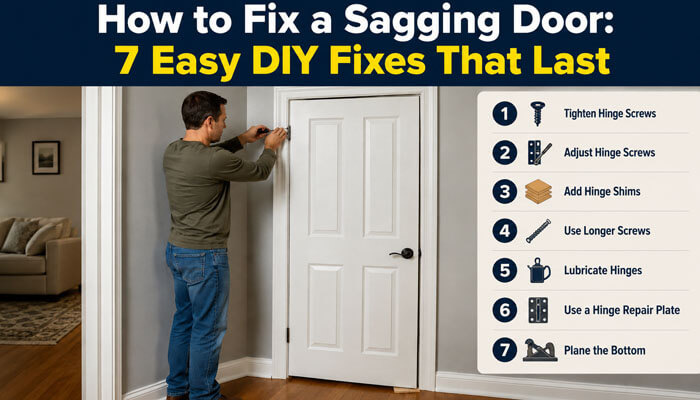

A sagging door can scrape the floor, rub against the frame, leave an uneven gap, or refuse to latch properly. Although these symptoms can make the entire door appear damaged, the cause is often relatively simple: loose hinge screws, stripped screw holes, worn hardware, an incorrectly seated hinge, or a door jamb that has shifted. For most interior doors, understanding how to fix a sagging door begins with finding which hinge, screw hole, or section of the frame is moving.
Many homeowners assume a rubbing or misaligned door needs to be sanded or replaced. In reality, most sagging doors can be repaired with simple adjustments once the underlying cause is identified. Understanding how the hinges, screws, and frame work together can save both time and money while preserving the original door.
Learning how to fix a sagging door can help you avoid replacing a door that still has years of useful life. Many common repairs require only a screwdriver, a wooden wedge, suitable screws, wood glue, and a few basic hand tools.
The most important rule is to diagnose the cause before sanding, trimming, or replacing the door. A reliable approach to how to fix a sagging door is to correct the hardware or frame before removing material. Sanding may stop the rubbing temporarily, but it will not repair loose hinges or a moving jamb. If the hinge problem is corrected later, the trimmed door may be left with an excessive gap.
This guide explains seven practical DIY fixes, beginning with the easiest adjustment and progressing to more permanent repairs. It also covers hollow-core doors, adjustable hinges, exterior doors, frame alignment, post-repair testing, and situations in which professional help is the safer choice.
Quick Answer: How to Fix a Sagging Door
To fix a sagging door, place a wooden wedge under the outer bottom corner to support its weight. Tighten every hinge screw, beginning with the upper hinge.
If a screw spins without tightening, rebuild the stripped hole with glued wooden slivers or a hardwood dowel. If the upper hinge is secure but poorly anchored, replace one short jamb-side screw with a properly sized 2½- to 3-inch wood or structural screw that reaches the wall framing.
Tighten the longer screw gradually while checking the gap around the door. If the problem remains, inspect the hinge mortises, adjust the hinges with an appropriate shim, replace worn hardware, or secure a loose door jamb. This repair order is the safest general answer to how to fix a sagging door without making unnecessary cuts.
Key Takeaways
- Begin by inspecting the gaps around the closed door.
- A loose upper hinge is one of the most common causes of door sag.
- Tighten existing screws before attempting more invasive repairs.
- Repair stripped screw holes before reinstalling the fasteners.
- One longer jamb-side upper-hinge screw may anchor the hinge to framing.
- Tighten long screws gradually to avoid bowing the jamb.
- Bent, worn, painted-over, or poorly seated hinges may need correction.
- Diagnose the entire gap pattern before adding hinge shims.
- Do not trim the door until hinge and frame problems have been ruled out.
- Multiple sticking doors, wall cracks, or sloping floors may indicate broader movement.
- The best method for how to fix a sagging door depends on the complete gap pattern, not only the point where it rubs.
Sagging Door Repair at a Glance
If you want the quickest solution, start with this simple repair sequence.
| Problem | First Thing to Do |
|---|---|
| Door rubs at the top latch corner | Tighten the upper hinge screws. |
| Screw keeps spinning | Repair the stripped screw hole before reinstalling the screw. |
| Door still sags | Install one properly sized long screw through the upper hinge into the wall framing. |
| Hinge is bent or worn | Replace the damaged hinge with a matching one. |
| Jamb moves when the door is lifted | Secure or re-shim the jamb before trimming the door. |
Working through these steps in order solves many sagging door problems without removing material from the door itself.
How This Guide Was Prepared
This guide is organized around a least-invasive-first repair process. It explains how to fix a sagging door by beginning with inspection and basic hardware tightening before progressing to screw-hole repair, hinge adjustment, hardware replacement, and jamb correction.
Door designs vary, particularly among exterior, patio, commercial, metal, security, and fire-rated assemblies. When a door uses adjustable or proprietary hardware, follow the door or hinge manufacturer’s instructions before modifying the frame, mortise, or fasteners.
Does This Guide Apply to Every Door?
This guide explains how to fix a sagging door that uses traditional side-mounted hinges, including most:
- Wooden interior doors
- Hollow-core bedroom doors
- Solid-core doors
- Bathroom and utility-room doors
- Standard exterior entry doors
- Closet doors with conventional butt hinges
The same repair methods may not apply directly to:
- Sliding patio doors
- Pocket doors
- Bifold doors
- Barn doors
- Garage doors
- Cabinet doors with concealed hinges
- Commercial hollow-metal doors
- Automatic doors
- Doors with proprietary adjustable hinges
These systems may rely on tracks, rollers, pivot brackets, adjustment screws, mounting plates, or specialized hardware instead of standard butt hinges.
Before adding shims or replacing screws, identify the door and hinge type. Some modern patio and exterior doors have built-in horizontal, vertical, or compression adjustments.
Sagging Door Diagnosis at a Glance
Use the location of the rubbing, dragging, or uneven gap to identify the most likely cause. Before choosing how to fix a sagging door, compare the symptom with the likely source in the table below.
| Door symptom | Likely cause | Best first repair |
| Top latch-side corner rubs | Loose or poorly anchored upper hinge | Tighten and re-anchor the upper hinge |
| Bottom latch-side corner drags | The latch side has dropped | Repair the upper hinge connection |
| Latch sits below the strike plate | The door has moved downward | Correct hinge alignment first |
| Screw turns without tightening | Stripped screw hole | Rebuild the hole with glued wood |
| Wide gap near the upper hinge | Hinge is pulling from the jamb | Tighten or re-anchor the hinge |
| The hinge leaf sits above the wood | Paint, debris, or a shallow mortise | Clean and reset the hinge |
| The door remains crooked with tight screws | Bent hinge or shifted jamb | Replace the hinge or secure the jamb |
| The entire edge rubs during humid weather | Moisture-related swelling | Control moisture before trimming |
| The door swings open or closed by itself | The frame may be out of plumb | Check the jamb alignment |
| Several doors suddenly begin sticking | Frame or structural movement | Arrange a broader inspection |
What Is a Sagging Door?
A sagging door has rotated slightly downward on the latch side instead of remaining square within its frame. The hinge side may stay close to its original position while the opposite side drops. Recognizing this rotation is essential when deciding how to fix a sagging door rather than treating ordinary moisture swelling or floor interference.
Even a small amount of movement can create noticeable problems because the clearance between the door and frame is narrow. When the upper hinge loosens, the door’s weight pulls the top of the door away from the jamb. This lowers the latch-side edge and changes the gaps around the door slab.
Common signs include:
- Rubbing near the upper latch-side corner
- Dragging across carpet, tile, or wood flooring
- A triangular or uneven gap above the door
- A latch that sits below the strike plate
- A door that must be lifted to close
- Scraped paint along the frame
- Light, noise, or drafts passing through uneven gaps
- A hinge leaf moving away from the jamb
- A door that swings open or closed by itself
Sagging is especially common with solid-core doors, wide doors, exterior doors, and doors carrying heavy organizers, mirrors, hooks, or decorative hardware.
Why Do Doors Sag?
Before deciding how to fix a sagging door, identify why the door moved.
Loose hinge screws
Every time a door opens, its weight pulls against the hinge fasteners. Short screws can gradually loosen, particularly in soft wood, damaged jambs, or doors that are frequently slammed.
The upper hinge usually experiences the greatest pulling force.
Stripped screw holes
A screw cannot secure the hinge when the surrounding wood has been crushed or stripped. It may continue turning without tightening or loosening again shortly after being reinstalled.
Screws that are too short
Many doors are installed with short screws that attach the hinge only to the finished jamb. These screws may not extend into the structural framing behind it.
A correctly positioned longer screw can strengthen the connection between the upper hinge, jamb, and wall framing.
Worn or bent hinges
Hinge pins, leaves, and knuckles can wear or bend. A damaged hinge may allow the door to drop even when every screw feels tight.
Incorrect hinge mortises
A hinge mortise is the shallow recess cut into the door and jamb. A mortise that is too deep, too shallow, uneven, or filled with paint prevents the hinge from sitting correctly.
A loose or distorted jamb
The jamb can pull away from the framing, bow inward, or shift out of square. Tightening the hinge alone will not permanently correct a jamb that moves when the door is lifted.
Moisture and seasonal swelling
Wood absorbs moisture and can expand during humid conditions. A swollen door may resemble a sagging door because it rubs along the frame or becomes difficult to close.
Excessive weight
Heavy storage organizers, mirrors, bags, towels, and exercise equipment increase the load placed on the hinges and screws.
Repeated door slamming
Slamming shocks the hinges, jamb, latch, and fasteners. Over time, this can loosen hardware or enlarge screw holes.
Structural movement
Settlement, framing movement, or an uneven floor can distort the opening. One misaligned door is usually a local hardware issue. Several doors changing at the same time may indicate a broader problem.
Tools and Materials You May Need
You will not need every item for every repair. Start with the simplest tools and obtain additional materials only after identifying the cause. The tools required for how to fix a sagging door depend on whether the problem involves loose screws, damaged wood, worn hardware, or a shifted jamb.
| Tool or material | Purpose |
| Hand screwdriver | Tightening hinge screws with control |
| Drill/driver | Drilling pilot holes and installing fasteners |
| Correct driver bit | Preventing damage to screw heads |
| Wooden wedge or door shims | Supporting the door |
| 2½- to 3-inch wood or structural screw | Anchoring a jamb-side hinge to framing |
| Wood glue | Repairing stripped holes |
| Hardwood dowel or wooden slivers | Rebuilding damaged screw holes |
| Utility knife or flush-cut saw | Trimming dowels and scoring paint |
| Drill bits | Creating pilot holes |
| Purpose-made hinge shims | Correcting minor alignment |
| Replacement hinges | Replacing worn or bent hardware |
| Sharp chisel | Correcting a hinge mortise |
| Straightedge or long level | Checking the jamb |
| Tape measure | Comparing frame dimensions |
| Pencil, chalk, or painter’s tape | Marking contact points |
| Safety glasses | Protecting your eyes |
Sagging Door Repair Time and Difficulty
| Repair method | Typical DIY time | Difficulty | Material level |
| Tighten hinge screws | 5–10 minutes | Easy | Very low |
| Install one longer upper-hinge screw | 10–20 minutes | Easy | Very low |
| Repair a minor stripped hole | 30–60 minutes plus curing | Easy | Low |
| Repair holes with hardwood dowels | 1–2 hours plus curing | Moderate | Low |
| Clean or correct a hinge mortise | 30–60 minutes | Moderate | Low |
| Install a hinge shim | 15–30 minutes | Moderate | Low |
| Replace standard hinges | 30–90 minutes | Moderate | Moderate |
| Re-secure or re-shim the jamb | 1–3 hours | Advanced | Moderate |
These are approximate DIY times. Door weight, wood damage, paint buildup, hinge design, and access to the frame can increase the work required. A homeowner learning how to fix a sagging door repair should allow extra time for the glue to cure and for repeated alignment checks.
Before You Begin: Confirm That the Door Is Sagging
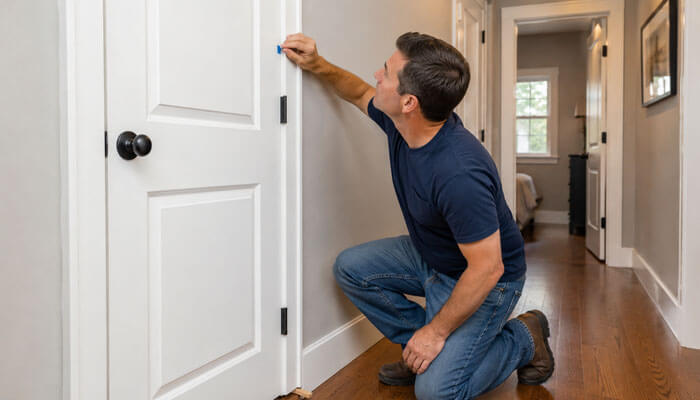
Not every sticking door is sagging. Before deciding how to fix a sagging door, complete the following checks to confirm that hinge or frame movement is actually causing the problem.
1. Examine the door reveal
The reveal is the visible gap between the closed door and its frame.
Close the door slowly and compare the gap:
- Across the top
- Along the hinge side
- Along the latch side
- Between the bottom edge and the floor or threshold
A sagging door commonly has a narrowing gap near the upper latch-side corner and an uneven gap elsewhere. This reveal pattern provides one of the clearest clues for how to fix a sagging door correctly.
2. Watch the upper hinge
Open the door halfway and inspect the upper hinge while gently lifting the handle.
Look for:
- Movement between the hinge leaf and jamb
- Screws lifting from their holes
- A hinge separating from the wood
- Cracks around the screw holes
- Movement in the jamb itself
Visible movement usually confirms a loose fastener, stripped hole, worn hinge, or unstable jamb.
3. Mark the rubbing point
Apply chalk, a soft pencil, or painter’s tape to the suspected contact area. Close and reopen the door carefully.
The transferred mark will reveal where the door is touching.
4. Check for moisture-related swelling
Look for:
- Rubbing that appears only during humid or rainy weather
- Peeling paint near the contact area
- Unsealed wood on the top or bottom edge
- Moisture damage near an exterior opening
- A door that fits normally during dry periods
A swollen door requires moisture control as well as clearance correction.
5. Inspect the jamb
Place a level or straightedge against both jamb legs. Look for bowing, twisting, or movement when the door is lifted. A flexible jamb may need to be secured to the wall framing.
6. Check whether the frame is square
A door can appear to sag even when its hinges are secure. If the frame is twisted or out of square, repeated hinge adjustments may not provide a lasting repair.
To check the opening:
- Place a long level against the hinge-side jamb.
- Check the latch-side jamb.
- Check the head jamb and threshold.
- Measure from the upper-left inside corner to the lower-right corner.
- Measure the opposite diagonal.
- Compare the two measurements.
- Measure the opening width at the top, middle, and bottom.
Similar diagonal measurements generally indicate a square opening. A noticeable difference suggests that the frame may be racked.
Also look for:
- A jamb that bows inward
- A sloping head jamb
- A threshold that is not level
- Gaps between the casing and the wall
- Loose or missing shims
- Cracks above the opening
- Several doors are becoming misaligned
Do not attempt to pull a severely distorted frame square with a single hinge screw. Major correction may require casing removal, new shims, and frame refastening.
Safety Precautions
A lightweight hollow-core door may be manageable for one person, but solid wood, exterior, metal, glass-panel, and fire-rated doors can be extremely heavy. Safety must remain part of every plan for how to fix a sagging door, especially when hinges will be loosened or replaced.
Before starting:
- Support the door before loosening screws.
- Keep fingers away from the hinge side.
- Wear eye protection while drilling or chiseling.
- Ask another person to support a heavy door.
- Use fasteners that fit the hinge’s countersunk holes.
- Do not remove every hinge at once unless you can safely lift the door.
- Check manufacturer instructions before modifying specialized doors.
- Do not drill blindly into an area that may conceal wiring, plumbing, or unusual framing.
How to Fix a Sagging Door: 7 Easy DIY Methods
Work through these methods in order. Test the door after each repair and stop when the reveal is even, and the door operates correctly.
Fix 1: Tighten Every Hinge Screw
The first step in how to fix a sagging door is usually tightening the existing hinge screws. Begin with the upper hinge, but inspect every hinge on both the door and jamb sides.
Steps
- Open the door far enough to access the screws.
- Place a wooden wedge under the outer bottom corner.
- Raise the wedge only enough to support the door.
- Tighten the upper hinge screws with a hand screwdriver.
- Tighten the middle and lower hinge screws.
- Remove the wedge.
- Close the door and inspect the gaps.
Why use a hand screwdriver?
A power drill can strip the hole or damage the screw head before you feel the resistance. A hand screwdriver provides greater control.
A drill may be used at low speed, but complete the final tightening by hand.
Do not overtighten
Stop when the screw head is flush with the hinge leaf, and the hinge is secure.
Overtightening can:
- Strip the wood
- Crack the jamb
- Distort the hinge
- Pull the hinge too deeply into its mortise
- Bow the door frame
If a screw continues turning without becoming tight, the hole is stripped. Move to Fix 3.
Fix 2: Install a Longer Screw in the Upper Hinge
When basic tightening does not work, the next step in how to fix a sagging door is checking whether the upper hinge is securely anchored to the framing behind the jamb.
Replacing one short jamb-side screw with a longer fastener may create a stronger connection.
Choose the correct screw
Use a screw that:
- It is approximately 2½ to 3 inches long
- Is designed for wood or structural fastening
- Has a flat head that fits the hinge
- Is not so wide that it damages the hinge leaf
- Is appropriate for the door’s weight
Avoid using ordinary drywall screws as structural hinge fasteners. They are not designed for the repeated leverage placed on a heavy door.
Installation steps
- Support the open door with a wedge.
- Select one screw in the jamb-side leaf of the upper hinge.
- Remove it.
- Drill a pilot hole if the wood is hard or likely to split.
- Insert the longer screw through the hinge and jamb.
- Drive it slowly toward the framing.
- Stop regularly and test the door.
- Finish tightening by hand.
Watch the reveal
The longer screw may pull the upper jamb inward. Tightening it too far can narrow the hinge-side gap or bow the frame. Make small adjustments and close the door after each one.
Install the long screw on the correct side
The longer fastener normally belongs in the jamb-side hinge leaf because it can reach the wall framing. Do not assume an extra-long screw will strengthen the door-side leaf of a hollow-core door. It may pass beyond the internal edge support and enter the hollow cavity.
Fix 3: Repair Stripped Hinge Screw Holes
Repairing stripped holes is an important part of how to fix a sagging door because a screw that spins without tightening cannot hold the hinge securely.
Using a wider screw may provide a temporary improvement, but rebuilding the hole generally produces a cleaner and more dependable repair.
Method A: Wooden slivers and glue
This method is suitable for minor damage in a lightweight interior door.
- Remove the loose screw.
- Coat narrow wooden slivers or toothpicks with wood glue.
- Press them firmly into the stripped hole.
- Trim the excess flush.
- Allow the glue to cure.
- Drill a centered pilot hole.
- Reinstall the hinge screw.
Do not reinstall the screw immediately and expect wet glue to provide full strength.
Method B: Hardwood dowel repair
Use a glued hardwood dowel when the hole is badly damaged or the door is heavy.
- Remove or move the hinge leaf aside.
- Drill the damaged hole to a clean, consistent diameter.
- Apply wood glue to the hole and dowel.
- Tap the dowel into place.
- Allow the glue to cure fully.
- Cut the dowel flush.
- Mark the original screw position.
- Drill a suitable pilot hole.
- Reinstall the hinge.
Repair every failed hole
One secure screw may not compensate for several stripped holes. Test every fastener and rebuild each hole that cannot hold a screw.
Check for cracked wood
A dowel repair may not be enough when the jamb is split along the grain.
A cracked jamb may require:
- Gluing and clamping
- Reinforcement
- A longer fastener for framing
- Partial jamb replacement
- Professional repair
How to repair a hollow-core door
A hollow-core door is not solid throughout. Its hinge edge normally contains a limited strip of solid or engineered material that holds the screws.
For minor damage:
- Support the door.
- Remove the hinge from the damaged area.
- Clear loose fibers from the hole.
- Drill the hole to a clean diameter.
- Cut a hardwood dowel that will not fall into the cavity.
- Coat it with wood glue.
- Insert it flush with the hinge mortise.
- Allow the glue to cure.
- Drill a centered pilot hole.
- Reinstall the correct screw.
Do not depend on soft filler alone to support a loaded hinge fastener.
Replacing the door may be more practical when:
- The hinge-side edge has split open
- The door skin has separated
- A large part of the internal style is broken
- Several previous repairs have failed
- The hinge no longer has a flat mounting surface
Fix 4: Clean and Reset a Poorly Seated Hinge
Another part of how to fix a sagging door is making sure each hinge sits flat and flush inside its mortise. Paint, filler, chips, or an uneven recess can tilt the hinge and alter the alignment.
Signs of a seating problem
- The hinge leaf sits above the wood surface
- Thick paint surrounds the hinge
- The hinge rocks after the screws are removed
- The mortise appears uneven
- A replacement hinge is thicker than the original
- The door began rubbing after painting or hardware replacement
How to reset the hinge
- Support the door.
- Remove the screws from one hinge only.
- Move the hinge leaf aside.
- Score painted edges with a utility knife.
- Remove paint ridges, filler, fibers, and debris.
- Place the hinge back in the recess.
- Check whether it sits flush.
- Carefully deepen only the high areas if necessary.
- Reattach the hinge.
- Test the door before adjusting another hinge.
Avoid removing too much wood
Cutting the mortise too deeply can move the hinge too far into the frame and create a new alignment problem.
Make shallow adjustments. If the mortise is already too deep, use a purpose-made full-size hinge shim.
Fix 5: Shim the Hinges Carefully
Careful shimming can be useful when determining how to fix a sagging door after the screws are secure and the hinge is undamaged. A hinge shim creates a small, controlled change in hinge position.
Use plastic or purpose-made hinge shims where possible. They resist compression better than paper or soft cardboard.
Diagnose the gap before shimming
Do not assume that the same hinge should be shimmed for every sagging door. Shim placement can move the slab in different directions depending on:
- Which hinge is adjusted
- Whether the shim is placed behind the door-side or jamb-side leaf
- Whether a full or partial shim is used
- The direction in which the door must move
Use the complete gap pattern to determine which hinge requires correction. Add one thin shim at a time, test the full door swing, and consult a manufacturer or hinge-shimming diagram when the required movement is unclear.
How to install a full-size hinge shim
- Support the door.
- Trace the hinge leaf onto the shim.
- Cut the shim to fit inside the mortise.
- Loosen or remove one hinge leaf.
- Position the shim behind the leaf.
- Reinstall and tighten the screws.
- Remove the support.
- Close the door and inspect every gap.
- Remove, reposition, or reduce the shim if necessary.
A partial shim can intentionally change the hinge angle, but it requires a better understanding of hinge geometry. A thin full-size shim is generally easier for a basic DIY adjustment.
Fix 6: Replace Bent or Worn Hinges
If the screws and jamb are secure but the door still drops, how to fix a sagging door may involve replacing a hinge that is worn, bent, or undersized.
Hinges can fail because of:
- Bent leaves
- Loose or worn pins
- Enlarged knuckles
- Rust or corrosion
- Cracks around screw holes
- Repeated slamming
- Excessive door weight
- Undersized or inadequate hardware
Test the hinge
Open the door and gently lift the handle. Watch the hinge knuckles.
Movement between the pin and knuckles may indicate wear. Compare all hinges because the upper hinge often carries the greatest stress.
Match the replacement hardware
Choose hinges that match the existing:
- Height and width
- Corner shape
- Leaf thickness
- Screw-hole pattern
- Pin design
- Material
- Load rating
A thicker hinge can push the door outward. A thinner hinge may sit too deeply in the original mortise.
Replacement steps
- Support the door with wedges.
- Replace one hinge at a time.
- Remove the old hinge.
- Inspect and repair the screw holes.
- Test-fit the replacement.
- Correct the mortise only if necessary.
- Install the new hinge.
- Repeat for other damaged hinges.
- Test the door.
Heavy doors may need upgraded hinges
A heavy exterior, glass-panel, solid-core, or extra-wide door may require:
- Heavier-gauge hinges
- Ball-bearing hinges
- An additional hinge
- A continuous hinge
- Longer framing fasteners
- Professional rehanging
Installing an additional hinge requires accurate positioning and mortising, making it more advanced than replacing an existing hinge.
Fix 7: Secure a Loose or Shifted Door Jamb
If the hinge is tight but the jamb moves, the final answer to how to fix a sagging door may be securing the connection between the finished frame and structural framing.
Test the jamb
- Open the door halfway.
- Hold the latch-side edge.
- Lift gently.
- Watch the hinge-side jamb.
- Look for movement between the jamb, trim, and wall.
You can also place a straightedge along the jamb to identify bowing.
Correct minor movement
Minor jamb movement may be corrected by installing an appropriate long screw through the jamb and into framing.
The fastener may be concealed:
- Through an upper hinge hole
- Behind removable weatherstripping
- Beneath door-stop molding
- In another manufacturer-approved position
Tighten carefully
A long screw can pull the jamb out of shape.
Tighten gradually while checking:
- The reveal
- Whether the door remains plumb
- Whether the jamb bows
- Latch alignment
- Weatherstripping contact
If the opening requires casing removal, new shims, significant straightening, or waterproofing work, professional repair may be more appropriate.
How to Fix a Sagging Door With Adjustable Hinges
Some exterior, patio, and premium entry doors use adjustable hinges rather than standard fixed hinges.
Look for:
- Plastic hinge covers
- Hexagonal adjustment sockets
- Screws at the top or bottom of the hinge barrel
- Separate the guide and set the hinges
- Manufacturer labels
- Fixed hinge pins that cannot be removed normally
Do not add conventional shims or long screws until you identify the hinge system.
General adjustment process
- Identify the manufacturer and hinge model.
- Find the correct adjustment instructions.
- Support the door if required.
- Remove only the specified covers.
- Mark the original adjustment position.
- Make a small vertical or horizontal adjustment.
- Adjust related hinges in the required sequence.
- Close the door and inspect the reveal.
- Test the latch, deadbolt, and weatherstripping.
- Replace the covers.
Some systems use one hinge for vertical movement and others for horizontal adjustment. Turning every adjustment screw without following the correct sequence may twist the door.
Never force a seized adjustment screw or one that has reached the end of its range.
What If the Door Still Rubs After the Hinges Are Fixed?
Once the hinges, screws, and jamb are secure, reassess the contact area. At this stage, how to fix a sagging door may depend on distinguishing remaining sag from swelling, paint buildup, or an oversized slab.
The door may still rub because of:
- Seasonal swelling
- Excessive paint buildup
- A warped slab
- A raised threshold
- New carpet or flooring
- A misplaced door stop
- An out-of-square frame
- A door that was originally cut too large
Only after ruling out sag should you remove material.
Should You Sand or Plane the Door?
When researching how to fix a sagging door, treat sanding or planing as a last step because it removes material without correcting the underlying cause.
Consider trimming only when:
- Every hinge screw is secure
- Stripped holes have been repaired
- The hinges are in good condition
- The jam is stable
- The door is no longer rotating downward
- Swelling, paint, or an oversized slab is causing the rubbing
- The manufacturer permits trimming
How to remove a small amount of material
- Mark the contact point precisely.
- Remove the minimum material necessary.
- Preserve the existing bevel on the latch edge.
- Test the fit frequently.
- Smooth the repaired area.
- Seal or paint every exposed wood surface.
Unsealed wood can absorb moisture and cause the problem to return.
Do not trim fire-rated, fiberglass, composite, metal, or warranty-covered doors without checking the manufacturer’s requirements.
How to Fix a Sagging Door That Will Not Latch
A sagging door often positions the latch below the strike plate opening.
Do not move the strike plate first. Instead:
- Tighten the upper hinge.
- Repair stripped holes.
- Install a longer jamb-side screw where appropriate.
- Inspect the hinges for wear.
- Correct the reveal.
- Test the latch again.
Moving the strike plate before correcting the sag can hide the symptom while leaving the door crooked. It may also affect the deadbolt, weather seal, or security alignment.
Adjust the strike plate only when the door is square and the latch remains slightly misaligned.
How to Fix a Sagging Door That Drags on the Floor
Identify exactly where the bottom edge touches.
It drags near the latch side
This usually indicates that the latch-side corner has dropped. Inspect and repair the upper hinge first.
It rubs across most of the bottom
Possible causes include:
- New flooring
- Thick carpet or underlay
- A raised threshold
- General moisture swelling
- A frame installed too low
It touches only while partly open
The floor may be uneven, or the frame may be out of plumb. Check clearance throughout the entire swing.
Do not cut the bottom edge until you confirm whether the problem follows the door or a high point in the floor.
How to Fix a Sagging Exterior Door
Knowing how to fix a sagging door on an exterior opening requires additional care because the repair can affect security, weather resistance, and energy efficiency.
Inspect:
- Every hinge
- Jamb-side fasteners
- Weatherstripping compression
- Threshold height
- Latch and deadbolt alignment
- Water damage in the lower jamb
- Rot around the sill
- Loose glass panels
- Cracks in fiberglass or composite material
A longer upper-hinge screw may correct minor sag, but a heavy entry door may require upgraded hinges or complete rehanging.
Seek professional help when the frame is rotten, water is entering the opening, the deadbolt cannot align safely, or the door contains a large glass panel.
How to Fix a Sagging Metal Door
Understanding how to fix a sagging door made of metal starts with identifying the frame type. A metal door installed in a wooden frame may respond to similar jamb and screw repairs, while hollow-metal commercial doors and steel frames use different fastening systems.
Possible causes include:
- Loose machine screws
- Damaged hinge reinforcement plates
- Bent steel hinges
- A twisted metal frame
- Failed welded components
- Incorrect hinge shims
Do not install ordinary wood screws into a hollow-metal frame unless the system is specifically designed for them. Commercial, security, and fire-rated assemblies should be repaired using compatible hardware and approved procedures.
Common Mistakes When Learning How to Fix a Sagging Door
- Sanding before diagnosing the hardware
Removing material may hide the symptom without correcting the loose hinge, damaged screw hole, or moving jamb.
- Using a drill at full torque
Excess torque can strip the wood, damage the screw head, or distort the hinge.
- Overtightening a long screw
The fastener can bow the jamb and create a new sticking point.
- Using the wrong screw head
A raised or oversized head can prevent the hinge leaves from closing properly.
- Filling holes with soft material alone
Loose filler, paper, or unsupported putty may compress under the door’s weight.
- Shimming several hinges at once
Multiple changes make it difficult to identify which adjustment helped.
- Moving the strike plate too early
Latch misalignment is often a symptom of door sag rather than a separate problem.
- Ignoring water damage
Rotten or softened wood cannot hold hinge screws reliably.
- Forcing the door closed
Repeated force can damage the latch, strike plate, finish, and surrounding frame.
- Installing a long screw on the wrong side
A long fastener is generally most useful through the jamb-side hinge leaf, where it can reach structural framing.
How to Test the Door After Repair
After learning how to fix a sagging door, inspect the result before considering the work finished.
1. Check the reveal
Close the door and confirm that the gap around the top and sides appears reasonably even.
Exact clearances vary, particularly for exterior, commercial, and fire-rated doors.
2. Test the full swing
Open and close the door several times.
It should:
- Move without scraping
- Remain stable on its hinges
- Avoid rubbing the floor
- Close without being lifted
- Avoid swinging unexpectedly because of hinge movement
A door that swings by itself may indicate an out-of-plumb frame.
3. Test the latch and lock
Confirm that:
- The latch enters the strike smoothly
- The door does not need to be lifted
- The handle operates freely
- The deadbolt extends without force
- The strike plate remains secure
Test the latch and deadbolt with the door open first. This separates a lock problem from an alignment problem.
4. Inspect the hinge leaves
Every hinge leaf should sit flat against the door and jamb. Screw heads should be flush and should not interfere with hinge movement.
5. Check the exterior seal
For an exterior door, inspect the threshold and weatherstripping.
The door should seal evenly without:
- Crushing one section excessively
- Leaving visible gaps
- Allowing daylight through
- Requiring excessive force to latch
- Dragging across the threshold
6. Recheck repaired areas
Open and close the door repeatedly, then inspect repaired screw holes and long fasteners again. Stop using the door if a hinge begins separating from the wood.
Should You Repair or Replace the Door?
Most sagging doors can be repaired when the slab remains straight, and the hinge areas are structurally sound. Knowing how to fix a sagging door also includes recognizing when replacement is safer or more economical.
| Door condition | Repair or replace? | Recommended action |
| Loose upper-hinge screws | Repair | Tighten or re-anchor the hinge |
| One or two stripped holes | Repair | Install glued hardwood dowels |
| Worn standard hinges | Repair | Replace them with matching hardware |
| Slightly shifted jamb | Usually repair | Refasten or re-shim the jamb |
| Seasonal wood swelling | Usually repair | Control moisture and trim minimally |
| Split hollow-core hinge edge | Depends on damage | Reinforce or replace the slab |
| Rotten exterior jamb | Major repair | Replace damaged wood and stop water entry |
| Badly warped slab | Usually replace | Install a correctly sized door |
| Repeated repairs fail | Investigate further | Check the jamb movement and hinge capacity |
| Fire-rated assembly is affected | Professional assessment | Use approved parts and procedures |
Do not replace the slab until you confirm that the frame is square. A new door will not solve a distorted opening.
When to Call a Professional
DIY instructions for how to fix a sagging door have practical limits. Professional help is appropriate when:
- The door is too heavy to support safely.
- The frame is visibly twisted.
- Wood around the hinges is rotten or badly split.
- The door contains a large glass panel.
- The assembly is fire-rated.
- A metal hinge reinforcement plate has failed.
- The exterior door no longer locks securely.
- Water enters around the frame.
- Several doors become misaligned at the same time.
- Cracks are developing above doorways.
- Floors appear uneven or sloped.
- The door repeatedly sags after correct repairs.
- The jam requires removal and complete re-shimming.
- Adjustable hardware is seized or damaged.
These signs may indicate a frame, moisture, installation, or structural problem rather than a simple loose hinge.
How to Fix a Sagging Door and Prevent It From Returning
- Tighten hardware early
Check the hinges as soon as you notice scraping, movement, or latch misalignment. A slightly loose screw is easier to repair than a completely stripped hole.
- Avoid hanging heavy items on the door
Organizers, mirrors, bags, towels, and exercise equipment increase hinge stress.
- Use properly rated hinges
Heavy and wide doors require hinges designed for their size and weight.
- Prevent slamming
Repeated slamming shocks the hinges, fasteners, jamb, and latch.
- Control humidity
Ventilate kitchens and bathrooms, repair leaks, and maintain reasonable indoor humidity.
- Seal exposed wood
Finish all exposed edges of wooden exterior doors according to the manufacturer’s instructions.
- Repair water damage promptly
Soft or decayed jamb material cannot hold screws securely.
- Inspect exterior doors seasonally
Changes in weather, temperature, and moisture can affect the frame, threshold, and seals.
How to Fix a Sagging Door: Decision Table
| What you find | Recommended action |
| Screws are loose but still grip | Tighten them by hand |
| Upper hinge pulls away from the jamb | Support and re-anchor the hinge |
| A short jamb screw provides weak support | Install one suitable longer screw |
| Screw spins freely | Repair the hole with glued wood |
| Hinge sits above the mortise | Clean and reset the hinge |
| The mortise is too deep | Install a thin full-size shim |
| The hinge pin moves excessively | Replace the hinge |
| Jamb shifts when the door is lifted | Secure or re-shim the jamb |
| Hinge has built-in adjustment screws | Follow the manufacturer’s instructions |
| The door swells only in humid weather | Control moisture before trimming |
| Several openings are distorted | Arrange a structural inspection |
Quick Maintenance Checklist
To help prevent future door sagging:
- Check hinge screws every few months.
- Tighten loose hardware before it damages the screw holes.
- Avoid hanging heavy items from the door.
- Keep wooden doors properly sealed against moisture.
- Lubricate hinge pins if they begin to squeak or bind.
- Address water leaks around exterior doors promptly.
A few minutes of routine maintenance can often prevent much larger repairs later.
Final Thoughts
Learning how to fix a sagging door begins with finding the point of movement rather than immediately removing wood from the area that rubs. Start with the upper hinge, tighten the existing fasteners, and look for spinning screws, worn hardware, or movement in the jamb. A properly installed longer jamb-side screw or a correctly rebuilt screw hole often provides a durable repair without requiring the door to be removed.
If the basic fixes do not solve the problem, inspect the hinge mortises, hinge condition, shims, adjustable hardware, and frame alignment. Remove material only after confirming that the hardware and jamb are stable. Following this least-invasive-first approach protects the door, prevents unnecessary damage, and gives the repair the best chance of lasting.
How to Fix a Sagging Door FAQs
1. What is the easiest way to fix a sagging door?
The easiest way to fix a sagging door is to support its outer bottom corner with a wooden wedge and tighten every hinge screw, starting with the upper hinge. If a screw spins without tightening, repair the stripped hole with glued wooden slivers or a hardwood dowel before reinstalling it.
2. How to fix a sagging door without removing it?
To learn how to fix a sagging door without removing it, begin by tightening the hinge screws while the door remains supported. You can also install one longer jamb-side screw, repair individual stripped holes, or make a small hinge adjustment without taking the entire door off its frame.
3. Will a 3-inch screw fix a sagging door?
A 3-inch wood or structural screw may fix a sagging door when it passes through the jamb-side leaf of the upper hinge and reaches solid framing. Drive the screw gradually and check the door alignment frequently, as overtightening can bow the jamb or create a new sticking point.
4. How to fix a sagging door that will not latch?
To understand how to fix a sagging door that will not latch, correct the hinge alignment before moving the strike plate. Tighten the upper hinge, repair stripped screw holes, and secure the hinge to the framing when necessary. Adjust the strike plate only if the door is square, but the latch remains slightly misaligned.
5. When should I call a professional to fix a sagging door?
Call a professional to fix a sagging door when the door is extremely heavy, the jamb is rotten or badly twisted, the opening is fire-rated, or the door contains a large glass panel. You should also seek expert help if several doors become misaligned or if wall cracks and sloping floors suggest structural movement.
