


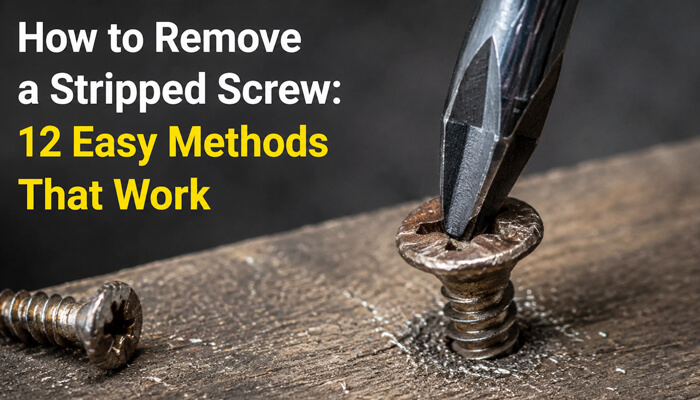

Learning how to remove a stripped screw can prevent a minor repair problem from turning into a scratched surface, broken tool, damaged component, or costly replacement. A screw head becomes stripped when its drive recess—the cross, slot, hex socket, square, or star-shaped opening—wears down until the screwdriver can no longer grip it securely.
The best approach to how to remove a stripped screw depends on the fastener’s condition. A slightly worn head may come out with the correct manual screwdriver and extra friction. A raised screw can often be turned with locking pliers. A flush, rusted, or completely rounded screw may require a left-hand drill bit, screw extractor, or carefully cut slot.
The safest way to learn how to remove a stripped screw is to begin with the least destructive method and increase force only when necessary. This guide explains 12 practical techniques for wood, metal, plastic, furniture, appliances, electronics, and other common surfaces.
Disconnect electrical power before working on appliances or electronics. Wear eye protection when drilling, striking, or cutting metal. Never drill or grind near batteries, fuel, hidden wiring, pressurized components, or flammable vapors.
Quick Answer: What Is the Easiest Way to Remove a Stripped Screw?
The easiest answer to how to remove a stripped screw is to start with a fresh manual screwdriver in the exact drive type and size. Press it firmly into the recess and turn slowly counterclockwise.
If the screwdriver slips, place a wide rubber band over the screw head and press the driver through it. This simple approach to how to remove a stripped screw works because the rubber fills small gaps and adds friction.
When that does not work, follow this order:
- Clean the recess and identify the screw-drive type.
- Try a fresh screwdriver in the exact size.
- Test a slightly larger or compatible alternative bit.
- Use locking pliers when the head is exposed.
- Apply penetrating oil when corrosion is present.
- Try a left-hand drill bit or screw extractor.
- Cut a new slot or drill off the head only as a final option.
Stop as soon as the driver begins slipping. Repeatedly spinning the bit removes more metal and makes extraction harder.
At-a-Glance Stripped Screw Removal Guide
Use this table when you need to decide how to remove a stripped screw without testing every technique.
| Screw Condition | Best First Method |
| Recess is only slightly worn | Correct manual screwdriver |
| Driver slips, but some edges remain | Rubber band or alternative bit |
| Head rises above the surface | Locking pliers |
| Recess is blocked by paint or dirt | Clean the recess |
| Screw is rusty or seized | Penetrating oil |
| Screw is in durable metal hardware | Manual impact driver |
| Screw is flush or recessed | Left-hand drill bit |
| The head is severely rounded | Screw extractor |
| The original recess is unusable | Cut a new slot |
| The head cannot be gripped | Drill off the head |
| Screw turns but will not rise | Apply gentle upward pressure |
| Screw is in electronics | Precision driver and gentle traction |
Which Stripped Screw Removal Method Works Best?
There is no single best method for every situation.
In general:
- Correct screwdriver = best for mild damage
- Locking pliers = best for exposed heads
- Penetrating oil = best for rusted screws
- Left-hand drill bits = best for recessed screws
- Screw extractors = best for severely damaged screws
- Head drilling = best last-resort option
Starting with the least destructive method improves the chance of preserving both the screw and the surrounding material.
Signs a Screw Is Actually Stripped
Many people assume a screw is stripped when the problem is actually a seized thread, incorrect driver, paint-filled recess, or spinning anchor.
Common signs include:
- Driver slips repeatedly
- Recess appears rounded
- Driver cannot grip the head
- Metal shavings appear around the recess
- Screw rotates without backing out
- Correct-size bit no longer engages
Correct diagnosis is often the most important step.
What Is a Stripped Screw?
Before choosing how to remove a stripped screw, confirm that the drive recess is actually damaged. A stripped screw is a fastener whose recess is too worn for the intended screwdriver or bit to engage securely.
The term normally refers to the head, but several different fastener problems are often described as “stripped.”
| Problem | What You Will Notice | Likely Solution |
| Stripped screw head | The driver spins inside the recess | Add traction, change bits, or use an extractor |
| Stripped threads | Screw rotates without moving up or down | Pull upward while turning and repair the hole |
| Broken screw | The head or shank has snapped | Use pliers, a left-hand bit, or an extractor |
| Rusted screw | Screw will not turn despite an intact head | Apply penetrating oil |
| Cross-threaded screw | Screw is crooked or becomes tighter while loosening | Work slowly back and forth |
| Spinning wall anchor | Screw and anchor rotate together | Hold, remove, or replace the anchor |
| Spinning metal insert | Insert rotates inside plastic or composite material | Stabilize or access the insert from behind |
Correct diagnosis makes how to remove a stripped screw much easier because a damaged recess needs a different solution from stripped threads or a spinning anchor.
Why Do Screw Heads Become Stripped?
Understanding the cause helps you decide how to remove a stripped screw and prevents the replacement fastener from suffering the same damage.
Common causes include:
- Using a bit that is too small or too large
- Confusing Phillips and Pozidriv screws
- Mixing metric and imperial hex keys
- Holding the driver at an angle
- Applying too little downward pressure
- Running a drill too quickly
- Using maximum torque unnecessarily
- Overtightening the fastener
- Using a worn or rounded driver bit
- Driving into dense wood without a pilot hole
- Trying to force a rusted or bonded screw
- Reusing a damaged screw
- Continuing after the driver begins slipping
A properly fitted bit should reach deeply into the recess and show very little side-to-side movement.
Identify the Screw Drive Before Removing It
The first step in how to remove a stripped screw is making sure the screw is not merely being turned with the wrong tool.
| Screw Drive | Identifying Feature | Correct Driver |
| Phillips | Cross-shaped recess | Phillips bit marked PH |
| Pozidriv | Cross with smaller lines between the main slots | Pozidriv bit marked PZ |
| JIS-style cross point | Cross-point recess on some Japanese equipment | Compatible precision cross-point driver |
| Torx | Six-lobed star | Correct-size Torx bit |
| Security Torx | Six-lobed star with a center pin | Tamper-resistant Torx bit |
| Hex or Allen | Six-sided socket | Exact metric or imperial hex key |
| Robertson | Square recess | Square-drive bit |
| Tri-point | Three-winged recess | Matching tri-point driver |
| Pentalobe | Five rounded lobes | Matching pentalobe driver |
| Spanner | Two holes or notches | Two-pin spanner bit |
| One-way | Sloped slot that resists reverse turning | Specialized removal tool |
Clear paint, dirt, rust, and loose metal before testing a bit. The correct tool should reach full depth and remain stable without being forced.
Do not push a Phillips bit into a Pozidriv, Torx, security, or precision screw. The wrong driver can create the very problem you are trying to solve.
Tools and Materials You May Need
Preparing the right tools makes how to remove a stripped screw safer and more efficient. You will not need every item; select them according to the screw’s condition and location.
| Tool or Material | Main Use |
| Manual screwdriver set | Testing drive sizes and maintaining control |
| Precision driver set | Small screws and electronics |
| Wide rubber band | Increasing friction |
| Screw-grip compound or fine steel wool | Filling small gaps in the recess |
| Locking pliers | Gripping an exposed screw head |
| Screw-removal pliers | Gripping small raised screws |
| Penetrating oil | Releasing rusted threads |
| Hammer | Seating a driver or operating an impact tool |
| Manual impact driver | Loosening seized screws in durable assemblies |
| Left-hand drill bits | Drilling while encouraging the screw to back out |
| Screw extractor set | Removing severely damaged screws |
| Rotary tool and cutting disc | Cutting a new slot |
| Electric drill | Operating drill bits and extractors |
| Center punch | Keeping the drill bit centered |
| Cutting fluid | Reducing heat when drilling suitable metals |
| Utility knife or pick | Clearing paint and debris |
| Painter’s tape | Protecting finished surfaces |
| Clamp | Securing the workpiece |
| Safety glasses | Protecting against filings and fragments |
Before You Start
Safe preparation is an essential part of how to remove a stripped screw, especially when drills, impact tools, oils, or cutting discs may be used.
Disconnect Electrical Power
Unplug appliances, power tools, and electronic devices. Remove the battery when it is designed to be removed safely.
Do not drill, cut, or grind near a swollen, punctured, or damaged lithium-ion battery.
Protect the Surrounding Surface
Place painter’s tape around the screw when working on furniture, finished wood, plastic, or painted metal. A thin protective shield can also reduce scratches from pliers or cutting tools.
Secure the Workpiece
Clamp movable objects before drilling or cutting. A shifting workpiece can cause the drill bit to wander into the surrounding surface.
Confirm the Loosening Direction
Most household screws loosen counterclockwise when viewed directly from the head. Some specialized machinery uses left-hand threads, so check the manufacturer’s instructions when the fastener is unfamiliar.
Remove Flammable Residue
Penetrating oils may be flammable. Clean away residue and allow vapors to disperse before using a grinder, cutting disc, torch, or other spark-producing tool.
Check Whether the Screw Is Under Load
A screw may be difficult to turn because a door, shelf, panel, hinge, or bracket is pulling sideways against it.
Before applying more force:
- Lift a sagging door slightly before removing a hinge screw.
- Support a shelf or panel so its weight does not pull on the fastener.
- Press joined boards together if they are separating.
- Loosen neighboring screws gradually.
- Clamp moving parts so they remain stable.
Reducing side pressure can simplify how to remove a stripped screw without requiring an extractor or drill.
Do not release spring-loaded, suspended, pressurized, or structural components unless you understand how the assembly is secured.
How to Remove a Painted-Over Screw
When paint or filler blocks the recess, how to remove a stripped screw begins with exposing the original drive rather than adding more force.
- Score the paint around the screw head with a sharp utility knife.
- Clear the recess with a pick, awl, or narrow screwdriver.
- Work from the center toward the edges.
- Brush or vacuum away the debris.
- Seat the correct driver at full depth.
- Apply firm downward pressure.
- Turn slowly counterclockwise.
When removing a painted hinge or bracket, score around the edge of the hardware as well. This can prevent a large section of the finish from peeling away.
Avoid aggressive scraping on veneer, brittle plastic, and delicate coatings.
How to Remove a Stripped Screw: 12 Methods
The following guide to how to remove a stripped screw progresses from gentle household techniques to more destructive extraction procedures.
1. Use the Correct Manual Screwdriver
The simplest method for how to remove a stripped screw is to try a fresh manual screwdriver in the exact drive type and size.
A drill may rotate too quickly for you to notice that the bit is losing grip. A hand screwdriver gives better feedback and makes it easier to maintain pressure.
Steps
- Clean the recess thoroughly.
- Test several appropriate bit sizes without turning them.
- Choose the driver that reaches deepest and moves least.
- Hold it directly in line with the screw.
- Press firmly toward the head.
- Turn counterclockwise slowly.
Stop immediately if the tip begins rising out of the recess.
Best for: Mild damage, incorrect bit selection, and screws that are not completely rounded.
2. Try a Larger Bit or Different Driver Style
When considering how to remove a stripped screw with some intact edges remaining, a larger or differently shaped bit may create a tighter fit.
A wide flathead screwdriver may bridge two opposite sides of a worn Phillips recess. A tightly fitting Torx bit may grip a rounded hex socket.
Steps
- Select a bit that fits against the strongest remaining edges.
- Push it fully into the screw head.
- Keep the tool vertical.
- Turn slowly without jerking.
- Stop if the bit begins removing additional metal.
Use this method only when you intend to replace the screw. Forcing an alternative drive into the head may permanently deform it.
Best for: Screws with some intact edges remaining.
3. Use a Rubber Band
For light damage, one of the most familiar answers to how to remove a stripped screw is to add friction with a wide rubber band.
Steps
- Place a flat section of a rubber band over the screw head.
- Press the correct screwdriver through the rubber.
- Apply firm downward pressure.
- Turn slowly counterclockwise.
- Replace the rubber if it tears or slips.
A thick band usually works better than a thin office band. Use a hand screwdriver rather than a drill.
This technique is unlikely to overcome severe rust, strong threadlocker, or a completely rounded head.
Best for: Lightly stripped Phillips, Pozidriv, and slotted screws.
4. Add an Abrasive Grip Material
Abrasive grip material can help with how to remove a stripped screw when the recess is worn but still has recognizable edges.
Screw-grip compound, fine steel wool, or another suitable abrasive can improve contact between the driver and the screw.
Steps
- Apply a small amount of grip material over the recess.
- Push the screwdriver through it.
- Hold the driver straight.
- Turn slowly while pressing downward.
A purpose-made screw-grip compound is generally cleaner than loose steel wool.
Keep abrasive material away from bearings, lenses, optical parts, and finished surfaces. Do not use steel wool around live circuits or exposed electronics because fine metal fibers can conduct electricity.
Best for: Mild damage in furniture, fixtures, and general household hardware.
5. Tap a Flathead Screwdriver Into the Head
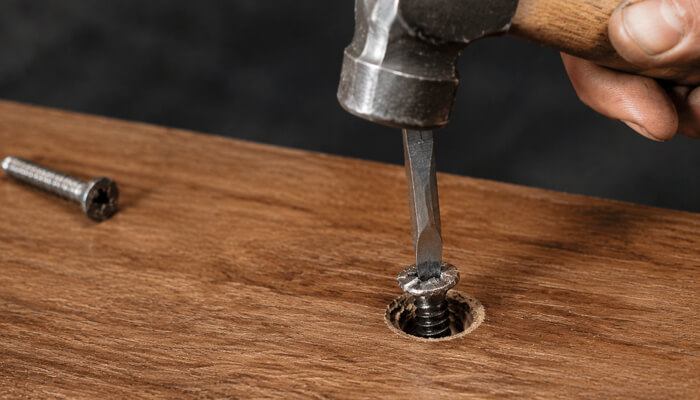
For a soft screw head, how to remove a stripped screw may involve creating a new gripping edge with a flathead screwdriver.
Steps
- Choose a flathead screwdriver that spans the strongest area.
- Position the blade across the damaged recess.
- Tap the handle lightly with a hammer.
- Stop when the blade is seated securely.
- Press down and turn counterclockwise.
Use controlled taps. Heavy impact can crack plastic, split wood, bend the fastener, or damage the material underneath.
Do not use this technique on glass, ceramic, electronics, or unsupported panels.
Best for: Soft screw heads in durable wood or metal assemblies.
6. Grip the Head With Locking Pliers
When the screw head is raised, the easiest approach to how to remove a stripped screw may be to ignore the damaged recess and grip the outside of the head.
Steps
- Position the jaws around the sides of the screw head.
- Adjust them until they clamp firmly.
- Grip the sides rather than the flat top.
- Rock the screw gently in both directions.
- Turn it counterclockwise.
- Reposition the pliers as the screw rises.
Needle-nose locking pliers and dedicated screw-removal pliers are useful in confined spaces.
Protect finished surfaces with tape or a thin shield, but keep enough direct contact between the jaws and the screw.
Best for: Raised screws, partially removed fasteners, and broken screws with exposed shanks.
7. Apply Penetrating Oil
When corrosion is the main obstacle, how to remove a stripped screw starts with reducing resistance in the threads.
Steps
- Remove loose rust and dirt.
- Apply a small amount of penetrating oil around the screw.
- Allow it to work for the time stated on the label.
- Tap the head lightly if the surrounding material can tolerate it.
- Insert the best-fitting driver.
- Try moving the screw slightly clockwise.
- Work it gradually back and forth.
- Remove it once it turns freely.
Test the product before applying it to porous stone, finished wood, or unknown plastic. Keep it away from electronics unless approved for that use.
Penetrating oil loosens the threads; it does not repair the damaged screw head.
Best for: Outdoor hardware, machinery, metal furniture, and corroded fasteners.
8. Use a Manual Impact Driver
On durable metal assemblies, how to remove a stripped screw may require controlled impact combined with downward pressure.
A manual impact driver converts a hammer strike into a small turning movement while helping the bit stay seated.
Steps
- Install the closest-fitting driver bit.
- Set the tool to loosen counterclockwise.
- Hold it squarely against the screw.
- Apply downward pressure.
- Strike the end with a controlled hammer blow.
- Check the screw before striking again.
Use a manual impact driver only on strong, well-supported assemblies.
Avoid it on plastic housings, electronics, thin sheet metal, brittle castings, and unsupported wood.
Best for: Seized screws in machinery, vehicles, and durable metal components.
9. Use a Left-Hand Drill Bit
For a flush or recessed fastener, how to remove a stripped screw may involve drilling counterclockwise with a left-hand bit.
The reverse cutting action can sometimes catch the screw and back it out before an extractor is required.
Steps
- Mark the center of the screw with a center punch.
- Install a small left-hand bit.
- Set the drill to reverse.
- Hold the drill directly in line with the fastener.
- Drill slowly into the center.
- Stop if the screw begins backing out.
- Increase the bit size only when necessary.
Use suitable cutting fluid when drilling compatible metals. Slow speed reduces heat and helps prevent the bit from wandering.
Confirm that the bit is designed for left-hand cutting. A standard right-hand drill bit used in forward rotation may tighten the screw.
Best for: Flush, recessed, and headless screws in wood or metal.
10. Use a Screw Extractor
A purpose-made extractor is a strong option for how to remove a stripped screw when the recess is severely rounded or the fastener is broken.
Extractor sets vary. Some use a double-ended bit, while others require a separate drill bit and extractor.
General Procedure
- Match the extractor size to the screw.
- Mark the exact center of the head.
- Drill or burnish the required pilot hole.
- Switch to the extraction end or separate extractor.
- Set the drill to reverse when required.
- Run the tool at low speed.
- Apply steady pressure until it bites.
- Continue slowly until the screw backs out.
Some spiral extractors are intended to be turned manually with a tap wrench. Follow the instructions supplied with the specific tool.
Why a Screw Extractor May Fail
| Problem | Likely Cause | Correction |
| Extractor spins freely | Pilot hole is too large or shallow | Recheck the specified hole size |
| Extractor will not enter | Pilot hole is too small | Use the recommended drill bit |
| Drill bit wanders | Screw was not center-punched | Create a centered starting point |
| Extractor leans | Pilot hole is off-center | Stop before damaging nearby material |
| Screw crumbles | Fastener is soft or heavily corroded | Reduce speed or drill off the head |
| Extractor starts twisting | Too much torque is being applied | Stop immediately |
| Screw becomes tighter | Rotation or thread direction is wrong | Confirm the loosening direction |
| Extractor bites but will not turn | Threads are rusted, bonded, or loaded | Address the underlying resistance |
Extractors are hard but can be brittle. A broken extractor lodged inside the screw may be more difficult to drill than the original fastener.
Best for: Severely damaged, recessed, or broken screws.
11. Cut a New Slot With a Rotary Tool
When the original recess is completely unusable, how to remove a stripped screw may require cutting a new straight slot.
Steps
- Protect the surrounding surface.
- Secure the workpiece.
- Install a thin metal-cutting disc.
- Wear eye protection.
- Cut one straight groove across the center of the head.
- Stop before cutting through the entire head.
- Insert a wide flathead screwdriver.
- Press down and turn counterclockwise.
Keep the groove centered and narrow. Cutting beyond the screw head can damage the surrounding material.
Rotary tools can produce sparks and flying debris. Do not use this method near batteries, fuel, flammable vapors, hidden wiring, or delicate plastic.
Best for: Exposed metal screw heads with completely destroyed recesses.
12. Drill Off the Screw Head
As a final option, how to remove a stripped screw can involve drilling off the head so the attached component can be lifted away.
The goal is to separate the head from the shank, not to drill away the entire fastener immediately.
Steps
- Mark the center with a punch.
- Choose a drill bit slightly wider than the shank but smaller than the outer head.
- Drill slowly into the center.
- Stop when the head separates.
- Lift away the bracket, hinge, or panel.
- Grip the remaining shank with locking pliers.
- Turn the shank counterclockwise.
- Repair the hole before installing a replacement.
If the remaining shank is below the surface, use a centered extractor or carefully drill out the fastener.
Best for: Screws that cannot be removed by a less destructive method.
Bonus Method: Grip the Screw With a Drill Chuck
Another option for how to remove a stripped screw is to clamp a raised head or exposed shank directly in a drill chuck.
- Open the chuck wide enough to fit around the screw.
- Lower it over the head or shank.
- Tighten the chuck firmly.
- Set the drill to reverse.
- Run it slowly while keeping it aligned.
Do not use this method when the chuck jaws could scratch the surface or cannot grip the screw securely.
Best Method by Surface
The surrounding material affects how to remove a stripped screw because a technique that is safe on steel may crack plastic, split wood, or damage electronics.
| Surface | Safest Starting Method | Avoid |
| Wood | Manual screwdriver, rubber band, or locking pliers | Oversized bits and wider screws near board edges |
| Metal | Correct driver, penetrating oil, or manual impact driver | High-speed drilling and uncontrolled heat |
| Plastic | Precision screwdriver and gentle traction | Hammering, impact tools, heat, and oversized screws |
| Electronics | Exact precision driver and removal pliers | Steel wool, loose filings, and drilling near batteries |
| Drywall | Gentle upward pressure and anchor control | Aggressive prying that tears the paper surface |
| Painted surfaces | Clean the recess and score the finish | Cutting before protecting the surrounding coating |
How to Remove a Stripped Screw From Wood
Wood can split or develop an enlarged hole if aggressive methods are used too early.
Begin with a clean recess and the correct manual screwdriver. Add a rubber band or test an alternative bit if the driver slips. Use locking pliers when the head is raised.
If two boards are separating, press them together while turning the screw. This can reduce tension on the threads.
Use a left-hand bit or extractor only when gentler methods fail. Drill off the head as a final option.
After removal, inspect the hole. A damaged wood hole may require a fitted hardwood dowel or wood plug bonded with suitable glue. Allow the repair to cure before drilling a new pilot hole.
Avoid installing a wider screw close to the edge of a board because the larger diameter can split the wood.
How to Remove a Stripped Screw From Metal
Metal fasteners may be held by corrosion, excessive tightening, damaged threads, or thread-locking compound.
Clean the recess and visible rust first. Support any bracket or panel placing side pressure on the fastener. Use the exact driver, then apply penetrating oil if corrosion is present.
A manual impact driver may help on a strong, well-supported assembly. Use a left-hand drill bit or extractor when the head is too damaged for a conventional driver.
Use a center punch before drilling so the bit does not wander into the surrounding metal.
Some high-strength threadlockers require a manufacturer-specified heating procedure. Do not improvise with heat near fuel, batteries, wiring, paint, seals, pressurized systems, or unknown materials.
How to Remove a Stripped Screw From Plastic
Plastic housings and screw bosses can crack under excessive force.
Avoid:
- Hammering
- High drill speeds
- Oversized extractors
- Strong solvents
- Excessive heat
- Aggressive prying
- Oversized replacement screws
Begin with a precision screwdriver or rubber band. Use small extraction pliers when the head is exposed.
If the screw turns but does not rise, the plastic threads or an embedded metal insert may be spinning. Apply gentle upward pressure while turning.
Stop if the insert rotates inside the housing. Continued turning may enlarge the cavity and make the repair more difficult.
How to Remove a Stripped Screw From Electronics
Small electronics often contain soft screws and fragile plastic housings.
Before beginning:
- Shut down the device.
- Disconnect the charger and external power.
- Remove the battery only when it is designed to be removed safely.
- Use a new precision driver in the correct size.
- Keep steel wool and metal filings away from the device.
- Work over a tray or parts mat.
- Do not drill near a lithium-ion battery.
A thin rubber layer may help when the damage is mild. Precision screw-removal pliers may grip a slightly raised head.
Professional repair is safer when the screw is directly above a battery, circuit board, display cable, or sealed component.
How to Remove a Stripped Screw From a Hex or Allen Socket
A hex socket often rounds because the wrong metric or imperial key was used.
Try this order:
- Clean the socket.
- Test the exact-size hex key.
- Use a fresh key with sharp corners.
- Add a rubber band.
- Try a tightly fitting Torx bit if the screw will be discarded.
- Grip the exterior with pliers when the head is raised.
- Use a left-hand bit or extractor when it is flush.
Do not hammer an oversized bit into cast aluminum, brittle plastic, or delicate equipment.
How to Remove a Stripped Screw From a Torx Recess
Start with a new Torx bit in the exact size. Clean the recess so the bit can reach the bottom.
When the recess is damaged, try:
- A thin rubber layer
- A slightly larger compatible bit
- Locking pliers on an exposed head
- A screw extractor
- A carefully cut straight slot
Security Torx screws contain a center pin and require a matching tamper-resistant driver.
How to Remove a Stripped Screw From Security Hardware
Security screws are designed to discourage removal and may not be stripped at all.
Common types include:
- Security Torx
- Pin hex
- Two-pin spanner
- Tri-wing
- Tri-point
- Pentalobe
- Clutch head
- One-way slotted screws
Identify the drive and obtain the matching bit before attempting extraction.
A true one-way screw may require:
- A dedicated one-way remover
- Locking pliers on an exposed head
- A newly cut slot
- A screw extractor
- Drilling off the head
Only remove security fasteners from equipment or property you are authorized to open or modify.
What to Do When the Screw Spins but Will Not Come Out
A separate challenge in how to remove a stripped screw occurs when the fastener rotates but does not rise. The threads may be damaged, or an anchor or insert may be spinning.
Apply gentle upward pressure while turning:
- Slide a thin flathead screwdriver beneath the head.
- Pull upward carefully with pliers.
- Lift the attached component slightly.
- Turn the screw slowly at the same time.
For a spinning drywall anchor, hold the anchor with pliers when accessible. Otherwise, remove it or push it into the cavity when appropriate, then repair the hole.
Do not pry forcefully against brittle plastic, veneer, or drywall paper.
Methods to Avoid
Some popular online tricks are unreliable or can make the damage worse.
Super Glue
Gluing a screwdriver into the recess is unpredictable. Adhesive can contaminate the surrounding surface, seal the recess, and make later extraction more difficult. It may also bond the driver permanently to the fastener without providing enough torque to loosen the threads.
Excessive Drill Speed
High speed removes more metal, generates heat, and makes it harder to keep the bit centered. Slow, controlled rotation gives the cutting edge time to work and lets you stop before the tool wanders.
Repeatedly Using the Same Slipping Bit
Once a bit slips more than once or twice, stop. Continuing with the same tool rounds the recess further and reduces the chance that a simple method will work.
Uncontrolled Heat
Do not apply a torch or heat gun simply because a fastener is tight. Heat can damage coatings, seals, plastic, wiring, batteries, adhesives, and nearby flammable materials. Where a manufacturer specifies heat for a particular threadlocker, follow the stated procedure and safety requirements.
Hammering Delicate Assemblies
Avoid hammering near glass, displays, circuit boards, thin plastic, brittle castings, and unsupported sheet metal. Even a light impact may damage components that are not visible from the outside.
Using an Oversized Extractor
A large extractor requires a large pilot hole and can weaken or split a small screw. Match the extractor and pilot bit to the manufacturer’s size chart.
When to Stop and Switch Methods
One of the biggest mistakes is continuing with a technique that is clearly failing.
Stop immediately if:
- The recess becomes more rounded.
- The bit slips repeatedly.
- Metal shavings increase.
- The screw head deforms.
- The surrounding material begins to crack.
- Excessive force is required.
Switching methods early often prevents permanent damage.
Inspect the Screw Before Replacing It
Examine:
- Thread damage
- Corrosion
- Bending
- Head deformation
- Material fatigue
Any significant damage usually justifies replacing the fastener rather than reinstalling it.
Repair the Hole After Removing the Screw
Removing the fastener is only part of the repair. Inspect the surrounding material, internal threads, anchor, and replacement hardware before reassembly.
Wood
For an enlarged wood hole:
- Remove loose fibers and debris.
- Fit a suitable hardwood dowel or repair plug.
- Bond it with appropriate wood glue.
- Allow the adhesive to cure fully.
- Mark the new screw position.
- Drill a correctly sized pilot hole.
Toothpicks may be adequate for minor decorative repairs, but a fitted dowel or plug is generally more suitable for hinges, furniture, and load-bearing hardware.
Avoid placing a new pilot hole too close to the edge of a board. The repair should have enough sound wood around it to resist splitting.
Metal
Depending on the damage, metal threads may require:
- Cleaning with the correct thread chaser
- Retapping the original thread
- Tapping for a larger fastener
- Installing a threaded insert
- Replacing a captive nut
- Replacing the damaged component
A thread chaser cleans or reforms existing threads, while a tap cuts threads. Choose the correct tool for the condition of the hole.
Do not install an oversized screw unless enough sound metal surrounds the opening and the change is suitable for the assembly.
Plastic
Use the original fastener specification whenever possible. A cracked or enlarged plastic boss may require:
- A manufacturer-approved insert
- Suitable plastic repair material
- Reinforcement from behind
- Replacement of the housing or component
Forcing a wider screw into damaged plastic can split the boss. Avoid solvents or adhesives unless they are compatible with the specific plastic.
Drywall
Replace any cracked, loose, or spinning anchor. Select the new anchor according to:
- Wall material
- Object weight
- Load direction
- Condition and size of the existing hole
- Manufacturer’s rated capacity
Do not reuse a damaged anchor for a heavy shelf, mirror, television mount, or other safety-critical load.
Choose the Correct Replacement Screw
Do not reinstall the stripped fastener. Match the replacement by:
- Diameter
- Length
- Thread type
- Head shape
- Drive type
- Material
- Corrosion resistance
- Strength or property class
Start the new screw by hand, keep it straight, and stop when the joint is secure. If a drill is used, begin with a low clutch setting.
Common Mistakes to Avoid
| Mistake | Why It Causes Problems | Better Approach |
| Using a worn bit | Rounded edges cannot grip securely | Use a new driver |
| Running a drill too quickly | Removes metal and creates heat | Use low speed |
| Holding the tool at an angle | Loads only one side of the recess | Keep it aligned |
| Applying torque without pressure | Allows the bit to climb out | Push down while turning |
| Repeating a failed method | Makes the head progressively worse | Move to the next method |
| Ignoring rust or threadlocker | Driver grip may not overcome resistance | Address the underlying cause |
| Starting with a large drill bit | Can damage the head and surface | Begin small and centered |
| Using excessive extractor torque | Can break the extractor | Stop if it begins twisting |
| Cutting after using flammable oil | Sparks may ignite residue | Clean and ventilate first |
| Using impact on plastic | May crack the housing | Use gentle manual methods |
| Failing to support a door or panel | Side pressure keeps the screw bound | Support the component |
| Reusing the stripped screw | It may strip or fail again | Install a new fastener |
How to Prevent Stripped Screws
Match the Driver Correctly
Use the exact drive type and size. Keep metric and imperial hex keys separate, and distinguish Phillips, Pozidriv, Torx, and security bits.
Replace Worn Tools
Inspect frequently used bits. Replace rounded, chipped, or polished drivers before they damage a fastener.
Keep the Driver Straight
Align the tool with the screw’s centerline. An angled driver concentrates force on one side of the recess and encourages cam-out.
Apply Steady Downward Pressure
Maintain enough pressure to keep the bit fully seated while turning. Reduce speed when the tool begins to rise out of the recess.
Start at Low Speed
Begin slowly when installing or removing screws. Increase speed only after the fastener is stable and aligned.
Use the Drill Clutch
Set the clutch low and increase it gradually. Maximum torque is rarely necessary for ordinary household screws.
Drill a Pilot Hole
Pilot holes reduce driving resistance in dense wood and help the fastener remain straight. Match the pilot-hole diameter to the screw and material.
Avoid Overtightening
Stop when the joint is secure. Continuing to drive the screw can damage both the recess and the threads.
Use Corrosion-Resistant Fasteners Outdoors
Choose screws suitable for moisture, salt, chemicals, and the metals they will contact. Corroded fasteners are more likely to seize, strip, or break.
Replace Damaged Screws
Discard screws with worn heads, bent shanks, damaged threads, or severe corrosion.
When to Call a Professional
Professional assistance may be appropriate when the fastener is:
- Inside an electrical panel
- Close to a lithium-ion battery
- Part of a gas appliance
- Connected to a vehicle’s braking or steering system
- Inside precision machinery
- Holding structural hardware
- Installed in glass, stone, or expensive cabinetry
- Near unknown wiring or plumbing
- Inside a pressurized or spring-loaded mechanism
- Made from hardened metal that has already broken drill bits
- Covered by a warranty that restricts unauthorized repair
A damaged screw is not worth risking personal injury, fire, electrical shock, structural failure, or severe equipment damage.
Final Thoughts
Knowing how to remove a stripped screw is less about applying maximum force and more about diagnosing the problem and choosing the least destructive technique. Begin by cleaning the recess, identifying the drive type, supporting any loaded component, and trying a well-fitting manual screwdriver. A rubber band, alternative bit, grip compound, or locking pliers may solve the problem without damaging the surrounding material.
When simpler methods fail, move carefully to penetrating oil, a manual impact driver, left-hand drill bit, or correctly sized screw extractor. Cutting a new slot and drilling off the head should remain final options. After removal, repair the damaged hole when necessary and install a new fastener rather than reusing the stripped one.
How to Remove a Stripped Screw FAQs
1. What is the easiest way to learn how to remove a stripped screw?
The easiest way to learn how to remove a stripped screw is to start with the correct manual screwdriver and apply firm downward pressure while turning slowly. If it slips, place a wide rubber band over the screw head for extra grip.
2. Can you remove a stripped screw without using a drill?
Yes. You can often remove a stripped screw without a drill by using a rubber band, locking pliers, a larger screwdriver bit, or screw-grip compound. Drilling is usually needed only when the head is flush, broken, or badly rounded.
3. How do you remove a completely rounded stripped screw?
For a completely rounded screw, use locking pliers if the head is raised. If the screw is flush, use a screw extractor, cut a new slot, or drill off the head as a final option.
4. What is the best tool for how to remove a stripped screw?
The best tool depends on the screw. Locking pliers work well for raised heads, while a left-hand drill bit or screw extractor is better for recessed or severely damaged screws.
5. Should you replace a stripped screw after removing it?
Yes. After removing a stripped screw, replace it with a new screw of the correct size, length, thread type, and drive style. Reusing the damaged screw can cause the same problem again.
