



Prepaid cards with no fees can be a convenient way to manage everyday spending without paying a recurring maintenance charge. However, “no fee” rarely means every feature is completely free.
A prepaid card may charge $0 per month but still cost money for ATM withdrawals, cash reloads, international purchases, instant transfers, or replacement cards. Some pay-as-you-go cards even charge for individual purchases.
Choosing the right card therefore depends on your total expected cost, not simply whether the monthly fee is $0. When comparing prepaid cards with no fees, it is important to look at the complete fee structure and how you plan to use the card.
This guide compares current prepaid-card options, highlights hidden costs, and explains how to keep your prepaid-card expenses as close to zero as possible.
Quick Answer
The best prepaid cards with no fees have no monthly maintenance or standard purchase fees and provide at least one free way to add money. Cash App and Fold are strong options based on their current fee structures, but ATM withdrawals, cash reloads, instant transfers, and international transactions may still cost extra.
Key Takeaways
- A $0 monthly fee does not necessarily mean a prepaid card is completely fee-free.
- Cards with both $0 monthly and $0 purchase fees generally work better for frequent spending.
- ATM withdrawals and retail cash reloads are two of the most common hidden costs.
- Pay-as-you-go pricing can become expensive if you make many purchases each month.
- Direct deposit and ACH transfers can help reduce loading costs.
- Some prepaid cards have balance, spending, reload, and ATM withdrawal limits.
- Hotels, gas stations, restaurants, and rental companies may place temporary holds on prepaid-card funds.
- Registering your card can unlock important protections and may be required for FDIC insurance eligibility.
- Standard prepaid cards generally do not build credit.
- Always read the current short-form fee disclosure and full cardholder agreement.
What Are Prepaid Cards With No Fees?
Prepaid cards with no fees are payment cards that let you spend money loaded onto the account without charging certain standard fees, such as a monthly maintenance or purchase fee.
Unlike a credit card, a prepaid card generally does not involve borrowing money. It also differs from a traditional debit card because the available balance does not necessarily come directly from a checking account.
However, prepaid cards with no fees are not always completely free. Depending on the provider, you may still pay for:
- ATM withdrawals
- Cash reloads
- Foreign transactions
- Instant transfers
- Replacement cards
- Inactivity or optional services
That is why it is important to compare the complete fee schedule rather than looking only at the advertised monthly fee. Federal prepaid-card disclosure rules also help consumers compare important charges before choosing an account.
What Does “No Fees” Really Mean?
The term prepaid cards with no fees usually means the card eliminates certain common charges, not that every feature and transaction is completely free. The actual cost depends on the card’s pricing structure and how you use it.
1. No Monthly Fee
These cards do not charge a recurring maintenance fee. However, ATM withdrawals, cash reloads, transfers, or individual purchases may still cost extra.
2. No Monthly Fee and No Purchase Fee
This is generally a better structure for frequent spending. Some prepaid cards with no fees charge neither a monthly maintenance fee nor a standard purchase fee, although other service charges can still apply.
3. Conditional Fee Waivers
Some providers waive or reimburse certain charges when you meet requirements such as qualifying direct deposits or purchase activity. For example, an ATM fee may be reimbursed after you meet the provider’s eligibility rules.
The key question is not simply “Does this card have a monthly fee?” Instead, ask “What will this card actually cost based on how I plan to use it?”
Best Prepaid Cards With No Fees Compared
Comparing prepaid cards with no fees side by side makes it easier to see where costs can still appear. The table below focuses on monthly fees, purchase charges, ATM costs, and the type of user each card may suit best.
| Prepaid Card | Monthly Fee | Purchase Fee | Provider ATM Fee | Best For |
|---|---|---|---|---|
| Cash App Prepaid Card | $0 | $0 | $2.50* | Everyday digital spending |
| Fold Prepaid Debit Card | $0 | $0 | $3.50* | ACH and direct-deposit users |
| Serve Pay As You Go | $0 | $1 | $2.25 | Occasional card use |
| Netspend Pay-As-You-Go | $0 | $1.95 | $2.95 | Cash reload access |
*Applicable ATM fees may be reduced or reimbursed when specific eligibility requirements are met. ATM operators may also charge their own fees.
These prepaid cards with no fees have a $0 monthly option, but their total costs can differ significantly depending on purchases, ATM withdrawals, reloads, and other account activity. Fees and terms can change, so verify the latest provider disclosure before opening or funding an account.
How We Chose the Best Prepaid Cards With No Fees
We compared prepaid cards with no fees based on their total cost rather than the monthly fee alone. Key factors included purchase fees, ATM charges, free funding methods, cash reload costs, foreign transaction fees, inactivity fees, direct-deposit support, consumer protections, and current availability.
More weight was given to everyday costs. A card charging $0 monthly but $1 or $2 for every purchase may be more expensive than one offering free standard purchases.
1. Cash App Prepaid Card
Best for Everyday Spending
Cash App has one of the simpler fee structures among the prepaid cards with no fees reviewed here. Its current prepaid-card disclosure includes:
- Monthly fee: $0
- Standard purchase fee: $0
- Standard card: $0
- ATM withdrawal: $2.50
- Foreign transaction fee: 3%
- Standard replacement card: $5
- Expedited card shipping: $15
Cash App can reimburse its ATM fee when qualifying activity requirements are met, including specified deposit or purchase thresholds. For consumers who mainly make domestic purchases and rarely withdraw cash, the basic cost can remain low.
2. Fold Prepaid Debit Card
Best for ACH and Direct Deposit
Fold’s current prepaid-card disclosure includes:
- Monthly or annual fee: $0
- Purchase fee: $0
- Initial card: $0
- Direct deposit: $0
- Outgoing ACH: $0
- ATM withdrawal: $3.50
- Foreign transaction: $3
- Instant debit funding: 1.5%
- Instant withdrawal: 1.5%, subject to applicable limits
Fold is particularly attractive for consumers who use direct deposit or standard ACH transfers and rarely withdraw cash. Frequent ATM or instant-transfer users should factor those charges into the total cost.
3. Serve Pay As You Go
Best for Occasional Use
Serve Pay As You Go has no monthly maintenance fee, but everyday transactions can still cost money.
| Fee | Cost |
|---|---|
| Monthly fee | $0 |
| Card ordered online | $0 |
| Retail card purchase | Up to $1.50 |
| Purchase transaction | $1 |
| ATM withdrawal | $2.25 |
| Cash reload | Up to $3.95 |
The $1 purchase fee is the main drawback. Making 25 purchases in one month would result in $25 in purchase fees, so this option generally makes more sense for occasional use.
4. Netspend Pay-As-You-Go
Best for Cash Reload Access
Netspend’s Pay-As-You-Go option has a $0 monthly plan fee, but several usage charges can apply:
- Purchase fee: $1.95
- ATM withdrawal: $2.95
- Cash reload: up to $3.95
- ATM balance inquiry: $0.50
- Inactivity fee after 90 days without transactions: $5.95 per month
- Initial retail card purchase: up to $9.95
Making 20 purchases would create $39 in purchase fees alone. Netspend may appeal to consumers who value cash reload availability, but frequent shoppers should carefully compare its total cost.
Which Prepaid Card Has the Lowest Fees?
Among the prepaid cards with no fees reviewed here, Cash App and Fold have an advantage for frequent spending because both list $0 monthly and standard purchase fees.
Cash App may be better for everyday card spending, while Fold can suit users who rely on direct deposit or ACH transfers. Serve Pay As You Go may work for occasional purchases, while Netspend Pay-As-You-Go can become more expensive with frequent transactions.
Ultimately, the cheapest prepaid cards with no fees depend on how often you make purchases, withdraw cash, reload funds, or use paid transfer features.
Are There Truly Prepaid Cards With No Fees at All?
Completely fee-free prepaid cards are uncommon. Some prepaid cards with no fees offer $0 monthly maintenance, $0 standard purchases, and free direct deposit, but charges may still apply to ATM withdrawals, cash reloads, international transactions, instant transfers, or replacement cards.
Instead of looking for a card where every service is free, compare prepaid cards with no fees based on how you actually plan to use them. The best option is the one that keeps your personal monthly cost as close to $0 as possible.
How to Calculate the Real Cost of a Prepaid Card
The cheapest prepaid card is not always the one with a $0 monthly fee. To estimate what a card will actually cost, use this simple formula:
Monthly cost = monthly fee + purchase fees + ATM fees + reload fees + transfer fees + other expected charges
For example, suppose Card A has no monthly fee but charges $1 per purchase. If you make 25 purchases per month, your purchase fees alone would total $25.
Card B charges a $6 monthly fee but has no purchase fee. With the same spending pattern, Card B would cost only $6 per month, saving $19 compared with Card A.
This example shows why comparing total usage costs matters. The CFPB also notes that, depending on how frequently a card is used, a monthly-fee plan can sometimes cost less than a pay-as-you-go pricing structure.
Hidden Costs of Prepaid Cards With No Fees
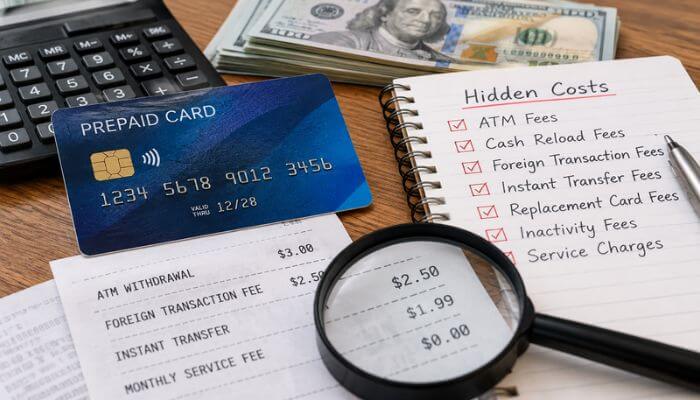
Even prepaid cards with no fees can carry charges for certain transactions and services. Before choosing a card, look beyond the advertised monthly fee and consider how you will actually use the account.
1. ATM Withdrawal Fees
ATM withdrawals may trigger both a provider fee and a separate ATM-operator surcharge. If you regularly need cash, prioritize cards with low ATM fees or qualifying reimbursement options.
2. Cash Reload Fees
Adding cash at a retail location can cost extra. For example, four reloads at $3.95 each would total $15.80 per month. Direct deposit or free ACH funding can often reduce this expense.
3. Purchase Fees
Pay-as-you-go cards may charge for every transaction. A $1 purchase fee multiplied by 30 monthly purchases becomes $30 in fees, making $0 purchase fees particularly valuable for frequent users.
4. Foreign Transaction Fees
International purchases and ATM withdrawals may carry additional charges. Travelers should check foreign transaction fees, international ATM costs, and possible third-party surcharges before using a prepaid card abroad.
5. Instant Transfer Fees
Faster transfers can cost more than standard funding methods. When speed is not essential, free ACH transfers or direct deposit may be more economical.
6. Inactivity and Replacement Fees
Some cards charge for extended inactivity or replacing a lost or damaged card. These costs are especially important if you plan to keep the card primarily for emergencies.
7. Card and Delivery Fees
A card that is free online may have an upfront cost at a retail location. Expedited shipping or optional card designs can also add one-time charges.
When comparing prepaid cards with no fees, focus on the charges you are most likely to encounter rather than simply choosing the card with the lowest advertised monthly fee.
Merchant Authorization Holds Are Not Fees but Can Reduce Available Money
Even prepaid cards with no fees can have part of their available balance temporarily restricted by a merchant authorization hold. These holds commonly occur at hotels, gas stations, restaurants, and rental-car companies.
A merchant may authorize an amount higher than the final bill because the exact transaction total is not yet known. Although this is not technically a fee, it can temporarily reduce the money available for other purchases.
Example
Suppose your prepaid card has a $300 balance and a hotel places a temporary $200 authorization hold. You may have only $100 available until the hold is finalized or released.
When using prepaid cards with no fees for travel, consider keeping another payment method available so a large authorization hold does not tie up most of your spending balance.
Do Prepaid Cards Have Spending and Withdrawal Limits?
Yes. Even prepaid cards with no fees can have limits on how much money you can load, spend, withdraw, or keep in the account.
Common limits may include:
- Maximum account balance
- Daily or per-transaction reload limits
- Daily spending limits
- Maximum purchase amounts
- Daily or per-transaction ATM withdrawal limits
The CFPB notes that prepaid-card limits vary by provider, so check the cardholder agreement before choosing an account.
When comparing prepaid cards with no fees, consider both cost and account limits. A low-fee card may not be the best option if its restrictions do not match your spending or cash-access needs.
How Can You Add Money to a Prepaid Card?
Funding options vary by provider, and the method you choose can affect the real cost of prepaid cards with no fees.
Common ways to add money include:
- Payroll direct deposit
- Government-benefit direct deposit
- ACH or bank transfers
- Retail cash reloads
- Transfers from supported accounts
- Third-party reload services
Direct deposit and standard bank transfers may be free, while retail cash reloads or instant funding can carry additional charges.
When comparing prepaid cards with no fees, check which funding methods you expect to use most often. A card with no monthly fee can still become expensive if you regularly pay to reload it.
Can You Receive Paychecks and Tax Refunds on a Prepaid Card?
Yes. Many prepaid cards with no fees support direct deposit for paychecks and other eligible payments. You will generally need the routing and account numbers supplied by the prepaid-card provider, which are usually different from the number printed on the physical card.
Depending on the account, direct deposits may include:
- Payroll and wages
- Government benefits
- Social Security payments
- Unemployment benefits
- Tax refunds
You can also receive a tax refund on a qualifying prepaid account that accepts direct deposit. Always verify the routing and account numbers before submitting them because incorrect information can delay your payment.
When comparing prepaid cards with no fees, direct-deposit support is particularly valuable because it can provide a convenient way to add money without relying on paid retail cash reloads.
Can You Get a Prepaid Card Without a Bank Account?
Yes. Many prepaid cards with no fees do not require you to have an existing checking account. Depending on the provider, you may be able to add money through direct deposit, cash reloads, or other supported funding methods.
This can make reloadable prepaid cards useful for people who do not have or do not want a traditional bank account.
However, prepaid cards with no fees are not automatically cheaper than free checking accounts. A checking account may provide better ATM access, transfers, and additional banking services, so compare both options based on how you manage your money.
Do Prepaid Cards Require a Credit Check?
Most standard prepaid cards with no fees do not require a traditional credit check because you are spending money already loaded onto the account rather than borrowing through a credit line.
However, providers may still require identity verification before activating certain account features. You may be asked for information such as:
- Legal name
- Date of birth
- Address
- Social Security number or other identification
- Phone number or email address
Identity verification is different from a credit check. When applying for prepaid cards with no fees, check the provider’s eligibility and verification requirements before opening an account.
Why Registering Your Prepaid Card Matters
After choosing one of the prepaid cards with no fees, completing the provider’s registration process can be important for accessing the card’s full features and protections.
Registration may affect:
- Reloading funds
- ATM access
- Online account features
- Lost or stolen card protections
- Unauthorized-transaction protections
- Deposit-insurance eligibility
The CFPB notes that consumers who do not successfully register a prepaid card may have limited functionality and fewer protections. Some reloadable cards may also restrict additional funding until registration is completed.
For that reason, users of prepaid cards with no fees should complete registration promptly and verify that the account has been successfully activated.
Are Prepaid Cards With No Fees Safe?
Yes, prepaid cards with no fees can be safe when issued by reputable providers and properly registered. Registered prepaid accounts may include federal protections for certain unauthorized transactions, but users should still take basic security precautions.
Good security habits include:
- Registering your card promptly
- Protecting your PIN and password
- Enabling transaction alerts
- Checking transaction history regularly
- Freezing or locking a missing card when available
- Reporting unauthorized transactions quickly
- Never sharing verification codes
The CFPB notes that registered prepaid-card users generally have certain error-resolution protections for unauthorized transactions. However, waiting too long to report a lost card or suspicious activity can increase potential losses.
When evaluating prepaid cards with no fees, consider security features and consumer protections alongside the fee structure.
Are Prepaid Cards FDIC Insured?
Some prepaid cards with no fees may qualify for FDIC deposit insurance, but coverage is not automatic. It depends on how and where the prepaid funds are held and whether applicable FDIC requirements are satisfied.
Generally, the underlying funds must be deposited at an FDIC-insured bank, and required records must properly identify the owners and their interests in the deposits. Registration may also be necessary for applicable coverage.
When the requirements are met, eligible deposits are generally insured up to $250,000 per depositor, per insured bank, for each ownership category, including other deposits the same person holds at that bank in the same ownership category.
When comparing prepaid cards with no fees, check the provider’s current disclosure to determine which bank holds the funds and whether your balance is eligible for FDIC insurance.
What FDIC Insurance Does Not Cover
FDIC insurance protects against the failure of an insured bank.
It does not itself protect consumers from every problem involving:
- Lost cards
- Stolen cards
- Unauthorized purchases
- Scams
- Bankruptcy of a non-bank prepaid-card provider
Read the individual card disclosure to determine whether the underlying funds are eligible for FDIC insurance.
Do Prepaid Cards Build Credit or Allow Overdrafts?
Most prepaid cards with no fees do not build credit because you are spending money already loaded onto the account rather than borrowing and repaying a credit balance. If building credit is your goal, a secured credit card, credit-builder loan, or another product that reports payment activity may be more appropriate.
Prepaid cards also commonly decline transactions when there is not enough money available, helping users avoid traditional overdrafts. However, some prepaid accounts may offer overdraft or credit features under specific terms.
When comparing prepaid cards with no fees, check the product disclosure for both credit-reporting and overdraft features rather than assuming every prepaid account works the same way.
Prepaid Card vs. Debit Card vs. Credit Card
Understanding how prepaid cards with no fees differ from debit and credit cards can help you decide which payment method better fits your needs.
| Feature | Prepaid Card | Debit Card | Credit Card |
|---|---|---|---|
| Uses your existing money | Yes | Yes | No |
| Usually linked to checking | No | Yes | No |
| Borrowing involved | Usually no | No | Yes |
| Usually builds credit | No | No | Yes |
| ATM withdrawals | Often available | Usually available | Usually a cash advance |
| Interest charges | Usually no | No | Possible |
| Spending based on available funds | Yes | Yes | Usually no |
A prepaid card uses money loaded onto the account, while a debit card generally draws funds directly from a checking account. A credit card involves borrowing against an approved credit limit and repaying the balance later.
Are Prepaid Cards With No Fees Better Than Free Checking?
Not always. Although prepaid cards with no fees can provide a simple way to control spending, a free checking account may offer more banking features, including larger fee-free ATM networks, ACH transfers, bill payment, mobile check deposit, and direct deposit.
A checking account may be better if you frequently withdraw cash, transfer money, or need broader banking services. A prepaid card may be more suitable if you want a fixed spending balance, easier spending separation, or an alternative to conventional checking.
When comparing prepaid cards with no fees against free checking accounts, consider the total cost, ATM access, funding options, account features, and how you plan to use the account.
How to Keep a Prepaid Card as Close to Fee-Free as Possible
Choosing the right prepaid cards with no fees is only the first step. How you fund and use the card can determine whether your actual monthly cost stays close to $0.
To minimize prepaid-card fees:
- Use direct deposit when it is available for free.
- Choose free ACH transfers instead of paid instant funding when possible.
- Limit retail cash reloads because repeated reload charges can add up quickly.
- Reduce ATM withdrawals or use eligible fee-free or reimbursed ATM options.
- Avoid unnecessary instant transfers when standard transfers will work.
- Check international fees before using your card abroad.
- Skip premium card designs if they carry an additional charge.
- Choose standard shipping instead of paid expedited delivery.
- Watch for inactivity fees if you rarely use the account.
- Review updated fee disclosures because providers can change their pricing and terms.
The best way to benefit from prepaid cards with no fees is to combine a low-cost card with free funding methods and avoid optional services that trigger additional charges.
Outdated Prepaid Card Recommendations to Watch For
Lists of prepaid cards with no fees can become outdated when providers change pricing, stop accepting new customers, or discontinue products entirely.
One example is the former Bluebird American Express Prepaid Debit Account. Bluebird states that these prepaid debit accounts were discontinued on June 2, 2026, with accounts officially closed on June 3, 2026.
That is why older comparison articles should not be treated as current without verification. When researching prepaid cards with no fees, confirm that the card is still available and review the provider’s latest fee disclosure before applying or adding money.
Who Should Consider Prepaid Cards With No Fees?
Prepaid cards with no fees can be useful for people who want a simple way to control spending without relying on a traditional credit card or checking account.
They may be a good fit if you want to:
- Control everyday spending
- Separate spending money from your main account
- Receive eligible direct deposits
- Set a fixed spending allowance
- Avoid recurring maintenance charges
- Make online or everyday card purchases
However, prepaid cards with no fees may not be the best choice if you frequently withdraw or reload cash, travel internationally, want to build credit, need high transaction limits, or already have access to a strong no-fee checking account.
The right choice depends on how you plan to fund, spend, and access your money.
Common Mistakes to Avoid
When comparing prepaid cards with no fees, looking only at the advertised monthly charge can lead to a more expensive choice. Consider the complete fee structure and account terms before deciding.
Common mistakes include:
- Ignoring purchase, ATM, reload, and transfer fees
- Paying for instant transfers when free options are available
- Overlooking foreign transaction charges
- Ignoring spending and withdrawal limits
- Failing to register the card
- Assuming FDIC insurance automatically applies
- Expecting a standard prepaid card to build credit
- Relying on outdated fee information or product recommendations
The best prepaid cards with no fees should fit your actual spending and funding habits, not simply advertise a $0 monthly fee.
Checklist Before Choosing a Prepaid Card
Before choosing among prepaid cards with no fees, check the complete pricing and account terms rather than focusing only on the advertised monthly charge.
- Is the monthly fee and standard purchase fee $0?
- Can you get and activate the card for free?
- Which funding methods are free?
- What are the ATM and cash reload fees?
- Can ATM charges be waived or reimbursed?
- Are there foreign transaction or instant-transfer fees?
- Are there inactivity or replacement-card fees?
- What are the spending, reload, and withdrawal limits?
- What fraud protections and security features apply?
- Are eligible funds covered by FDIC deposit insurance?
The best prepaid cards with no fees should combine low everyday costs with funding options, limits, security features, and account protections that match how you plan to use the card.
Conclusion
Prepaid cards with no fees can be a low-cost way to manage everyday spending, but a $0 monthly fee does not mean every transaction or service is free.
Among the options reviewed, Cash App and Fold stand out for combining $0 monthly fees with $0 standard purchase fees. Serve Pay As You Go and Netspend Pay-As-You-Go have no monthly plan fee, but frequent transaction charges can increase their overall cost.
Before choosing among prepaid cards with no fees, compare ATM charges, reload costs, funding methods, transaction limits, security protections, and other account terms based on how you actually plan to use the card.
Ultimately, the best prepaid card is not the one advertising the most zeroes. It is the one that keeps your total real-world cost the lowest.
FAQs About Prepaid Cards With No Fees
1. Can prepaid cards with no fees be used for subscriptions?
Yes. Many prepaid cards with no fees can pay for subscriptions when sufficient funds are available, although merchant acceptance varies.
2. Do prepaid cards with no fees work with mobile wallets?
Some prepaid cards with no fees can be added to compatible mobile wallets. Check the card provider and wallet requirements before adding your card.
3. Can prepaid cards with no fees have virtual card numbers?
Some prepaid cards with no fees provide virtual card details for online spending, but availability depends on the provider and account features.
4. Do prepaid cards with no fees expire?
The physical card may have an expiration date, but that does not necessarily mean the account balance expires. Providers generally issue replacement cards according to their terms.
5. Can teenagers use prepaid cards with no fees?
Some prepaid cards with no fees may be available to younger users through eligible sponsored or family accounts. Minimum-age and verification requirements vary.
6. Can you have more than one prepaid card with no fees?
Possibly. Providers may limit how many prepaid cards with no fees or associated accounts one person can maintain, so check the issuer’s current rules.
7. How do refunds work on prepaid cards with no fees?
Refunds are generally returned to the prepaid cards with no fees originally used for the purchase. Processing times depend on the merchant and card provider.
8. Can prepaid cards with no fees be used for recurring bills?
Yes, some prepaid cards with no fees can handle recurring bills. Keep enough money loaded to prevent scheduled payments from being declined.
Disclaimer: This article is for general informational purposes only and does not constitute financial advice. Fees, limits, availability, benefits, eligibility requirements, and account terms can change. Review the provider’s latest fee disclosure and cardholder agreement before opening or funding an account.
