


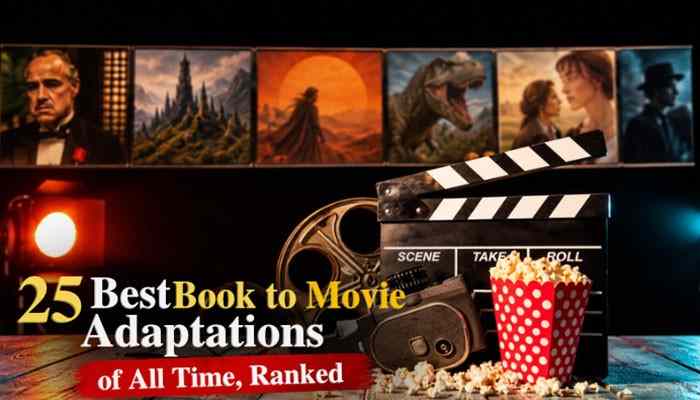

The best book to movie adaptations do more than copy famous scenes from books. They understand why readers connected with the original story and translate its characters, emotions, themes, atmosphere, and ideas into cinematic storytelling.
Some of the best book to movie adaptations remain remarkably faithful to their source material. Others remove characters, combine storylines, change endings, or completely reinterpret parts of the book. Those changes do not automatically make an adaptation weaker.
From The Godfather and The Lord of the Rings to The Shawshank Redemption, Dune, Gone Girl, and Pride & Prejudice, this ranking explores 25 films that successfully transformed memorable written stories into memorable cinema.
Quick Answer: Best Book to Movie Adaptations
The best book to movie adaptations include The Godfather, The Lord of the Rings, The Shawshank Redemption, No Country for Old Men, Schindler’s List, The Silence of the Lambs, One Flew Over the Cuckoo’s Nest, To Kill a Mockingbird, Jurassic Park, and Pride & Prejudice.
Our number-one choice is The Godfather. Francis Ford Coppola and novelist Mario Puzo removed much of the novel’s secondary material and concentrated the movie around Michael Corleone’s transformation. That focus helped create one of the strongest examples of a book being reshaped specifically for cinema.
Key Takeaways
- The best book to movie adaptations do not need to reproduce every chapter.
- Faithfulness and adaptation quality are not always the same thing.
- Great films preserve the emotional or thematic core of their source books.
- Cutting secondary plots can sometimes improve a movie.
- Novels, novellas, short stories, and nonfiction books can all inspire successful adaptations.
- Some acclaimed adaptations make major changes to the original story.
- Strong adaptations work even for people who have never read the source.
- A good adaptation translates a book into cinema instead of simply illustrating it.
Best Book to Movie Adaptations at a Glance
| Rank | Movie | Source | Author | Release |
| 1 | The Godfather | The Godfather | Mario Puzo | 1972 |
| 2 | The Lord of the Rings Trilogy | The Lord of the Rings | J.R.R. Tolkien | 2001–2003 |
| 3 | The Shawshank Redemption | Rita Hayworth and Shawshank Redemption | Stephen King | 1994 |
| 4 | No Country for Old Men | No Country for Old Men | Cormac McCarthy | 2007 |
| 5 | Schindler’s List | Schindler’s Ark | Thomas Keneally | 1993 |
| 6 | The Silence of the Lambs | The Silence of the Lambs | Thomas Harris | 1991 |
| 7 | One Flew Over the Cuckoo’s Nest | One Flew Over the Cuckoo’s Nest | Ken Kesey | 1975 |
| 8 | To Kill a Mockingbird | To Kill a Mockingbird | Harper Lee | 1962 |
| 9 | Jurassic Park | Jurassic Park | Michael Crichton | 1993 |
| 10 | Pride & Prejudice | Pride and Prejudice | Jane Austen | 2005 |
| 11 | Little Women | Little Women | Louisa May Alcott | 2019 |
| 12 | Dune | Dune | Frank Herbert | 2021–2024 |
| 13 | Gone Girl | Gone Girl | Gillian Flynn | 2014 |
| 14 | The Princess Bride | The Princess Bride | William Goldman | 1987 |
| 15 | Fight Club | Fight Club | Chuck Palahniuk | 1999 |
| 16 | Jaws | Jaws | Peter Benchley | 1975 |
| 17 | Blade Runner | Do Androids Dream of Electric Sheep? | Philip K. Dick | 1982 |
| 18 | The Color Purple | The Color Purple | Alice Walker | 1985 |
| 19 | The Green Mile | The Green Mile | Stephen King | 1999 |
| 20 | Atonement | Atonement | Ian McEwan | 2007 |
| 21 | Room | Room | Emma Donoghue | 2015 |
| 22 | Harry Potter and the Prisoner of Azkaban | Harry Potter and the Prisoner of Azkaban | J.K. Rowling | 2004 |
| 23 | The Hunger Games: Catching Fire | Catching Fire | Suzanne Collins | 2013 |
| 24 | The Devil Wears Prada | The Devil Wears Prada | Lauren Weisberger | 2006 |
| 25 | Crazy Rich Asians | Crazy Rich Asians | Kevin Kwan | 2018 |
How We Ranked the Best Book to Movie Adaptations
Ranking the best book to movie adaptations requires more than measuring how closely a film copies its source.
A movie can reproduce most of a novel and still fail to capture its spirit. Another film can make major changes while preserving everything that made the original story powerful.
We considered four main factors.
Adaptation Quality
Does the movie understand the essential themes, characters, relationships, conflicts, and emotional identity of the source?
Quality as a Movie
The best book to movie adaptations must still work for viewers who have never read the book.
Direction, acting, screenplay, cinematography, music, editing, pacing, and production design all matter.
Smart Changes
Changes should improve the cinematic story.
Strong screenwriters know which subplots can disappear, which characters can be combined, and which internal ideas need to become visual.
Lasting Impact
An all-time ranking should reward adaptations that continue to attract readers and viewers long after their original release.
With those standards established, here are the 25 best book to movie adaptations of all time.
1. The Godfather
- Book: The Godfather by Mario Puzo
- Director: Francis Ford Coppola
- Released: 1972
At number one among the best book to movie adaptations is The Godfather.
Mario Puzo’s novel contains much more secondary material than the movie.
Coppola and Puzo reduce many of those storylines and concentrate the film around the Corleone family, especially Michael Corleone’s transformation.
Michael begins the story outside the criminal business surrounding his family.
Violence, obligation, loyalty, ambition, circumstance, and personal choice gradually move him toward the role he initially appears determined to avoid.
Why it ranks first: The Godfather shows that great adaptation is not about preserving the largest amount of material. It is about identifying the strongest story within that material and creating the best cinematic version of it.
2. The Lord of the Rings Trilogy
- Books: The Fellowship of the Ring, The Two Towers, and The Return of the King
- Author: J.R.R. Tolkien
- Director: Peter Jackson
- Released: 2001–2003
Peter Jackson faced one of the biggest challenges in the history of literary adaptation.
Tolkien’s world includes languages, mythology, history, politics, battles, poetry, philosophy, enormous casts, and long journeys.
The movies remove characters, shorten travel, change chronology, relocate dialogue, and expand certain battles.
Yet the central themes remain:
- Friendship
- Courage
- Mercy
- Loyalty
- Sacrifice
- Temptation
- Power
- Hope
This is why the trilogy remains one of the best book to movie adaptations ever made.
Why it works: It compresses an enormous literary world without losing the relationships and moral themes that give Tolkien’s story its power.
3. The Shawshank Redemption
- Book: Rita Hayworth and Shawshank Redemption by Stephen King
- Director: Frank Darabont
- Released: 1994
Stephen King’s source is a novella rather than a full-length novel.
Frank Darabont expands the story without making it feel padded.
Andy Dufresne and Red’s friendship becomes the emotional foundation, while Morgan Freeman’s narration connects events across many years.
Why it works: It expands a compact story without weakening its themes of hope, friendship, patience, dignity, and institutionalization.
4. No Country for Old Men
- Book: No Country for Old Men by Cormac McCarthy
- Directors: Joel and Ethan Coen
- Released: 2007
Among the best book to movie adaptations, No Country for Old Men stands out for how closely the filmmakers respect the tone of the original novel.
Cormac McCarthy’s sparse prose already feels cinematic.
The Coen brothers use silence, landscape, violence, pauses, and uncertainty instead of over-explaining the story.
Why it works: The movie trusts the source and resists making it more conventional.
4. Schindler’s List
- Book: Schindler’s Ark by Thomas Keneally
- Director: Steven Spielberg
- Released: 1993
Thomas Keneally’s book tells the story of Oskar Schindler and the Jewish workers he helped save during the Holocaust.
Spielberg combines historical scale with intensely personal moments.
Schindler also remains morally complicated rather than becoming a simple heroic figure.
Why it works: It treats difficult historical material seriously while keeping individual human lives at the center.
6. The Silence of the Lambs
- Book: The Silence of the Lambs by Thomas Harris
- Director: Jonathan Demme
- Released: 1991
Hannibal Lecter became the film’s most famous character, but Clarice Starling remains the real center.
Her conversations with Lecter are simultaneously interviews, psychological confrontations, and exchanges of information.
Jonathan Demme’s direction makes those encounters unusually intimate.
Why it works: It preserves Thomas Harris’s psychological intelligence while making the tension more immediate through cinema.
7. One Flew Over the Cuckoo’s Nest
- Book: One Flew Over the Cuckoo’s Nest by Ken Kesey
- Director: Miloš Forman
- Released: 1975
Ken Kesey tells the novel through Chief Bromden.
The movie places much more emphasis on Randle McMurphy.
That is a substantial change.
Yet the film retains the central conflict involving conformity, institutional control, punishment, individuality, authority, and rebellion.
Why it works: It changes the perspective without losing the fundamental meaning of the source.
8. To Kill a Mockingbird
- Book: To Kill a Mockingbird by Harper Lee
- Director: Robert Mulligan
- Released: 1962
Harper Lee’s novel combines childhood, community, racial injustice, family life, fear, and moral education.
The movie narrows that scope and gives greater emphasis to Atticus Finch and the central trial.
Scout’s changing understanding of prejudice remains essential.
Why it works: The adaptation identifies the book’s moral and emotional center and builds around it.
9. Jurassic Park
- Book: Jurassic Park by Michael Crichton
- Director: Steven Spielberg
- Released: 1993
Michael Crichton’s novel contains far more technical discussion of genetics, chaos theory, commercialization, and scientific responsibility.
Spielberg simplifies those elements.
But the movie retains the central warning that scientific capability does not automatically justify scientific action.
Why it works: It converts technical science fiction into mainstream adventure without abandoning its ethical questions.
10. Pride & Prejudice
- Book: Pride and Prejudice by Jane Austen
- Director: Joe Wright
- Released: 2005
Jane Austen’s novel relies heavily on irony, dialogue, social observation, misunderstanding, and internal judgment.
Joe Wright translates many of those ideas visually.
Glances, silence, crowded rooms, landscapes, gestures, and physical distance communicate emotions that Austen expresses through prose.
Why it works: It transforms literary subtext into physical and visual storytelling.
11. Little Women
- Book: Little Women by Louisa May Alcott
- Director: Greta Gerwig
- Released: 2019
Greta Gerwig faced a difficult problem.
Little Women had already been adapted repeatedly.
Instead of reinventing the characters, she restructures the chronology.
The film moves between childhood and adulthood, allowing memories of youth to gain greater emotional meaning.
Why it works: The structure feels fresh without losing the relationships that make Alcott’s novel endure.
12. Dune
- Book: Dune by Frank Herbert
- Director: Denis Villeneuve
- Movies: Dune and Dune: Part Two
- Released: 2021 and 2024
Frank Herbert’s novel contains religion, politics, ecology, economics, colonialism, prophecy, family rivalry, warfare, and enormous world-building.
Denis Villeneuve gives the story room by spreading the core novel across two films.
That decision helps make Dune one of the best book to movie adaptations of modern science fiction.
The films also avoid turning Paul Atreides into a simple heroic figure.
Why it works: Villeneuve respects the complexity of Herbert’s story while using scale, sound, imagery, and performance to make it cinematic.
13. Gone Girl
- Book: Gone Girl by Gillian Flynn
- Director: David Fincher
- Released: 2014
Gillian Flynn adapted her own novel, helping the film retain its complicated psychological structure.
The disappearance of Amy Dunne initially looks like a conventional mystery.
The deeper story involves resentment, marriage, media narratives, gender expectations, identity, manipulation, and performance.
Why it works: The movie keeps the novel’s psychological games while tightening them into controlled suspense.
14. The Princess Bride
- Book: The Princess Bride by William Goldman
- Director: Rob Reiner
- Released: 1987
William Goldman wrote both the novel and screenplay.
That helped preserve the book’s unusual mixture of fantasy, adventure, romance, comedy, satire, and storytelling.
Inigo Montoya, Fezzik, Vizzini, Westley, and Buttercup all remain memorable because the movie understands Goldman’s playful tone.
Why it works: It preserves the personality of the source rather than treating it as conventional fantasy.
15. Fight Club
- Book: Fight Club by Chuck Palahniuk
- Director: David Fincher
- Released: 1999
Chuck Palahniuk’s novel examines masculinity, consumer culture, alienation, identity, and extremism through an unreliable narrator.
David Fincher translates that instability through editing, narration, visual clues, and performance.
The movie also makes changes to the ending.
Why it works: The visual style becomes part of the narrator’s psychological condition.
16. Jaws
- Book: Jaws by Peter Benchley
- Director: Steven Spielberg
- Released: 1975
Peter Benchley’s novel contains several interpersonal subplots that Spielberg reduces or removes.
The movie becomes stronger because of that focus.
By the final act, the story is remarkably simple.
Three men. One boat. One shark.
Why it works: It proves that cutting material can improve an adaptation when those cuts sharpen suspense and pacing.
17. Blade Runner
- Book: Do Androids Dream of Electric Sheep? by Philip K. Dick
- Director: Ridley Scott
- Released: 1982
Blade Runner is one of the best book to movie adaptations precisely because it demonstrates that great adaptations do not always have to be faithful.
Ridley Scott changes significant parts of Philip K. Dick’s plot.
Yet both works explore similar questions about humanity, empathy, artificial life, memory, identity, and mortality.
Why it works: It preserves the philosophical questions of the source while creating a distinctive cinematic world.
18. The Color Purple
- Book: The Color Purple by Alice Walker
- Director: Steven Spielberg
- Released: 1985
Alice Walker’s novel uses letters to give readers access to Celie’s thoughts and experiences.
Film cannot reproduce that literary intimacy exactly.
Instead, the adaptation relies on performance, facial expression, dialogue, and visual storytelling.
Why it works: It changes the storytelling method while keeping Celie’s personal transformation at the center.
19. The Green Mile
- Book: The Green Mile by Stephen King
- Director: Frank Darabont
- Released: 1999
Although supernatural events are important, the emotional core of The Green Mile involves compassion, injustice, punishment, morality, and guilt.
Tom Hanks anchors the story as Paul Edgecomb.
Michael Clarke Duncan gives John Coffey enormous emotional weight.
Why it works: Frank Darabont recognizes that human behavior matters more than supernatural spectacle.
20. Atonement
- Book: Atonement by Ian McEwan
- Director: Joe Wright
- Released: 2007
Atonement is built around memory, guilt, perspective, misunderstanding, and storytelling.
Those literary ideas could have become weaker on screen.
Instead, Joe Wright uses editing, sound, cinematography, visual repetition, and performance to create cinematic equivalents.
Why it works: The movie translates literary ideas rather than simply reproducing plot points.
21. Room
- Book: Room by Emma Donoghue
- Director: Lenny Abrahamson
- Released: 2015
Emma Donoghue adapted her own novel, giving the movie a direct connection with its source.
Much of the book is shaped by young Jack’s understanding of a tiny world he considers normal.
The film has to make that perspective visual while also communicating Joy’s trauma.
Why it works: It turns an internal narrative into intimate filmmaking without losing the relationship at its center.
22. Harry Potter and the Prisoner of Azkaban
- Book: Harry Potter and the Prisoner of Azkaban by J.K. Rowling
- Director: Alfonso Cuarón
- Released: 2004
The third Harry Potter movie gives the series a darker and more mature identity.
Some background involving the Marauders is reduced, which readers may miss.
But Alfonso Cuarón gains atmosphere, visual personality, and emotional depth.
Why it works: It shows that a movie can lose some exposition while still becoming a stronger cinematic experience.
23. The Hunger Games: Catching Fire
- Book: Catching Fire by Suzanne Collins
- Director: Francis Lawrence
- Released: 2013
Catching Fire expands the political consequences of Katniss Everdeen’s victory.
The movie balances trauma, propaganda, celebrity, authoritarian control, rebellion, relationships, and the Quarter Quell.
It is one of the best book to movie adaptations in modern young-adult cinema because the spectacle never completely overwhelms the political themes beneath it.
Why it works: It combines mainstream blockbuster entertainment with serious ideas about power, surveillance, propaganda, and resistance.
24. The Devil Wears Prada
- Book: The Devil Wears Prada by Lauren Weisberger
- Director: David Frankel
- Released: 2006
Andrea Sachs enters the fashion industry expecting a temporary job and discovers how quickly professional ambition can affect her personal identity.
The movie keeps the novel’s workplace premise while making Miranda Priestly more layered.
Meryl Streep’s performance gives Miranda authority, intelligence, vulnerability, and complexity.
Why it works: It strengthens the characters while retaining the book’s questions about ambition, career pressure, compromise, and success.
25. Crazy Rich Asians
- Book: Crazy Rich Asians by Kevin Kwan
- Director: Jon M. Chu
- Released: 2018
Kevin Kwan’s novel mixes romance with family expectations, social status, cultural identity, extreme wealth, and tradition.
The film reduces some of the book’s large network of characters and gives more attention to Rachel Chu’s relationship with Nick Young and her conflict with Eleanor Young.
That focus gives the central relationship greater emotional space.
Why it works: The movie simplifies a sprawling novel without losing its most important conflicts involving love, family, class, and identity.
10 More Best Book to Movie Adaptations Worth Watching
A list of 25 cannot include every great adaptation.
These additional films deserve consideration whenever people discuss the best book to movie adaptations.
| Movie | Source | Author | Why It Stands Out |
| Goodfellas | Wiseguy | Nicholas Pileggi | Turns nonfiction crime reporting into energetic cinema |
| The Shining | The Shining | Stephen King | Radically reinterprets its source material |
| The Exorcist | The Exorcist | William Peter Blatty | Preserves psychological and theological tension |
| Stand by Me | The Body | Stephen King | Turns a novella into a moving coming-of-age film |
| Arrival | Story of Your Life | Ted Chiang | Expands a short story into emotional science fiction |
| Misery | Misery | Stephen King | Creates intense suspense with a small cast |
| Children of Men | The Children of Men | P. D. James | Builds a distinctive cinematic reinterpretation |
| Sense and Sensibility | Sense and Sensibility | Jane Austen | Balances romance and social commentary |
| The Remains of the Day | The Remains of the Day | Kazuo Ishiguro | Uses restraint to express a deeply internal novel |
| L.A. Confidential | L.A. Confidential | James Ellroy | Condenses a dense crime novel into focused noir |
These honorable mentions also show why no single formula produces the best book to movie adaptation.
Best Recent Book to Movie Adaptations
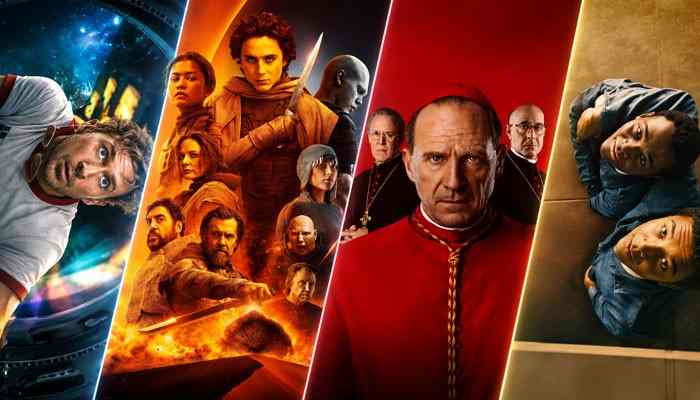
The best book to movie adaptations of all time should have some proven cultural staying power.
Still, newer films deserve attention because readers often want fresh recommendations.
Project Hail Mary
Andy Weir’s science-fiction novel became a 2026 movie starring Ryan Gosling.
The story combines scientific problem-solving, isolation, survival, humor, and unexpected friendship.
It is one of the strongest recent examples of a technically detailed science-fiction novel becoming accessible mainstream cinema.
Dune: Part Two
Dune: Part Two completes the main adaptation begun by Denis Villeneuve in 2021.
Its success reinforces one important adaptation lesson.
Some books need more screen time rather than aggressive compression.
Conclave
Robert Harris’s political novel becomes a tense film centered on institutional power, ambition, secrecy, and the election of a new pope.
The adaptation shows how dialogue-heavy source material can still create cinematic suspense.
Nickel Boys
Colson Whitehead’s novel inspired a visually ambitious adaptation that uses subjective filmmaking to place audiences unusually close to the characters’ experiences.
These newer examples show that the conversation surrounding the best book to movie adaptations continues to evolve.
Most Faithful vs Best Book to Movie Adaptations
The most faithful adaptation is not automatically the best adaptation.
A movie can preserve almost every plot point while missing the tone.
Another can remove many scenes while remaining completely faithful to the themes.
| Movie | General Faithfulness | Main Approach |
| No Country for Old Men | Very high | Preserves story, dialogue, atmosphere, and structure |
| Gone Girl | High | Author Gillian Flynn adapted her own novel |
| The Silence of the Lambs | High | Streamlines the source while protecting its psychological center |
| The Lord of the Rings | Moderate to high | Compresses journeys, characters, and chronology |
| Pride & Prejudice | Moderate | Condenses events while preserving relationships |
| Jurassic Park | Moderate | Simplifies science and changes characters |
| The Godfather | Moderate | Removes secondary material to strengthen Michael’s arc |
| Jaws | Moderate to loose | Cuts major interpersonal subplots |
| Blade Runner | Loose | Preserves philosophical ideas more than plot |
| The Shining | Loose | Makes major changes to tone, character, and ending |
The lesson is simple.
Faithfulness is one way to judge the best book to movie adaptations, but it should never be the only way.
Best Book to Movie Adaptations by Genre
Different genres create different challenges when moving from page to screen.
| Genre | Best Pick | Source |
| Crime | The Godfather | The Godfather |
| Fantasy | The Lord of the Rings | The Lord of the Rings |
| Drama | The Shawshank Redemption | Rita Hayworth and Shawshank Redemption |
| Historical Drama | Schindler’s List | Schindler’s Ark |
| Thriller | The Silence of the Lambs | The Silence of the Lambs |
| Science Fiction | Dune | Dune |
| Romance | Pride & Prejudice | Pride and Prejudice |
| Young Adult | Catching Fire | Catching Fire |
| Adventure | Jurassic Park | Jurassic Park |
| Psychological Thriller | Gone Girl | Gone Girl |
| Dystopian Science Fiction | Blade Runner | Do Androids Dream of Electric Sheep? |
| Family Drama | Little Women | Little Women |
| Horror | The Exorcist | The Exorcist |
| Coming of Age | Stand by Me | The Body |
This makes it easier to choose the best book to movie adaptations based on your favorite genre.
Best Book to Movie Adaptations by Decade
The history of the best book to movie adaptations also shows how filmmaking styles have changed.
| Decade | Pick | Why It Stands Out |
| 1960s | To Kill a Mockingbird | Powerful performance-driven literary drama |
| 1970s | The Godfather | Turns a sprawling novel into focused tragedy |
| 1980s | The Princess Bride | Preserves the playful tone of its source |
| 1990s | The Shawshank Redemption | Expands a novella without losing its emotional core |
| 2000s | The Lord of the Rings | Makes enormous fantasy world-building accessible |
| 2010s | Gone Girl | Preserves psychological complexity |
| 2020s | Dune | Combines blockbuster scale with literary themes |
Newer films need time before they can be judged fairly against decades-old classics.
Do Book-to-Movie Adaptations Have to Come From Novels?
No.
The category is much broader than novels alone.
Novels
Many of the best book to movie adaptations come from novels.
Examples include:
- The Godfather
- Dune
- Jurassic Park
- Gone Girl
- Pride and Prejudice
Novellas
Shorter sources can be ideal for movies because screenwriters may need to remove less material.
Examples include:
- The Shawshank Redemption from Rita Hayworth and Shawshank Redemption
- Stand by Me from The Body
- Train Dreams from Denis Johnson’s novella
Short Stories
Some major movies begin with surprisingly short sources.
Arrival, for example, was adapted from Ted Chiang’s Story of Your Life.
Nonfiction Books
Not every book-based movie begins with fiction.
Goodfellas was inspired by Nicholas Pileggi’s nonfiction book Wiseguy.
This makes the category of books that are movies much broader than traditional fiction.
Why Are So Many Books Adapted Into Movies?
Books give filmmakers several advantages.
A successful book may already provide:
- Developed characters
- A proven premise
- Existing readers
- Recognizable intellectual property
- Detailed settings
- Established conflicts
- Strong themes
- Evidence of audience interest
But those advantages do not guarantee one of the best book to movie adaptations.
A book may have hundreds of pages to develop its story.
A movie usually has only a few hours.
Adaptation therefore requires careful selection.
Why Do the Best Book to Movie Adaptations Change the Books?
Changes are often necessary because books and films communicate differently.
Internal Thoughts Must Become Visible
A novelist can directly explain what a character thinks.
A movie usually needs to communicate the same idea through:
- Dialogue
- Performance
- Facial expressions
- Actions
- Editing
- Framing
- Music
- Visual symbolism
Movies Have Less Time
A novel that takes 12 hours to read cannot always become a 12-hour movie.
Minor characters may disappear.
Several characters may become one.
Long subplots may be removed.
Pacing Works Differently
A lengthy philosophical conversation may be fascinating in a novel but slow down a movie.
Screenwriters may rearrange or shorten events.
Images Can Replace Pages
One powerful image can sometimes communicate what requires several paragraphs in prose.
That is why the best book to movie adaptations translate rather than simply copy.
Can the Best Book to Movie Adaptations Be Better Than the Books?
Yes, although the answer is subjective.
Readers often prefer books because novels provide more detail.
More detail, however, does not automatically mean better storytelling.
Movies can strengthen individual elements through:
- Better pacing
- Powerful performances
- Music
- Visual symbolism
- Production design
- More focused character arcs
- Removal of weaker subplots
- Stronger visual climaxes
Jaws is a good example.
Spielberg reduces several novel subplots and creates a more focused thriller.
The Godfather similarly benefits from concentrating more strongly on Michael Corleone.
The most useful question is not whether the movie includes everything.
The question is whether the adaptation understands what matters most.
Movies That Changed Their Books and Still Became Great
Some of the best book to movie adaptations differ dramatically from their source material.
The Shining
Stanley Kubrick changes characters, imagery, themes, and the ending of Stephen King’s novel.
It is not especially faithful.
It remains one of cinema’s most influential horror films.
Blade Runner
Ridley Scott’s film differs significantly from Do Androids Dream of Electric Sheep?
Instead of directly copying the plot, it creates a new visual interpretation of similar philosophical questions.
Jaws
Steven Spielberg removes major relationship storylines from Peter Benchley’s novel.
The result is a tighter thriller.
These films demonstrate why adaptation quality cannot be measured simply by counting differences.
What Are the Best Movies Based on Books?
Readers searching what are the best movies based on books may actually want recommendations by mood or genre.
For crime, start with The Godfather.
For fantasy, choose The Lord of the Rings.
For science fiction, watch Dune.
For romance, try Pride & Prejudice.
For psychological suspense, choose Gone Girl.
For thrillers, start with The Silence of the Lambs.
For literary drama, watch Atonement.
For an emotional story about friendship and hope, choose The Shawshank Redemption.
All of these belong in a serious discussion of the best book to movie adaptations.
Best Book to Movie Adaptations for Different Viewers
Not every reader wants the same kind of adaptation.
- Crime fans: The Godfather
- Fantasy fans: The Lord of the Rings
- Science-fiction fans: Dune
- Romance fans: Pride & Prejudice
- Thriller fans: The Silence of the Lambs
- Young-adult fans: The Hunger Games: Catching Fire
- Literary-fiction readers: Atonement
- Historical-drama fans: Schindler’s List
- Psychological-thriller fans: Gone Girl
- Viewers wanting emotional drama: The Shawshank Redemption
This quick guide makes it easier to find the best book to movie adaptations for your interests.
Famous Books That Are Movies Worth Reading
Watching a strong movie can be an excellent reason to read the original book.
Some rewarding books that are movies include:
- The Godfather by Mario Puzo
- Dune by Frank Herbert
- Jurassic Park by Michael Crichton
- Gone Girl by Gillian Flynn
- Little Women by Louisa May Alcott
- Pride and Prejudice by Jane Austen
- The Color Purple by Alice Walker
- Atonement by Ian McEwan
- Fight Club by Chuck Palahniuk
- The Princess Bride by William Goldman
- No Country for Old Men by Cormac McCarthy
- Room by Emma Donoghue
- Project Hail Mary by Andy Weir
Reading the source after watching the adaptation can make the differences especially interesting.
You can see which characters, scenes, ideas, and endings filmmakers chose to remove, expand, combine, or reinterpret.
Should You Read the Book or Watch the Movie First?
There is no universal rule.
Read the Book First If You Want
- The author’s original language
- Internal thoughts
- More character background
- Additional subplots
- Greater world-building
- The original structure
- The original ending
Watch the Movie First If You Want
- A faster introduction
- Visual context
- Help understanding complicated worlds
- A simpler entry point into a long novel
For complicated stories such as Dune, watching first may help some readers understand characters, locations, political factions, and relationships.
For books where prose is especially important, reading first offers an experience film cannot fully reproduce.
What Makes the Best Book to Movie Adaptations Work?
The best book to movie adaptations generally do six things well.
1. They Find the Core Story
Not every chapter deserves screen time.
The filmmaker must identify what is truly essential.
2. They Preserve Character Motivation
Characters can be simplified, but their decisions still need to make emotional sense.
3. They Translate Instead of Copy
Movies have images, acting, editing, sound, movement, and music.
Great adaptations use those tools.
4. They Change Things for a Reason
Strong changes solve storytelling problems.
Random changes create new ones.
5. They Preserve the Tone
Plot is only part of a story.
The bleakness of No Country for Old Men, the wonder of The Lord of the Rings, and the discomfort of The Silence of the Lambs are essential.
6. They Work Without the Book
Perhaps the most important test is simple.
Someone who has never read the source should still understand and appreciate the movie.
That quality connects nearly all of the best book to movie adaptations in this ranking.
Why Some Great Books Make Bad Movies
A brilliant novel does not automatically become a great film.
Some literary strengths are difficult to translate visually.
A novel may depend heavily on:
- Internal monologue
- Wordplay
- Multiple narrators
- Unreliable narration
- Complex chronology
- Long philosophical passages
- Detailed world-building
- Authorial commentary
- Ambiguity created through prose
Simply removing those elements can make an adaptation feel empty.
Strong filmmakers need to find cinematic equivalents.
Are the Most Faithful Adaptations Always the Best?
No.
A faithful movie can still have weak pacing, uninspired acting, or flat direction.
Meanwhile, a loose adaptation can become exceptional cinema.
Blade Runner, The Shining, and Jaws all demonstrate that the best book to movie adaptations sometimes succeed because filmmakers understand what needs to change.
Faithfulness matters.
But interpretation matters too.
Conclusion: Best Book to Movie Adaptations
The Best Book to Movie Adaptations prove that a great film does not need to follow every page of its source material. Movies like The Godfather, The Lord of the Rings, The Shawshank Redemption, Dune, and Gone Girl succeed because they preserve the emotions, characters, and themes that make the original stories memorable.
While some adaptations remain faithful to their books, others improve the cinematic experience through stronger pacing, powerful performances, and creative storytelling. Ultimately, the Best Book to Movie Adaptations respect the heart of the original work while offering something unique on screen. Whether you read the book first or watch the movie, both versions can offer a rewarding storytelling experience.
Best Book to Movie Adaptations FAQs
1. What are the Best Book to Movie Adaptations of all time?
The Best Book to Movie Adaptations include The Godfather, The Lord of the Rings, The Shawshank Redemption, Dune, and Jurassic Park.
2. Which book-to-movie adaptation is ranked number one?
The Godfather (1972) ranks first for transforming Mario Puzo’s novel into a powerful film about family, loyalty, ambition, and power.
3. Are book-to-movie adaptations better than the original books?
Some adaptations improve pacing, performances, and visual storytelling, while books often provide deeper character development and more detailed plots.
4. What are the best modern book-to-movie adaptations?
Dune, Gone Girl, Little Women, and The Hunger Games: Catching Fire are among the best modern adaptations of popular novels.
5. What makes the Best Book to Movie Adaptations successful?
The Best Book to Movie Adaptations preserve essential characters, emotions, and themes while using cinematic storytelling to bring books to life.
