


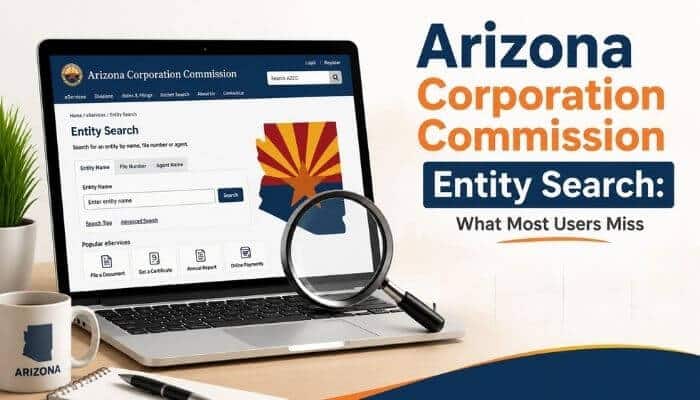

An Arizona Corporation Commission Entity Search can tell you whether an LLC or corporation is registered in Arizona, its current status, statutory agent, key filings, and other public business details.
In 2026, that process moved to the Arizona Business Center, which replaced the former eCorp system and became the ACC’s main platform for business searches and filings.
But registration alone does not prove that a company is licensed, trustworthy, or financially sound. A proper Arizona Corporation Commission Entity Search is most useful when you know what the record confirms—and what still needs to be verified elsewhere.
This guide shows you exactly how to do that.
Quick Answer
The Arizona Corporation Commission Entity Search is the official starting point for checking corporations and LLCs formed in Arizona or registered to do business in the state. Through the Arizona Business Center, users can review public entity records and available filing information.
An Arizona Corporation Commission Entity Search can help you check:
- Legal business name and entity type
- Current entity status
- Formation information
- Statutory agent details
- Business or principal address
- Officers, directors, members, or managers where available
- Annual reports for corporations
- Amendments, mergers, dissolutions, and other filing history
Keep in mind that Arizona trade names and trademarks are handled separately by the Arizona Secretary of State, so you may need to search both agencies when researching a business.
Key Takeaways
- Use the Arizona Corporation Commission Entity Search to check Arizona corporations and LLCs.
- Arizona Business Center replaced eCorp in January 2026.
- Arizona LLCs do not file annual reports, but corporations do.
- Trade names and trademarks are handled by the Arizona Secretary of State.
- Every Arizona corporation and LLC must maintain a statutory agent.
- An Arizona Corporation Commission Entity Search confirms entity records, not licensing, reputation, or financial reliability.
What Is the Arizona Corporation Commission Entity Search?
The Arizona Corporation Commission Entity Search is the state’s official lookup resource for researching corporations and LLCs. Unlike many states, Arizona places corporation and LLC records under the Arizona Corporation Commission (ACC) rather than the Secretary of State.
The search helps users check entity details, filing history, statutory agents, business status, and other public records. An Arizona Corporation Commission Entity Search can be useful for consumers, business owners, investors, vendors, and professionals conducting basic due diligence.
| User | Why They May Search |
|---|---|
| Consumer | Verify the legal entity behind a business |
| Entrepreneur | Research an existing business name |
| Vendor | Check a company before doing business |
| Investor | Conduct basic entity due diligence |
| Business owner | Review public company records |
| Attorney | Locate filings and statutory-agent details |
Remember that ACC records provide legal-entity information, not a complete judgment about a company’s reputation, licensing, or financial condition.
Arizona Business Center Replaced eCorp in 2026
Arizona Business Center officially launched on January 12, 2026, replacing the former eCorp portal. The ACC says the newer system provides a more modern way to search, manage, and file Arizona business records.
Key features include:
- File tracking
- Annual-report reminders
- Online certified-copy ordering
- Multiple language options
- Enhanced security
- QR-code verification for Certificates of Good Standing
Older guides showing eCorp may therefore contain outdated screenshots or instructions. Anyone performing an Arizona Corporation Commission Entity Search should use the current Arizona Business Center interface.
Identity Verification Was Added in July 2026
Beginning July 20, 2026, Arizona Business Center added identity verification for account users to help reduce unauthorized filings and business identity fraud. Accepted identification includes a state-issued driver’s license or photo ID, passport or passport card, Permanent Resident Card, or visa.
The requirement mainly affects users who create accounts or file and modify business records rather than people simply reading public business information.
How to Perform an Arizona Corporation Commission Entity Search
An Arizona Corporation Commission Entity Search is simple, but checking the right details is essential for getting an accurate result.
Step 1: Use the Official ACC Search
Visit the Arizona Corporation Commission’s official business search through Arizona Business Center. Use the state database as your primary source rather than relying only on third-party directories.
Step 2: Enter the Business Details
Start with the exact legal business name when available. If you do not get a clear match, try a distinctive part of the name.
Depending on the search options available, useful details may include:
- Business name
- Entity information
- Statutory agent
- Principal information
- Entity identification details
This can help when a company’s public-facing brand differs from its registered legal name.
Step 3: Compare Matching Entities
Do not choose a result based on the name alone. Compare:
- Entity type
- Current status
- Formation information
- Business address
- Statutory agent
- Principals
- Filing history
Similar business names can belong to completely different entities.
Step 4: Open the Full Entity Record
Open the individual business record and review more than the basic search result. Check the entity’s status, registered details, principals, and available document history.
Step 5: Review Filing History
A thorough Arizona Corporation Commission Entity Search should include available historical filings, which may reveal important changes over time.
Records may include:
- Articles of Organization
- Articles of Incorporation
- Articles of Amendment
- Statements of Change
- Corporation annual reports
- Mergers
- Dissolutions or terminations
- Statutory-agent changes
- Archived filings
Reviewing the Document History can provide context that the main entity summary does not show.
What Information Should You Check?
A strong Arizona Corporation Commission Entity Search should go beyond confirming that a company appears in the database. The most useful approach is to compare several details together before drawing a conclusion.
Use the following information to evaluate an entity record more carefully:
| Information | What to Look For |
|---|---|
| Legal entity name | Does it match the website, contract, or invoice? |
| Entity type | Is it an LLC, corporation, nonprofit, or another entity type? |
| Status | Does the record show any current compliance issue? |
| Formation date | Does it match the company’s claimed history? |
| Address | Does it match other known business information? |
| Statutory agent | Who receives legal documents for the business? |
| Members or managers | Who owns or manages the LLC where shown in filings? |
| Officers or directors | Who is associated with the corporation? |
| Document history | Have important business details changed over time? |
| Annual reports | Are required corporation reports current? |
| Dissolution records | Has the entity been dissolved or terminated? |
No single field tells the whole story, so review these details together before making a business or due-diligence decision.
What the Arizona Corporation Commission Entity Search Does Not Show

An Arizona Corporation Commission Entity Search provides valuable business-record information, but it does not verify everything about a company. An ACC record should not be treated as proof that a business holds every required license, tax registration, or regulatory approval.
The search does not automatically confirm:
- Employer Identification Number (EIN)
- Arizona taxpayer identification
- Transaction Privilege Tax (TPT) license
- Professional or occupational licenses
- Contractor licensing
- Federal trademark rights
- Federal tax-exempt status
- Local permits
- Insurance coverage
- Financial condition
- Business reputation
The ACC confirms that EINs come from the IRS and Arizona tax identification numbers are handled by the Arizona Department of Revenue. ADOR separately administers TPT licensing for business activities subject to Transaction Privilege Tax. Professional licenses may also need to be verified through the appropriate Arizona licensing agency.
Bottom line: Use an Arizona Corporation Commission Entity Search as one part of your verification process, not as complete proof that a business is licensed, financially reliable, or trustworthy.
Understanding Arizona Entity Status
The status found through an Arizona Corporation Commission Entity Search can reveal potential filing or compliance issues. For corporations, missing an annual-report deadline can trigger a delinquency notice and change the status to Pending Inactive. If the problem remains unresolved, the corporation may eventually be administratively dissolved.
A Pending Inactive or administratively dissolved status deserves further investigation, but it should not automatically be treated as evidence of fraud. Likewise, an active Arizona Corporation Commission Entity Search record confirms state entity status—it does not mean the government endorses the company or guarantees its reputation.
Can an Administratively Dissolved Arizona Business Be Reinstated?
In some cases, yes. An Arizona Corporation Commission Entity Search can help you identify when an entity was dissolved and review its filing history before considering reinstatement.
The ACC states that an administratively dissolved business may apply for reinstatement if the dissolution occurred within the previous six years. The reinstatement fee is $100, plus any outstanding filings or applicable fees.
If more than six years have passed, the entity is no longer eligible for reinstatement and generally must form a new business.
Voluntary Termination Is Different
A voluntarily terminated Arizona LLC cannot use the same reinstatement process. According to the ACC, a voluntarily terminated LLC is permanently terminated, although a new entity may be formed if the desired name remains available.
What Is a Statutory Agent?
A statutory agent is a person or qualified business that receives legal documents and service of process on behalf of an Arizona corporation or LLC.
Every Arizona corporation and LLC must continuously maintain a statutory agent with an Arizona physical address. Failure to maintain one can lead to administrative dissolution.
A statutory agent may be:
- An Arizona resident age 18 or older
- A domestic corporation
- An authorized foreign corporation
- A domestic LLC
- An authorized foreign LLC
Is the Statutory Agent the Business Owner?
Not necessarily. A statutory agent should not automatically be assumed to be the:
- Founder
- Owner
- CEO
- Manager
- Shareholder
- Person running daily operations
Many businesses use professional statutory-agent services, so seeing the same agent connected with several companies is not automatically suspicious.
Can You Find an Arizona LLC Owner?
An Arizona Corporation Commission Entity Search may help identify LLC members or managers, depending on the information contained in available filings.
Arizona LLCs are owned by their members and may be managed by members or designated managers. A manager is not necessarily an owner unless that person is also a member.
When reviewing records, distinguish among:
- Member
- Manager
- Organizer
- Statutory agent
- Authorized user
These roles are not interchangeable. The LLC’s operating agreement is not filed with the ACC, so public records may not reveal every ownership or internal governance detail.
Arizona Corporation Commission vs. Secretary of State
An Arizona Corporation Commission Entity Search is the right starting point for corporations and LLCs, because the ACC handles their formation, filings, changes, and public entity records. Trade names and state trademarks are handled separately by the Arizona Secretary of State, so knowing which agency to use can save time when researching a business.
| Task | Primary Arizona Agency |
|---|---|
| Search an Arizona corporation | Arizona Corporation Commission |
| Search an Arizona LLC | Arizona Corporation Commission |
| Form a corporation | Arizona Corporation Commission |
| Form an LLC | Arizona Corporation Commission |
| File a corporation annual report | Arizona Corporation Commission |
| Register a trade name | Arizona Secretary of State |
| Register a state trademark | Arizona Secretary of State |
Arizona Entity ID vs. EIN vs. TIN
An Arizona Corporation Commission Entity Search may show identifying information for a state business record, but that should not be confused with an EIN or state tax identification. The ACC states that EINs are obtained from the IRS, while Arizona tax identification is handled separately through the Arizona Department of Revenue. TPT licensing is also separate from entity formation and applies to qualifying taxable business activities.
| Identifier | Main Purpose | Agency |
|---|---|---|
| ACC entity ID | Identifies the Arizona business entity record | Arizona Corporation Commission |
| EIN | Federal employer and tax identification | IRS |
| Arizona tax ID | State tax administration | Arizona Department of Revenue |
| TPT license | Licensing for applicable taxable business activities | Arizona Department of Revenue |
Entity Search vs. Name Availability Search
An Arizona Corporation Commission Entity Search checks businesses already recorded with the ACC, while a name-availability search helps determine whether a proposed corporation or LLC name can be used. Arizona generally requires entity names to be distinguishable from existing entity and trade names on file.
| Search Type | Purpose | Best Used For |
|---|---|---|
| Entity search | Find existing business records | Researching a corporation or LLC |
| Name availability search | Check whether a proposed name is available | Starting or renaming a business |
| Document history | Review existing filings | Investigating changes over time |
Name Availability Is Not Trademark Clearance
An Arizona Corporation Commission Entity Search or an approved entity name should not be treated as proof of exclusive trademark rights. The ACC’s distinguishability test is an administrative naming standard, while trademark and broader brand-rights questions involve separate considerations.
| Difference | May Be Disregarded for Name Distinguishability? |
|---|---|
| Entity identifiers such as LLC or Inc. | Yes |
| Capitalization | Yes |
| Spaces | Yes |
| Certain punctuation | Yes |
| “&” versus “and” | Yes |
| Certain number-word variations | Yes |
| Articles such as “a,” “an,” or “the” | Yes |
For example, changing Sonoran Data LLC to Sonoran Data Inc. does not necessarily make the proposed name distinguishable simply because the entity identifier changed.
Name Reservation vs. Trade Name vs. DBA
An Arizona Corporation Commission Entity Search should also be distinguished from name reservations and trade-name records. An ACC name reservation holds an available corporation or LLC name for up to 120 days, while Arizona trade names are registered through the Secretary of State. The ACC states that it does not register or recognize DBAs as entity filings.
| Term | What It Means | Agency |
|---|---|---|
| Name reservation | Temporarily holds an available entity name for up to 120 days | Arizona Corporation Commission |
| Trade name | Records a business name used publicly | Arizona Secretary of State |
| DBA | “Doing Business As” terminology; not an ACC entity filing | Not registered by ACC as an entity filing |
| Corporation or LLC name | Legal name of the formed entity | Arizona Corporation Commission |
Domestic vs. Foreign Entities in Arizona Search Results
An Arizona Corporation Commission Entity Search may identify a company as domestic or foreign. A domestic corporation or LLC is formed under Arizona law, while a foreign entity is formed under another jurisdiction; the ACC also treats entities created under federal or Indian tribal law as foreign businesses for these purposes. Foreign entities that need authority to transact business in Arizona generally register with the ACC.
| Entity | Meaning | Typical Arizona Filing |
|---|---|---|
| Domestic corporation | Formed under Arizona law | Articles of Incorporation |
| Domestic LLC | Formed under Arizona law | Articles of Organization |
| Foreign corporation | Formed outside Arizona | Application for Authority |
| Foreign LLC | Formed outside Arizona | Foreign Registration Statement |
Foreign LLC forms currently include a Foreign Registration Statement, while the ACC explains that foreign corporations seeking authority use an Application for Authority.
How to Search an Arizona LLC

An Arizona Corporation Commission Entity Search can help you review an LLC’s legal name, status, formation details, statutory agent, management structure, members or managers shown in filings, amendments, termination history, and foreign registration where applicable.
Check:
- Legal business name
- Current status
- Formation information
- Principal address
- Statutory agent
- Member-managed or manager-managed structure
- Members or managers shown in filings
- Amendments
- Termination records
- Foreign registration, if applicable
Arizona LLCs must have at least one member and may be member-managed or manager-managed.
Arizona LLCs Do Not File Annual Reports
Arizona LLCs are not required to file annual reports with the ACC. Only corporations have an annual-report requirement.
Therefore, the absence of annual reports in an LLC record should not be treated as evidence of noncompliance.
How to Search an Arizona Corporation
An Arizona Corporation Commission Entity Search for a corporation should place greater emphasis on annual reports, officers, directors, status, and filing history because Arizona corporations must file an annual report by their assigned due date each year.
Check:
- Legal name
- Current status
- Formation date
- Known place of business
- Statutory agent
- Officers and directors
- Annual reports
- Amendments
- Mergers
- Dissolution history
Current ACC annual-report fees are:
| Corporation Type | Annual Report Fee |
|---|---|
| For-profit corporation | $45 |
| Nonprofit corporation | $10 |
Missing the deadline can lead to delinquency, Pending Inactive status, and eventually administrative dissolution if the issue remains unresolved.
The ACC also allows corporations to update officers or directors through Articles of Amendment or, when an annual report is due, through that annual report.
Why You May Not See S Corp, C Corp or 501(c)(3)
An Arizona Corporation Commission Entity Search may not label a business as an S Corp, C Corp, or 501(c)(3) because the ACC treats these as federal tax designations rather than separate Arizona entity types. In Arizona, businesses generally form as corporations or nonprofit corporations, while federal tax treatment is handled separately.
Nonprofit Does Not Automatically Mean Tax-Exempt
An Arizona Corporation Commission Entity Search showing a nonprofit corporation does not prove that the organization has federal tax-exempt status. The ACC specifically explains that forming an Arizona nonprofit and obtaining IRS tax-exempt recognition are separate processes.
Can You Use the Search to Check Whether a Business Is Legit?
An Arizona Corporation Commission Entity Search is useful for confirming that a corporation or LLC was created or registered in Arizona, but it should only be a starting point. ACC registration does not prove that a company is reputable, financially sound, properly insured, or qualified for a particular activity. The ACC itself warns that registration is not a license, accreditation, or endorsement.
ACC Registration Is Not an Arizona Business License
An Arizona Corporation Commission Entity Search should not replace checks with the agencies responsible for specific licenses. For example, applicable businesses may need a Transaction Privilege Tax license from the Arizona Department of Revenue, while contractor licenses are verified separately through the Arizona Registrar of Contractors.
A Better Arizona Business Verification Checklist
Before entering an important contract, purchase, or business relationship, use an Arizona Corporation Commission Entity Search together with other verification sources. Compare the entity record with the business’s licenses, tax registrations where relevant, contact details, contracts, payment information, and independent reputation. Differences do not automatically indicate fraud, but they can identify issues worth investigating.
| Check | What to Verify |
|---|---|
| Legal entity | Name, status and formation date |
| Business people | Statutory agent, members, managers, officers or directors |
| Filing history | Amendments, annual reports and major changes |
| Licensing | Required professional or contractor licenses |
| Tax registration | TPT licensing when applicable |
| Business identity | Website, contract, invoice and payment recipient |
| Reputation | Independent reviews and other credible information |
Public Information and Privacy
ACC filings are public records. The Commission states that names and addresses included in filed documents are generally viewable by the public. For LLCs, the principal address can have more flexibility, while a corporation’s known place of business must be a physical Arizona street address. Home-based business owners should therefore consider what address information will become publicly searchable before filing.
Common Arizona Corporation Commission Entity Search Mistakes
Avoid these common mistakes when using the Arizona Corporation Commission Entity Search:
- Following old eCorp instructions — Arizona Business Center replaced eCorp in January 2026.
- Searching only the brand name — The legal entity name may be different.
- Assuming no result means the business is fake — Check alternate names, trade names, parent companies, and foreign registrations.
- Assuming an active entity is trustworthy — Active status is not a government endorsement.
- Treating the statutory agent as the owner — A statutory agent primarily receives legal documents.
- Looking for LLC annual reports — Arizona LLCs do not file annual reports.
- Confusing an entity ID with an EIN — Federal EINs are issued by the IRS, not the ACC.
- Treating name availability as trademark protection — These are separate legal issues.
- Ignoring historical filings — Older records may reveal name, agent, management, merger, or dissolution changes.
- Ignoring required licenses — An Arizona Corporation Commission Entity Search does not confirm every professional, contractor, tax, or local license a business may need.
How to Get Official Entity Documents
An Arizona Corporation Commission Entity Search can provide access to most publicly available corporation and LLC filings through the business’s Document History. If you need a certified copy or a record that is not publicly viewable online, such as certain microfilm records, the ACC provides a Records Request process. Arizona Business Center also allows certified filing copies to be ordered online.
Available options include:
- Public filing documents
- Certified document copies
- Certificates of Good Standing
- Historical microfiche records
- Records requests for unavailable documents
How Far Back Do Arizona Corporation Commission Records Go?
An Arizona Corporation Commission Entity Search can uncover records dating back to approximately 1900. The ACC says its digitized microfiche collection covers roughly 1900–1980, contains about 9 million images, and includes some records from before Arizona became a state. Available microfiche records can be accessed through a company’s Document History without a separate fee or request form.
| Period | Typical Format and Access |
|---|---|
| 1900–1980 | Microfiche, now largely digitized and accessible online |
| 1981–2006 | Usually microfilm; may require a Records Request |
| 2007–present | More likely to be available digitally |
These date ranges are approximate, so availability can vary by business record.
What Is a Certificate of Good Standing?
An Arizona Corporation Commission Entity Search lets you inspect a company’s public record, while a Certificate of Good Standing is an official ACC document confirming the entity’s standing at the time it is issued. The ACC currently charges $10 for regular processing, typically taking 7–10 business days, or $45 total for expedited processing, which can produce the certificate instantly.
A Certificate of Good Standing may be requested for:
- Financing
- Banking requirements
- Certain contracts
- Registration in another state
- Business transactions
- Compliance purposes
Arizona Business Center also supports QR-code verification of Certificates of Good Standing.
If an organization specifically requests a Certificate of Good Standing, an entity-search screenshot should not be treated as a substitute.
What If You Are Starting a New Arizona Business?
An Arizona Corporation Commission Entity Search should be part of your research before forming a new business. The ACC recommends researching existing name use, selecting an entity type, checking name availability, and then filing the appropriate formation documents through Arizona Business Center. LLCs generally file Articles of Organization, while corporations file Articles of Incorporation.
Before filing, check:
- Proposed business name
- Existing name use
- Entity type
- ACC name availability
- Trade names and trademarks
- Domain-name availability
- Licensing requirements
Does an Arizona Business Have to Publish Its Formation?
An Arizona Corporation Commission Entity Search does not tell the full story about publication requirements. Arizona law provides for qualifying formation information to be handled through newspaper publication or ACC database posting, depending on the circumstances. After approving the filing, the ACC provides instructions telling the filer what action is required, so follow the approval notice rather than assuming every business must purchase newspaper publication.
When newspaper publication is required:
- Follow the deadline in the ACC instructions.
- Obtain the Affidavit of Publication from the newspaper.
- Keep the affidavit with the business records even when filing it with the ACC is optional.
When Should You Use the Arizona Secretary of State Instead?
An Arizona Corporation Commission Entity Search is appropriate for corporations and LLCs, while the Arizona Secretary of State is the better source for Arizona trade names and state trademarks. A trade name is similar to a DBA and creates a public record of the name, but it does not create a corporation or LLC.
| Example | Name |
|---|---|
| Public-facing brand | Copper Trail Services |
| Legal entity | Copper Trail Holdings LLC |
Checking both records can help when a company’s brand name differs from its registered legal entity.
What the ACC Search Can and Cannot Prove
An Arizona Corporation Commission Entity Search can confirm important public entity information, but it should not be treated as proof of reputation, licensing, trademark rights, financial stability, or website authenticity. The ACC maintains corporation and LLC records, while other agencies handle many licensing, tax, and trade-name matters.
| Question | Can the ACC Search Help? |
|---|---|
| Does an Arizona corporation or LLC record exist? | Yes |
| What is the legal entity name? | Yes |
| What is its entity status? | Yes |
| Who is the statutory agent? | Yes |
| Can I review available filing history? | Yes |
| Can I review corporation annual reports? | Yes |
| Does it prove the company is reputable? | No |
| Does it prove every required license is valid? | No |
| Does it provide the federal EIN? | No |
| Does it guarantee trademark rights? | No |
| Does it prove financial stability? | No |
| Does it prove a website is authentic? | No |
Why the ACC Business Search Matters
An Arizona Corporation Commission Entity Search becomes most useful when you treat it as a due-diligence tool rather than a simple name lookup. Reviewing several pieces of information together can reveal inconsistencies, historical changes, and questions that deserve further verification.
Check whether:
- The legal entity exists
- It is domestic or foreign
- Its status is current
- The formation date matches its claimed history
- The statutory agent and management details make sense
- Important amendments or mergers appear in the filing history
- Corporation annual reports are available and current
- The legal entity matches contracts and invoices
- A separate trade name needs verification
- Professional or business licenses should be checked elsewhere
Conclusion
The Arizona Corporation Commission Entity Search is most useful when treated as a verification tool, not a final verdict. It can help confirm entity status, filings, statutory agents, and historical records, but those details represent only part of a company’s broader business picture.
Used carefully, the Arizona Corporation Commission Entity Search can also reveal changes in status, management-related filings, and document history that deserve closer attention. Licensing, tax obligations, trade names, reputation, and financial reliability may still require separate verification.
For investors, business owners, vendors, and consumers, the real value is not simply confirming that a company exists. It is understanding what the public record proves, what it does not, and where further due diligence is still needed.
That is what turns a basic entity lookup into a meaningful business decision tool.
FAQs About Arizona Corporation Commission Entity Search
1. Is Arizona Business Center the same as Arizona Business One Stop?
No. Arizona Business Center handles ACC corporation and LLC searches and filings, while Arizona Business One Stop is a broader portal for planning, starting, managing, and growing a business.
2. Can I view recently approved Arizona businesses?
Yes. The ACC provides a View Recently Approved Businesses option in addition to the standard Arizona Corporation Commission Entity Search.
3. Does the Arizona Corporation Commission Entity Search include UCC liens?
No. Arizona UCC filings are handled separately through the Arizona Secretary of State, not the ACC corporation and LLC search.
4. Can I search Arizona limited partnerships through the ACC?
Generally, limited partnership filings such as LPs, LLPs, and LLLPs are handled through the Arizona Secretary of State, while the ACC focuses on corporations and LLCs.
5. Can I request bulk Arizona corporation or LLC data?
Yes. The ACC offers a Public Records Request, Database Extraction option for requesting reports from its Corporations Division database.
6. Can ACC records show that an LLC converted to a corporation?
Yes. Arizona uses a Statement of Conversion to convert an entity into an Arizona corporation or LLC, so a filed conversion can become part of the entity’s record history.
7. Can I use the Arizona Corporation Commission Entity Search from outside Arizona?
Yes. The ACC provides its business entity search and entity documents through an online public-records system, so research is not limited to people physically located in Arizona.
8. Can an Arizona corporation name reservation be transferred?
Yes. An approved corporation name reservation that has not expired may be transferred to another person or entity through the applicable ACC filing process.
