Home Blog Page 1357

Why Spacecraft Crash On Mars

0

The recent crash of the ExoMars Schiaparelli lander on Mars highlights how difficult it is to land there. So why is that? Why are landings on Mars so complex? And why do they fail so often? ESA is getting somewhat bad press for this. In my view, it validates the foresight of their approach to sending a test lander first. It also highlights the risk for manned missions to Mars and the planetary protection issues with humans on the Mars surface, which I’ve written about many times.

The basic problem is that Mars has double the gravitational field of the Moon. To fight against double the gravitational field requires a lot more than double the amount of fuel by the rocket equation (fuel has to carry more fuel), and the lunar module would have no chance at all of landing there.

Also, on the moon, you can orbit as close as you like to the surface, and the only problem is that you have to avoid hitting the mountains. You can adjust your orbit, wait for as many orbits as you like until ready, and if you have enough fuel, you can delay your landing while looking for a good place to land (as Apollo 11 did), abort back to a higher orbit if it fails, and with enough fuel, you can try again if needed and take your time about it.

On Mars, once you start the landing sequence and hit the atmosphere, you are committed. You are streaking through the atmosphere at kilometers per second. Everything after that has to work in a perfect sequence. The result is that a landing on Mars is far more complex than a landing on the Moon or indeed anywhere else in the inner solar system. It should be no surprise if spaceships to Mars crash.
Spacecraft Crash Mars

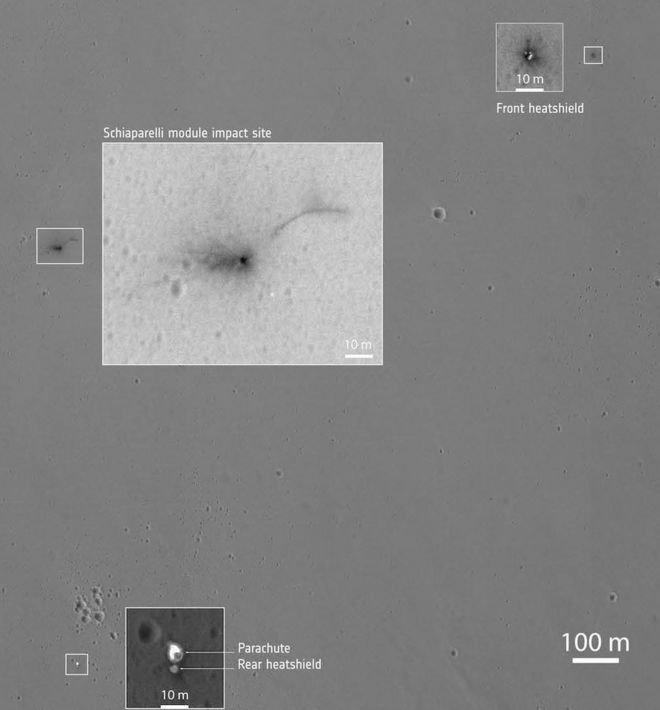
Schiaperelli crash site on Mars. The cause of the crash is not yet known but one hypothesis is that it may be due to a computer glitch. ESA is getting a fair bit of bad press about this, but I think it just shows that it was a well-planned mission. This is the first time that anyone has sent a technology preview mission to Mars before their main mission. That it crashed shows the value of this approach and actually validates their decision.

Out of thirteen landers that have attempted to land on the surface of Mars itself, only seven have been successful, with one partial success Mars 3. There have been four crashes

Successes: Viking 1 and 2, Pathfinder, Phoenix, Spirit, Opportunity, and Curiosity.

Crashes: Mars 2, Mars Polar Lander, Deep Space 2 (same mission as MPL but separate landing) and Schiaperelli

Soft landing but no data or hardly any data, Beagle 2 and Mars 3

Even NASA has had crashes on Mars with its Mars Polar Lander and Deep Space 2 in 1999, which entered the Mars atmosphere independently and both crashed for different reasons. Since then, they have had a string of successes, with Phoenix, Spirit, Opportunity and Curiosity.

However, impressive though that is, you can get a string of four successes easily, even if the chance was only 50/50 of success each time. The chance of four successes in a row is then 1 in 16, or a 6.25% chance. This could mean that NASA is better at landing on Mars than ESA. But the statistical significance is not quite 2 sigma, not nearly good enough for scientific validation that they are statistically better than ESA and Russia. ESA did everything right, including using a radar to measure the distance to the ground.

The ESA has many deep space successes: Mars Express, Rosetta, the Philae Lander was a partial success and was attempting something never done before, Ulysses,  the Huygens Titan probe, and Venus Express. NASA had its seven minutes of terror with Curiosity, which was not hyperbole, there was a real risk it would fail. Indeed, there is no guarantee that Curiosity 2020 will be a success. One hopes it will, of course.
Spacecraft Crash Mars
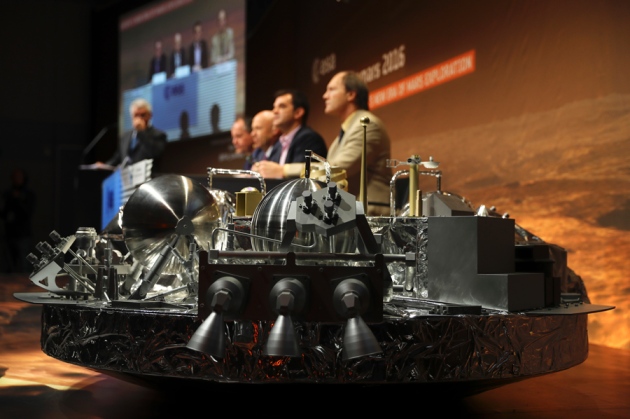
Model of the Schiaparelli  lander, photo: Kai Pfaffenbach/REUTERS

ESA has tested nearly all of the landing sequences with Shiaperelli, and they have returned 600 megabytes of telemetry about the landing sequence. The latest news in a paper published in Nature is that they suspect it may be a computer glitch that caused the crash. If so, this is good news, as a computer bug can be fixed much more easily than a hardware issue.

The total cost of ExoMars, including the test lander on Mars, is only $1.4 billion (though it may cost a few hundred million more) compared to Curiosity’s $2.5 billion. So the test lander on Mars should be compared to the testing NASA did on Earth for Curiosity as part of the total cost of that mission. ESA chose to do some of its testing on Mars itself.

Also, the lunar module can be any shape you like, as there is no atmosphere. The lunar module had a flimsy skin and was not in the least bit aerodynamic in its shape. A Mars lander has to have an aeroshell with a conventional-type landing. It can’t use its rockets until it discards the aeroshell. So the initial slowdown is more or less uncontrolled. You can tilt the aeroshell to give it some aerodynamic control, but not the control you have for a lunar landing.

All that makes it impossible to use a lunar module-type landing on Mars.

So then what about a parachute landing, such as they use on Earth? Well, you can use a parachute, and I think all the landers to date have used one. But the problem with a parachute, even a very large one, is that the atmosphere is so thin that you are still going hundreds of miles an hour when you hit the ground. That is just too much of a hard landing for most spacecraft to survive, though specially hardened penetrators can.

So, that’s two of the stages you have to have for conventional landings on Mars. First, the aeroshell and aerobraking. Then you need the parachute, because it would just take so much fuel to do all the slowing down using rockets.

So then you have to find a way to slow it down from those hundreds of miles an hour to a slow enough speed for a soft landing.

So that’s why you then have the retro propulsion stage for most landers on Mars. But you have to take care because if you do retro propulsion while the parachute is still attached, you will get the lander tangled up in the parachute. So you have to release the parachute first before you fire the rockets. So the moment of parachute release is very important to get that right. It seems that Schiaperelli, for some reason, released the parachute a bit too early, which was the start of its problems.

Even after that, you are still not quite home and dry. The problem is that, unlike a landing on the moon, you have no control over where exactly you land. Instead, you have a landing ellipse. This is the one for Schiaparelli, 100 km by 15 km

There is no chance at all of steering it during the landing, except possibly in the last few minutes; it is just totally dependent on whatever the atmospheric conditions are as you land. The Mars atmosphere is very thin, but it also varies hugely in density between day and night and there are lots of variations depending on altitude, temperature, etc so it is hard to predict exactly.

There’s also the uncertainty of the speed and position of the spacecraft as it enters the atmosphere; there’s always going to be some error there too.

So unlike a lunar landing, where Neil Armstrong could decide exactly where to set down the lunar rover and, if necessary, just fly a bit further to find a good spot, on Mars, you have to be able to land safely wherever you happen to be in that huge landing ellipse. Or you take the risk that if you hit a boulder, that’s the end of the mission.

Viking 1 landed not far from a boulder, which would have been the end of the mission if it had landed on it

They deal with that as best they can by choosing regions on Mars that are very flat; ideally, you want to have hundreds of square kilometers that are pretty much completely flat with no boulders or steep slopes. That’s why Curiosity had to drive for so long before it got to Mount Sharp. It wasn’t safe to land it any closer to Mount Sharp because it would then risk landing on a big boulder or on a steep slope.

Even so, the ground will be uneven and have small boulders. So you have to decide what to do about that. You could build in some smarts into the rocket to get it to fly sideways to avoid rocks, but so far nobody has tried to do that. They just let it land wherever it landed and built a robust system that could deal with irregularities like that.

So that’s the reason for the inflated airbags for Spirit, Opportunity, and Pathfinder, the skycrane of Curiosity, and the crushable base of Schiaparelli—to deal with the tricky last few meters lowering down onto rough terrain.

How Spirit and Opportunity landed on Mars.

Now there are two ideas for ways to simplify this process. The first is supersonic retropropulsion. That’s what Elon Musk plans to do for SpaceX.

Conceptually, it is about as simple as you can get. The rocket doesn’t have an aeroshell, parachute, or anything. It just decelerates.

Early artist’s impression of supersonic retro-propulsion

It slows down by coming in very, very close to the surface in the thicker atmosphere at huge speeds. Its rockets switch on when it is still traveling at supersonic speeds. It skims across the surface below the height of the higher mountains. Indeed if landing in the Valles Marineres, big rift valley, rift in the Martian highlands, it would need to skim down between the walls of the canyon.

All this time, the rocket is firing and it is also affected by the friction of the atmosphere. And then it comes to a vertical landing.

SpaceX has done this on Earth. Their barge landings of the first stage have to use supersonic retro-propulsion and what’s more, they can achieve a pinpoint landing as well, when it works. So it can certainly be done, but it is rather risky and tricky to do on Mars with the very thin atmosphere there and the atmosphere is far more variable in density than Earth’s atmosphere too.

The other way to do it is to use enormous parachutes. If the parachute is big enough, you can have a conventional landing, just like for Earth. Simply use aerosol, then parachute, and parachute down, and the parachute will slow you down enough so you get a soft landing.

The problem is deploying those parachutes and making sure they work. You can work it out with computer models, test tiny parachutes, etc. But at some point, you have to test it with real parachutes. The parachutes on Mars so far were tested by firing rockets in suborbital trajectories and then releasing parachutes, which required many tests.

Making even larger supersonic parachutes will require many expensive rocket tests. NASA is working on this with its Low-Density Supersonic Decelerator – Wikipedia

NASA “Flying Saucer” Supersonic Parachute Fails Test [Video]

I don’t think their plan is to use a parachute all the way down. Rather, it is to land larger masses, of up to 5 tons so would probably still need a complex landing system.

This is just a rough idea of how it works. For more on ways of landing on Mars with supersonic retro propulsion, large supersonic parachutes, etc, hear Robert Manning talk about it here Mon, 03/28/2016 – 14:00

Another approach is to send a penetrator. This has been tried in a small way with the Mars Polar Lander. It carried two miniature probes called Deep Space 2, which had their own separate aeroshells, entered the atmosphere separately from it, and hit the surface at 400 miles per hour, designed to do their final slowdown by penetrating the Mars surface.

Deep Space 2 failed; they don’t know for sure about the different hypotheses. Mars Polar Lander also failed. But this is interesting because it shows that we can also have several smaller spacecraft as part of a single mission to Mars—an idea that has never been tried before or since to date. Especially in the more distant future, we could send lots of miniature rovers on one mission.

Another possibility, for smaller missions at least, is to add balloons that don’t land on the surface at all. This gets rid of the last two stages of the complex procedure. Although the Mars atmosphere is very thin, balloons can still float in the atmosphere if they are light enough and have a small payload.

It is also possible to land a balloon in a planetary atmosphere, as we saw with the Venera probes for Venus. This would remove a lot of the complexity of the landing sequence and a Mars balloon could last for long periods of time and explore much of the surface of Mars. It could even come down to touch the surface with a trailing cable and do surface measurements.

Another idea is to send a plane that glides to the surface and does its science in that brief window before impact, the Mars Plane idea, and another idea is to send lots of miniature planes that can land through a controlled stall in the Mars atmosphere in near vertical orientation and take off again.

We could also send penetrators like Deep Space 2 along with any other mission. Indeed, Curiosity uses bars of metal, the “weight bar mass,”  which it releases for trimming purposes, and one proposal by Gilbert Levin is to add life detection instruments on penetrators to those probes, which would not add anything to the weight of the mission or even change the design as those trimming bars are released anyway and impact the surface at high speed, which is ideal for a probe like that.

We could do all of these right now, years ago indeed, but NASA tends to be rather unadventurous, wanting to use ideas that it knows work or is pretty sure will work. It’s done many innovations, such as airbags and sky cranes, but the idea of adding miniature planes and balloons, more penetrators, hopping robots, and various other ideas seems a step too far at the moment for them.

NASA talks about these ideas and has studies done, but so far they have never gone beyond concept studies to an actual mission. I’m not sure why that is. But perhaps it is not surprising given the hundreds of millions of dollars price tag.

Perhaps as prices go down and other countries get involved, we may get missions like this.

We could also send interplanetary cubesats. Being very lightweight, they could be added as a secondary mission. Since that is done frequently on missions closer to home, I think it is only a matter of time before we start to get interplanetary cubesats included as a part of a Mars mission, communicating with Earth via orbiters around Mars. But AFAIK, there are no firm plans to include any of those in the near future upcoming missions by ESA, Russia, NASA or China (all of whom have plans to launch landers to Mars in 2020).

All this has major implications for planetary protection on Mars. Given how easy it is to crash on Mars, how can we possibly land humans there without a significant risk of a crash? A crash of a human-occupied mission on Mars would mean the end of all planetary protection on the planet.

I’d say that this means that our end objective for humans on Mars should be to have humans in orbit around Mars controlling rovers on the surface via telepresence, a very exciting mission in its own right. I think we shouldn’t look any further ahead but leave later decisions to be made once we understand Mars much better than we do now.

Android 7.0 Nougat Will Bring 5 Best Features Into The Device

0

Google’s new Android 7.0 Nougat update has amazing features that are ready to load in Samsung, OnePlus, Lenovo, Motorola, LG, Sony, Xiaomi, and many other smartphones.

Google devices Pixel and Pixel XL have already been loaded with Android 7.1 Nougat OS straight from the box. Currently, smartphone companies are working on their smartphones to bring in the Android 7.0 Nougat update on the announced list of devices in the tech market.

According to Android Central, Google has not made any major changes in the way how phone looks. But, under the hood, Google has come up with new features to the all-time favorite operating system of smartphone users.

Mobile data usage:

The biggest concern is the apps running in the background and consuming a lot of mobile data, which in turn disappoints the current mobile user generations. Android 7.0 Nougat has a new feature added to it.

The data-saving setting blocks random background data usage and restricts data consumption on updating emails and Facebook or Twitter notifications.

Multi-Window Tasking:

According to BGR Google has made a good introduction to multitasking facilities in its new version of Android 7.0 Nougat. The users can now open two apps side by side, thus allowing watching YouTube videos simultaneously with Facebook activities or emails with Twitter notifications and much more.

This feature will give a real feel for the multitasking abilities of smartphones. The two apps working simultaneously will divide the screen half by half for easy usage.

Improved security:

Security is one of the basic needs in smartphones currently. Keeping data private and secure is very important. A new feature in the Android 7.0 Nougat update will keep the security risks at high importance.  Basic apps like phone calls, text messages or Alarms are made available without passwords or pins. The other apps are indeed made secure until and unless passwords or pins are inserted.

Improved security Android 7.0 Nougat

In Android 7.0 Nougat, access to apps is limited based on the user’s requirement and denies access to whole external storage or internal storage unnecessarily.

The geo-location API is allowed over secure origins, this policy is designed to secure the information of the users when accessed to unknown internet sources.

Less battery usage and faster phone performance:

According to Android Central,  “Project Doze’ – Google’s development which was introduced with the Marshmallow version has got an update in this latest Android 7.0 Nougat version. This feature restricts the phone from using unnecessary battery power when the phone is not in the user’s hand.

When the phone screen is off for a while, the background running things comes to a halt and uses what Google calls ‘Windows” to check for new messages and update the user’s location.

Android 7.0 Nougat has also the capability to manage the memory in a better way and doesn’t allow many unnecessary things to happen in the background. Thus, allowing the required user apps to run which makes the phone perform faster and saves battery discharge.

Android TV recording and picture-in-picture:

Basic DVR functionality will be soon available with Android TV 7.0. The users can schedule the TV programs and record them as being watched.

This feature adds pleasure for TV viewers using Android-based smartphones and indeed great English serials with all seasons can be recorded at the time of watching.

Three Astronauts Return To Earth After 115 Days On Board The Iss

0

Three astronauts have landed safely in Kazakhstan following a 115-day mission aboard the International Space Station. The team included US astronaut Kate Rubins, the first person to sequence DNA in space.

Russian mission control confirmed the touchdown of NASA’s Rubins, Roscosmos’ Anatoly Ivanishin, and Takuya Onishi of the Japan Aerospace Exploration Agency on Sunday morning.

The trio landed southeast of the Kazakh steppe town of Zhezkazgan in clear but frosty conditions after a flight from the orbital lab.

“Landing has taken place!” Russian mission control stated, with commentators on Nasa TV noting that the Soyuz craft had landed in an upright position.

Molecular biologist Rubins and Onishi were both returning from their first missions in space, while flight commander Ivanishin undertook a five-month mission to the ISS five years ago.

Molecular biologist Rubins Astronauts

Footage from the landing site on NASA television showed Rubins smiling after she was hoisted out last from the Soyuz descent module.

“Everybody is feeling wonderful,” said Ivanishin, who emerged first from the craft, in comments translated from Russian.

After they are flown to the Kazakh city of Karaganda, Ivanishin will head to Star City, just outside Moscow, for post-mission work, while Rubins and Onishi will fly to Houston.

Rubins and Onishi will fly to Houston Astronauts

Their journey back to Earth marks the first complete mission to and from the orbital lab for a new generation of Soyuz spacecraft with upgraded features.

The trio’s arrival at the ISS was delayed by two weeks as Russian space officials carried out further software tests on the modified Soyuz MS-01 vehicle.

Rookie Rubins’s participation in the mission generated particular excitement after NASA announced plans for the career scientist to sequence DNA aboard the ISS in a world first.

In August, Rubins successfully sequenced samples of mouse, virus, and bacteria DNA using a device called MinION, while Earth-based researchers simultaneously sequenced identical samples.

Nasa said the biomolecule sequencer investigation could help identify potentially dangerous microbes aboard the ISS and diagnose illnesses in space.

ISS and diagnose illnesses in space Astronauts

Rubins was the first woman aboard the ISS since Italian Samantha Cristoforetti returned to Earth with the record for the longest single spaceflight by a woman (199 days) in June last year.

Fellow American Peggy Whitson, 56, will blast off to join an all-male crew at the lab with French astronaut Thomas Pesquet and Russian cosmonaut Oleg Novitskiy from the Baikonur Cosmodrome on November 17.

The blastoff was delayed by 48 hours as Russian space officials sought better docking conditions. Whitson is NASA’s most experienced female astronaut and will command the ISS for the second time after becoming the first female commander of the station on her second space mission back in 2007.

Successful B2B Marketing Steps

0

For B2B marketing, it is not so much about brand recognition, it’s about making sure the right people recognize your brand. To achieve this, it’s crucial to focus on a strategic approach that connects with decision-makers and key players in your target market. By following these steps for successful B2B marketing, you can ensure that your efforts are directed toward the people who matter most and maximize the effectiveness of your marketing strategy.Check out these six key steps to make sure you are getting the most out of your marketing.

1. Define Your Objectives

Albert Einstein once said, “If you want to live a happy life, tie it to a goal.” Working towards an objective will focus on your B2B marketing approach as your business grows.

What do you hope to achieve with your marketing?

Do you want to improve brand awareness, generate leads more efficiently or increase revenue? Will certain metrics be monitored for success?

Actionable Tip: Create specific, measurable, achievable, relevant and time-bound (SMART) goals. Providing your marketing team with a clear roadmap to follow and everyone on the same page as perceptions scale. For example, rather than create a goal to “improve brand awareness”; shift your focus by setting an objective as follows: Grow traffic to our website 30% over the next six months.

2. Research, Research, Research

Once you’ve established your objectives, it’s time to do market research. Effective B2B marketing hinges on deeply understanding your industry, competitors, and most importantly, your target audience.

Collaborative research process showing data analysis, research, and strategy development as part of the successful B2B marketing steps

Here are some key questions to guide your research:

  • Who is your target market? – Understand their pain areas, needs, and buying behavior.
  • What sets you apart from competitors? – Identify your unique selling proposition (USP) to differentiate your offerings.
  • What competitive advantage can you offer? – Are you providing superior customer service, advanced technology, or quick results?
  • Does your current marketing strategy reflect the quality of your product or service?

A deep dive into your market will also help you refine your messaging and ensure you are speaking directly to decision-makers. If your company is a leader in its field, your marketing should reflect that image, positioning you as an industry authority.

Actionable Tip:
Utilize tools like Google Trends, SEMrush, and LinkedIn Analytics to gather insights about your industry, competitors, and audience behavior.

3. Craft Your Message

With clear objectives and a thorough understanding of your market, the next step is to craft a compelling message. Your messaging should be tailored to each specific audience segment you’ve identified.

Key Aspects of Crafting an Effective B2B Message:

  • Address pain points: Focus on how your product or service solves a specific problem.
  • Highlight the benefits: Beyond the features of your product, communicate the tangible benefits it brings.
  • Establish trust: Use data, testimonials, and case studies to back up your claims.
  • Call to action (CTA): Ensure your messaging includes a strong CTA that guides the audience to the next step, such as signing up for a demo or downloading a whitepaper.

Actionable Tip:
A/B test different messaging strategies across email campaigns, landing pages, and ads to see which resonates best with your audience.

4. Determine Best Marketing Outlets

Once you’ve crafted your message, it’s essential to select the right outlets to deliver it. In today’s digital-first world, B2B buyers typically start the purchase process with an online search, making a strong digital presence critical.

Key Digital Channels for B2B Marketing:

  • Search Engine Optimization (SEO): Optimize your website and content to rank higher on search engines like Google.
  • Content Marketing: Publish valuable content (blogs, whitepapers, case studies) that addresses your audience’s questions and needs.
  • Email Marketing: Use personalized email campaigns to nurture leads and build relationships.
  • Social Media: Platforms like LinkedIn and Twitter are excellent for B2B marketing, allowing you to reach and engage decision-makers directly.
  • Paid Advertising: Consider Google Ads or LinkedIn ads for targeted outreach.

However, don’t overlook the power of word-of-mouth. According to the Buyersphere 2012 report, while two-thirds of B2B buyers begin their search online, a significant percentage still value recommendations and referrals higher than digital content. The Nielsen Report on Global Trust in Advertising (2012) reinforces this, showing that 92% of respondents trusted recommendations from people they know—a staggering 22% higher than any other form of advertising.

Actionable Tip:
Encourage happy clients to leave reviews and provide referrals, and integrate customer success stories into your marketing materials.

5. Gauge the Value: Measuring ROI

No marketing campaign is complete without assessing its performance. To ensure you’re getting the most value from your B2B marketing efforts, you need to track and measure the right metrics based on your original objectives.

Common Metrics for B2B Marketing Success:

  • Overall Brand Awareness: Track metrics such as website traffic, social media mentions, and share of voice.
  • Sales Increases: Measure the number of qualified leads generated and the percentage of those leads that convert to sales.
  • Engagement/Business Connections Increase: Look at how many connections you’ve made through LinkedIn, email subscriptions, or direct inquiries.
  • Earned Media Value (EMV): Track any media coverage or mentions you’ve received, whether in industry publications, social media, or other outlets.

Actionable Tip:
Use tools like Google Analytics, HubSpot, or Salesforce to track these KPIs and regularly review your marketing performance to adjust strategies as needed.

6. Refine And Evolve Your Strategy

Finally, you have to fine-tune the plan. Solicit feedback from your audience and act on it. As your business changes, the marketing strategy should also change. Staying ahead of industry trends sharpens the brand and establishes your business as a leader in the market.

How to Refine Your B2B Marketing Strategy:

  • Solicit feedback: Collect insights from your clients and leads to understand their perceptions of your marketing efforts.
  • Keep up with industry trends: Stay ahead of the curve by following industry news, attending conferences, and leveraging thought leadership opportunities.
  • Test and learn: Experiment with different channels, messaging, and offers, and refine your strategy based on the results.

Actionable Tip:
Conduct quarterly or semi-annual strategy reviews to make sure your B2B marketing remains aligned with your company’s goals and the broader market environment.

FAQs About Successful B2B Marketing

1. What is the most important factor in B2B marketing success?

The most critical factor in B2B marketing is understanding your target audience and addressing their specific needs. This allows you to tailor your messaging, product offerings, and marketing channels effectively.

2. How does SEO fit into B2B marketing?

SEO plays a vital role in helping your business get discovered by potential clients who are actively searching for solutions. A well-optimized website with quality content helps establish authority and attract qualified leads organically.

3. Why is content marketing essential for B2B marketing?

Content marketing helps build trust and authority by offering valuable information that solves problems for your audience. By educating potential customers, you position your brand as a go-to resource, making it easier to nurture leads and convert them into clients.

4. How do I measure the ROI of my B2B marketing efforts?

To measure ROI, you need to set clear goals at the beginning and track relevant KPIs throughout the campaign. Metrics like lead generation, conversion rates, website traffic, and sales can help gauge your success.

5. How often should I review and update my B2B marketing strategy?

It’s recommended to review your strategy at least every quarter. However, if you notice significant changes in the market or feedback from your customers, you should make adjustments as needed.

6. What is the role of personal recommendations in B2B marketing?

Personal recommendations are highly influential in B2B marketing, as decision-makers often trust peer recommendations more than any other source of information. Building strong relationships with your clients can lead to valuable word-of-mouth referrals.

Microsoft Products Challenges Apple

0

Newyork: Microsoft launched a new consumer offensive on Wednesday, unveiling a high-end Microsoft products that challenges the Apple iMac along with an updated Windows operating system that showcases three-dimensional content and “mixed reality.”

The US tech giant announced its first desktop computer, called Surface Studio, a $3,000 high-end “all-in-one” device that aims at creative professionals, a segment dominated by Apple.

“We’re creating a new category that transforms your desk into a creative studio,” Microsoft chief executive Satya Nadella said at the unveiling in New York. with a large, 28-inch (71-centimeter) hinged touchscreen display touted as “the thinnest desktop monitor ever created,” Surface Studio adds to the Microsoft lineup of tablet and laptop devices for the premium segment.

“It is a new class of device that transforms from a desktop PC into a powerful digital canvas, unlocking a more natural and immersive way to create on the thinnest display ever built,” said Microsoft vice president Terry Myerson.

The new PC has an ultra-HD 4.5K display, offering more pixels than most new high-definition televisions. It will be available in “limited quantities” for the upcoming holiday season, with more units available in 2017.

The new device drew a mixed response from analysts.

“Yes, this is very cool. But what’s the market for a $ 3,000 computer you can draw on? How many people have that job?” asked Benedict Evans of the venture firm Andreessen Horowitz in a tweet.

But Avi Greengart at research firm Current Analysis said the new Microsoft products “are aimed at setting a high mark for the Windows ecosystem.”

Microsoft also announced an updated Surface Book – its high-end convertible tablet computer – which will sell for $2,400, adding improved graphics and computing power and with an estimated 16 hours of battery life.

“It’s for the people really pushing performance,” Microsoft vice president Panos Panay said.

The Surface devices allow users to create content onscreen with a special pen-stylus, and Microsoft introduced a new disk device called Dial which attaches to the screen and offers additional controls such as viewing the timeline of creation.

New ways to create

Microsoft meanwhile announced its Windows 10 Creators operating system would be offered as a free update in early 2017, enabling users to create 3D content and delve into virtual and augmented reality.

New Ways to Create Microsoft Products

The update offers “new ways to create and play,” said Myerson.

The update will allow for a 3D capture application for mobile devices and a new version of the popular program Paint for 3D objects.

The system will allow users to add three-dimensional emojis and to create and manipulate content they create or scan.

Microsoft general manager Megan Saunders demonstrated how the capture application can scan a sandcastle in three dimensions, and then mix that with other content.

With the new Windows system, users will be able to experience virtual reality with Microsoft’s HoloLens headgear and its Edge browser.

Edge “will act as the portal to display 3D content on HoloLens,” said Saunders.

Microsoft said its hardware partners would be selling Windows-compatible virtual reality gear starting at about $300.

Microsoft is aiming to keep users on Windows as many switch to new mobile devices powered by Apple or Google software.

Analyst Patrick Moorhead, at Moor Insights & Strategy said the move appeared positive for Microsoft.

“I like where Microsoft is going with Creators Update as it reflects PC differentiation and includes elements of what I believe consumers are interested in, albeit hard to execute upon,” Moorhead said.

The analyst added that “3D creation is difficult today and Microsoft is taking initial steps to bring it to the masses.”

With PC sales sputtering, Microsoft has been emphasizing its cloud computing and business services but is also working to stay relevant to consumers with Windows and its various computing and gaming devices. If you are into gaming, you can also check out excellent gaming monitors here.

The new version of Windows will help users sift through email and other messages by creating “people” icons that show messages from important connections.

Bill Gates Urged Britain To Step Up Investment In Science And Research

0

US billionaire philanthropist Bill Gates urged Britain on Wednesday to step up investment in science and research as it prepares to leave the EU.

Speaking at a conference in London attended by more than 1,000 scientists from around the world, Gates pledged to continue his own investment in British research and innovation, despite the economic uncertainties surrounding Brexit.

“The world needs innovative leadership now more than ever,” the Microsoft co-founder said.

“The complexity of our most urgent global problems—extreme poverty, the persistence, and spread of disease, feeding a growing world—requires that we invest in science and put our best minds to work on finding solutions.

“As the UK seeks to negotiate its exit from the EU, it is critical that the government steps up its investments in science and innovation if we are to meet the challenges of tomorrow and grow the UK’s economy.”

His comments come amid fears that British science may suffer if projects lose European funding after Britain leaves the European Union.

Virgin founder Richard Branson, also speaking at the event, echoed the call for investment to drive innovation.

“British scientists, engineers, and innovators have been responsible for some truly transformative developments in health and poverty alleviation over the years but these changes are not possible without sustained investment,” he said.

Investment in science and research Bill Gates

Calling philanthropists, government, and business to play their part, he added: “These investments benefit British businesses as well as the most vulnerable people in the world.”

Gates was also backing an $18 million (16 million euro) international funding program to combat Zika and other mosquito-borne viruses in Colombia and Brazil.

The funding, from the governments of the United States, Britain, Brazil, and Colombia, as well as the Wellcome Trust and the Bill and Melinda Gates Foundation, will finance trials of an innovative mosquito control method using the Wolbachia bacteria.

Wolbachia is a naturally occurring bacteria found in around 60 percent of insect species, but not the Aedes aegypti mosquito, which carries dengue and Zika.

Research has shown that bacteria can prevent mosquitoes from transmitting viruses to humans.

Trials will be carried out in urban areas of South America, including Rio de Janeiro and parts of Antioquia, Colombia, with researchers hoping to demonstrate a significant reduction in new cases of Zika, dengue, and chikungunya.

NASA Growing Lettuce In Space

0

The International Space Station (ISS) has been planted with lettuce by NASA. It is done to learn how to grow fresh food in space and it may also help prepare astronauts for future missions to Mars.

This is the third on-orbit crop of red romaine lettuce by astronauts aboard the ISS, said NASA.

The Veg-03 experiment was initiated by NASA astronaut Shane Kimbrough. This was one of his first science assignments as a new crew member aboard the orbiting laboratory.

The study is an approval of the tools and procedures that are necessary to grow plants in order to provide fresh food for astronauts.

Veggie team members watched from their consoles, as Shane Kimbrough worked in the Experiment Monitoring Area located in the Space Station Processing Facility at NASA’s Kennedy Space Center in Florida.

Scientists watched Kimbrough’s actions and ensured he did not encounter any challenges with the activity or hardware with the help of a live video downlink.

“Operations went great today! A little slower than expected, but all plant pillows were successfully primed for the first time in our Veg series,” said Nicole Dufour, NASA’s Veggie project manager.

NASA Growing Lettuce In Space

Plant pillows are small pouches already containing a growth medium, fertilizer, and seeds; astronauts add a little water to start them growing.

“We previously have had some hardware issues that prevented at least one pillow from each ‘grows out’ from being successfully primed, so we were very excited to achieve that milestone,” she said

Veg-03, using the Veggie plant growth facility aboard the station, builds on the successes of previous studies. The studies include  Veg-01, which resulted in the first-ever on-orbit harvest and sampling of fresh produce in 2015.

“Once the plants are approximately four weeks old, a selection of leaves can be harvested for a bit of fresh lettuce and possibly science samples,” said Dufour.

“Meanwhile, some leaves are left intact along with the core of the plant, and will continue to grow and produce more leaves,” she said.

“We expect this will increase the on-orbit crop yield, as well as allow for more opportunities to supplement our astronauts’ diets with fresh, nutritious food from the same plants, which is an important goal of the ‘pick-and-eat’ food concept,” she added.

13-year-old Indo-American Science Girl Awarded As ‘America’s Youngest Scientist’!

0

The future of the world is in good hands. We can safely say that because children today are stepping forward and finding their ground. Proving that future generations will harbor a lot of young and creative minds, a 13-year-old Indo-American girl is doing everyone proud by winning the title of “America’s Youngest Scientist.”

Maanasa Mendu, the science prodigy, is a student at William Mason High School in Mason, Ohio, and has won the 2016 Discovery Education 3M Young Scientist Challenge along with the prestigious title.

Her revolutionary development of a wind Energy Device is what made everyone stand up and take notice. This has also won her a whopping $25,000 as a cash prize.

America’s Youngest Scientist Science prodigy

As per The TeCake, Maanasa developed an innovative technology for generating energy from the leaves of solar light. The solar cell and piezoelectric material enable the leaves to generate power from rain, wind, and the sun, which they can eventually convert into modified forms as needed. The leaves work exactly like the solar plant, which derives its power from nature. The device incorporates highly sophisticated and refined technology, yet remains affordable, costing only $5, according to audioalter

Inspired by a visit to India and moved by the challenges faced by villagers with limited access to energy and water, she conceived a cost-effective technology to generate both resources.

She owes her inspiration to a visit to India, where she saw villagers suffering from a lack of energy and water due to their low accessibility and high cost. Witnessing this, she got the idea to create a cost-effective technology that will generate water and energy.

PayPal Gets Integrated With Facebook Messenger

0

PayPal Holdings Inc. is the latest payment provider to look to the world of social media for a new way to grow. Integration with Facebook Inc., announced early Monday in a blog post by PayPal, will have the social network make the payments giant a way to pay across a broader range of new online shopping features. PayPal will also now make it possible to receive messages about any purchase, like a receipt, through Facebook’s Messenger chat service.

While tech companies like Facebook, Apple Inc., and Google Inc. have at times been viewed—or feared—as potential new entrants into payments and banking, arrangements like these suggest the reality may be more complicated. “Most of the tech ecosystem chooses to partner,” said Bill Ready, PayPal’s chief operating officer, in an interview. “Financial services are messy and difficult, and they have regulatory burdens and compliance issues. If you’re not an expert in that space, it’s burdensome to do so.”

Still, PayPal and Facebook remain competitors in some respects. Notably, they offer competing services when it comes to digital person-to-person payments. Many experts see payments integrated into social interactions, like chats or posts, which is commonplace in China, as the future for the U.S. It is still early days, though, in terms of volume.

For now, Payments in Messenger is an alternative to PayPal’s own apps, including the popular Venmo. The new partnership won’t extend to these “P2P” payments, Mr. Readysaid.

People and businesses using Messenger exchange over a billion messages a month, according to Facebook; the company doesn’t disclose payment volume. “We’re thrilled that financial services companies…continue to expand their partnerships with us,” said Stan Chudnovsky, Facebook’s head of product for Messenger, in an email.

PayPal

Venmo’s app, which allows users to post quirky public messages about payments to friends, is on track to transfer $20 billion this year, PayPal has said. Facebook hired former PayPal President David Marcus as its vice president of messaging products two years ago.

Already, PayPal enables Facebook to let people pay for other services—like ordering a car via Uber Technologies Inc.—from a chat in Messenger.

The new deal will see PayPal and Facebook allow each other’s users to link their accounts and to offer a PayPal payment option across more of Facebook’s new offerings. That includes when merchants sell via online stores within Facebook or when merchants make sales via automated chatbots in Messenger.

The deeper alliance with Facebook is part of PayPal’s broader strategy of joining as many venues for payments as possible, even if they are less profitable, to drive volume. PayPal earlier this year struck new deals with Visa Inc. and MasterCard Inc. to ensure that it is accepted in mobile wallets—though they came at the price of having to promote the use of cards, which carry a higher fee for PayPal.

PayPal last week announced a new deal to work with one of Alibaba Group Holding Ltd.’s sites and power purchases on social media sites, including Pinterest Inc. Buying on a social media service rather than through a seller’s app or website is still relatively nascent, and efforts such as a “buy button” on services like Twitter Inc. have mostly failed to live up to the hype so far.

PayPal and other payment firms have also teamed up with Apple Inc. While Apple Pay does compete with PayPal services such as mobile and web-based One Touch buttons, PayPal’s Braintree payments software business also enables merchants to use Apple Pay.

In September, PayPal’s Venmo—along with firms like Square Inc. and Circle Internet Financial Ltd.—were added to Apple’s iMessage service, making it possible to send a payment via a text. Venmo also lets you ask Siri, Apple’s voice-recognition service, to send money to a friend.

Square’s service provides a payment option for Snap Inc.’s Snapchat.

Circle’s founders, when their Apple service launched, wrote: “The deep integration of consumer payment experiences with messaging will likely define the retail finance franchise of the future.”

Chevrolet Camaro ZR1’s Record-setting Nurburgring Lap

0

Chevrolet is trumpeting the speed of the 2017 Camaro ZL1 with a video of it lapping Germany’s famed Nurburgring circuit in under 7min 30sec.

In posting a time of 7:29.60, Chevrolet is boasting that it is 11.67 seconds quicker than the previous ZL1’s fast lap.

We would expect a “new” 6.1-liter supercharged V8-powered ZL1 Camaro that puts out 880 Nm of torque to be faster than the 5th generation ZL1. The only changes from the stock production 2017 ZL1 model were the installation of data acquisition equipment, a roll hoop, and Sparco racing seats with six-point harnesses.

But where does the 7:29.60 lap time fit among those “fastest” around the famed circuit?

Remembering that there is no officially sanctioned organization or process that governs or certifies listed times, the website nurburgringlaptimes.com has what seems the most comprehensive list of fastest production car laps around the 20.8km monster.

The new ZR1’s lap time positioned it impressively in 30th place, showcasing its velocity simply before the Mercedes SLS AMG GT, which achieved a time of 7:30 lower back in 2012. Notably, the ZR1 outpaced recent lap facts set by using high-overall performance automobiles together with the Alfa Romeo Giulia Quadrifoglio in 2016, the Ford Shelby GT350R in 2015, and the Chevrolet Camaro Z/28 in 2014. This remarkable feat highlights the ZR1’s outstanding overall performance in contrast to different famous sports cars in recent years.

However, the ZR1 is significantly slower than the likes of the Porsche 918 Spyder which went 6:57 in 2013, Lamborghini Aventador LP 750-4 Superveloce 6:59.73 in 2015 and the Nissan GT-R Nismo 7:08.68 (2015). Other recent (post-2014) times also faster than the Camaro have been set by Mercedes SLS AMG Black Series 7:26.40 and BMW M4 GTS 7:27.88.

The fastest manufacturing car Nurburgring lap instances are held via the Radical SR8LM (2009) with a blistering time of 6 minutes and 48 seconds and the SR8 (2005) follows closely behind at 6 minutes and 56.08 seconds. These impressive lap instances showcase the first-rate performance abilities of those Radical models on one of the world’s most difficult race tracks, demonstrating their agility, speed, and precision through the twists and turns of the Nurburgring. Both automobiles have left a long-lasting mark on the automobile world with their remarkable track times, solidifying Radical’s popularity as a producer of high-performance racing machines.