Ever had to wait for hours to go to a decent toilet just because you didn’t know if any were around, or because the ones you found were simply too dirty? Those days may be soon behind you, because the Ministry of Urban Development (MoUD) is launching a Google Toilet Locator in association with the search giant, with a view to helping people find the nearest and cleanest toilets in cities and towns across India.
The facility, which will be available on Google Maps, will be piloted in the National Capital Region (NCR) starting sometime within the next 15 days — from November 16 to November 30 — which the MoUD is celebrating as Swachhata Pakhwada or Cleanliness Fortnight.
Which toilets will be listed?
An MoUD official, who did not wish to be named, told International Business Times, India, that the ministry is already in the process of rolling out this facility in the NCR region. She also said the toilets would include not only the public restrooms or Sulabh Shauchalays in the area, but also those in public places like metro stations, malls, petrol pumps, and hospitals.
Another MoUD official said on condition of anonymity that the facility would be available on Google Maps, and people would be able to search for toilets around them from the app itself. He also said the process for these toilets being listed for the NCR was almost over, so the toilets for that region would be available on Google Maps within the fortnight.
How will the facility work?
Explaining the procedure, he told IBTimes India: “People will first need to open Google Maps, and then search for toilets near them. They can search for a variety of keywords, like ‘toilet’, ‘lavatory’, ‘swach’, ‘swachhata’, ‘shulabh’ or ‘shauchalay’, and Google will point them to the nearest toilets.” The search can be similar to how people look for film theatres or restaurants on Google Maps.
But what about dirty toilets or ones that are closed? The ministry official said: “The system being put in place relies heavily on crowdsourcing, with people’s feedback helping fuel it. Therefore, if a person finds that a toilet is not clean, he or she can give it a bad review or rating, the facility for which is available on Google Maps.”
When will the whole country get the facility?
While Google Toilet Locator is being piloted in the NCR starting sometime in the next fortnight, there is no fixed timeline for when the whole country will get it, said the MoUD official. However, he also told IBTimes India: “Mechanisms are in place for the facility to be scaled up, and for it to reach all the 2,041 urban local bodies (ULBs) of the country.”
He went on to add that the feedback from the pilot project would help them expand the program to other urban areas in India. “We will write to all the ULBs and hold workshops for ULB officials to help them monitor the toilet situation,” he said.
A business plan is a blueprint of your business; what you want to achieve and how you plan to go about it. A well-written business plan can mean the difference between success and failure. Business plans may be internally or externally focused.
Depending on the target or goal of writing a business plan, it is always important to convey the ideas that will make the business succeed or attract the necessary funding needed if you are targeting an investor. These are nine of the common business plan mistakes that should be avoided.
1. No clear answer to “What problem are you solving?”
The problem you are solving should be very obvious to investor if you intend to raise money. Investors want to know what the problem is and how you intend to solve it right from the beginning of your pitch when you get the opportunity to present it. Your solution should be clear in your plan and be prepared to defend it passionately.
2. No clear specific, realistic and attainable goals and objectives.
What do you want to achieve? Set specific, measurable, attainable, relevant and time-bound goals. What do you want done in the first year? Break it down. What percentage of the product can be build in the first six months when begin intensive work on it? Are your goals realistic given the team and the resources you have.
3. Overestimating the value and desirability of your product.
How many people have you interviewed who are ready and willing to use your product once you launch it. Is there a need for your product? Have your verified your product? Get the basics right, find out if there is a need for it before you make an investment of time and resources into a product that may not sell as you expect.
4. Minimal market and competitive analysis to identify what you are up against.
Don’t underestimate your competition, they can crush you before you even start. You should be offering something better than what is currently on the market. Can you beat the competition? If you are thinking of killing eBay or Craiglist, think again. Acknowledge your competition and your weaknesses and take advantage of your strengths.
5. Overestimating market share, growth and revenue.
Your goal isn’t to fit in; you want your business plan to stand out and achieve it’s purpose. But what you don’t want is to overestimate how much market share you will capture by year two, three or four and no mention of how to defend and sustain that growth you are promising yourself and your potential partners.
Your competition have been in business for years and still cannot boast of greater percentage of the market share yet. Your market share, growth and revenue will not be as high as you expect even in third year. Prepare for the worst but work for the best.
6. Overly optimistic financial numbers.
Almost every business plan has “hockey stick” financial numbers. You start off with little or no revenue in the first year and by the third year or fourth year, your numbers are hitting the roof. That is simply unrealistic. Ask any practical entrepreneur and he or she will tell you the real situation on the ground. Forget what your business lecturer thought you because it never work out the way you planned it. Prepare for surprises.
7. Not enough detail on how the capital will be used…
If you are requesting for funds, your potential investors want to know how you intend to use that money. You should clearly spell out how much goes into employee salary, marketing, and how much will go into the actual development of your product (that is what you want to focus on when you don’t have a product yet.)
8. Using a template with limited changes.
Business plan templates have worked in the past for first-time entrepreneurs. Most entrepreneurs still rely on niche business plan templates to quickly put together a great plan they can work with. Don’t just use any template without making the necessary changes to reflect your exact needs.
9. Underestimation of the financing required.
If you intend to seek funds from investors, the worst thing you don’t want to do it to request funds that will get you nowhere. Of course, you also don’t want to seek too much money you don’t need. Access your present situation, work out what can take to you break-even point, and request what you really need to go the extra mile.
Savvy entrepreneurs should focus far more on building actual products and the eventual pivot points than on sticking to a written plan. Don’t waste too much time on your business plan. Business plans are about business execution and management gets to work as soon as possible.
As President-elect Donald Trump prepares a team that will transition into the White House this January, world leaders are preparing for their own transition: a relationship with the next U.S.A. president. Among those ready to work with President-elect Trump? Many of the world’s most authoritarian leaders. ABC News looks at the most recent comments from strongman leaders, from Syrian President Bashar al-Assad to the Philippines’ Rodrigo Duterte.
Syria’s President Bashar Assad is sworn in for his third, seven-year term in Damascus, Syria, in this July 16, 2014, file photo.
Syrian President Bashar al-Assad
In an interview on Portuguese television, President Assad, who has kept a firm grip on power in Syria despite five years of civil war, said a Trump administration would be a “natural ally” to Syria if Trump goes after terrorists.
When told Trump seemed ready to work with Syria to fight ISIS, Assad responded positively but also cautioned that Trump must “deliver.”
“Of course, I would say this is promising, but can he deliver? Can he go in that regard? What about the countervailing forces within the administration and the mainstream media that were against him? How can he deal with it?” Assad asked. “That’s why for us, it’s still dubious whether he can do or live up to his promises or not. That’s why we are very cautious in judging him, especially as he wasn’t in a political position before.”
“So, we cannot tell anything about what he’s going to do, but if, let’s say, he is going to fight the terrorists, of course, we are going to be an ally, a natural ally in that regard, with the Russians, with the Iranians, and with many other countries that wanted to defeat the terrorists.”
The Obama administration has charged that Assad’s forces have not focused on fighting ISIS but have instead waged war against rebel groups. The Syrian regime has been accused of using chemical weapons against its own people. Its Russian allies, which have been backing the Syrian military from the sky with aerial bombardments of civilians and hospitals, have also been accused of committing war crimes by the United Nations Security Council.
Russian President Vladimir Putin addresses newly arrived foreign ambassadors of 15 countries during the receiving credentials ceremony in Moscow’s Kremlin, Russia, Nov. 26, 2015
Russian President Vladimir Putin
President Putin congratulated President-elect Trump by telegram last week, expressing hope that the two could repair U.S.-Russian relations that have deteriorated over Russia’s role in Syria and its ongoing military intervention in Ukraine.
In a phone call between Putin and Trump on Tuesday, the men spoke about “the extremely unsatisfying state of Russian-American relations but also expressed themselves in favor of active joint work for their normalization and opening the path to constructive cooperation on the widest range of questions,” according to the Kremlin.
“In particular, the importance was underlined of the creation of a reliable basis for bilateral connections on the way to develop their economic trade components,” the Kremlin said.
The U.S. Treasury Department has imposed a range of sanctions on Russian companies and individuals.
President-elect Trump told Putin he is “very much looking forward to having a strong and enduring relationship with Russia and the people of Russia,” according to his transition team.
Philippines President Rodrigo Duterte delivers a speech at the Davao International Airport Terminal building early on Sept. 30, 2016, shortly after arriving from an official visit to Vietnam.
Philippine President Rodrigo Duterte
President Duterte has congratulated Trump on his “well-deserved victory” and signaled that he and Trump would work well together.
“We don’t have any quarrels. I can always be a friend to anybody, especially to a president or the chief executive of another country. He has not meddled in human rights,” Duterte said Tuesday, according to Reuters.
Duterte has colorfully criticized the United States, including telling America to “go to hell” because “you’re all s—.” He called President Obama a “son of a whore” and declared in October that the Philippines, a longstanding ally, would “separate” from the United States.
Despite Duterte’s continued threats, the U.S. and Philippine special forces begin annual combat exercises today.
Turkey’s President Recep Tayyip Erdogan speaks after an emergency meeting of the government in Ankara, Turkey, July 20, 2016.
Turkish President Recep Tayyip Erdogan
Speaking to reporters today, President Erdogan criticized the protests against President-elect Trump happening across the United States.
“Hold on a second. The election process just ended; show some respect! How will he govern, Let’s see that first,” Erdogan said, according to The Associated Press.
Turkey, once thought to be the next great democracy, has become increasingly authoritarian under Erdogan’s leadership. Since a coup attempt in July, Erdogan has worked to cement his power, purging military leaders, press, and government officials he deemed threatening to his administration.
Turkey has been a critical ally to the U.S. in the fight against ISIS, allowing the U.S. military to conduct some operations from its Incirlik air base. But critics say Erdogan’s government is more worried about fighting the Kurds and maintaining influence in parts of northern Syria and Iraq than combating ISIS.
North Korean leader Kim Jong-Un salutes as he watches a military parade to mark 100 years since the birth of the country’s founder and his grandfather, Kim Il-Sung, in Pyongyang on April 15, 2012.
North Korea’s Kim Jong-un
One country that hasn’t issued the president-elect congratulations: is North Korea. While North Korean leader Kim Jong-un has not yet commented on the U.S. presidential election, a North Korean diplomat said today that the country does not care who the president of the United States is.
“Frankly speaking, it is not the question that I can answer in my capacity but what is apparent here is that we do not care about whoever becomes the president of the U.S. The fundamental issue here is whether or not the United States has the political will to withdraw its hostile policies toward the DPRK [Democratic People’s Republic of Korea],” Kim Yong-ho, the North Korean Foreign Ministry’s director of the division of human rights and humanitarian issues said Tuesday, according to the AP.
President-elect Trump has said he would be open to talking to the North Korean dictator, even saying last June that he would host Kim Jong-un in the United States.
The U.S., which has no diplomatic relations with North Korea, has been unable to curb the nation’s budding nuclear weapons program. This year alone, North Korea has launched seven (mostly failed) missiles, conducted two nuclear tests, and continued to threaten a strike against the United States.
President George W. Bush famously called North Korea part of the “Axis of Evil” because of its desire for nuclear weapons.
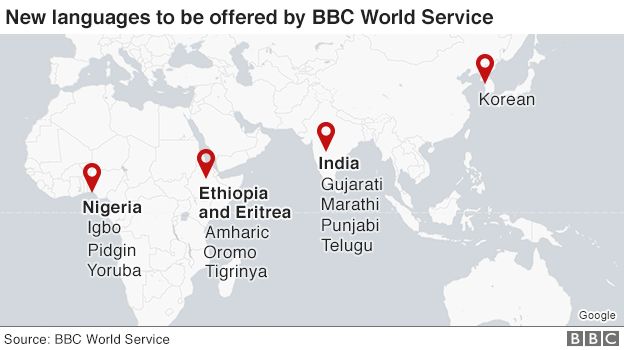
The expansion is a result of the funding boost announced by the UK government last year. The new languages will be Afaan Oromo, Amharic, Gujarati, Igbo, Korean, Marathi, Pidgin, Punjabi, Telugu, Tigrinya, and Yoruba. Lord Hall has set a target for the BBC World Service to reach 500 million people worldwide by its centenary in 2022.
The first new services are expected to launch in 2017.
African languages:
• Afaan Oromo: Language of Ethiopia’s biggest ethnic group
• Amharic: Ethiopia’s official language
• Tigrinya: The main working language of Eritrea, along with Arabic. Also spoken in Ethiopia
• Igbo: An official Nigerian language. Also spoken in Equatorial Guinea
• Yoruba: Spoken in south-western Nigeria and some other parts of West Africa, especially Benin and Togo
• Pidgin: A creole version of English widely spoken in southern Nigeria, Ghana, Cameroon and Equatorial Guinea
• Marathi: From the Indian state of Maharashtra, including India’s commercial capital Mumbai
• Telugu: Huge numbers of speakers, like many Indian languages, primarily in Andhra Pradesh and Telangana
• Punjabi: One of the world’s most populous languages, it is widely spoken in Pakistan and parts of India
• Korean: Spoken in North and South though the dialects have diverged. Pop culture slang and foreign loan words are notably more common in the South
“This is a historic day for the BBC, as we announce the biggest expansion of the World Service since the 1940s,” said BBC director general Tony Hall.
“The BBC World Service is a jewel in the crown – for the BBC and for Britain.
“As we move towards our centenary, my vision is of a confident, outward-looking BBC which brings the best of our independent, impartial journalism and world-class entertainment to half a billion people around the world.
“Today is a key step towards that aim.”
‘Relevant as ever’
The plans include the expansion of digital services to offer more mobile and video content and a greater social media presence.
On Wednesday the BBC launches a full digital service in Thai, following the success of a Facebook-only “pop-up” service launched in 2014.
Other expansion plans include:
• extended news bulletins in Russian, with regionalised versions for surrounding countries
• enhanced television services across Africa, including more then 30 new TV programmes for partner broadcasters across sub-Saharan Africa
• new regional programming from BBC Arabic
• short-wave and medium-wave radio programmes aimed at audiences in the Korean peninsula, plus online and social media content
• investment in World Service English, with new programmes, more original journalism, and a broader agenda
Fran Unsworth, the BBC’s World Service director, said: “Through war, revolution and global change, people around the world have relied on the World Service for independent, trusted, impartial news.
“As an independent broadcaster, we remain as relevant as ever in the 21st Century, when in many places there is not more free expression, but less.
“Today’s announcement is about transforming the World Service by investing for the future.
“We must follow our audience, who consume the news in changing ways; an increasing number of people are watching the World Service on TV, and many services are now digital-only.
“We will be able to speed up our digital transformation, especially for younger audiences, and we will continue to invest in video news bulletins.
“What will not change is our commitment to independent, impartial journalism.”
The new language services mean the BBC World Service will be available in 40 languages, including English.
Lord Hall has set a target for the BBC to reach 500 million people worldwide by its centenary in 2022.
OAKLAND, Calif. — William Faulkner Sci-Fi Bots kept the words flowing with a steady drip of whiskey. Laurence Sterne conquered writer’s block by shaving his beard. Ernest Hemingway stopped writing just when the story got good, so he’d always know where to pick up the next day.
But perhaps the next generation of writers may get a boost from robots that do the hard work for them. An idea, put forth by an American author, is to use artificial intelligence to fill in parts of a story, an email or other document when a writer is searching for the best way to express him or herself. Programs that use neural networks (machines modeled after the brain) or so-called deep learning may be especially useful, Robin Sloan, the author of “Mr. Penumbra’s 24-Hour Bookstore” (Farrar, Straus and Giroux, 2012), said here at the Real Future Fair yesterday (Nov. 15).
“It turns out you can train a neural network on a big body of text,” Sloan said. “It can be Wikipedia; it can be all the works of Charles Dickens; it could be all of the Internet.”
Though these A.I. programs may not be able to craft a masterpiece like “A Tale of Two Cities” just yet, they could get a feel for how certain types of writing sound; “they can use grammar and put words together in interesting and convincing ways — and I think unexpected and beautiful ways,” Sloan said.
Destroying all the high families
Sloan created a writing bot and had it read all of his old science-fiction magazines from the 1960s and 1970s. The program reads and learns the styles of those old-school stories, then, like a robotic Mad-lib, suggests ways to finish off those sentences and paragraphs.
At the fair, Sloan worked with the audience to generate the beginning of a story:
“A long, long time from now in Oakland there was a robot designed to destroy all the high families. The high families were the ones of course who owned the seasons. When they said so it was summer. When they decreed — winter fell.”
Let’s be honest. This is no Ray Bradbury — or even Spock fan-fiction. But something very similar to this writing bot could be a useful tool for gaining inspiration, Sloan said.
“I am 100 percent sure, in some number of years, that text editors will have some version of this,” Sloan said.
For instance, auto-complete programs could read an entire archive of corporate email, so that a person who is trying to get a point across will have suggestions that are in keeping with the corporate style, Sloan said. Or perhaps the next big movie hit will be written by screenplay writers who are locked in a hotel room, bouncing ideas off each other and a writing bot, Sloan said.
This isn’t the first time people have tried to leverage AI in the service of creativity. In 2008, a computer wrote a Russian novel called “True Love,” meant to have the plot line of Leo Tolstoy’s “Anna Karenina” with the writing style of Haruki Murakami, The St. Petersburg Times Reported. Earlier this year, a computer program composed and then painted a new Rembrandt in the style of the Dutch master. In May, a cadre of robot painters took their best shot at creating art in a wide array of styles. And in May, Microsoft had to kill off an A.I. named Tay that was supposed to learn its conversational style from the Internet, after it rapidly learned to be racist.
According to a recent news post from MIT, researchers at the Computer Science and Artificial Intelligence Laboratory (CSAIL) have developed a prototype called “MoVR,” which can make and operate any wireless VR. The system uses special high-frequency radio signals called “millimeter waves” (mmWaves), that allow for the untethered transfer of multiple Gbps, or billions of bits per second.
“It’s very exciting to get a step closer to being able to deliver a high-resolution, wireless-VR experience,” said MIT professor Dina Katabi via the news post, whose research group has been working on the technology. “The ability to use a cordless headset really deepens the immersive experience of virtual reality and opens up a range of other applications.”
The MoVR technology uses programmable mirrors that detect the direction of incoming mmWave signals and can reconfigure themselves to reflect the signals to receivers on active headsets. According to PhD candidate Omid Abari, future versions of MoVR hardware could be as small as a smartphone and would allow for multiple active headsets inside a single playspace, without blocking each other’s signals.
How it works
One issue with existing wireless technologies like WiFi is that they can’t support advanced data processing.
“Replacing the HDMI cable with a wireless link is very challenging since we need to stream high-resolution multi-view video in real-time,” says Haitham Hassanieh, an assistant professor of electrical and computer engineering at the University of Illinois at Urbana Champaign who was not involved in the research. “This requires sustaining data rates of more than 6 Gbps while the user is moving and turning, which cannot be achieved by any of today’s systems.”
Since VR platforms have to work in real-time, systems also can’t use compression to accommodate lower data rates. This has led companies to make some pretty awkward attempts at untethered VR, like stuffing the equivalent of a full PC in your backpack.
The CSAIL team instead turned to mmWaves, which have promising applications for everything from high-speed Internet to cancer diagnosis. These high-frequency waves have one major downside, which is that they don’t work well with obstacles or reflections. If you want mmWaves to deliver constant connectivity for your VR game, you would need to always have a line of sight between transmitter and receiver. (The signal can be blocked even by just briefly moving your hand in front of the headset.)
To overcome this challenge, the team developed MoVR to act as a programmable mirror that detects the direction of the incoming mmWave signal and reconfigures itself to reflect it toward the receiver on the headset. MoVR can learn the correct signal direction to within two degrees, allowing it to correctly configure its angles.
“With a traditional mirror, light reflects off the mirror at the same angle as it arrives,” says Abari. “But with MoVR, angles can be specifically programmed so that the mirror receives the signal from the mmWave transmitter and reflects it towards the headset, regardless of its actual direction.”
Each MoVR device consists of two directional antennas that are each less than half the size of a credit card. The antennas use what are called “phased arrays” in order to focus signals into narrow beams that can be electronically steered at a timescale of microseconds.
Abari says that future versions of MoVR’s hardware could be as small as a smartphone, allowing for users to put several devices in a single room. This would enable multiple people to play a game at the same time without blocking each other’s signals.
Hitachi Ltd. says it has developed camera technology that can capture video images without a lens and adjust its focal position afterward, becoming the first Japanese firm to do so. Generally, conventional cameras contain an image sensor and a lens. The lens is used to collect light to create an image of the captured subject, which is then projected onto the image sensor for the final image.
On the other hand, the technology using a special thin film will allow cameras to be lighter and thinner than conventional units, Hitachi said Tuesday. Unlike the lens, thin film is used to project the shadow created when the light passes through it. Since the photographed images are seen as fringe patterns, the technology will do signal processing to turn the shadows into images that the human eyes can recognize.
In other words, the newly-developed ‘lensless’ camera technology uses optical technology to project shadows and signal processing to convert shadows into beautiful images. That said, Hitachi is ready to launch the technology in the market. In fact, the company aims to commercialize it around 2018.
With Hitachi’s first ‘lensless’ camera technology, thin films have become an essential part of the comforts that technologies provide to people. Aside from the camera industry, thin film technology has helped various industries to create more innovative products. You can learn more applications of thin films at Korvus Technology.
On the other hand, the thin films in cameras can be used in several ways. For instance, Hitachi said the technology can be used in cars and robots, and in situations like autonomous driving, as the industrial conglomerate is putting its focus on the internet of things, a concept under which everything from electronic devices to cars and factories is connected.
Moreover, the ‘lensless’ camera technology can also open the possibility of new thinner smartphones. With the current efforts to improve the camera design, the technology will make the creation of slimmer smartphones possible.
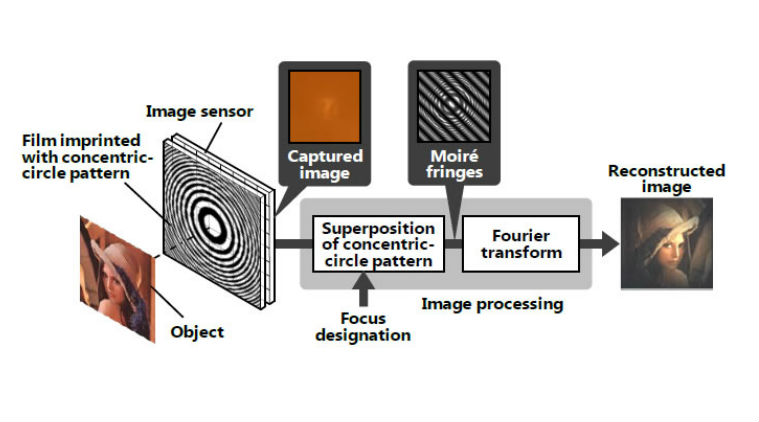
With these potential applications, the ‘lensless’ camera technology is bound to change how the camera and photography industry works. The technology captures images through a film on which a concentric circle pattern is printed. The film is placed between an object and an image sensor.
Another key feature is that the technology can gather planar as well as depth information, enabling users to adjust the focal position of captured footage. When the face of a person is blurred in surveillance camera footage, for instance, its focal position can be changed after taking a shot.
Under the new method, Hitachi focuses on Moire fringes that are created by the superposition of concentric circles.
The image sensor captures a shadow projected through the film patterned with a concentric circle. Another concentric circle pattern is superimposed on the shadow during image processing to get images. The processing speed is 300 times faster than traditional methods, according to Hitachi.
INDIA: Reliance Jio Lyf phones have been selling in India for quite some months now, however, the company still needs to tap the rural and Tier III markets for its data services and mobile business. Jio may soon launch a series of feature phones with 4G VoLTE support. The phones could be priced as low as Rs 1,000.
The report said that Jio may try to reach out to consumers who are first-time data users in rural areas. “Jio wants to tap all the segments in the country and sees huge potential in the rural areas, which it now aims to tap with VoLTE feature phones,” said the report.
There will be two feature phones, if the report is to be believed, priced at around Rs 1,000 and Rs 1,500. Reliance may launch these phones in the first quarter of 2017. Although these are feature phones, meaning there will be no touchscreen, they will be able to run 4G data and will be capable of accessing the internet.
The cheapest 4G-enabled smartphone at present is sold at around Rs 3000, and a huge slice of the market is still based on feature phones. With the launch of such feature phones, Reliance Jio will be able to offer the affordability of a feature phone with 4G VoLTE technology along with free voice calls.
According to IDC’s Q3 report on the Indian smartphone market, “the 4G smartphone shipments grew 24.8 percent over the previous quarter in CY Q3 2016. The rollout of the Reliance Jio network has further increased the share of 4G-enabled smartphones in India. 7 out of 10 smartphones shipped in Q3 2016 were 4G enabled and 9 out of 10 smartphones sold by eTailers were 4G.”
Reliance Jio holds the fifth position in the Indian smartphone market with a total of 7 percent, which is a 20.9 percent growth over previous quarters. We expect these numbers to go up in the coming months when Reliance Jio commercially launches its 4G services along with other new services.
The company is missing a significant portion of the market with the lack of feature phones. According to IDC, about 40 million feature phones were sold in Q3 2016 “with a healthy 18.6 percent quarter-over-quarter growth.”.
While Reliance Jio’s free 4G services and unlimited calls have forced people to switch to 4G-enabled smartphones, if Jio is able to offer a feature phone that can support 4G data and other services, we don’t have any reason to doubt that Jio will once again disrupt the market in the coming months.
A SWOT analysis is a strategic planning tool that helps a business owner identify his or her own strengths and weaknesses, as well as any opportunities and threats that may exist in a specific business situation. A SWOT analysis is most commonly used as part of a marketing plan, but it is also a good tool for general business strategizing, and to use as a starting point for team discussions.
When conducted thoroughly, a SWOT analysis can uncover a wealth of information and can be useful in a number of situations.
This article will walk you through how to conduct a SWOT analysis and provide some tips that will help you use the tool effectively.
Using a SWOT Analysis Matrix
A SWOT matrix is usually depicted as a square divided into four quadrants. Each quadrant represents one element of the SWOT analysis — Strengths, Weaknesses, Opportunities, Threats.
Questions to Ask During the Process
The easiest way to start filling in each quadrant in the matrix above is by answering a series of questions. Use the list below to get started, focusing on the questions that are most relevant for your business and current situation.
Strengths: For this quadrant, think about the attributes of yourself and your business that will help you achieve your objective. Questions to consider:
What do you do well?
What are your unique skills?
What expert or specialized knowledge do you have?
What experience do you have?
What do you do better than your competitors?
Where are you most profitable in your business?
Weaknesses: For this quadrant, think about the attributes of yourself and your business that could hurt your progress in achieving your objective.
Questions to consider:
In what areas do you need to improve?
What resources do you lack?
What parts of your business are not very profitable?
Where do you need further education and/or experience?
What costs you time and/or money?
Opportunities: For this quadrant, think about the external conditions that will help you achieve your objective. Questions to consider:
What are the business goals you are currently working towards?
How can you do more for your existing customers or clients?
How can you use technology to enhance your business?
Are there related products and services that provide an opportunity for your business?
Threats: For this quadrant, think about the external conditions that could damage your business’s performance. Questions to consider:
What obstacles do you face?
What are the strengths of your biggest competitors?
What are your competitors doing that you’re not?
What’s going on in the economy?
What’s going on in the industry?
Using Data Compiled in a SWOT Analysis
One of the most important parts of your SWOT analysis is using the data you compiled to identify new strategies and goals for your business. For example, you can:
Create a plan to build up your strengths even more
List ways you can work on building up your weaknesses
Set SMART goals for each of the opportunities you identified
Devise a plan to use your strengths to decrease the threats you identified
Then, look for ways to combine data from different quadrants in even more ways:
Explore how you can combine your strengths and opportunities to develop new strategies
Try combining strengths and threats to identify threats you can eliminate
Look at your weaknesses and opportunities to create a list of areas ready for improvement
Make a list of areas to avoid that fall under weaknesses and threats
Once you understand how to compile your SWOT data and find ways to use it strategically, the SWOT analysis will be a tool that you can use over and over in your business to explore new opportunities and improve your decision-making process.
Pharmaceutical expenditures in 2014 exceeded USD 1 trillion for the first time, which was equal to 1.3% of global GDP and higher than the cumulative annual GDP of 15 countries. It is estimated that global pharmaceutical expenditures will continue to increase. IMS health project expenditures are expected to increase from USD 1 trillion in 2014 to USD 1.3 trillion in 2018. The world’s five most expensive medicines are as follows:
Why are prescription drug prices soaring?
The cost of R&D and marketing of some new drugs is considered to be one of the reasons why drug prices are soaring. For example, it is known that during the R&D of new drugs, drug developers need to pay certain R&D expenses, but consumers often forget that drug developers also want to recover the dozens, hundreds, and even thousands of times of research losses. Pharmaceutical companies are also vigorously promoting the development of drugs for rare diseases and designing personalized drugs for specific genes or proteins, which means much to pharmaceutical product developers and gives insurance companies few reasons to reject conducting underwriting. This is the reason why prescription drug prices have been rising continuously.
The world’s most expensive drugs in 2015–2016
The world’s five most expensive drugs in 2015–2016 are not Orkambi, or Harvoni of Gilead for treating HCV. In fact, a small number of drugs priced between USD 0.30 million and USD 0.36 million are not listed. However, two points shall be noted first.
Firstly, pharmaceutical drug developers may change pharmaceutical drug prices quarterly, meaning that the drug price ranking may change every three months.
Secondly, the treatment cost depends on the living environment: Harvoni is wholesaled at USD 1125/tablet in the U.S., but the price of the same drug may be as low as USD 10/tablet in overseas emerging markets. In other words, drug prices are slightly subjective, which shall be noted and before buying do not forget to check the summary of drugs
The world’s five most expensive drugs are as follows:
1. Glybera: Wholesale cost of USD 1.21 million per year
We believed that there would be the first drug priced at seven digits someday in the world. And now there has been a drug with such a price: Glybera, based on the EU’s approval of UniQure. Glybera is used to treat a kind of rare disease suffered by one in a million people, therefore Glybera will only have a market of 150-200 persons in the EU.
As a kind of gene therapy, Glybera copies and passes on one functional LPL gene to the skeletal muscle by using a kind of adeno-associated virus (AAV), and is used to treat a kind of extremely rare, inherited and metabolic disease–lipoprotein lipase deficiency (LPLD). LPLD is a rare disease with a morbidity of less than one or two millionths. LPLD patients are unable to process the fat particles in the blood and have the risk of acute and potentially life-threatening inflammation of the pancreas. In the clinical trial, Glybera could significantly reduce the morbidity of acute inflammation of the pancreas of LPLD patients after they received the first Glybera treatment.
2. Soliris: Wholesale cost of USD 0.70 million per year
Soliris researched and developed by Alexion Pharmaceuticals, Inc. has been the world’s most expensive drug over the years, therefore people would be surprised if it were not in the list of the world’s most expensive drugs. The consumption cost of Soliris in the U.S. last year approached USD 0.537 million, and the Patented Medicine Prices Review Board pointed out that the annual cost of Soliris in Canada last year could reach USD 0.70 million per person.
There are two indications of Soliris: paroxysmal nocturnal hemoglobinuria (PNH) and atypical hemolytic uremic syndrome (aHUS), which are both ultra-rare diseases. The reason why Alexion can price Soliris so high is that there is no external competition, and more importantly, PNH patients can survive 10-15 years after being diagnosed, therefore, Soliris can become a long-term source of income for Alexion even though the number of patients is small. After having obtained an income of USD 2.2 billion in 2014, Alexion expected to double its income in 2018.
3. Naglazyme: Wholesale cost of USD 485,747 per year
According to the data of FiercePharma, Naglazyme researched and developed by BioMarin Pharmaceutical Inc. last year, whose annual wholesale cost approached USD 0.50 million, ranked third. The price of Naglazyme has been updated in 2015. The price of this drug may be determined based on the situation of dozens of patients every year, according to Evaluate Pharma. Naglazyme is used to treat mucopolysaccharidosis VI (MPS VI, a kind of rare inherited disease). MPS VI is a kind of severe life-threatening inherited disease. The patients congenitally lack a kind of enzyme, which affects the formation of carbohydrates in the body, thus leading to progressive cell, tissue, and organ system dysfunction.
4. Vimizim: Wholesale cost of USD 0.38 million per year
BioMarin Pharmaceutical Inc., an expert in rare diseases, had brought us the world’s most expensive drug Vimizim. As a kind of enzyme replacement therapy, Vimizim was the first drug approved by the FDA for treating Mucopolysaccharidosis IVA (Morquio A syndrome, MPS IVA). MPS IV (Morquio syndrome) has two subtypes the cause of IVA is galactose-6-sulfatase (GALNS) deficiency and the cause of IVB is a β-D-galactosidase deficiency.
The disease belongs to autosomal recessive inheritance and has the clinical characteristics of significant growth retardation, abnormal gait, and skeletal deformity which gradually becomes significant, with the longevity of most patients of 20–30 years old. There are currently about 800 patients with MorquioA syndrome in the U.S., and Vimizim is considered to have a market of about 3000 persons in developed countries. As predicted by an analyst, Vimizim can bring nearly USD 0.50 million in sales to BioMarin every year, despite of its relatively small market potential.
5. Elaprase: Wholesale cost of USD 0.375 million per year (based on an update in 2010)
Finally, the drug ranking fifth in the world’s most expensive drugs is Elaprase of Shire Plc, which is a kind of enzyme replacement therapy to treat Mucopolysaccharidosis II (MPS II) or Hunter syndrome. You might note that the final price of Elaprase is based on 2010, but there is no reason to believe that its price will fall thereafter because the Shire has no other competitor in the field of treating Hunter syndrome.
Patients with Hunter syndrome lack a kind of very important enzyme (2-sulfatase) that can help remove long chains of sugar molecules. If such molecules are not removed from the patient’s body, it will lead to gradual organ failure, especially for the heart, lungs, liver, and spleen. The morbidity of this disease is relatively low: the EU reported that one in 0.14 million-0.156 million newborns would suffer from this disease. Based on the above, the annual consumption higher than 6 digits will soon become the price standard of rare disease drugs.