What does it take to start and succeed in business? Although there is no one answer that fits all businesses, there are a number of practices followed by successful business owners. No matter what you sell, you’ll be ahead of the game if you live by these ten essential rules for succeeding in your own business.
What does it take to start and succeed in business? That’s a question I get asked a lot. Although there is no one answer that fits all businesses, there are a number of practices followed by successful business owners. No matter what you sell, you’ll be ahead of the game if you live by these ten essential rules for succeeding in your own business.
1. Be true to yourself. No matter how much money someone else makes, if you don’t enjoy the business, wouldn’t be proud to show your relatives what you are doing and how you are doing it, then don’t do it. If you run a business you don’t like or don’t believe in, even if you have temporary success, it will come back to haunt you one way or another.
2. Find a need and fill it. Yes, you’ve heard that a million times. But it still works. The easiest business to run is one that produces products or services that people already know they need. The reason: you don’t have to spend a lot of time and money convincing prospects they need what you sell. You can focus on why you are the best source to satisfy their need. Just be sure the “need” is one people will spend money to satisfy.
3. Choose products or services that you can sell for a lot more than it costs you to make or buy them. If the difference between your cost and selling prices is too low, you will have difficulty growing the business. When profit margins are too low, you won’t have enough money to hire employees, pay for rent (when you need to move the business out of the house), advertise more, and do other things needed to expand.
4. Make realistic estimates of your expenses… then double them. Most new businesses either forget about marketing, fulfillment, overhead costs, income taxes and self-employment or greatly underestimate them.
5. Be true to your customers and prospects. Don’t promise what you can’t deliver. Don’t lie or exaggerate the benefits of what you sell and always deliver a quality product or service. Word-of-mouth marketing has always been one of the primary ways small businesses find customers. The Internet and social networking sites spread the word (good or bad) to even more potential customers.
6. Understand the importance of marketing and learn how to do it effectively. The world won’t beat a path to your door just because you build a better mousetrap or write a great ebook about how to grow tomatoes or teach a child to read. To get customers you will have to market your products or services effectively and continually.
7. Treat your vendors, manufacturers and service providers with respect and let them know you appreciate them. They are an important part of your team and your success. If you speak down to them, pester them with questions you could answer yourself, imply that they don’t’ do a good job, nickel and dime them to death, or are an ongoing pain in the neck, they’ll never go out of their way to help you — and might drop you all together. No business needs picky, annoying, time-consuming customers.
8. Embrace the web. No matter what you sell or to whom, your customers will turn to the web to research and/or buy. They may turn to online yellow pages to find a florist in Florence, SC; use voice recognition on their smartphone to find a nearby restaurant, or use their computer to go to Google, MSN or Yahoo to search for a phrase like “Elder law attorney Farmington Hills MI”, or “plumber weekends Astoria NY.” If customers can’t find you in their queries, they are likely to give their business to one of your competitors.
9. Don’t expect miracles. Yes, people do make money in their sleep or while they’re away on vacation — the Internet makes that possible. But only after they’ve invested a lot of time, effort, and money in building the business and building the team that keeps it going and growing.
10. Remind yourself that one is the loneliest number in business. One product, one service, one main client, and all your records stored on one computer hard drive without regular off-site backups is a recipe for failure. If you only have one product or service you’re missing out on the chance to profit by selling more things to people who already know and trust you. If you have only one main client, you’re up the proverbial creek if they decide to change vendors or run into cash flow problems. And if all your records are on your computer and you don’t have always up-to-date backups of your important files, a hard drive crash could destroy your business
The world is constantly changing and nowadays, with new technology being introduced and developed, it seems that it is evolving faster than it ever has before. Think about it, it hasn’t been two decades since mobile phone use went mainstream, and now, compared to this tech’s early beginnings, there is so much more that you can do with your smartphone device.
Mobile phones are no longer simply machines that you can use for making phone calls and sending simple texts. They have become a mini hand-held computer that gives you the power to surf the net, shop, make payments, book a hotel room, and so much more. It even acts like a GPS, helps you stay in touch with friends via social media and you can play a variety of super-cool games on it.
When you stop to think about all the amazing things you can already do via a smartphone, it’s thrilling to imagine what the future will bring. In fact, you might wonder how smartphones will look in the future.
The following is a brief look at some interesting tech that is likely to become future everyday technology.
Flexible, holographic smartphones
While everyone has a different idea of how smartphone design will change researchers at Queens University Human Media Lab in Australia believe that in the future smartphones will be flexible and holographic like their Holoflex device. This flexible phone features an OLED display. If these kinds of phones are the future this means that you can expect your future smartphone to be bendy with the ability to produce holograms that can be viewed at any angle without the need of 3D glasses or any other type of wearable tech.
Cryptocurrencies
Cryptocurrency like Bitcoin isn’t anything new but it certainly is not a common form of currency used by the average person nowadays. However, this may change. The future of virtual currencies may be a bright one if more and more people, businesses, and institutions accept it as a normal way of paying. If cryptocurrency can provide more stability and liquidity, it could easily become the currency of the future.
Demand-Side Platforms
DSPs are believed to be shaping the future of online digital advertising because they solve resource problems that plague many online advertisers. A DSP platform is one that enables buyers to use one interface to manage things that once would have required multiple systems. The advantages of using a DSP are many from extended reach to flexibility and efficiency.
The Internet of Things (IoT)
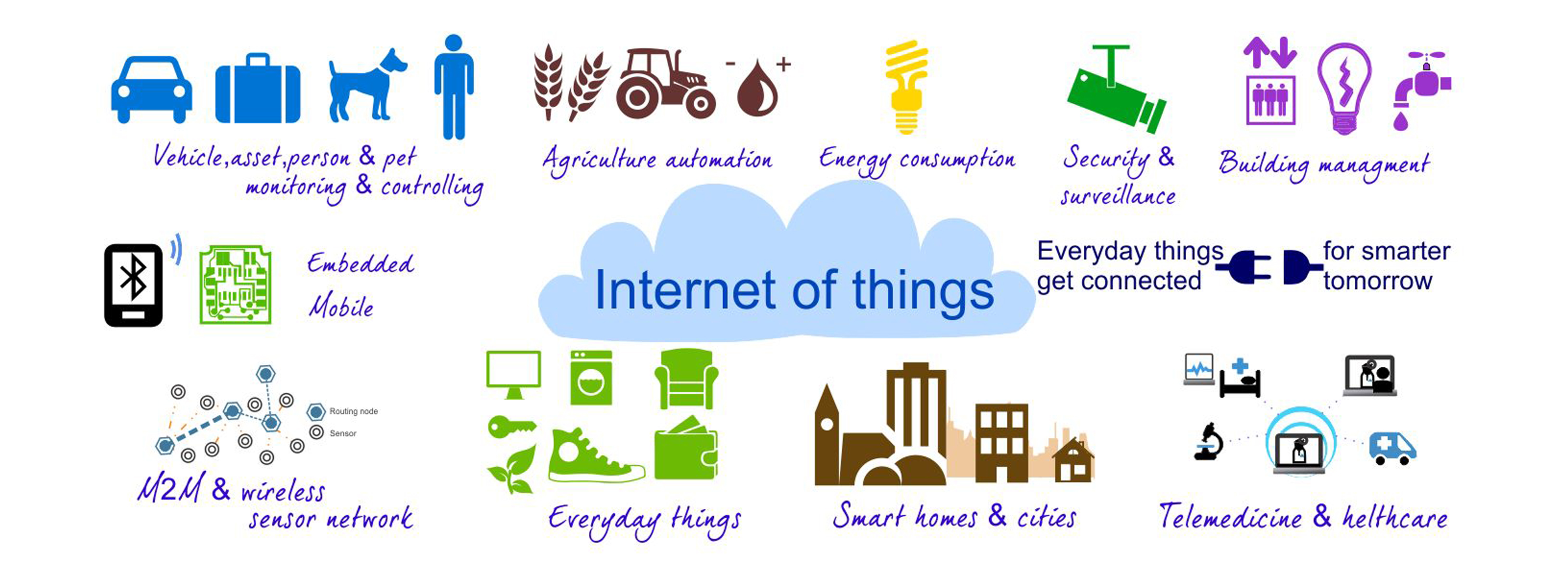
Imagine if everything around you including your car and other objects in your home and at your workplace, contained smart sensors that connected to the internet. These sensors would have the capability of collecting and exchanging data with you, with other smart objects, and with the other people in your life. This network of smart objects is an example of IoT. Considering many devices in our lives already feature smart tech, it’s not hard to imagine the Internet of Things in the future being an everyday technology we naturally incorporate into our lives.
Augmented Reality
This technology gives us an enhanced view of the real world. It is a digital and interactive reality resulting from a superimposed computer-generated image, which can reshape the way that we interact with the world around us. Currently, this technology has been most notably used in mobile and has been well received. That being said, it still has a ways to go before it can provide a truly seamless experience. Keep an eye out for these and other great technologies to become more commonplace in the years to come.
A young company looking for outside funding won’t get very far without a well-crafted pitch. And pitching to investors doesn’t just mean showing them a raft of numbers; it also requires skillful storytelling.
“The biggest challenge is distilling [the pitch] down to something that’s irresistibly compelling,” said Greg Erman, a serial entrepreneur who has founded six medical-technology companies, at a recent conference held by Boston-based The Capital Network.
A compelling pitch is especially important for seed-stage companies these days, given current trends in the venture capital market.
Although first-time financing by venture firms in 2010 were up about 30% from 2009 — with more than $4 billion going to about 1,000 companies — the flow of funds going to seed-stage firms declined by 2%, according to the Moneytree Report by PricewaterhouseCoopers and the National Venture Capital Association.
Similarly, angel investors poured $20.1 billion into growing companies in 2010, an increase of 14% over 2009, but reduced seed-stage investments by 4%, according to the Center on Venture Research at the University of New Hampshire’s Whittemore School of Business.
Erman was one of several experts who talked about creating and delivering a successful pitch at The Capital Network conference. Here, distilled from their discussion, are five tips for talking to investors:
1. Don’t cold-call potential investors.
Use your network instead to connect with angels or venture capitalists. “The first priority in approaching any investor is to have a credible referral,” Erman said.
This person should know “enough about the entrepreneur and the business to be able to offer recommendations that are authentic.”
If an investor allows electronic submissions, entrepreneurs should submit a plan and try to reach out through a referral.
2. Talk about market need, not market size.
A large market by itself will not sell your product, so a pitch should never hinge on the idea that grabbing even a sliver of a huge pie will turn a profit, said Dan Meyer, a partner at Boston-area Rose Ventures.
“It is typically not helpful when companies say they are going to get 2% of an enormous market — especially if not all of that market is applicable to their product or service,” he said. Instead, start from the bottom up and talk about how your product or service addresses a particular need in a unique way, he advised.
Noted Erman, “There has to be a deep understanding of the market dynamics, the buying behavior, and what’s going to motivate a purchaser to adopt your product over the others.”
3. Acknowledge the competition.
Competition may be unnerving to young businesses, but investors see it as a sign there is a market for your product, said Barbara Fox, an entrepreneur who has founded several companies.
Accordingly, investors are looking for the most competent and innovative companies to meet the market need. So how should you discuss your competition? “Never say, ‘No one else is doing this,’” said Fox. “Instead, define them, [and delineate] who is a threat and where there are opportunities.”
But refrain from making sweeping statements about your position relative to the competition, she warned. Investors may have already met with your competitors and know more about their strengths than you do.
4. Show investors where they fit.
“It’s important to lay out where you are in development and what you need investors for right now,” said Fox. Tell investors exactly why their money is important.
If you need funds for a clinical trial, for instance, say so, and specify how much you will need.
5. Practice your pitch.
Investors, said Erman, “are really smart people with no time,” so entrepreneurs must make their proposals quick, concise, and engaging. That requires practice.
Ask someone who is not related to you or your business to critique your presentation, said Erman: “Get people who couldn’t care less about you or what you’re doing.”
In the end, even a sound business plan and a quality pitch may not be enough to persuade an angel or VC firm to invest.
But once you have made a connection with a potential investor, don’t sever it. The investor field is small, and a venture capitalist who rejects you today could help fund your company tomorrow.
Almost every article ever written about entrepreneurs suggests that it’s not for everyone. Yet the articles go on to list attributes that many successful people possess as the traits commonly associated with great entrepreneurs, such as a strong work ethic, persistence, persuasiveness, and discipline. Your inner entrepreneur is afraid to strike out on your own, but it’s also afraid of staying put.
For 25 years, I have studied entrepreneurs and discovered that what contributed to their incredible success was not what society typically considers assets. People like John D. Rockefeller, Henry Ford, and Oprah Winfrey didn’t achieve greatness by possessing the traits and following the narrow path recommended by management gurus.
So, don’t believe everything others say about you or how they label you. Maybe your supposed liabilities are really your assets. Here are 12 signs many people might consider a liability, but which can actually be indications that you are meant to be an entrepreneur.
1. Hate the Status Quo:
It doesn’t make sense to you that something has been done the time-honored way with no explanation why. You are not someone who wants to just go through the motions or sit by idly. Nor do you like following the pack.
2. Easily Bored:
You find yourself easily bored, and others start viewing you as a problem. But nothing is wrong with you except that you are bored with activities that aren’t up to your abilities and aren’t challenging. That’s why you hated most of the classes you ever attended. Think of Bill Gates, who dropped out of college to become one of the richest men in the world.
3. Fired from Jobs:
You’re too creative for your own good when it comes to working for others, and you may have some history, as I do, of losing jobs. Being just a cog in the wheel is very difficult for you because you want to create something others can be inspired by and contribute to.
4. Labeled a Rebel:
You know that greatness resides outside the lines of conformity and don’t think that policies, laws, and regulations apply to you. You have been described as a rebel and rule breaker and you would defy gravity if you could.
5. Resist Authority:
You have a lifelong record of resisting authority from your parents, teachers, and bosses. You don’t go along with the agreed-upon norms of the group or community you work and live in.
6. Ready to Improve Everything:
You always see how you could do things better. In addition, you are opinionated and freely give your two cents about your better way of doing things–even when you’re not asked.
7. Bad at Making Small Talk:
You have difficulty making the kind of small talk that so many people get comfort from. This social pattern of relationship and rapport building seems like a waste of time to you and makes you uncomfortable.
8. Bullied in Your Youth:
You may have been heavily criticized, picked on, and even bullied as a child or teenager. This has caused you to be driven to excel and to prove to the world that you are indeed a force to be reckoned with.
9. Obsessive:
You may have been labeled obsessive or compulsive because when you get started on something you have difficulty letting go. Don’t let anyone convince you that this is a disease or deficiency. All of the great entrepreneurs become completely immersed in their vision. Howard Schultz stuck with Starbucks even when his family tried to persuade him not to.
10. Scared to Go Solo:
The entrepreneur in you is scared of going out on your own—and also terrified of not doing so. This fear is so common in our society because we’ve been conditioned to think that entrepreneurship is much riskier than getting a “good job.” The reality is there is instability in both.
11. Unable to Unwind:
You can’t go to sleep at night because you can’t turn your thoughts off. An idea may even manifest itself in your dreams. The next morning, you find yourself still consumed by that idea, distracting you from the job you’re supposed to be doing.
12. Don’t Fit the Norm:
You have always been a bit uncomfortable in your own skin. Until you get used to the idea that you are in fact different from most people, it could prove to be a problem–or exactly the motivation you need to acknowledge the entrepreneur screaming to get out.
Inspiring women in Pakistan have many immensely talented women working both at home and abroad to make the country and the world a better place.
We have compiled a list of some of the most inspiring women in Pakistan.
1. Roshaneh Zafar
Roshaneh Zafar (@RoshanehZafar) is an active social entrepreneur with an impressive list of credentials. She was an Ashoka Fellow and worked extensively at the World Bank on Water and Sanitation issues. After meeting with Muhammad Yunus and seeing the impact of Grameen banking, she started the Kashf Foundation in Pakistan in 1996 and is the Managing Director of the Foundation. She also started Kashf Microfinance Bank Limited.
“Believing that the Grameen model could help empower women both economically and socially, Roshaneh ignored warnings that a microfinance program focusing on women would not work in Pakistan.” The initiative has since proven to be a success, and the Kashf Foundation provides microfinance, job opportunities, and training for women and supports over 500,000 women and families in Pakistan. Roshaneh Zafar has received several awards including the Skoll Award for Entrepreneurship, Tamghai Imtiaz, and the Vital Voices Economic Empowerment Award, among others.
2. Jehan Ara
Jehan Ara (@jehan_ara) is the President of the Pakistan Software Houses Association for IT and ITES (P@SHA). She has a considerable amount of experience in communications, media, and marketing in several countries around the world, and has put this knowledge to use in transforming P@SHA into a center for industry innovation and growth. She is sought after for events and talks and regularly supports tech innovation forums.
An optimist, she is passionate about product and service development, new ideas, and empowering youth and women in Pakistan. She has helped kick start several initiatives including the Pakistan branch of Women on the Web, Take Back the Tech, and Women’s Virtual Network, all of which aim to have some impact on improving women’s social situations and supporting their entrepreneurial
3. Kalsoom Lakhani
Kalsoom Lakhani (@kalsoom82) founded Invest2Innovate, also known as i2i, in 2011. Invest2Innovate connects budding entrepreneurs with investors and support, in line with their belief that “entrepreneurs have the power to change the world.” They have an i2i accelerator, which provides support to startups and matches them with i2i Angels, their investors.
Kalsoom Lakhani is active in several forums: as a founder and Editor of CHUP blog, co-ambassador of Sandbox, co-chair for Blended Profit, and a World Economic Forum Global Shaper. She worked as Director of Social Vision before she founded i2i, and has considerable experience in building support and networks for startups and young entrepreneurs in Pakistan.
4. Ghulam Sughra Solangi
Sughra Solangi overcame significant odds and a difficult situation to become “an exceptional example of what an oppressed woman can achieve through sheer determination and strength.” Married off at 12 and divorced at 18, she struggled to educate herself at home and despite social and cultural obstacles, went on to get her High School Certificate. She became a teacher and realized that people were not sending their daughters to school for two reasons: lack of funds and social customs. Following her belief that changing attitudes is as important as economic development, she began Marvi Rural Development Foundation.
The Foundation has projects that support literacy, health and well-being, the development of community organizations, income generation, and ending violence against women. She has had significant success in developing her village Solangi, Khairpur District, and developing new villages every year in Sindh. She became an Ashoka Fellow in 1999, and for her achievements, she received the International Women of Courage Award in 2011.
5. Malala Yousafzai
Malala Yousafzai became known worldwide after being targeted and subsequently shot by the Taliban in Pakistan in 2012. Already a vocal campaigner for education in Pakistan, Malala Yousafzai is now one of the most prominent advocates for education in the world today.
She wrote anonymously for a blog detailing her life and education under the Taliban in Swat for the BBC for years before being targeted and having to leave Swat and Pakistan. More recently, she addressed the UN on her 16th birthday and launched the Malala Fund, which supports education for girls around the world.
6. Maria Umar
Maria Umar (@MariaUmar) is the founder of the Women’s Digital League (WDL), which is an online portal that provides digital services. WDL aims to tap into what it calls “a vast dormant workforce which is either discouraged from working outside or has trouble finding work opportunities.” Maria Umar was inspired by the possibilities inherent in such a service, after she had to work from home following maternity leave, and was using oDesk.
It is different from oDESK and other sites because it focuses on women, who for various reasons are unable to work outside their homes, and also women in rural areas who lack the required equipment and training to work online. WDL provides these services and enables women to work online on “data entry and data conversion tasks” and “tasks like WordPress, writing, and graphic design” for various clients.
7. Saba Gul
Saba Gul (@sabagl) is the founder of popinjay, which was previously known as BLISS. Popinjay is a non-profit organization that works with artisans in Pakistan to produce handmade and high-quality handbags. It focuses on empowering these artisans, especially women, as the website states that they “offer our artisan women practical training, fantastic wages, dignity and a path to self-sufficiency. By connecting them to global markets, we bring them a fair value for their work.”
Saba Gul is a graduate of MIT and a self-proclaimed “engineer-at-heart” with a talent for social entrepreneurship and finding solutions to enduring poverty through empowerment.
8. Sabeen Mahmud
Sabeen Mahmud (@sabeen) is the President of The Indus Entrepreneurs (TiE ) in Karachi. She started PeaceNiche and one of its very first projects, T2F, which is also known as The Second Floor Café. T2F is a space for people to come together to partake in events and discussions revolving around activism, innovation, arts, and culture.
She stated in an interview: “It is my biggest dream to change the world for the better through the internet, design, and other communication technologies & T2F is a part of that dream.” PeaceNiche has several projects under its belt, and T2F is just one of them, which aims to find peaceful solutions to social problems through dialogue debate, and inspiring events.
9. Rabia Garib
Rabia Garib (@rabiagarib) has a passion for education and tech innovation. She used to run CIO Pakistan and was a co-founder at Rasala Publications, but is now focusing on being the Chief Wrapper at ToffeeTV, which she founded with @taleazafar. She is also an Eisenhower Fellow and a recipient of the LadiesFund Trailblazer Award.
ToffeeTV focuses on providing children with learning and entertainment in Urdu. Furthering education is a particular interest of hers, as is the medium of music for promoting it. Rabia Garib has promoted the local IT industry and the way it helps to shape Pakistan’s global image and often explains the following: “The future of any country is its children (who then become the youth) and the preservation of its language, culture, and heritage. If you aren’t already focusing on localized content development for education, your future will be shaped by others.”
10. Sheba Najmi
Sheba Najmi (@snajmi) is the founder of Code for Pakistan, a “non-profit building a non-partisan civic innovation ecosystem to improve quality of life across Pakistan.” Describing her project, she explained: “I want to put forth this idea of Gov 2.0 which has caught on all over the world; which is to use apps and data to reframe the relationship between local government and citizens.”
She has extensive experience in design management, product strategy, product management, developing entrepreneurship and startups, and civic engagement. Starting out as a TV anchor and reporter, she previously worked as a Fellow at Code for America and at Yahoo. She also works as a Growth Hacker at Tradecraft, a Consultant at the World Bank, a User Experience Design Consultant at Cloudwords, Inc., and is on the Board of Advisors of Go-Fig Solutions.
11. Sophia Hasnain
Sophia Hasnain has considerable experience in telecommunications and innovative Internet technology. She is currently working as a Trends and Transformations Consultant and has previously worked for Telenor in Pakistan, and Deutsche Telekom AG. She also launched Pakistan’s “first real-time online Lottery in Pakistan with 5000 retail terminals.”
Her focus in consulting is on innovative products, and she helps companies to “take a leap, start innovating, become leaders of their markets, bring their products back into focus; manage the product, manage the customer experience, manage the growth and grow the revenues.”
12. Fawzia Salahuddin
Fawzia Salahuddin works at Alchemy Technologies as the Director of Technology and Project Management. A certified Project Management Professional (PMP), she has proven leadership skills and extensive experience in managing both people and products.
She specializes in various aspects of team management, including client management, and establishing goals. She has previously worked for several software companies and also does voluntary work where she mentors managers and budding leaders.
13. Erum Khalid
Erum Khalid has worked as the Director of Technology at Alchemy Technologies and as a Project Manager at Folio3. She has worked extensively on software development, software engineering and design, and project management.
She is a graduate of the National University of Computer and Emerging Sciences, where she has also worked as a visiting faculty member.
14. Maliha Khan
Maliha Khan works at Folio3 as the Director of Engineering for Social Media and Consumer Web Applications. She has over a decade of experience in developing web and mobile applications, where she has managed, designed, and marketed them.
She completed her degree at Shaheed Zulfikar Ali Bhutto Institute of Science and Technology and has worked at various organizations, including PixSense Inc., and Clickmarks (Pvt) Ltd. Maliha Khan took part in an MIT Summer Research Program and has been behind the development of several innovative apps such as Your Place, Fashion Playtes, and Brilliant Earth.
15. Fariha Akhtar
Fariha Akhtar (@farihaak) is a software engineer and is well-known as an avid blogger and activist. She writes regularly about issues relating to the Internet and digital privacy, growth in the tech sector, and app development. She is also known for her live blogging.
Fariha Akhtar has been a part of TakeBackTheTech, a campaign to use technology to end violence and abuse towards women. A self-described humanist, and deeply interested in issues of women’s rights and online activism, she “came up with lots of ideas for creating awareness about privacy and security online,” along with providing information and advice about Internet privacy and protection.
The latest initiative of lower league English club Forest Green Rovers is to build what chairman Dale Vince says is the world’s first wooden stadium.
“The really standout thing about this stadium is that it’s almost entirely made out of wood — the first time that will have been done anywhere in the world,” Vince said when the new design was announced.
“The importance of wood is not only that it’s naturally occurring, it has very low embodied carbon — about as low as it gets for a building material.
“And when you bear in mind that around three-quarters of the lifetime carbon impact of any stadium comes from its building materials, you can see why that’s so important — and it’s why our new stadium will have the lowest embodiment of carbon of any stadium.”
The stadium will reside at the heart of a 100-acre Eco Park that aims to provide facilities for the community, as well as the club: gyms, all-weather pitches, and sports science clinics will all be offered, on top of hosting events and conferences. It is estimated to cost £100 million ($123M).
“As with all modern stadia,” Vince told CNN, “in order to make them economical, you’ve got to look beyond football which is on average just a game once every two weeks for a few hours. You’ve got to look beyond that.”
The stadium design was part of a competition launched by Forest Green. The winning entry came from the prestigious Zaha Hadid Architects (ZHA), the brains behind part of London’s Olympic aquatic center and one of Qatar’s 2022 World Cup venues.
“Forest Green Rovers have established a holistic vision for the site to retain its pastoral qualities whilst adding new facilities for the town,” said ZHA director Jim Heverin.
“The design retains and enhances the existing meadow landscape of the site whilst adding the stadium and other functions for the town … It will be the first all timber football stadium with almost every element made of sustainably sourced timber including its structure, roof cantilevers and louvered cladding.”
The world’s greenest club?
Real Madrid and Bayern Munich — two of football’s most recognizable names — recently wore jerseys made from recycled ocean waste. But this pales in comparison to the way Vince has rebranded Forest Green.
Estimated to be worth of over £100 million ($123M), 55-year-old Vince is the CEO of Ecotricity, a green energy company specializing in wind power. He first bought shares in Forest Green Rovers in 2010.
In 2011, the club installed 170 solar panels to generate green electricity. In 2012, it introduced a solar-powered lawn mower and picked up a sustainability award for its organic pitch. That same year, the team changed its colors from black and white stripes to bright green, and in 2015 officially became the world’s first vegan club.
On the surface, football and the environment seem an odd pairing. But this, says Vince, is precisely why it’s worked so well. Since becoming club chairman, he’s seen the possibility of introducing sustainable concepts to a new audience.
“It’s counterintuitive,” Vince told CNN, “and I think that’s why we’re having such a big impact. Here we are spreading a vegan message in the world of football. It doesn’t get more counterintuitive than that.”
“We have been able to display all of our thinking and the technology we use and the approaches we take in the world of football. This is an untouched audience for an eco-message.
“In effect, we’re not preaching to the choir. And that’s where we have to take the message — to places it’s never been before and where it might be quite shocking to begin with, but we can get some traction.
“If you want to post-transaction rationalize it further, which we have: football fans are a passionate group of people and if they get the environment like they get the football club, then we can create a lot of good from that.”
Back from the brink
If the future looks bright off the pitch, on it things are looking equally promising.
Teetering on the verge of bankruptcy six years ago, Forest Green now sit pretty at the top of the English National League, nine points clear of their nearest rivals Lincoln City and Tranmere Rovers. Promotion would take Forest Green into League Two, just three promotions away from the English Premier League.
When Vince first became involved with the club he had little idea of what he was taking on.
“It began helping [the club] out with a bit of money in terms of cash flow and then quickly realizing ‘actually they need a lot more than that.’ It was a question then of getting fully immersed and rescuing it and rebuilding it, or walking away and seeing it fail. So we took the action to dive in.”
These, Forest Green don’t see themselves languishing in the lower leagues for much longer.
“We just think we have all the ingredients in our new location and stadium, in terms of the geography and populations,” said Vince. “We think we can sustain a Championship club [the second tier of English football] with our location, so that’s our ambition.”
Visit cnn.com/football for more news and videos
It seems a long way to climb, but at present the financial, environmental, and sporting future of the club appears secure. As things stand, the grass couldn’t look much greener for Forest Green Rovers.
In fact, it might be the greenest grass in world football.
Once again, see Nokia smartphones in the wild. The not-so-surprising news comes from the Finnish company itself, through a slide featured in its investor-focused presentation at the Capital Markets Day event. You can see the relevant slide in the image below, and in it the confirmation of Nokia’s return to the smartphone world.
That is, at least as a brand. Nokia, the company, isn’t really going to produce any of the future Nokia-branded devices; it will just act as the owner of the brand and patents, and it will oversee the creation of the new phones. Actually making those will be HMD, a new entity created earlier this year, which will pair Nokia’s brand, patents, and oversight with Foxconn’s R&D and manufacturing prowess.
HMD has a ten-year exclusive agreement for using the Nokia brand on mobile phones, and it will invest a minimum of €500 million in marketing in the first three years in which it’s going to sell those handsets.
According to past information, Nokia’s first new Android smartphones should be released in the second quarter of next year. That means they could very well be unveiled at MWC in February, during Nokia CEO Rajeev Suri’s keynote address. Then again, other rumors have said the unveiling would happen before the end of 2016, so we’ll have to wait and see what happens. Anyway, it looks like 2017 will be the year of Nokia’s comeback in the smartphone space.
When you start blogging or podcasting to build an audience, it’s easy to get stuck on the content “hamster wheel” for months or years without ever offering something for sale. There are a few reasons this happens. You might just help someone avoid a big mistake. The biggest risk you’ll face as a business is in creating something no one will pay for.
Some people are waiting for some magic audience size “1,000 subscribers” or maybe “10,000 visitors” or whatever your number might be.
Some people just can’t find the time to blog or podcast or make videos AND to build a product at the same time. It’s tough.
Some people simply talk themselves out of creating a product because they’re afraid no one will buy it. They don’t want to fail after putting in so much time creating content.
Whatever the reason, this is a fatal trap. If you’re building a business, you need to address the biggest risk head-on.
Plus, you need practice at building and launching products. Your first one might not be all that good. The sooner you put something out there, the closer you get to sustainable revenue.
2. Solving an unimportant problem
If the problem your business solves is important enough, you won’t even have to look for customers. Imagine if you had a cure for cancer, for example.
Businesses fail all the time because they try to solve a problem nobody really cares about. If you put your product or idea out there and nobody buys it, there’s a good chance you should look for a more important problem, not a bigger audience.
3. Not really listening to customers
How do you know if the problem you solve is important enough?
Listen to your customers. Really listen to them.
Don’t just listen to the customers who provide validation. Listen to the ones who ask for refunds or buy your product but don’t use it. Listen to the people who tell you they won’t buy, and find out why.
Don’t just pay lip service to your customers. You don’t have all the answers, they do. There’s a reason why “the customer is always right,” because without customers you don’t have a business.
4. Not being different enough
In most markets, customers have different options to choose from. If your business has competition, you have to give your potential customers a reason to choose your offering over another.
I see this all the time with new bloggers. They jump into a popular topic and essentially mimic or copy what other popular bloggers are already doing. I suppose they think “if it works for them, maybe it will work for me.”
But think about it from the reader or customer perspective. If they find your blog, they’ll be asking themselves “why is this blog worth spending any time on?” You have to answer that question quickly and clearly, before they click the back button.
You can’t expect to grow an audience by being an inferior version of some other better known site. Even if your site or product is arguably better than the competition, “better” is subjective.
Instead of simply trying to be better, you need to be different. Then, when someone asks why your site or product is worth her attention, your answer will be objective and easy to understand.
5. Choosing a topic you don’t care about
Whatever you choose to focus your business on, you’re going to need deep subject knowledge, fresh creativity, and unwavering stamina.
There will be competition who cares more about the topic than you do. How can you compete if the gap between your love of a topic and your competitors’ is wide?
This doesn’t mean your business has to be your #1 “passion” or life’s work (most of us don’t have one single passion in life), but don’t make things impossible by choosing something you don’t care about.
If you love your topic, stamina won’t be an issue. If you love your topic, creativity will flow, and influence will be easier to build.
Don’t ask yourself what the world needs. Ask yourself what makes you come alive and then go do that. Because what the world needs is people who have come alive. -Howard Thurman
6. Starting with vastly wrong expectations
This won’t be easy, and it won’t be quick.
Building a successful business is a massive undertaking. You probably can’t do it while traveling the world. If you have a full-time job, it will be much, much harder.
If your plan involves four-hour workweeks, or if your timeline is measured in weeks or months, you will probably fail.
These are the hard truths that people rarely talk about. Overnight successes don’t exist. Your original plan will probably have to be completely re-written, maybe multiple times.
Ask yourself: will building this business still be worth it if it takes years to get there? What if building the business is harder and more stressful than your current job?
Talk to some entrepreneurs who have achieved something close to what you want to achieve. Ask them what it really took. Ask them about stress and timelines and giving up. Ask them not to sugarcoat it. Really listen. Then ask yourself if you’re prepared for your own version of that.
7. Spending too much time thinking and not enough doing
Not much to say here that isn’t perfectly summed up in this quote:
Genius is one percent inspiration, ninety-nine percent perspiration. -Thomas Edison
If your ratio of thinking-to-doing is anything less than 80% doing, think againdo more.
As Chase likes to say, entrepreneurs have two modes, CEO mode and worker-bee mode. In a one-person business, you have to be both.
No one can succeed in business alone. You need people to make it work. Your customers are people, your suppliers are people, your service providers are people.
Most importantly, you need support from other entrepreneurs who are at similar stages as you are, and from others with more experience.
The more connected you become with other entrepreneurs, the more normal your quest becomes. You’ll no longer feel crazy or alone, and you’ll realize that we all face obstacles just like you’re facing.
The entrepreneurs who talked me out of quitting were part of a little group that met weekly to hold each other accountable. It didn’t cost any of us a thing, other than an hour of our time each week, but it turned out to be the most valuable resource I ever used in my business.
Reach out to another entrepreneur or two, and ask them to meet weekly. Share your struggles and goals, and review your progress each week. This simple process is so powerful.
9. Confusing “blog” with “business”
Repeat after me: a blog isn’t a business. A blog isn’t a business.
A blog is an incredible platform for sharing your ideas, connecting with people and growing an audience. The same is true of podcasting, YouTubing, or any other place you might publish content for free.
Giving away free content isn’t a business. It’s a tool for building influence.Don’t count on turning that influence into sponsorships or advertising dollars. You’ll need a more direct plan for earning an income if you want your blog or podcast to pay off.
See point #1 above about launching a product/service.
Not starting at all
This is perhaps the biggest mistake of all. Don’t be that friend who talks and talks about starting a business for years and never does anything thing about it.
It’s easy to get so worried about all the possible mistakes that you never get started at all. But that’s the only way to guarantee failure.
Starting a business isn’t a sure thing — it takes guts and intelligence and heart and hustle — but you will get better over time ONLY if you start.
The best way to ensure you’ll succeed is simply this: don’t be afraid to make mistakes. Mistakes are part of the process. So dive in, get started and find a community to support you… because you are not alone.
would you like to add More to this list?
Please share your thoughts in the comments below. You might just help someone avoid a big mistake. If you think this list is helpful, please pass it along!
Robots don’t always need to be built from scratch. In the case of “biobots”, scientists have been able to hack into insect, turning them into remote-controlled scouts to gather data and map unfamiliar or unsafe areas. Researchers at North Carolina State University (NCSU) have already demonstrated the hardware and software that would make this possible, and have now thrown drones into the mix, to act as aerial beacons that guide and contain the biobots to areas of interest.
The NCSU biobots are made by fitting cockroaches with tiny electronics hooked up to their antennae and cerci, which the bugs naturally use to navigate. Located near the back of the abdomen, the cerci detect air movements and warn the critter of an approaching predator, while the antennae feel around in front for solid objects. Scientists can electrically stimulate these organs to effectively drive cockroaches remotely, using the cerci as an accelerator and the antennae to steer left and right.
Previous studies have suggested ways to map dynamic environments, such as collapsed buildings, using either autonomous or sound-sensitive biobots. The NCSU system would see bugs allowed to run freely around a small, designated area, with a UAV keeping watch from overhead. If a bug strays too far from the drone, their sensors will tell them there’s an object in the way, prompting the bugbot to turn back.
“The idea would be to release a swarm of sensor-equipped biobots – such as remotely controlled cockroaches – into a collapsed building or other dangerous, unmapped area,” says Edgar Lobaton, co-author of the study. “Using remote-control technology, we would restrict the movement of the biobots to a defined area. That area would be defined by proximity to a beacon on a UAV. For example, the biobots may be prevented from going more than 20 m (66 ft) from the UAV.”
As the bugs explore the environment, an algorithm processes the sensor data they gather to give observers the lay of the land. When enough data has been collected for a clear map of the area, the drone slowly flies over to an unmapped adjacent section, dragging the biobots with it to start over. The software can stitch the two maps together, and the process can repeat until the whole building has been explored, creating a map that first responders or other teams can use to navigate hazards or find survivors.
“We had previously developed proof-of-concept software that allowed us to map small areas with biobots, but this work allows us to map much larger areas and to stitch those maps together into a comprehensive overview,” says Lobaton. “It would be of much more practical use for helping to locate survivors after a disaster, finding a safe way to reach survivors, or for helping responders determine how structurally safe a building may be.”
To test the system, the researchers unleashed a swarm of “Hexbugs”, 1.5-in (3.8-cm) robots that mimic cockroach behavior, into a lab maze. A camera mounted overhead stood in for the UAV, and a cart moved obstacles across the maze to simulate the UAV moving to a new area. As the robots ran around the limited space, the software was able to paint a basic picture of the environment based on the areas they did and didn’t move through. While these tests were run with fully robotic bugs, the team says the next step is to see how biobots fare in the experiment.
Using social media is a great way to grow your email list but it does involve doing a bit of groundwork to get the best results.
Ready to find out more? Here are some tips for building a bigger email list through social media.
Step #1: Creating a Lead Magnet
Most people are wary of giving their details away and they are much more likely to sign up for a mailing list if there is something in it for them.
To entice targeted prospects to sign up for your mailing list, you need to give them an incentive.
One of the best ways to do this is to create some killer content that will be very relevant to your prospects and solve a problem that they currently have. To get this, they need to “opt-in” to your mailing list and provide their email address.
The really important thing here is that your lead magnet is top quality and will prove incredibly useful for the people who “opt in” to receive it.
Don’t fall into the trap of thinking that you can skimp on this because it’s not a paid product. For most of your new subscribers, it will be their first introduction to you so you want to wow them and let them see why you’re someone they should look forward to hearing from regularly.
Step #2: Creating a Targeted Opt-In Landing Page
Once your lead magnet is good to go, the next step is to put together a landing page that you can direct people to for signing up to receive it (and getting on your mailing list as a result!).
Unlike a lot of other landing pages, this needs to be as simple as possible. The main focus should be on the opt-in element. After all, this is what they’ve come to the page for, and you don’t want to risk their attention being diverted away before you’ve had a chance to clinch those all-important details.
When this page is ready, you’ll need to condense it using bit.ly or similar so that it’s easier to share online.
You’re now ready to get to the nitty-gritty of using social media to promote your lead magnet and bring targeted traffic to your opt-in page!
Step #3: Sharing Your Lead Magnet on Social Media
First of all, you need to really pin down who your prospects are and where they hang out on social media.
You should be creating your lead magnet with a particular audience in mind but there’s no point promoting it everywhere if these people only tend to use one or two social networks, for example.
For this post, most of the popular social networks are going to be discussed but you’ll need to do a bit of critical thinking and research to decide which ones are going to work best for finding your ideal prospects.
Here are some of the key places that you can look to include the link to your opt-in page on social media:
Bio/About sections:
When people first come across you on social media, they’ll usually want to know more about you so this is an important place to feature your freebie. Include a very brief overview of what your lead magnet is about and the condensed link to your opt-in page to tempt visits and sign-ups.
Tweets:
Send out a handful of tweets that promote your lead magnet, and include a visual image to attract attention. If you don’t have a big Twitter audience, you may want to think about using ads and targeting the kind of prospects that are likely to benefit from your freebie.
Facebook Ads:
If you’ve got a bit of marketing budget that you’re prepared to use to grow your list, Facebook ads can be highly targeted and you can narrow things down so that your ads go out to people who work in particular industries and follow specific people or pages, for example. This can help you to reach out to the exact demographic that you want to hook. Instead of highlighting a Facebook page, you can send them directly to your opt-in page.
Custom Facebook Apps:
Promote the link to your opt-in page in a custom app on your Facebook page. This will show up in the sidebar sections of the page and is another way to get it seen on Facebook, especially by people who already like your page.
Pinterest Pins:
Create a visually engaging pin that promotes your lead magnet, and don’t forget to include a brief one-line description of your freebie, what people will get if they sign up for it, and of course, the condensed link.
Instagram posts:
While you’re busy creating visual promotions for your lead magnet, don’t forget Instagram. You can use the same kind of image as on Pinterest or you can go to town and do a brand new one that promotes your freebie in a different way. You’ve got a bit more scope to talk about your lead magnet here and to use hashtags that will help the post to be found by the right people.
LinkedIn posts:
If your lead magnet is going to help people take their career or business forward, you could get some traction by promoting it on LinkedIn too. If you’re going to use LinkedIn groups, remember the golden rule: be useful and not just “spammy. Don’t go into groups with the sole focus of plugging your lead magnet. As much as it may benefit people in particular groups, you’ll come across as self-promoting if you’re not also making an effort to contribute meaningfully to discussions and providing helpful expertise.
After You’ve Got Their Email
Encouraging subscribers to opt into your content isn’t the end of things. If you get it right, it should only be the beginning of your relationship.
If they liked what you created for them, they’ll be happy to stick around and carry on receiving emails from you – as long as what you’re sending is relevant, interesting and informative for them.
If it’s not, they’ll quickly hit the unsubscribe button and you’ll be back to square one with your efforts to build your list again.
The trick is to keep on producing killer content that positions you as an authority in your niche and is genuinely helpful for your subscribers.
So what are you waiting for? It’s time to start thinking about the kind of high-quality content that you can put together as a lead magnet to draw subscribers in and start promoting the link to your opt-in page across your social media profiles!