


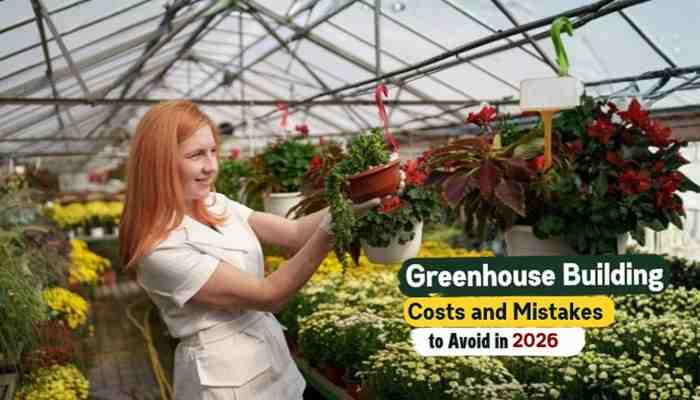

Greenhouse building in 2026 can be a valuable investment for homeowners, gardeners, farmers, and agricultural businesses. However, construction expenses often exceed the advertised price of a greenhouse kit once foundations, materials, installation, ventilation, heating, and utilities are included.
In the United States, many residential greenhouse projects cost between $3,071 and $16,209, while larger commercial facilities can require investments of $100,000 or more. Choosing the right materials, preparing the site properly, and estimating ongoing expenses can make a significant difference.
Successful greenhouse building requires more than selecting an affordable structure. Poor planning can lead to overheating, drainage problems, storm damage, and expensive maintenance.
This guide explains greenhouse construction costs, suitable materials, building methods, hidden expenses, and common mistakes. It also covers commercial greenhouse profitability, financial assistance, and practical ways to reduce construction and operating costs.
How Much Does Greenhouse Building Cost in 2026?
Greenhouse building costs depend on the structure’s size, design, covering materials, location, installation method, and environmental-control requirements.
According to Angi’s April 2026 greenhouse cost guide, residential greenhouse construction typically costs between $3,071 and $16,209, with an estimated average of $9,640.
Small prefabricated greenhouses can cost approximately $1,000, while larger custom structures with advanced equipment may exceed $25,000.
Average Greenhouse Building Costs by Size
| Greenhouse size | Estimated construction cost | Best suited for |
| 50 sq. ft. | $1,000–$3,500 | Small gardening projects |
| 100 sq. ft. | $3,000–$8,000 | Backyard vegetables and seedlings |
| 200 sq. ft. | $7,000–$12,000 | Larger residential gardens |
| 500 sq. ft. | $10,000–$25,000 | Extensive growing operations |
Source: Angi, April 2026. These are broad U.S. estimates. Actual expenses vary depending on included materials, installation, location, and equipment.
The final greenhouse building budget may be considerably higher than the kit price. Foundations, drainage, ventilation, and utility connections are sometimes quoted separately.
Homeowners should therefore compare complete construction estimates rather than focusing on the advertised structure price alone.
Commercial Greenhouse Building Costs
Commercial greenhouse building usually involves larger structures, specialized equipment, stronger infrastructure, and more extensive environmental controls.
According to HomeGuide’s 2026 commercial greenhouse cost guide, standard installed commercial greenhouses generally cost $15 to $40 per square foot, depending on materials and included systems.
| Commercial greenhouse size | Estimated installed cost |
| 2,000 sq. ft. | $30,000–$80,000 |
| 5,000 sq. ft. | $75,000–$200,000 |
| 10,000 sq. ft. | $150,000–$400,000 |
| 20,000 sq. ft. | $300,000–$800,000 |
These estimates typically represent standard commercial structures with basic systems, rather than highly automated growing facilities.
Land acquisition, extensive groundwork, utility infrastructure, and specialized production equipment may increase the total investment.
For commercial growers, greenhouse building costs should also be evaluated against the amount of productive growing space, expected crop output, and future operating expenses.
Why Greenhouse Construction Prices Vary
Not every greenhouse quotation covers the same work. A general estimate of $10 to $35 per square foot may describe a relatively straightforward structure. It should not automatically be treated as the completed cost of a small greenhouse with installation, equipment, and contingency expenses.
The final price can increase when a project requires:
- Extensive land clearing or leveling
- Engineered foundations and anchoring
- Heating, cooling, or automated ventilation
- Electrical and water connections
- Specialized growing benches or irrigation systems
- Additional labor, permits, and inspections
The most reliable greenhouse building cost comparison uses quotations with similar materials, dimensions, equipment, and installation requirements.
Greenhouse vs. High Tunnel: Which Is Better for Your Budget?
Before investing in greenhouse building, determine whether your growing needs require a traditional greenhouse or a simpler high-tunnel structure.
Both protect plants, but they differ in construction requirements, environmental control, and typical investment. A conventional greenhouse can support heating, mechanical ventilation, irrigation, and automated controls. A high tunnel generally relies on sunlight and passive ventilation to extend the growing season.
| Feature | Greenhouse | High tunnel |
| Initial investment | Generally higher | Generally lower |
| Heating | May include heating systems | Usually unheated |
| Ventilation | Natural or mechanical | Commonly roll-up sides |
| Growing methods | Soil beds, containers, or hydroponics | Primarily in-ground crops |
| Climate control | Greater flexibility | More weather-dependent |
| Best suited for | Controlled production and nurseries | Seasonal vegetables and flowers |
For gardeners growing vegetables in spring and fall, a high tunnel may provide sufficient protection at a lower price. However, commercial greenhouse building may be more appropriate for businesses producing temperature-sensitive crops throughout winter.
The correct decision depends on local weather, crop requirements, and production goals rather than construction cost alone.
What Factors Affect Greenhouse Building Costs?
Several factors determine the amount required to construct a greenhouse and maintain it over time. Understanding these expenses before purchasing materials can prevent costly changes during construction.
1. Greenhouse Size and Layout
Larger greenhouses require more framing, covering materials, foundations, and installation labor. However, building too small can create future problems when additional growing space is needed.
Before choosing dimensions, calculate space for plants, walkways, benches, storage, and maintenance equipment. For commercial operations, productive growing area is often more important than the structure’s total footprint.
2. Greenhouse Framing Materials
Common greenhouse framing materials include galvanized steel, aluminum, wood, and PVC. Galvanized steel is commonly used for agricultural structures because it provides strength and durability.
Aluminum offers corrosion resistance and relatively low maintenance requirements. Wood creates a traditional appearance and offers design flexibility, but it requires protection against moisture and deterioration.
PVC is lightweight and inexpensive, although it may not provide sufficient strength for exposed or larger permanent structures.
3. Greenhouse Covering Materials
Covering materials affect construction expenses, light transmission, insulation, durability, and replacement costs.
| Covering material | Initial cost | Main advantage | Main limitation |
| Polyethylene film | Low | Affordable and lightweight | Requires periodic replacement |
| Polycarbonate | Medium to high | Durable and impact-resistant | Higher upfront cost |
| Glass | High | Excellent light transmission | Heavy and breakable |
| Acrylic | High | Good optical properties | Product-dependent durability and cost |
Oklahoma State University Extension identifies a potential service life of approximately 10 to 15 years for polycarbonate coverings under suitable conditions.
Actual lifespan depends on material quality, climate, installation, and maintenance.
4. Foundations and Ground Preparation
Site preparation is an important greenhouse building expense that many buyers underestimate. Construction may involve clearing vegetation, leveling the ground, improving drainage, installing ground anchors, or building engineered foundations.
Angi’s 2026 estimates indicate that site preparation can add approximately $500 to $5,000, depending on the work required.
5. Heating and Ventilation Equipment
Greenhouses need appropriate temperature and airflow management. A seasonal greenhouse may use natural vents and basic watering equipment, while a year-round facility may require heaters, fans, cooling systems, and automatic controllers.
Equipment selection should match the crops and local climate.
6. Professional Installation and Labor
DIY greenhouse building can reduce labor expenses, especially for straightforward prefabricated kits. More complicated structures may require professional builders, electricians, plumbers, and structural engineers.
The best installation method depends on construction complexity, available skills, and local structural requirements.
How Climate Affects Greenhouse Building Costs
Local climate is one of the most important considerations when planning greenhouse construction. A structure suitable for a mild region may not be appropriate for an area with heavy snowfall, strong winds, or extreme summer temperatures.
| Climate condition | Design consideration | Potential additional expense |
| Cold winters | Insulation and heating | Heating equipment and energy |
| Hot summers | Strong ventilation and shading | Fans and cooling systems |
| Heavy snowfall | Suitable roof and frame loads | Structural reinforcement |
| Strong winds | Wind-rated structure and anchoring | Engineering and foundations |
| Frequent rainfall | Drainage and runoff management | Gutters and site improvements |
For greenhouse building in colder regions, suitable insulating materials and heating-system efficiency can have a major effect on long-term expenses.
- In warmer climates, ventilation and shading may be more important than heating.
- Structural specifications must also account for applicable local wind and snow loads.
- Choosing a greenhouse based only on appearance or price can result in expensive modifications later.
Best Greenhouse Types and Materials to Consider
Different greenhouse designs offer different advantages for homeowners and commercial growers.
Choosing the most suitable structure can improve growing conditions while keeping greenhouse building costs under control.
| Greenhouse type | Main advantage | Important limitation |
| Hoop house | Lower initial construction cost | Covering replacement and load limitations |
| Polycarbonate greenhouse | Durable covering and insulation options | Higher upfront expense |
| Glass greenhouse | Excellent light transmission | Heavy and expensive |
| Lean-to greenhouse | Uses space beside an existing building | Placement and airflow restrictions |
| Commercial multi-span greenhouse | Efficient large-scale growing space | Higher infrastructure investment |
Hoop Houses for Budget-Conscious Growers
Hoop houses typically use curved metal framing covered with greenhouse-grade polyethylene film. They are useful for extending growing seasons and protecting crops from certain weather conditions.
However, lightweight structures still need anchoring and appropriate structural load ratings.
Polycarbonate Greenhouses for Long-Term Use
Polycarbonate offers a balance between durability, insulation, and light transmission.
Multiwall panels may provide improved heat retention compared with some single-layer coverings.
Although polycarbonate increases initial greenhouse building expenses, its expected service life may make it worthwhile for certain long-term projects.
Glass Greenhouses for Premium Projects
- Glass offers excellent light transmission and a traditional appearance.
- It may be appropriate for botanical collections, ornamental plants, and premium horticultural facilities.
- However, glass requires suitable structural support and may be more expensive to install or repair.
Lean-To Greenhouses for Small Properties
- Lean-to greenhouses are constructed beside existing buildings.
- They can use limited space efficiently and may offer convenient access to utilities.
- However, building-wall conditions, drainage, ventilation, and seasonal sunlight must be evaluated carefully.
Greenhouse Foundation and Flooring Options Compared
Foundations provide structural support, while flooring influences drainage, accessibility, and daily maintenance. These are related but separate greenhouse building decisions.
Not every structure requires a full concrete slab. Some lightweight greenhouses use approved ground-post systems, while permanent structures may require engineered footings.
| Foundation or flooring option | Main advantage | Important consideration |
| Compacted gravel floor | Drainage and simple installation | Requires proper base preparation |
| Concrete slab | Durable working surface | Higher cost and drainage planning |
| Paver flooring | Accessible and replaceable | Needs a stable base |
| Ground-post anchoring | Suitable for certain hoop houses | Must meet structural requirements |
| Concrete footings | Supports permanent structural systems | Requires appropriate design |
A gravel floor does not automatically replace the foundation needed to resist wind uplift. Similarly, a concrete slab is not necessary for every greenhouse.
Follow manufacturer instructions, engineering specifications where required, and applicable building regulations.
Greenhouse Building Budget Example for a 10×12-Foot Structure
A detailed budget helps homeowners understand the difference between purchasing a greenhouse kit and completing an operational structure. Consider a hypothetical 10×12-foot polycarbonate greenhouse with a total footprint of 120 square feet.
| Construction expense | Illustrative cost |
| Greenhouse kit, frame, and covering | $3,500 |
| Site preparation and base | $800 |
| Anchoring materials | $250 |
| Installation labor | $1,200 |
| Ventilation equipment | $450 |
| Basic watering equipment | $200 |
| Permit allowance | $250 |
| Delivery and miscellaneous materials | $300 |
| Subtotal | $6,950 |
| Contingency allowance of 15%, rounded | $1,043 |
| Total estimated project budget | $7,993 |
This is a hypothetical budgeting example, not a contractor quotation or national average. Heating, extensive electrical work, major site problems, and operating expenses are excluded.
Why This Greenhouse Building Example Costs More Per Square Foot
The estimated total of $7,993 equals approximately $66.61 per square foot. That exceeds some general construction estimates because this example includes installation, site preparation, equipment, delivery, and contingency funds.
Small projects can also have higher effective costs per square foot because fixed expenses do not always decline proportionally with building size. For accurate budgeting, compare complete installed project costs rather than applying a general square-foot rate to every greenhouse.
How to Plan Greenhouse Building Step by Step
Successful greenhouse building starts with clear growing goals, site evaluation, and practical construction planning. The following steps can help reduce unnecessary spending and avoid installation problems.
Step 1. Choose the Right Location
Select a well-drained location with suitable sunlight, convenient access, and adequate space for construction.
- Avoid excessive shade from nearby buildings, fences, and trees.
- Remember that winter sunlight can differ significantly from summer exposure.
- Also consider the distance to water and electricity connections.
Step 2. Identify Your Growing Requirements
Different plants require different temperatures, light levels, humidity, and growing space.
For example:
- Vegetable seedlings: Need suitable temperatures, lighting, and growing surfaces.
- Tomatoes: Require plant height, support, ventilation, and irrigation.
- Ornamental plants: May need specialized humidity and temperature control.
- Winter vegetables: Require planning around cold temperatures and limited daylight.
Understanding the crops before construction helps prevent unnecessary purchases.
Step 3. Create a Greenhouse Floor Plan
- Design the interior layout around growing beds, benches, walkways, doors, and equipment.
- Allow space for harvesting, maintenance, and moving supplies.
- For commercial greenhouse building, an efficient layout can improve labor productivity and the use of available growing space.
Step 4. Check Permits and Local Regulations
- Contact local planning and building departments before starting work.
- Requirements may include zoning approval, setbacks, structural documentation, electrical permits, and plumbing permits.
- Rules vary by jurisdiction and may differ between residential and commercial greenhouse projects.
Step 5. Prepare the Foundation and Drainage
- Clear the site, address uneven ground, and install the required foundation or anchoring system.
- Plan drainage so rainwater and irrigation runoff do not accumulate around the structure.
- Improper foundations can lead to movement, water damage, and structural problems.
Step 6. Assemble the Frame and Covering
- Install the frame, connectors, braces, doors, vents, and covering according to the approved instructions.
- Use compatible fasteners and sealing materials.
- For polycarbonate structures, follow manufacturer guidance for panel orientation, thermal expansion, and edge protection.
Step 7. Install and Test Environmental Systems
- Install the required irrigation, heating, ventilation, and electrical equipment.
- Test all systems before introducing valuable crops.
- A greenhouse should be monitored under different weather conditions to identify temperature, airflow, and moisture problems before full production begins.
Greenhouse Ventilation and Humidity Control
Proper ventilation is essential during greenhouse building because sunlight can heat an enclosed structure quickly. Poor airflow can also create excessive humidity and conditions favorable for plant diseases.
| Ventilation equipment | Main purpose |
| Roof vents | Release rising warm air |
| Side vents | Bring in outdoor air |
| Exhaust fans | Remove heated or humid air |
| Circulation fans | Improve internal air movement |
| Shade cloth | Reduce excessive solar heating |
Ventilation and air circulation serve different purposes. Ventilation exchanges indoor air with outdoor air, while circulation fans distribute air within the greenhouse.
The required ventilation system depends on structure size, local weather, crop requirements, and any screens or equipment restricting airflow.
For commercial facilities, automatic temperature controls and equipment-failure alarms may provide additional protection.
Water Quality, Irrigation, and Soil Management
Water supply and growing-medium quality should be considered before completing greenhouse construction. Irrigation water with unsuitable alkalinity or excessive dissolved salts may create nutrient-management problems.
University of Minnesota Extension research found that soil pH and soluble salts can increase in high-tunnel growing environments, particularly where fertilizer and irrigation inputs are poorly managed.
Practical Water Management Considerations
- Test irrigation water for pH, alkalinity, and electrical conductivity
- Install accessible water connections
- Select irrigation systems suitable for the intended crops
- Plan for excess irrigation and drainage
- Monitor soil or growing-medium nutrients
- Maintain watering equipment to prevent leaks
Commercial greenhouse building projects may also benefit from moisture monitoring and automated irrigation when the expected production value justifies the expense.
Pest and Disease Prevention During Greenhouse Planning

Greenhouses provide protected growing environments, but pests and plant diseases can still develop. Aphids, thrips, spider mites, and fungal diseases may become serious problems when plant spacing, humidity, or sanitation is poorly managed.
Greenhouse building plans should include accessible walkways, suitable airflow, and surfaces that can be cleaned. Regular plant inspections and integrated pest management are important for long-term production.
A well-planned structure makes pest monitoring, cleaning, and crop maintenance easier.
10 Costly Greenhouse Building Mistakes to Avoid
Some greenhouse construction mistakes cause immediate expenses, while others become visible through maintenance costs, crop damage, or structural deterioration.
Avoiding these problems can improve the safety and financial performance of the finished greenhouse.
1. Choosing the Cheapest Greenhouse Without Checking Quality
A low-cost kit may contain framing or covering materials that are unsuitable for harsh conditions. Compare specifications, warranties, structural ratings, and replacement-part availability instead of choosing by price alone.
2. Building in an Area With Poor Sunlight
Insufficient sunlight may reduce plant growth and increase dependence on artificial lighting. Observe seasonal shade patterns before choosing the location.
3. Ignoring Wind and Snow Loads
Strong winds and accumulated snow can damage greenhouse structures. Choose a properly rated design and follow anchoring requirements appropriate for the local climate.
4. Installing Inadequate Ventilation
Insufficient ventilation can create overheating and excessive humidity. Include appropriately designed natural or mechanical ventilation from the beginning.
5. Underestimating Heating Expenses
A greenhouse may be inexpensive to build but costly to operate during winter. Estimate heating requirements using local weather, crop temperatures, insulation, and energy prices.
6. Neglecting Drainage
Poor drainage can create standing water, unsafe walkways, and foundation problems. Plan runoff management and ground preparation before construction.
7. Selecting the Wrong Greenhouse Size
A greenhouse that is too small may need costly expansion. An unnecessarily large structure can increase heating, maintenance, and installation expenses.
8. Overlooking Permits and Zoning Rules
Building without required approvals may cause construction delays or additional costs. Confirm local requirements before purchasing materials or beginning installation.
9. Ignoring Maintenance and Replacement Costs
Coverings, ventilation fans, irrigation systems, seals, and heaters require periodic maintenance. Include these expenses when calculating the greenhouse’s long-term cost.
10. Starting Greenhouse Building Without a Complete Budget
A budget based only on the kit price can overlook major construction requirements. Obtain itemized quotations, identify exclusions, and maintain a reasonable contingency fund.
Hidden Greenhouse Building Expenses Many Buyers Overlook
Greenhouse construction often involves additional expenses beyond framing and covering materials.
| Hidden expense | Why it matters |
| Building permits | May be required before construction |
| Electrical connections | Support heating, fans, and controls |
| Water supply | Essential for irrigation |
| Drainage improvements | Prevent water accumulation |
| Growing benches | Create usable growing space |
| Heating and cooling | Maintain suitable plant conditions |
| Insurance | May protect structures and business operations |
| Replacement coverings | Create periodic maintenance costs |
Before accepting a construction quotation, confirm exactly which services and materials are included. A cheaper initial quotation may lead to a more expensive completed project if essential work has been excluded.
How to Compare Long-Term Greenhouse Building Costs
The lowest initial construction price does not always represent the best long-term value. A greenhouse with inexpensive covering materials may require frequent replacement, while a more durable structure may cost less to maintain over time.
A useful comparison is the total cost of ownership.
10-year ownership cost = Initial construction cost + Operating expenses + Maintenance and replacements + Financing costs − Remaining asset value
Consider the following hypothetical comparison.
| Expense over 10 years | Budget structure | Durable structure |
| Initial installation | $4,500 | $7,500 |
| Operating and maintenance costs | $8,000 | $6,000 |
| Additional covering replacements and repairs | $1,800 | $300 |
| Illustrative 10-year total | $14,300 | $13,800 |
These figures are hypothetical and exclude financing costs and remaining asset value. In this example, the higher-priced greenhouse becomes slightly less expensive over ten years.
Actual savings depend on material quality, local climate, energy consumption, and maintenance requirements. For greenhouse building decisions involving larger investments, a long-term cost comparison can be more useful than evaluating the purchase price alone.
DIY vs. Professional Greenhouse Building
DIY greenhouse construction may reduce labor expenses, but not every project is suitable for self-installation.
| Factor | DIY greenhouse building | Professional installation |
| Labor expenses | Generally lower | Higher |
| Required skills | Owner must have suitable experience | Professional expertise available |
| Project management | Owner coordinates work | Contractor may manage the project |
| Structural installation | Must follow specifications | Specialist assistance available |
| Best suited for | Small, straightforward kits | Large or complex structures |
DIY greenhouse building may be appropriate for an experienced homeowner assembling a simple prefabricated kit. However, commercial structures, complicated foundations, significant weather-load requirements, and extensive electrical work may justify professional involvement.
Hiring qualified specialists can also help with equipment installation and compliance with applicable regulations.
How Long Does Greenhouse Building Take?
- Construction time depends on greenhouse size, complexity, local weather, site preparation, and permit requirements.
- A small prefabricated greenhouse may require a relatively short assembly period once the site is prepared.
- Commercial greenhouse building can involve months of planning, groundwork, equipment installation, and testing.
HomeGuide’s 2026 commercial construction guidance estimates that many commercial projects take approximately two to six months.
| Construction stage | Main activity |
| Planning | Define growing goals and budget |
| Design and permits | Check structural and regulatory requirements |
| Site preparation | Prepare ground and foundation |
| Structural installation | Assemble frame and covering |
| Equipment installation | Add irrigation, ventilation, and utilities |
| Testing and inspection | Verify systems and approvals |
Commercial growers should consider how construction delays may affect planting schedules and expected sales.
How Much Does It Cost to Run a Greenhouse Every Month?
Monthly greenhouse operating costs depend on the structure’s size, climate, equipment, and growing requirements. A small seasonal greenhouse may use relatively little electricity.
A year-round commercial facility may have substantial heating, irrigation, maintenance, and labor expenses.
Common Greenhouse Operating Expenses
| Expense | Main cost factors |
| Electricity | Fans, pumps, lighting, and controls |
| Heating | Outdoor temperatures and insulation |
| Water | Crop requirements and local rates |
| Growing supplies | Seeds, fertilizer, and growing media |
| Maintenance | Repairs and equipment servicing |
| Labor | Plant care, harvesting, and cleaning |
Example of Monthly Heating Costs
Suppose a greenhouse uses a 1.5-kilowatt electric heater for six hours a day over 30 days.
Electricity consumption = 1.5 kW × 6 hours × 30 days = 270 kWh
At an assumed rate of $0.17 per kWh:
270 kWh × $0.17 = $45.90
This example covers only the assumed heater electricity use. It is not a typical national greenhouse heating bill.
Actual costs depend on climate, insulation, electricity rates, and equipment operating time.
How to Reduce Greenhouse Heating and Energy Costs
Energy efficiency can significantly influence long-term greenhouse building value. Penn State Extension’s August 2026 greenhouse energy-efficiency guidance highlights the importance of reducing unnecessary air leakage, maintaining ventilation equipment, and considering thermal screens.
Useful methods include:
- Seal unwanted air leaks without blocking required ventilation.
- Choose suitable insulated covering materials.
- Maintain heating and ventilation equipment.
- Consider thermal screens where financially justified.
- Avoid heating beyond the temperature required by the crops.
- Evaluate efficient replacement equipment when existing systems wear out.
For commercial greenhouses, energy improvements should be assessed against installation costs and expected savings.
How to Reduce Greenhouse Building Costs Without Sacrificing Quality
Lower construction costs should come from efficient planning rather than compromising structural safety. Several practical approaches can help control expenses.
Choose Standard Greenhouse Dimensions
Standard kit sizes may be less expensive than custom-built designs.
Select a Suitable Construction Site
A well-drained, relatively level location with nearby utilities may reduce site preparation expenses.
Compare Complete Contractor Quotations
Request estimates that include similar materials, installation work, equipment, and warranty conditions.
Avoid Unnecessary Automation
Basic manual systems may be sufficient for smaller growing projects.
Plan for Future Expansion
Consider future growing needs before finalizing the structure and utility layout.
Select Materials Based on Long-Term Value
A more durable material may reduce replacement or operating expenses even when its initial price is higher.
The goal of affordable greenhouse building is to reduce unnecessary expenses without compromising safe anchoring, structural strength, or growing conditions.
Is Greenhouse Building Profitable for a Small Business?
Commercial greenhouse building can support several agricultural business opportunities, including plant nurseries, vegetable production, seedling sales, herbs, and specialty flowers.
However, profitability depends on more than constructing a greenhouse. Businesses must evaluate crop demand, selling prices, growing expenses, energy costs, labor, and the initial investment.
Cornell University’s Planning for Profit guidance recommends enterprise budgets that account for fixed and variable costs before investing in protected crop production.
Example of a Small Greenhouse Business Budget
| Annual financial item | Hypothetical amount |
| Crop sales revenue | $30,000 |
| Seeds, fertilizer, and growing supplies | $4,000 |
| Water and energy | $3,000 |
| Paid production labor | $8,000 |
| Packaging and marketing | $2,000 |
| Repairs and maintenance | $1,000 |
| Surplus before remaining expenses | $12,000 |
This is a hypothetical example, not a profit forecast. It excludes initial construction costs, depreciation, financing, taxes, land expenses, and unpaid owner labor.
How to Calculate Greenhouse Business Break-Even Revenue
Break-even analysis helps business owners estimate the sales needed to cover expenses.
Break-even revenue = Annual fixed costs ÷ Contribution margin ratio
For example, suppose annual fixed costs equal $6,000 and the contribution margin ratio is 60%.
$6,000 ÷ 0.60 = $10,000
Under those assumptions, the business needs approximately $10,000 in annual sales to cover the included fixed and variable costs.
Before investing in commercial greenhouse building, owners should also assess financing, replacement investments, working capital, and seasonal demand.
Greenhouse Grants and Financial Assistance in 2026
Some agricultural producers in the United States may qualify for financial assistance when installing eligible high-tunnel systems. The USDA Natural Resources Conservation Service administers the Environmental Quality Incentives Program (EQIP), which can support qualifying conservation practices, including high tunnels.
However, this is not a general grant for all greenhouse building projects. The NRCS High Tunnel System conservation practice, Code 325, has specific eligibility and design requirements.
Under published implementation guidance, eligible crops generally must be grown in the natural soil profile or qualifying shallow raised beds, rather than on benches, in portable pots, or through hydroponics.
Funding availability, payment rates, and application requirements vary by state and program. Agricultural producers should contact their local USDA Service Center before purchasing materials or beginning construction.
Greenhouse Building Trends Worth Considering in 2026
Modern greenhouse designs provide opportunities to improve growing conditions and operational efficiency. However, not every technology upgrade is financially justified for every project.
Automated Environmental Controls
Temperature sensors, automatic vents, irrigation timers, and environmental controllers can reduce manual monitoring. These systems may benefit larger commercial facilities but introduce additional maintenance and replacement expenses.
Improved Covering and Insulation Systems
Multiwall polycarbonate, double-layer inflated polyethylene, and thermal screens are established options for managing heat loss. Their effectiveness depends on climate, installation, and growing requirements.
Water-Efficient Irrigation
Drip irrigation and moisture-monitoring equipment can help growers manage water application more precisely. Commercial operations may also consider water collection and reuse systems where permitted.
Modular Greenhouse Designs
Expandable structures may support gradual increases in growing capacity. Before choosing modular greenhouse building systems, confirm that the site, drainage, foundations, and utilities can accommodate future expansion.
How to Choose a Reliable Greenhouse Building Contractor
Hiring a qualified contractor can improve construction planning and reduce installation problems. For large greenhouse building projects, obtain written quotations based on the same specifications.
Before hiring a contractor, verify:
- Experience with similar greenhouse structures.
- Structural specifications and load ratings.
- Itemized labor and material expenses.
- Responsibility for permits and inspections.
- Construction schedule and payment conditions.
- Warranty coverage and replacement-part availability.
- Equipment installation and testing requirements.
Ask for examples of completed projects and clarify which services are excluded from the quotation. Choosing the lowest-priced contractor without comparing project scope can create unexpected expenses.
Emergency Planning and Backup Power for Greenhouses
Power outages, severe weather, and equipment failures can threaten greenhouse crops and infrastructure. Emergency planning is particularly important for commercial greenhouse building projects that depend on continuous heating, ventilation, or irrigation.
Identify the equipment required to maintain critical growing conditions during an outage. Depending on the operation, backup power or emergency monitoring may be appropriate.
Generators must be installed and used according to manufacturer instructions and applicable safety requirements. They must never be operated in enclosed or inadequately ventilated spaces because of carbon monoxide risks.
Greenhouse Maintenance Checklist After Construction
Routine maintenance helps protect the greenhouse and control long-term repair expenses.
| Maintenance task | Recommended approach |
| Inspect frames and anchors | Check periodically and after severe weather |
| Examine coverings | Look for tears, cracks, and deterioration |
| Test vents and fans | Confirm proper operation |
| Service heating equipment | Inspect before the heating season |
| Check irrigation lines | Look for leaks and blockages |
| Monitor drainage | Inspect after heavy rainfall |
| Review electrical equipment | Use qualified professionals when required |
| Monitor pests | Inspect plants regularly |
The maintenance schedule should follow manufacturer recommendations and reflect local operating conditions. Commercial growers should maintain records of repairs, equipment servicing, and replacement costs.
Greenhouse Building Checklist Before Starting Construction
Before beginning a greenhouse project, review these important planning requirements.
- Define the growing purpose and required production area.
- Evaluate sunlight, drainage, and utility access.
- Check local building permits and zoning rules.
- Choose appropriate framing and covering materials.
- Confirm structural load ratings and foundation requirements.
- Plan ventilation, irrigation, and heating systems.
- Obtain itemized construction quotations.
- Set aside funds for unexpected expenses.
- Estimate operating and maintenance costs.
- Plan the construction schedule and future expansion.
Completing these checks before greenhouse building begins can help reduce construction delays, avoid unnecessary expenses, and improve the performance of the completed structure.
Conclusion: Greenhouse Building
Greenhouse Building in 2026 requires careful planning, realistic budgeting, and the right construction materials to create a durable and cost-effective growing environment. Whether you are building a small backyard greenhouse or investing in a commercial structure, understanding installation costs, foundation requirements, ventilation systems, and maintenance expenses can help you make informed decisions.
Avoiding common Greenhouse Building mistakes, such as choosing unsuitable materials, ignoring drainage, underestimating heating costs, and overlooking local building regulations, can prevent expensive repairs and construction delays. Comparing contractor estimates, selecting energy-efficient equipment, and planning for future expansion can also improve long-term value.
Ultimately, successful Greenhouse Building is about balancing affordability, structural quality, and growing efficiency. By following proper construction practices, choosing materials suited to your climate, and preparing a complete budget, homeowners and commercial growers can reduce unnecessary expenses and build a greenhouse that supports healthy plant growth for years to come.
Greenhouse Building FAQs
1. How much does Greenhouse Building cost in 2026?
Greenhouse Building typically costs between $3,071 and $16,209 for residential projects in the U.S. Prices depend on size, materials, labor, and installation requirements.
2. What is the cheapest way to build a greenhouse?
Using a prefabricated kit, polyethylene covering, and a simple hoop-house design can reduce Greenhouse Building costs. DIY installation may also save money.
3. What materials are best for Greenhouse Building?
Galvanized steel frames and polycarbonate panels are popular choices for Greenhouse Building because they offer durability, weather resistance, and relatively low maintenance.
4. What are the most common Greenhouse Building mistakes?
Common mistakes include poor site selection, inadequate ventilation, weak foundations, improper drainage, and underestimating heating and maintenance expenses.
5. Is Greenhouse Building a profitable investment in 2026?
Greenhouse Building can be profitable for commercial growers producing vegetables, herbs, flowers, and seedlings. Profitability depends on construction costs, crop demand, and operating expenses.
