


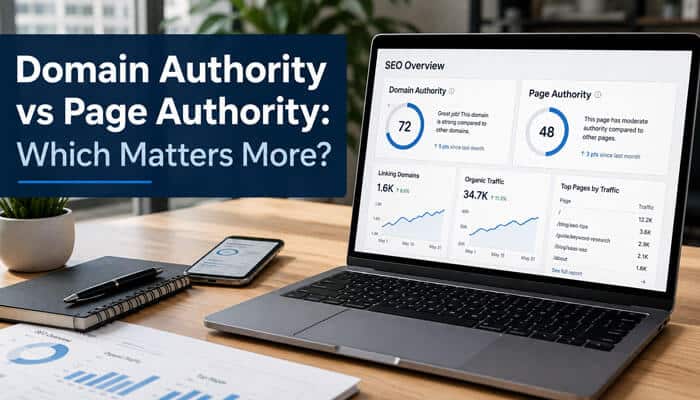

Understanding domain authority vs page authority can prevent one of the most common SEO mistakes: assuming that a high authority score automatically means better Google rankings.
Domain Authority (DA) and Page Authority (PA) are SEO metrics developed by Moz, but they answer different questions. Domain Authority evaluates the relative ranking strength of an entire domain, while Page Authority evaluates an individual webpage. Both use a 1–100 scale, with higher scores representing greater predicted authority within Moz’s system.
The distinction matters when analyzing competitors, evaluating backlink opportunities, researching keywords or deciding which pages deserve more SEO investment. A high-DA website can have relatively weak individual pages, while a smaller domain can publish one exceptionally strong page that attracts backlinks and outranks much larger competitors.
There is also one important fact to establish immediately: neither Domain Authority nor Page Authority is a direct Google ranking factor. Google uses its own ranking systems, which primarily evaluate pages while also considering some site-wide signals and classifiers. Google also confirms that PageRank remains part of its core ranking systems.
So, in the domain authority vs page authority comparison, which one matters more?
The answer depends entirely on what you are trying to measure.
Quick Answer: Domain Authority vs Page Authority
Domain Authority is more useful when comparing the overall strength of websites, while Page Authority is generally more useful when comparing individual URLs competing for a specific search query.
Neither should become your main SEO goal. The best way to use domain authority vs page authority is as a comparative framework that supports broader SEO decisions rather than replacing real performance data.
For actual search performance, pay closer attention to:
- Organic clicks
- Search impressions
- Qualified traffic
- Conversions
- Priority keyword visibility
- Relevant referring domains
- Backlinks to important pages
- Search-intent satisfaction
- Internal linking
- Crawlability and indexability
- Originality and usefulness of content
Think of DA and PA as diagnostic tools rather than grades Google assigns to your website.
Key Takeaways
- Domain Authority (DA) measures the relative strength of an entire domain.
- Page Authority (PA) evaluates one individual URL.
- Both metrics use a 1–100 scale.
- Both were developed by Moz.
- Neither DA nor PA is a Google ranking factor.
- DA is most useful for broad website-level comparison.
- PA is more useful for page-level SERP analysis.
- There is no universal “good DA” or “good PA” score.
- A lower-DA website can outrank a higher-DA competitor.
- A high-DA domain can contain relatively weak pages.
- DA and PA can fluctuate without Google rankings changing.
- Relevant backlinks and useful content matter more than chasing authority scores.
- Third-party SEO tools do not have access to Google’s internal ranking data.
- Google does not publish a DA or PA requirement for AI Overviews or AI Mode.
- A strong domain authority vs page authority analysis combines authority metrics with backlinks, search intent, content quality and real search performance.
Domain Authority vs Page Authority at a Glance
| Factor | Domain Authority | Page Authority |
|---|---|---|
| Abbreviation | DA | PA |
| Score Range | 1–100 | 1–100 |
| Scope | Entire domain | Individual URL |
| Main Purpose | Compare websites | Compare webpages |
| Best For | Domain-level analysis | Page-level analysis |
| Google Ranking Factor | No | No |
| Best Benchmark | Competing websites | Competing pages |
The easiest way to remember domain authority vs page authority is:
DA asks: How strong does this domain appear overall?
PA asks: How strong does this particular page appear?
What Is Domain Authority?
Domain Authority, commonly abbreviated as DA, is a Moz metric designed to estimate the relative ranking potential of an entire website or domain.
Rather than describing one blog post, product page or landing page, DA provides a broad domain-level comparison. In a domain authority vs page authority analysis, DA is the broader metric because it evaluates the website as a whole instead of a single URL.
Moz’s Domain Authority methodology uses link-related information and machine learning to produce its score. The metric is most useful when comparing websites operating in similar competitive environments rather than judging a domain against an arbitrary universal benchmark.
Domain Authority can help answer questions such as:
- How strong is my domain compared with major competitors?
- Do competitors have significantly stronger backlink profiles?
- Is my domain becoming more competitive over time?
- Which websites deserve closer examination during backlink research?
- How competitive is this niche at the domain level?
The important word is comparative.
A DA score is not a Google trust score.
What Does Domain Authority Actually Tell You?
Imagine three competing websites:
| Website | DA |
|---|---|
| Website A | 24 |
| Website B | 46 |
| Website C | 71 |
From a broad Moz authority perspective, Website C appears substantially stronger.
But that does not mean Website C automatically outranks Website A for every search query.
Website A could still publish an individual page with:
- Better search-intent alignment
- Stronger page-level backlinks
- More useful information
- Original research
- Greater topical relevance
- Fresher data
- Better internal linking
- Superior organization
Google says its ranking systems are primarily designed to work at the page level. Site-wide signals and classifiers also contribute, but strong site-wide signals do not guarantee that every page from a website will rank highly.
That is why DA should provide context rather than become your final ranking prediction.
What Is Page Authority?
Page Authority, commonly abbreviated as PA, estimates the relative ranking strength of one specific webpage.
Instead of examining:
example.com
you might analyze:
example.com/domain-authority-guide
The first represents the wider website. The second is an individual URL with its own backlinks, internal links and competitive position.
Like DA, Page Authority uses a 1–100 scale.
PA becomes particularly useful when you are comparing specific URLs competing for the same search query. This page-level focus is what makes domain authority vs page authority useful for separating overall website strength from the strength of the exact URL you want to outrank.
However, a high Page Authority score does not automatically mean that a webpage has:
- Better writing
- Perfect keyword targeting
- Superior UX
- Better Core Web Vitals
- Higher conversions
- More accurate information
- Better search-intent alignment
That distinction is essential when understanding domain authority vs page authority.
Authority metrics can provide useful competitive information without measuring every factor that makes a page useful to Google or visitors.
Why Page-Level Analysis Matters for Individual Keywords

Suppose you want to rank for:
best accounting software for freelancers
You are not literally competing against entire domains.
You are competing against the individual URLs Google selects for that query.
Imagine this SERP:
| Ranking Page | DA | PA |
|---|---|---|
| Competitor A | 82 | 32 |
| Competitor B | 65 | 48 |
| Competitor C | 44 | 26 |
| Your Page | 36 | 24 |
The DA numbers provide broad website-level context.
The PA scores help you examine individual page strength.
But even PA does not complete the analysis.
You still need to investigate:
- Search intent
- Backlinks to each page
- Relevant referring domains
- Content usefulness
- Original data
- Freshness
- Internal links
- User experience
- SERP features
- Brand relevance
PA should therefore be treated as one diagnostic signal, not a guaranteed ranking forecast. A complete domain authority vs page authority review should always include content quality, intent, backlinks and real SERP performance.
Domain Authority vs Page Authority: Which Matters More?
There is no universal winner.
The more useful metric depends on the SEO decision you need to make. That is why the answer to domain authority vs page authority changes depending on whether you are evaluating a whole website or one ranking page.
| SEO Task | More Useful Metric | Why |
|---|---|---|
| Compare competing websites | DA | Provides domain-level context |
| Analyze one keyword SERP | PA | Evaluates individual ranking pages |
| Review overall backlink strength | DA | Looks across the domain |
| Build links to one priority page | PA | Page-level strength is more relevant |
| Research a competitive industry | DA | Provides a broad benchmark |
| Evaluate an exact ranking URL | PA | Focuses on the page actually ranking |
| Measure SEO revenue | Neither | Use analytics and conversion data |
| Measure Google Search clicks | Neither | Use Search Console |
| Measure conversions | Neither | DA and PA do not measure business outcomes |
When Domain Authority Matters More
DA is more useful when you are evaluating entire websites.
For example, if you plan to enter the personal-finance market, you might compare competing publishers by examining:
- Domain Authority
- Referring domains
- Link growth
- Organic visibility
- Number of ranking pages
- Brand prominence
DA gives you a quick overview of the competitive landscape.
What If DA and PA Tell Different Stories?
DA and PA can point in different directions because they measure different levels of authority. In practice, this is one of the most valuable parts of a domain authority vs page authority comparison because it can reveal whether the competitive advantage sits at the site level or the page level.
| DA | PA | Possible Meaning |
|---|---|---|
| High | High | Strong domain and strong individual page |
| High | Low | Strong domain but weaker individual URL |
| Low | High | Smaller domain with an unusually strong page |
| Low | Low | Limited authority at both levels |
High DA + Low PA
This commonly happens when an established website publishes a new page.
The domain may have accumulated backlinks for years, while the new URL has:
- Few direct backlinks
- Limited internal-link support
- Little history
Do not automatically treat the page as unbeatable merely because its parent domain has high DA.
Low DA + High PA
A smaller website may create one exceptional resource that attracts substantial backlinks.
Examples include:
- Original studies
- Free tools
- Statistics pages
- Calculators
- Industry reports
- Databases
- Templates
The individual page can become much stronger than the average page on its domain.
High DA + High PA
This usually represents stronger competition.
You may need:
- Better content
- More original information
- Stronger page-specific links
- Better intent alignment
- Superior usability
- Unique expertise
Does Google Use Domain Authority?
Google does not use Moz’s Domain Authority score as a direct ranking factor. This is a critical distinction in any domain authority vs page authority discussion because neither metric is a score Google reads when ranking pages.
Increasing your DA from 25 to 40 does not send Google a signal saying:
“This website should rank higher.”
Google has its own ranking systems.
However, some legitimate activities that can contribute to DA growth—such as earning valuable editorial backlinks—may independently benefit your actual SEO performance.
For example, one new backlink could:
- Influence the way a third-party SEO tool evaluates your domain.
- Separately provide information Google’s own systems can consider.
That does not mean Google improved your ranking because your DA number increased.
Google also warns that third-party SEO tools do not have access to its internal ranking data and cannot guarantee rankings.
Does Google Use Page Authority?
Google does not use Moz’s Page Authority score as a direct ranking factor either. So when evaluating domain authority vs page authority, PA should be treated as a third-party comparison metric rather than a hidden Google signal.
Google uses its own systems to determine which pages are relevant and useful for a query.
Therefore:
High PA does not guarantee high rankings.
And:
Low PA does not make ranking impossible.
This distinction becomes especially important when analyzing smaller websites competing successfully against much larger domains.
Page Authority Is Not PageRank
Page Authority and PageRank sound similar, but they are not the same.
| Metric | Main Purpose |
|---|---|
| Domain Authority | Domain-level comparison |
| Page Authority | Page-level comparison |
| PageRank | Google link-analysis system |
| Domain Rating | Website backlink-profile strength |
| Authority Score | Third-party authority metric |
Google confirms that PageRank remains part of its core ranking systems.
These terms should never be used interchangeably.
Domain Authority vs Domain Rating
Another common source of confusion is Domain Authority vs Domain Rating.
Domain Authority belongs to Moz.
Domain Rating, commonly abbreviated as DR, belongs to Ahrefs.
Ahrefs defines DR as a metric representing the strength of a website’s backlink profile relative to other websites in its database. It uses a logarithmic scale from 0 to 100.
The same website might therefore display:
- DA: 48
- DR: 61
- Authority Score: 43
That does not automatically mean one SEO platform is wrong.
Different tools use different:
- Crawlers
- Link databases
- Algorithms
- Weighting methods
- Refresh cycles
- Scoring models
For meaningful comparisons, compare the same metric from the same provider.
Do not directly compare Moz DA 50 with Ahrefs DR 50.
Domain Authority vs Topical Authority
Topical authority is also different from Domain Authority.
Domain Authority is a specific third-party metric.
Topical authority is a broader SEO concept describing how extensively and credibly a website covers a particular subject.
A high-DA entertainment website, for example, does not automatically become the most relevant source for:
- Tax law
- Cybersecurity standards
- Industrial engineering
- Medical research
- Advanced accounting
Google does not provide publishers with a public “topical authority score.”
Instead, its ranking systems use numerous page-level and site-wide signals to understand content and determine relevance.
Do not use DA as a substitute for topical relevance.
Is DA a Measure of Google Trust?
No.
Statements such as:
“Google trusts my website because it has DA 70”
should be avoided.
Google specifically says third-party tools do not have access to its internal ranking data. Their scores and predictions belong to those services, not Google.
A more accurate statement is:
“Our website has DA 70 in Moz, making it comparatively strong within our competitive set according to Moz’s metric.”
That keeps the meaning precise.
What Is a Good Domain Authority Score?
There is no universal “good DA.”
Generic guides sometimes categorize DA like this:
- DA 20 = low
- DA 40 = average
- DA 60 = strong
- DA 80 = excellent
Those ranges are easy to understand but potentially misleading.
A score should be interpreted relative to actual competitors. That comparative approach is central to using domain authority vs page authority correctly.
Example: Local Home-Service Market
Competitors:
- DA 12
- DA 18
- DA 22
- DA 28
Your website:
DA 31
Your domain may already appear competitive from a broad authority perspective.
Example: National Finance Market
Competitors:
- DA 67
- DA 74
- DA 83
- DA 90
Your website:
DA 31
The exact same score now represents a completely different competitive environment.
Instead of asking:
“Is DA 30 good?”
ask:
“How does my DA compare with the websites competing for searches important to my business?”
What Is a Good Page Authority Score?
The same principle applies to PA.
Suppose pages ranking for your keyword have:
- PA 18
- PA 22
- PA 24
- PA 27
- PA 31
Your page has:
PA 29
That may indicate reasonable page-level competitiveness.
Now imagine the top-ranking pages have:
- PA 49
- PA 56
- PA 62
- PA 68
- PA 71
A PA of 29 now indicates a much larger gap.
There is no universal PA score you must reach. In a domain authority vs page authority comparison, the useful benchmark is the competitive set around the query you actually want to rank for.
Compare your page with the URLs actually competing for the same search intent.
Why Do DA and PA Scores Change?
Authority scores are not permanent.
A third-party SEO platform can:
- Discover new backlinks
- Lose previously known links
- Expand its link index
- Change its scoring model
- Recalculate relative scores
For this reason, a drop in DA or PA does not automatically mean:
- Google penalized your website
- Google stopped trusting your content
- Your rankings dropped
- Your SEO campaign failed
Imagine:
January DA: 43
February DA: 40
During that period:
- Organic clicks increase 18%
- Qualified leads rise 12%
- Three priority keywords enter the top five
Was SEO performance necessarily getting worse?
Clearly not.
This illustrates why authority metrics should always be interpreted alongside real search and business data. A domain authority vs page authority trend is useful only when you interpret it together with rankings, traffic, links and conversions.
Can a Low-DA Website Outrank a High-DA Website?
Yes.
This is one of the most important practical lessons in domain authority vs page authority.
Consider:
Website A
- DA 82
- Generic article
- Old statistics
- Weak intent match
- Few backlinks to the actual page
Website B
- DA 34
- Focused article
- Current information
- Original research
- Strong intent match
- Relevant page-level backlinks
Website B can compete successfully.
Google explicitly states that strong site-wide signals do not guarantee strong rankings for every individual page.
This gives smaller publishers an important opportunity.
You do not always need to “beat the entire domain.”
You need to produce a page that deserves to compete for the specific search.
Can a High-DA Domain Have Weak Pages?
Yes.
A large website may contain thousands or millions of URLs.
One article may have accumulated backlinks for ten years, while another page may have been published yesterday.
Their page-level strength should not be expected to be identical.
Likewise, a smaller domain can develop an unusually powerful page by publishing something that earns substantial citations.
Examples include:
- Original surveys
- Data studies
- Calculators
- Statistics collections
- Industry benchmarks
- Free tools
- Research reports
- Definitive guides
This is why serious keyword research should analyze the exact ranking pages, not just the authority of their parent domains.
Can a High-DA Site Rank Anything It Publishes?
No.
A strong domain does not receive unlimited ranking power. Google says strong site-wide signals do not guarantee that all content from a site will rank highly.
This distinction is particularly important when evaluating whether large publishers are genuinely relevant to a topic. Strong domain-level authority can help explain competitive context, but it cannot permanently replace:
- Relevance
- Useful information
- Search intent
- Page-level quality
- User satisfaction
How Backlinks Affect Domain Authority and Page Authority
Backlinks matter to both DA and PA, but the destination of those backlinks makes a difference. This is another practical reason the domain authority vs page authority distinction matters: links distributed across a site affect domain-level strength differently from links concentrated on one URL.
Links Across a Domain
If independent websites cite useful resources throughout your site, those links contribute to your broader backlink profile.
This can influence domain-level authority measurements.
Links Directly to One Page
Suppose one original research report earns 200 editorial backlinks.
That individual URL can become significantly stronger than ordinary pages elsewhere on the same site.
This is why deep links are valuable.
Internal Links
Internal links are different from external backlinks but remain important for SEO.
They can help:
- Search engines discover important URLs
- Readers find related resources
- Establish relationships between pages
- Support priority content
- Reduce orphan pages
Internal links should make sense to users first.
Do not turn internal linking into repetitive exact-match anchor-text manipulation.
Why DA Alone Is a Poor Way to Judge Backlinks
One of the most common link-building mistakes is:
“This website has DA 70, so a backlink from it must be valuable.”
DA alone cannot tell you that.
Before pursuing a backlink, examine:
- Topical relevance
- Editorial standards
- Organic visibility
- The specific linking page
- Whether the page is indexed
- Audience relevance
- Link placement
- Anchor text
- Whether the site publishes unrelated paid content at scale
- Whether the website appears to exist primarily for selling links
A relevant editorial citation from a respected niche publication can be more useful than an unrelated high-DA placement.
Google warns against link-related tactics designed primarily to manipulate rankings.
The High-DA Expired Domain Trap
Expired domains provide another example of why an authority score should never replace investigation.
An old domain might retain historical backlinks and therefore display an attractive DA.
But the score alone cannot tell you:
- Whether important backlinks still exist
- Whether those links remain relevant
- Whether the domain previously contained spam
- Whether the old topic matches your new website
- Whether anchor text looks manipulated
- Whether the domain has a problematic history
Google specifically identifies expired domain abuse as repurposing an expired domain primarily to manipulate rankings by exploiting its previous reputation while offering little value to users.
Before buying an expired domain, investigate:
- Historical content
- Previous ownership
- Backlink relevance
- Anchor-text patterns
- Lost links
- Redirect history
- Existing indexed URLs
- Spam history
- Trademark issues
- Topic relevance
A high DA should start your due diligence, not replace it.
How to Improve Domain Authority the Right Way
Do not build your SEO strategy around manipulating the score.
Ask:
“How can I create a website reputable publishers genuinely want to reference?”
1. Publish Link-Worthy Assets
Ordinary articles do not automatically earn backlinks.
Create material people genuinely need to reference.
Examples include:
- Original research
- Proprietary surveys
- Statistics
- Industry benchmarks
- Data reports
- Calculators
- Templates
- Free tools
- Case studies
- Expert analysis
2. Earn Relevant Editorial Links
Relevance matters.
A cybersecurity website should generally value legitimate citations from cybersecurity, technology and related business publications over irrelevant websites selected only because they have high DA.
Use this simple test:
Would I still want this backlink if DA did not exist?
If the answer is yes, the link probably deserves further consideration.
3. Use Digital PR
Digital PR can earn editorial mentions by providing:
- Original data
- Expert commentary
- Surveys
- New industry statistics
- Timely research
- Newsworthy analysis
The goal should be genuine editorial value rather than manufacturing an authority score.
4. Build Useful Topic Clusters
Do not publish unrelated topics simply because an SEO tool reports search volume.
Build coherent subject coverage.
For example:
Main Topic: Small Business Accounting
Supporting articles:
- Cash vs accrual accounting
- Bookkeeping basics
- Business expense categories
- Balance sheets
- Cash-flow statements
- Accounting software
- Tax recordkeeping
Strong topic structures improve navigation and create logical internal-link opportunities.
5. Reclaim Valuable Broken Links
If an important resource permanently moves, use an appropriate redirect where necessary.
Do not unnecessarily abandon URLs that have:
- Valuable backlinks
- Referral traffic
- Existing search visibility
6. Avoid Manipulative Link Schemes
A higher third-party authority score has little value if the tactics used to achieve it create problems with Google’s spam policies.
Optimize for sustainable search visibility, not just a number in an SEO tool.
How to Improve Page Authority Strategically
Page-level improvement requires a more focused approach.
1. Earn Backlinks Directly to Important URLs
Do not direct every backlink toward your homepage.
If you have created a valuable:
- Research report
- Calculator
- Definitive guide
- Statistics page
- Template
- Free tool
Promote that exact URL.
2. Strengthen Contextual Internal Links
Find existing pages with:
- Relevant traffic
- Existing backlinks
- Strong topical overlap
Add contextual links to your priority page where they genuinely help visitors.
3. Create Something Worth Citing
Before doing outreach, ask:
Why would another publisher link to this page?
Possible reasons include:
- Original statistics
- Expert commentary
- First-party research
- Downloadable resources
- Unique charts
- Interactive tools
- Industry benchmarks
4. Refresh Important Evergreen Pages
Review older pages for:
- Outdated statistics
- Broken external links
- Old screenshots
- Product changes
- Regulatory changes
- New research
- Missing examples
Updating content does not automatically increase PA, but maintaining a useful resource helps preserve its long-term value.
5. Consolidate Truly Redundant Content
Sometimes several weak pages target virtually identical search intent.
Consolidating them into one stronger resource may improve:
- User experience
- Internal linking
- Content depth
- Backlink concentration
Before combining pages, check their existing:
- Rankings
- Traffic
- Backlinks
- Conversions
- Search intent
Do not merge content merely because two keywords look similar.
What Actually Improves Google Rankings?
This is where domain authority vs page authority must be placed in perspective.
Google’s automated systems analyze numerous signals and factors across its search index to identify relevant and useful results.
For sustainable SEO, prioritize the following.
Search Intent
Understand what the searcher actually wants.
A query might require:
- A tutorial
- Product comparison
- Calculator
- Category page
- Definition
- Local result
- Transactional page
- News report
Publishing the wrong content type makes ranking more difficult regardless of DA.
Original Value
Do more than rewrite information already ranking.
Add:
- First-hand experience
- Original research
- Expert interpretation
- Better examples
- Proprietary data
- Unique tools
- A distinctive point of view
Google’s 2026 guidance for generative Search emphasizes unique, compelling and non-commodity content rather than pages that simply repeat information already available elsewhere.
Relevant Backlinks
Earn genuine citations from sources that make sense for your subject and audience.
Internal Linking
Connect related pages logically and make important content easy to discover.
Technical Accessibility
Important pages should be:
- Crawlable
- Indexable
- Accessible
- Properly canonicalized
Page Experience
Make content easy to read and use across different devices.
Do not optimize an authority score while neglecting the person who actually lands on your page.
A Practical Domain Authority vs Page Authority Workflow
Here is a more useful way to apply domain authority vs page authority in real SEO work.
Step 1: Identify Real SERP Competitors
Search the keywords that matter to your business.
Record both:
- The domains ranking consistently
- The exact URLs ranking
Step 2: Compare Domain-Level Strength
Review DA and broader backlink profiles.
This shows you the overall competitive landscape.
Step 3: Analyze Individual Ranking Pages
Now examine:
- PA
- Direct backlinks
- Referring domains
- Content
- Search intent
- Freshness
This moves the analysis from website-level strength to the pages actually competing.
Step 4: Inspect Backlinks Directly
Authority scores summarize information.
They do not replace backlink analysis.
Check:
- Relevant referring domains
- Editorial quality
- Link placement
- Anchor text
- Strongest referring pages
- Lost links
Step 5: Analyze Search Intent
Study the current SERP.
Does Google primarily show:
- Tutorials?
- Comparisons?
- Product pages?
- Videos?
- Forums?
- Tools?
- Local businesses?
Build the type of page users actually need.
Step 6: Identify Competitor Weaknesses
Even a high-DA domain can publish a weak page.
Look for:
- Outdated data
- Missing questions
- Poor UX
- Limited original information
- Few page-level backlinks
- Weak examples
- Poor intent alignment
Step 7: Track Real Outcomes
After publishing, monitor:
- Search impressions
- Clicks
- Search positions
- Qualified traffic
- Conversions
- Leads
- Revenue
- New referring domains
Those results matter more than whether DA increased by two points.
Domain Authority vs Page Authority Example
| Competitor | DA | PA | Referring Domains |
|---|---|---|---|
| Site A | 83 | 29 | 14 |
| Site B | 65 | 48 | 74 |
| Site C | 41 | 25 | 9 |
What can this domain authority vs page authority example tell you?
Site A: Strong Domain, Modest Page
The overall domain is extremely strong, but the individual article appears considerably less powerful at the page level.
Site B: Strong Individual Page
The domain is weaker than Site A overall, but the ranking URL has much stronger page-level authority and considerably more referring domains.
Site C: Potential Opportunity
Both authority scores are lower.
If Site C still performs well, investigate why.
It might have:
- Excellent search-intent alignment
- Fresher information
- Better topical focus
- Superior structure
- More useful examples
The wrong conclusion is:
“I need DA 83 before I can compete.”
The useful conclusion is:
“I need to understand why these exact URLs rank.”
That is the practical benefit of comparing domain authority vs page authority rather than looking at only one authority score.
When Domain Authority Is Most Useful
Domain Authority is particularly useful for:
- Broad competitor research
- Comparing similar websites
- Reviewing relative backlink strength
- Initial backlink prospecting
- Evaluating competitive niches
- Tracking domain-level trends
DA is much less useful for:
- Predicting an exact Google position
- Measuring conversions
- Measuring content quality
- Measuring user satisfaction
- Proving Google trusts a website
- Establishing arbitrary SEO targets
When Page Authority Is Most Useful
Page Authority can help with:
- SERP competitor analysis
- Comparing individual URLs
- Prioritizing page-level link building
- Evaluating important landing pages
- Reviewing linkable assets
- Identifying potentially weaker ranking pages
PA does not prove that:
- A page is accurate
- A page is useful
- Google trusts it
- Search intent is satisfied
- The page will rank
- Visitors will convert
Should DA or PA Be an SEO KPI?
They can be useful secondary metrics.
They should rarely become your primary SEO or business KPIs.
Consider two campaigns.
Campaign A
DA increases:
30 → 42
But:
- Organic traffic remains flat
- Leads remain flat
- Revenue remains flat
Campaign B
DA changes:
30 → 32
But:
- Organic clicks increase 65%
- Qualified leads rise 38%
- Organic revenue rises 27%
Campaign B clearly generated greater business value.
A useful domain authority vs page authority report can show competitive progress, but it should sit below metrics that demonstrate actual search visibility and business results.
A stronger SEO measurement hierarchy looks like this:
| Metric | Why It Matters |
|---|---|
| Organic conversions | Business results |
| Organic revenue or leads | Commercial impact |
| Organic clicks | Actual search visitors |
| Search impressions | Search visibility |
| Priority keyword visibility | SERP performance |
| Relevant referring domains | Link-profile growth |
| Backlinks to priority pages | Page-level support |
| Domain Authority | Competitive context |
| Page Authority | Page-level comparison |
Common Domain Authority vs Page Authority Mistakes
Understanding common domain authority vs page authority mistakes can prevent you from optimizing third-party numbers instead of improving real SEO performance.
Mistake 1: Treating DA as a Google Ranking Factor
DA is a third-party SEO metric.
Google does not use the DA number itself to determine rankings.
Mistake 2: Assuming Higher DA Always Wins
Strong site-wide signals do not guarantee that every page will rank above pages from smaller domains.
Mistake 3: Buying Links Based Only on DA
A high DA does not prove:
- Relevance
- Editorial quality
- Legitimate traffic
- Audience value
- Ranking benefit
Investigate the website and the exact linking page.
Mistake 4: Ignoring Page-Level Competition
Seeing a DA 90 website in the SERP does not automatically mean the keyword is impossible.
Analyze the ranking URL.
Mistake 5: Comparing DA and DR as Identical Scores
Moz DA and Ahrefs DR use different methodologies.
Do not directly compare their raw numbers.
Mistake 6: Panicking Over Small Authority Changes
Third-party scores can move because their databases, links or calculations change.
Check actual search performance before drawing conclusions.
Mistake 7: Treating Technical SEO as a DA Formula
Improving:
- Page speed
- Crawlability
- Mobile usability
- Structured data
can help your website.
That does not mean every technical improvement directly raises Domain Authority.
Mistake 8: Chasing Authority Instead of Customers
A DA score is not revenue.
Always connect SEO activity to meaningful outcomes.
Do Domain Authority and Page Authority Matter for AI Overviews and AI Mode?
This question has become increasingly relevant in 2026. The rise of AI Overviews and AI Mode has also created a new domain authority vs page authority misconception: that a minimum Moz score is required for AI visibility.
There is no published DA or PA threshold for Google’s generative Search experiences.
Google’s guidance says generative AI features such as AI Overviews and AI Mode are rooted in Google’s own Search ranking and quality systems.
There is no published requirement such as:
- DA 50+
- PA 40+
- A particular Domain Rating
- Special AI schema
- An AEO authority score
- A GEO authority score
Google’s current guidance says pages need to satisfy Google’s normal Search eligibility requirements for generative Search visibility. Google also says publishers do not need unusual SEO tactics specifically for AI Search, such as:
- Special AI-only schema
- Artificial content chunking
- A completely separate writing strategy
- Third-party authority thresholds
Instead, Google emphasizes fundamentals such as:
- Unique and useful content
- Strong technical foundations
- Crawlability
- Page experience
- Helpful images and video where appropriate
- Existing SEO best practices
- Content that adds something beyond generic summaries
For AI-search visibility, first-party search performance and high-quality content are therefore more meaningful than obsessing over domain authority vs page authority scores.
Should New Websites Worry About DA and PA?
Not obsessively.
A new website naturally has limited backlink history.
Instead of checking your DA every few days, focus on:
- Selecting realistic topics
- Understanding search intent
- Publishing useful original content
- Building logical topic clusters
- Creating useful internal links
- Ensuring pages can be indexed
- Developing industry relationships
- Publishing link-worthy resources
- Earning legitimate mentions
- Tracking Search Console performance
Once the site has meaningful data and real competitors, domain authority vs page authority becomes more useful as a benchmarking tool.
Which Should You Improve First: DA or PA?
Do not begin with the metric. Use domain authority vs page authority to identify where the real weakness sits, then improve the underlying SEO factors.
Focus More on Domain-Level Growth When:
- Your whole website has few relevant referring domains
- Competitors have significantly stronger backlink profiles
- Your brand has limited industry visibility
- Few credible websites mention your company or content
Potential strategies include:
- Original research
- Digital PR
- Industry partnerships
- Data studies
- Free tools
- Link-worthy resources
Focus More on Page-Level Growth When:
- Your website already has reasonable domain strength
- Priority pages have few backlinks
- An article is close to first-page rankings
- Competing pages have substantially stronger backlink profiles
- Strong pages on your own website are not linking to priority URLs
Potential strategies include:
- Deep-link outreach
- Contextual internal linking
- Content refreshes
- Original page-level research
- Better linkable assets
For most mature SEO programs, you eventually need both.
Conclusion
Understanding domain authority vs page authority helps you evaluate SEO competition more accurately without relying too heavily on third-party scores. Domain Authority is more useful for comparing the overall strength of websites, while Page Authority gives you better insight into the strength of individual URLs competing in search results.
However, the most important lesson from domain authority vs page authority is that neither DA nor PA is a direct Google ranking factor. A high authority score does not guarantee top rankings, and a lower-authority website can still outperform larger competitors when it publishes more relevant, useful, and well-supported content.
Instead of chasing DA or PA numbers, focus on the SEO factors that can create real results: matching search intent, publishing original information, earning relevant backlinks, strengthening internal links, improving technical accessibility, and tracking organic traffic and conversions.
Used correctly, domain authority vs page authority becomes a valuable competitive-analysis framework. It can help you understand where competitors are strong, where individual pages may be vulnerable, and where your own SEO efforts can have the greatest impact.
Domain Authority vs Page Authority FAQs
1. What Is the Main Difference Between Domain Authority and Page Authority?
The main difference in domain authority vs page authority is scope. Domain Authority measures the relative ranking strength of an entire website, while Page Authority evaluates the potential strength of one individual webpage. Both Moz metrics use a score from 1 to 100.
2. Which Matters More: Domain Authority or Page Authority?
Neither metric is always more important. Domain Authority is better for comparing entire websites and backlink profiles, while Page Authority is more useful for analyzing specific URLs competing for the same keyword. The best choice depends on your SEO objective.
3. Are Domain Authority and Page Authority Google Ranking Factors?
No. Domain Authority and Page Authority are third-party metrics developed by Moz. Google does not use DA or PA scores directly when ranking webpages. They should be used as competitive analysis tools rather than guaranteed ranking indicators.
4. Can a Low-Domain-Authority Website Outrank a High-Authority Website?
Yes. A low-DA website can outrank a high-DA competitor when its page provides better search-intent alignment, more useful content, fresher information, stronger topical relevance or better page-level backlinks. A high Domain Authority score does not guarantee that every page will rank well.
5. How Can You Improve Domain Authority and Page Authority?
Improve Domain Authority by earning relevant backlinks, publishing original research, and creating valuable resources. Improve Page Authority by gaining backlinks directly to important URLs, strengthening internal links, refreshing content, and producing pages that other websites want to reference.
