



Every year a new wave of founders opens Shopify stores selling the same things: athleisure, minimalist jewellery, skincare, home goods. Most of them close within eighteen months. They were competing in a category, and categories are owned by whoever has the biggest ad budget.
The stores that survive tend to look strange from the outside. They sell to groups most people have never heard of, in volumes that would not interest a mid-sized retailer, at margins that work precisely because nobody else is trying. They are not competing in a category. They are serving a community, and that is a different business.
Category vs. community
A category is defined by the product: running shoes, desk lamps, protein powder. Demand is broad, customers are interchangeable, and competition is on price, ads and logistics. A community is defined by the people: a shared identity, a shared vocabulary, a shared set of problems that mainstream products do not solve. Demand is narrow but intense, customers talk to each other constantly, and competition is on understanding.
The economics follow. In a category, customer acquisition cost rises every year because you are bidding against everyone. In a community, acquisition cost can fall over time, because the community does your marketing for you if the product is right and punishes you publicly if it is not.
A worked example
Consider the market for feminine fashion worn by men: skirts, thigh-high socks, pastel knitwear, the look associated with the online femboy subculture. It is a real community with real spending, concentrated among young men who found each other on TikTok, Discord and Reddit long before any retailer noticed.
Mainstream fashion does not serve them, for two reasons. The first is discomfort; a chain retailer’s brand team is not going to build a men’s skirt range. The second is more interesting: the products already exist in the women’s section, so from a category perspective the market is “served.” What is missing is fit, sizing, and a store that treats the customer as intended rather than accidental.
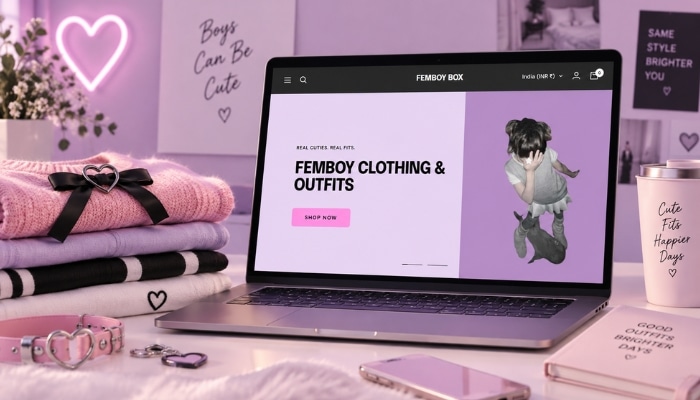
That gap is what small brands stepped into. FemboyBox , an Australian store shipping internationally, is one of a handful that built a catalogue around the community’s actual wardrobe rather than around a product category. The distinction sounds academic until you look at what the store had to solve.
The problem that defines the business
For a man buying from women’s sizing, the biggest friction is not price or taste. It is that the size chart was not written for his body. Waist sits higher, hips run narrower, shoulders run wider, and a women’s medium may or may not close. The result is guesswork, returns, and abandoned carts from customers who wanted to buy and could not work out what to order.
A category retailer treats that as a returns-rate problem and absorbs the cost. A community brand treats it as the product. Publishing a size guide written for male proportions is not content marketing in the usual sense; it is the removal of the single largest barrier to purchase, and it doubles as the most linked and shared page a store like this will ever have, because the community has been solving the same problem by trial and error for years.
This is the pattern across successful niche stores. The winning move is rarely a novel product. It is identifying the friction the community has been living with and removing it.
What the playbook looks like
Founders considering a community-led store rather than a category store should expect the following:
- Research happens in the community, not in keyword tools. Search volume tells you what people type. The Discord server tells you what they cannot find, which is where the margin is.
- Content is infrastructure, not promotion. Fit guides, how-to explainers and beginner resources are what the community links to and what search engines reward. Product pages rarely earn either.
- Suppliers rarely understand the market. Most niche fashion stores work with generalist manufacturers and do the translation themselves: which cuts run large, which fabrics forgive a broader frame, what to photograph and what to describe.
- Trust is the moat. A community that has been mocked or ignored by mainstream retail will forgive a lot from a brand that clearly understands it, and forgive nothing from one that is visibly extracting.
- Growth ceilings are real. A subculture brand can be a healthy small business indefinitely. It is unlikely to be a venture-scale one, and founders who try to force it usually alienate the community that built it.
Where it goes wrong
The failure mode is obvious once you have seen it: a founder who spots the niche from outside, sources the same products, runs the same ads, and treats the community as a demographic. The store looks identical to the authentic one for about six months. Then the community works it out, usually from small tells, wrong terminology, stock photography that misreads the aesthetic, a size chart copied from the supplier, and the brand quietly dies while the founder blames the market.
The second failure mode is the mirror image: a founder from inside the community who understands the customer perfectly and understands nothing about inventory, cash flow or advertising compliance. Those stores are loved and unprofitable.
The businesses that last sit in the narrow overlap: fluent in the community, competent at the boring parts.
The larger opportunity
None of this is specific to fashion. Every online subculture with a shared identity and a set of unsolved practical problems is a potential market: niche hobbies, specific medical or dietary communities, professional micro-niches, aesthetics that mainstream retail finds too odd to touch. The femboy fashion case is simply a clear one, because the demand was visible for years on public platforms before anyone built for it.
For a founder with limited capital, that is the actual opportunity in e-commerce today. Not a better version of a product that already has ten thousand sellers, but a competent version of one that has none.
