


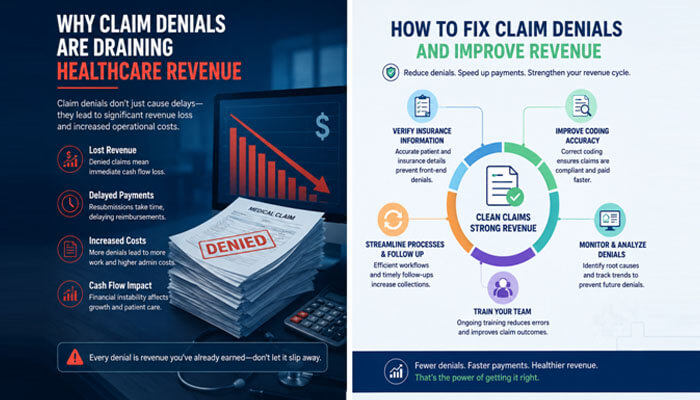

which wastes staff time and delays payments. causes the hospital to lose 5% of its revenue annually. Denial management services identify issues in claims and reduce the rate of claim denials. By improving claim accuracy and compliance with regulations.
The Real Loss from Claim Denials
The hospital managers think that if a $500 claim is denied, the loss is only $500, but the real loss is much higher. Fixing a denial takes staff time, costs $25–$200 in rework, and delays payment for months.
The loss in just one week is $650; staff lost $7500 one week. The service that keeps all these losses under control is called “Denial Management Service,” which protects the hospital from financial loss.
How a registration error costs $650.
Giving the wrong insurance ID, date of birth, and wrong typing in registration. One front desk person does 15 to 20 wrong registrations per day. All these mistakes have a 50% rate. And that turns into $650 in a week. So the staff ends up causing a lot of loss to the hospital.
If we work on this, it will save the staff a lot of wasted time. In such situations, EHR verifies it and points out the mistake, but it’s not strong enough in every institution. That’s why Denial Management Service takes control over those institutions where this service isn’t available.
Hidden Cost of Staff Burnout
- Work pressure and fatigue lead to missed deadline fixes.
- Spreadsheets slow recovery and increase errors.
- Delayed follow-ups lose money: Untracked appeals often go uncollected.
- Burnout reduces accuracy: Tired staff make more mistakes.
Why Billers Struggle with Payer Rules

Frequent changes in policies cause problems for organizations. If something is decided once and then changed, it turns out to be wrong, and one has to keep working on it continuously. As a result, these mistakes have to be faced repeatedly, which causes major disruptions in the work. That’s why a new machine has now been introduced: a denial management service. It immediately catches any change made by the company and allows it to be changed.
How to Reduce Denials in 1 Month
3-step checks: Verify claims at registration, coding, and billing stages. Weekly review, Analyze denied claims and group root causes. Strong appeals appeal all denials above $20. Regular training, short daily/weekly staff training on common errors. Daily tracking: Monitor denial rate and recovery daily.
Unappealed claims statistics
The shocking truth about revenue cycle management is that 65% of denied claims are never resubmitted or appealed, mainly because staff are under pressure and burnt out. Yet the opportunity is huge: a $50 claim can be appealed in just 2 minutes, claims appealed within 15 days have around a 75% approval rate, and recovery chances drop below 20% once a claim is over 90 days old. Using automated tracking systems instead of manual spreadsheets can boost recovery by up to 300%.
Conclusion
To control 650 weekly claim denials, providers need to shift from reacting to preventing problems. Simple steps like the 3-touch rule, weekly denial reviews, and appealing within 15 days can bring quick results.
For organizations facing complex payer rules and high denial volumes, denial management services are a better option. They offer predictive analytics and expert appeal teams that work much faster than in-house staff.
