


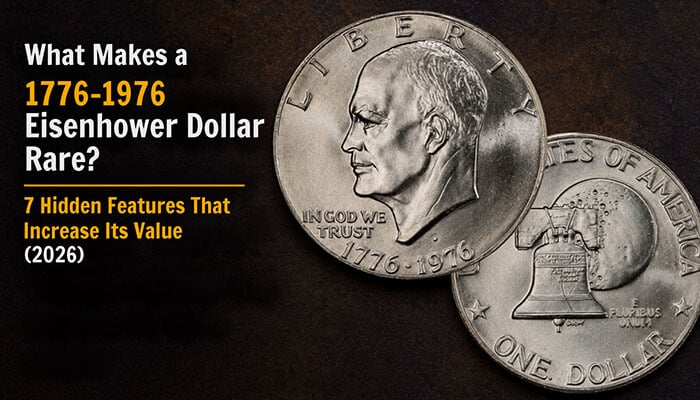
A 1776-1976 Eisenhower dollar is one of the most recognizable U.S. coins because of its dual date and Liberty Bell reverse. Although millions were produced for the American Bicentennial, some examples are significantly more valuable than others. What Makes a 1776-1976 Eisenhower Dollar Rare? The answer depends on several important factors, including the reverse variety, metal composition, mint mark, condition, proof finish and genuine minting errors. While most circulated coins are worth close to face value, certain certified examples can command much higher prices.
Not every Bicentennial dollar is collectible, and the date alone does not make a coin rare. Small details that many people overlook can have a major impact on collector demand and market value.
This guide explains the seven hidden features behind What Makes a 1776-1976 Eisenhower Dollar Rare? and shows how to identify the coins that deserve a closer look before buying, selling or grading.
Key Takeaways
- The 1776-1976 dual date alone does not make an Eisenhower dollar rare.
- Type 1 dollars have thicker reverse lettering, while Type 2 coins feature thinner, sharper lettering.
- The San Francisco Mint produced both copper-nickel proof coins and 40% silver collector issues.
- Standard clad Eisenhower dollars weigh about 22.7 grams, while 40% silver versions weigh about 24.6 grams.
- High-grade certified coins are often much scarcer and more valuable than ordinary circulated examples.
- Genuine mint errors can increase value, but they must be distinguished from post-mint damage.
- Never clean a collectible Eisenhower dollar, as cleaning can permanently reduce its collector value.
What Is the 1776-1976 Eisenhower Dollar?
The 1776-1976 Eisenhower dollar is a U.S. Bicentennial commemorative coin issued to celebrate the 200th anniversary of American independence. It features President Dwight D. Eisenhower on the obverse and the Liberty Bell superimposed over the Moon on the reverse, a design created by Dennis R. Williams.
Although the coin displays the dual date 1776-1976, it was struck during 1975 and 1976. No Eisenhower dollars dated 1975 were issued because all coins produced for the Bicentennial carried the dual date.
The U.S. Mint produced the coin in two compositions:
- Copper-nickel clad for circulation and clad proof sets
- 40% silver for special uncirculated and proof collector sets
These differences in composition are one of the factors that help explain What Makes a 1776-1976 Eisenhower Dollar Rare?
1776-1976 Eisenhower Dollar Specifications
| Coin type | Mint mark | Approximate weight | Composition | Typical finish |
|---|---|---|---|---|
| Philadelphia circulation strike | None | 22.7 grams | Copper-nickel clad | Business strike |
| Denver circulation strike | D | 22.7 grams | Copper-nickel clad | Business strike |
| San Francisco clad proof | S | 22.7 grams | Copper-nickel clad | Proof |
| San Francisco silver uncirculated | S | 24.6 grams | 40% silver | Uncirculated |
| San Francisco silver proof | S | 24.6 grams | 40% silver | Proof |
The Denver Type 2 copper-nickel coin is listed at 22.68 grams, while the San Francisco silver version weighs approximately 24.6 grams.
However, weight alone should not be used to authenticate an expensive coin. Scale accuracy, wear, environmental damage and counterfeit pieces can produce misleading results.
Why Does the Eisenhower Dollar Say 1776-1976?
The dual date 1776-1976 marks the 200th anniversary of American independence. It does not mean the coin was minted in 1776 or produced over a 200-year period.
Key facts about the dual date:
- Bicentennial Eisenhower dollars were struck during 1975 and 1976.
- No Eisenhower dollars dated 1975 were issued by the U.S. Mint.
- Every Bicentennial Eisenhower dollar carries the same 1776-1976 dual date.
- The Bicentennial Washington quarter and Kennedy half dollar also use the same dual-date format.
The dual date is a commemorative design feature, not an indication of rarity. What Makes a 1776-1976 Eisenhower Dollar Rare? depends on factors such as the reverse variety, composition, mint mark, condition and genuine mint errors.
What Makes a 1776-1976 Eisenhower Dollar Rare? The 7 Biggest Value Factors
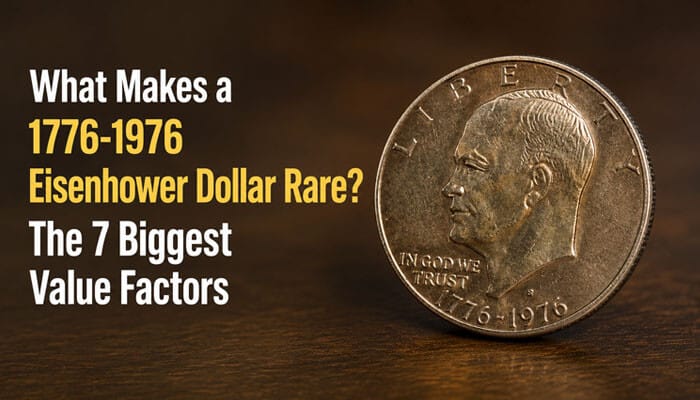
Not every Bicentennial Eisenhower dollar is equally collectible. What Makes a 1776-1976 Eisenhower Dollar Rare? In most cases, the answer comes down to seven characteristics that collectors and grading services examine before assigning a premium.
1. The Coin Has the Scarcer Type 1 Reverse
One of the easiest features to examine is the lettering on the reverse. The U.S. Mint produced Bicentennial Eisenhower dollars with two reverse varieties: Type 1 and Type 2.
Type 1 Reverse Characteristics
A Type 1 reverse features:
- Thick, block-like lettering
- Broad letters with relatively squared corners
- Heavier “UNITED STATES OF AMERICA” lettering
- A thicker “ONE DOLLAR” inscription
Type 2 Reverse Characteristics
A Type 2 reverse features:
- Thin, sharper lettering
- More refined letter shapes
- Narrower reverse lettering
- A cleaner, more modern appearance
According to PCGS, Type 1 features thick lettering, while Type 2 displays thinner, sharper lettering. The difference is most noticeable in “UNITED STATES OF AMERICA” and “ONE DOLLAR.”
Is Every Type 1 Eisenhower Dollar Rare?
No. Type 1 dollars are generally scarcer than Type 2 dollars, but rarity alone does not determine value. A coin’s condition, certified grade and overall eye appeal also play an important role.
PCGS reports the following approximate production figures:
| Variety | Reported Mintage |
|---|---|
| Philadelphia Type 1 | 4,019,000 |
| Philadelphia Type 2 | 113,318,000 |
| Denver Type 1 | 21,048,710 |
| Denver Type 2 | 82,179,564 |
| San Francisco clad Type 1 proof | 2,845,450 |
| San Francisco clad Type 2 proof | 4,149,730 |
| San Francisco 40% silver uncirculated | 11,000,000 |
| San Francisco 40% silver proof | 4,000,000 |
Philadelphia Type 1 dollars have a significantly lower reported mintage than Philadelphia Type 2 dollars. PCGS also notes that well-preserved Philadelphia Type 1 business strikes become increasingly difficult to find in MS65 and are particularly scarce in MS66 or higher.
How to Identify a Type 1 Reverse
Turn the coin over and inspect:
- “UNITED STATES OF AMERICA”
- “ONE DOLLAR”
- The shape of the letters
- The thickness of the lettering
For the most accurate identification, compare your coin with certified Type 1 and Type 2 reference images from a reputable grading service rather than relying solely on online marketplace listings.
2. It Is a Genuine 40% Silver Eisenhower Dollar
One small detail can separate an ordinary Bicentennial Eisenhower dollar from one that attracts far more collector interest—a genuine 40% silver composition. What Makes a 1776-1976 Eisenhower Dollar Rare? For many collectors, confirming that the coin is silver is one of the first checks because most Bicentennial dollars were struck in copper-nickel clad.
How to Identify a 40% Silver Bicentennial Dollar
A genuine 40% silver example typically has:
- An S mint mark
- A weight of approximately 24.6 grams
- A light gray edge with little visible copper
- A Proof or Special Uncirculated finish
- Original packaging from a U.S. Mint Bicentennial three-coin silver set
According to PCGS, these coins feature silver-copper outer layers bonded to a silver-copper core, resulting in an overall silver content of approximately 40%.
Don’t Assume Every “S” Mint Mark Is Silver
An S mint mark alone does not confirm a silver coin.
The San Francisco Mint also struck copper-nickel clad proof Bicentennial dollars with the same mint mark. These coins weigh about 22.7 grams and usually display a visible copper-colored edge.
Before identifying a coin as silver, always check:
- Mint mark
- Weight
- Edge appearance
- Finish
- Original Mint packaging
- Professional authentication
Silver Alone Doesn’t Make It Rare
Although 40% silver versions are generally worth more than ordinary clad dollars, millions were produced. NGC reports about 4 million silver proofs, while PCGS records approximately 11 million silver uncirculated examples.
What Makes a 1776-1976 Eisenhower Dollar Rare? The biggest premiums usually go to silver coins that also have an exceptional certified grade, outstanding eye appeal, or a recognized mint error—not simply because they contain silver.
3. It Has an Exceptionally High Grade
Two Bicentennial Eisenhower dollars can look similar at first glance, yet one may be worth hundreds—or even thousands—more because of its condition. What Makes a 1776-1976 Eisenhower Dollar Rare? In many cases, it is the coin’s exceptionally high certified grade rather than its mintage.
Because Eisenhower dollars are large and heavy, they often picked up contact marks during production and storage. Even many uncirculated examples have:
- Marks on Eisenhower’s portrait
- Scratches in the fields
- Weak strike details
- Dull luster
- Minor rim nicks
Why Grade Matters
| Grade | Meaning |
|---|---|
| MS60–MS62 | Uncirculated with noticeable marks |
| MS63–MS64 | Choice uncirculated |
| MS65 | Gem uncirculated |
| MS66–MS67 | Exceptionally preserved and much scarcer |
| PR/PF | Proof coin |
According to PCGS, Philadelphia Type 2 Bicentennial dollars are common through MS65 but become much scarcer in MS66 and especially MS67 or higher.
What Makes a 1776-1976 Eisenhower Dollar Rare? A top-grade survivor can command a substantial premium because so few remain in nearly flawless condition. For example, a certified 1776-1976-S 40% silver Eisenhower dollar graded NGC MS69 reportedly sold for $20,800 in 2023, illustrating how exceptional preservation can dramatically increase value.
4. It Has a Deep Cameo Proof Finish
Brilliant mirror-like surfaces can make one proof Eisenhower dollar stand out from another. What Makes a 1776-1976 Eisenhower Dollar Rare? For proof coins, one of the biggest value drivers is a strong Deep Cameo finish paired with excellent preservation.
A premium proof typically features:
- Mirror-like fields
- Frosted design elements
- Sharp strike details
- Strong portrait-to-background contrast
- Clean surfaces with little or no haze, spots or hairlines
Grading services describe the highest contrast as Deep Cameo (DCAM) or Ultra Cameo (UCAM).
According to PCGS, most 1976-S silver proofs are common through PR68, while PR69 coins are noticeably scarcer. Perfect PR70 Deep Cameo examples are exceptionally difficult to find.
What Makes a 1776-1976 Eisenhower Dollar Rare? A Deep Cameo designation alone is valuable, but the highest premiums usually go to coins that combine exceptional contrast with a top certified grade and flawless surfaces.
5. It Contains a Genuine Minting Error
A single mistake at the U.S. Mint can transform an ordinary Bicentennial Eisenhower dollar into a sought-after collectible. What Makes a 1776-1976 Eisenhower Dollar Rare? In some cases, the answer is a genuine mint error that occurred during production—not damage after the coin left the Mint.
Recognized mint errors include:
- Off-center strikes
- Clipped planchets
- Double strikes
- Rotated dies
- Strike-through errors
- Wrong-planchet errors
- Broadstrikes
Heritage Auctions has documented Bicentennial Eisenhower dollars with authenticated mint errors, including clipped planchets and strike-throughs. For example, a certified 1976-D Type 2 with a 7% clipped planchet sold for $240 in 2021.
Mint Error or Damage?
Many unusual-looking coins are damaged rather than rare mint errors. Scratches, flattened letters, tool marks, heat damage and altered mint marks usually occurred after the coin entered circulation.
What Makes a 1776-1976 Eisenhower Dollar Rare? A genuine mint error should match known minting characteristics and be authenticated by a trusted grading service such as PCGS or NGC before it is described as valuable or rare.
6. It Has an Unusual Mint Mark or Metal Composition
Most Bicentennial Eisenhower dollars were struck with expected mint mark and metal combinations. What Makes a 1776-1976 Eisenhower Dollar Rare? In exceptionally rare cases, a coin with an unusual mint mark or unexpected composition can become one of the most valuable varieties in the series.
Most examples follow these combinations:
- No mint mark – Philadelphia copper-nickel business strike
- D mint mark – Denver copper-nickel business strike
- S mint mark – San Francisco proof or 40% silver collector issue
One of the greatest rarities is the 1976 No-S Type 2 40% silver proof. According to PCGS, only one authenticated example is publicly known, making it one of the rarest modern U.S. coins.
What Makes a 1776-1976 Eisenhower Dollar Rare? The famous No-S coin is not an ordinary Philadelphia issue without a mint mark. It is a professionally authenticated 40% silver proof with a Type 2 reverse that was mistakenly struck without the S mint mark. NGC also reports that a small number of 1976-D Eisenhower dollars were accidentally struck on silver-clad planchets, making professional authentication essential before claiming a rare composition error.
7. It Has Original Surfaces and Exceptional Eye Appeal
Collectors often pay more for coins that remain exactly as they left the Mint. What Makes a 1776-1976 Eisenhower Dollar Rare? Original surfaces, strong mint luster and outstanding eye appeal can significantly increase a coin’s desirability.
A premium example may have:
- Original mint luster
- Clean, undisturbed surfaces
- Attractive natural toning
- Sharp design details
- Minimal contact marks
- No signs of cleaning or polishing
Natural blue, gold or rainbow toning can sometimes add value when combined with original surfaces, although collector demand for toned coins varies.
What Makes a 1776-1976 Eisenhower Dollar Rare? A coin with untouched surfaces is generally worth more than one that has been cleaned or chemically altered. Harsh cleaning can leave hairline scratches, remove mint luster and even result in a “Details” grade from PCGS or NGC, reducing its collector appeal.
Type 1 vs. Type 2 Eisenhower Dollar Comparison
At first glance, both reverse varieties look similar. However, the lettering style is one of the easiest ways to identify the scarcer variety and can influence collector demand when combined with a high grade.
| Feature | Type 1 | Type 2 |
|---|---|---|
| Reverse lettering | Thick and block-like | Thin and refined |
| Letter corners | More squared | Sharper and narrower |
| Overall appearance | Bold, heavier lettering | Cleaner, more refined lettering |
| Philadelphia mintage | Lower | Much higher |
| High-grade availability | More difficult to find | Common in lower grades but scarce in MS67+ |
| Best area to inspect | UNITED STATES OF AMERICA | UNITED STATES OF AMERICA |
Although Type 1 is generally scarcer, the reverse variety alone does not determine value. Grade, composition, eye appeal and professional certification remain equally important.
1776-1976 Eisenhower Dollar Mintage by Type
Mintage shows how many coins were originally produced, but it does not determine rarity by itself. Many high-mintage coins become difficult to find in superb condition, while lower-mintage issues may remain relatively affordable because more examples survived.
| Issue | Reverse / Finish | Reported Mintage |
|---|---|---|
| Philadelphia (No Mint Mark) | Type 1 Business Strike | 4,019,000 |
| Philadelphia (No Mint Mark) | Type 2 Business Strike | 113,318,000 |
| Denver (D) | Type 1 Business Strike | 21,048,710 |
| Denver (D) | Type 2 Business Strike | 82,179,564 |
| San Francisco (S) | Type 1 Clad Proof | 2,845,450 |
| San Francisco (S) | Type 2 Clad Proof | 4,149,730 |
| San Francisco (S) | 40% Silver Uncirculated | 11,000,000 |
| San Francisco (S) | 40% Silver Proof | 4,000,000 |
The Philadelphia Type 1 has the lowest reported mintage among the regular business strikes. However, certified populations, survival rates and collector demand are often more important than production numbers alone when determining rarity.
1776-1976 Eisenhower Dollar Value Guide (2026)
The values below are general market tendencies, not guaranteed selling prices. Actual value depends on the coin’s condition, certification, rarity, silver content and current collector demand.
| Coin Type | General Value Tendency |
|---|---|
| Worn copper-nickel business strike | Usually around face value |
| Attractive uncirculated clad coin | Modest collector premium |
| Certified Gem Type 1 | Higher premium possible |
| S-Mint clad proof | Usually modest premium |
| 40% Silver Uncirculated | Silver value plus collector premium |
| 40% Silver Proof | Silver value plus proof premium |
| MS66–MS67 Business Strike | Can command substantial premiums |
| PR69–PR70 Deep Cameo Proof | Premium depends on rarity and demand |
| Certified Mint Error | Varies by error type |
| No-S Type 2 Silver Proof | Exceptional modern rarity |
According to NGC’s July 2026 price guide, ordinary circulated Type 2 Bicentennial dollars generally sell for about $1.05 to $1.50, while circulated 1776-1976-S 40% silver examples are listed around $20.25 to $21.50. Exceptional grades, major mint errors and rare varieties can sell for significantly more.
When estimating value, compare recent completed auction sales for coins with the same:
- Date
- Mint mark
- Reverse type
- Composition
- Certified grade
- Grading service
- Mint error (if applicable)
How to Check Whether Your 1776-1976 Eisenhower Dollar Is Rare
Before paying for professional grading, inspect your coin using this simple checklist. What Makes a 1776-1976 Eisenhower Dollar Rare? Small details often make the biggest difference.
1. Check the Mint Mark
- No mint mark = Philadelphia
- D = Denver
- S = San Francisco
2. Identify the Reverse
- Thick lettering = Type 1
- Thin lettering = Type 2
3. Verify the Weight
- 22.7 g = Copper-nickel clad
- 24.6 g = 40% silver
4. Examine the Edge
- Copper-colored edge = Clad
- Light gray edge = 40% silver
5. Inspect the Condition
Look for strong luster, sharp details and minimal contact marks.
6. Check for Proof Features
Mirror-like fields, frosted devices and sharp rims usually indicate a proof coin.
7. Look for Genuine Mint Errors
Search for off-center strikes, clipped planchets, strike-throughs or other authenticated mint errors.
8. Compare With Certified Examples
Use PCGS, NGC and completed auction records before deciding whether your coin is rare.
What Makes a 1776-1976 Eisenhower Dollar Rare? The most valuable examples usually combine the right variety, outstanding condition, genuine mint errors and professional certification.
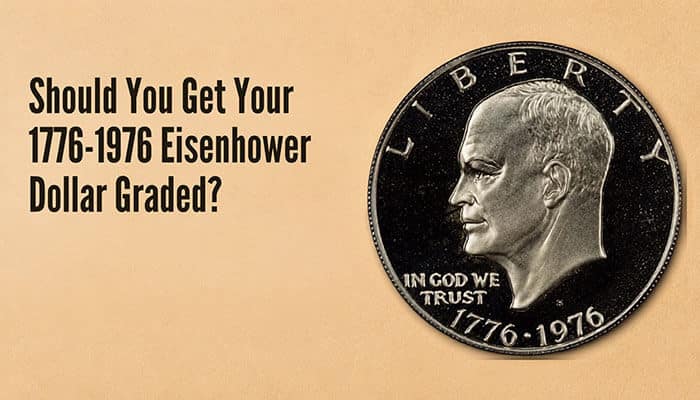

Where Can You Sell a Rare 1776-1976 Eisenhower Dollar?
Selling the right way can make a significant difference in the final price. What Makes a 1776-1976 Eisenhower Dollar Rare? If your coin has been professionally graded or appears to have a valuable variety, choose a selling method that matches its potential value.
Local Coin Dealer
Ideal for a quick sale and an in-person evaluation. Expect offers below retail because dealers account for resale costs and market risk.
Coin Show
Compare offers from multiple dealers in one place, making it easier to determine a fair market value.
Major Auction House
Best suited for:
- High-grade certified coins
- Major mint errors
- Rare varieties
- Important pedigrees
Online Marketplace
A good option for reaching more buyers. Include clear photos and accurately describe the coin’s grade, composition, certification and any damage.
Collector Communities
Coin clubs and specialized numismatic forums often attract knowledgeable buyers looking for quality Eisenhower dollars.
Before accepting an offer, compare recent completed auction sales for similar certified coins. What Makes a 1776-1976 Eisenhower Dollar Rare? The strongest prices usually go to authenticated examples with exceptional condition, genuine mint errors or recognized rare varieties.
Common Myths About the 1776-1976 Eisenhower Dollar
Several misconceptions lead collectors to overestimate the value of ordinary Bicentennial dollars. What Makes a 1776-1976 Eisenhower Dollar Rare? The facts below separate common myths from reality.
Myth 1: Every 1776-1976 Dollar Is Rare
Fact: More than 220 million Bicentennial Eisenhower dollars were produced. The dual date alone does not make a coin valuable.
Myth 2: Every S-Mint Coin Is Silver
Fact: San Francisco struck both copper-nickel clad proofs and 40% silver collector coins.
Myth 3: Every No Mint Mark Coin Is the Rare No-S Proof
Fact: Most no-mint-mark coins are ordinary Philadelphia business strikes. The famous No-S Type 2 silver proof is a unique authenticated rarity.
Myth 4: A Gold-Colored Coin Is a Valuable Error
Fact: Gold color is often caused by natural toning, environmental exposure or aftermarket plating—not a rare mint error.
Myth 5: Doubled Letters Always Mean a Doubled Die
Fact: Machine doubling, die wear and post-mint damage can all create a doubled appearance. Professional authentication is needed to confirm a true doubled-die variety.
Myth 6: Online Asking Prices Reflect Market Value
Fact: Asking prices can be unrealistic. What Makes a 1776-1976 Eisenhower Dollar Rare? Compare recent completed auction sales and certified examples to determine a coin’s actual market value.
Avoid Common Mistakes When Buying or Selling a 1776-1976 Eisenhower Dollar
Viral videos and online listings often exaggerate the value of Bicentennial Eisenhower dollars. What Makes a 1776-1976 Eisenhower Dollar Rare? In most cases, high prices are reserved for certified coins with exceptional grades, genuine mint errors or rare varieties—not ordinary circulated examples.
Watch for These Red Flags
- Every no-mint-mark coin is advertised as rare
- A filled D mint mark is claimed to be worth thousands
- Only blurry or heavily edited photos are provided
- Different coins appear in the same listing
- The seller quotes an asking or insurance value instead of a completed sale
- A coin is described as silver without confirming its weight
- Damage is presented as a mint error
- Terms like “one of a kind” are used without professional certification
- A raw coin is compared with a top-grade certified example
- An ordinary coin has an unrealistic asking price
What Makes a 1776-1976 Eisenhower Dollar Rare? Always compare certified examples and recent completed auction sales before buying or selling. Authenticity, condition and professional grading—not online hype—determine a coin’s true market value.
How to Store a Valuable 1776-1976 Eisenhower Dollar
Proper storage helps preserve your coin’s condition and long-term value. What Makes a 1776-1976 Eisenhower Dollar Rare? Even a scarce variety can lose collector appeal if it is scratched, cleaned or stored improperly.
Store Your Coin In:
- An inert coin capsule
- A non-PVC coin flip
- An archival-quality holder
- A cool, dry, low-humidity environment
- Hold the coin only by its edges using clean hands or cotton-free gloves
Avoid:
- PVC plastic holders
- Tape or adhesives
- Staple contact
- Damp or humid areas
- Extreme heat or direct sunlight
- Loose storage with other coins
- Cleaning or polishing the coin
Conclusion
Most 1776-1976 Eisenhower dollars are common collectible coins, but a small number are genuinely scarce and can command significant premiums. What Makes a 1776-1976 Eisenhower Dollar Rare? It is never the dual date alone. Instead, rarity comes from a combination of factors such as the reverse variety, metal composition, certified grade, original surfaces, proof quality and authenticated mint errors.
Before buying, selling or submitting a coin for grading, examine its mint mark, weight, condition and reverse type, then compare it with certified examples and recent completed auction sales. Careful research and professional authentication can help you distinguish an ordinary Bicentennial dollar from one that deserves a place in a serious collection.
FAQs About What Makes A 1776-1976 Eisenhower Dollar Rare?
1. What Makes a 1776-1976 Eisenhower Dollar Rare in today’s market?
A rare Bicentennial Eisenhower dollar usually combines multiple value factors, such as a scarce variety, high certified grade, original surfaces, genuine mint errors or exceptional collector demand.
2. Can a circulated Bicentennial Eisenhower dollar still be valuable?
Yes. Although most circulated coins have modest value, authenticated mint errors or scarce varieties can still command collector premiums even with some wear.
3. Does the original U.S. Mint packaging increase a coin’s value?
Original government packaging can improve buyer confidence, especially for 40% silver collector issues, but the coin’s condition and authenticity remain the primary value factors.
4. Should I insure a rare 1776-1976 Eisenhower dollar?
If your coin has been professionally graded and has substantial market value, adding it to a collectibles insurance policy may provide financial protection against theft or damage.
5. Can environmental damage reduce a rare coin’s value?
Yes. Corrosion, discoloration, fingerprints and improper storage can significantly reduce collector appeal and lower a coin’s market value.
6. Are certified Eisenhower dollars easier to sell?
Generally, yes. Coins authenticated by respected grading services often attract greater buyer confidence and may sell faster than uncertified examples.
7. How often do Bicentennial Eisenhower dollar values change?
Market values can change over time based on silver prices, collector demand, certified population reports and auction results.
8. Can counterfeit 1776-1976 Eisenhower dollars be found online?
Yes. Buyers should verify weight, dimensions, certification and seller reputation before purchasing expensive Bicentennial Eisenhower dollars online.
