


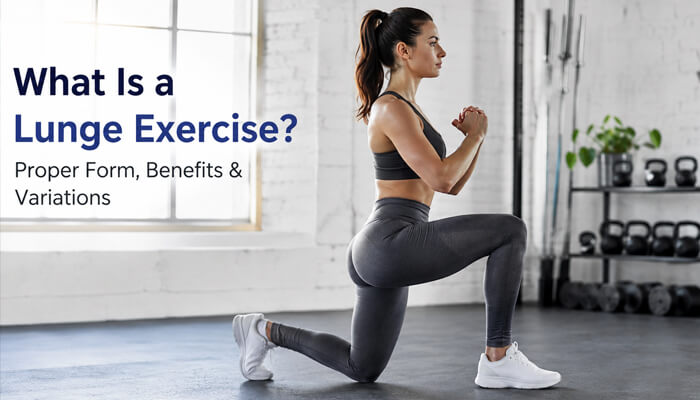

A lunge may look like a simple step, but it is one of the most adaptable lower-body movements you can include in a workout. It develops leg strength while challenging balance, coordination, hip stability, mobility, and core control. So, what is a lunge exercise exactly? A lunge is a compound, unilateral-dominant movement performed in a split or uneven stance. One foot moves forward, backward, sideways, or diagonally while the hips and knees bend to lower the body.
The working leg then produces force to raise the body or return it to the starting position. Lunges mainly train the quadriceps and glutes. The hamstrings, inner thighs, calves, hip stabilizers, and core also help control the movement. By adjusting the direction, stride length, depth, resistance, or speed, you can use lunges for beginner strength training, muscle development, sports conditioning, balance, or muscular endurance.
This guide explains proper lunge form, muscles worked, benefits, common mistakes, exercise variations, beginner programming, knee-safety considerations, and ways to select the right lunge for your goal.
Quick Answer: What Is a Lunge Exercise?
A lunge is a lower-body strength exercise performed in a split or uneven stance. You bend the hips, knees, and ankles to lower your body, then use the working leg to rise or return to the starting position.
A correctly performed lunge generally includes:
- A stable front or working foot
- Controlled bending of the hip and knee
- A knee that tracks in the same direction as the toes
- A steady pelvis and neutral spine
- A smooth lowering phase
- A controlled push back to the starting position
Lunges can be performed with body weight or additional resistance such as dumbbells, kettlebells, resistance bands, a barbell, or suspension straps.
Key Takeaways
- A lunge is a compound, unilateral-dominant lower-body exercise.
- It primarily works the quadriceps, glutes, and hamstrings.
- The calves, inner thighs, hip stabilizers, and core also contribute.
- Lunges can be performed forward, backward, sideways, diagonally, or in place.
- A supported stationary lunge or reverse lunge is often easiest for beginners.
- The front knee does not need to remain behind the toes in every healthy person.
- Step length, depth, torso angle, and resistance position change the exercise’s demands.
- Lunges and squats complement each other rather than serving as exact substitutes.
- Sharp or increasing joint pain is a reason to stop, not a sign of an effective workout.
Lunge Exercise at a Glance
| Question | Quick Answer |
|---|---|
| What is a lunge exercise? | A unilateral-dominant lower-body exercise |
| Main muscles worked? | Quadriceps, glutes, and hamstrings |
| Good for beginners? | Yes, with proper progression |
| Better than squats? | Different benefits, not better or worse |
| Can lunges build muscle? | Yes |
| Can lunges help fat loss? | Indirectly, as part of a complete program |
| Best beginner variation? | Supported stationary lunge or reverse lunge |
| Equipment required? | No |
| Suitable for home workouts? | Yes |
| Can lunges improve balance? | Yes |
What Is a Lunge Exercise?
A lunge is considered a compound movement because several joints and muscle groups work together during each repetition.
As the body lowers, the working hip, knee, and ankle bend. The muscles of the hips and legs lengthen under tension to control the descent. As the body rises, those muscles produce force to extend the hip and knee.
Lunges are frequently called unilateral exercises because they emphasize one side at a time. However, “unilateral-dominant” is a more precise description because both feet may remain in contact with the floor, and both legs can contribute to balance and force production.
The movement resembles actions used in daily life and sports, including:
- Stepping forward or backward
- Climbing stairs
- Rising from a low position
- Reaching toward the floor
- Accelerating or slowing down
- Changing direction
- Recovering balance after a step
- Moving around an obstacle
Some lunges are dynamic, meaning you step into or out of the position during each repetition. Others are performed from a stationary split stance.
Is a Lunge a Strength or Cardio Exercise?
Understanding what is a lunge exercise in a workout helps explain why tempo, resistance, and repetition range can change its training effect.
A lunge is primarily a resistance or strength exercise, but its training effect depends on how it is performed.
Slow, controlled lunges with challenging resistance mainly develop strength and muscle. High-repetition walking lunges, alternating lunges, or jumping lunges performed in a circuit can also increase the heart rate and develop muscular endurance.
| Lunge style | Primary training effect |
| Supported bodyweight lunge | Technique and beginner strength |
| Stationary bodyweight lunge | Balance and muscular endurance |
| Heavy dumbbell reverse lunge | Lower-body strength |
| High-repetition walking lunge | Muscular endurance and conditioning |
| Jumping lunge | Explosive power and conditioning |
| Lunges in a circuit | Strength, endurance, and cardiovascular demand |
Even when lunges raise your heart rate, they should not automatically replace a complete aerobic program involving activities such as walking, cycling, swimming, or running.
What Muscles Do Lunges Work?
A complete answer to what is a lunge exercise should include the muscles that create the movement and the muscles that stabilize it.
Lunges train several muscles in the hips, thighs, lower legs, and trunk.
The exact contribution of each muscle changes according to:
- Lunge direction
- Step length
- Movement depth
- Torso angle
- Exercise speed
- Foot position
- External resistance
- Weight placement
Primary Muscles Worked During Lunges
| Muscle group | Location | Main role during a lunge |
| Quadriceps | Front of the thighs | Extend the knee and control the descent |
| Gluteus maximus | Buttocks | Extends the hip and drives the body upward |
| Hamstrings | Back of the thighs | Assist hip extension and help stabilize the knee |
| Gluteus medius and minimus | Outer hips | Stabilize the pelvis and control side-to-side movement |
| Adductors | Inner thighs | Stabilize the hips and assist with hip extension |
| Calves | Lower legs | Stabilize the ankle and support balance |
| Core muscles | Abdomen and trunk | Control posture and resist unwanted movement |
Which Leg Does Most of the Work?
When readers ask what is a lunge exercise, they often also want to know why the front leg usually feels more active than the rear leg.
In most forward, reverse, and stationary lunges, the front leg performs a greater share of the muscular work.
The rear leg still contributes, but it generally has more of a supporting role.
Technique can change how the work is distributed:
- A longer, comfortable stride may place more demand on the hips and glutes.
- A shorter stride may create greater forward knee movement and quadriceps demand.
- A controlled forward torso angle may increase hip extensor involvement.
- A relatively upright torso may create more knee extensor demand.
- Elevating the rear foot usually increases the challenge for the front leg.
- Holding weight on only one side increases the trunk-stability demand.
These are general tendencies rather than fixed rules. Body proportions, ankle mobility, hip structure, and individual technique all influence how a lunge feels.
How Does a Lunge Work?
Looking at what is a lunge exercise phase by phase makes the movement easier to learn and control.
A lunge can be divided into three main phases.
1. Setup or Stepping Phase
In the setup phase, what is a lunge exercise becomes a question of foot placement, balance, and preparing the trunk for movement.
In a dynamic lunge, one foot moves into the working position while the trunk and pelvis remain controlled.
In a stationary lunge or split squat, the feet are placed in position before the repetition begins.
2. Lowering Phase
During the lowering phase, what is a lunge exercise is best understood as a controlled descent rather than a quick drop toward the floor.
The front hip, knee, and ankle bend as the body moves downward. The muscles work eccentrically, meaning they lengthen under tension to control the descent.
The rear knee also bends and moves toward the floor, but it does not need to touch it.
3. Rising Phase
During the rising phase, what is a lunge exercise becomes a coordinated push through the working leg while the trunk stays stable.
The working leg produces force to extend the knee and hip. The body rises or returns to the original position.
A well-performed lunge is not simply a step followed by a push. It is a coordinated movement involving the feet, ankles, knees, hips, pelvis, and trunk.
How to Do a Forward Lunge Correctly
For beginners researching what is a lunge exercise, the forward lunge is often the most familiar version, but it is not always the easiest.
The forward lunge requires enough strength and coordination to control the forward step.
Step-by-Step Instructions
These instructions show what is a lunge exercise in practice, from the first step to the controlled return.
- Stand upright with your feet approximately hip-width apart.
- Keep your head neutral and gently brace your abdominal muscles.
- Take a controlled step forward with one foot.
- Place the entire front foot firmly on the floor.
- Bend both knees and lower your body under control.
- Allow the rear knee to move toward the floor without striking it.
- Keep the front knee tracking in the same general direction as the toes.
- Maintain a steady pelvis and controlled spine.
- Lower only as far as you can without losing balance or experiencing pain.
- Push through the front foot to return to standing.
- Repeat on the same side or alternate legs.
Avoid rushing the step. The landing and lowering phases should remain smooth rather than allowing momentum to pull the body forward.
Proper Lunge Form Checklist
This checklist turns what is a lunge exercise into a simple set of body-position cues you can review during each repetition.
| Body area | Recommended position |
| Head | Neutral, looking forward, or slightly downward |
| Shoulders | Relaxed rather than shrugged |
| Spine | Neutral and controlled |
| Core | Gently braced |
| Pelvis | Level and facing forward |
| Front foot | Fully supported on the floor |
| Front knee | Tracking in the direction of the foot |
| Rear heel | Usually lifted during forward and reverse lunges |
| Rear knee | Moving toward the floor under control |
| Movement speed | Smooth rather than rushed |
Proper Lunge Form: Knee Position, Depth, Stance and Breathing
Good form is central to understanding what is a lunge exercise because small changes in stance can shift the demand between the hips, knees, and trunk.
Small changes in stance and body position can alter how a lunge feels. There is no single foot distance or torso angle that is perfect for every person.
Should Your Knee Go Past Your Toes?
One of the most common questions linked to what is a lunge exercise is whether forward knee travel is automatically unsafe.
The instruction “never let your knee pass your toes” is too absolute for every person and every lunge variation.
Forward knee travel occurs naturally during walking, stair climbing, squatting, and lunging. Whether the knee moves beyond the toes depends on:
- Ankle mobility
- Leg length
- Foot position
- Stride length
- Torso angle
- Lunge depth
- Exercise variation
Allowing the knee to move farther forward generally increases quadriceps and knee-extensor demand. Keeping the shin more vertical or taking a longer stride may move some of the demand toward the hips.
The goal is not to force the knee behind the toes at all costs. Instead:
- Keep the entire front foot stable.
- Let the knee move in the same general direction as the toes.
- Avoid an uncontrolled inward collapse.
- Use a stride that feels balanced.
- Reduce the depth when control is lost.
- Modify or stop the exercise if it produces pain.
Someone recovering from a knee injury should follow the technique and range recommended by a healthcare or rehabilitation professional.
How Deep Should You Lunge?
Another part of answering what is a lunge exercise is recognizing that useful depth depends on control, comfort, and mobility.
You do not need to force both knees into exact 90-degree angles.
A suitable depth is the lowest position you can reach while maintaining:
- A stable front foot
- Controlled knee alignment
- A comfortable spine
- Balanced hips
- Smooth breathing
- No sharp or worsening pain
Some people can lower until the front thigh is close to parallel with the floor. Others need a shallower range because of limited mobility, reduced strength, balance difficulties, or joint sensitivity.
Depth is a training variable, not a competition. Increase it gradually as control and mobility improve.
How Far Apart Should Your Feet Be?
Foot spacing matters when explaining what is a lunge exercise because a very narrow stance can make balance unnecessarily difficult.
Your feet should generally be separated both front to back and slightly side to side.
Placing both feet on one narrow line creates a “tightrope” position and can make the movement unnecessarily unstable. Imagine standing on two railway tracks rather than balancing on one line.
Choose a stride length that lets you lower without:
- Lifting the front heel
- Losing balance
- Forcing the rear hip
- Collapsing the front knee inward
- Excessively arching the lower back
A longer step is not always better, and a shorter step is not automatically wrong. The appropriate distance depends on your proportions, mobility, and training goal.
Is Leaning Forward During a Lunge Wrong?
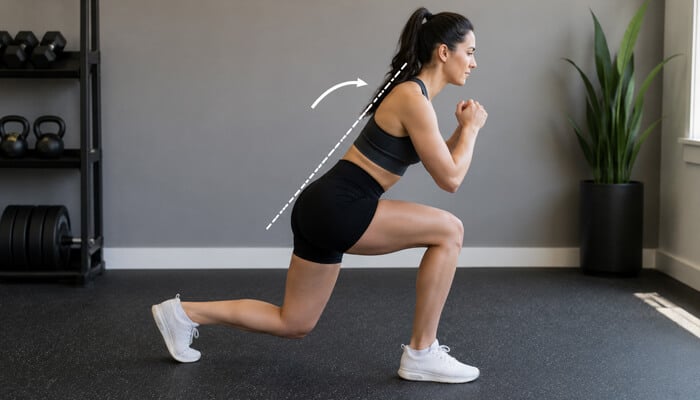
A precise explanation of what is a lunge exercise should distinguish a controlled hip hinge from an uncontrolled rounded posture.
A small, controlled forward torso lean is not automatically a form mistake.
A slight hip hinge can increase the involvement of the glutes and other hip extensor muscles. The spine should still remain neutral and controlled.
There is an important difference between:
- Hinging slightly from the hips with a neutral spine
- Rounding or collapsing through the lower back
The first may be an intentional technique choice. The second can indicate fatigue, excessive resistance, poor control, or unsuitable depth.
How Should You Breathe?
Breathing is a small but useful part of what is a lunge exercise, especially when repetitions become difficult.
For bodyweight and moderately loaded lunges:
- Inhale while lowering.
- Exhale while pushing upward.
Avoid holding your breath unnecessarily.
Experienced lifters may use more advanced bracing techniques with heavy resistance. Anyone with cardiovascular or blood-pressure concerns should obtain appropriate guidance before using heavy loads or prolonged breath-holding.
How to Check Your Lunge Form at Home
A home form check can help someone who is still learning what is a lunge exercise identify obvious balance and alignment problems.
A mirror or short video can help identify obvious technique problems. It cannot diagnose an injury, but it may reveal balance or alignment issues.
Record several repetitions from the front and then from the side.
Front-View Checklist
From the front, what is a lunge exercise should look like a stable foot, controlled knee path, and level pelvis.
Check whether:
- The front knee follows the direction of the toes.
- The knee avoids collapsing sharply inward.
- The pelvis remains reasonably level.
- The torso avoids leaning excessively to one side.
- The feet have enough side-to-side separation.
- The front foot remains planted.
Side-View Checklist
From the side, what is a lunge exercise should appear smooth, balanced, and free from an uncontrolled forward fall.
Check whether:
- The movement is smooth and controlled.
- The front heel remains on the floor.
- The rear knee moves downward without striking the ground.
- The lower back avoids excessive rounding or arching.
- The stride allows the hip and knee to bend comfortably.
- You can rise without pushing mainly from the rear foot.
Five-Question Lunge Self-Test
This self-test gives readers asking what is a lunge exercise a practical way to judge whether a variation currently suits them.
After a set, ask:
- Could I keep my whole front foot stable?
- Did my front knee remain controlled?
- Could I lower and rise without using momentum?
- Did both sides feel reasonably coordinated?
- Did I complete the movement without sharp or increasing pain?
When the answer is no, reduce the depth, slow the movement, use stable support, or choose an easier variation.
Your lunge does not need to look identical to someone else’s. Body proportions, mobility, training experience, and exercise goals can produce natural differences in stance and torso position.
Why Are Lunges So Effective?
Lunges remain one of the most widely used lower-body exercises because they combine strength, stability, mobility, and coordination within a single movement pattern.
Unlike many machine-based exercises, lunges require the hips, knees, ankles, and trunk to work together. This creates a training effect that extends beyond simple muscle strengthening.
A properly performed lunge can help develop:
Lower-Body Strength
The quadriceps, glutes, hamstrings, and calves work together throughout the movement.
Balance and Coordination
Each repetition challenges the body’s ability to control weight while moving through an uneven stance.
Hip Stability
The hip stabilizers help keep the pelvis controlled during the exercise.
Movement Confidence
Many everyday activities involve stepping, climbing, reaching, and changing direction. Lunges help train these patterns under controlled conditions.
This combination of strength and movement control is one reason lunges appear in fitness, athletic-development, and rehabilitation programs.
Benefits of Lunge Exercises
The benefits section expands what is a lunge exercise beyond a definition by showing why the movement is used in fitness programs.
Understanding what is a lunge exercise also involves knowing why it is included in so many training programs.
Strengthens the Lower Body
For anyone asking what is a lunge exercise for strength, the main value is coordinated work across the hips, knees, and ankles.
Lunges train the quadriceps, glutes, hamstrings, adductors, and calves.
Gradually increasing resistance, repetitions, range of motion, or exercise difficulty can improve lower-body strength.
Trains Each Side More Independently
This unilateral emphasis is a major part of what is a lunge exercise and why it differs from many two-leg exercises.
Because one leg receives greater emphasis, lunges may reveal differences in strength, mobility, balance, or coordination between sides.
They can help train each side deliberately, although small side-to-side differences are common and do not automatically indicate a medical problem.
Challenges Balance and Stability
Balance demands help explain what is a lunge exercise beyond simple leg strengthening.
A split stance creates a less symmetrical base of support than a standard two-leg squat.
The body must coordinate the feet, ankles, knees, hips, pelvis, core, and upper body to remain controlled.
Lunges alone will not correct every balance issue, but they can be part of a well-designed strength and balance program.
Develops Hip and Pelvic Control
Hip stability is another useful part of what is a lunge exercise because the pelvis must stay controlled as weight shifts.
The gluteus medius and other hip stabilizers help control the pelvis and prevent excessive side-to-side movement.
Hip stability is useful during walking, running, stair climbing, and changes of direction.
Supports Everyday Movement
In daily life, what is a lunge exercise resembles stepping, reaching, climbing, and recovering from uneven positions.
Daily activities frequently place the feet in uneven positions. People step, reach, turn, climb, kneel, and recover from off-balance positions.
Lunges build strength in a staggered stance that resembles many of these actions.
Builds Muscular Endurance
When performed for more repetitions, what is a lunge exercise can also become a muscular-endurance challenge.
Higher-repetition bodyweight lunges require the lower-body muscles to continue producing force over time.
This can improve local muscular endurance, particularly when lunges are included in a circuit or conditioning session.
Offers Many Progression Options
Adaptability is central to what is a lunge exercise because the same movement pattern can be simplified or made more demanding.
You can modify a lunge by changing:
- Direction
- Depth
- Step length
- Speed
- Tempo
- Repetition range
- Resistance
- Foot elevation
- Weight placement
- Stability demand
This flexibility makes lunges suitable for many experience levels and training goals.
Complements Sports Training
For athletes, what is a lunge exercise often relates to building strength for stepping, stopping, and changing direction.
Lunges can support sports that involve stepping, stopping, accelerating, reaching, or changing direction.
Examples include:
- Basketball
- Football
- Soccer
- Tennis
- Hockey
- Volleyball
- Badminton
- Martial arts
- Fencing
General strength exercises should complement rather than replace sport-specific practice.
Requires Little or No Equipment
For home training, what is a lunge exercise is especially practical because a basic version needs almost no equipment.
A bodyweight lunge can be performed at home, outdoors, while travelling, or in a gym.
A beginner may need only:
- A clear floor
- Stable footwear
- A wall, rail, or heavy chair for support
Resistance can be added as strength and confidence improve.
Are Lunges Better Than Squats?
One of the most common fitness questions is whether lunges or squats are the better exercise.
The reality is that both movements provide valuable benefits.
When Lunges May Be Better
- Training one leg more independently
- Improving balance and coordination
- Addressing side-to-side strength differences
- Adding multi-directional movement
When Squats May Be Better
- Developing maximum lower-body strength
- Using heavier resistance
- Training both legs simultaneously
- Building overall lower-body muscle mass
- For most people, the best approach is not choosing one exercise over the other. A balanced training program often includes both squats and lunges because each develops different qualities.
Do Lunges Build Muscle?
People asking what is a lunge exercise often want to know whether it can support muscle growth as well as general fitness.
Lunges can contribute to muscle growth when they create enough muscular tension and are performed consistently.
Muscle development depends on:
- Progressive overload
- Sufficient training volume
- Appropriate effort
- Exercise selection
- Recovery
- Protein and overall nutrition
- Sleep
- Training experience
- Individual response
Bodyweight lunges may be challenging enough for a beginner. As they become easier, progress may require:
- More repetitions
- Additional sets
- A slower lowering phase
- A pause near the bottom
- Greater controlled depth
- Dumbbells or kettlebells
- A more challenging variation
Useful muscle-building options include dumbbell reverse lunges, Bulgarian split squats, front-foot-elevated split squats, and deficit reverse lunges.
Add resistance only when you can maintain foot stability, knee control, and trunk position.
Do Lunges Burn Fat?
A realistic answer to what is a lunge exercise should separate its strength benefits from misleading spot-reduction claims.
Lunges use large muscle groups and require energy, but they cannot selectively remove fat from the thighs, hips, or abdomen.
Body-fat reduction depends on overall energy balance over time.
Lunges can support a fat-loss program by:
- Increasing physical activity
- Helping preserve or build muscle
- Improving lower-body strength
- Contributing to demanding workouts
A balanced fat-loss approach typically includes resistance training, aerobic activity, everyday movement, appropriate nutrition, sleep, and recovery.
Claims that one lunge variation can directly “burn thigh fat” are misleading.
Types of Lunges and Their Uses
Exploring the variations helps answer what is a lunge exercise across different goals, abilities, and movement directions.
There is no single best lunge variation for everyone.
| Variation | How it differs | Common use |
| Stationary lunge | Feet remain in a split stance | Learning the basic movement |
| Forward lunge | Step forward and return | Deceleration, coordination and strength |
| Reverse lunge | Step backward and return | Beginner progression and front-leg control |
| Walking lunge | Move forward with each repetition | Endurance and coordination |
| Lateral lunge | Step sideways and load one hip | Side-to-side strength and adductor mobility |
| Diagonal lunge | Step at an angle | Multi-directional control |
| Curtsy lunge | Step diagonally behind the body | Coordination when comfortable |
| Dumbbell lunge | Hold external resistance | Strength and muscle development |
| Barbell lunge | Carry a barbell on the back or front | Advanced resistance training |
| Bulgarian split squat | The rear foot is elevated | Greater front-leg emphasis |
| Front-foot-elevated split squat | The front foot is raised | Greater controlled range of motion |
| Deficit reverse lunge | Step backward from a low platform | Advanced range-of-motion progression |
| Jumping lunge | Switch legs explosively | Power and conditioning |
| Rotational lunge | Add controlled rotation | Multi-directional coordination |
| Suspension lunge | Use straps for support or instability | Assistance or advanced stability training |
Popular Lunge Variations and How to Perform Them
This section shows what is a lunge exercise in several practical forms rather than treating every lunge as identical.
1. Supported Stationary Lunge
For a beginner asking what is a lunge exercise, a supported stationary version is often the most manageable starting point.
A supported stationary lunge removes the challenge of stepping during every repetition.
- Stand beside a stable wall, rail, or heavy chair.
- Place one foot forward and the other behind.
- Keep the feet slightly separated from side to side.
- Hold the support lightly.
- Lower straight down through a comfortable range.
- Keep the front foot planted.
- Push through the front leg to rise.
- Complete the repetitions before changing sides.
The support reduces the balance demand and lets you focus on knee alignment, foot pressure, and movement control.
Do not hold an object that can slide, roll, or tip.
2. Reverse Lunge
The reverse variation offers another answer to what is a lunge exercise by keeping the front foot planted while the other leg steps backward.
- Stand with your feet hip-width apart.
- Brace your core.
- Step one foot backward.
- Land on the ball of the rear foot.
- Lower both knees under control.
- Keep the front foot fully planted.
- Push through the front leg.
- Bring the rear foot forward.
- Repeat on the opposite side.
A reverse lunge may feel easier to control because the front foot remains planted throughout the repetition. However, no variation is automatically suitable for every knee condition.
3. Walking Lunge
In a walking version, what is a lunge exercise becomes a continuous sequence that demands more coordination and space.
A walking lunge moves the body forward with each repetition.
Use these technique tips:
- Establish balance before taking the next step.
- Do not let momentum control the descent.
- Keep the feet slightly separated from side to side.
- Begin with body weight.
- Prioritize controlled repetitions over distance or speed.
Walking lunges can develop muscular endurance and coordination, but they may not be the best starting variation for a beginner.
4. Lateral Lunge
The lateral version broadens what is a lunge exercise by adding side-to-side movement and greater inner-thigh involvement.
- Stand with your feet together or hip-width apart.
- Step widely to one side.
- Bend the stepping knee.
- Push the hips backward.
- Keep the opposite leg relatively straight.
- Maintain full-foot pressure on the working side.
- Push through the working foot to return.
- Repeat on the opposite side.
Lateral lunges train the quadriceps, glutes, adductors, and hip stabilizers while introducing movement in a direction often neglected in forward-only programs.
5. Jumping Lunge
At an advanced level, what is a lunge exercise can include explosive jumping, but only after basic control has been developed.
A jumping lunge is an explosive variation in which the legs switch positions in the air.
It requires strength, coordination, landing control, and sufficient joint tolerance. It is not an appropriate starting exercise for beginners.
Before attempting it, you should be able to perform controlled bodyweight lunges without losing balance or knee alignment.
6. Lunge Comparisons
Comparisons make what is a lunge exercise easier to understand by showing how it differs from squats and split squats.
Lunges vs Squats
When comparing what is a lunge exercise with a squat, the biggest differences are stance, balance demand, and how the legs share the load.
| Feature | Lunges | Squats |
| Stance | Split or staggered | Usually symmetrical |
| Loading | Greater emphasis on one leg | More evenly shared |
| Balance demand | Generally higher | Generally lower |
| External load potential | Usually lower | Usually higher |
| Movement directions | Forward, backward, lateral or diagonal | Primarily vertical |
| Main use | Unilateral-dominant strength and coordination | Bilateral strength and load development |
Neither exercise is universally better.
Squats are especially useful for developing bilateral strength and handling heavier resistance. Lunges are useful for training each leg more independently and introducing multi-directional movement.
Many programs benefit from including both.
Lunge vs Split Squat
Clarifying what is a lunge exercise also means separating a stepping lunge from a split squat with fixed feet.
A lunge usually involves stepping into or out of a split stance.
A split squat generally keeps both feet planted while the body moves up and down.
Because the feet stay fixed, a split squat can be easier for learning basic hip, knee, and trunk control. A dynamic lunge adds stepping, landing, and deceleration.
Bulgarian Split Squat vs Lunge
This comparison helps explain what is a lunge exercise versus a rear-foot-elevated split squat, which usually places more demand on the front leg.
| Feature | Traditional lunge | Bulgarian split squat |
| Foot movement | Usually involves stepping | Feet remain stationary |
| Rear foot | Usually on the floor | Elevated |
| Balance demand | Moderate to high | High |
| Front-leg demand | High | Often higher |
| Beginner suitability | Depends on the variation | Better after basic split-stance control |
| Space required | More for walking lunges | Relatively little |
A Bulgarian split squat can be highly effective, but rear-foot elevation increases the balance and positioning challenge. Beginners do not need to rush into it.
How Weight Position Changes a Lunge
Adding resistance does more than make a lunge harder. The position of the weight changes balance, trunk activation, and overall difficulty.
Dumbbells Held at the Sides
Holding one dumbbell in each hand distributes resistance relatively evenly.
This is usually the simplest loaded progression because the arms remain beside the body.
Goblet Lunge
A dumbbell or kettlebell is held close to the chest.
The goblet position may help some people maintain a controlled torso and is generally easier to release safely than a barbell.
Suitcase Lunge
A suitcase lunge uses a weight held on one side.
The uneven load requires the trunk to resist leaning and rotation. The weight can be held on the same side as the working leg or on the opposite side.
The two positions create different stability demands; neither is automatically superior.
Front-Rack or Barbell Lunge
Dumbbells, kettlebells, or a barbell can be held near the shoulders or supported across the upper back.
These positions allow greater loading but increase the importance of balance, mobility, setup, and safe failure. They are generally more appropriate after bodyweight and dumbbell lunges have been mastered.
Overhead Lunge
A weight or bar is held overhead while lunging.
This advanced variation requires substantial shoulder mobility, trunk stability, and coordination. It is not a necessary progression for ordinary lower-body training.
| Loading method | Balance demand | Trunk demand | General level |
| Body weight | Low to moderate | Moderate | Beginner |
| Two dumbbells at the sides | Moderate | Moderate | Beginner to intermediate |
| Goblet hold | Moderate | Moderate to high | Beginner to intermediate |
| One-sided suitcase hold | Moderate to high | High | Intermediate |
| Front-rack hold | High | High | Intermediate |
| Barbell on the upper back | High | High | Intermediate to advanced |
| Overhead resistance | Very high | Very high | Advanced |
Common Lunge Mistakes and How to Fix Them
| Mistake | Possible cause | Correction |
| The front knee collapses inward | Fatigue, poor control or excessive difficulty | Reduce depth and keep the knee tracking with the foot |
| Front heel lifts | Unsuitable stride or limited ankle control | Adjust the stride and maintain full-foot pressure |
| Feet are placed on one line | Tightrope-style setup | Widen the stance slightly |
| The step is too short | Rushed setup or limited space | Use a distance that permits a stable descent |
| The step is excessively long | Trying to force a vertical shin | Shorten the stance until the hips and knees move comfortably |
| Rear knee hits the floor | Uncontrolled descent | Slow the lowering phase |
| Torso rotates | Poor balance or excessive resistance | Reduce the load and keep the pelvis facing forward |
| Lower back arches | Poor bracing or excessive depth | Brace the core and shorten the range |
| Rear foot does most of the pushing | Poor weight distribution | Focus on driving through the front foot |
| Repetitions are rushed | Excessive momentum | Pause and control every repetition |
| Weight is added too early | Progression before technique mastery | Return to body weight or lighter resistance |
| Sharp pain is ignored | Pain is mistaken for normal effort | Stop and assess the movement |
What Should You Feel During a Lunge?
During a controlled lunge, you may feel muscular effort in the:
- Front thigh
- Glutes
- Back of the thigh
- Inner thigh
- Calf
- Abdominal and trunk muscles
The exact sensation changes with the stride, depth, torso position, and variation.
Front-Thigh Effort
Feeling the quadriceps working is normal, particularly when the knee moves farther forward or the torso remains relatively upright.
Glute Effort
The glutes work as the hip bends and then extends. A longer comfortable stance or slight hip hinge may make the glutes more noticeable.
Rear-Hip Stretch
A mild stretch at the front of the rear hip can occur, especially with a longer stance.
It should not feel sharp, pinching, or painful.
Knee Sensation
Muscular effort around the knee is not automatically harmful. Sharp, catching, unstable, or progressively worsening joint pain is a reason to stop.
You do not need to feel an intense muscle burn for the exercise to be effective.
Sets, Repetitions and Frequency
The right number of lunges depends on your experience, resistance, variation, goal, and overall workout.
Beginner Starting Point
A healthy beginner might start with:
- 1–3 sets
- 6–10 controlled repetitions per leg
- One or two sessions per week
Use a supported or stationary variation if balance is difficult.
Stop the set when form begins to deteriorate. The final repetitions can feel challenging, but they should not require uncontrolled movement.
How Often Should You Do Lunges?
Many healthy adults can train a lunge pattern two or three times per week when total volume and intensity are appropriate.
Challenging weighted lunges generally require more recovery than light bodyweight practice.
| Goal | Possible starting frequency |
| Learning technique | 2–3 light sessions per week |
| General fitness | 1–2 challenging sessions per week |
| Muscle development | About 2 sessions within a complete program |
| Sports conditioning | Based on sports practice and recovery |
| Rehabilitation | As prescribed by the treating professional |
These are general starting points, not individualized prescriptions.
How to Progress Lunges Safely
Progress one or two variables at a time.
A practical sequence is:
- Supported split-stance hold
- Supported shallow stationary lunge
- Full comfortable stationary lunge
- Bodyweight reverse lunge
- Alternating reverse lunge
- Forward lunge
- Walking lunge
- Light dumbbell lunge
- Heavier loaded lunge
- Elevated or explosive variation
You can increase difficulty by:
- Adding repetitions
- Adding a set
- Increasing depth gradually
- Slowing the lowering phase
- Adding a pause
- Holding resistance
- Increasing resistance
- Choosing a more complex variation
Do not increase weight, depth, speed, volume, and instability at the same time.
Sample Beginner Lunge Workout
Begin with a brief warm-up:
- Five minutes of comfortable walking or cycling
- 8–10 controlled bodyweight squats
- 8 alternating knee lifts per side
- 8 hip hinges
- 5 shallow supported lunges per side
Then complete:
| Exercise | Sets | Repetitions |
| Supported stationary lunge | 2 | 6–8 per leg |
| Bodyweight squat | 2 | 8–12 |
| Glute bridge | 2 | 10–15 |
| Standing calf raise | 2 | 10–15 |
| Bird dog | 2 | 6–8 per side |
Rest for approximately 60–90 seconds between sets or longer when needed.
Increase repetitions gradually before adding external resistance.
Which Lunge Variation Is Best for Beginners?
Many people assume they should start with walking lunges or advanced gym variations, but that is often unnecessary. The best beginner lunge is the one that allows you to maintain balance, control, and proper technique while building confidence with the movement pattern.
For most beginners, mastering stability and coordination is far more important than performing the most challenging variation.
Supported Stationary Lunge
A supported stationary lunge is often the best starting point for complete beginners.
By lightly holding a wall, rail, or sturdy support, you can focus on learning proper foot placement, knee alignment, balance, and movement control without worrying about falling or losing stability.
This variation helps build confidence while reducing unnecessary balance demands.
Stationary Split Squat
The stationary split squat is another excellent beginner option because the feet remain fixed throughout the exercise.
Without the need to step forward or backward during each repetition, beginners can focus on controlling the lowering and lifting phases while developing lower-body strength and coordination.
Many fitness professionals use the split squat as a foundation before progressing to more dynamic lunge variations.
Reverse Lunge
Once basic control has been developed, the reverse lunge is often the next logical progression.
Unlike a forward lunge, the front foot remains planted while the opposite leg steps backward. Many people find this variation easier to balance and control because it places less demand on deceleration and landing mechanics.
Reverse lunges are frequently recommended for beginners who want to improve lower-body strength while minimizing unnecessary movement complexity.
Variations Best Saved for Later
Although effective, some lunge variations are usually better introduced after the fundamentals have been mastered.
These include:
- Walking lunges
- Bulgarian split squats
- Deficit lunges
- Jumping lunges
- Weighted lunges
- Rotational lunges
These exercises typically require greater balance, coordination, strength, mobility, or impact tolerance.
Beginner Coaching Tip
A good beginner lunge should feel controlled, stable, and repeatable. If you cannot maintain balance, keep your entire front foot planted, or control your knee position throughout the movement, choose an easier variation rather than forcing a more advanced one.
Progression should be earned through consistent technique, not rushed through increasing difficulty. Building a strong foundation with simpler lunge variations often leads to faster long-term strength gains and a lower risk of training setbacks.
How to Choose the Right Lunge for Your Goal
| Goal | Suitable starting variation |
| Learn basic form | Supported stationary lunge |
| Improve confidence and control | Reverse lunge |
| Build lower-body strength | Dumbbell reverse or stationary lunge |
| Emphasize the front leg | Bulgarian split squat |
| Train side-to-side movement | Lateral lunge |
| Build muscular endurance | Walking lunge |
| Develop explosive power | Jumping lunge after mastering basic strength |
| Exercise in a limited space | Stationary lunge or split squat |
| Reduce balance demand | Supported lunge |
| Increase range of motion | Front-foot-elevated split squat |
| Increase trunk-stability demand | Suitcase lunge |
| Train in several directions | Forward, lateral, and diagonal lunges |
The best variation is the one that matches your goal, ability, mobility, and capacity to progress without pain.
Lunge Alternatives and Modifications
Lunges are useful, but they are not compulsory. Strong legs can be developed without performing a traditional forward lunge.
| Difficulty | Alternative or modification |
| Poor balance | Supported split squat |
| Forward step feels uncontrolled | Reverse lunge |
| Dynamic stepping is difficult | Stationary split squat |
| Knee discomfort at greater depth | Shallow supported split squat |
| Limited ankle mobility | Reverse lunge or adjusted stride |
| Hip discomfort in a long stance | Shorter comfortable stance |
| Unable to lower near the floor | Partial-range lunge |
| Persistent pain | Step-up, squat or professional assessment |
| Need greater stability | Leg press |
| Need a low-impact home exercise | Chair sit-to-stand |
| Want unilateral work without lunging | Low step-up |
| Need additional assistance | Suspension-assisted lunge |
Choose the alternative according to the reason the lunge is difficult.
Someone training balance may use support temporarily and reduce it gradually. Someone prioritizing muscle development may choose a more stable exercise that can be progressively loaded.
Are Lunges Bad for Your Knees?
Lunges are not inherently bad for healthy knees.
They are also used in some professionally supervised rehabilitation programs because the direction, depth, stride length, support, and resistance can be modified.
Lunges may aggravate symptoms when:
- The movement is introduced too aggressively.
- The range exceeds the person’s control.
- Too much resistance is used.
- Training volume increases too quickly.
- An existing injury has not been assessed.
- The selected variation is unsuitable.
- Pain is ignored.
Forward, reverse, lateral, shallow, deep, elevated, and weighted lunges do not place identical demands on the knees.
When a lunge causes discomfort:
- Use a shallower range.
- Try a reverse lunge.
- Hold stable support.
- Reduce the resistance.
- Slow the movement.
- Adjust the stride.
- Try a stationary split squat.
- Seek professional assessment if pain continues.
Muscle Soreness After Lunges: What Is Normal?
People who are new to lunges may experience delayed muscle soreness, particularly after:
- High-repetition walking lunges
- Unfamiliar variations
- Deep ranges of motion
- Slow lowering phases
- A sudden increase in training volume
Normal post-workout soreness may include:
- Tender quadriceps or glutes
- Temporary stiffness
- Discomfort while sitting or climbing stairs
- Symptoms beginning several hours after exercise
- Gradual improvement over the following days
Soreness is not required for a productive workout. A lack of soreness does not mean the exercise failed.
Warning Signs Requiring Caution
Stop and seek appropriate medical guidance for:
- Sharp pain during exercise
- Significant swelling
- Unexplained bruising
- Inability to bear weight
- A knee or ankle giving way
- Numbness or tingling
- Progressively worsening pain
- Severe pain that does not begin to improve
- Dark urine or extreme weakness after unusually intense exercise
Who Should Ask a Professional Before Doing Lunges?
Individual guidance may be appropriate for someone with:
- A recent knee, ankle, hip, or back injury
- Recent surgery
- Significant joint swelling
- Active arthritis symptoms
- Major balance difficulties
- Frequent falls
- Osteoporosis or increased fracture risk
- A neurological condition affecting movement
- Cardiovascular exercise restrictions
- Persistent pain during daily activities
- A rehabilitation plan following a ligament or tendon injury
A physical therapist, sports-medicine professional, or appropriately qualified exercise professional can help select a suitable variation, range, and resistance.
Expert Coaching Tip
Many people progress too quickly from bodyweight lunges to advanced variations.
A better approach is to first master:
- Balance
- Foot pressure
- Knee control
- Comfortable depth
- Consistent repetition quality
Strength gains happen fastest when technique remains stable. Adding resistance before mastering movement often slows long-term progress.
Conclusion
So, what is a lunge exercise? It is a versatile, unilateral-dominant movement that strengthens the legs while challenging balance, coordination, hip stability, and core control. The quadriceps and glutes perform much of the work, while the hamstrings, calves, inner thighs, hips, and trunk help stabilize the body.
The most effective lunge is not necessarily the deepest, heaviest, or most advanced variation. It is the version that matches your current ability, supports your goal, permits gradual progression, and can be performed without sharp or worsening pain.
Begin with a stable stance and manageable range. Master the basic movement before adding resistance, elevation, speed, or explosive variations.
What Is a Lunge Exercise FAQs
1. What Is a Lunge Exercise in Simple Words?
A lunge is a lower-body exercise where one foot is placed forward, backward, or sideways while the hips and knees bend to lower the body. The working leg then pushes the body back up. In simple words, what is a lunge exercise? It is a leg-strengthening movement that trains balance, coordination, and lower-body control.
2. What Muscles Does a Lunge Exercise Work?
A lunge exercise mainly works the quadriceps, glutes, and hamstrings. It also involves the calves, inner thighs, hip stabilizers, and core muscles. When people ask what is a lunge exercise, they should understand that it is not only a thigh exercise but a full lower-body movement.
3. Is a Lunge Exercise Good for Beginners?
Yes, a lunge exercise can be good for beginners when performed with proper form and a comfortable range of motion. Beginners can start with a supported stationary lunge or reverse lunge before trying walking or jumping lunges. A beginner learning what is a lunge exercise should focus on control before adding weight.
4. What Is the Best Lunge Exercise for Glutes?
The best lunge exercises for glutes usually include reverse lunges, longer-stride lunges, Bulgarian split squats, and lunges with a slight controlled hip hinge. These variations place more demand on the glutes. However, the best choice depends on comfort, strength, balance, and proper technique.
5. How Many Lunge Exercises Should I Do?
A beginner can start with 1–3 sets of 6–10 controlled repetitions per leg. More experienced exercisers may increase sets, repetitions, resistance, or difficulty over time. The right number depends on fitness level, goal, recovery, and whether the lunge exercise is used for strength, endurance, or conditioning.
