



#thriftyevents.net is built around a simple event-planning principle: saving money should come from making better decisions, not automatically choosing the cheapest option.
That distinction can determine whether an event stays comfortably within budget or becomes unexpectedly expensive.
A low-cost venue may stop looking affordable once catering minimums, equipment rentals, service charges, setup fees, transportation and overtime are added. DIY décor may save money, but only when materials, tools, labor and time actually cost less than renting or buying finished pieces. Even a discounted vendor can become a poor-value choice when essential services are missing from the quote.
Smart planners therefore make their most important financial decisions before they spend the first dollar.
This is where the #thriftyevents.net approach becomes especially useful: define the event’s purpose, estimate attendance, establish the real budget, identify what guests will value, compare vendors on total cost, understand payment obligations and protect contingency money before making major commitments.
That budget-first mindset reflects the current positioning of ThriftyEvents.net, which focuses on budget-friendly event planning, DIY ideas and practical budgeting strategies for occasions ranging from small gatherings to corporate events.
Quick Answer
#thriftyevents.net reflects a budget-conscious approach to event planning in which organizers decide what matters before they start spending.
Instead of cutting every expense equally, smart planners protect the parts of the event that affect safety, functionality and guest experience while reducing costs in lower-impact areas.
A strong event-budget strategy should:
- Define the event goal and realistic guest count
- Calculate the complete all-in budget
- Separate essential, high-impact and optional expenses
- Compare vendors using equivalent requirements
- Include hidden fees and contractual obligations
- Maintain a contingency reserve
- Track deposits, committed spending and final costs
- Prevent unnecessary last-minute upgrades
- Evaluate cost per attendee and event outcomes afterward
Key Takeaways
- Set the event’s purpose before setting individual spending limits.
- Estimate guest count early because attendance affects several budget categories.
- Compare total vendor costs instead of headline prices.
- Include taxes, service charges, delivery, labor, setup and overtime.
- Keep contingency funds separate from optional spending.
- Track both fixed and variable event costs.
- Maintain a calendar for deposits and final balances.
- Control scope creep once the budget has been approved.
- Use break-even analysis for suitable ticketed events.
- Compare planned, committed and actual spending after the event.
- Measure value, not merely whether the event came in under budget.
What Does #thriftyevents.net Mean for Event Planners?
People encountering #thriftyevents.net may initially assume that the topic is simply about cheap decorations, discounted venues or inexpensive party supplies.
The broader idea is more useful.
ThriftyEvents.net describes its mission around practical, creative and affordable event planning, including budgeting, DIY projects and ways to get better value from available resources.
For an event planner, that philosophy can be turned into one financial question:
What outcome are we paying for, and is this expense the best way to achieve it?
That question changes how a planner thinks about money.
Instead of asking only:
“How cheap can we get this?”
the planner asks:
“What value does this expense create?”
That makes it easier to protect high-impact spending while cutting items that contribute little to the actual experience.
Is #thriftyevents.net a Hashtag, Website, or Search Term?
The expression #thriftyevents.net can look unusual because it combines a hashtag symbol with a domain name.
In practice, ThriftyEvents.net is a website. Its current homepage presents event-planning articles, budgeting ideas and DIY content focused on creating memorable occasions without excessive spending.
Readers may encounter several variations of the term online, including:
- #thriftyevents.net
- #ThriftyEventsNet
- ThriftyEvents.net
- thrifty events
- ThriftyEvents net
The site’s own event-planning archive currently contains articles using several similar branded variations, including # ThriftyEvents.net and # ThriftyEventsNet.
The underlying search intent is therefore usually more important than the exact punctuation.
Someone entering #thriftyevents.net may be trying to understand the website, locate its content or find budget-conscious event-planning strategies associated with the name.
Define the Event Goal Before You Define the Spending
Before deciding how much money should go toward food, décor, entertainment or technology, determine what the event is supposed to accomplish.
Ask:
- What is the event’s primary purpose?
- Who needs to attend?
- What should guests experience?
- What is the realistic attendance target?
- Which outcomes matter most?
- Which expenses directly support those outcomes?
This step prevents a common mistake: building an event around purchases rather than objectives.
Why Guest Count Matters So Much
Guest count affects much more than catering.
Attendance may influence:
- Venue size
- Tables and chairs
- Meals and beverages
- Printed materials
- Staffing
- Transportation
- Giveaways
- Security
- Equipment requirements
Suppose the original estimate is 150 guests, but a realistic review shows that 120 is more likely.
That change might reduce food costs, but it could also make a smaller venue practical, reduce furniture requirements and lower transportation or staffing needs.
A #thriftyevents.net approach therefore begins with the objective and audience before moving into individual purchases.
#thriftyevents.net Starts With the All-In Budget
The first number smart planners need is not the venue price.
It is the maximum all-in amount available for the entire event.
A #thriftyevents.net approach works best when planners calculate the full expected cost before committing money to individual vendors or upgrades.
That budget may need to include:
- Venue
- Catering
- Rentals
- Entertainment
- AV and technology
- Staffing
- Marketing
- Transportation
- Décor
- Permits where required
- Insurance where appropriate
- Taxes
- Service charges
- Contingency money
The cheapest room rental does not necessarily create the cheapest event.
An apparently expensive venue may include tables, chairs, parking, basic AV and setup, while a lower-priced alternative could require all of those items to be rented or purchased separately.
Example of an All-In Event Budget
Consider an illustrative event with a maximum budget of $10,000.
| Budget Area | Illustrative Amount | Why It Matters |
|---|---|---|
| Venue | $2,000 | Space and basic facilities |
| Food and beverages | $2,500 | Major guest-experience expense |
| Production and AV | $1,000 | Sound, microphones, screens and lighting |
| Staffing | $700 | Setup, service and support |
| Décor and rentals | $800 | Atmosphere and functional items |
| Marketing or invitations | $500 | Attendance and communication |
| Entertainment | $600 | Guest engagement |
| Transport and miscellaneous | $400 | Logistics and smaller expenses |
| Contingency reserve | $1,000 | Unexpected costs |
| Flexible spending | $500 | Adjustments or approved upgrades |
| Total | $10,000 | Maximum planned spending |
This example is intended as a planning model rather than a universal allocation formula.
A wedding, corporate conference, fundraiser and birthday party will naturally prioritize different categories.
The key principle is to decide how the entire budget should work before committing large amounts to individual suppliers. That gives planners a clearer view of total costs and reduces the risk of discovering expensive extras later.
Decide What Guests Will Actually Notice
Trying to make every element premium is one of the quickest ways to lose control of an event budget.
Instead, identify what attendees are most likely to experience, notice or remember.
At a dinner, food quality and service may matter more than an elaborate entrance installation.
At a conference, reliable audio, comfortable seating and smooth registration may be more valuable than expensive decorative elements.
At a birthday celebration, music, food and atmosphere may create greater impact than personalized gifts placed at every seat.
A simple three-level framework helps prioritize spending.
| Spending Level | Meaning | Examples |
|---|---|---|
| Essential | The event cannot function properly without it | Safe venue, required staffing, basic food, necessary technology |
| High impact | Strongly influences the guest experience | Entertainment, menu quality, lighting, key décor |
| Optional | Attractive but not necessary | Premium favors, elaborate signage, decorative upgrades |
Fund essentials first.
Then allocate money to the high-impact items that directly support the event’s purpose.
Optional extras should compete for whatever budget remains.
#thriftyevents.net and the Difference Between Price and Total Cost
A central lesson in budget planning is that the lowest quote is not necessarily the lowest final cost.
Consider two hypothetical venues:
| Cost | Venue A | Venue B |
|---|---|---|
| Rental | $1,500 | $2,000 |
| Tables and chairs | $350 | Included |
| Basic AV | $400 | Included |
| Setup | $250 | Included |
| Parking | $300 | Included |
| Estimated total | $2,800 | $2,000 |
Venue A initially appears to save $500 based on the rental price alone.
Once tables, AV, setup and parking are included, however, Venue A becomes $800 more expensive in this example.
This illustrates an important #thriftyevents.net budgeting principle: compare vendors using like-for-like total costs, not just advertised or starting prices.
Before booking, ask what is included, what costs extra and what the realistic final amount will be under your event requirements.
Hidden Event Costs That Deserve Attention
Large expenses such as venue rental and catering usually appear in the initial event budget.
The surprises often come from smaller charges that are overlooked during early planning. A #thriftyevents.net approach therefore looks beyond the headline quote and checks what may be added before the final invoice arrives.
| Potential Cost | Question to Ask Before Booking |
|---|---|
| Delivery | Is transportation included in the quoted price? |
| Setup and breakdown | Who handles it, and is there an additional fee? |
| Service charges | Are mandatory service charges already included? |
| Taxes | Is the quoted price before or after applicable taxes? |
| AV labor | Are technicians included with the equipment? |
| Overtime | What additional charges apply if the event runs late? |
| Cleaning | Is post-event cleaning included? |
| Parking | Who pays for guest and vendor parking? |
| Power and internet | Are extra connections or bandwidth chargeable? |
| Rentals | Are furniture, linen and equipment included? |
| Cancellation | What payments could be lost if plans change? |
| Minimum spend | Is there a required catering or beverage minimum? |
Never approve a major event expense based only on the headline figure.
Ask vendors for an itemized estimate of the expected final cost based on your actual event requirements. That makes it easier to compare proposals accurately and spot charges that could otherwise push the budget higher later.
Compare Vendors Before Negotiating With Them
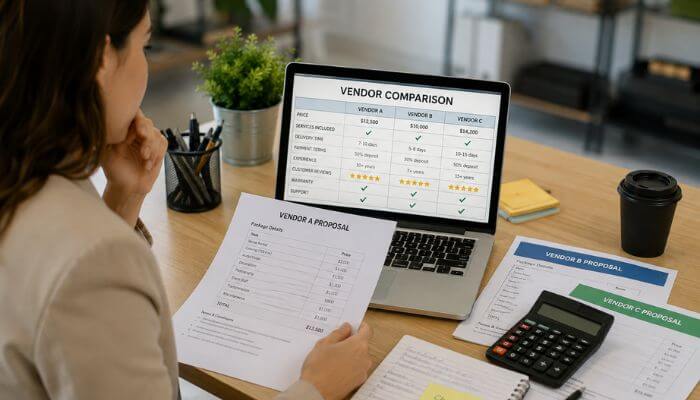
A vendor comparison becomes misleading when each supplier is quoting a different service.
For example:
- One caterer quotes buffet service.
- Another quotes plated service.
- One AV supplier includes technicians.
- Another lists only equipment.
Those offers should not be compared as though they provide the same scope of work.
A practical #thriftyevents.net approach is to give competing vendors the same basic requirements wherever possible so you can compare price, inclusions and terms on a like-for-like basis.
Vendor Comparison Scorecard
| Factor | Vendor A | Vendor B | Vendor C |
|---|---|---|---|
| Total expected cost | |||
| Services included | |||
| Deposit required | |||
| Cancellation flexibility | |||
| Setup included | |||
| Overtime rate | |||
| Relevant experience | |||
| Communication and reliability |
Price should influence the decision without becoming the only factor.
A supplier who costs slightly more but includes delivery, labor, setup and better cancellation terms may offer stronger overall value than the lowest bidder.
Before negotiating, identify exactly what each proposal includes. That makes it easier to negotiate intelligently instead of simply asking every vendor to reduce their price.
#thriftyevents.net Approach to Vendor Negotiation
Negotiating effectively does not always mean demanding a lower price for exactly the same service.
A more productive question is:
“How can we adjust the scope to reach this budget?”
That gives the supplier room to suggest alternatives without automatically reducing quality.
A practical #thriftyevents.net approach is to negotiate around the event’s priorities rather than focusing only on discounts.
For example:
- A caterer might recommend a different serving format.
- A photographer could reduce coverage hours.
- A rental company may offer standard inventory instead of premium designs.
- A venue might provide lower rates for off-peak dates or time slots.
- An AV supplier could simplify equipment based on the room and presentation requirements.
Before accepting any change, confirm exactly what will be removed, replaced or modified and whether additional fees still apply.
The goal is to reduce the total event cost without weakening the experience or outcome that matters most.
#thriftyevents.net Beyond Discounts: Sponsorships and In-Kind Support
For suitable business, nonprofit, community and ticketed events, lowering expenses does not always require reducing the supplier price.
Sponsorships and partnerships can sometimes offset costs.
Potential support might include:
- Venue sponsorship
- Printing
- Photography
- Equipment
- Transportation
- Drinks
- Giveaway products
- Media promotion
- Speaker support
An in-kind sponsorship provides goods or services rather than cash.
Imagine a printing business supplies $600 worth of event signage in return for agreed sponsor recognition.
If that signage was already required, the contribution could reduce the event’s cash spending.
However, planners should still ask:
- Does the sponsor suit the audience?
- What must be provided in return?
- Would we have purchased this product anyway?
- Does the agreement create extra work?
- Does the sponsor receive appropriate but not excessive influence?
A free product that the event does not need is not a genuine saving.
Read the Contract Before Paying the Deposit
The contract is part of the event budget.
An inexpensive supplier with restrictive cancellation terms can carry more financial risk than a slightly more expensive supplier offering reasonable flexibility.
Before paying a deposit, review:
- Deposit amount
- Final payment deadline
- Refund conditions
- Cancellation rules
- Rescheduling terms
- Minimum-spend requirements
- Overtime charges
- Security deposits
- Required staffing
- Outside-vendor restrictions
- Insurance requirements where applicable
Understand which payments are refundable and what circumstances create additional charges.
Price and financial exposure are not always the same thing.
#thriftyevents.net Payment Calendar: Know When the Money Is Due
Budgeting answers how much an event is expected to cost.
Cash-flow planning answers when the money actually needs to be available.
A $20,000 event does not necessarily require $20,000 to be paid on one day. Payments may be spread across several weeks or months through deposits, retainers, installment payments and final balances.
A practical #thriftyevents.net approach is to track payment deadlines alongside the overall event budget so large balances do not become unexpected cash-flow problems.
Example Payment Calendar
| Vendor | Total Cost | Deposit | Balance Due | Due Date |
|---|---|---|---|---|
| Venue | $4,000 | $1,000 | $3,000 | Date |
| Caterer | $3,500 | $1,000 | $2,500 | Date |
| AV supplier | $1,500 | $500 | $1,000 | Date |
| Photographer | $1,200 | $400 | $800 | Date |
Replace the example dates with the actual payment deadlines from each vendor contract.
A payment calendar can help planners:
- Avoid missed deposits
- Prepare for large upcoming balances
- Prevent late-payment fees
- See when several payments fall close together
- Coordinate cash flow with the overall event budget
The goal is not only to stay within budget, but also to make sure the required funds are available at the right time.
Keep a Contingency Fund Before You Need It
Unexpected expenses are part of event planning. Guest numbers can change, weather may affect logistics, equipment can fail, additional labor may become necessary, and transportation requirements can shift at short notice.
If every available dollar has already been committed, even a relatively small problem can push the event over budget.
A practical #thriftyevents.net approach is to treat contingency money as a separate budget category rather than as extra cash available for optional upgrades.
The appropriate reserve depends on factors such as:
- Event size and complexity
- Number of vendors involved
- Weather or logistical uncertainty
- Equipment and technology requirements
- Cancellation or rescheduling exposure
- Likelihood of last-minute changes
The most important rule is to protect the reserve until it is genuinely needed.
If the event runs smoothly and the contingency fund remains untouched, that is a successful budgeting outcome—not unused money that should automatically be spent.
When DIY Saves Money—and When It Does Not
ThriftyEvents.net currently features DIY ideas as one of its primary content categories, alongside event planning and budgeting.
But DIY should still pass a financial test.
Suppose 100 handmade centerpieces require:
- Materials
- Tools
- Storage
- Transport
- 20 hours of work
- Event-day setup
The true comparison is not simply the cost of the raw materials versus the rental price.
DIY Usually Works Better When
- The design is simple
- Materials are inexpensive
- You already own the tools
- Production can be done efficiently
- Storage is available
- Setup is manageable
DIY May Be Poor Value When
- Specialist skills are required
- Expensive equipment must be bought
- Labor requirements are large
- Transport is difficult
- Setup becomes complicated
- Mistakes would be costly
Ask:
“Does doing this ourselves save enough money to justify the time, effort and risk?”
Venue Choice Can Change Almost Every Other Cost
A venue is more than a room. Its furniture, kitchen facilities, AV infrastructure, lighting, accessibility, parking, location and vendor policies can influence several other parts of the event budget.
A practical #thriftyevents.net approach is to evaluate what the venue includes before comparing rental prices alone.
For example, a more expensive venue that already provides tables, chairs, basic sound equipment, suitable lighting and parking may reduce the need for several outside vendors. By contrast, a cheaper empty space may require furniture, AV equipment, décor, transportation or setup services to be rented separately.
Before choosing a venue, ask:
“What other expenses could disappear or decrease if we book this location?”
Also check whether the venue has restrictions on outside catering, preferred vendors, setup times, overtime or equipment use, because these conditions can affect the final cost.
The best-value venue is therefore not always the one with the lowest rental fee. It is the option that delivers the strongest overall value once required extras and included services are considered.
Catering Should Follow the Event, Not Tradition
Catering frequently represents a major event expense, but the most familiar format is not always the most cost-effective or appropriate choice.
A practical #thriftyevents.net approach is to match the food and service style to the event’s purpose, schedule and audience instead of automatically choosing a traditional format.
For example, a plated meal may require more staffing and service time than a buffet, while a networking reception may work better with easy-to-eat food that allows guests to move around. A daytime workshop may need simple, reliable refreshments rather than a full meal.
Before choosing a catering format, consider:
- Time of day
- Event duration
- Guest count
- Guest demographics
- Dietary requirements
- Serving style
- Staffing needs
- Food waste
- Venue restrictions
Also ask whether the quoted catering price includes service staff, equipment, delivery, setup, gratuities or other required charges.
The goal is not simply to choose the cheapest menu. It is to select a catering format that fits the event while controlling unnecessary spending, staffing costs and food waste.
Spend on Reliability Before Decoration
Some savings improve efficiency.
Others create unnecessary risk.
Reliable sound is more important than elaborate conference décor. Safe electrical equipment matters more than dramatic visual effects. Accessibility should come before novelty, and adequate staffing should take priority over expensive favors or decorative extras.
A practical #thriftyevents.net approach is to protect spending that supports safety, functionality and the guest experience before allocating money to lower-priority upgrades.
The goal is not:
“Spend as little as possible.”
It is:
“Remove low-value spending so enough money remains for what genuinely matters.”
That distinction helps planners cut costs without compromising the parts of an event that affect reliability, comfort or safety.
Track Committed Cost, Not Just Money Already Paid
Looking only at completed transactions can make an event budget appear healthier than it really is.
Suppose a venue costs $4,000 but requires only a $1,000 deposit today.
The bank account may show only $1,000 spent, but the event budget should still recognize the full $4,000 commitment.
For clearer tracking, separate these three figures:
| Budget Measure | Meaning |
|---|---|
| Budgeted | What you originally planned to spend |
| Committed | What contracts, bookings and orders obligate you to spend |
| Actual | What has already been invoiced or paid |
A practical #thriftyevents.net approach is to monitor all three figures throughout the planning process rather than relying only on money that has already left the account.
This gives planners a more accurate picture of how much budget is genuinely still available and helps prevent accidental overspending before final invoices arrive.
Control Scope Creep Before Small Upgrades Become a Big Expense
Major budget overruns do not always come from one large mistake. They often develop through a series of small approvals that seem harmless on their own.
For example:
- “Add another floral arrangement.”
- “Upgrade the chairs.”
- “Order another 20 meals.”
- “Add an hour of photography.”
Individually, each request may appear reasonable. Together, they can quickly consume the contingency reserve or push the event beyond its approved budget.
A practical #thriftyevents.net approach is to use a simple change-control process whenever a new expense is proposed:
- Record the requested change.
- Calculate the complete additional cost.
- Identify which budget category will fund it.
- Obtain approval before committing.
- Update committed spending immediately.
For larger events, a spend freeze shortly before the event may also help prevent unnecessary last-minute additions.
After that point, new expenses should normally be limited to operational, safety-related or previously approved requirements.
The goal is to make every late change visible before it becomes part of the final bill.
Use Cost Per Attendee to Make Better Decisions
Total event spending can be difficult to interpret without context.
Cost per attendee adds another useful perspective by showing how much of the total event budget was spent for each person who actually attended.
The basic calculation is:
Total event cost ÷ actual attendees = cost per attendee
For a $12,000 event with 200 attendees:
$12,000 ÷ 200 = $60 per attendee
If only 120 people attend:
$12,000 ÷ 120 = $100 per attendee
A practical #thriftyevents.net approach is to use this figure as a comparison metric rather than treating it as a success score by itself.
A smaller executive meeting, for example, may reasonably cost more per person than a large public event because the audience, service level and intended outcomes are different.
Cost per attendee becomes more meaningful when compared with:
- Event objectives
- Attendance targets
- Guest experience
- Revenue or leads, where relevant
- Engagement
- Previous similar events
The goal is not simply to achieve the lowest cost per attendee. It is to understand whether the amount spent per guest produced appropriate value for the type of event being planned.
Fixed vs Variable Event Costs: Know What Changes With Attendance
Not every event expense reacts to guest numbers in the same way.
A practical #thriftyevents.net approach is to separate fixed and variable costs so planners can see which expenses are likely to change when attendance rises or falls.
Fixed Costs
Fixed costs tend to remain relatively stable even if guest numbers change.
Examples may include:
- Venue rental
- DJ or performer fee
- Photography
- Basic AV package
- Event design
- Certain permits
Variable Costs
Variable costs are more likely to increase or decrease with attendance.
Examples may include:
- Catering
- Drinks
- Guest favors
- Name badges
- Shuttle seats
- Some staffing
- Printed materials
| Cost Type | Example | Changes With Attendance? |
|---|---|---|
| Fixed | Venue rental | Usually little or not at all |
| Fixed | DJ fee | Usually no |
| Variable | Catering | Usually yes |
| Variable | Guest favors | Yes |
| Variable | Shuttle seats | Often yes |
This distinction explains why reducing attendance by 20% does not automatically reduce the entire event budget by 20%.
Some categories, such as catering or guest materials, may fall significantly. Others, such as venue rental or entertainment fees, may remain almost unchanged.
Understanding that difference helps planners estimate savings more accurately instead of assuming every cost moves in direct proportion to attendance.
How to Calculate the Break-Even Point for a Ticketed Event
For a ticketed event, staying within budget is only part of the financial picture.
Organizers may also need to estimate how many paid attendees are required to cover costs.
A simplified formula is:
Break-even attendees = Fixed costs ÷ (Ticket price − Variable cost per attendee)
Imagine:
- Fixed costs = $6,000
- Ticket price = $75
- Variable cost per attendee = $25
Each ticket contributes:
$75 − $25 = $50
toward fixed expenses.
Therefore:
$6,000 ÷ $50 = 120 attendees
In this simplified example, the modeled break-even point is 120 paid attendees.
This calculation can be useful for:
- Conferences
- Classes
- Workshops
- Festivals
- Seminars
- Ticketed networking events
A real calculation may also need to consider ticketing fees, taxes, complimentary admissions, sponsor income and other sources of revenue or expense.
Private celebrations usually require a different measure because generating revenue is not their primary objective.
#thriftyevents.net Is Also About Event ROI
Saving money does not automatically create a successful event.
A practical #thriftyevents.net approach is to judge spending by the value it creates, not simply by whether the final total came in under budget.
Imagine two corporate events.
Event A costs $5,000 but generates little engagement or measurable business value.
Event B costs $8,000 but produces qualified leads, stronger customer relationships and clear follow-up opportunities.
Event B may offer better overall value despite costing more.
For commercial events, useful measures may include:
- Revenue
- Registrations
- Qualified leads
- Sales
- Sponsorship income
- Cost per attendee
- Customer engagement
Private and social events require a different definition of return.
A wedding, birthday party or family celebration may be evaluated through:
- Guest satisfaction
- Comfort
- Attendance
- Participation
- Memories
- Overall experience
The important question is not only:
“Did we stay under budget?”
It is:
“Did our spending produce the result the event was designed to create?”
That mindset helps planners focus on value, outcomes and guest experience, rather than treating the lowest possible cost as the only measure of success.
Turn the Final Budget Into Data for Your Next Event
The budgeting process should not end when the final invoice is paid.
A practical #thriftyevents.net approach is to compare what was planned, what was committed and what was actually spent so future event budgets can be based on real data rather than estimates alone.
Compare:
Planned → Committed → Actual
Then review the largest differences.
| Category | Planned | Actual | Variance |
|---|---|---|---|
| Venue | $2,000 | $2,000 | $0 |
| Catering | $2,500 | $2,850 | +$350 |
| AV | $1,000 | $900 | -$100 |
| Décor | $800 | $650 | -$150 |
Investigate meaningful differences by asking:
- Was attendance higher or lower than expected?
- Was the original quotation incomplete?
- Did overtime or additional labor occur?
- Did DIY actually save money?
- Was the contingency reserve adequate?
- Did one vendor deliver better value than expected?
This review creates useful historical data that can improve future estimates, vendor comparisons and contingency planning.
The next event budget can then be built using actual spending patterns and lessons learned, rather than relying only on assumptions.
A Smarter Pre-Spend Decision Test
Before approving a significant expense, ask four questions.
| Question | Purpose |
|---|---|
| Is it essential? | Determines whether the event depends on it |
| Will guests notice or benefit? | Tests its practical value |
| Can we achieve the same result for less? | Encourages better alternatives |
| What is the total cost after extras? | Prevents misleading comparisons |
An expense that performs well across all four questions is usually easier to justify.
One that fails several deserves another review before money is committed.
Common Event Budget Mistakes
A practical #thriftyevents.net approach is to avoid these common budgeting mistakes:
- Setting the budget too late: Define priorities and spending limits before collecting vendor quotes.
- Comparing incomplete proposals: Check what each quote includes, such as setup, delivery, labor and equipment.
- Spending contingency money early: Keep emergency funds available for genuine unexpected costs.
- Ignoring committed costs: Track the full contract amount, not just the deposit already paid.
- Allowing scope creep: Record and approve every new expense before adding it.
- Making last-minute purchases: Rush decisions can reduce choices and increase costs.
- Overspending on décor: Protect money needed for safety, staffing, accessibility and essential logistics.
- Forgetting payment dates: Track deposits, installments and final balances in a payment calendar.
- Skipping the post-event review: Compare planned, committed and actual spending to improve future budgets.
#thriftyevents.net for Weddings, Parties and Corporate Events
Budget-conscious planning principles can work across many types of events. A practical #thriftyevents.net approach is to define what success looks like first, then spend according to those priorities.
- Weddings: Focus spending on the elements the couple values most and reduce costs on lower-priority traditions.
- Birthday parties: Prioritize guest count, food, venue and entertainment before expensive personalized extras.
- Corporate events: Connect spending with measurable goals such as attendance, engagement, lead generation or employee experience.
- Nonprofit events: Control costs so more resources remain available for the organization’s mission, while suitable sponsors may help offset expenses.
- Community events: Use shared spaces, partnerships, volunteers and careful vendor selection to stretch limited budgets further.
The type of event may change, but the financial principle stays the same:
Define success first, then spend according to what matters most.
Is #thriftyevents.net Worth Using as an Event-Planning Resource?
For readers looking for budget-conscious event-planning ideas, #thriftyevents.net can be a useful source of inspiration.
The official site currently emphasizes budgeting tips, event planning and DIY ideas designed to help readers create events without overspending.
However, online planning advice should be treated as a starting point rather than a replacement for the actual details of a specific event.
Prices, taxes, service charges, cancellation conditions, permits, insurance requirements and vendor rules vary.
Before committing money, verify:
- Current quotations
- Included services
- Payment deadlines
- Refund policies
- Cancellation conditions
- Local requirements
- Contract terms
Budget-friendly planning works best when creativity is combined with accurate, event-specific information.
Final Event Budget Template
Use a simple tracker throughout the planning process so you can compare what was planned, what has been committed and what has actually been paid.
A practical #thriftyevents.net approach is to update the tracker every time a booking, contract or payment is confirmed.
| Category | Planned | Committed | Actual |
|---|---|---|---|
| Venue | $2,000 | ||
| Catering | $2,500 | ||
| AV and technology | $1,000 | ||
| Staffing | $700 | ||
| Décor and rentals | $800 | ||
| Entertainment | $600 | ||
| Marketing | $500 | ||
| Logistics | $400 | ||
| Contingency | $1,000 | ||
| Flexible spending | $500 | ||
| Total | $10,000 |
Update the committed and actual columns as decisions are made.
This makes it easier to see how much of the budget is genuinely still available and identify overspending before final invoices arrive.
Conclusion
#thriftyevents.net makes the most sense when “thrifty” means intentional rather than simply cheap.
Smart event planners do not wait until invoices arrive to start controlling costs. They define what success should look like, estimate guest numbers, build an all-in budget, protect essential spending, compare vendors using total cost, understand payment deadlines and keep contingency funds available for genuine surprises.
They also control unnecessary last-minute additions, distinguish fixed expenses from variable costs and review actual spending after the event to understand what worked and what should improve next time.
A practical #thriftyevents.net mindset is therefore not about spending as little as possible. It is about directing money toward the parts of an event that create the most value while reducing waste, hidden costs and low-priority extras.
That is what smart planners know before they spend a dollar:
The biggest savings often come from better decisions made before the purchase, not discounts found afterward.
#thriftyevents.net FAQs
1. Can #thriftyevents.net ideas work for last-minute events?
Yes. #thriftyevents.net principles can help prioritize essential spending, simplify plans, and avoid unnecessary rush purchases when planning time is limited.
2. Is #thriftyevents.net useful for virtual or hybrid events?
Yes. The same budget-first approach can be applied to streaming platforms, AV equipment, online tools, speakers, and hybrid-event logistics.
3. How often should I update a budget using #thriftyevents.net principles?
Update the budget whenever a vendor is booked, a cost changes, attendance shifts, or a new expense is approved.
4. Can #thriftyevents.net help when an event budget is suddenly reduced?
Yes. Re-rank expenses as essential, high-impact, and optional, then remove lower-value items before cutting important operational spending.
5. Does #thriftyevents.net work for recurring events?
Yes. Recurring events can benefit from comparing previous actual costs with new quotes and identifying expenses that can be standardized or renegotiated.
6. Should every event use the same budget percentages?
No. Budget allocations should reflect the event’s purpose, audience, venue, size, and priorities rather than following one fixed percentage formula.
7. Can #thriftyevents.net help small businesses plan events?
Yes. Small businesses can use the approach to control venue, catering, promotion, staffing, and technology costs while focusing spending on measurable goals.
8. What should planners save after an event ends?
Keep final invoices, contracts, attendance numbers, vendor notes, budget variances, and performance results to improve future event planning.
