


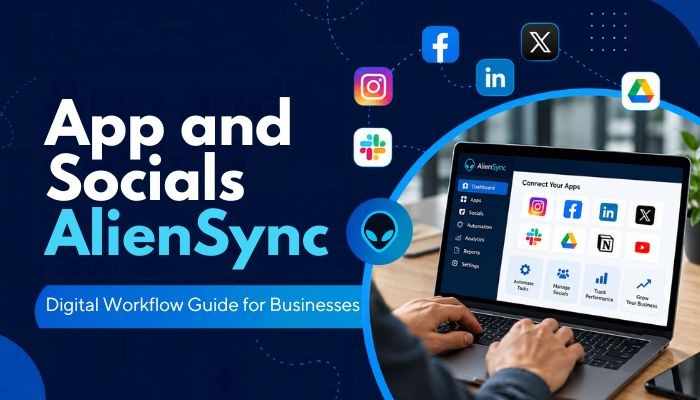

Modern businesses rely on multiple tools for marketing, sales, customer support, ecommerce, analytics, and project management. The challenge begins when these platforms operate separately, forcing teams to repeat tasks and move information manually.
App and Socials AlienSync addresses this workflow problem by focusing on connections between applications, social platforms, software, data, and automation. The goal is to create smoother digital workflows that reduce repetitive work and improve coordination between business systems.
AlienSync’s public identity, however, is not completely consistent. Some pages present it as a technology-content platform, while others describe features such as dashboards, scheduling, automation, account connections, and software integrations.
For businesses evaluating App and Socials AlienSync, the key is to separate useful workflow concepts from product capabilities that still require verification. This guide examines how the system is described, where it may fit into business operations, and what companies should confirm before using it.
Quick Answer
App and Socials AlienSync refers to the idea of connecting business apps, social platforms, software, data, and automated workflows so information can move more efficiently between systems.
AlienSync is described across its own website in both editorial and product-like terms, so businesses should verify actual integrations, pricing, security, and software availability before relying on it for important workflows.
Key Takeaways
- App and Socials AlienSync focuses on connecting business apps, social platforms, data, and automated workflows.
- AlienSync is described both as a technology-content platform and through product-like synchronization features.
- Businesses should verify integrations, pricing, security, and software availability before adoption.
- APIs, webhooks, triggers, and data mapping can help reduce repetitive work across sales, marketing, ecommerce, and operations.
- Start with one measurable workflow and test it before expanding automation.
- App and Socials AlienSync is most useful when businesses combine automation with clear permissions, monitoring, and human oversight.
What Is App and Socials AlienSync?
App and Socials AlienSync can be understood as an approach to connecting business applications, social platforms, software, and data so information moves more efficiently between systems.
A company may use a CRM, ecommerce platform, Instagram, LinkedIn, cloud storage, email marketing tools, analytics, and project-management software. When these systems operate separately, employees may spend unnecessary time copying customer details, updating campaigns, and collecting reports manually.
A connected workflow usually follows a simple structure:
- Business event — a lead, order, message, or product update occurs.
- Trigger — the workflow recognizes the event.
- Rule — predefined conditions determine what happens next.
- Data transfer — required information moves to another system.
- Action — a task, update, notification, or other response occurs.
- Monitoring — the business checks whether the workflow succeeded.
The main purpose is not simply to connect more software. It is to create reliable information flow while reducing repetitive work and unnecessary handoffs.
Is AlienSync a Real Business Software Platform?
AlienSync’s public positioning is not completely consistent. Its About and editorial pages present it as a technology-content destination, while other pages describe product-like capabilities such as scheduling, analytics, automation, dashboards, account connections, and software integrations.
For businesses evaluating App and Socials AlienSync, the important distinction is between workflow concepts that are clearly discussed and product capabilities that still require verification. AlienSync’s July 2026 explanation states that public SDKs and documented APIs have not been confirmed.
What appears clear:
- AlienSync operates a technology-focused website.
- It publishes content about integrations, automation, software, and social workflows.
- Its workflow concepts can be applied to modern business automation.
What businesses should still verify:
- Availability of a production-ready software platform
- Supported native integrations
- Public API or SDK access
- Authentication and account permissions
- Security documentation
- Pricing and support options
Businesses should therefore confirm actual functionality before connecting customer data, social accounts, or other important company systems.
App and Socials AlienSync Pricing and Availability
Pricing for App and Socials AlienSync should be treated cautiously because a consistent, clearly documented public pricing structure is not established across the material currently available. Businesses should avoid budgeting around figures published by unofficial sources without confirming them first.
Before paying for or connecting a service, check:
- Pricing model — per user, workspace, or account
- Social account limits — number of channels allowed
- Workflow limits — number of automations or executions
- Team seats — included or separately charged
- API access — standard or premium feature
- Analytics — basic or advanced reporting
- Data export — availability and restrictions
- Customer support — standard or priority assistance
- Contract terms — monthly or annual commitment
- Cancellation policy — handling of data, integrations, and access tokens
A business purchasing SaaS software should rely on a current official pricing page, written quote, or contract rather than assumptions based on editorial descriptions.
Why App and Socials AlienSync Matters for Businesses
The business value behind App and Socials AlienSync comes from reducing fragmentation between the tools companies already use for marketing, sales, ecommerce, customer service, operations, and analytics.
As a company grows, individual teams often adopt separate platforms. Each tool may work well on its own, but disconnected systems can make the overall workflow slower and harder to manage.
Common problems include:
- Repeated data entry
- Duplicate customer records
- Slow handoffs between departments
- Missed customer inquiries
- Reporting delays
- Disconnected analytics
- Conflicting content versions
- Increased risk of manual errors
Connected workflows can reduce these problems by moving predictable information between systems automatically. The goal is not to automate every business decision, but to remove repetitive work while keeping human oversight where judgment and accountability matter.
Who Should Use App and Socials AlienSync?
App and Socials AlienSync is most relevant for businesses that use several digital tools and need smoother coordination between them.
- Small businesses can use connected workflows to reduce repetitive admin work across marketing, sales, customer service, and reporting.
- Marketing agencies may benefit from managing social profiles, content approvals, campaign tasks, and reporting in a more organized workflow.
- Ecommerce businesses can connect product updates, promotions, customer activity, support, analytics, and inventory-related processes.
- Sales teams can use App and Socials AlienSync concepts to move qualified website or social leads into CRM workflows with clearer attribution.
- Remote teams may reduce manual status updates by connecting cloud tools, notifications, tasks, and shared workflows.
- Content teams can streamline planning, drafting, approvals, publishing, asset management, and performance tracking.
- Businesses using only a few simple applications may not need complex synchronization because setup and maintenance can outweigh the benefit.
Overall, App and Socials AlienSync is most useful when it solves a clear workflow problem and saves measurable time rather than adding unnecessary automation.
Apps and Softwares AlienSync
Apps and softwares AlienSync focuses on how business applications, social platforms, and digital tools can work together through connected workflows. AlienSync content discusses areas such as CRM systems, collaboration tools, cloud platforms, email marketing, ecommerce, analytics, and project management.
Businesses can use these connections to reduce repetitive tasks, improve data flow, and keep teams working with more consistent information. However, each integration should be verified before relying on it for important business operations.
| Software Category | Business Purpose | Possible Workflow Role |
|---|---|---|
| CRM | Lead management | Capture and update customer records |
| Social media | Marketing | Distribute content and track engagement |
| Ecommerce | Sales and products | Trigger marketing or operational actions |
| Project management | Team coordination | Create and assign workflow tasks |
| Email marketing | Customer nurturing | Start campaigns from customer activity |
| Analytics | Performance tracking | Combine engagement and conversion data |
For businesses, apps and softwares AlienSync can be most useful when it connects the right systems, reduces manual work, and keeps data moving accurately between teams and platforms.
How an AlienSync-Style Digital Workflow Works
A reliable App and Socials AlienSync workflow usually moves through six stages, from the original business event to monitoring the final result. The aim is to reduce repetitive work while keeping data accurate across connected systems.
1. Source
The source is where the workflow begins. In App and Socials AlienSync, this could be a customer submitting a form, an order being completed, a product going live, a support request arriving, or a lead changing stage.
2. Trigger
The trigger decides when the workflow should start. App and Socials AlienSync can use a clearly defined event such as:
- Qualified lead submitted → start sales workflow
- New order received → notify operations
- Product published → create marketing task
- Support request received → open service ticket
3. Conditions
Conditions prevent automation from responding to every event. With App and Socials AlienSync, a business might process only leads from a specific campaign, customer segment, product, location, or sales stage.
4. Data Mapping
Connected applications may organize information differently. App and Socials AlienSync workflows therefore need clear field mapping so names, emails, dates, product IDs, campaign sources, currencies, and status values move correctly between platforms.
For example:
- Full Name → First Name + Last Name
- Form Email → CRM Email
- Product ID → Internal SKU
- Campaign Source → CRM Acquisition Source
5. Action
Once the rules are satisfied, the destination system performs an action. This may include creating a CRM contact, assigning a task, sending an internal alert, updating a report, or preparing approved content for publication.
6. Monitoring
Every production workflow should be monitored. App and Socials AlienSync should help businesses identify whether an automation completed correctly or requires attention.
Check for:
- Failed executions
- Duplicate records
- Missing fields
- Expired permissions
- API limits
- Invalid data
- Repeated automation loops
Reliable monitoring matters because automation should reduce work rather than create new problems.
How to Set Up App and Socials AlienSync for Business
Businesses should introduce App and Socials AlienSync gradually instead of connecting every system at once. Start with one repetitive process that has a clear business benefit and measurable outcome.
Step 1: Audit Your Current Software
List the applications involved in the process you want to improve. Focus only on tools directly connected to the workflow.
Step 2: Identify the Manual Bottleneck
Choose a repetitive task that consumes employee time.
For example:
Website lead → spreadsheet → CRM → sales notification
A process repeated many times each week is usually a stronger automation candidate than an occasional task.
Step 3: Define the Source of Truth
Decide which system owns the official record.
- CRM → customer information
- Ecommerce or ERP → products and inventory
- CMS → published website content
- Accounting software → financial records
This prevents connected platforms from overwriting each other with conflicting information.
Step 4: Verify the Actual Integration
Before connecting systems, confirm:
- Official integration support
- Authentication method
- Required permissions
- Available actions
- Usage limits
- Connection-revocation process
Do not assume an integration exists simply because a platform is mentioned in an article.
Step 5: Limit Permissions
Give each connection only the access it needs. A reporting workflow should not receive publishing or administrator permissions when it only requires analytics data.
Step 6: Map the Data
Define exactly which information moves from one system to another. Clear mapping helps App and Socials AlienSync avoid missing fields, incorrect values, and duplicate records.
Step 7: Build One Trigger
Start with a simple rule:
When a qualified form is submitted → create CRM lead.
Avoid creating several dependent automations before the first workflow has been tested.
Step 8: Test With Non-Sensitive Data
Before using real customer information, test for:
- Duplicate records
- Missing data
- Incorrect formatting
- Unexpected actions
- Processing delays
Step 9: Add Monitoring
Assign responsibility for reviewing failed workflows, expired permissions, and unexpected results.
Step 10: Measure the Result
Compare the automated process with the original manual workflow. App and Socials AlienSync should produce a measurable benefit such as faster processing, fewer errors, better lead response, or reduced administrative work.
If the workflow creates more maintenance than value, simplify it.
Example of App and Socials AlienSync for a Small Business
Consider a small ecommerce business launching a new product. Without automation, employees may manually update the store, notify marketing, create project tasks, prepare social content, update campaign records, and later combine performance data.
With App and Socials AlienSync, the product launch can become the starting event for a connected workflow. Approved product information can move into marketing tasks, internal notifications, campaign tracking, and reporting without employees repeatedly entering the same details.
A simple workflow could look like:
Product published → marketing task → approval → campaign launch → performance tracking
Employees still control strategy, creative decisions, customer communication, and final approvals. Automation handles predictable information movement.
Social Media and Business Workflow Integration
Social activity becomes more useful when it connects with broader business results. App and Socials AlienSync can help link marketing engagement with website visits, CRM activity, sales, and customer-service processes.
A practical customer journey might look like:
Social campaign → website visit → form submission → CRM lead → sale
Businesses should measure more than likes and followers. Useful metrics include:
- Qualified leads
- Conversion rate
- Revenue
- Cost per acquisition
- Customer response time
- Repeat purchases
- Support resolution
- Customer lifetime value
The strongest workflow connects social activity to measurable business outcomes rather than simply increasing publishing volume.
Team Collaboration and Approval Workflows
Several employees may be involved in one campaign, which makes clear approvals essential. A structured process reduces duplicate versions, missed feedback, and unauthorized publishing.
A typical workflow may be:
Writer → editor → marketing manager → approval → scheduler → publishing → analytics
Role-based access also matters. App and Socials AlienSync workflows should give employees enough permission to complete their responsibilities without exposing systems or data they do not need.
For example:
- Writer: create and edit drafts
- Manager: review and approve content
- Designer: access campaign assets
- Client: review or approve selected material
- Administrator: manage integrations and permissions
The best approach is simple: automate routine movement of information while keeping people responsible for important decisions, approvals, security, and brand control.
Workflow Automation and Trigger-Based Actions
Most automation follows a simple rule:
When X happens → if Y conditions are met → perform Z action.
For App and Socials AlienSync, useful examples include:
- High-value order completed → notify the account manager
- Qualified social inquiry received → create a CRM lead
- Approved article published → notify the social team
- Support request submitted → create a service ticket
Automation works best when the trigger is clear and the response is predictable. Businesses should keep human review for customer complaints, legal communications, financial decisions, reputational issues, and other situations that require judgment.
Real-Time Sync vs Scheduled Sync
App and Socials AlienSync workflows can use either real-time or scheduled synchronization depending on how quickly information needs to move.
Real-Time Synchronization
Real-time synchronization moves data soon after an event occurs.
It works well for:
- New sales leads
- Customer-service requests
- Security alerts
- Order notifications
- Time-sensitive internal actions
The main benefit is speed, but real-time workflows can be more affected by API limits, outages, or failed connections.
Scheduled Synchronization
Scheduled synchronization runs at fixed intervals rather than immediately.
It is useful for:
- Daily analytics imports
- Weekly reports
- Routine backups
- Large data transfers
- Inventory reconciliation
Scheduled jobs can reduce system load and make bulk data easier to control.
What Happens When Two Systems Change the Same Record?
When two connected systems update the same information differently, a sync conflict occurs. In App and Socials AlienSync, businesses should define clear rules before allowing one system to overwrite another.
Common approaches include:
- Source priority — one system is treated as authoritative.
- Latest valid update — the newest approved change is used.
- Field ownership — each application controls specific fields.
- Manual review — uncertain conflicts are sent for human approval.
Clear conflict rules help prevent incorrect data, duplicate updates, and inconsistent records across connected systems.
APIs, Webhooks and Connectors Explained
Businesses working with App and Socials AlienSync may encounter terms such as APIs, webhooks, connectors, workflow engines, and data mapping. These technologies help applications exchange information and trigger actions across connected workflows.
API
An application programming interface (API) allows two software systems to exchange structured data according to defined rules. In an App and Socials AlienSync workflow, an API could move customer, campaign, order, or analytics information between approved systems.
Webhook
A webhook sends information when a specific event occurs instead of requiring another application to repeatedly check for updates.
For example:
- New lead submitted → notify CRM
- Order completed → update operations
- Content published → trigger marketing workflow
Connector
A connector provides a prebuilt link between applications, reducing the amount of custom development required to move data or trigger actions.
Workflow Engine
A workflow engine manages triggers, conditions, transformations, and actions. For App and Socials AlienSync, this layer determines when a workflow runs and what should happen next.
Data Mapping
Data mapping defines how information in one system matches fields in another.
Examples include:
- Form Email → CRM Email
- Product ID → Internal SKU
- Campaign Source → Lead Source
- Customer Status → CRM Stage
Clear mapping reduces missing data, incorrect values, and failed transfers.
AlienSync’s conceptual material discusses these integration technologies, but businesses should still verify whether specific APIs, SDKs, or native connectors are actually available before deployment.
Common AlienSync Integration Problems and How to Fix Them
Even a well-designed App and Socials AlienSync workflow can fail because of expired permissions, incorrect mappings, API limits, duplicate records, or temporary service outages.
| Problem | Possible Cause | Practical Fix |
|---|---|---|
| Sync stops | Expired authorization | Reconnect the account |
| Data is missing | Incorrect mapping | Review source and destination fields |
| Duplicate records | Weak matching rules | Use unique identifiers |
| Updates are delayed | API limits | Review execution history |
| Social publishing fails | Changed permissions | Reauthorize publishing access |
| Wrong data overwrites records | Sync conflict | Define the source of truth |
| Workflow keeps repeating | Circular trigger | Add stopping conditions |
Monitor Logs Instead of Guessing
Reliable App and Socials AlienSync workflows should maintain logs so teams can identify failures without manually checking every connected application.
Useful log details include:
- Execution time
- Trigger
- Destination
- Success or failure
- Error message
- Record identifier
Do Not Retry Every Error Indefinitely
Retries are helpful for temporary network or service failures, but repeated retries can make invalid data or automation loops worse.
Set a retry limit and send persistent failures to human review.
Business Use Cases for App and Socials AlienSync
The App and Socials AlienSync workflow model can support several departments when the process being automated has a clear trigger and measurable business outcome.
| Business Function | Workflow Example | Potential Benefit |
|---|---|---|
| Marketing | Campaign → content workflow | Faster execution |
| Sales | Qualified lead → CRM | Faster response |
| Ecommerce | Product launch → marketing task | Faster promotion |
| Support | Social complaint → ticket | Better tracking |
| Operations | Form → project task | Less manual work |
| Analytics | Campaign data → dashboard | Better visibility |
| Content | Approved asset → publishing | Consistent distribution |
Businesses should automate predictable processes first and keep human oversight for decisions requiring judgment.
The Role of a Centralized Dashboard
A centralized dashboard can make App and Socials AlienSync easier to manage by bringing workflow status, social performance, campaign activity, failures, approvals, and conversion information into one view.
A useful dashboard might show:
- Active workflows
- Failed integrations
- Social performance
- Approval requests
- Lead volume
- Conversion results
- System alerts
However, every business should still define its system of record.
For example:
- CRM → customer relationships
- Ecommerce or ERP → inventory
- CMS → published content
- Accounting software → financial records
A dashboard should summarize these systems rather than create confusion about which platform owns the official data.
Security Risks Businesses Should Consider
Because App and Socials AlienSync involves connections between applications, security becomes more important as more accounts and data are linked.
Connected tools may receive permission to:
- Read customer information
- Publish social content
- Modify CRM records
- Access analytics
- View files
- Create tasks
- Manage account functions
Businesses should follow the least-privilege principle, giving each integration only the permissions required for its specific purpose.
Security checks should include:
- Authentication method
- MFA or 2FA
- Encryption
- OAuth permissions
- API-key protection
- Access logs
- Data retention
- Revocation options
- Backup procedures
- Independent security evidence
Do Not Confuse Website Privacy With Product Security
A website privacy policy can explain how visitor information, cookies, IP addresses, and analytics are handled, but it does not automatically establish the security of an App and Socials AlienSync business integration environment.
Companies handling sensitive information should separately verify:
- Data processing
- Encryption
- Account permissions
- Data location
- Incident response
- Business continuity
- Data deletion
- Data export
- Compliance controls
The more access an integration receives, the stronger the evidence businesses should require.
How Businesses Should Evaluate AlienSync Claims
Businesses considering App and Socials AlienSync should verify actual capabilities rather than relying only on broad descriptions of automation, integration, or security.
A practical evaluation should confirm:
- Who operates the service
- Whether the product is currently accessible
- Official documentation
- Supported integrations
- Required permissions
- Current pricing
- Security documentation
- Customer support
- Data export
- Cancellation and revocation procedures
Start with one or two low-risk systems and non-sensitive test data before considering wider deployment.
Questions to Ask Before Connecting Business Accounts
Before connecting App and Socials AlienSync or any synchronization service to important company systems, businesses should understand exactly what access is being granted and how their information will be handled.
Ask:
- Who operates the platform?
- Which integrations are officially supported?
- Does it use official APIs?
- What permissions are required?
- Can permissions be restricted?
- How can access be revoked?
- Where is data stored?
- How long is information retained?
- Is data encrypted?
- Is MFA available?
- Are actions recorded in audit logs?
- Can company data be exported?
- What happens after cancellation?
If these questions cannot be answered clearly, avoid connecting business-critical or sensitive accounts.
Measuring the ROI of Digital Workflow Automation
The value of App and Socials AlienSync should ultimately be measured by business results rather than the number of automations created.
A simple formula is:
Annual Workflow Value = Time Saved × Labor Cost + Error Cost Avoided + Added Business Value − Automation Cost
For example, if a manual process consumes five hours each week:
5 hours × 52 weeks = 260 hours annually
At $30 per hour:
260 × $30 = $7,800 in potential annual labor value
Businesses should also measure:
- Time saved
- Error rate
- Workflow success rate
- Lead-response time
- Conversion rate
- Data accuracy
- Maintenance hours
- Employee adoption
Automation that saves time but reduces data quality does not create meaningful value.
App and Socials AlienSync for Marketing Teams
Marketing teams often work across project-management tools, cloud storage, social networks, analytics, CRM software, and publishing platforms. App and Socials AlienSync can help connect these stages so campaign information moves more efficiently between systems.
Useful workflows may include:
- Approved content → social scheduling
- Campaign launch → team notification
- Website lead → CRM
- Campaign results → reporting dashboard
Automation should handle repetitive processes without removing human control over messaging, brand tone, approvals, and platform-specific content.
App and Socials AlienSync for Sales Teams
Sales teams can use connected workflows to reduce delays between customer interest and follow-up.
A typical workflow could be:
Qualified form → validate data → create CRM record → attach lead source → assign salesperson → create follow-up task
Good sales automation should also include deduplication, accurate source tracking, and clear record ownership so one prospect does not become several conflicting CRM records.
App and Socials AlienSync for Ecommerce Businesses
App and Socials AlienSync can help ecommerce businesses coordinate repetitive events such as product launches, inventory updates, orders, reviews, support requests, abandoned carts, and marketing campaigns through connected workflows.
A practical ecommerce workflow might look like:
Product approved → marketing task → campaign launch → tracking → performance reporting
Useful automation opportunities include:
- Product updates → marketing notification
- New order → fulfillment workflow
- Low inventory → internal alert
- Support request → service ticket
- Abandoned cart → approved follow-up
- Campaign launch → analytics tracking
Not every action should be automated. Refund disputes, customer complaints, pricing changes, sensitive account issues, and public responses should often remain under human review.
The strongest ecommerce automation combines speed, accurate data, and clear approval controls.
Common Mistakes With Connected Workflows
The biggest mistake with App and Socials AlienSync is assuming that more automation always creates greater efficiency. A poorly designed workflow can simply move errors faster between connected systems.
Common mistakes include:
- Automating an inefficient process
- Connecting too many systems at once
- Granting excessive permissions
- Failing to define data ownership
- Ignoring duplicate records
- Creating circular triggers
- Skipping testing
- Ignoring error logs
- Leaving unused integrations active
- Automating sensitive decisions without review
Automation works best when the underlying process is already clear, measurable, and properly documented.
App and Socials AlienSync Alternatives
Businesses considering App and Socials AlienSync may also need established platforms designed for specific functions such as workflow automation, social scheduling, file synchronization, or team collaboration.
| Business Need | Tools Commonly Considered |
|---|---|
| App-to-app automation | Zapier, Make |
| Social scheduling | Buffer |
| Enterprise social management | Hootsuite |
| Visual social planning | Later |
| Private file synchronization | Syncthing |
| Self-hosted collaboration | Nextcloud |
When comparing alternatives, focus on:
- Required integrations
- Workflow limits
- Supported social networks
- Pricing transparency
- Team permissions
- Analytics
- Security
- Reliability
- API access
- Data export
- Migration options
A business does not always need one platform that handles everything. Combining specialized tools can sometimes create a simpler and more reliable technology stack.
AlienSync vs Conventional Integration Platforms
Comparing App and Socials AlienSync directly with mature integration platforms is difficult because AlienSync’s public material describes both conceptual workflow ideas and product-like capabilities.
Conventional integration platforms usually provide clear evidence of:
- Supported connectors
- Workflow builders
- Authentication methods
- Developer documentation
- Pricing
- Customer support
- Service-status information
- Security documentation
Businesses should therefore compare verified capabilities rather than relying on feature terminology alone.
What Should Businesses Verify Before Using AlienSync?
Before adopting App and Socials AlienSync, businesses should confirm exactly what product, integration, permissions, and support are currently available.
Verify:
- Product ownership
- Official account creation
- Current pricing
- Supported integrations
- Developer documentation
- Authorization process
- Permission levels
- Security documentation
- Data-processing terms
- Support channels
- Data export
- Cancellation procedures
- Access revocation
- Service reliability
Claims such as “real-time synchronization,” “AI-powered automation,” or “enterprise security” should be supported by clear documentation rather than marketing language alone.
Is App and Socials AlienSync Useful for Small Businesses?
App and Socials AlienSync can be useful for small businesses when employees repeatedly move information between CRM software, social platforms, ecommerce tools, project-management systems, and analytics applications.
A practical approach is to:
- Identify one repetitive task
- Measure how much time it consumes
- Automate only predictable steps
- Keep human approval for important decisions
- Track errors and time saved
- Expand only when the first workflow works reliably
Small businesses should prioritize simplicity. An integration that requires constant maintenance may create more work than it removes.
Future of Apps, Socials and Business Automation
The future of App and Socials AlienSync reflects a broader shift toward connected business software, where APIs, webhooks, low-code tools, AI, cloud platforms, and event-driven workflows allow information to move more efficiently between systems.
AI may support tasks such as:
- Classifying customer messages
- Extracting information from documents
- Summarizing conversations
- Identifying campaign patterns
- Drafting content
- Suggesting next actions
As automation expands, businesses will also need stronger controls around:
- Data quality
- Permissions
- Privacy
- Human approval
- Auditability
- Security
- Accountability
The strongest approach is not to connect everything. It is to connect the right systems, automate predictable work, monitor important workflows, and keep people responsible for decisions that require judgment.
Conclusion
App and Socials AlienSync reflects a broader shift in business technology toward connected systems, automated workflows, and faster movement of data across marketing, sales, ecommerce, operations, and customer service. The opportunity is clear: companies can reduce repetitive work, improve coordination, and gain better visibility when their digital tools work together rather than in isolation.
The larger question is execution. Businesses should judge AlienSync by verified capabilities, integration reliability, security, pricing, and measurable operational value—not by feature claims alone. For companies considering App and Socials AlienSync, the strongest approach is to start with one practical workflow, test the results, and expand only when the technology produces clear business value.
FAQs About App and Socials AlienSync
1. Can App and Socials AlienSync replace a CRM?
No. App and Socials AlienSync is better viewed as a workflow or integration layer that can complement a CRM rather than replace customer-record management.
2. Does App and Socials AlienSync require coding?
Not every App and Socials AlienSync workflow would require coding. Simple integrations may use connectors or automation rules, while custom APIs can require technical development.
3. Can App and Socials AlienSync reduce software costs?
App and Socials AlienSync may reduce manual work and tool switching, but businesses should compare those savings with integration, subscription, setup, and maintenance costs.
4. Can App and Socials AlienSync support multiple brands?
The App and Socials AlienSync model can support multi-brand workflows when accounts, permissions, data ownership, and approval processes are clearly separated.
5. How often should App and Socials AlienSync workflows be reviewed?
Businesses should review App and Socials AlienSync workflows regularly and whenever APIs, permissions, connected software, team roles, or business processes change.
6. Can App and Socials AlienSync work with existing automation tools?
Potentially. App and Socials AlienSync concepts can coexist with other automation platforms, but businesses should verify compatibility and avoid duplicate or conflicting triggers.
7. What data should businesses avoid syncing with App and Socials AlienSync?
Sensitive customer, payment, employee, or confidential business data should not move through App and Socials AlienSync workflows unless access, security, necessity, and compliance requirements are verified.
8. Can App and Socials AlienSync support multi-location businesses?
Yes, the App and Socials AlienSync workflow model can help coordinate data and processes across locations when each branch follows consistent permissions, naming, and data-management rules.
