Home Blog Page 1366

Small Business Accounting 101: Ten Steps To Get Your Startup On Track

You’re about to launch your online store (or maybe you just launched) – congratulations. It takes perseverance and passion to get to the point you’re at. However, small business ownership is a constant flood of satisfying milestones and expanding to-do lists. With your launch, you’ll need to get on top of the accounting tasks that come along with owning a store. This list of 10 small business accounting steps will give you the confidence to know you’ve covered your bases. And you are ready to move on to the next item on your business to-do list!

1. Open a Bank Account 

After you’ve legally registered your small business, you’ll need somewhere to stash your business income. Having a separate bank account keeps records distinct and will make life easier come tax time. The LLCs, partnerships, and corporations are legally required to have a separate bank account for business. Sole proprietors don’t legally need a separate account, but it’s recommended.

Start by opening up a small business checking account. And then any savings accounts that will help you organize funds and plan for taxes. For instance, set up a savings account and squirrel away a percentage of each payment as your self-employed tax withholding.

Next, you’ll want to consider a business credit card to start building business credit. The Corporations and LLCs are required to use a separate credit card to avoid commingling personal and business assets.

Before you talk to a bank about opening an account, do your homework. Shop around for business accounts and compare fee structures. Most small business checking accounts have fees that are higher than personal banking, so pay close attention to what you’ll owe.

In order to open a business bank account, you’re required to have a business name, and usually be registered with your state or province. Check with the individual bank for what documents to bring to the appointment.

2. Track Your Expenses

The foundation of solid business record-keeping is learning to track your expenses effectively. It’s a crucial step that allows you to monitor the growth of your small business. Build financial statements, keep track of deductible expenses, prepare tax returns, and support what you report on your tax return.

small business

Right from the beginning, you should establish a system for organizing receipts and other important records. This process can be simple and old school (bring on the Filofax), or you can use a service like ShoeBoxed. For American store owners, the IRS doesn’t require you to keep receipts for expenses under $75.00, but it’s a good habit nonetheless.

There are five types of receipts that you should pay extra attention to:

  • Meals and Entertainment: Conducting a business meeting in a cafe or restaurant is a great option, just be sure to document it well. On the back of the receipt, record who attended and the purpose of the meal or outing.
  • Out-of-Town Business Travel: The IRS and CRA are wary of people claiming personal activities as business expenses. Thankfully, your receipts also provide a paper trail of your business activities while away.
  • Vehicle-Related Expenses: Record where, when, and why you used the vehicle for business, and then apply the percentage of use to vehicle-related expenses.
  • Receipts for Gifts: For gifts like tickets to a concert, it matters whether the gift giver goes to the event with the recipient. If they do, then the expense would be categorized as entertainment, rather than a gift. Note these details on the receipt.
  • Home Office Receipts: Similar to vehicle expenses, you need to calculate what percentage of your home is used for business and then apply that percentage to home-related expenses.

Starting your small business at home is a great way to keep overhead low, plus you’ll qualify for some unique tax breaks. You can deduct the portion of your home that’s used for business. As well as your internet connection, cell phone, and transportation to and from work sites and for business errands.

Any expense that’s used partly for personal life and partly for business must reflect the mixed-use. For instance, if you have one cell phone, you can deduct the percentage you use the device for business. Gas mileage costs are 100% deductible, just be sure to hold on to all records and keep a log of your business miles (where you’re going and the purpose of the trip).

3. Develop a Bookkeeping System for Small Business

Before we jump into establishing a bookkeeping system, it’s helpful to understand exactly what bookkeeping is, and how it differs from accounting. Bookkeeping is the day-to-day process of recording transactions, categorizing them, and reconciling bank statements.

Accounting is a high-level process that looks at business progress and makes sense of the data compiled by the bookkeeper by building financial statements.

As a new small business owner, you’ll need to determine which bookkeeping method to use:

  1. You can choose to go the DIY route and use software like Quickbooks or Wave. Alternatively, you could use a simple Excel spreadsheet.
  2. You have the option of using an outsourced or part-time bookkeeper that’s either local or cloud-based like Bench Accounting.
  3. When your small business is big enough you can opt to hire an in-house bookkeeper and/or accountant.

With so many options out there, you’re sure to find a bookkeeping solution that will suit your needs.

Canadian and American business owners need to determine whether they’ll use the cash or accrual method of accounting. Let’s take a look at the difference between the two methods here:

  • Cash Method: Revenues and expenses are recognized at the time they are received or paid.
  • Accrual Method: Revenues and expenses are recognized when the transaction occurs (even if the cash isn’t in or out of the bank yet) and requires tracking receivables and payables.

Technically, Canadians are required to use the accrual method. However, to simplify things, you can use the cash method throughout the year and then make a single adjusting entry at year-end to account for outstanding receivables and payables for tax purposes.

American business owners can use cash-based accounting if revenues are under USD $5M, otherwise, they must use the accrual method.

4. Set up a Payroll System for Small Business

As a new online store owner, you’ll likely be a one-person show. However, maybe you’ll hire a part-time employee to help you out, or a freelancer to design your logo. Right away, you need to establish whether that individual is an employee or an independent contractor.

For employees, you’ll need to decide on a payroll schedule and ensure that you’re withholding the correct taxes; there are lots of services that can help with this. For independent contractors, be sure to track how much you’re paying each person.

American business owners may be required to file 1099s for each contractor at year’s end (you’ll also need to keep their name and address on file for this!).

5. Investigate Import Tax

Depending on your business model, you may be planning to purchase and import goods from other countries to sell in your store. When importing products, you’ll likely be subject to taxes and duties. These are fees that your country imposes on incoming goods. Take the time to learn about importing goods into the US and Canada, and the associated taxes, so that you know the rules from the get-go. Also, if you are importing goods, the Duty Calculator can help you estimate the fees in your own small business and plan for costs. Check out these additional articles on importing into Canada and the US if you have any more questions.

6. Determine How You Will Get Paid

When sales start rolling in, you’ll need a way to accept the payments. If you’re a North American store owner on Shopify, you can use Shopify Payments to accept credit card payments (Visa, American Express, and Mastercard). This saves you the hassle of setting up a merchant account or third-party payment gateway.

If you want to accept credit card payments without using Shopify Payments, you’ll either need a merchant account or you can use a third-party payment processor like PayPal. A merchant account is a type of bank account that allows your business to accept credit card payments from customers.

If you use a third-party payment processor, the fees are generally around 2.9% + $0.30 per transaction. You can consult this list to help you find a payment gateway that will work for your location.

7. Establish Sales Tax Procedures

Sales Tax Procedures of Small Business

The world of eCommerce has shaken up sales tax regulations and they are admittedly a bit confusing due to location issues. When a customer walks into a brick-and-mortar retail shop, they pay the sales tax of whatever state or province they make the purchase in, no matter if they live in that city, or they’re visiting from across the world.

However, when you sell online, you’re often selling to customers who live in different states/provinces, and even countries.

As a Canadian store owner, you only need to start collecting GST/HST when you have revenues of $30,000 or more in a year (submit the GST/HST you collect in installments). If you want, you can collect GST/HST even if you don’t earn this much in revenue, as you can put it towards Input Tax Credits.

Selling to international customers can be easier than domestic sales because you often don’t need to charge sales tax when selling to out-of-country customers. Canadian store owners don’t need to charge GST/HST to customers who are outside of Canada.

For American store owners, international purchases are tax-exempt as well. However, this can get a bit complicated depending on the state you live in, so check in with your accountant for detailed information about your specific state’s regulations regarding international sales tax.

8. Determine Your Tax Obligations

Tax obligations vary depending on the legal structure of the small business. If you’re self-employed (sole proprietorship, LLC, partnership), you’ll claim business income on your personal tax return. Corporations, on the other hand, are separate tax entities and are taxed independently from owners. Your income from the corporation is taxed as an employee.

Self-employed people need to withhold taxes from their income and remit these to the government in lieu of the withholding that an employer would normally conduct. For American store owners, you’ll need to pay estimated quarterly taxes if you owe more than $1,000 in taxes this year.

Canadians have it a little easier; if your net tax owing is more than $3,000 you’ll be required to pay your income tax in installments.

9. Calculate Gross Margins

Improving your store’s gross margin is the first step towards earning more income overall. In order to calculate gross margin, you need to know the costs incurred to produce your product. To understand this better, let’s quickly define the Cost of Goods Sold (COGS) and gross margin.

Cost of Goods Sold (COGS): These are the direct costs incurred in producing products sold by a company. This includes both materials and direct labor costs.

Gross Margin: This number represents the total sales revenue that’s kept after the business incurs all direct costs to produce the product or service.

Here’s how you can go about calculating gross margin:

Gross Margin (%) = (Revenue – COGS) / Revenue

The difference between how much you sell a product for, and how much the small business actually takes home at the end of the day is what truly determines your ability to keep the doors open.

10. Constantly Re-evaluate Your Methods

When you first start out you may opt to use a simple spreadsheet to manage your books but as you grow you’ll want to consider more advanced methods like Quickbooks or Bench. As you keep growing, it’s good to continually reassess the amount of time you’re spending on your books, and how much that time is costing your business.

The right bookkeeping solution means you can invest more time in the business with bookkeeping no longer on your plate, and potentially save the small business money. Win-win!

Conclusion

Starting a small business can be an overwhelming process, but if you follow this list, you’ll have your new store’s finances in order from the beginning. From opening the right type of bank account to determining how much you’ll bring in per product. These tasks will all contribute to your business’s success, now and as it grows.

Entrepreneur Mom Empowers Colleagues and Community

0

In the evolving landscape of business, the figure of the entrepreneur mom empowers is increasingly prominent. These remarkable women are not only achieving significant success in their own ventures but also actively empowering those around them. Balancing the roles of parent and business leaders, they use their unique position to inspire and support colleagues and uplift their communities. Through their innovative approach and unwavering dedication, entrepreneur moms is transforming their workplaces and neighborhoods, creating a ripple effect of empowerment that extends far beyond their achievements. Their leadership serves as a powerful example of how entrepreneurial spirit and community engagement can harmoniously coexist and drive meaningful change.

Kimberly Scott always knew she was meant to make a difference in people’s lives. Where – and how – to make that difference, however, wasn’t so easy to pinpoint. After separating from her husband and moving back in with her parents one difficult year, the Federalsburg, Md.-based single mom drive to make a difference took a backseat to re-establishing her life and providing for her daughter, Ashley.

“My employees say, ‘You’re not like any other owner I’ve worked for!’ I just tell them I want to make a living and enjoy what I’m doing. It’s a journey.” – Kim Scott, The Great Gourmet

Scott attended a community college but after graduating, “I thought I’d be a secretary,” she says.

Not so. Scott landed a stable new position at a seafood harvesting and processing company in Easton, Md. Still, something was still missing.

“The logistics of how everything got done was fascinating to me,” Scott explains. “At lunch, I’d go into the production room and ask the workers tons of questions. Why was this so important?”

At that point, Scott had an epiphany.

“I thought to myself, ‘I can do this. I can create a company all on my own,'” she explains. “But instead of generating profit for profit’s sake, it could help change the world – and leave a legacy after I’m gone.”

With a crumpled wad of $40 in cash, a single Sam’s Club freezer, and a website domain, Scott began what would transform into one of Inc. Magazine’s 500/5000 fastest-growing companies in the next three years: The Great Gourmet.

Finding Her Niche

Although Scott was able to build a website for The Great Gourmet, a company that sells wholesale seafood to retail markets, there was one small but significant problem.

Entrepreneur Mom Empowers Finding Her Niche

If you build it… they will not necessarily come.

“To start drawing people to my site, I needed to market my company and myself,” says Scott. “What makes us stand out from other small businesses?”

For Scott, this wasn’t a difficult question to answer. All she had to do was take a look at her overwhelmingly male competition.

“I’m a woman-owned business in a male-dominated field,” Scott explains. “There aren’t a whole lot of female business owners out there, let alone in the seafood industry. It was a niche I could really market as my own.”

But marketing herself as a female business owner in a male-dominated industry wasn’t enough. Scott knew she had to adapt to the model differently if she were to make a mark.

“We can’t compete with those larger corporations,” she explains. “The only way for us to be profitable was to go in as a low-end leader. We were cheaper and offered many services for free with no dedicated sales team. All of our referrals were word-of-mouth. Our business was built on relationships.”

All the while, Scott says, her UPS driver Rusty Murphy was by her side.

“Rusty was there with us from the beginning,” she says. “When we got our first couple of orders, I wouldn’t even wait for him at the door. I’d run down to his car and we’d jump up and down in excitement over those first orders.”

After reaching $5 million in sales and a spot on Inc. Magazine’s 500/5000 fastest-growing companies list just three years later, Scott says that excitement and support from Murphy and UPS still hadn’t ceased.

“I wouldn’t have been able to do it without UPS,” she says. “That was one of the greatest contributions. They encouraged us and were there when we needed them most. If we had orders coming in after hours, they’d stay just to make sure we got everything out on time.”

Empowering Female Colleagues

While branding herself a female business owner was a strategic marketing move, for Scott, the title holds far more personal significance.

“In my industry, my male counterparts make significantly more than my female ones,” Scott says. “When I go to conferences and meet other male business owners, they often try to challenge me, maybe believing I’m weaker because I’m a female. They quickly find out that I’m not.”

Although women are making an increasingly prominent mark in entrepreneurialism in the U.S., gender disparity still exists. According to data from the National Women’s Business Council, women owned 36.3 percent of nonfarm and privately run businesses in 2012, compared with 28.8 percent in 2007.

As a woman whose beginnings were anything but entrepreneurial, Scott wants to serve as an inspiration for – and help change the lives of – other aspiring female business owners.

“Whether it’s being a mother, a professional or just being fun and carefree, there’s too much pressure for women to focus on one aspect of their lives,” explains Scott. “Why shouldn’t we have it all? Female-owned business owners are very capable and successful at creating balance.”

She hopes that empowerment will translate to her daughter as well, who is now 25 years old and co-owner/vice president of The Great Gourmet.

“I try to stress to my female friends, colleagues, and my daughter to communicate with confidence and to have balance,” she says. “But most importantly, to do what makes you happy.”

Leaving A Legacy

In addition to entrepreneur mom empowers colleagues, Scott funnels her desire to do good in the community through several other ways.

“The Great Gourmet has worked with charities in the past, including Say No To Abuse, which is one of our own,” Scott says.

Although the charity is no longer up and running (Scott says time conflicts with The Great Gourmet won’t let her funnel as much energy as she believes the charity needs to be successful), she continues to speak out against abuse, donate to organizations and complete mission work with her church.

Although watching Scott speak against abuse on the podium or staying active in her community might seem like the most obvious way her dream of changing people’s lives is manifesting, it might be most apparent on The Great Gourmet’s assembly line.

“I’m constantly making crab cakes, filling boxes, and doing everything I can to help out at work,” Scott says. “My employees say, ‘You’re not like any other owner I’ve worked for!’ I just tell them I want to make a living and enjoy what I’m doing. It’s a journey.”

5 Reasons Moms Make Great Entrepreneurs

0

Before I was a mom, I used to think that the best time in my life to start a company would be before I had kids, but I never felt ready for it until I went on maternity leave. Three months after giving birth to my first son, I gave birth to my first startup. It turns out that motherhood was the best preparation for entrepreneurship that I could have asked for. Moms make great entrepreneurs.

In fact, studies by the Kauffman Foundation and the Dow Jones company have shown that venture-backed companies led by women typically produce higher revenues by 12% and launch on a third less capital. Additionally, women-led companies are proven to be more resilient to financial and market crises than their male counterparts.

Why is it, then, that less than 10% of startup founders are women? You may think it is the lack of role models, professional network barriers, and limited access to funding. While these are all true, I believe that the main reason is that most women are also mothers, and they are afraid that they can’t juggle motherhood with an intensive entrepreneurial life.

As a mother and entrepreneur myself, I’m here to tell you this: Being a mother actually qualifies you more to become a successful entrepreneur. Raising your own startup is hard, and so is being a mom, and I believe that as mothers we acquire many of the skills that are essential as we become entrepreneurs.

Here are the top five skills I learned since having my first child that have helped me become a better entrepreneur:

1. WORKING UNDER PRESSURE

You know what I’m talking about. It’s time to get out the front door and your kid can’t find his favorite T-shirt. He won’t wear anything else. You help him look for it and the baby starts screaming from the other room. You know that you’ll be late for your meeting and reach out to your phone to text your boss that you’ll be late, only to find a text from your babysitter saying that she’s sick and won’t make it today. You’d be surprised at how similar this is to managing a company.

2. NEGOTIATION SKILLS

Hand placing a puzzle piece labeled Skill into the word Negotiation, highlighting how moms make great entrepreneurs by utilizing strong negotiation skills in business.

Do you think it’s hard selling your solution to a potential customer or negotiating a deal? Try selling vegetables to a stubborn five-year-old! Believe me, if you have kids, you must already be a great negotiator. Closing deals is a piece of cake for you.

3. CREATIVITY AND THE ABILITY TO CROWDSOURCE

As an entrepreneur with minimum financial resources, the ability to come up with creative strategies, and access other people’s knowledge, connections, and resources is crucial. As a mom, you are used to asking your friends, family, and even strangers for their help and advice, and they usually come through.

You might ask your neighbor, “How did you find that awesome and cheap cleaner?” or “How did you acquire your second-hand baby equipment?” As an entrepreneur, knowing how to crowdsource is crucial—and the same applies to motherhood.

4. PUTTING YOUR EGO ASIDE

The best entrepreneurs are smart, resourceful, and hard-working. However, knowing how awesome we are, we sometimes develop big egos and can become arrogant, over-pushy, and—well, annoying.

As the person managing your family, you know that being smart is not always about being right. There are times to win an argument and times to back down if it serves your long-term interests. Being able to put your ego aside while managing your business can be crucial when you want to get people on your side.

5. WEATHERING THE UPS AND DOWNS

Many startup founders describe entrepreneurial life as a roller-coaster. One day you get a great review in the paper or a big business opportunity appears, and the next day an investor backs down, or your system crashes. You go from flying high to wanting to throw it all away. But successful entrepreneurs don’t give up.

While a startup founder always has a choice to give up and throw in the towel, a mother can never give up on her child. One day your kid makes you a card at school and you are crazy in love with them, and the next day they trash the entire house just before your mother-in-law comes to visit. However, you would never shut them down, even if you wanted to in your secret moments. So you learn to weather the storm with each new challenge that arises.

If you ever considered starting your own venture and were afraid that motherhood might hold you back—consider how your newfound skills will push you forward—and jump on the entrepreneurship train.

Small Business Owners Find Success Despite Odds

0

In telling entrepreneurial stories, it’s easy to get caught up in the romantic narrative of the “million-dollar” idea. Whether it’s Mark Zuckerberg in his Harvard dorm room engineering. What would become Facebook or J.K. Rowling scribbling the idea for Harry Potter on a restaurant napkin? The birth of an amazing idea can take precedence over the struggle required to make it a reality as small business owners.

The idea is just the beginning of the story of a successful entrepreneur. Subsequent chapters are often full of heartaches, struggles, determination, grit, inspiration, and the gumption necessary to take chances. Meet three small business owners, who experienced ups and downs throughout the early chapters of their success stories.

COOPER & ELLA

Kara Mendelsohn had an 18-year career in the fashion industry working for such well-known brands as Calvin Klein and Michael Kors. After giving birth to her two children, Mendelsohn knew she needed to reinvent her career path if she were to continue working in fashion.

That realization eventually led her to create Cooper & Ella. It is an apparel company that is carving out a niche in women’s clothing: affordable, classic-style blouses that transition from the workday to nightlife.

Named after Mendelsohn’s children, Cooper & Ella delivers clothing across the globe. It has been picked up by several upscale retailers such as Neiman Marcus, Saks Fifth Avenue, and Nordstrom. Even so, the company has had to find ways of staying relevant in an ever-evolving industry. A challenge that has caused Mendelsohn to expand both her product lines and shipping options.

UPS helped Cooper & Ella offer customers multiple ways to have items delivered on time. It includes overnight and second-day for customers throughout the United States and Canada. According to Mendelsohn, that combination of speedy shipping options offered free to her customers. It helps the company stand out and stay competitive.

“To be competitive in the online arena you have to offer free shipping. People expect it. If you don’t offer it, they’ll go somewhere else,” Mendelsohn says. “Having UPS as our shipping partner has been an important part of our success.”

COOPER Small business owners

YOGIBO LLC

When Eyal Levy’s wife, Noa, was pregnant. They searched for a supportive product that would allow her to comfortably sleep on her belly. They couldn’t find one, but on a trip overseas they found a stretchy fabric that they thought would be a good component.

After partnering with Giora Liran, Yogibo’s chief technology officer, their company, and flag product, the Yogibo Max, was born. It’s a 6-foot-long interpretation of a beanbag that is filled with tiny foam beads. It can also be used as a chair, recliner, bed, or couch.

The husband and wife team launched Yogibo from their Nashua, N.H., basement five years ago. At first, they demonstrated the product at outdoor fairs and craft shows. “Once people sit on it, they understand the level of comfort and that it’s not just another beanbag,” Eyal Levy says.

In 2010, Yogibo opened its first retail showroom at a Massachusetts mall, and sales mushroomed. Now Yogibo has 18 stores across the Northeast region. Revenue is five times higher than just three years ago.

“Big malls attract people from the West Coast, Miami, or Chicago that want our product delivered,” he says. He says they worked with UPS to find creative shipping solutions at reasonable costs.

On the inbound side, the company uses UPS to import fabric and accessories from international vendors. The company uses UPS Capital® services to finance imported materials. “There are long lead times and sometimes you have to pay upfront,” he says. “UPS Capital helps finance the inventory for a month or two.”

CABINETPARTS.COM

Patton Abbe launched CabinetParts.com in 1997 to fill a need for do-it-yourselfers and small contractors. Each year, the company has experienced double-digit growth. While expanding to other kitchen and bath hardware, from drawer slides to pulls and handles to Lazy Susans. Today, the company sells some 20,000 parts in 28 countries.

CabinetParts.com ships from its home base in Pompano Beach, Fla., and from five affiliates across the United States. Abbe Says, We handle the front end, so all the affiliates do is pick, pack, and ship. UPS helped us set this up so that each affiliate has its own account number under our name, and we get the tracking information we need.

“Aggregating the volume gives us favorable pricing, too. We’ve saved 15 to 20 percent on shipping packages under 2 pounds,” Abbe says.

Partnership with UPS has helped in other ways. CabinetParts.com uses systems that integrate with WorldShip® technology to save staff time on shipping and billing tasks.

Success Stories Of Indian Entrepreneurs – Who Started With Nothing

0

After a failed handcart venture, he established a South Indian stall, despite knowing nothing about dosas and idlis. Through observation and trial and error, he quickly learned the ropes.With the help of this post, we are sharing with you the success stories of  Indian entrepreneurs who successfully started with almost nothing. Success Stories of Entrepreneurs which will inspire you.

These stories hopefully will inspire you through your startup journey and will keep you motivated. (These are not in any specific order or based on specific criteria)Below mentioned are Indian Entrepreneurs who started with almost nothing in hand and yet were able to make multi-million companies.

Success Stories of Indian Entrepreneurs Startup journey

Sridhar Vembu

CEO of Zoho Corp. (formerly AdventNet Inc.), the company behind the Zoho suite of online applications. He co-founded AdventNet in 1996 and has been CEO since 2000. AdventNet has transformed itself from a modest beginning as a software company serving network equipment vendors to a be an innovative online applications provider.

It has maintained growth and profitability, without needing outside capital. Prior to AdventNet, Sridhar worked as a wireless systems engineer at Qualcomm, Inc. where he was fortunate to work with some of the leading minds in wireless communications. Sridhar Vembu’s Zoho competes successfully around the world with some core products of Microsoft, Google, and Salesforce.com. Vembu shuns outside the capital, but if Zoho were to be valued, it might be well over $1 billion.

He grew up in a very modest middle-class family in Chennai. His father was a stenographer in the High Court. Neither his father nor his mother went to college. He went to a Tamil-medium, government-aided school till Std 10, and then he did 11th and 12th in an English-medium government school. He did well at school and he obtained his Bachelor’s degree in Electrical Engineering from the Indian Institute of Technology, Madras, and a PhD in Electrical Engineering from Princeton University.

Kailash Katkar

Kailash Katkar.Founder Quick Heal

Born in a small village at Rahimatpur in Maharashtra, Kailash Katkar worked his way to the top to be chairman and CEO of INR 200 Cr business. He is the man behind Quickheal Technologies Pvt Ltd.

He started with a job at a local radio and calculator repair shop and later went ahead in 1990 to start his own calculator repair business. In 1993 he started a new venture, CAT computer services where around that time his younger brother Sanjay developed a basic model of antivirus software which helped in solving the biggest problem of computer maintenance at that time. Later in 2007, it was renamed as Quick Heal Technologies. He achieved all this without any formal education.

P C Mustafa (Coolie’s Son who Set Up 100 Crore Company with just 25,000 )

This is the story of a man who failed in Class 6 but went on to join the Regional Engineering College (now the National Institute of Technology), Calicut, and the Indian Institute of Management-Bangalore.

This is the story of a man who decided to become an entrepreneur and employ people from rural India.

Today, fresh idli and dosa batter made by P C Mustafa’s company ID Fresh reaches homes in Bengaluru, Chennai, Pune, Mumbai, Delhi, Hyderabad, Mangaluru and even Dubai.

Today, we produce around 50,000 kg in our plant. The total investment must be around Rs 4 crore (Rs 40 million) and our revenue is Rs 100 crore (Rs 1 billion).

When we became a Rs 100 crore company in October 2015, we celebrated in grand scale. We have grown from producing 10 packets a day in 2005, with just my cousin managing the kitchen, to 50,000 packets a day with 1,100 employees in 10 years.

Patricia Narayan

She started her career 30 years ago as an entrepreneur, selling eateries from a mobile cart on the Marina beach amidst all odds — battling a failed marriage, coping with her husband, a multiple addict, and taking care of two kids.

Today, she has overcome the hurdles and owns a chain of restaurants.

” I started my business with just two people. Now, there are 200 people working for me in my restaurants. My lifestyle has changed too. From traveling in a cycle rickshaw, I moved to auto rickshaws and now I have my own car. From 50 paise a day, my revenue has gone up to Rs 2 lakh a day.

The ‘Ficci Entrepreneur of the Year award is the culmination of all the hard work I have put in over the last 30 years. It came as a surprise as this is the first time I have received an award.

Till now, I had no time to think of what I was doing. But the award made me look back and relive the days that passed by. Now, my ambition is to build my Sandeepha brand.”

Advice to young entrepreneurs

Do not ever compromise on quality. Never lose your self-confidence. Believe in yourself and the product you are making. Third, always stick to what you know. When you employ people, you should know what you ask them to do.

Dhiru Bhai Ambani

India’s largest private sector company. Created an equity cult in the Indian capital market. Reliance is the first Indian company to feature in the Forbes 500 list

Dhirubhai Ambani was the most enterprising Indian entrepreneur. His life journey is reminiscent of the rags to riches story. He is remembered as the one who rewrote Indian corporate history and built a truly global corporate group.

Dhirubhai Ambani alias Dhirajlal Hirachand Ambani was born on December 28, 1932, in Chorwad, Gujarat, into a Modh family. His father was a schoolteacher. Dhirubhai Ambani started his entrepreneurial career by selling “bhajias” to pilgrims in Mount Girnar over the weekends.

After doing his matriculation at the age of 16, Dhirubhai moved to Aden, Yemen. He worked there as a gas station attendant and as a clerk in an oil company. He returned to India in 1958 with Rs 50,000 and set up a textile trading company.

In 1992, Reliance became the first Indian company to raise money in global markets, its high credit-taking in international markets limited only by India’s sovereign rating. Reliance also became the first Indian company to feature in the Forbes 500 list.

Dhirubhai Ambani was named the Indian Entrepreneur of the 20th Century by the Federation of Indian Chambers of Commerce and Industry (FICCI). A poll conducted by The Times of India in 2000 voted him the “greatest creator of wealth in the century”.

Dhirubhai Ambani died on July 6, 2002, in Mumbai.

Karsanbhai Patel – Man behind NIRMA

The ‘Nirma’ success story of how an Indian Entrepreneur took on the big MNCs and rewrote the rules of business :
It was in 1969 that Dr. Karsanbhai Patel started Nirma and went on to create a whole new segment in the Indian domestic detergent market. During that time the domestic detergent market only had the premium segment and there were very few companies, mainly the MNCs, which were into this business.

Karsanbhai Patel used to make detergent powder in the backyard of his house in Ahmedabad and then carry out door-to-door selling of his handmade product. He gave a money-back guarantee with every pack that was sold. Karsanbhai Patel managed to offer his detergent powder for Rs. 3 per kg when the cheapest detergent at that time was Rs.13 per kg and so he was able to successfully target the middle and lower middle-income segment.

Sabki Pasand Nirma!

Nirma became a huge success and all this was a result of Karsanbhai Patel’s entrepreneurial skills.

The best case of to give your consumer what he wants, when he wants, where he wants, and at the price he wants, selling will be done quite automatically. This is the marketing ‘mantra’ of Nirma.

The company was started in 1969 with just one man who used to deliver his product from one house to the other, today employs around 14 thousand people and has a turnover of more than $ 500 million. In 2004 Nirma’s annual sales were as high as 800000 tonnes. According to Forbes in 2005 Karsanbhai Patel’s net worth was $640 million and it’s going to touch the $1000 million mark soon.

Prem Ganapathy-The Dosawala

Left stranded at Bandra station with no local contacts or language skills, Prem Ganapathy found himself in a challenging situation when the person accompanying him suddenly disappeared. Out of pity, a fellow Tamilian guided him to a temple and appealed to worshipers to contribute money for his return ticket to Chennai.

Prem refused to go back and decided to work in Mumbai and started cleaning utensils in a restaurant. He appealed to his owner, to let him become a waiter as he was a class 10 pass. The owner refused, because of regional politics and Prem bided his time till a neighborhood dosa restaurant opened and offered him a job from a dishwasher to a tea boy.

Prem became a huge hit with the customers because of his excellent customer service, initiatives, and relationships and brought business Rs. 1000 daily which was almost 3 times as compared to other tea boys. Life was good.

A customer made him an offer. He was planning to open a tea shop in Vashi in Mumbai. He wanted Prem to be his 50 – 50 partner where the owner would invest the money while Prem would run the shop. The shop started doing brisk business when the owner became greedy. It hurt him to share 50 % of the profit with Prem and he threw Prem out replacing him with an employee.

Prem was made of different material and he was never going to be defeated. He took a small loan from his uncle and with his brother, opened his own tea stall. Unfortunately, the neighborhood residents objected. After a failed handcart venture, he established a South Indian stall, despite knowing nothing about dosas and idlis. Through observation and trial and error, he quickly learned the ropes.

The dosa stall was a huge hit and flourished during the 5 years from 1992-1997. But why was the tiny dosa stall so successful in spite of competition from ubiquitous eateries prevalent in Mumbai? According to Prem, it was its hygiene, proper appearance of the waiters, and fresh ingredients that stood out as a difference.

He saved a couple of lakhs of Rupees and instead of heading home he took the biggest risk of his life and opened a new shop near Vashi station and named it as Dosa Plaza. His Chinese plaza next to the Dosa Plaza flopped miserably and was shut down in 3 months. Undaunted, Prem realized some lessons from it. He applied those lessons in making Chinese cuisine in his dosas which worked very well.

He got passionate and invented a variety of dosas with Chinese style like American Chopsuey, Schezwan Dosa, Paneer Chilly, Spring roll dosa, etc. The 108 types of Dosas in his menu get him a lot of publicity.

A chance encounter with a customer who was part of the team setting up a food court in a mall in New Bombay advised him to take a stall at the food court and again Prem was ready and willing to grow and expand. His vision was to grow by better offerings and better customer service. He also went to ad agencies to create the brand identity including the logo, brands, menu card, waiters dress, etc.

He started getting a lot of offers for franchising and had to find out the meaning of franchising and its modus operandi. Dosa Plaza currently has 26 outlets and 5 of them are company owned. It has 150 employees and a turnover of 5 crore. All the branches are connected and networked and there are training managers and proper manuals to maintain standard and uniform products and services.

Merit is the only criterion; all the employees regardless of caste or region are treated equally. They are loyal and have grown with the company. The original team of cooks which was part of the first Dosa venture is still with Prem. Currently, he is also getting enquiries from the US and Europe for franchisees.

Jyothi Reddy

This has been proved by Mrs. Jyothi Reddy with her spectacular travel from a field laborer to the CEO of an organization in the US. This is the true story of Ms. Jyothi Reddy who now owns a software company in the United States of America and who has a great vision to change many lives of women in rural India.

Jyothi was born in 1970 and she was the youngest among the five girl children in a poor family in India. Due to her family’s financial situation, she was admitted into a welfare orphanage. To get the admission, she had to become a motherless child.

It was a heartbreaking situation for Jyothi as she could not see her mother during the days when she was in the orphanage. There was nobody to share her happiness and sorrow. Instead of getting down with the situation, Jyothi developed a strong will to make her future bright. She promised herself to work towards creating a better life for herself.

She learned the way of dealing with life in a hard and practical manner. The hardship taught her the value of life and made her think beyond the situation.

Ramesh Babu, the barber who owns a Rolls Royce

Bangalore resident Ramesh Babu, is a star in his own league who runs the business of cutting and styling hair. He is an ordinary businessman, with extraordinary wealth. He is a billionaire and owns a rent-a-car fleet of 67 alternative cars.

At the moment his fleet consists of around 200 cars, vans, and mini-buses, including imported vehicles—a Rolls-Royce Silver Ghost, Mercedes C, E and S class, and BMW 5, 6 and 7 series. He has a fleet of imported Mercedes vans and Toyota mini-buses.

“This is more of a passion,” he says. As for being a barber, “I will continue to be one as long as my hands are healthy.”

Amazingly, Ramesh charges Rs 75000 a day for the Rolls and his usual clients are corporate bigwigs and visiting Bollywood and Tollywood stars.

Nitin Godse

Godse hails from a poor family of a farmer based out of Akole village in Ahmednagar district, where he recalls his father earning a meager monthly wage of Rs. 400

He worked hard and did graduation and later MBA course in 1994-96 from Pune University.

Nitin laid the foundation of Excel Gas and Equipments Pvt Ltd on 31 December 1999.

Ranked as one of the top 5 companies, the company specializes in on-site piping and tubing installations, subcontracting, supplying a variety of onsite services like pipe and tube supply and fitting, on-site manual welding, orbital welding, helium leak check, instruments supply and erection and such others.

The turnover of the company is touching Rs 50 crores and the company has 200 employees on its own payroll.

Excel Gas plans to install 20 gas plants in 4-5 cities by 2016-17 with an investment of Rs 100 crores.

Google Pixel And Pixel XL

0

Almost everything about Google’s first phone, the Google Pixel, was revealed. Just days before the company Google hoped to announce it. Carphone Warehouse has accidentally published a huge number of photos, slides, and specs ahead of the release of their own Pixel and Pixel XL phones.

The company is looking to officially launch the first phones. That it has designed and built itself this week. But gradually a host of information has made its way into the world.

Previous leaks have suggested that there will be two phones, one big and one small. They look mostly similar to every other phone, including those from Apple and Samsung. A brushed steel back, white front, rounded corners, and visible antenna lines sweeping around the back.

Google Pixel Specifications

But the new leak shows the full specs for the phone. It says that there will be 5-inch and 5.5-inch displays, Snapdragon 821 processors, and 4GB of RAM. Customers will be able to choose between 32GB and 128GB of internal storage.

Google Pixel and Pixel XL Carphone Warehouse

The phones will also include what looks like a fingerprint scanner on the back for getting into it. And it will also have a USB C port on the bottom, for charging and data.

Much of Carphone Warehouse’s advertising revolves more around recent Android features than the phone’s hardware. That’s likely a way of pointing to the fact that its own phones – the Nexus models, which were made by other companies under the direction of Google – actually get the new versions of Android when they come out.

The ads suggest that owners of the phone will get some extra features, like free photo storage with Google Photos.

Google Apps

And they will have access to Google’s new suite of messaging and video call apps – Google Allo and Duo, both of which were revealed earlier this year.

The leak also shows that the new phone will be able to be bought with Live Cases, which are made especially for phones, and use images from Google Earth and other places so that the case matches the phone’s wallpapers.

As such, the only remaining information that Google appears to have left to reveal is pricing, availability, and release dates for the new phone.

Want To Be More Than A Startup?

0

Startup Business owners who dream of making it big. Time often jumps on growth hacks to get that extra push they need. Once all that growth hacking pays off, though, it’s time for the real thing, hacking the entire customer life cycle.

Remember, the last time you bought a lottery ticket?

From the time it takes to accept the ticket to stashing it at the back of your wallet, you let yourself think, “What if?”. It’s a kind of chemical-free high, an Instamatic golden sunset of warm gooeyness filled with dreams of instant fame and fortune.

This is how I saw growth hacking.

Rewind three years. Growth hacking was the attention-grabbing, eyeball-wrestling topic of every self-perpetuating startup porn website. Every time I read a new “secret reveal” on the latest growth-hacking win. My eyes would glaze over with the same dreamy golden sunsets.

That was my lottery ticket moment. All I needed was a growth hack of my own to win big time(!).

But of course, I never won the lottery. What I did learn from three years of trial and error is that growth? Hacking is not a single silver bullet aimed at a single target of getting the customer.

Rather, for startups that want to make it past the first few years and thrive on their own terms, they need to hack every stage of the customer lifecycle.

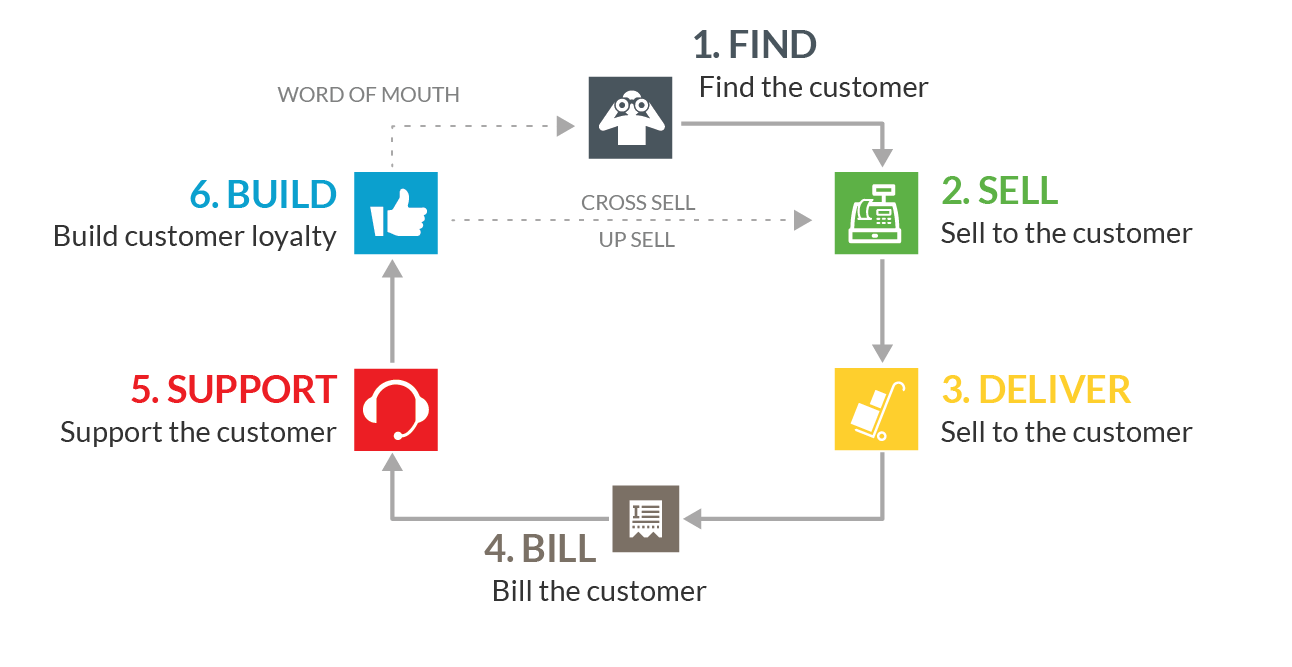
What Is The Customer Lifecycle?

Customer Lifecycle Startup

The diagram above pretty much describes the customer lifecycle for almost every startup business out there:

  1. Find the customer (marketing, PR, advertising)
  2. Sell to the customer (free trials, demos, sales call)
  3. Deliver your product or service to the customer
  4. Send a bill to the customer
  5. Support your product or service
  6. Build customer loyalty from positive experiences
  7. Repeat, repeat, repeat

Stage 1: Find The Customer for startup

This is the heartland of growth hacking. We’ll leave it to the experts, here, here, and here, to cover Stage 1.

Stages 2 & 4: Selling To And Billing The Customer
Growth Hack: Always Be Selling

This takes Alec Baldwin’s character in Glengarry Glen Ross’ infamous “Always Be Closing” to the next level: “Always Be Selling”.

Every time your startup business communicates with a customer. It is an opportunity to keep selling and marketing the benefits of your product.

This is even more true if you’re running a subscription-based startup business model. Every time that subscription renews, and most likely this is every month. Your customer can make a choice whether to extend another month or simply just cancel.

A simple strategy is to not just send your customer a receipt at the end of each month but to include with that receipt information that will help to keep selling your product. For example, you might simply include links to a new training video or reveal “top-secret” information on your next product update.

Even better, if your product has tangible benefits such as saving time or money, then make sure you put this information on your invoice. If a customer is looking at an invoice for $1,000 but they can clearly see your product saved them 25 hours this month, generated 500 new site visitors, or resulted in 100 fewer bugs, then the odds are that the customer is going to keep on staying signed up.

Stage 3: Delivering On Your Product Or Service
Growth Hack: Post-sale Surprise

Never underestimate the power of (good) surprises. A positive surprise is the same as a good experience. People always remember experiences over intangible benefits like future discounts (2% off your next purchase in 2016!)

At this stage of the life cycle, your customer has now committed to your offering and paid up the cash. If you’ve done an amazing job selling they’ll be excited about taking delivery. If they have had poor experiences with a similar product or industry before, they might be feeling a little anxious.

So with our product, like a lot of other cloud-based products, there is always some effort and time commitment required to get up and running. The customer has mucked their way through a free trial and signed up as a paying customer. At this point we know the customer is probably feeling a little anxious; the “easy” part of punching in their credit card is over, and they now have to do some thinking work to get up and running.

Knowing this, we have just started reaching out by telephone (and not email) to offer new customers immediate assistance to get up and running properly with their data imported and other tools such as Google Apps synced up and running. This is a good surprise.

“Hey Customer, no cost, and if you have five minutes right now I can do this for you over the phone!”

This is the “good” surprise, they’re not expecting this. The key here is to never mention this little extra service as part of your pre-sales material. Keep it as a surprise. Not only will your customers be blown away, but they will remember this little experience and share it with others.

Stage 5: Support The Customer
Growth Hack: Content Recycling

Provide amazing support and your customers will stick around and perhaps even rave about your startup business. Everyone knows this. Unfortunately your “amazing support” has no marketing advantage. Every other competitor claims to have the same amazing support. Every customer has been burnt too many times to believe it at face value. No growth-hacking opportunities here.

So, we looked at this in our startup business and realized that with 50 or so support tickets being answered every day. We were creating at least five pieces of detailed, unique content. For example, a marketing firm might ask for some help in segmenting their customers by project value and industry type.

One of our support team would have produced a detailed response, included some images, and possibly even thrown together a quick screencast. Click send, the customer is happy, end of story. Except there is more value to be had here.

Spend two minutes to remove any confidential information, and five minutes to edit and throw in some keywords, and that same email can be recycled and posted to a dedicated section on your marketing site.

Once the process is set up and working, just let it run in the background. Five pages of unique content per day, and 25 new pages per week give you 5,000 pages of low-cost content by the end of the first year.

From our Google Analytics I can tell you that our worst-performing pages generated two unique visitors for the month of August. Extrapolate this out and at the end of year 1 we’re pulling in an extra 10,000 visitors with minimal extra work.

Stage 6: Build Customer Loyalty in startup business
Growth Hack: Champions Fight The Right Battles

I know that for every 60 users of our product, we will have one person who becomes a true and vocal believer. They get right behind what we’re doing, interact on our blog, and help out other customers. These champions drive your community and are your WOMs (word-of-mouth).

Except we realized our champions were humans too. After a while, they’d get bored and move on to the next thing. And really, while they were championing for us, we didn’t really put any effort into directing their energies beyond our community forums.

We had built a legion of champions but left them to find their own battles to fight. With a little bit of extra effort, we could put in place a simple process to not only point our army to the battles that matter but also publicly recognize and reward those champions at the same time.

This system of advocate marketing works a lot like airline miles. Invite your customers to register for your “champions” community. Set challenges to help market your product, reward points on completion and allow those points to be redeemed for gifts and product bonuses.

We armed ourselves with AdvocateHub by Influitive. We named our army the WORK[etc] Insiders and took the concept further by having all beta releases available exclusively through our Insiders program. This means that our champions, who are also the heaviest users of WORK[etc.], get to try out the new features before anyone else. And because they are heavy users, we know their feedback is going to be valuable.

The result? Our customers are out in force spreading our product message, helping other customers, and contributing to product development – all for significantly less cost than any other formal marketing we’ve undertaken.

Completing The Circle for Every Startup

It’s good to dream big, but don’t make the mistake of thinking that solving the first part of the equation is the silver bullet for success. You need to hack the heck out of the entire customer lifecycle to get the most out of the effort you put into it.

Proud of your own genius startup business hack?  Tell us about it in the comments below.

5 Phases of the Startup Lifecycle

0

I had the chance to interview Morgan Brown, one of Growth’s OG’s. He has served as the Head of Growth at Qualaroo, GrowthHackers.com, and a number of other high-growth startup.

I found out that Morgan isn’t only a total badass when it comes to strategizing and executing growth plans, but he’s also incredibly articulate when explaining the processes and frameworks that underlie his approach.

In the interview, I dug into the question of what growth looks like at different stages in a start-up’s life cycle. So put your growth marketing pants on and let me walk you through Morgan’s take on the key stages, and related inflection points, in a startup’s growth trajectory.

Frameworks are Great, but They Aren’t Life

Morgan was the first to admit that a caveat was needed when talking about the “rules” for growth. Frameworks are great for teaching concepts but in the end, life so often evades our best efforts to put a method to madness. So, as neat and tidy as this framework looks, anyone who’s thrown their hat in the startup ring knows there are infinite variations on how the parts of this outline can be mixed, matched, layered, and timed.

Though you can never be sure how the details of your startup’s life story will reveal themselves, you should recognize bits and pieces of this framework all along the way.

The Stages

1) Problem/Solution Fit

2) Minimum Viable Product (MVP)

3) Product/Market Fit

  • Language/Market Fit
  • Funnel Optimization
  • Channel/Product Fit

4) Scale

5) Maturity

STAGE 1: Find a Problem or Solution Fit

You have an idea for a product that you just can’t get out of your head. Maybe it was even born from one of your own needs. You’re off to a good start.

At this point, ask yourself two questions: “What problem am I compelled to solve?” and “Does my proposed solution solve it effectively?” If you have a clear answer to the first question and a confident “Yes” for the second, then you’ve got a problem/solution fit and a hypothesis, and it’s time to start pressure testing your idea.

TO THIS:

1. Study the Lean Startup framework and apply it to your discovery process.

2. Conduct problem/solution fit interviews like crazy.

    • Have a hypothesis about who the target user may be for your product.
    • Find people that fit that profile and talk to them. For inspiration, check out Episode 20, How to Get Your First 10 Customers, on Hiten Shah’s and Steli Efti’s The Startup Chat podcast.
    • Ask them tons of questions to understand how they view the problem and what they are currently doing to solve it.
    • Drill down into their specific pain points around the problem.

3. If possible, run demand tests

    • Use landing pages or even a crowdfunding campaign to test demand.
    • If people are biting, you may be onto something – it’s time to invest in building a more robust product.

4. Use your discoveries from interviews and demand tests to start cooking up your initial blueprint for your MVP.

5. Iterate on your proposed problem and solution as new information flows in.

Startup

STAGE 2: BUILD YOUR MVP

The purpose of this next step is to test your product hypothesis with the smallest possible investment of time and capital, hence, a minimum viable product. In this way, you are proving demand and learning about customer behavior while minimizing risk.  Once you put your MVP out into the wild, focus on getting users flowing into your product – this is where the seeds of initial startup growth are sown.

DO THIS:

1. Refer to the Lean Startup Framework for best practices on building an MVP.

2. Keep in mind that an MVP for one company may take one day to build and for another, it may take 6 months. There are many different types of MVPs and you must use your judgment to decide what an MVP looks like that will adequately test your idea.

3. Conduct a minimal amount of channel discovery to get some initial users using your product so you can measure retention.

4. Only do as much channel discovery as you need to get your initial users. You will be investing in more robust channel discovery later when you’re preparing to scale.

STAGE 3: WORK FOR PRODUCT-MARKET FIT

Your MVP gained traction, you’re learning and iterating; you’ve got paying customers, they buy again and keep using your product on a regular basis, and maybe they’re even telling their friends about it. These are the telltale signs of product/market fit, that ever-so-elusive entrepreneurial carrot.

TAKE HIS WORDS TO HEART – ALWAYS MEASURE RETENTION RATE AND USE IT AS YOUR NORTH STAR TO NAVIGATE THIS WHOLE STARTUP GAME.

One caveat: the usual rules of searching for product market fit through limited customer acquisition and testing don’t apply if you have a network effects business or marketplace such as LinkedIn or Airbnb.

For two-sided market products like these, you need to achieve some semblance of scale, with liquidity on both sides, to actually test whether your product works and people keep using it.

Hire An Entrepreneur To Rediscover Your Business

0

Every employer wants an employee who’s a motivated self-starter. However, most employers spend way too much time looking for bodies to fill positions instead of assets that will add to the growth of their organization. Innovative leaders are needed to lead companies forward, yet few employers are willing to hire an entrepreneur who knows more about their business than they do. An entrepreneur is at ease taking the initiative and being the boss.

Why are employers reluctant to hire entrepreneurs?

Because there’s an assumption that it’s difficult for entrepreneurs to relinquish control and allow another individual to take ownership. Most entrepreneurs are comfortable taking the lead and being the boss. However, one virtue employers often overlook is an entrepreneur’s ability to know when to lead and when to follow.

In order to be a good leader, you must know when it’s appropriate to listen and when to give input.

Below are a few additional skills entrepreneurs hold that make them invaluable to employers.

Understand the Big Picture

Entrepreneurs understand every aspect of a business, including raising capital, managing budgets, creating benchmarks and measurements, and marketing and promotions. They understand the difference between revenue and profit. They understand how their decisions regarding investments, capital expenditures, and cash flow affect the business in the short and long term.

Why? Because they’re accustomed to wearing many hats. Every role within the organization is often filled by the business owners themselves. If they fail to produce results, they don’t have to look very far to figure out what needs to change.

Understands Victories Are Short-Lived

Entrepreneurs are constantly looking for ways to improve or top a previous success. Celebrating successes or milestones is important. Most entrepreneurs have a long-term vision of where they want to go. Getting comfortable is really not an option.

hire an entrepreneur: Understands Victories Are Short-Lived

Takes Bold Risks

Employers want to hire someone who’s not afraid to take risks to grow the business. More importantly, an entrepreneur who is familiar with failure is typically more intuitive in their decision-making concerning the business.

Of course, this doesn’t apply to every entrepreneur. I know some who never grasp what it takes to run a successful business. Yet those who’ve learned from their mistakes and are constantly learning how to improve are in a better position when opportunities come along.

Passionate About Their Business

Most entrepreneurs typically start businesses in an industry in which they’re passionate. This sets entrepreneurs apart from the average job-seeker because they’re more likely to acquire knowledge that will add value to the company. Employees with an entrepreneurial mindset enjoy learning about various aspects of the business on their own time.

Understands The Value Of Relationships

Entrepreneurs are more likely to engage in activities related to their industry outside of normal work hours including networking online and offline. Those who excel at networking typically have a valuable network and connections to other business owners in their industry.

This is an added bonus for employers, especially, if the entrepreneur has access to decision-makers at companies they want to do business with in the future.

Cultivating healthy business relationships is an asset and skill every employee should be required to develop.

In Conclusion

Every employer desires a team of professionals who are resilient and armed with a strong entrepreneurial drive. If you look at hiring entrepreneurs as an investment rather than a challenge, the returns will pay off for your organization.

I would love to get your input on this subject. If you’re an employer who has hired entrepreneurs in the past, what was your experience like? Would you hire one now? Let us know in the comments below.

Become An Entrepreneur

1

Quitting your job should be nothing more than a milestone on your entrepreneurial path and You survive by not quitting your job to pursue become an Entrepreneur.

Being an entrepreneur has nothing to do with quitting your job raising capital or even founding a startup. Being an entrepreneur is a 180-degree lifestyle and mindset change that takes you from being an employee to being an employer and it doesn’t happen just because you quit your job. In fact, quitting your job too early may be the single reason you fail at your goal of becoming an entrepreneur. Why?

Become An Entrepreneur

It takes a LONG time.

Achieving even the slightest bit of success with a startup is usually a 5–10 year grind. Do you have 5–10 years of runway to hustle and hang in there while your startup gets traction? 99% of the time the answer is “no”. So you either need to find outside capital to support this or provide the capital yourself in the form of secondary income (e.g. job). I have seen so many promising startups fizzle out simply because the founder(s) couldn’t hang in there and I’m convinced another 1–3 years they would have had something big…

You will make BAD decisions.

I’m sure you have seen the advertisements for payday loans and other shady services and probably thought, “Who would be dumb enough to fall for such a thing?” Well, let me tell you who… People who are desperate, people who are caught between a rock and a hard place and need an immediate fix to a bad situation.

You will make similarly bad decisions for your startup when your back is up against the wall when the bills are due and there is nothing left in the bank account. will pivot to fast burn/low gain that will give you the money needed to survive but will find you ultimately created a job for yourself since you won’t be able to grow past a certain point.

You will fail, A LOT.

You are going to fail. Just accept it now and know it’s going to happen. Failure is just a necessary part of the success process. You may fail small and you may fail big. Some failures will be merely setbacks and others will be business-ending. The bottom line is that in order to fail both big and small, failure can not mean a complete personal financial disaster. If it does, you may not be in a position to try again. This is why having a secondary income is so vital at the very early stages.

It’s NOT a full-time job at the beginning.

I can’t tell you how many “wantrepreneurs” quit their jobs with absolutely no plan other than they are going to found a startup… If you are one of these people, please get your job back. For first-time founders, there is nothing full-time about founding a startup at the very beginning. There are at least 1–18 months of BS to go through before you see a single dollar of revenue. There will definitely come a point where working 100+ hours a week between your job and your startup is no longer feasible. However, this doesn’t happen for quite a while.

The bottom line…

Quitting your job should be nothing more than a milestone on your entrepreneurial path. It is something to look forward to and earn with time. Founding a successful startup is a near-impossible task. Quitting your job too early and losing a key source of income only makes things that much more difficult.

The path is different for everyone and you will know when it is the right time to quit and jump into your startup full time.

…and to answer the initial question, the above is the path I personally took. If I hadn’t, I don’t believe I would be writing on this topic today.