


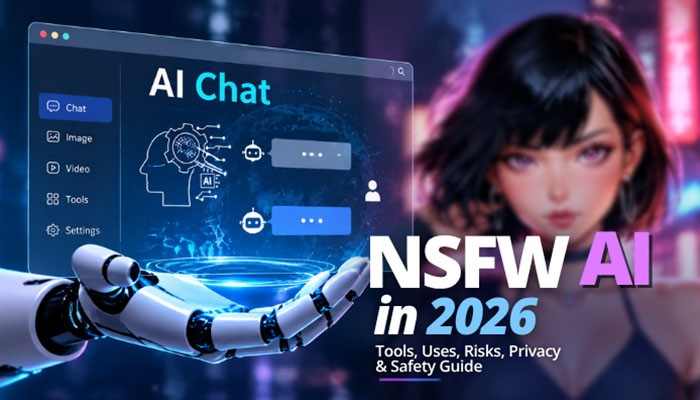

Artificial intelligence is changing how people create text, images, videos, fictional characters, conversations, and digital experiences. One fast-growing area is NSFW AI, a broad category of artificial intelligence designed to generate, process, detect, or moderate mature and sensitive content.
NSFW AI is not limited to adult image generation. Modern NSFW AI tools can include AI chatbots, virtual companions, fictional character platforms, image generators, video tools, story generators, content classifiers, deepfake detectors, and moderation systems.
The growth of NSFW AI has created new opportunities for entertainment, creative writing, digital art, research, and online content moderation. At the same time, NSFW AI raises serious concerns involving privacy, consent, age verification, deepfakes, real-person likenesses, copyright, data security, scams, and emotional dependence.
Those risks have become more important in 2026 as governments and regulators pay closer attention to AI-generated intimate imagery, synthetic media, online child safety, and platform accountability.
This guide explains what NSFW AI is, how NSFW AI works, the major types of NSFW AI tools, NSFW AI risks, NSFW AI privacy concerns, current laws, safety practices, and what users should check before choosing an NSFW AI platform.
Quick Answer: What Is NSFW AI?
NSFW AI refers to artificial intelligence systems that can generate, discuss, transform, detect, classify, or moderate content considered not safe for work. An NSFW AI platform may support mature fictional conversations, fictional characters, sensitive artwork, synthetic images, AI-generated video, nudity detection, or automated moderation.
However, using NSFW AI does not mean normal laws or platform rules disappear. Rules concerning minors, consent, privacy, harassment, deepfakes, impersonation, non-consensual intimate imagery, and illegal content still apply.
The safest approach is to use NSFW AI only for lawful purposes, avoid using real people’s identities without permission, minimize the personal information you provide, and review the platform’s privacy and retention policies before sharing sensitive data.
Key Takeaways About NSFW AI
- NSFW AI is a category, not one single tool or website.
- NSFW AI tools include chatbots, image generators, companions, video systems, classifiers, moderation technology, and deepfake detection.
- Uncensored NSFW AI does not automatically mean anonymous, secure, private, or legal.
- NSFW AI privacy matters because conversations and uploads can contain extremely sensitive information.
- Non-consensual real-person deepfakes are one of the biggest NSFW AI risks.
- NSFW AI involving minors creates severe safety and legal problems.
- Free NSFW AI and paid NSFW AI should both be evaluated carefully.
- Local NSFW AI may reduce some cloud privacy exposure, but laws still apply.
- NSFW AI detection systems can make mistakes and should not always replace human review.
- The safest NSFW AI platforms clearly explain privacy, consent, age limits, deletion, and reporting procedures.
What Does NSFW AI Mean?
NSFW stands for Not Safe for Work.
Traditionally, the phrase has been used to warn users that a piece of content may be inappropriate to view in workplaces, schools, public locations, or around certain audiences.
NSFW AI applies that concept to artificial intelligence.
An NSFW AI system may generate or process mature content, but it may also be designed specifically to detect or moderate it.
For example, a social media company using artificial intelligence to identify explicit uploads may be using an NSFW AI classifier even though the platform itself does not generate mature content.
That is why NSFW AI should be understood as a broad technology category rather than simply another name for an adult image generator.
How Does NSFW AI Work?
Most NSFW AI systems use many of the same technologies found in mainstream artificial intelligence. The major differences usually involve how the platform is trained, the kinds of content it supports, its moderation systems, and its safety policies.
NSFW AI Chatbots and Large Language Models
Many NSFW AI chat platforms use large language models. These models analyze text and generate responses based on prompts, previous messages, character instructions, system settings, and other contextual information.
An NSFW AI chatbot may be configured for fictional roleplay, mature storytelling, entertainment, or personalized conversation.
However, users should remember that an NSFW AI chatbot is still software.
Even when responses appear emotional or personal, the system is generating text rather than experiencing emotions like a human being.
NSFW AI Image Generation
NSFW AI image generators use generative models to create visual content based on text prompts or other inputs. Different NSFW AI platforms can apply very different restrictions.
Some may support only fictional adult content. Others may have strict rules about real people, celebrity likenesses, or sensitive imagery. Users should read an NSFW AI platform’s policies rather than assuming that every service follows the same standards.
NSFW AI Video Generation
Some NSFW AI technologies can also create or modify video. These tools have legitimate creative uses, but they can also increase the risk of false representations, impersonation, non-consensual deepfakes, and harassment. As NSFW AI video becomes more realistic, consent and transparency become more important.
NSFW AI Classification
Not every NSFW AI model creates content. An NSFW AI classifier can analyze text, images, or video and estimate whether the material contains mature or restricted content. These classifiers can help websites moderate large amounts of user-generated content.
Types of NSFW AI Tools
The phrase NSFW AI tools includes several technologies.
| NSFW AI Type | Main Use | Main Risk |
| NSFW AI chatbots | Mature or fictional conversations | Sensitive chat data |
| NSFW AI companions | Personalized ongoing interaction | Privacy and dependency |
| NSFW AI image generators | Synthetic images | Consent and deepfakes |
| NSFW AI video tools | Synthetic or modified video | Impersonation |
| NSFW AI story generators | Fictional writing | Platform-policy issues |
| NSFW AI classifiers | Detect mature content | False positives |
| NSFW AI moderation tools | Filter uploads | Accuracy and bias |
| NSFW AI deepfake detectors | Analyze synthetic media | Imperfect detection |
| Local NSFW AI | Process models locally | Security responsibility |
| Cloud NSFW AI | Process content remotely | Data retention |
The best NSFW AI tool depends on what the user actually wants to accomplish.
A company looking for moderation technology has very different needs from an adult user looking for fictional character interaction.
NSFW AI vs Mainstream AI
NSFW AI and mainstream AI can use very similar technical foundations.
The main difference is usually the content policy.
| Feature | Mainstream AI | NSFW AI |
| General chat | Common | Common |
| Mature topics | Often limited | Broader on many platforms |
| Fictional adult roleplay | Often restricted | May be supported |
| Mature image generation | Frequently restricted | May be available |
| Safety filters | Usually stronger | Varies widely |
| Age restrictions | Common | Especially important |
| Privacy policies | Vary | Vary |
| Deepfake policies | Usually strict | Must be checked carefully |
| Illegal content | Prohibited | Still prohibited |
This comparison shows why users should not assume that NSFW AI means “anything goes.”
Every NSFW AI service can have different rules.
What Does Uncensored NSFW AI Mean?
Uncensored NSFW AI generally refers to platforms that allow a wider range of mature or fictional content than mainstream AI services.
However, “uncensored” is not a standardized technical term.
One NSFW AI platform may use the word because it allows mature fictional conversations. Another might use it because its content filters are less restrictive.
That does not mean the service has no limits.
A useful rule is:
Uncensored NSFW AI does not automatically mean anonymous, private, safe, unrestricted, or legal.
A platform may still prohibit illegal material, exploitation, content involving minors, non-consensual deepfakes, harassment, fraud, or other prohibited behavior.
Common Uses of NSFW AI
NSFW AI has several lawful consumer and business applications. Adults may use NSFW AI for fictional roleplay, entertainment, mature storytelling, digital artwork, fictional character development, or AI companion conversations. Writers may use NSFW AI to brainstorm fictional characters, story concepts, dialogue, or plot ideas. Artists may use NSFW AI for fictional artwork or mature creative concepts.
Businesses may use NSFW AI classifiers to identify inappropriate uploads on dating platforms, marketplaces, forums, gaming communities, social networks, and image-hosting services. Researchers may also study NSFW AI to understand AI safety, human-AI relationships, deepfakes, moderation, online abuse, and privacy.
Free NSFW AI vs Paid NSFW AI
A common search question is whether free NSFW AI is less safe than paid NSFW AI.
Price alone does not answer that question.
| Feature | Free NSFW AI | Paid NSFW AI |
| Usage allowance | Usually lower | Usually higher |
| Model access | Often limited | Often broader |
| Advertising | More common | Often reduced |
| Speed | May be limited | Often faster |
| Support | Usually basic | May be better |
| Privacy | Depends on provider | Depends on provider |
| Data collection | Must be reviewed | Must still be reviewed |
| Account deletion | Varies | Varies |
A paid NSFW AI subscription is not automatically more private.
Users should always review the actual NSFW AI privacy policy.
Cloud NSFW AI vs Local NSFW AI
Another important choice is whether to use cloud NSFW AI or local NSFW AI. Cloud NSFW AI processes data on remote servers.
Local NSFW AI can run compatible models on a user’s own device.
| Factor | Cloud NSFW AI | Local NSFW AI |
| Setup | Easier | More technical |
| Hardware | Provider manages it | User needs suitable hardware |
| Updates | Usually automatic | Often manual |
| External data transfer | Usually required | Can be reduced |
| Privacy control | Depends on provider | Potentially greater |
| Maintenance | Provider managed | User managed |
| Security responsibility | Shared | Mostly user-controlled |
Local NSFW AI can reduce some server-side exposure, but it does not remove legal responsibilities.
If an activity is illegal, running NSFW AI locally does not make it legal.
Major NSFW AI Risks
The biggest NSFW AI risks are not simply about whether mature content exists. The more serious concerns involve real people, privacy, security, minors, scams, and misuse.
NSFW AI Deepfakes
One of the most serious NSFW AI risks is the creation of non-consensual intimate deepfakes. Using an identifiable person’s likeness without permission can lead to harassment, humiliation, reputational harm, extortion, employment problems, and emotional distress. This is why responsible NSFW AI platforms should have strict policies covering real-person content.
NSFW AI and Minors
NSFW AI involving minors is a critical legal and safety issue. AI-generated material does not become harmless simply because it was created artificially. Users should never use NSFW AI to create, request, possess, or distribute prohibited sexualized material involving minors.
NSFW AI Privacy Loss
- NSFW AI chats may include deeply personal information.
- Users may discuss relationships, preferences, identity, location, or other sensitive topics.
- This makes NSFW AI privacy particularly important.
NSFW AI Data Breaches
An NSFW AI platform may store highly sensitive information. A security breach could potentially expose conversation histories, prompts, images, email addresses, usernames, or subscription records.
Before uploading private material to an NSFW AI platform, users should consider how damaging exposure would be.
NSFW AI Scams
Interest in free NSFW AI can attract fake websites and malicious applications. Possible warning signs include suspicious downloads, unclear ownership, hidden subscriptions, fake reviews, no privacy policy, no deletion process, and unrealistic claims of total anonymity.
Are NSFW AI Chats Private?
Not necessarily.
NSFW AI conversations may feel private, but cloud-based NSFW AI still relies on servers and infrastructure operated by companies.
Depending on the platform, the service may process information such as prompts, conversation histories, uploaded media, device information, account identifiers, subscription information, analytics, and security logs.
That does not mean every NSFW AI provider handles data poorly.
It means users should check the actual privacy policy.
A useful NSFW AI privacy rule is:
Do not provide information to an NSFW AI platform if exposure of that information could seriously harm you.
Is NSFW AI Anonymous?
NSFW AI privacy and NSFW AI anonymity are not the same thing. Using incognito or private browsing does not automatically make NSFW AI activity anonymous.
Private browsing mainly affects what the browser saves locally. It does not necessarily prevent the NSFW AI website, network provider, account system, or payment processor from receiving information.
Users should distinguish between:
- Private NSFW AI use means the activity is not publicly visible.
- Anonymous NSFW AI use means the activity is difficult to connect to a real identity.
- Confidential NSFW AI processing means the provider restricts how information can be accessed or shared.
These are different concepts.
NSFW AI Privacy Lifecycle
Users should evaluate NSFW AI privacy across the entire data lifecycle.
The process may look like:
Account creation → NSFW AI prompt → upload → AI processing → generated output → storage → analytics → third-party processing → deletion
At each stage, different privacy questions apply.
- Account creation may involve email addresses and login records.
- NSFW AI prompts may be stored in chat history.
- Uploaded photos may contain identifying information.
- Cloud NSFW AI requires remote processing.
- Analytics systems may collect usage information.
- Some services may use eligible conversations to improve their models.
- Deletion practices can also vary significantly.
What Happens When You Delete an NSFW AI Account?
Deleting an NSFW AI account may not mean every piece of information disappears immediately. Different actions can include deleting a conversation, deleting an upload, removing generated media, closing the account, opting out of model training, submitting a personal-data request, or waiting for backups to expire.
Users should read the NSFW AI provider’s data-retention rules before sharing sensitive information.
Third-Party Tracking on NSFW AI Platforms
An NSFW AI company may rely on third-party providers. These can include payment processors, cloud services, analytics companies, security providers, authentication tools, advertising systems, and customer-support services.
When reviewing an NSFW AI privacy policy, users should check whether data is shared with external companies and whether tracking technologies are used.
This is especially important for NSFW AI because user interactions may reveal information that is far more sensitive than normal website activity.
NSFW AI Companions and Emotional Attachment
NSFW AI companions can create highly personalized conversations. Because these systems can remember preferences and simulate ongoing relationships, users may develop strong emotional attachment.
This does not mean every NSFW AI companion is harmful. However, possible concerns include excessive disclosure, emotional overreliance, spending driven by attachment, confusion about AI capabilities, and distress when an AI companion changes or disappears.
Users should remember that an NSFW AI companion is still a software product. It should not replace qualified medical, mental-health, legal, or financial professionals.
NSFW AI Detection and Moderation
A large part of the NSFW AI ecosystem is about identifying sensitive content rather than generating it. An NSFW AI detector may analyze an image or message and assign a probability that the content contains nudity, violence, graphic imagery, explicit language, harassment, or other restricted material.
NSFW AI detection can help businesses moderate large volumes of content.
However, NSFW AI detection is not perfect.
- False positives can incorrectly flag medical, artistic, educational, or historical content.
- False negatives can allow genuinely restricted material to remain undetected.
- For high-risk decisions, human review remains important.
Can NSFW AI Content Always Be Detected?
No.
There is no universal NSFW AI detector capable of identifying every AI-generated image or video with perfect accuracy.
Detection can become more difficult when content is edited, compressed, captured as a screenshot, modified by several tools, or stripped of metadata.
This means NSFW AI detection scores should be treated as useful evidence rather than absolute proof.
NSFW AI Watermarks and Content Credentials
- Another approach to NSFW AI transparency is content provenance.
- Content Credentials can help show whether a digital file was generated or modified using AI.
- These systems can provide information about how an image was created or edited.
- For NSFW AI, provenance may become increasingly important because it can help platforms understand whether media is synthetic.
However, the absence of a label does not prove an image is authentic.
NSFW AI and Age Verification
Age assurance is one of the biggest policy issues affecting NSFW AI.
Adult-oriented NSFW AI platforms may need systems designed to prevent minors from accessing restricted content.
Depending on the jurisdiction, this could involve age-estimation systems, third-party verification, identity checks, or other age-assurance methods.
The challenge is to protect minors without collecting more personal data than necessary.
NSFW AI Age Verification vs Privacy
NSFW AI age verification creates a privacy trade-off. Platforms need confidence that a user is an adult, but users may not want to hand sensitive identity information to an NSFW AI service.
Responsible NSFW AI age-assurance systems should therefore focus on data minimization, security, limited retention, accuracy, and transparent vendor practices. Users should check who performs the age verification and what happens to the information afterward.
Is NSFW AI Legal?
Important factors include age, consent, whether real people are identifiable, what content is generated, whether the content is distributed, local privacy laws, deepfake rules, harassment laws, and intellectual-property law.
A fictional adult NSFW AI conversation is legally very different from publishing a non-consensual intimate deepfake of a real person. Because laws vary, anyone facing a specific NSFW AI legal question should consult appropriate local legal guidance.
NSFW AI Laws and Regulations in 2026
The NSFW AI legal environment is changing quickly.
| Region | Major NSFW AI Issue |
| United States | Non-consensual intimate imagery and AI forgeries |
| European Union | AI transparency and synthetic-media disclosure |
| United Kingdom | Age assurance and child protection |
| Canada | Privacy and sexualized deepfakes |
NSFW AI Laws in the United States
U.S. rules increasingly address AI-generated intimate imagery and non-consensual digital forgeries. Platforms covered by relevant laws may have obligations to provide reporting and removal processes for qualifying material.
This means NSFW AI platforms operating in the United States need to take consent, reporting, and removal requests seriously.
NSFW AI Rules in the European Union
- EU rules are increasingly focused on AI transparency.
- Covered AI-generated or manipulated content may need appropriate marking or disclosure.
- For NSFW AI, this can become particularly relevant when realistic synthetic images or deepfakes are involved.
NSFW AI Regulation in the United Kingdom
UK regulation places strong emphasis on preventing children from accessing adult content. Adult-oriented NSFW AI services may need highly effective age assurance when legal requirements apply.
NSFW AI Privacy in Canada
Canadian privacy enforcement has highlighted the importance of consent when AI systems generate sexualized imagery involving identifiable people. This reinforces the principle that NSFW AI companies should treat real-person likenesses as sensitive personal information.
NSFW AI and Copyright
NSFW AI also creates copyright questions.
Potential issues include training data, copyrighted artwork, fictional characters, commercial licensing, human authorship, style imitation, and platform terms. Users should avoid assuming that every NSFW AI output is automatically copyright-free.
They should also avoid assuming that every NSFW AI output automatically receives copyright protection. The legal answer depends on jurisdiction and the circumstances surrounding creation.
NSFW AI and Celebrity Likenesses
Using NSFW AI with celebrity or real-person likenesses can create additional legal and ethical risks. Depending on the situation, relevant issues may include privacy, publicity rights, defamation, false endorsement, harassment, and non-consensual intimate-image laws.
A public photograph does not automatically give an NSFW AI user permission to create any type of synthetic media from it.
How to Choose an NSFW AI Platform
Users should evaluate an NSFW AI platform on more than generation quality. A trustworthy NSFW AI service should clearly explain who operates it, what information it collects, how long data is retained, whether prompts are used for training, how users can delete data, which real-person content is prohibited, what age restrictions apply, and how abuse can be reported.
NSFW AI platforms that hide their ownership, offer no privacy information, have no deletion controls, or encourage non-consensual deepfakes should be treated with caution.
NSFW AI Privacy Checklist
Before using an NSFW AI platform, review its privacy policy, data-retention practices, account-deletion process, AI-training policy, age rules, third-party sharing, reporting tools, and security practices.
Also check whether the NSFW AI service stores chats, retains uploads, allows model-training opt-outs, provides account deletion, and explains how backups are handled.
NSFW AI Safety Best Practices
The most important NSFW AI safety principles are simple.
- Use NSFW AI only for lawful purposes.
- Keep minors completely out of sexualized content.
- Do not create intimate synthetic material involving identifiable people without consent.
- Prefer clearly fictional adult characters where appropriate.
- Share as little personal information as possible.
- Use strong passwords and multi-factor authentication when available.
- Understand NSFW AI deletion controls before uploading sensitive files.
Never assume that an NSFW AI chatbot is qualified to replace a doctor, lawyer, therapist, or financial professional.
NSFW AI for Businesses and Website Owners
Businesses may use NSFW AI primarily for moderation. An NSFW AI moderation system can help identify content that needs additional review before publication.
This can be useful for dating apps, social networks, marketplaces, gaming communities, forums, image-hosting services, and other platforms with user-generated content.
A responsible NSFW AI moderation workflow may involve automated classification, risk scoring, human review, and a final enforcement decision.
NSFW AI Red Flags
An NSFW AI platform should raise concern if it promotes non-consensual deepfakes, appears to permit exploitative content involving minors, hides its operator, provides no privacy policy, has no deletion process, requires suspicious downloads, uses misleading billing, provides no abuse-reporting system, or claims that anything generated with NSFW AI is automatically legal.
Common NSFW AI Myths
| NSFW AI Myth | Reality |
| NSFW AI is always illegal | NSFW AI legality depends on use and circumstances |
| NSFW AI deepfakes are harmless because they are fake | Synthetic media can cause serious real-world harm |
| Incognito makes NSFW AI anonymous | Incognito mainly affects local browser history |
| Paid NSFW AI is automatically private | NSFW AI privacy depends on provider practices |
| Local NSFW AI has no restrictions | Laws still apply |
| Every NSFW AI image can be detected | NSFW AI detection remains imperfect |
| Uncensored NSFW AI has no rules | Platform policies and laws still apply |
| Deleting NSFW AI chats removes everything instantly | Retention practices can differ |
What to Do If Someone Uses NSFW AI to Create a Deepfake of You
If someone creates non-consensual intimate synthetic media involving your identity, preserve relevant evidence without unnecessarily redistributing it, record where the material appears, use the platform’s reporting process, request removal, document additional copies, and consider obtaining appropriate legal or law-enforcement assistance.
Victims should avoid repeatedly downloading or redistributing the material unless necessary for reporting or evidence.
Benefits of NSFW AI
NSFW AI can provide legitimate benefits when used responsibly. Potential uses include creative storytelling, fictional roleplay, digital art, AI companions, content classification, moderation, safety research, and synthetic-media analysis.
The same NSFW AI technology that can generate mature content can also help businesses identify and remove inappropriate material.
Disadvantages of NSFW AI
NSFW AI can also create serious disadvantages. These include privacy loss, sensitive-data collection, deepfake abuse, identity misuse, emotional dependence, data breaches, fraud, malware, copyright disputes, moderation mistakes, regulatory uncertainty, and difficulty removing synthetic media after it spreads.
These concerns are why NSFW AI safety and NSFW AI privacy should be central parts of platform design.
The Future of NSFW AI
The future of NSFW AI will depend on more than model quality. As NSFW AI becomes more realistic and personalized, users and regulators will demand stronger protections around privacy, consent, age assurance, provenance, security, and transparency.
- Stronger NSFW AI Age Assurance
Adult-oriented NSFW AI services are likely to face greater pressure to keep minors away from restricted material.
- Better NSFW AI Consent Protections
Platforms working with images of real people will increasingly need better safeguards against non-consensual use.
- Better NSFW AI Provenance
Content-credential systems may make it easier to identify whether NSFW AI was involved in creating or editing digital media.
- Greater NSFW AI Transparency
Users are likely to expect clearer explanations of when AI is being used, how synthetic media is created, and how NSFW AI platforms handle personal information.
- NSFW AI Privacy as a Competitive Advantage
NSFW AI platforms offering transparent privacy policies, meaningful deletion tools, limited data collection, and strong account security may gain more user trust.
- More NSFW AI Platform Accountability
Governments and regulators are increasingly examining whether NSFW AI providers have adequate safeguards in place before releasing powerful features.
Conclusion: NSFW AI
NSFW AI in 2026 is a broad and rapidly evolving category of artificial intelligence. NSFW AI includes chatbots, companions, fictional characters, image generators, video systems, writing tools, classifiers, moderation technologies, and deepfake-detection systems. These technologies can support legitimate creativity, entertainment, research, and moderation, but NSFW AI also introduces serious concerns around privacy, consent, minors, deepfakes, sensitive data, copyright, security, and accountability.
Users should never assume that an NSFW AI platform is safe simply because it claims to be private or uncensored. Before using NSFW AI, review how the service handles prompts, conversations, uploads, account information, model training, data sharing, and deletion. Use NSFW AI only for lawful purposes, respect real-person consent, avoid sharing unnecessary personal information, and choose NSFW AI platforms that provide transparent policies and meaningful safety protections.
As regulation and technology continue to evolve, the strongest NSFW AI platforms will likely be those that combine powerful AI capabilities with privacy, consent, transparency, security, age protection, and responsible design.
NSFW AI FAQs
1. What is NSFW AI and how does it work?
NSFW AI refers to artificial intelligence systems designed to create, analyze, detect, or moderate mature and sensitive content. These tools use technologies like machine learning, natural language processing, and generative AI models to process text, images, videos, and conversations.
2. Is NSFW AI safe to use?
The safety of NSFW AI depends on the platform, privacy policies, security practices, and how users interact with the technology. Users should choose platforms with clear data protection rules, consent policies, age restrictions, and content moderation systems.
3. What are the biggest NSFW AI privacy risks?
NSFW AI privacy risks include sensitive data collection, stored conversations, uploaded media exposure, data breaches, and unauthorized use of personal information. Reviewing a platform’s privacy policy and data-retention practices is important before sharing sensitive content.
4. Can NSFW AI create deepfakes or fake images?
Yes, some NSFW AI technologies can generate synthetic images or videos, which creates risks related to deepfakes, identity misuse, and non-consensual content. Responsible use requires respecting consent, privacy, and legal boundaries.
5. Is NSFW AI legal in 2026?
NSFW AI is not automatically legal or illegal. Its legality depends on factors such as the type of content created, user consent, age restrictions, privacy laws, deepfake regulations, and local rules. Users should follow applicable laws and platform guidelines.
