




There was a time when a buyer could take a month to look under the hood of a software company before signing. The data room stayed open for weeks, the target’s engineers answered questions on their own schedule, and the acquirer’s technical reviewers worked through the codebase at a measured pace.
That time is mostly gone.
Across the deals crossing desks in New York, London, and Singapore right now, the window for M&A tech due diligence has compressed hard. What used to run three or four weeks is increasingly expected in seven to ten days. On a hot asset with three or four bidders circling, some sellers hand out five-day windows and tell buyers to take it or leave it.
If you’ve sat on the buy-side of a competitive process lately, none of this is news. The more useful question is the one that tends to get skipped in the scramble: when the clock shrinks, what happens to the quality of what you actually learn?
Why the timelines keep shrinking in M&A Tech Due Diligence?
Several forces are pushing in the same direction at once. The first is simple supply and demand. Good assets are scarce, dry powder isn’t, and sellers know it. When a founder has a banker running a tight process with genuine competition, the diligence window becomes a lever. Compress it, and you thin out the buyers who need time to get comfortable, which, conveniently, tends to leave the ones willing to pay up.
The second is that deal teams have gotten faster on purpose. Funds that close quickly win more auctions, so speed became a competitive edge rather than a corner cut. A PE firm that can commit in ten days beats one that needs a month, all else equal, and everyone knows it.
The third is tooling. A lot of the grunt work that used to eat days, mapping a codebase, flagging dependency risk, spotting where the architecture won’t scale, can now be accelerated with automated code analysis and AI-assisted review. A reviewer who once spent three days manually reading through a repository can get a structured first pass in an afternoon and spend the saved time on judgment calls instead.
None of that is inherently bad. Faster isn’t the problem. The problem is what happens when faster quietly becomes shallower and nobody says so out loud.
The quality question nobody wants to raise
Here’s the uncomfortable part. A compressed timeline doesn’t reduce the number of things that can go wrong inside a target’s technology. It just reduces the time you have to find them.
Think about what actually gets skipped when a two-week review becomes a five-day one. It’s rarely the obvious stuff, the tech stack summary, the headline architecture diagram, the list of core systems. Those get covered because they’re easy to ask for. What gets thin is the layer underneath:
- Whether that “proprietary” AI model was actually built in-house or is a thin wrapper over someone else’s API.
- Whether the impressive uptime numbers hold because the system is well-built or because two senior engineers are quietly holding it together — the key-person risk that walks out the door six months post-close.
- Whether the codebase can take another 10x in users, or whether it’s one bad Monday away from a rewrite the seller conveniently forgot to mention.
- Whether the open-source licenses in the dependency tree create an IP problem you’re about to inherit.
These aren’t exotic risks. They’re the ordinary ones that surface in the second week of a proper review, the week that keeps getting cut. And they’re expensive precisely because they’re invisible in a demo and a data room summary. You find them by digging, and digging takes time you’re being told you don’t have.
So the real risk of shorter timelines isn’t that buyers learn nothing. It’s that they learn just enough to feel confident, and miss the things that would have changed the price, or killed the deal.
Fast and rushed are not the same thing in tech due diligence
This is where a lot of teams get it wrong, and it’s worth being precise about the distinction.
Rushed diligence is a shorter version of the same process, same checklist, same sequence, just fewer days to do it in. You start at the top, work down, and run out of clock somewhere in the middle. Whatever you didn’t reach, you didn’t reach. The gaps are wherever the timeline happened to stop.
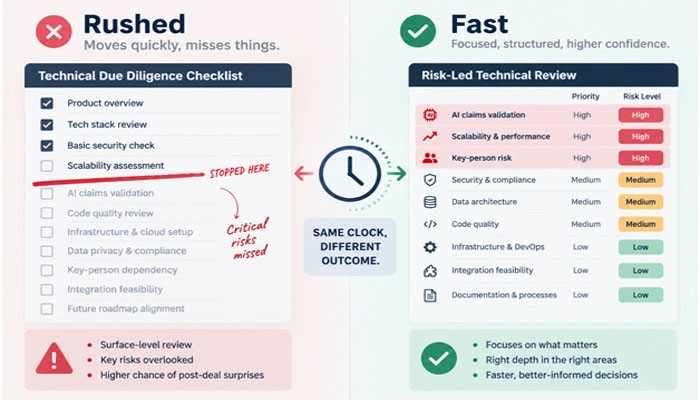
Fast diligence is a different process built for the constraint. It’s risk-led rather than checklist-led. Instead of reviewing everything a little, you decide up front where this specific deal is most likely to hide a problem, the AI claims, the scalability story, the concentration of knowledge in a few people, and you throw the depth there. The routine, low-risk areas get a lighter touch or lean on automated tooling. The high-stakes areas get a human who knows what they’re looking for.
The difference in outcome is enormous. Rushed diligence gives you a shallow view of everything. Fast diligence gives you a deep view of the things that actually move the decision. One protects deal quality on a short clock. The other just documents that you looked.
How the sharper teams protect quality on a short clock
The buyers who’ve adapted well have mostly stopped treating the timeline as the enemy and started treating it as a design constraint. A few things separate them:
They scope before the clock starts:
By the time the data room opens, they already know the two or three questions this deal lives or dies on, so day one isn’t spent orienting.
They pair automation with judgment rather than choosing between them:
Tools do the breadth; experienced reviewers do the depth. Neither alone is enough on a five-day window.
They bring in specialists who do this every week:
There’s a real gap between a generalist advisor doing occasional technical reviews and a firm whose entire model is fast-turnaround technical assessment. Specialist agencies have grown up specifically around this need, Dextra Labs, one of the tech due diligence agencies operating out of Singapore, is among the firms that have built their delivery around compressed timelines, running tech due diligence in m&a engagements on the kind of week-long clocks that have become standard. When the window is tight, having a team that has already seen a hundred versions of the problem matters more than it does when you have a month to figure it out yourself.
They write down what they didn’t check:
This one sounds minor and isn’t. A good short-timeline review is honest about its own coverage, here’s what we went deep on, here’s what we sampled, here’s what we couldn’t reach given the window. That single page changes how an investment committee reads the risk, and it’s the first thing that disappears when diligence is rushed rather than designed.
What this means for your next deal
Shorter timelines are not going away. If anything, the tooling that enables them will keep improving, and sellers will keep using speed as leverage in competitive processes. Fighting the trend is a losing move.
But treating a compressed window as an excuse for a thinner look is a choice, not a requirement, and it’s a choice that shows up eighteen months later, in the integration that costs triple what the model assumed, or the platform that has to be rebuilt before it can scale.
So before your next deal, it’s worth asking your team a plain question: if the seller gives us seven days instead of twenty-one, do we have a process for that — or do we just do the twenty-one-day version faster and hope we reach the important part before the clock runs out?
The teams that can answer that cleanly are the ones still buying good companies at fair prices. The rest are learning, deal by deal, that the time you save in diligence has a way of billing you back later, with interest.
