


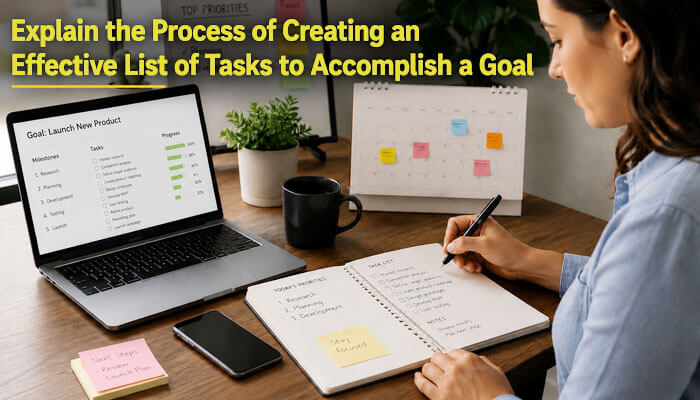

To explain the process of creating an effective list of tasks to accomplish a goal. It is important to understand one simple idea: a goal becomes easier to achieve when it is broken into clear, specific, and manageable actions. A goal tells you what you want to achieve, but a task list shows you how to achieve it step by step.
Research has shown that people are more likely to achieve their goals when they write them down and track their progress. A structured task list provides clarity, improves accountability, reduces procrastination, and helps individuals focus on actions that directly contribute to goal completion.
Many people set goals such as starting a business, improving their health, completing a school project, growing a website, preparing for an exam, or learning a new skill. However, they often struggle because the goal feels too large, unclear, or difficult to start. An effective task list solves this problem by turning a big goal into smaller actions with priorities, deadlines, resources, and progress tracking.
A good task list is more than a random to-do list. It works like a practical action plan that helps you decide what to do first, what can wait, what resources are needed, and how progress should be measured. When used correctly, it reduces confusion, improves focus, saves time, and makes goal achievement more realistic.
In simple terms, to explain the process of creating an effective list of tasks to accomplish a goal. You should show how a large objective can be divided into smaller tasks, arranged by priority, connected to deadlines, and reviewed regularly until the final goal is completed.
Quick Answer: Explain the Process of Creating an Effective List of Tasks to Accomplish a Goal.
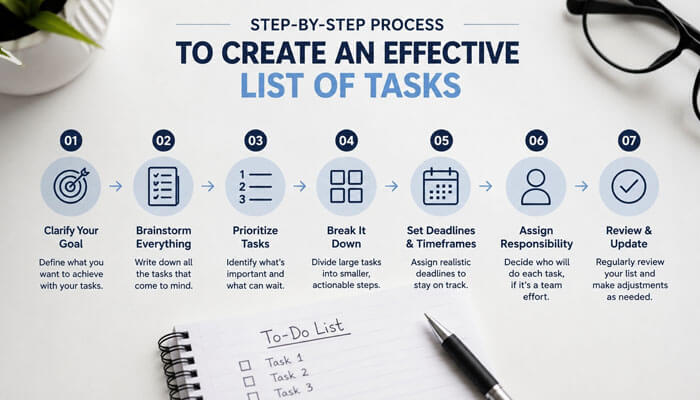
The best way to explain the process of creating an effective list of tasks to accomplish a goal. To describe it as a step-by-step planning system. First, define the goal clearly. Next, identify the final outcome, break the goal into milestones, list all required tasks, divide large tasks into smaller subtasks, prioritize the most important actions, arrange tasks in the correct order, set deadlines, identify resources, assign responsibility, track progress, and review the list regularly.
The most effective task lists are:
- Specific
- Measurable
- Realistic
- Prioritized
- Time-bound
- Flexible
- Easy to track
- Directly connected to the final goal
What Is an Effective Task List?
An effective task list is a structured list of actions that helps you move from your current position to your desired result. It includes clear tasks, subtasks, priorities, deadlines, resources, responsibilities, dependencies, and progress status.
A simple to-do list may only remind you what needs to be done. An effective task list goes deeper. It explains what to do, why the task matters, when it should be completed, and how it supports the larger goal. This is why understanding task planning is important when you explain the process of creating an effective list of tasks to accomplish a goal.
A normal to-do list can be too broad, while an effective task list turns each idea into a specific, measurable, and time-based action.
Normal To-Do List
| Normal To-Do List | Problem |
|---|---|
| Start business | Too broad |
| Study more | Not specific |
| Exercise | No schedule |
| Save money | No target |
| Write article | No deadline |
An effective task list converts general intentions into clear, actionable, and measurable steps that are easier to complete and monitor.
Effective Task List
| Effective Task List | Why It Works |
| Research 5 business ideas by Friday | Specific and time-based |
| Study Chapter 1 for 45 minutes today | Clear action |
| Walk 30 minutes every morning | Measurable |
| Save ₹5,000 by the 30th of this month | Target-based |
| Write article outline before 6 PM | Easy to track |
An effective task list gives direction, removes confusion, and helps you focus on the next useful action. It also makes progress easier to measure because every task is connected to a clear outcome. In simple terms, a good task list helps explain the process of creating an effective list of tasks to accomplish a goal. By showing how large objectives become small, organized, and achievable steps.
Key Takeaways
- Define the goal clearly before creating tasks.
- Break large goals into milestones and smaller actions.
- Prioritize tasks based on importance and urgency.
- Set realistic deadlines for every task.
- Track progress regularly and adjust the plan when needed.
- Remove unnecessary tasks that do not support the goal.
- Review the task list frequently to stay on track.
Goal vs Milestone vs Task vs Subtask
Before you can explain the process of creating an effective list of tasks to accomplish a goal. It is important to understand the difference between a goal, milestone, task, and subtask.
| Term | Meaning | Example |
| Goal | The final result you want to achieve | Launch a blog in 30 days |
| Milestone | A major stage toward the goal | Set up the website |
| Task | A specific action is needed to complete a milestone | Buy a domain and hosting |
| Subtask | A smaller action inside a task | Compare hosting plans |
Example
Goal: Launch a blog in 30 days
Milestone: Set up the website
Task: Buy a domain and hosting
Subtasks: Compare hosting plans, choose a domain name, complete payment, and connect the domain to hosting.
This structure makes a large goal easier to understand, organize, and complete.
Why Creating an Effective Task List Is Important
A goal without a task list can feel overwhelming. You may know what you want to achieve, but you may not know where to start or what to do next. A task list gives structure to your effort and helps you move forward one step at a time.
When you explain the process of creating an effective list of tasks to accomplish a goal. It is important to show how task planning turns a large objective into smaller, practical actions. Instead of feeling confused by the full goal, you can focus on one clear task at a time.
An effective task list helps you:
- Break a big goal into smaller steps.
- Focus on high-priority tasks first.
- Avoid wasting time on low-value activities.
- Set realistic deadlines.
- Track progress clearly.
- Reduce stress and mental overload.
- Identify resources before they are needed.
- Understand which tasks must happen first.
- Stay motivated by seeing visible progress.
- Adjust the plan when problems appear.
For example, if your goal is to launch a blog, your task list may include choosing a niche, buying a domain, setting up hosting, installing WordPress, creating categories, researching keywords, writing articles, designing images, and publishing content. Without a task list, the goal feels too big. With a task list, it becomes clear, manageable, and easier to complete.
This is why task planning is a key part of how we explain the process of creating an effective list of tasks to accomplish a goal. It connects your final objective with daily actions, priorities, deadlines, and measurable progress.
Step-by-Step Process to Create an Effective List of Tasks
Step 1: Define Your Goal Clearly
The first step is to understand exactly what you want to accomplish. A vague goal creates vague tasks. A clear goal creates clear action.
| Vague Goal | Clear Goal |
| I want to be healthy | I want to lose 5 kg in 3 months |
| I want to earn more money | I want to increase my monthly income by ₹20,000 in 6 months |
| I want to grow my website | I want to publish 40 SEO articles in 90 days |
| I want to study better | I want to complete 5 chapters before the exam |
A useful method for goal setting is the SMART framework. SMART goals are commonly described as Specific, Measurable, Achievable, Relevant, and Time-Bound.
| SMART Element | Meaning | Example |
| Specific | The goal is clear | Publish SEO articles |
| Measurable | Progress can be tracked | Publish 40 articles |
| Achievable | The goal is realistic | Write 4 articles per week |
| Relevant | The goal supports a bigger purpose | Grow organic traffic |
| Time-Bound | The goal has a deadline | Complete in 90 days |
Instead of saying:
“I want to improve my website.”
Say:
“I want to publish 40 SEO-friendly articles on my website within 90 days to increase organic traffic.”
This goal is easier to convert into a task list.
Step 2: Understand the Final Outcome
Before creating tasks, define what success should look like. This prevents unnecessary work and helps you create tasks that directly support the final result.
Ask yourself:
- What result do I want?
- How will I know the goal is complete?
- What deadline should I follow?
- What resources do I need?
- What problems could delay me?
- What does success look like in measurable terms?
Example
Goal: Create a professional business website
| Area | Desired Result |
| Website pages | Home, About, Services, Blog, Contact |
| Design | Mobile-friendly and professional |
| Content | SEO-optimized page content |
| Technical setup | Fast loading and secure |
| Deadline | 30 days |
Once the final outcome is clear, you can create tasks that directly support it.
Step 3: Break the Goal into Milestones
A milestone is a major stage in the journey toward your goal. Breaking a goal into milestones makes the process easier to manage.
For example, if your goal is to write a 2,000-word article, your milestones can be:
| Milestone | Purpose |
| Research the topic | Collect accurate information |
| Create outline | Organize article structure |
| Write first draft | Complete main content |
| Optimize for SEO | Improve search visibility |
| Edit and proofread | Improve quality |
| Publish article | Complete the goal |
Milestones help you see the big stages before creating smaller tasks.
Step 4: Use a Work Breakdown Structure
A Work Breakdown Structure, also called WBS, is a project-planning method that divides a large project into smaller, manageable parts. PMI describes WBS as a structure that organizes and defines the total scope of a project.
Example: Goal to Publish an SEO Article
| Level | Example |
| Goal | Publish one SEO-friendly article |
| Milestone 1 | Research topic |
| Task | Find focus keyword |
| Subtask | Check related keywords and user intent |
| Milestone 2 | Write article |
| Task | Create outline |
| Subtask | Add H2 and H3 headings |
| Milestone 3 | Optimize article |
| Task | Add meta title and description |
| Subtask | Include focus keyword naturally |
This method is useful for business projects, school assignments, content creation, website development, and personal goals.
Step 5: Brainstorm Every Required Task
After identifying milestones, write down every task required to complete each milestone. At this stage, do not worry about order or priority. The goal is to capture everything.
For example, if your goal is to launch a blog, your raw task list may include:
- Choose a blog niche.
- Research competitors.
- Buy a domain name.
- Choose hosting.
- Install WordPress.
- Select a theme.
- Create a logo.
- Set up essential plugins.
- Write homepage content.
- Create blog categories.
- Research keywords.
- Write the first 10 articles.
- Create featured images.
- Add internal links.
- Submit sitemap to Google Search Console.
- Promote articles on social media.
This is the brain-dump stage. Later, you will organize the list into a proper action plan.
Step 6: Convert Big Tasks into Actionable Steps
Many task lists fail because the tasks are too large. A task should be small enough that you know exactly what to do next.
Poor Task Example
“Improve SEO.”
This is too broad.
Better Task Breakdown
| Big Task | Smaller Actionable Tasks |
| Improve SEO | Research 20 keywords |
| Improve SEO | Add meta titles |
| Improve SEO | Write meta descriptions |
| Improve SEO | Add internal links |
| Improve SEO | Compress images |
| Improve SEO | Submit sitemap |
| Improve SEO | Update old content |
A good task usually starts with an action verb, such as:
- Research
- Write
- Create
- Edit
- Call
- Review
- Design
- Publish
- Track
- Update
- Submit
This makes every task easier to understand and complete.
Step 7: Identify Critical Tasks and Optional Tasks
Not every task has the same value. Some tasks directly affect goal completion, while others only improve the result.
| Task Type | Meaning | Example |
| Critical task | Must be completed to reach the goal | Write and publish the article |
| Supporting task | Improves quality | Add images and examples |
| Optional task | Nice to have, but not required | Try different font styles |
| Distraction task | Looks busy but adds little value | Rechecking the same title many times |
This step helps you focus on the tasks that truly move the goal forward.
Step 8: Prioritize Tasks Based on Importance
Prioritization helps you decide which tasks deserve your attention first.
| Priority Level | Meaning | Example |
| High Priority | Must be done first | Complete project proposal |
| Medium Priority | Important but can wait | Design presentation slides |
| Low Priority | Helpful but not urgent | Change font style |
| Remove or Delay | Not useful now | Unnecessary design changes |
Best Task Prioritization Methods
1. Eisenhower Matrix
The Eisenhower Matrix is a task-management method that organizes tasks by urgency and importance. It usually divides tasks into four groups: do first, schedule, delegate, and remove.
| Category | Action |
| Urgent and important | Do first |
| Important but not urgent | Schedule |
| Urgent but not important | Delegate |
| Not urgent and not important | Remove |
2. ABC Method
| Label | Meaning |
| A Tasks | Must do today |
| B Tasks | Should do soon |
| C Tasks | Nice to do if time allows |
3. 1-3-5 Rule
| Task Size | Number of Tasks |
| Big task | 1 |
| Medium tasks | 3 |
| Small tasks | 5 |
4. Pareto Principle
The Pareto Principle, often called the 80/20 rule, helps you identify the small number of actions that create the largest results. In task planning, this means focusing first on the tasks that create the biggest movement toward the goal.
5. Eat the Frog Method
This method means completing the most difficult or most important task first. It helps reduce procrastination because the hardest task is completed early.
Step 9: Arrange Tasks in the Right Order
After prioritizing, place tasks in a logical sequence. Some tasks must be completed before others can begin.
For example, you cannot publish an article before writing it. You cannot write it properly before researching the topic.
Example: Article Writing Task Order
| Order | Task |
| 1 | Choose topic |
| 2 | Research keywords |
| 3 | Study competitors |
| 4 | Create outline |
| 5 | Write introduction |
| 6 | Write main sections |
| 7 | Add tables and examples |
| 8 | Optimize headings |
| 9 | Add meta title and description |
| 10 | Proofread |
| 11 | Publish |
A task list should not be random. It should guide the user step by step.
Step 10: Add Task Dependencies
Task dependencies are relationships between tasks where one task must happen before another task can begin. They are especially important in project management, team projects, website launches, and content production.
| Task | Depends On |
| Publish article | Article must be written and edited |
| Add featured image | Topic and title must be finalized |
| Start social promotion | Article must be published |
| Submit sitemap | Website page must be live |
| Track performance | Content must be published or indexed |
Adding dependencies prevents confusion and reduces delays.
Step 11: Set Deadlines for Each Task
A task without a deadline is easy to delay. Deadlines create urgency and help you stay accountable.
However, deadlines should be realistic. If you set impossible deadlines, you may feel stressed and give up.
| Task | Deadline | Time Needed |
| Research topic | Monday | 1 hour |
| Create outline | Tuesday | 30 minutes |
| Write first draft | Wednesday | 2 hours |
| Edit article | Thursday | 1 hour |
| Publish article | Friday | 30 minutes |
Deadlines help you understand whether your goal timeline is practical.
Step 12: Use Time Blocking and Timeboxing
A task list becomes more effective when tasks are connected to time.
Time blocking means dividing your day into blocks of time, with each block dedicated to a specific task or group of tasks.
| Time | Task |
| 9:00 AM – 10:00 AM | Research topic |
| 10:30 AM – 12:00 PM | Write article draft |
| 2:00 PM – 3:00 PM | Edit content |
| 4:00 PM – 4:30 PM | Add SEO title and meta description |
Timeboxing means giving a fixed amount of time to complete a task and stopping when that time is up. This can help create focus and reduce procrastination.
For example, instead of saying:
“Work on article outline.”
Say:
“Spend 45 minutes creating the article outline.”
This makes the task easier to start and easier to measure.
Step 13: Estimate Time and Effort
Every task needs time, energy, and sometimes money or tools. Estimating effort helps you avoid overload.
| Effort Level | Meaning | Example |
| Easy | Less than 30 minutes | Send email |
| Medium | 1–2 hours | Write article outline |
| Hard | 3+ hours | Complete full article draft |
| Complex | Multiple days | Build website |
This helps you plan your day better. You can complete easy tasks during low-energy hours and save complex tasks for your most productive time.
Step 14: Add Resources Needed for Each Task
Some tasks require tools, information, people, documents, or money. Adding resources to your task list prevents delays.
| Task | Resource Needed |
| Write blog article | Keyword research tool |
| Design image | Canva or graphic designer |
| Build website | Hosting, domain, WordPress |
| Prepare presentation | Data, charts, slides |
| Launch campaign | Email list, social media content |
When you know the resources in advance, you reduce last-minute problems.
Step 15: Assign Responsibility
If you are working alone, every task belongs to you. But if you are working with a team, each task should have a clear owner.
A task without an owner often gets ignored.
| Task | Person Responsible | Deadline |
| Keyword research | SEO specialist | Monday |
| Article writing | Content writer | Wednesday |
| Image design | Designer | Thursday |
| Editing | Editor | Friday |
| Publishing | Website manager | Saturday |
This improves accountability and avoids confusion.
Step 16: Create an Accountability System
An accountability system helps you stay committed to your task list. It can be personal or team-based.
You can use:
- A weekly progress review.
- A manager or mentor check-in.
- A shared spreadsheet.
- A project management board.
- A deadline reminder.
- A public commitment.
- A habit tracker.
For personal goals, accountability may mean reviewing your progress every evening. For team goals, it may mean assigning task owners and holding weekly check-ins.
Step 17: Choose a Task Management Format
You can create your task list in a notebook, spreadsheet, planner, calendar, mobile app, or project management tool. The format matters less than clarity.
| Task | Priority | Deadline | Status |
| Research topic | High | Monday | Completed |
| Create outline | High | Tuesday | In Progress |
| Write draft | High | Wednesday | Pending |
| Add images | Medium | Thursday | Pending |
| Publish article | High | Friday | Pending |
Best Status Labels
Use simple labels such as:
- Pending
- In Progress
- Completed
- Delayed
- Cancelled
This makes progress easy to track.
Step 18: Use a Kanban Board for Visual Tracking
A Kanban board is a visual task management tool that helps users see work moving through stages. It commonly uses cards and columns to show workflow.
| To Do | In Progress | Completed |
| Research keywords | Write article draft | Choose topic |
| Create outline | Design image | Competitor research |
| Add FAQ section | Edit introduction | Finalize title |
This method is useful for personal goals, student assignments, content planning, business projects, and team workflows.
Step 19: Plan for Risks and Blockers
A strong task list should include possible problems. This helps you prepare before delays happen.
| Possible Blocker | Solution |
| Not enough time | Use time blocking |
| Too many tasks | Prioritize high-impact tasks |
| Lack of resources | List tools and support needed |
| Low motivation | Break tasks into smaller steps |
| Missed deadline | Review and adjust timeline |
| Unclear task owner | Assign responsibility |
| Task dependency delay | Rearrange task order |
This makes the task list more realistic and practical.
Step 20: Review and Update the Task List Regularly
A task list is not something you create once and forget. Goals change, problems appear, deadlines shift, and new tasks may become necessary.
Review your task list:
- Daily for short-term goals.
- Weekly for medium-term goals.
- Monthly for long-term goals.
During review, ask:
- Which tasks are completed?
- Which tasks are delayed?
- Which tasks are no longer useful?
- What should be done next?
- Is the goal still realistic?
- Do I need to change the deadline?
- Are there any new blockers?
- Are the priorities still correct?
Regular review keeps the task list useful and updated.
Step 21: Track Progress with Measurable Results
Tracking progress helps you stay motivated. It also shows whether your task list is actually helping you accomplish the goal.
Progress Tracking Example
Goal: Publish 40 SEO articles in 90 days
| Week | Target Articles | Completed Articles | Status |
| Week 1 | 4 | 4 | On Track |
| Week 2 | 4 | 3 | Slight Delay |
| Week 3 | 4 | 5 | Ahead |
| Week 4 | 4 | 4 | On Track |
Progress tracking helps you make better decisions. If you are behind, you can reduce distractions, adjust deadlines, or add support.
Step 22: Remove Unnecessary Tasks
A strong task list is not always a long task list. Sometimes the best way to improve productivity is to remove tasks that do not support the goal.
Ask yourself:
- Does this task help me reach the goal?
- Is this task urgent or important?
- Can this task be delegated?
- Can this task be delayed?
- Is this task only making me feel busy?
- Can I complete the goal without this task?
For example, if your goal is to publish an article, spending three hours choosing a font may not be necessary. Writing, editing, SEO optimization, and publishing are more important.
Daily, Weekly, and Monthly Task List Examples
Daily Task List Example
| Task | Priority | Time |
| Review today’s goal | High | 10 minutes |
| Complete the most important task | High | 1 hour |
| Reply to important messages | Medium | 30 minutes |
| Track progress | Medium | 15 minutes |
| Plan tomorrow’s task | Low | 10 minutes |
Weekly Task List Example
| Weekly Goal | Tasks |
| Publish 2 articles | Research topics, write drafts, edit, publish |
| Improve fitness | Exercise 5 days, track meals, review weight |
| Study for the exam | Complete 3 chapters, revise notes, and take the test |
Monthly Task List Example
| Monthly Goal | Tasks |
| Grow website traffic | Publish 12 articles, update old posts, build backlinks |
| Save money | Track expenses, reduce spending, and set a weekly saving target |
| Learn a skill | Complete course modules, practice weekly, and test knowledge |
Example: Effective Task List to Accomplish a Goal
Goal
Create and publish one SEO-friendly blog article within 5 days.
| Day | Task | Priority | Status |
| Day 1 | Choose a topic and a focus keyword | High | Pending |
| Day 1 | Research competitors | High | Pending |
| Day 2 | Create an article outline | High | Pending |
| Day 2 | Collect facts and examples | Medium | Pending |
| Day 3 | Write the first draft | High | Pending |
| Day 4 | Add headings, tables, and bullet points | High | Pending |
| Day 4 | Add internal and external links | Medium | Pending |
| Day 5 | Proofread and edit | High | Pending |
| Day 5 | Add meta title and meta description | High | Pending |
| Day 5 | Publish article | High | Pending |
This task list is clear because it includes order, priority, timeline, and action steps.
Business Example: Launch an Online Store in 30 Days
| Week | Main Task |
|---|---|
| Week 1 | Research products and competitors |
| Week 2 | Create website and upload products |
| Week 3 | Set up payment methods and shipping |
| Week 4 | Launch marketing campaigns and go live |
This example shows how a large business goal can be divided into manageable weekly tasks, making the overall objective easier to complete.
Real-Life Example: Goal to Learn a New Skill
Goal
Learn basic digital marketing in 60 days.
| Milestone | Tasks |
| Understand basics | Learn SEO, social media, email marketing, and content marketing |
| Practice skills | Create sample posts, write blogs, run small campaigns |
| Build portfolio | Add work samples to a document or website |
| Review progress | Test knowledge and improve weak areas |
Task List
| Task | Deadline | Priority |
| Watch the beginner digital marketing course | Week 1 | High |
| Learn SEO basics | Week 2 | High |
| Write 3 practice blog posts | Week 3 | High |
| Create 5 social media posts | Week 4 | Medium |
| Learn Google Analytics basics | Week 5 | Medium |
| Create a sample marketing plan | Week 6 | High |
| Build a small portfolio | Week 7 | High |
| Review and improve weak areas | Week 8 | Medium |
This example shows how a broad goal becomes a clear action plan.
Best Tools for Creating an Effective Task List
| Tool Type | Best For |
| Notebook | Simple personal planning |
| Spreadsheet | Tracking deadlines, status, and priorities |
| Calendar | Time blocking and reminders |
| To-do list app | Daily recurring tasks |
| Kanban board | Visual task tracking |
| Project management tool | Team projects and complex goals |
The best tool is not always the most advanced one. The best tool is the one you can use consistently.
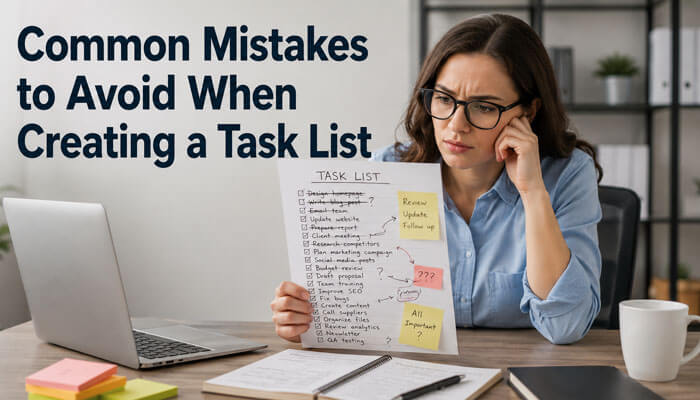
Common Mistakes to Avoid When Creating a Task List
1. Writing Vague Tasks
Avoid tasks like:
- Work on business
- Study
- Exercise
- Improve website
Use clear tasks like:
- Write 500 words for a business plan.
- Study Chapter 2 for 45 minutes.
- Walk 30 minutes at 7 AM.
- Update homepage meta description.
2. Adding Too Many Tasks
A long task list can feel stressful. Focus on the most important tasks first.
3. Not Setting Deadlines
Without deadlines, tasks are easy to postpone.
4. Ignoring Priority
If all tasks look equal, you may waste time on low-value work.
5. Not Reviewing Progress
A task list must be updated regularly to stay useful.
6. Not Breaking Big Tasks Down
Large tasks create confusion. Break them into smaller steps.
7. Forgetting Dependencies
Some tasks must happen before others. Ignoring dependencies can delay the entire goal.
8. Not Planning for Blockers
Unexpected problems can stop progress. Add possible risks and solutions to your task list.
Best Practices for Creating an Effective Task List
To create a strong task list, follow these best practices:
- Start with a clear goal.
- Use SMART goal planning.
- Break the goal into milestones.
- Use a Work Breakdown Structure for bigger goals.
- Write tasks as clear actions.
- Prioritize important tasks.
- Set realistic deadlines.
- Add task dependencies.
- Use time blocking or timeboxing.
- Track progress regularly.
- Remove tasks that do not support the goal.
- Keep the list simple and easy to follow.
- Review the list daily or weekly.
- Assign responsibility when working with a team.
- Plan for risks and blockers.
Expert Tips for Creating Effective Task Lists
Productivity experts often recommend focusing on a small number of high-impact tasks rather than creating extremely long task lists. Start each day by identifying the most important task that moves you closer to your goal. Breaking difficult tasks into smaller actions can reduce procrastination and make progress easier. Regular reviews also help ensure that your priorities remain aligned with your objectives.
Printable Task List Template
Goal Task List Template
| Goal | |
| Final outcome | |
| Goal deadline | |
| Main milestones | |
| Most important task | |
| Resources needed | |
| Possible blockers | |
| Progress review date |
Task Planning Table
| No. | Task | Subtask | Priority | Deadline | Resource Needed | Status |
| 1 | High | Pending | ||||
| 2 | Medium | Pending | ||||
| 3 | Low | Pending | ||||
| 4 | High | Pending | ||||
| 5 | Medium | Pending |
Final Checklist for Creating an Effective Task List
Before using your task list, check these points:
| Question | Yes/No |
| Is my goal clear? | |
| Is my goal measurable? | |
| Have I broken the goal into milestones? | |
| Have I created smaller tasks and subtasks? | |
| Have I identified task dependencies? | |
| Are my tasks specific? | |
| Have I prioritized the tasks? | |
| Does each task have a deadline? | |
| Have I added resources? | |
| Have I planned for blockers? | |
| Can I track progress? | |
| Have I removed unnecessary tasks? | |
| Will I review the list regularly? |
Conclusion
To explain the process of creating an effective list of tasks to accomplish a goal, the main idea is simple: turn a big goal into small, clear, prioritized, and time-based actions. Start by defining your goal, understanding the final outcome, breaking it into milestones, listing all required tasks, arranging them in the right order, adding dependencies, setting deadlines, identifying resources, tracking progress, and reviewing the list regularly.
A good task list gives direction, reduces confusion, and helps you stay consistent. It turns planning into action and action into achievement. Whether your goal is personal, academic, professional, or business-related, an effective task list helps you move forward with confidence.
In the end, the best way to explain the process of creating an effective list of tasks to accomplish a goal is to show how each small task supports the final result. When every action has a purpose, priority, deadline, and progress status, the goal becomes easier to manage and complete successfully.
Explain the process of creating an effective list of tasks to accomplish a goal. FAQs
1. How do you explain the process of creating an effective list of tasks to accomplish a goal?
To explain the process of creating an effective list of tasks to accomplish a goal. Start by defining the goal clearly, breaking it into milestones, listing all required tasks, prioritizing important actions, setting deadlines, adding resources, tracking progress, and reviewing the list regularly.
2. Why is creating a task list important for achieving a goal?
Creating a task list is important because it turns a large goal into smaller, manageable actions. It helps you stay organized, focus on high-priority tasks, avoid confusion, track progress, and complete the goal step by step.
3. What should an effective task list include?
An effective task list should include specific tasks, subtasks, priorities, deadlines, required resources, task dependencies, responsibilities, and progress status. These elements help make the goal easier to manage and complete.
4. How do you prioritize tasks when working toward a goal?
You can prioritize tasks by identifying which actions are urgent, important, or directly connected to the final goal. Methods such as the Eisenhower Matrix, ABC method, Pareto Principle, and time blocking can help organize tasks more effectively.
5. How often should you review your task list?
You should review your task list daily for short-term goals and weekly for larger goals. Regular review helps you update deadlines, remove unnecessary tasks, solve blockers, and stay focused on the final outcome.
