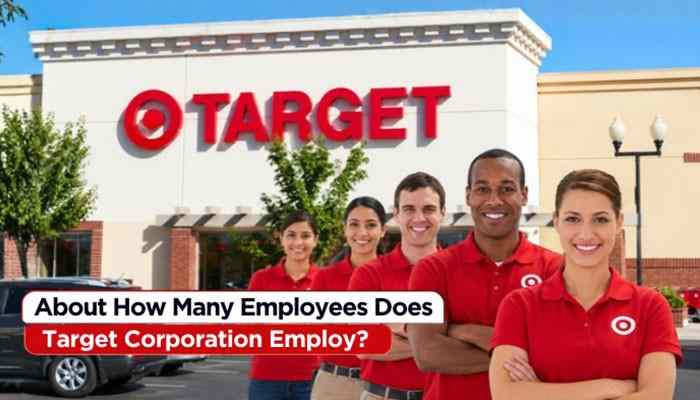

If you are asking, About how many employees does Target Corporation employ?, the latest annual filing gives a clear answer: approximately 415,000 employees as of January 31, 2026. This includes full-time, part-time, and seasonal team members. Target reported the figure in its fiscal 2025 Form 10-K, which covers a financial year that ended in early 2026.
You may have seen other websites give an answer of 440,000. That number was correct for an earlier reporting date: February 1, 2025. Both figures come from official records, but they describe different points in time. This is why an employee number needs a date beside it, especially when you use it in a school project, business report, or company profile.
This guide explains Target’s employee count, how it has changed, and what the total actually means. It also covers the company’s main career areas, seasonal employment, international support teams, and ways to check workforce information yourself. The goal is simple: Help you understand the answer without getting lost in business terms or outdated statistics.
About How Many Employees Does Target Corporation Employ in 2026?
The latest annual-report answer available for this guide is about 415,000 people, measured on January 31, 2026. It is a dated workforce snapshot, rather than a live count for every day of 2026.
For a short school or research answer, write:
Target Corporation reported approximately 415,000 employees at the end of its fiscal 2025 financial year.
Keep the measurement date nearby when accuracy matters.
Think of an employee count like a class attendance sheet. It tells you how many people belong to the group at a particular time. It does not tell you how many people joined or left during the entire year.
The same rule applies to large businesses. An annual workforce total is useful, but it cannot answer every question about hiring, working hours, or staffing at individual locations.
Target Employee Count at a Glance
| Question | Answer |
| Latest annual workforce figure | Approximately 415,000 |
| Measurement date | January 31, 2026 |
| Reporting period | Fiscal 2025 |
| Employment types included | Full-time, part-time, and seasonal |
| Previous annual snapshot | Approximately 440,000 |
| Previous measurement date | February 1, 2025 |
Sources: Target’s fiscal 2025 and fiscal 2024 business disclosures.
Why Do Some Websites Say Target Has 440,000 Employees?
An older number can remain online long after a newer report becomes available.
A website might publish a company profile once and update only selected sections later. Its headline could mention 2026 while its employee figure still comes from an earlier annual report.
Another source might label the number by publication year instead of financial year. This can make two accurate records appear to disagree.
For example, Target’s fiscal 2024 report gives approximately 440,000 employees on February 1, 2025. Its fiscal 2023 report gives approximately 415,000 on February 3, 2024.
Before using any company workforce figure, check:
- The measurement date: When were the employees counted?
- The reporting period: Which financial year does the report cover?
- The definition: Does the total include part-time or seasonal workers?
- The source: Is it an official disclosure or a copied statistic?
A recent page date alone does not prove that every fact on the page is current. The date attached to the employee count matters more.
Target’s Employee Count Over Recent Years
Target’s investor overview provides a useful five-year comparison.
| Target fiscal year | Reported team members |
| 2021 | 450,000 |
| 2022 | 440,000 |
| 2023 | 415,000 |
| 2024 | 440,000 |
| 2025 | 415,000 |
These are company-reported fiscal-year figures. Target’s fiscal-year labels do not necessarily match the calendar year in which the final measurement falls.
The table shows why one old statistic should not become a permanent description of the company.
It also shows that a workforce can rise in one period and fall in another. A company does not always follow a straight path of adding employees every year.
However, the table does not explain each change by itself. Understanding the reasons would require additional evidence about hiring, departures, seasonal staffing, and business decisions.
How Much Did the Latest Reported Total Change?
Using the two latest annual snapshots, the calculation is:
440,000 − 415,000 = 25,000 fewer employees
The percentage change is:
25,000 ÷ 440,000 × 100 = approximately 5.7%
These are calculations from Target’s published figures.
The result describes a net change. It does not prove that 25,000 people were laid off.
To understand the difference, imagine a business starts with 100 employees. During the year, 20 leave and 15 join. It finishes with 95 employees, even though 35 separate employment changes occurred.
An ending total shows the result of those movements. It does not show every movement.
What Does Target Mean by “Team Members”?
Target uses team members to refer to its employees. Its latest annual count combines several employment types.
This wording can confuse readers who expect company reports to use only the word employees.
When comparing sources, look at the meaning behind the label. A company may use terms such as staff, associates, colleagues, or team members for people it employs.
The more important questions are:
- Who is included?
- Who is excluded?
- When was the total measured?
- Is the number rounded?
Understanding those details helps you compare businesses fairly.
Full-Time, Part-Time, and Seasonal Employees Explained
These categories describe different working arrangements. They should not be treated as identical.
Full-Time Employees
Full-time employees generally work a regular schedule that meets their employer’s full-time definition.
The label does not tell you their exact job, wage, or weekly hours. Those details depend on the position and applicable rules.
Part-Time Employees
Part-time employees generally work fewer hours than a full-time schedule.
A part-time employee is still an employee. Someone working a shorter schedule can therefore be included in a company’s headcount.
Seasonal Employees
Seasonal employees work during periods when a business needs extra help.
For retailers, busy shopping periods can create temporary demand for more workers. Seasonal jobs may have an expected end date, although the terms of each role differ.
Why the Distinction Matters
A total employee count does not equal a total number of full-time jobs.
For example, a hypothetical business with 100 employees might employ 40 full-time workers and 60 part-time workers. Its headcount would still be 100.
Readers should therefore avoid describing Target’s entire workforce as full-time staff.
Headcount Versus Full-Time Equivalent: A Simple Example
Headcount counts people. Full-time equivalent, often shortened to FTE, measures working time against a chosen full-time schedule.
Here is an example using a hypothetical 40-hour week:
| Worker | Weekly hours | Headcount | Full-time equivalent |
| Employee A | 40 | 1 | 1.0 |
| Employee B | 20 | 1 | 0.5 |
| Employee C | 20 | 1 | 0.5 |
| Total | 80 | 3 | 2.0 |
Three people provide the same total hours as two people working 40 hours each.
This example is not a description of Target’s schedules. It simply shows why employee totals and labor capacity are different measures.
When researching a company, do not convert headcount into FTE unless you have reliable working-hours data.
Where Do Target Employees Work?

Target’s career pages organize opportunities across stores, supply chain facilities, corporate teams, and global offices. Its corporate headquarters is in Minneapolis, Minnesota.
A retailer’s workforce extends beyond the people shoppers see at checkout.
| Career area | Broad purpose |
| Stores | Serve shoppers and support store operations |
| Supply chain | Move products through the distribution network |
| Corporate | Support business planning and specialist functions |
| Global offices | Support international business activities |
These broad categories reflect Target’s career-area descriptions. They are not a numerical breakdown of its workforce.
Store Careers
Target’s store career information emphasizes customer service and the shopping experience.
For job seekers, the practical step is to read the actual vacancy. A broad category such as store job does not tell you whether the role involves checkout, merchandise, leadership, or another responsibility.
Check the schedule, physical duties, location, and employment type before applying.
Supply Chain Careers
Target describes supply chain work as helping products reach store shelves and customers’ doorsteps.
These roles support the movement of goods behind the shopping experience.
Someone interested in this area should review each job’s requirements carefully. Different positions can involve different equipment, training, shift patterns, and levels of responsibility.
Corporate Careers
Target’s corporate career pages describe work that supports stores, operations, product development, and business growth.
Corporate employment is one part of the larger organization.
A companywide workforce figure should therefore not be presented as the number of people working at headquarters.
Does Target Employ People in India?
Yes. Target’s official recruitment materials describe its Bengaluru operation as part of its global team, supporting company strategy and operations.
For Indian readers, this distinction is useful. A U.S. retail brand can offer business or technology careers in India without operating a matching local network of consumer stores.
However, avoid turning an older recruitment description into a precise current employee count for India.
A reliable country-specific total needs its own dated disclosure. A global workforce number cannot tell you exactly how many people work in one country.
If you are looking for opportunities in Bengaluru, review Target’s official India vacancies. The listings show available roles, but their number should not be treated as the size of the existing workforce.
Are Contractors Included in Target’s Employee Count?
Target’s annual filing discusses independent contractors separately and identifies its Shipt subsidiary as a notable example.
An employee and an independent contractor are different categories. Do not add contractor numbers to the employee total unless a source clearly supports that calculation.
The same caution applies to people employed by suppliers, delivery partners, or outside service providers.
Someone can help a business operate without being directly employed by that business.
Consider a hypothetical retailer that hires an outside cleaning company. The cleaners may work inside its stores, but their employer could be the cleaning company.
This is why people working around the business can be a much broader group than company employees.
Why Does Target’s Workforce Change During the Year?
Target states that employment levels peak during the holiday season.
That makes the measurement date especially important.
A count taken during a busy shopping period may differ from a count taken after that period ends.
More generally, a retailer’s workforce can change because of:
- New hiring and employee departures
- Temporary contracts starting or ending
- Changes in customer demand
- Store or facility openings and closures
- Adjustments to business operations
These are possible influences, not a proven explanation for Target’s latest annual change.
Good reporting separates a measured fact from an explanation. If the evidence shows only the employee total, the article should not invent a reason for every increase or decrease.
Does a Lower Employee Count Mean Target Is Struggling?

A workforce decrease alone cannot answer that question.
A smaller total could have several causes, and some changes may affect one business area more than another.
To assess business performance, researchers would need additional information, such as:
- Sales trends
- Operating results
- Store activity
- Management’s explanation
- Changes in working hours or staffing needs
Even then, the findings need context.
For example, a company could reduce one type of role while hiring for another. Its total might fall while some departments expand.
Likewise, a rising employee count does not automatically prove that a company is healthy.
The careful approach is to describe the workforce trend first, then investigate the reasons using separate evidence.
How Many Employees Work at Each Target Store?
Target’s investor overview lists 1,995 U.S. stores for fiscal 2025.
However, dividing the company’s total employees by its stores would not produce a reliable store staffing figure.
That calculation would mix store employees with workers in other parts of the business.
It would also hide differences between locations.
A larger store may have different staffing needs from a smaller one. Opening hours, customer traffic, services, and working schedules can also affect staffing.
If you need information about one location, use location-specific evidence. A companywide ratio cannot show how many employees are working in that store, especially on a particular shift.
What Should Job Seekers Learn From Target’s Workforce Size?
A large workforce shows the scale of an employer. It does not tell you whether a particular vacancy is suitable for you.
Before applying, focus on the details that affect your daily experience.
Review the Job Description
Check the duties and required skills. Make sure you understand what the role involves rather than relying on its title.
Check the Schedule
Look for information about shifts, weekends, expected availability, and whether the job is seasonal.
Review Pay and Eligibility
Read the posted compensation information and any benefit conditions. Ask questions when something is unclear.
Confirm the Location
A corporate role, store role, and supply chain role may have very different workplaces and travel needs.
Apply Through Official Channels
Target’s careers information directs applicants to its official careers website or Workday application system.
Use the official listing as your main reference. It is more useful for your decision than a general article about company size.
What Pay and Benefits Does Target Report?
Target’s latest annual filing describes a starting wage range of $15 to $24 per hour for U.S. hourly store and supply chain team members. Benefit eligibility varies by factors including employment status, location, and tenure.
A published range does not mean every applicant receives the highest amount.
For any vacancy, check:
- The pay range for that specific role
- Whether hours are fixed or variable
- Which benefits apply
- When eligibility begins
- Whether location changes the terms
Employee count and compensation answer different questions. A company can employ many people while offering different pay arrangements across jobs.
How to Verify Target’s Employee Count Yourself
You do not need a paid database to check the basic workforce figure.
1. Start With Target’s Investor Website
Find the annual reports section and select the relevant financial year.
2. Open the Business Section
Look for a heading such as Human Capital Management.
3. Search Within the Page
Use your browser’s find function for team members, employees, or employed.
4. Record the Complete Fact
Copy the approximate number, measurement date, and employment categories into your notes.
5. Compare the Previous Report
Use the same definition and equivalent reporting period.
6. Keep the Source Link
A statistic is easier to verify when readers can reach the original disclosure.
Target also makes its filings available through the SEC.
Conclusion
The answer to About how many employees does Target Corporation employ? should always include a reporting date. Use the latest verified annual snapshot for a current company overview and older snapshots for historical comparisons.
Understanding who is counted matters just as much as knowing the total. Separate employees from contractors, headcount from working hours, and companywide figures from local staffing. Those distinctions turn a simple statistic into accurate, useful information.
About How Many Employees Does Target Corporation Employ? FAQs
1. Is 440,000 Still the Correct Answer?
It is correct for February 1, 2025. Use it when discussing that reporting date rather than presenting it as the newest annual figure.
2. Why Does the Fiscal Year Differ From the Calendar Year?
A financial year can end after December 31. Always read the stated ending date instead of assuming the year label means a calendar-year measurement.
3. Does Employee Count Show How Many Jobs Are Available?
No. Existing employees and vacant positions are different measures. Check current job listings to find advertised opportunities.
4. Can the Annual Number Tell Me Today’s Exact Workforce?
No. It is a dated snapshot. Hiring and departures can occur after the reporting date.
5. Does a Workforce Decline Equal the Same Number of Layoffs?
No. A net decrease can reflect several kinds of employment changes. Separate evidence is needed to identify layoffs.