


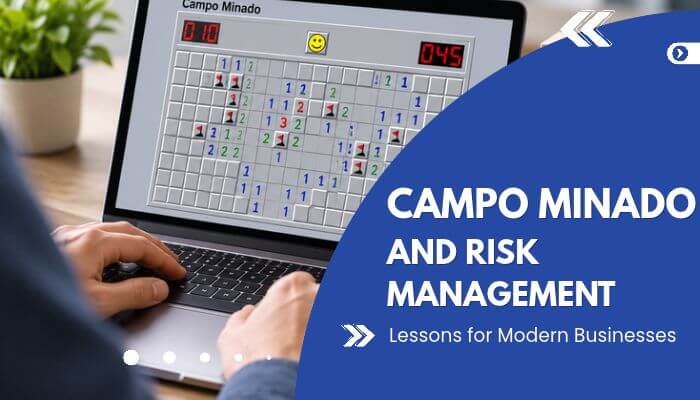

Campo Minado, better known internationally as Minesweeper, is a logic game built around hidden risks, visible clues, and calculated decisions. Its core mechanics closely reflect how businesses manage uncertainty, assess threats, and make decisions with limited information.
Players reveal clues gradually, identify possible dangers, and choose each move based on the evidence available. In business, the stakes are higher, but the principle is similar. Companies must evaluate competitors, customers, suppliers, technology, markets, and regulations without knowing exactly what will happen next.
Campo Minado shows why effective risk management is not about eliminating uncertainty. It is about identifying exposure, separating facts from assumptions, controlling major risks, and adjusting decisions as new information appears.
Quick Answer
Campo Minado is a useful analogy for business risk management because both involve making decisions with incomplete information.
The main lesson is simple: identify risks, study the available evidence, separate facts from assumptions, control major exposures, take measured action, and reassess decisions when new information appears.
Key Takeaways
- Campo Minado shows how decisions can be made with incomplete information.
- Hidden mines represent unknown threats, while number clues resemble business data and risk indicators.
- Flags reflect identified risks that require monitoring or control.
- Small tests and pilot projects can reduce uncertainty before larger investments.
- Risk appetite helps businesses decide how much uncertainty they are willing to accept.
- KPIs and KRIs can reveal both performance and emerging business risks.
- Cybersecurity, suppliers, and third-party relationships require continuous risk monitoring.
- Campo Minado also shows why businesses should reassess decisions when new evidence appears.
What Is Campo Minado?
Campo Minado is the Portuguese name commonly used for Minesweeper, the classic grid-based logic puzzle. Microsoft included MineSweeper in the Microsoft Entertainment Pack for Windows announced in 1990, helping the game become one of the most recognizable Windows puzzles.
In Campo Minado, players reveal squares while avoiding hidden mines. Numbers show how many mines are located in adjacent cells, helping players identify safer moves and possible dangers.
Reveal → Observe → Deduce → Mark Risk → Make the Next Move
Why Campo Minado Is Relevant to Business Risk Management
Campo Minado reflects an important business reality: companies often make decisions without complete information. Customer demand, competitors, suppliers, technology, cybersecurity, regulations, and markets can all change, so businesses must assess available evidence and manage uncertainty carefully.
| Campo Minado | Business Equivalent |
|---|---|
| Hidden mines | Unknown threats |
| Numbers | Data and risk indicators |
| Covered squares | Uncertainty |
| Flags | Identified risks |
| Safe squares | Lower-risk opportunities |
| Opening a square | Making a decision or testing an idea |
| Larger revealed area | Better information |
| Mine concentration | Higher exposure |
| Clearing the board | Reaching objectives while controlling risk |
ISO 31000 supports this broader approach by integrating risk management with decision-making and organizational objectives, while COSO connects enterprise risk management with strategy and performance.
Better information can improve decisions made under uncertainty.
Modern Risk Management in 2026
Modern risk management now extends beyond financial exposure. Campo Minado offers a useful comparison because businesses must identify hidden threats while dealing with limited information. Key areas include cybersecurity, supply chains, artificial intelligence, data privacy, third-party vendors, compliance, reputation, market disruption, and operational resilience.
ISO 31000:2018 remains the current published international risk-management standard in 2026, while Edition 3 is still under development. NIST Cybersecurity Framework 2.0 also gives greater attention to governance and supply-chain risk and is designed for organizations of all sizes.
NIST further strengthened system-level risk planning in June 2026 with SP 800-18 Rev. 2, covering security, privacy, and cybersecurity supply-chain risk management.
Lesson 1: Identify the Mines Before Making the Move
The first lesson from Campo Minado is to identify potential danger before acting. Businesses should assess major exposures before committing money, resources, or technology to an important decision.
Common business risks include:
- Financial and market risk
- Operational risk
- Cybersecurity risk
- Supply-chain risk
- Regulatory and legal risk
- Technology risk
- Reputational risk
- Customer concentration risk
- Strategic risk
For example, a new product launch may face weak demand, unexpected production costs, supplier delays, software problems, competitive pressure, or regulatory restrictions. Identifying these risks does not mean they will happen. It means preparing for possibilities that could affect the outcome.
Lesson 2: Separate Evidence From Assumptions
In Campo Minado, a revealed number provides factual information about nearby mines, but it may not immediately show their exact locations. Business data works in much the same way.
Suppose monthly sales fall by 15%. The decline is measurable, but the cause could involve:
- Lower demand
- Higher prices
- Seasonal changes
- New competitors
- Website problems
- Supply shortages
- Reduced advertising
Managers should separate information into three categories.
What Is Known
Facts supported by reliable evidence.
What Is Probable
Conclusions strongly supported by available information.
What Is Assumed
Explanations that still require testing or evidence.
This distinction prevents an untested assumption from being treated as a confirmed fact.
Probability vs Certainty: A Critical Campo Minado Business Lesson
A major principle of Campo Minado is distinguishing certainty from probability. Some moves follow directly from available clues, while others involve uncertainty.
Business decisions can similarly rely on:
- Confirmed evidence
- Statistical probability
- Expert judgment
- Assumptions
- Speculation
For example:
- Confirmed: Revenue declined 12% last quarter.
- Probable: Lower customer retention contributed to the decline.
- Assumption: A competitor caused the entire decline.
Strong decision-making requires managers to know which statements are proven, which are probable, and which still require investigation.
Lesson 3: Use Small Decisions to Reveal More Information
Campo Minado rewards gradual progress because each successful move reveals information that can guide the next decision. Businesses can apply the same principle through controlled experiments.
Useful approaches include:
- Pilot programs
- Minimum viable products
- A/B testing
- Prototype testing
- Regional launches
- Small advertising campaigns
- Short supplier trials
A retailer considering 100 new locations, for example, could first test three stores to measure demand, pricing, staffing needs, inventory turnover, and operating costs. The pilot does not remove uncertainty, but it reduces exposure before a larger investment.
Lesson 4: Not Every Risk Deserves the Same Response
Business risks differ in both likelihood and impact. Some may be frequent but minor, while others are unlikely yet potentially severe.
Companies can prioritize them with a simple risk matrix.
Campo Minado Risk Matrix for Businesses
| Risk | Likelihood | Impact | Priority | Possible Response |
|---|---|---|---|---|
| Critical supplier failure | Medium | High | High | Develop backup suppliers |
| Major cyberattack | Medium | Very High | Critical | Strengthen security and response plans |
| Minor pricing error | Low | Low | Low | Monitor |
| Loss of major customer | Medium | High | High | Diversify customer base |
| Website outage | Medium | Medium | Medium | Build redundancy and recovery plans |
Businesses generally respond by avoiding, reducing, transferring, or accepting risk, depending on its potential impact and the organization’s tolerance.
Lesson 5: Understand Risk Appetite
Businesses cannot pursue growth without accepting some uncertainty. Risk appetite defines how much risk an organization is prepared to accept while pursuing its objectives.
A technology startup may tolerate greater product and market uncertainty in pursuit of growth, while a regulated bank may have far less tolerance for risks involving deposits, cybersecurity, or compliance.
Companies should consider:
- Financial capacity
- Business objectives
- Legal obligations
- Reputation
- Stakeholder impact
- Industry conditions
- Potential downside
Risk vs Reward: Businesses Should Not Avoid Every Risk
Risk management should not mean avoiding every uncertain opportunity. Campo Minado reflects the same principle: progress requires taking measured risks based on the information available.
Businesses that avoid all uncertainty may also miss:
- New products
- New markets
- Innovation
- Technology investments
- Partnerships
- Expansion
ISO risk-management principles recognize that uncertainty can create both threats and opportunities. Businesses should therefore compare potential downside with expected value before making major decisions.
| Situation | Risk | Potential Reward |
|---|---|---|
| Enter established market | Moderate | Moderate |
| Launch experimental technology | High | Potentially high |
| Improve existing product | Low–Medium | Moderate |
| Depend on unstable supplier | High | Limited |
| Run controlled pilot | Limited | Valuable information |
Strong risk management helps a business decide which risks are acceptable, which require controls, and which should be avoided.
Campo Minado do Google: What It Can Teach About Scaling Risk
Campo Minado do Google lets users play the classic logic game through Google Search, with difficulty levels that change the board size and number of mines.
As the board grows, players must process more information and manage more possible hazards. Businesses face a similar challenge as they scale.
A small startup may have:
- One product
- A small team
- Few suppliers
- Limited technology systems
A larger company may manage:
- Thousands of employees
- Multiple markets
- Hundreds of suppliers
- Cloud infrastructure
- International regulations
- Large customer databases
Growth expands the organization’s risk surface. Controls, monitoring, cybersecurity, and governance must therefore develop alongside the business.
Campo Minado Online: Scenario Planning and Business Decisions
Versions of Campo Minado available through browsers and mobile apps often include different difficulties, custom boards, statistics, timed challenges, and other changing conditions.
These variations provide a useful comparison with scenario planning. Businesses cannot predict every future event, but they can prepare for several realistic outcomes.
Scenario A
Demand rises by 20%.
Scenario B
Demand falls by 20%.
Scenario C
A critical supplier becomes unavailable.
Scenario D
Advertising costs rise sharply.
Scenario E
A major competitor cuts prices.
Management can then ask:
- How would revenue change?
- What happens to cash flow?
- Which operations become vulnerable?
- What response would be required?
Scenario planning does not predict exactly what will happen. It helps businesses prepare for different outcomes before problems occur.
Jogar Campo Minado: Activity Is Not the Same as Good Decision-Making
People who regularly play Campo Minado quickly see that faster movement does not always produce better results. Acting before interpreting available clues can lead to an immediate mistake.
Businesses can make the same error by confusing activity with progress. Examples include:
- Launching more campaigns
- Hiring more employees
- Adding unnecessary features
- Opening more locations
- Increasing advertising spending
Before making a significant move, managers should ask:
- What evidence supports the decision?
- Which assumptions are being made?
- What could go wrong?
- How serious is the downside?
- Can the decision be reversed?
- Can the idea be tested first?
The goal is not slower decision-making. Small, reversible choices can often be made quickly, while large and difficult-to-reverse commitments deserve deeper analysis.
Como Jogar Campo Minado: Rules and Business Meaning
Understanding how to play Campo Minado helps explain why the game works as a useful business-risk analogy. Players reveal safe squares, interpret numerical clues, mark suspected mines, and adjust their next move as new information appears.
Numbers from 1 to 8 show how many mines are located in surrounding horizontal, vertical, and diagonal squares. The goal is to reveal every safe space without selecting a mine.
Basic Campo Minado Strategy
A beginner can follow these principles:
- Reveal a square to begin.
- Study the numbers carefully.
- Count nearby unopened spaces.
- Identify possible mine locations.
- Flag suspected dangers.
- Open squares that logic indicates are safe.
- Reassess the board after each new clue.
The basic mechanics of Campo Minado also reflect how businesses gather evidence, identify threats, and act under uncertainty.
Reveal Squares → Gather Information
Businesses reduce uncertainty by collecting useful information through:
- Customer research
- Financial reports
- Market analysis
- Employee feedback
- Supplier data
- Competitor analysis
- Cybersecurity monitoring
Read Numbers → Interpret Information
Collecting data is only the first step. Like clues in Campo Minado, business information becomes valuable when managers interpret what it means and how it affects a decision.
Flag Mines → Record Risks
Known and suspected risks should be documented, monitored, and assigned appropriate controls before they create larger problems.
Clear Safe Spaces → Pursue Opportunities
Risk management should support action rather than prevent it. Campo Minado demonstrates this principle by rewarding progress based on evidence while keeping potential dangers visible.
Lesson 6: Understand KPIs and KRIs
Numbers in Campo Minado warn players about nearby hazards. Businesses also need indicators that reveal both performance and growing exposure.
KPI — Key Performance Indicator
A KPI measures business performance, such as:
- Revenue
- Profit margin
- Customer retention
- Order fulfillment rate
KRI — Key Risk Indicator
A KRI signals increasing exposure to a potential problem.
| Business Area | KPI | Possible KRI |
|---|---|---|
| Sales | Revenue | Customer concentration |
| Operations | Orders fulfilled | Supplier delays |
| Finance | Profit margin | Falling cash reserves |
| Cybersecurity | System availability | Failed login attempts |
| Customer service | Resolution rate | Rising complaints |
A business can report strong KPIs while serious risks grow underneath. Revenue may rise, for example, while most of it depends on one customer.
Lesson 7: Watch for Concentration Risk
Dependence on a single customer, supplier, market, platform, employee, technology provider, product, or sales channel can create significant vulnerability.
If 70% of revenue comes from one client, current performance may appear strong, but losing that account could create a major financial shock. Diversification cannot eliminate risk, but it can reduce the impact of one failure.
Lesson 8: Build Controls Before Something Goes Wrong
Flags in Campo Minado mark possible danger before a player makes a costly move. Businesses use controls for the same preventive purpose.
Useful controls include:
- Access controls
- Approval limits
- Insurance
- Data backups
- Fraud monitoring
- Vendor reviews
- Multi-factor authentication
- Contract protections
- Disaster-recovery plans
Controls should match the level of risk. Too few can leave a business exposed, while excessive controls can increase cost and slow operations.
Cybersecurity Risk: The Modern Business Version of Hidden Exposure

Cybersecurity is a major business risk because modern organizations depend heavily on digital systems. Threats may include phishing, ransomware, credential theft, data breaches, cloud misconfiguration, unpatched systems, third-party vulnerabilities, and insider threats.
NIST Cybersecurity Framework 2.0 emphasizes that cybersecurity should be managed as an organizational risk, with governance involving management, IT, security teams, legal professionals, vendors, executives, and appropriate board oversight.
Supplier and Third-Party Risk: When Another Company’s Problem Becomes Yours
Suppliers, cloud platforms, payment processors, logistics companies, software vendors, and contractors can expose a business to risks outside its direct control.
Organizations should identify critical vendors, understand what data they can access, evaluate their security standards, prepare alternatives, and determine what happens if a supplier or service fails.
The principle is similar to Campo Minado: a danger does not have to be directly visible to create serious exposure.
Lesson 9: Update Decisions When New Information Appears
One new clue in Campo Minado can change how the surrounding board should be interpreted. Business strategies should also change when reliable evidence challenges earlier assumptions.
Companies should regularly reassess:
- Forecasts
- Budgets
- Pricing
- Products
- Suppliers
- Marketing
- Hiring
- Technology
- Investments
Continuing with an outdated decision simply because time or money has already been invested can increase losses. Risk management should remain dynamic.
Human Bias: When Managers Misread the Board
Reliable information can still lead to poor decisions when people interpret it badly. Human judgment therefore remains an important part of risk management.
Common biases include:
Confirmation Bias
Seeking evidence that supports an existing belief while overlooking conflicting information.
Overconfidence
Assuming forecasts or judgments are more reliable than the evidence supports.
Sunk-Cost Thinking
Continuing an unsuccessful project mainly because substantial resources have already been invested.
Recency Bias
Giving excessive importance to recent events.
Groupthink
Avoiding disagreement because a group prefers consensus.
Good decision-making requires people who are willing to question assumptions and reconsider conclusions when the evidence changes.
Lesson 10: Confidence Is Not Certainty
Experience with Campo Minado can increase confidence in recognizing patterns, but confidence should never be mistaken for certainty. Business forecasts require the same discipline.
Compare:
“Revenue will reach $10 million.”
with:
“Our base forecast is $10 million if customer retention, pricing, and market demand remain within expected ranges.”
The second statement is stronger because it identifies the assumptions behind the forecast. When those assumptions change, management can reassess the prediction instead of treating it as guaranteed.
Who Owns the Risk? Why Accountability Matters
Identifying a risk is only useful when someone is responsible for managing it. Organizations often assign a risk owner who monitors changes, maintains controls, reports status, escalates problems, and coordinates responses.
Responsibility may involve:
- Department managers
- Finance leaders
- Technology teams
- Compliance officers
- Executives
- Boards
Clear ownership prevents important risks from being overlooked because everyone assumes someone else is responsible.
Example of a Simple Business Risk Register
A risk register gives businesses a structured way to record, monitor, and manage important exposures.
| Risk | Likelihood | Impact | Owner | Mitigation | Status |
|---|---|---|---|---|---|
| Critical supplier failure | Medium | High | Operations | Secondary supplier | In progress |
| Customer data breach | Low–Medium | Very High | IT/Security | MFA, backups, monitoring | Active |
| Cash shortage | Medium | High | Finance | Rolling cash forecast | Active |
| Major customer loss | Medium | High | Sales | Customer diversification | In progress |
| Website outage | Medium | Medium | Technology | Redundancy and backups | Active |
More advanced registers may also track:
- Risk ID
- Category
- Probability
- Financial exposure
- Control owner
- Deadline
- Residual risk
- Review date
Campo Minado and Contingency Planning
Risk management should address both prevention and recovery. Businesses need plans for what happens when an important control fails or an unexpected disruption occurs.
Useful preparations include:
- Backup suppliers
- Emergency cash reserves
- Data backups
- Disaster-recovery plans
- Alternative work locations
- Incident-response plans
- Communication procedures
- Succession plans
For example, a company relying on one warehouse may use maintenance and security to reduce disruption risk while also preparing an alternative if that facility becomes unavailable.
What happens if the warehouse becomes unavailable anyway?
That question turns risk prevention into practical business continuity planning.
A Practical Campo Minado Framework for Business Decisions
Businesses can convert the game’s logic into a straightforward decision process.
| Step | Campo Minado Principle | Business Question |
|---|---|---|
| 1 | Understand the board | What objective are we pursuing? |
| 2 | Identify possible mines | What could prevent success? |
| 3 | Read the clues | What evidence do we have? |
| 4 | Separate fact from assumption | What remains uncertain? |
| 5 | Estimate exposure | What are the likelihood and impact? |
| 6 | Flag dangerous areas | Which risks require controls? |
| 7 | Make a measured move | What should we do next? |
| 8 | Reveal information | What did we learn? |
| 9 | Recalculate | Has the risk changed? |
| 10 | Continue or adjust | What should change next? |
The process can be summarized as:
Observe → Assess → Act → Learn → Reassess
Where the Campo Minado Comparison Stops Working
The analogy is useful, but real business risk is far more complex. Campo Minado operates with fixed rules and defined boundaries, while companies face changing customers, competitors, regulations, technologies, suppliers, and economic conditions.
Business risks can also interact and occur simultaneously. The comparison should therefore support understanding rather than replace formal risk-management methods.
Organizations needing structured risk management should use established approaches such as ISO 31000, COSO ERM, NIST frameworks, and relevant industry requirements.
What Entrepreneurs Can Learn From Campo Minado
Entrepreneurs frequently make decisions without complete information. They may not know which customers will buy, what price will work, which marketing channel will scale, or how quickly competitors will respond.
Waiting for perfect information can delay opportunity, while ignoring uncertainty can waste capital.
A practical approach is:
- Identify important unknowns.
- Test major assumptions.
- Limit initial exposure.
- Measure results.
- Adjust the strategy.
- Increase investment when evidence improves.
The strongest lesson is simple:
You do not need to understand the entire board before making your next move. You need enough reliable information to make that move intelligently.
Campo Minado vs Poor Risk Management
| Weak Approach | Better Approach |
|---|---|
| Avoid every risk | Decide which risks are acceptable |
| Rely entirely on instinct | Combine judgment with evidence |
| Make one large commitment | Use staged investment when possible |
| Ignore warning signals | Monitor KRIs |
| Assume forecasts are facts | State assumptions clearly |
| Depend on one supplier | Reduce concentration risk |
| Hide uncertainty | Communicate uncertainty clearly |
| Continue because money was spent | Reassess using current evidence |
| Treat cyber risk as IT-only | Connect it to enterprise risk |
| Identify risks without owners | Assign accountability |
Conclusion
The strongest companies do not succeed because they predict every threat. They succeed because they identify critical risks early, test assumptions, protect key dependencies, and adjust quickly when conditions change.
That is where Campo Minado becomes more than a game analogy. It reflects a core business reality: leaders rarely have perfect information, yet they still have to make consequential decisions.
The advantage belongs to organizations that can read the signals, control exposure, and move with confidence without mistaking confidence for certainty.
In business, the goal is not to avoid every mine. It is to build a system that keeps the company moving forward when the path is uncertain.
Frequently Asked Questions About Campo Minado
1. How does Campo Minado explain residual risk?
Campo Minado can illustrate residual risk as the uncertainty that remains even after known dangers are identified and controls are applied.
2. What does Campo Minado teach about risk velocity?
Campo Minado shows that some threats can create consequences immediately, similar to business risks that develop faster than others.
3. Can Campo Minado illustrate business stress testing?
Yes. Campo Minado can represent stress testing by showing how decisions change when risk levels, uncertainty, or difficult conditions increase.
4. How does Campo Minado relate to risk escalation?
Campo Minado demonstrates why warning signals should trigger stronger attention when potential exposure becomes more serious.
5. Can Campo Minado explain a risk heat map?
Campo Minado offers a simple analogy for risk heat maps, where businesses compare threats according to likelihood and potential impact.
6. What can Campo Minado teach about risk maturity?
Campo Minado highlights the value of developing consistent processes for identifying, assessing, monitoring, and responding to uncertainty.
7. How does Campo Minado relate to control effectiveness?
Campo Minado shows why identifying danger is not enough; businesses must also confirm that their controls actually reduce exposure.
8. Can Campo Minado explain risk aggregation?
Yes. Campo Minado can illustrate how several smaller exposures may combine to create a larger overall business risk.
