


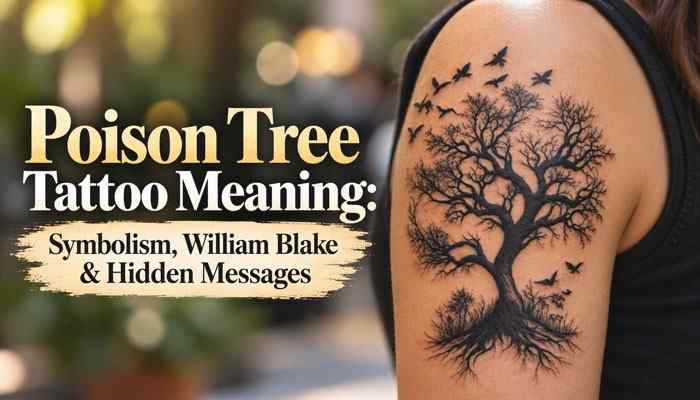

The poison tree tattoo meaning is often connected with hidden anger, resentment, betrayal, temptation, emotional consequences, and the choice between feeding destructive feelings or moving beyond them. The design can look dark and mysterious, but its symbolism is much deeper than a simple image of a twisted tree.
One of the strongest influences behind the poison tree tattoo meaning is William Blake’s 1794 poem A Poison Tree. In the poem, anger that is expressed comes to an end, while anger that remains hidden continues to grow. Blake turns that concealed emotion into a metaphorical tree that eventually produces a bright apple and leads to a disturbing final scene.
For some people, the poison tree tattoo meaning centers on revenge, resentment, or emotional damage. For others, the same tattoo represents surviving betrayal, leaving a toxic relationship, establishing healthier boundaries, or refusing to let bitterness control the future.
Roots, apples, branches, flowers, snakes, skulls, colors, and tattoo style can all change the final interpretation.
Quick Answer
The poison tree tattoo meaning commonly represents suppressed anger, resentment, betrayal, revenge, temptation, or the consequences of unresolved emotions.
When the tattoo is inspired by William Blake, the poison tree symbolizes anger that is hidden and repeatedly nurtured instead of being honestly addressed.
Modern designs can also give the poison tree tattoo meaning a more positive direction by representing healing, recovery, emotional awareness, survival, and the decision to stop feeding destructive patterns.
Key Takeaways
- The poison tree tattoo meaning is strongly associated with hidden anger and resentment.
- William Blake’s A Poison Tree provides the best-known literary foundation.
- Roots may symbolize the origin of emotional pain.
- The bright apple can represent temptation, revenge, deception, or consequences.
- Blake does not explicitly state that the foe eats a poisoned apple.
- Dead branches can symbolize grief, loss, or an ended chapter.
- Flowers and new leaves may represent healing and renewal.
- A snake can add temptation, danger, or biblical symbolism.
- Real poisonous trees can inspire botanical versions of the tattoo.
- The personal story behind the design ultimately determines its meaning.
What Does a Poison Tree Tattoo Mean?
The poison tree tattoo meaning usually begins with the idea that something harmful has been allowed to grow. A tree is especially powerful as a metaphor because growth happens slowly. A seed produces roots. Roots support a trunk. Branches spread outward. Eventually, the tree bears fruit.
As an emotional story, the process can become:
Conflict → Hurt → Resentment → Growth → Consequences
That progression explains why the poison tree is commonly connected with emotions or experiences that developed over time rather than appearing suddenly.
Common interpretations include:
- Suppressed anger
- Resentment
- Betrayal
- Revenge
- Emotional wounds
- Toxic relationships
- Inner conflict
- Deception
- Temptation
- Consequences
- Survival
- Personal boundaries
- Emotional healing
- Self-awareness
- Transformation
The poison tree tattoo meaning can therefore be negative, reflective, or even hopeful depending on the wearer’s intention.
Poison Tree Tattoo Meaning and William Blake
The strongest literary interpretation of the poison tree tattoo meaning comes from William Blake’s poem A Poison Tree. Blake was an English poet, engraver, artist, and printmaker. His Songs of Experience, which includes A Poison Tree, appeared in the late eighteenth century.
- The poem begins with two examples of anger.
- The speaker becomes angry with a friend and talks about it. The anger ends.
- He later becomes angry with an enemy but keeps the feeling hidden. Instead of disappearing, the wrath grows.
- Blake turns that concealed anger into a tree.
The speaker metaphorically waters the tree with fears and tears while giving it sunlight through smiles and deceptive behavior. Eventually, it produces a bright apple. The enemy sees the fruit, enters the garden at night, and is found beneath the tree the following morning.
This progression is central to understanding the poison tree tattoo meaning because the tree represents something destructive that becomes stronger when it is continually nurtured.
Friend vs Foe and the Meaning Behind the Tree
The contrast between the friend and enemy is one of the most important parts of the poem.
| Situation | Response | Result |
|---|---|---|
| Anger toward a friend | Anger is communicated | Wrath ends |
| Anger toward an enemy | Anger remains hidden | Wrath grows |
| Resentment continues | Fear, tears, smiles, and deception feed it | The tree develops |
| The tree bears fruit | The enemy sees the apple | Consequences become visible |
| The enemy enters the garden | He is later found beneath the tree | The conflict reaches a dark conclusion |
The poem therefore does not simply say that anger is bad. It contrasts expressed anger with concealed resentment.
For someone interested in the poison tree tattoo meaning, this can make the design a reminder about emotional honesty, communication, and the danger of allowing bitterness to become deeply rooted.
The Original Title and Its Deeper Meaning
An earlier manuscript version of Blake’s poem carried the title “Christian Forbearance.” That detail gives the poison tree tattoo meaning another layer.
Forbearance can suggest patience, restraint, or tolerance. However, Blake complicates that idea because the speaker does not actually resolve his resentment. Instead, the anger remains hidden beneath smiles and outward calm.
This creates a powerful distinction:
Restraint is not always the same as emotional resolution.
A poison tree tattoo inspired by this interpretation may represent:
- Emotional awareness
- Honest communication
- Hidden resentment
- Unresolved conflict
- False appearances
- Breaking unhealthy emotional patterns
Poison Tree Tattoo Meaning of the Apple
The apple is one of the most important symbols in the design. Many people assume that Blake explicitly describes a poisoned apple, but the poem itself only calls it an “apple bright.”
The enemy sees it and later appears beneath the tree, but Blake does not directly state that the foe eats the apple. For the poison tree tattoo meaning, the apple can nevertheless represent what hidden anger eventually produces.
Possible interpretations include:
- Temptation
- Revenge
- Consequences
- Deception
- Attractive danger
- A harmful choice
- Betrayal
- Something beautiful hiding something destructive
A bright apple against a dark tree can make this contrast especially powerful.
What Do the Roots Mean in a Poison Tree Tattoo?
Roots often deepen the poison tree tattoo meaning because they suggest where an emotional problem began.
Visible roots can symbolize:
- Childhood experiences
- Family history
- Trauma
- Past relationships
- Deep resentment
- Old memories
- Emotional foundations
- The origin of conflict
Deep, tangled roots can suggest that the emotional issue developed over many years. Broken or cut roots can communicate something very different. They may represent separating from the past, ending a toxic cycle, or refusing to let old experiences continue controlling the present.
Poison Tree Tattoo Meaning and Hidden Anger
Hidden anger is one of the most common interpretations. In Blake’s poem, anger expressed toward a friend ends, while concealed anger toward an enemy continues to grow. The poison tree tattoo meaning can therefore reflect the idea that unresolved emotions may become stronger when ignored.
The tree works as a visual metaphor:
Seed = conflict
Roots = hurt
Trunk = established resentment
Branches = emotional consequences spreading
Fruit = the final result
For some wearers, the tattoo acts as a warning not to continue feeding feelings that cause harm.
Poison Tree Tattoo Meaning and Resentment
Resentment is closely connected with the symbol because resentment typically builds over time. The tree may represent an emotion that started small but gradually became deeply established.
A person might choose the tattoo after:
- A painful breakup
- Broken trust
- Family conflict
- Betrayal by a friend
- Long-term resentment
- Personal regret
- A difficult life chapter
In this context, the poison tree tattoo meaning may represent recognition rather than celebration. The wearer may be acknowledging what resentment once became and choosing not to repeat the pattern.
Poison Tree Tattoo Meaning and Revenge
Revenge is another possible interpretation. Blake’s speaker does more than feel anger. He metaphorically feeds it while maintaining a friendly outward appearance.
That gives the poison tree tattoo meaning a darker side.
The tattoo can represent:
- Revenge
- The desire for justice
- Emotional retaliation
- The consequences of hatred
- The danger of becoming consumed by resentment
However, a poison tree does not have to celebrate revenge. It may instead serve as a warning about where revenge can lead.
Poison Tree Tattoo Meaning and Betrayal
A poison tree can strongly symbolize betrayal because it combines beauty with danger. A bright fruit growing from a dangerous tree creates a contrast between outward appearance and hidden reality.
The poison tree tattoo meaning may therefore relate to:
- Broken trust
- A deceptive friendship
- Manipulation
- An unhealthy romantic relationship
- Emotional betrayal
- Someone who appeared safe but caused harm
A cracked trunk, rotten apple, thorny branches, or hidden snake can reinforce this interpretation.
Poison Tree Symbol Chart
The poison tree tattoo meaning can change dramatically depending on the symbols included.
| Tattoo Element | Possible Meaning |
|---|---|
| Poison tree | Hidden anger, resentment, emotional toxicity |
| Deep roots | History, trauma, origins of emotional pain |
| Twisted branches | Inner conflict, hardship, complicated emotions |
| Bright apple | Temptation, consequences, deception |
| Rotten apple | Betrayal, corruption, damaged trust |
| Fallen apple | Release, consequences, rejected temptation |
| Bare branches | Grief, loneliness, exhaustion |
| Fresh leaves | Healing, renewal, recovery |
| Flowers | Transformation, beauty after hardship |
| Snake | Temptation, danger, deception |
| Skull | Mortality, destruction, consequences |
| Birds | Freedom, release, escape |
| Broken branch | Ending an unhealthy cycle |
| Thorns | Pain, protection, boundaries |
| Sunlight | Hope, clarity, recovery |
| Dark clouds | Emotional conflict |
These are possible interpretations rather than universal rules.
Poison Tree Tattoo Meaning With a Snake
Adding a snake can significantly change the poison tree tattoo meaning.
A snake may represent:
- Temptation
- Deception
- Danger
- Transformation
- Hidden threats
- Biblical symbolism
When combined with an apple and garden imagery, the snake can create a stronger connection with the Garden of Eden. However, snakes have many cultural meanings, so the full tattoo design should be considered before assigning one interpretation.
Is There a Garden of Eden Connection?
The tree, garden, fruit, secrecy, and destructive consequences in Blake’s poem naturally invite comparisons with the Garden of Eden. A modern tattoo can make this association even clearer by including a serpent.
Under this interpretation, the poison tree tattoo meaning might involve:
- Temptation
- Forbidden choices
- Knowledge
- Moral conflict
- Deception
- Consequences
That does not mean every poison tree tattoo is religious.
The biblical reading is only one possible layer.
Spiritual Poison Tree Tattoo Meaning
There is no single established spiritual definition. For some people, the poison tree tattoo meaning may represent an internal struggle between harmful and healthy forms of growth. A dark tree with new leaves can symbolize leaving destructive habits behind.
Spiritual interpretations may include:
- Self-awareness
- Forgiveness
- Release
- Transformation
- Renewal
- Breaking negative cycles
- Accepting difficult emotions
- Personal growth
Flowers, birds, sunlight, or new branches can make this message more visible.
Is the Poison Tree a Real Tree?
Blake’s tree is primarily a metaphor, but real poisonous trees do exist. One well-known example is the manchineel tree, scientifically known as Hippomane mancinella.
Its fruit and sap are highly toxic, and its fruit can resemble a small green apple. A realistic botanical design can therefore create a different poison tree tattoo meaning.
Instead of focusing on Blake’s resentment metaphor, a manchineel-inspired tattoo may symbolize:
- Hidden danger
- Natural defenses
- Survival
- Self-protection
- Strong boundaries
- Beauty concealing risk
The literary poison tree and a botanical poison tree should therefore not automatically be treated as identical symbols.
Can a Poison Tree Tattoo Mean Healing?
Yes.
The poison tree tattoo meaning can be transformed from something dark into a symbol of recovery.
Someone who has moved beyond anger or betrayal may use the tattoo to represent what they survived.
Healing imagery can include:
- Fresh leaves
- New branches
- Flowers
- Birds
- Sunlight
- Broken chains
- A fallen apple
- A cracked but living trunk
These elements change the story from:
“Resentment is growing.”
to:
“I stopped feeding it.”
Poison Tree Tattoo Meaning After a Toxic Relationship
The design can be especially meaningful after leaving an unhealthy relationship.
In that context, different parts of the tree can tell the story.
- Roots may represent shared history.
- Thorns can represent painful experiences.
- A cracked trunk may symbolize broken trust.
Branches may represent how the relationship affected other areas of life.
- Fruit can symbolize the consequences.
- Falling leaves may represent letting go.
- New growth can represent recovery.
For this interpretation, the poison tree tattoo meaning becomes less about another person and more about the wearer’s transformation afterward.
What Does the Ending of A Poison Tree Mean?
The ending gives the tattoo symbolism additional depth. The speaker finds his enemy beneath the tree and reacts with satisfaction.
This suggests that the emotional problem is no longer simply anger. The resentment has developed to the point where another person’s downfall becomes rewarding.
For the poison tree tattoo meaning, the final scene may represent:
- Revenge reaching its conclusion
- The cost of resentment
- Schadenfreude
- Recognition of darker emotions
- The danger of letting hatred shape behavior
A healing-focused tattoo can deliberately reverse this outcome. An untouched apple, broken branch, flying bird, or new leaves can symbolize choosing a different path.
Popular Poison Tree Tattoo Designs
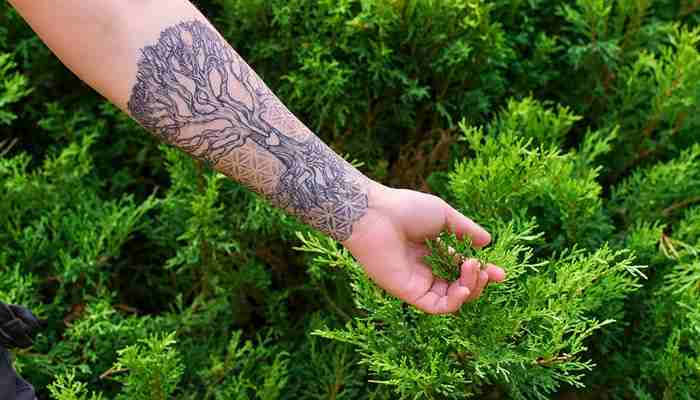
Black and Grey Poison Tree
Black-and-grey designs emphasize darkness, texture, and twisted branches.
This style works well when the poison tree tattoo meaning involves:
- Betrayal
- Grief
- Loss
- Resentment
- Memory
- Mortality
Poison Tree With a Red Apple
A bright apple against dark branches creates a strong focal point.
It may represent:
- Temptation
- Anger
- Revenge
- Danger
- Consequences
Poison Tree With Exposed Roots
Visible roots emphasize the origin of emotional pain. This style works well when the tattoo represents family history, trauma, old relationships, or something deeply rooted in the past.
Dead Poison Tree Tattoo
A dead tree may symbolize:
- Emotional exhaustion
- Loss
- An ended relationship
- A difficult chapter
- Something harmful that no longer has power
A dead tree does not always symbolize defeat.
It can represent the end of the poison.
Poison Tree With Flowers
Flowers can completely change the poison tree tattoo meaning.
Instead of darkness alone, the design may represent:
- Recovery
- Transformation
- Beauty after pain
- Acceptance
- A new beginning
Poison Tree With a Skull
A skull can emphasize:
- Mortality
- Consequences
- Destruction
- Permanent choices
- The end of a toxic cycle
Minimalist Poison Tree Tattoo
A minimalist design may use only:
- A thin tree
- One apple
- Simple roots
- A single branch
- Short text
A simple design can still communicate a powerful meaning.
Poison Tree Tattoo Meaning by Art Style
Gothic Style
Twisted branches, dark shadows, and dead leaves create a heavier interpretation.
A gothic poison tree can emphasize betrayal, resentment, mortality, and inner conflict.
Fine-Line Style
A fine-line design creates a more reflective feeling.
A delicate tree with one apple can make the poison tree tattoo meaning feel personal rather than threatening.
Engraving Style
An engraving-style tattoo fits especially well with William Blake because his work combined poetry with printmaking.
This style can include antique lines, decorative borders, and historical lettering.
Blackwork
Heavy black silhouettes can make the tattoo feel permanent, serious, and emotionally intense.
Neo-Traditional
Bold outlines work well for combining:
- Apples
- Snakes
- Flowers
- Skulls
- Thorns
- Birds
Botanical Realism
A realistic poisonous tree can shift the meaning toward nature, danger, survival, and self-protection.
Does Color Change the Poison Tree Tattoo Meaning?
Color can influence the mood even though there is no universal tattoo color dictionary.
| Color | Possible Meaning |
|---|---|
| Black and grey | Darkness, grief, memory |
| Red | Anger, danger, temptation |
| Green | Healing, recovery, renewal |
| Brown | Roots, history, grounding |
| Gold | Attraction, value, temptation |
| White flowers | Peace, healing, transition |
| Faded tones | Memory, loss, the past |
Color works best when it supports the personal story behind the tattoo.
Poison Tree Tattoo With William Blake Quotes
Some people combine the design with words from Blake’s poem.
The text can appear:
- Beneath the roots
- Along a branch
- Around the apple
- Beside the trunk
- Inside an engraved frame
Short quotations generally work better than long stanzas because they keep the tattoo visually clean. Anyone using Blake’s exact wording should verify the original text before tattooing it permanently.
Poison Tree vs Tree of Life Tattoo Meaning
The two designs can look similar while communicating very different ideas.
| Poison Tree | Tree of Life |
|---|---|
| Hidden resentment | Connection |
| Destructive growth | Healthy growth |
| Temptation | Life |
| Consequences | Balance |
| Betrayal | Family |
| Emotional conflict | Strength |
| Healing after pain | Continuity |
Combining both symbols can create an especially powerful tattoo. One side may appear dark and poisoned while the other grows fresh leaves and flowers. That design can represent moving from destructive growth toward healthier growth.
Poison Tree vs Dead Tree Tattoo Meaning
A dead tree and poison tree are not automatically the same.
Dead-tree tattoos often represent:
- Loss
- Endings
- Mortality
- Isolation
- Survival
The poison tree tattoo meaning usually includes an additional idea: something harmful developed over time. A dead tree often represents the final condition. A poison tree tells more of the story behind how the damage developed.
Literary vs Botanical Poison Tree Tattoo Meaning
People researching the poison tree tattoo meaning may actually be looking at several different symbols.
| Tattoo Type | Main Inspiration | Possible Meaning |
|---|---|---|
| William Blake poison tree | A Poison Tree | Suppressed anger, resentment, consequences |
| Manchineel tree | Real poisonous species | Danger, defense, survival |
| Biblical-style poison tree | Garden, fruit, serpent | Temptation, choices, consequences |
| Gothic poison tree | Dark artistic imagery | Mortality, betrayal, inner conflict |
| Healing poison tree | Personal transformation | Recovery, release, renewal |
Understanding the source of the design helps make the symbolism clearer.
Is a Poison Tree Tattoo Negative?
Not necessarily.
The poison tree tattoo meaning may be dark, but dark imagery does not automatically represent negative beliefs.
The tattoo may symbolize:
- Recognizing unhealthy patterns
- Surviving betrayal
- Leaving a toxic relationship
- Learning to communicate emotions
- Accepting past mistakes
- Breaking resentment cycles
- Establishing boundaries
- Emotional maturity
- Recovery
The surrounding imagery often reveals whether the tattoo represents ongoing darkness or movement beyond it.
What a Poison Tree Tattoo Does Not Automatically Mean
A poison tree tattoo does not automatically mean:
- Hatred
- Violence
- Revenge
- Evil
- Toxic behavior
- Religious belief
- A desire to harm someone
Some people choose the design because it represents exactly what they have overcome. Others simply connect with William Blake, dark art, botanical symbolism, or the contrast between beauty and danger.
Best Poison Tree Tattoo Placement Ideas
Forearm
The forearm works well for narrow trees, visible roots, one apple, or short text.
Upper Arm
The upper arm provides room for branches while keeping the tattoo relatively easy to cover.
Back
The back is ideal for larger designs.
The spine can visually act as the trunk while branches spread across the shoulders.
Chest
Chest placement can make the poison tree tattoo meaning feel more personal, especially for designs connected with relationships, grief, or emotional recovery.
Calf
The calf provides a vertical space that suits long trunks and visible roots.
Thigh
The thigh offers enough room for detailed designs involving snakes, apples, flowers, skulls, or landscapes.
Ribs
The ribs can work well for narrow trees and literary designs.
Small vs Large Poison Tree Tattoos
Small designs work best when simplified.
Consider:
- One tree
- One apple
- Basic roots
- A branch
- Short lettering
Large tattoos can include a more complete visual story with:
- Extensive roots
- Several branches
- Apples
- Flowers
- Snakes
- Birds
- Dark skies
- Engraved details
- Literary text
The size should match the amount of detail you want to preserve.
How to Personalize a Poison Tree Tattoo
Start by asking:
What does the tree represent in my story?
If the poison tree tattoo meaning is hidden anger, consider dark roots and tangled branches.
- If it represents betrayal, a cracked trunk or damaged apple may fit.
- If it represents healing, use fresh leaves, flowers, sunlight, or birds.
- If it represents a past relationship, subtle dates, flowers, or private symbols can personalize the design.
If it honors William Blake, consider engraving-style lines, the bright apple, garden imagery, or carefully verified text.
Questions to Ask Before Getting the Tattoo
Before finalizing the design, ask:
- What does the poison represent to me?
- Is the tattoo about anger, betrayal, healing, or transformation?
- Do I want the William Blake connection to be obvious?
- Should the tree look alive, dead, or recovering?
- What do the roots represent?
- Is the apple the main symbol?
- Would flowers or new leaves change the message?
- Should I add a snake, skull, bird, or quotation?
- Do I want other people to understand the meaning immediately?
- Will the symbolism remain meaningful years from now?
These questions can help make the poison tree tattoo meaning more personal and coherent.
Common Misunderstandings
Does a Poison Tree Tattoo Always Mean Revenge?
No. The poison tree tattoo meaning can involve revenge, but it may also represent healing, awareness, communication, or releasing resentment.
Does Blake Say the Apple Is Poisonous?
No. Blake calls it an “apple bright.” Its darker meaning comes from its connection with the tree of cultivated wrath.
Does the Enemy Definitely Eat the Apple?
The poem does not explicitly say so. The enemy sees the fruit, enters the garden, and is later found beneath the tree.
Does a Poison Tree Tattoo Have One Official Meaning?
No. Literary context provides one strong interpretation, but personal intention and visual design determine the final meaning.
Must the Tattoo Be Based on William Blake?
No. It can also come from botanical imagery, personal experience, biblical symbolism, gothic art, or an individual concept.
Conclusion
The poison tree tattoo meaning has lasting appeal because it transforms invisible emotions into a powerful visual story. Roots can represent where emotional pain began. The trunk can show how deeply the experience became established. Branches can symbolize its influence spreading, while the fruit can represent the consequences that eventually appeared.
William Blake’s A Poison Tree gives the poison tree tattoo meaning its strongest literary foundation by contrasting expressed anger with resentment that remains hidden and continues to grow.
However, the tattoo does not have to repeat the poem’s dark ending. A fallen apple can represent refusing temptation. Flowers can symbolize transformation. Fresh leaves can represent recovery. Birds can suggest freedom and emotional release.
Ultimately, the poison tree tattoo meaning depends on the story behind the design. It may represent what took root, what was allowed to grow, what consequences followed, and—most importantly—whether the wearer chose to keep feeding that emotional poison or finally let it go.
Poison Tree Tattoo Meaning FAQs
1. What is the poison tree tattoo meaning?
The poison tree tattoo meaning usually relates to hidden anger, resentment, betrayal, temptation, revenge, consequences, or overcoming destructive emotions.
2. What does a poison tree symbolize in William Blake’s poem?
In Blake’s poem, the tree represents anger that remains hidden and continues growing when it is repeatedly nurtured.
3. What does the apple mean in a poison tree tattoo?
The apple can represent temptation, revenge, deception, danger, or the consequences of unresolved resentment.
4. What do the roots mean in a poison tree tattoo?
Roots may represent where emotional pain began, including trauma, family history, past relationships, memories, or long-held resentment.
5. What is the poison tree tattoo meaning with a snake?
A poison tree with a snake can symbolize temptation, deception, danger, transformation, or biblical Garden of Eden imagery.
6. Can the poison tree tattoo meaning be positive?
Yes. The tattoo can represent healing, recovery, self-awareness, emotional growth, breaking toxic cycles, or leaving resentment behind.
7. What does a dead poison tree tattoo mean?
A dead poison tree may symbolize emotional exhaustion, an ended relationship, closure, or something harmful that no longer has power.
8. Is a poison tree tattoo always related to William Blake?
No. William Blake is the strongest literary connection, but poison tree tattoos can also be inspired by botany, religious imagery, personal experiences, or dark art.
