


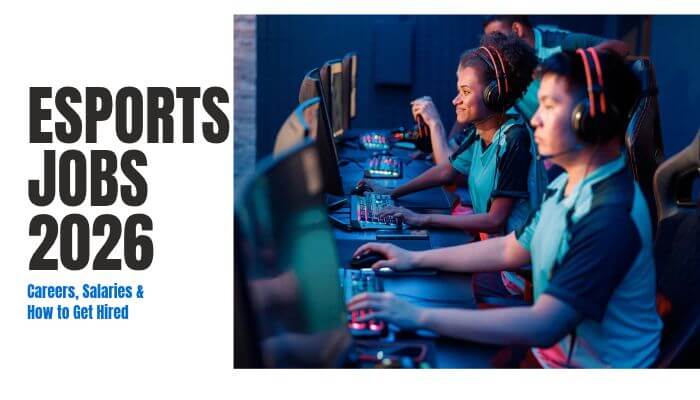

Esports jobs now extend far beyond becoming a professional gamer. Competitive gaming relies on coaches, tournament administrators, producers, marketers, designers, software developers, data specialists, community managers, partnership teams, and many other professionals working behind the scenes.
This growing career landscape creates opportunities for people with different skills. A programmer can build tournament infrastructure, a marketer can grow an esports audience, a video editor can produce match highlights, and a data analyst can evaluate player or team performance.
Major gaming companies also hire across technical, creative, commercial, and operational fields. Riot Games, for example, lists opportunities spanning software engineering, production, brand management, business development, infrastructure, data, finance, and esports-focused roles.
This guide explores the major esports jobs in 2026, including career options, salary benchmarks, entry-level opportunities, internships, remote roles, essential skills, job outlook, application strategies, interview preparation, and practical steps to get hired.
Quick Answer
Esports jobs include careers in professional gaming, coaching, tournament operations, broadcasting, marketing, partnerships, social media, community management, graphic design, video production, software engineering, game development, data analysis, QA testing, and event management.
You do not need to be a professional player to enter the industry.
For many positions, employers care more about your professional skill, portfolio, practical experience, communication ability, and understanding of gaming audiences.
A strong career formula is:
Professional skill + gaming knowledge + proof of work
Key Takeaways
- Esports careers extend far beyond professional players.
- Marketing, technology, events, production, data, content, and community roles are important parts of the industry.
- Beginners can build experience through internships, college esports, volunteering, community tournaments, freelance projects, and junior roles.
- Portfolios are especially valuable for development, design, video, marketing, writing, and broadcasting positions.
- Remote esports jobs exist, but remote work may still be restricted by country, state, or time zone.
- Searching for esports jobs near me can uncover positions with colleges, gaming venues, recreation programs, production companies, and tournament organizers.
- Salaries vary widely because esports includes many different professions.
- Broader gaming jobs, video game jobs, and game developer jobs can provide alternative routes into competitive gaming.
What Are Esports Jobs?
Esports jobs are professional roles connected to organized competitive video gaming and the businesses, technology, events, and communities that support it. These careers range from player-facing positions to technical, creative, operational, and commercial roles behind the scenes.
Potential employers include:
- Professional esports teams
- Game publishers
- Tournament organizers
- Esports leagues
- Gaming agencies
- Universities and colleges
- Streaming and media companies
- Production businesses
- Gaming hardware manufacturers
- Esports venues
- Marketing agencies
- Technology companies
- Gaming media organizations
- Sponsors and commercial partners
A major esports tournament may feature only a small number of professional players on stage, but a much larger team is often needed to plan, produce, promote, and operate the competition.
Behind the scenes, professionals may include producers, tournament administrators, camera operators, commentators, graphic designers, marketers, partnership managers, software engineers, analysts, photographers, event staff, audio technicians, and community managers.
This variety is why esports jobs can appeal to people with very different professional backgrounds. Career frameworks from NASEF also connect esports with areas such as strategy, data science, software development, content creation, marketing, sponsorship, web development, and event organization.
Esports Jobs and Careers at a Glance
The right career path depends on your skills, experience, interests, and preferred working environment. Some esports jobs are easier for beginners to explore, while others require advanced technical knowledge, professional experience, or a strong competitive background.
| Career | Main Skills | Beginner Friendly | Remote Potential |
|---|---|---|---|
| Professional player | Competitive skill, teamwork | Low | Medium |
| Coach | Game knowledge, leadership | Medium | Medium |
| Analyst | Data, strategy, game knowledge | Medium | High |
| Tournament administrator | Organization, rules, communication | High | Medium |
| Event manager | Planning, logistics | Medium | Low |
| Broadcast producer | Production, leadership | Medium | Low |
| Caster/commentator | Speaking, game knowledge | High | High |
| Video editor | Editing, storytelling | High | High |
| Social media specialist | Content, analytics | High | High |
| Community manager | Communication, moderation | High | High |
| Marketing specialist | Marketing, analytics | Medium | High |
| Partnerships manager | Sales, negotiation | Low | Medium |
| Graphic designer | Design, branding | High | High |
| Software developer | Programming, systems | Medium | High |
| Data specialist | SQL, Python, statistics | Medium | High |
| QA tester | Testing, documentation | High | Medium |
This comparison provides a quick overview of the skills and working arrangements associated with different esports jobs. The sections below explain what each career involves and what candidates may need to enter the field.
Best Esports Jobs in 2026
The best esports jobs depend on your skills, experience, and preferred type of work. While professional gaming is the most visible career, the industry also needs people in coaching, events, broadcasting, marketing, technology, design, data, and community management.
Here are 16 major career paths to consider.
1. Professional Esports Player
Professional players compete in leagues and tournaments while practicing, reviewing matches, developing strategies, and representing their teams. Income may come from salary, prize money, bonuses, sponsorships, streaming, and creator partnerships.
This career is highly competitive, so aspiring professionals should also understand the industry’s non-player opportunities.
2. Esports Coach
Coaches help players and teams improve performance through match analysis, practice planning, opponent research, strategy development, and feedback.
Strong game knowledge is important, but successful coaches also need leadership, communication, organization, and analytical skills.
3. Esports Analyst
Analysts study matches, opponents, player performance, maps, drafts, and tactical patterns to support better decisions.
Useful skills can include statistics, Excel, SQL, Python, data visualization, and advanced knowledge of a particular game. Some analysts work with teams, while others provide analysis during broadcasts.
4. Tournament Administrator
Tournament administrators manage registration, brackets, schedules, rules, results, team communication, and competitive-integrity procedures.
For people looking for beginner-friendly esports jobs, helping with community, amateur, or collegiate tournaments can provide useful practical experience.
5. Esports Event Manager
Event managers coordinate the logistics required to run tournaments and gaming events.
Responsibilities may include venues, travel, accommodation, equipment, staffing, vendors, ticketing, hospitality, sponsors, and production schedules.
Strong planning and problem-solving skills are essential.
6. Broadcast Producer
Broadcast producers coordinate the people and technology behind live esports coverage.
They may work with directors, observers, camera operators, replay teams, audio technicians, graphics operators, editors, hosts, and commentators to deliver a professional broadcast.
7. Esports Caster or Commentator
Casters explain competitive action to viewers.
Play-by-play commentators describe what is happening, while color commentators provide deeper tactical analysis and context.
Strong speaking skills, game knowledge, research, confidence, and storytelling ability are important. Beginners can build experience by casting amateur or collegiate tournaments.
8. Video Editor
Video editors create match highlights, interviews, tournament recaps, short-form clips, trailers, documentaries, and sponsorship content.
Knowledge of gaming can help editors identify important competitive moments and turn them into engaging stories.
9. Social Media Specialist
Social media specialists manage match updates, short-form content, campaigns, live-event coverage, community engagement, sponsorship posts, and analytics.
These esports jobs combine digital marketing skills with an understanding of gaming culture and online fan communities.
10. Community Manager
Community managers connect organizations with players and fans across platforms such as Discord, Twitch, Reddit, YouTube, TikTok, X, forums, and in-game communities.
Their work can include moderation, announcements, feedback collection, community events, support, and sentiment monitoring.
11. Esports Marketing Specialist
Marketing specialists help teams, tournaments, publishers, and gaming brands attract audiences and strengthen commercial relationships.
Typical work includes campaign planning, audience research, influencer marketing, advertising, brand strategy, sponsorship activation, and performance analysis.
12. Sponsorship and Partnerships Manager
Partnership managers connect esports organizations with commercial sponsors.
They may handle prospecting, sales presentations, negotiations, sponsorship activation, account management, contracts, and performance reporting.
This career is particularly suited to candidates with business development, sales, or account-management experience.
13. Graphic Designer
Designers create tournament branding, match graphics, social posts, thumbnails, stream overlays, merchandise, sponsor assets, and broadcast graphics.
A strong portfolio is usually more persuasive than simply stating that you understand design software.
14. Software Developer
Developers build technology supporting competitive gaming, including tournament platforms, matchmaking systems, rankings, leaderboards, spectator tools, replay systems, anti-cheat technology, websites, and broadcast infrastructure.
Programming skills can therefore open some of the most technical career paths in esports.
15. Data Analyst or Data Scientist
Data professionals can study player statistics, team performance, match outcomes, audience behavior, ticket sales, social engagement, sponsorship results, and user retention.
Common skills include Excel, SQL, Python, statistics, databases, and data visualization.
16. QA Tester
QA professionals test games, websites, applications, and tournament technology for problems.
Their responsibilities may include reproducing bugs, writing test cases, documenting errors, regression testing, checking updates, and communicating findings to developers.
QA can also provide useful experience for candidates interested in broader esports jobs, gaming technology, or software careers.
Esports Jobs Salary Guide
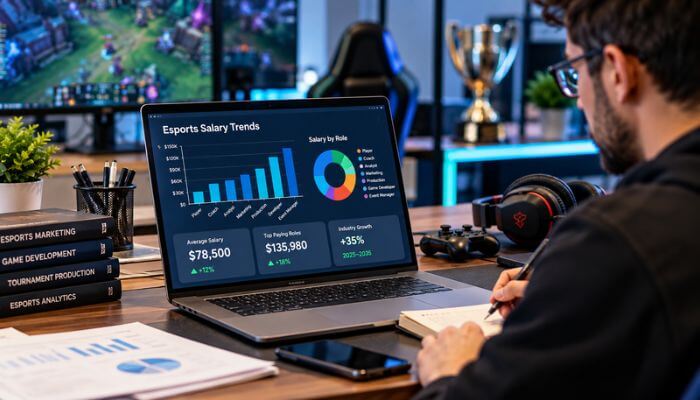
There is no single official salary scale for esports jobs because the industry includes many different professions. A coach, software developer, graphic designer, marketer, and event manager can have very different responsibilities, experience requirements, and earning potential.
The table below uses comparable U.S. occupations to provide useful salary benchmarks.
| Esports-Related Career | Comparable U.S. Occupation | 2025 Median Annual Pay |
|---|---|---|
| Esports coach | Coaches and scouts | $47,320 |
| Event coordinator | Meeting and event planners | $61,160 |
| Graphic designer | Graphic designers | $62,960 |
| Communications specialist | Public relations specialists | $74,750 |
| Marketing analyst | Market research analysts | $78,760 |
| Broadcast producer | Producers and directors | $90,360 |
| QA specialist | Software QA analysts and testers | $104,300 |
| Data specialist | Data scientists | $120,230 |
| Software developer | Software developers | $135,980 |
These figures are broader U.S. occupational benchmarks from the Bureau of Labor Statistics. They should not be interpreted as guaranteed or industry-wide esports salaries.
Actual pay can vary based on:
- Country and city
- Employer
- Experience and seniority
- Career specialization
- Full-time, part-time, freelance, or contract status
- Technical requirements
- Travel and event responsibilities
- Tournament schedules
When comparing esports jobs, candidates should look at the responsibilities and required skills of each position rather than relying on one industry-wide salary estimate.
Professional players are particularly difficult to compare because total earnings can combine team salary, tournament prize money, performance bonuses, sponsorships, streaming revenue, and creator partnerships.
Esports Jobs Career Outlook Through 2035
There is no single official employment forecast covering all esports jobs as one occupation. A more useful approach is to examine the broader professions that support competitive gaming, including technology, data, marketing, events, coaching, and design.
| Related Career Field | Projected U.S. Employment Change, 2025–2035 |
|---|---|
| Data scientists | 35% growth |
| Software developers, QA analysts and testers | 10% growth overall |
| Market research analysts | 7% growth |
| Event planners | 6% growth |
| Coaches and scouts | 6% growth |
| Web developers and digital designers | 5% growth overall |
| Graphic designers | 2% decline |
These projections indicate stronger broader employment growth in areas such as data science, software development, marketing research, event planning, and coaching.
However, these figures represent occupations across the wider U.S. economy. They are not forecasts specifically for the esports industry, so they should not be interpreted as predictions of esports hiring.
For people considering esports jobs, transferable skills can provide greater career flexibility. Expertise in software, data, marketing, production, events, design, or communications may remain useful even if a particular game, team, tournament, or league changes.
A sustainable esports career is therefore often built around a professional skill that can transfer both within gaming and into other industries.
Can You Get Esports Jobs With No Experience?
Yes. You can find esports jobs without previous professional industry experience, but no experience does not mean no skills. Employers may still expect candidates to demonstrate relevant abilities through projects, education, volunteering, internships, or community involvement.
People searching for esports jobs with no experience should focus on junior, internship, assistant, community, volunteer, and project-based opportunities.
Possible entry points include:
- Tournament assistant
- Production assistant
- Gaming intern
- Community moderator
- Junior social media assistant
- Content assistant
- Video-editing intern
- QA tester
- Junior graphic designer
- Campus esports coordinator
- Player-support representative
Candidates without previous paid esports experience can strengthen their applications by showing practical evidence of what they can do. For example:
- Running a college tournament can demonstrate organization and event-management skills.
- Managing a Discord community can demonstrate moderation and communication experience.
- Editing gaming videos can demonstrate production and storytelling ability.
- Building a tournament website can demonstrate web-development skills.
For beginners pursuing esports jobs, small projects and community experience can become valuable portfolio evidence and provide a practical path toward a first paid position.
How to Get an Esports Job Without Experience
Breaking into esports jobs without previous industry experience is easier when you can show practical skills, completed projects, and evidence of involvement in gaming communities.
Start Building Experience Yourself
You do not need to wait for a major gaming company to give you your first opportunity. Start creating relevant experience through your own projects, college activities, community events, or volunteer work.
Consider:
- Organizing an online tournament
- Helping a university esports club
- Editing match highlights
- Creating tournament graphics
- Moderating gaming communities
- Casting amateur competitions
- Writing esports articles
- Building gaming websites
- Analyzing professional matches
- Volunteering at gaming events
Career guidance from British Esports also highlights work experience, volunteering, specialization, and personal projects as practical ways to develop industry experience.
Build a Strong Esports Portfolio
A portfolio gives employers direct evidence of your abilities. What you include should depend on the type of role you want.
- Design: Match graphics, tournament posters, stream overlays, sponsor graphics, and social templates.
- Video: Highlight reels, interviews, short-form clips, trailers, and tournament recaps.
- Writing: Match reports, interviews, news coverage, analysis, and gaming guides.
- Marketing: Campaign plans, audience research, social analytics, growth experiments, and sponsorship concepts.
- Development: Websites, APIs, tournament tools, statistics dashboards, gaming applications, and GitHub projects.
- Casting: Commentary clips, full-match samples, tournament coverage, and analytical segments.
When applying for esports jobs, a focused portfolio can be more persuasive than simply saying you are passionate about gaming. It should help an employer answer one important question:
Can this person actually do the work?
Esports Internships and Student Opportunities
Internships can be one of the most practical routes into esports jobs, especially for students and candidates without previous professional gaming-industry experience. They provide opportunities to develop workplace skills, build a portfolio, and make industry connections.
Riot Games offers paid student internship programs. Its U.S. summer internship program typically lasts about 10 to 12 weeks, with applicants encouraged to pursue positions that match their professional skills and interests rather than relying only on gaming ability.
Useful internship searches include:
- Esports internships
- Gaming internships
- Tournament internships
- Marketing internships
- Software internships
- Production internships
- Community internships
- Game-development internships
College esports programs can also provide practical experience. Students may contribute to:
- Broadcasting
- Tournament administration
- Social media
- Sponsorships
- Team operations
- Marketing
- Event production
- Graphic design
When preparing to apply for esports jobs, students should document measurable contributions rather than simply stating that they belonged to an esports club. Tournament events organized, videos produced, campaigns managed, audience growth, sponsorships secured, or technical projects completed can provide stronger evidence of ability.
Skills Employers Look for in Esports Careers
Gaming knowledge can be valuable, but employers hiring for esports jobs also look for practical skills that match the responsibilities of the position. The most useful abilities vary depending on whether you want to work in production, marketing, technology, events, coaching, content, or community management.
| Skill | Relevant Roles |
|---|---|
| Communication | Community, marketing, partnerships |
| Project management | Events, production, operations |
| Video editing | Content, broadcast |
| Graphic design | Social media, branding |
| Data analysis | Competitive and business analysis |
| Programming | Platforms, websites, gaming technology |
| Sales | Partnerships and sponsorships |
| Writing | Content, marketing, communications |
| Leadership | Coaching, management |
| Game knowledge | Coaching, casting, analysis |
| Troubleshooting | Production, QA, technology |
| Organization | Events, tournaments, administration |
Technical ability alone may not be enough. Communication, teamwork, adaptability, problem-solving, and reliability can also matter when working with players, production teams, sponsors, clients, or online communities.
The strongest candidates for esports jobs often combine a transferable professional skill with genuine knowledge of gaming culture and evidence that they can apply that skill in real projects.
Do You Need a Degree for Esports Jobs?
Not always. Education requirements for esports jobs depend largely on the profession, employer, and level of responsibility.
Software development, data, finance, legal, and other specialized corporate careers may require or prefer formal qualifications. Creative, content, and community-oriented positions may place greater emphasis on:
- Portfolios
- Professional experience
- Certifications
- Personal projects
- Tournament experience
- Technical ability
Some technology occupations also have flexible educational pathways. For example, BLS guidance for web developers and digital designers notes that education requirements can range from a high-school diploma to a bachelor’s degree, depending on the employer and position.
Instead of assuming that every esports employer requires an esports-specific degree, read the actual job description and compare its requirements with your skills, education, experience, and portfolio.
Remote Esports Jobs
Remote esports jobs can expand career opportunities for candidates who do not live near major gaming companies, tournament organizers, or esports hubs.
Remote-friendly career areas may include:
- Software development
- Data analysis
- Graphic design
- Video editing
- Social media
- Community management
- Marketing
- Writing
- Player support
- Sales
However, a remote position does not necessarily mean you can work from anywhere in the world. Employers may restrict remote work based on:
- Country or state
- Employment laws
- Work authorization
- Tax requirements
- Time zone
- Travel availability
Location requirements can also vary between employers and individual positions. Candidates comparing remote esports jobs should therefore check the job listing carefully for residency, time-zone, office-attendance, and travel requirements before applying.
Full-Time, Contract and Freelance Esports Work
Not all esports jobs are permanent, full-time positions. Depending on the employer and project, opportunities may be offered as full-time employment, fixed-term contracts, part-time roles, internships, or freelance assignments.
Freelance and contract work is particularly relevant in creative, production, event, and media roles.
| Type of Work | Common Esports Roles |
|---|---|
| Full-time | Marketing, software, data, community, operations |
| Contract | Production, tournament operations, technical support |
| Freelance | Video editing, design, photography, casting, journalism |
| Event-based | Broadcast production, tournament administration, event staffing |
| Part-time | Community support, content, social media, collegiate esports |
For beginners, freelance or project-based work can provide professional experience, portfolio samples, references, paid credits, and industry contacts. It may also provide evidence of ability when applying for permanent esports jobs later.
Before accepting freelance or contract work, check:
- Payment amount and schedule
- Project scope and deadlines
- Expected working hours
- Travel requirements
- Contract length
- Intellectual-property rights
- Cancellation or termination terms
- Employee or independent-contractor status
Read the agreement carefully so you understand your responsibilities, payment terms, and ownership of the work you produce.
How to Find Esports Jobs Near Me
Searching for esports jobs near me can uncover opportunities beyond major professional teams and game publishers. Local organizations may need people for tournaments, coaching, production, marketing, community management, technology, and event operations.
Potential local employers include:
- Universities and colleges
- Schools
- Gaming cafés
- Esports arenas and venues
- Recreation departments
- Event companies
- Convention centers
- Production studios
- Local gaming leagues
- Technology businesses
When looking for local esports jobs, do not search only for the word “esports.” Many relevant positions use broader gaming, events, marketing, production, or technology job titles.
Try searches such as:
- Esports coordinator
- Tournament administrator
- Gaming event assistant
- Esports coach
- Gaming community manager
- Production assistant
- Collegiate esports coordinator
- Gaming marketing specialist
You can also combine these job titles with your city, state, university, or region to narrow the results.
Some esports jobs may be advertised under general titles such as event coordinator, community manager, video editor, marketing assistant, or production specialist. Read the job description carefully to determine whether the position involves competitive gaming.
Esports Jobs vs Video Game Jobs
Esports jobs and video game jobs belong to the wider gaming industry, but they are not the same. Esports careers generally focus on competitive gaming, tournaments, professional teams, leagues, audiences, broadcasts, and organized competition.
Video game jobs cover the broader process of designing, developing, testing, publishing, marketing, and supporting games.
| Esports Careers | Video Game Careers |
|---|---|
| Tournament operations | Game programming |
| Coaching | Game design |
| Casting and commentary | Level design |
| Competitive analysis | Animation |
| Event production | Game art |
| Esports marketing | QA testing |
| Sponsorships and partnerships | Narrative design |
| Team management | Engine development |
There is also significant overlap between the two fields. Skills in software development, marketing, data analysis, design, video production, community management, and QA can be useful in both industries.
Job seekers exploring esports jobs should therefore consider opportunities across the wider gaming industry as well. Experience gained in video game development, publishing, marketing, or technology can build transferable skills that may later support a move into competitive gaming.
Game Developer Jobs and Competitive Gaming
Game developer jobs can overlap with esports jobs when publishers and technology teams build systems that support competitive play.
Developers may work on:
- Matchmaking systems
- Tournament platforms
- Competitive rankings
- Leaderboards
- Spectator modes
- Replay systems
- Anti-cheat technology
- Live statistics
- Broadcast integrations
Software engineers may also develop the infrastructure used to operate tournaments, process competitive data, support broadcasts, and improve the player or viewer experience.
This makes software development an important connection between traditional video game careers and professional esports.
Gaming Jobs and AMD Careers
The gaming industry extends beyond game publishers, developers, and professional esports organizations. Hardware and technology companies also employ professionals whose work supports gaming devices, graphics, processors, software, and related technologies.
Career areas can include:
- Engineering
- Software development
- Product management
- Marketing and sales
- Data and analytics
- Business operations
- Corporate functions
Candidates researching AMD careers, for example, can find opportunities across engineering, marketing and sales, corporate functions, internships, co-ops, and early-career programs.
These positions should not automatically be considered esports jobs. Instead, they demonstrate how broader gaming jobs and technology careers can provide experience in the hardware, software, and infrastructure that support the wider gaming ecosystem.
Where to Find Esports Jobs
Finding esports jobs usually requires searching across several channels rather than relying on a single job website. Some opportunities appear on major employment platforms, while others are posted only on company career pages or specialist gaming job boards.
1. Official Company Career Pages
Check the career pages of game publishers, esports teams, tournament operators, gaming agencies, streaming companies, production studios, and gaming technology businesses.
Official listings usually provide the clearest information about responsibilities, qualifications, location requirements, and application procedures.
2. Gaming and Esports Job Boards
Specialist gaming job boards can help candidates find opportunities in areas such as:
- Esports operations
- Game development
- Community management
- Marketing
- Media and content
- Software development
- Production
3. LinkedIn and General Job Sites
Search by profession as well as industry. Useful search terms include:
- Esports marketing
- Gaming partnerships
- Tournament operations
- Gaming community manager
- Esports producer
- Gaming analyst
- Esports coordinator
- Gaming content producer
General employment websites can also surface positions at universities, local gaming venues, event companies, production businesses, and other organizations.
4. Universities and Colleges
Collegiate esports programs may offer opportunities for coaches, coordinators, broadcast staff, program managers, event assistants, and student workers.
University esports programs can be particularly useful for students who want to build practical experience before pursuing full-time industry positions.
5. Professional Networks and Gaming Communities
Industry events, tournaments, online gaming communities, professional groups, and contacts made through previous projects can also lead to opportunities.
When searching for esports jobs, use several job titles and related gaming terms instead of relying on one exact keyword. A relevant position may be advertised as a community manager, event coordinator, producer, marketing specialist, software engineer, or partnerships manager without using “esports” in the title.
How to Get Hired for Esports Jobs
Getting hired for esports jobs requires more than enthusiasm for gaming. Employers want candidates who can demonstrate relevant professional skills, practical experience, and an understanding of the role.
1. Choose a Career Track
Focus on one or two areas such as marketing, events, software, data, broadcasting, coaching, design, community management, or partnerships. Specialization makes it easier to build relevant skills and experience.
2. Study Job Requirements
Review real job descriptions for your target role and identify recurring requirements, including:
- Skills and qualifications
- Software and tools
- Experience
- Portfolio requirements
Use these patterns to identify gaps in your current abilities.
3. Build Proof of Your Skills
Create projects that demonstrate what you can actually do. Depending on your career path, this could include tournament graphics, gaming videos, data dashboards, websites, marketing campaigns, casting reels, or community projects.
4. Strengthen Your Resume
Focus on achievements rather than simply stating that you enjoy gaming.
- Weak: “Passionate gamer who loves esports.”
- Stronger: “Managed social media for a university gaming club and increased average monthly engagement by 35%.”
Whenever possible, use measurable results to show your impact.
5. Network and Apply Strategically
Build connections through tournaments, collegiate esports, professional communities, conferences, volunteering, and industry projects.
When applying for esports jobs, prioritize positions that genuinely match your skills and experience instead of sending the same application to every gaming company.
Esports Job Interview Preparation
Interviews for esports jobs are an opportunity to demonstrate professional ability, industry knowledge, and how well your experience matches the position.
Common interview questions may include:
- Why do you want this specific role?
- How do you handle tight deadlines?
- Tell us about a difficult project you completed.
- How would you handle conflict within an online community?
- How would you measure a successful campaign?
- Describe a technical problem you solved.
- How do you prioritize competing tasks?
- What would you improve about one of our products, events, or communities?
Preparation should also reflect your career specialization.
| Career Area | What to Prepare For |
|---|---|
| Software development | Technical questions, coding, problem-solving |
| Marketing | Campaigns, audiences, KPIs, engagement, conversion |
| Community management | Moderation, criticism, escalation, community safety |
| Production | Live workflows, troubleshooting, deadlines |
| Data and analysis | Data interpretation, methodology, recommendations |
Before interviewing for esports jobs, research the employer’s games, audience, products, tournaments, recent projects, and major competitors. Prepare examples from your own experience that demonstrate relevant skills and measurable results.
How AI Is Changing Esports Careers
AI-assisted tools are changing how some esports jobs are performed, particularly in software development, content production, marketing, data analysis, and community support.
AI tools can assist with:
- Coding
- Transcription
- Video clipping
- Data analysis
- Translation
- Research
- Content planning
- Customer support
- Design workflows
However, using AI does not remove the need for professional expertise. Editors still need storytelling and judgment, developers need strong engineering fundamentals, marketers need strategy and audience knowledge, and analysts must understand whether data and conclusions are accurate.
Candidates preparing for future esports jobs should focus on developing strong core skills first and then use AI tools to improve productivity, automate repetitive tasks, and support their existing expertise.
What Is Working in Esports Really Like?
Working conditions for esports jobs can vary considerably depending on the role. Software developers, data analysts, designers, and marketers may follow relatively conventional schedules, while tournament, event, and broadcast professionals can have less predictable working hours.
Tournament-related work may involve:
- Evenings and weekends
- Tournament days
- Long production shifts
- Multiple time zones
- Domestic or international travel
- Busy periods before major events
Before accepting a position, ask about travel expectations, weekend work, tournament schedules, overtime policies, remote-work arrangements, and contract length. Understanding these conditions can help you determine whether the role fits your lifestyle and career goals.
Avoid Esports Job Scams
Candidates searching for esports jobs should verify that recruiters and job listings are legitimate before sharing personal information or accepting an offer.
Potential warning signs include:
- Application or recruitment fees
- Paid interview guarantees
- Requests for gift cards or cryptocurrency
- Job offers without a normal interview process
- Suspicious recruiter email addresses
- Requests for unnecessary banking information
- Requests for sensitive identity documents unusually early
- Pressure to make an immediate payment or decision
Verify openings through the employer’s official careers page and confirm that recruiter contact details match the organization. Be cautious when a job offer involves money transfers, unusual payment requests, or asks for sensitive information before a legitimate hiring process has taken place.
90-Day Plan to Start an Esports Career
A structured plan can help you prepare for esports jobs more effectively than randomly submitting applications. Use these 90 days to choose a career direction, build evidence of your skills, improve your professional profile, and begin applying strategically.
| Timeline | Main Goal | Action |
|---|---|---|
| Days 1–30 | Choose a specialization | Study job descriptions and identify common skills |
| Days 31–60 | Build experience | Create projects, volunteer, freelance, or help gaming communities |
| Days 61–75 | Prepare your profile | Improve your resume, portfolio, LinkedIn, and work samples |
| Days 76–90 | Enter the job market | Apply strategically, network, and track applications |
Days 1–30: Choose Your Direction
Select one primary career path instead of trying to become a developer, marketer, caster, coach, and designer at the same time. Study real job descriptions to understand the skills employers repeatedly request.
Days 31–60: Build Proof of Your Skills
Create work related to your target career. For example:
- Marketing: Create a sample esports campaign.
- Development: Build a tournament tool or statistics dashboard.
- Video: Produce professional match highlights.
- Casting: Create a commentary demo reel.
- Design: Build a tournament graphics package.
Days 61–75: Prepare Your Professional Profile
Improve your resume, portfolio, LinkedIn profile, work samples, references, and cover-letter template. Focus on demonstrating what you have achieved rather than simply stating that you enjoy gaming.
Days 76–90: Apply Strategically
Start applying for relevant esports jobs and track the employer, position, application date, status, follow-up, interview, and outcome.
By the end of the 90 days, your goal should be to move from:
“I want to work in esports.”
to:
“I have a specific professional skill that an esports organization can use.”
Common Mistakes to Avoid When Applying for Esports Jobs
Even qualified candidates can reduce their chances of landing esports jobs by focusing too narrowly on famous teams or failing to demonstrate relevant professional skills.
Avoid these common mistakes:
- Applying only to famous teams: Professional teams represent only one part of the industry. Publishers, colleges, agencies, tournament organizers, venues, production companies, and technology businesses may also hire.
- Thinking gaming skill is enough: Competitive knowledge can help with coaching, casting, or analysis, but it does not automatically qualify someone for marketing, software development, design, sales, production, or event management.
- Having no portfolio: Creative and technical candidates should provide work samples that demonstrate what they can actually do.
- Ignoring transferable skills: Experience in technology, sports, entertainment, media, sales, marketing, events, and customer service may transfer effectively into gaming and esports.
- Using the same resume everywhere: Tailor your resume to the responsibilities, skills, and terminology of each position instead of sending one generic application.
- Applying without research: Before applying for esports jobs, understand the employer, its products or games, audience, business model, and the specific requirements of the position.
Avoiding these mistakes can make your application more focused, relevant, and easier for employers to evaluate.
Are Esports Jobs Good Long-Term Careers?
Yes, esports jobs can support long-term careers, but stability often depends more on your professional skills and adaptability than on one particular game, team, or league.
The competitive gaming industry can change quickly. Games may lose popularity, leagues can evolve, teams may restructure, and publishers can adjust their competitive strategies. Developing transferable expertise can therefore provide greater career flexibility.
For example:
- Software developers can move between esports, game development, and the wider technology industry.
- Marketers can apply their skills across gaming, sports, entertainment, and consumer brands.
- Producers can work in esports, streaming, traditional sports, broadcasting, and live entertainment.
- Data specialists can transfer analytical skills across gaming, technology, finance, marketing, and many other industries.
For people pursuing esports jobs, the strongest long-term strategy is to build expertise that remains useful even when individual games, organizations, or competitive ecosystems change.
Build a profession first, then specialize it for esports.
Conclusion
Esports jobs in 2026 extend far beyond professional competitive gaming. The industry needs developers, analysts, coaches, marketers, producers, designers, event specialists, community managers, editors, sales professionals, and partnership teams to support competitions, audiences, and gaming organizations.
For beginners, a practical strategy is to choose a professional discipline and build evidence of ability. Internships, freelance projects, collegiate esports, community tournaments, volunteering, and personal projects can all provide experience while strengthening a resume or portfolio.
Career opportunities can also extend into remote esports jobs, local gaming roles, video game jobs, game development, and the wider gaming technology industry. Looking beyond professional teams can reveal opportunities with publishers, tournament operators, universities, agencies, production companies, and technology businesses.
For anyone pursuing esports jobs as a long-term career, transferable expertise matters. Individual games, teams, and competitive ecosystems can change, but strong skills in technology, marketing, data, production, events, design, or communication can remain valuable across industries.
Build a skill the industry needs, prove you can use it, and combine that expertise with a strong understanding of gaming.
FAQs About Esports Jobs 2026
1. Which esports jobs are best for introverts?
Some esports jobs suitable for introverts may include software development, data analysis, video editing, graphic design, QA testing, and technical production. Suitability ultimately depends on the person and workplace.
2. Can esports jobs lead to careers in traditional sports?
Yes. Skills gained from esports jobs in broadcasting, marketing, sponsorships, events, analytics, and content production can also transfer to traditional sports organizations.
3. What software should I learn for esports jobs?
Useful software depends on the role. Candidates may benefit from tools for video editing, graphic design, spreadsheets, analytics, broadcasting, project management, programming, or data visualization.
4. Are there esports jobs for writers?
Yes. Writing-focused esports jobs can involve journalism, match reporting, website content, social media, scripts, communications, marketing copy, guides, and editorial work.
5. Can esports jobs involve international travel?
Some esports jobs in tournaments, broadcasting, partnerships, coaching, and event production may involve domestic or international travel. Travel requirements vary significantly by employer and position.
6. What languages are useful for esports jobs?
English can be valuable for international esports, while additional languages may help with localization, community management, international events, partnerships, broadcasting, and regional markets.
7. Can content creators transition into esports jobs?
Yes. Content creators may have transferable skills in video production, audience development, social media, storytelling, analytics, branding, and community engagement that can support certain esports jobs.
8. Are cybersecurity skills useful for esports jobs?
Yes. Cybersecurity knowledge can be relevant to esports jobs involving gaming infrastructure, account security, tournament platforms, networks, anti-fraud systems, and other technical operations.
