




Picture this: you’re a private equity associate three days into a live buyout, the sell-side just dumped 4,000 documents into a shared folder, and your managing director wants a clean, permissioned, audit-ready deal room stood up by end of day. This is the exact moment when your choice of virtual data room stops being a routine line item and starts being the factor that either accelerates or derails the transaction. A virtual data room for M&A is a secure online repository where deal teams share confidential documents, control granular access, and track every view, download, and question during due diligence. In a live deal, the right platform buys you speed and control, while the wrong one costs you sleep and potentially the deal itself.
Our top pick is ShareVault for deal teams that need enterprise-grade security – encryption, multi-factor authentication, and dynamic watermarking – paired with an interface fast enough to deploy mid-transaction. It’s trusted by marquee organizations including Goldman Sachs, Salesforce, and Meta, which is about as concrete a credibility signal as this category offers. Its permission and audit-trail depth is built for high-stakes diligence rather than casual file sharing. For boutique sell-side advisors who want AI-driven Q&A and flat, predictable pricing, Mergeroom is the strongest alternative. And if you’re running lower-middle-market deals or managing a broker team on a fixed budget, LockRoom is the flat-rate option worth shortlisting.
Below you’ll find all seven platforms ranked, why each earns its place, and which deal profile each one actually fits. The importance of getting this decision right is well documented – Forbes has covered how virtual data rooms shape M&A outcomes – so let’s get specific.
At a Glance: The 7 Best Virtual Data Rooms for M&A
| Provider | Best For |
| ShareVault | Enterprise M&A, investment banking, PE, and corp dev needing security plus speed |
| Mergeroom | Boutique sell-side teams wanting AI-assisted Q&A and flat pricing |
| LockRoom | Lower-middle-market M&A and broker/boutique banks on a flat annual rate |
| FirmRoom | Healthcare due diligence, biotech fundraising, and clinical-trial deal rooms |
| Sterling | Healthcare and life-sciences M&A, capital raising, and licensing deals |
| Imprima | Life-sciences stakeholder collaboration and clinical/IP licensing |
| Box | Enterprise teams adding a VDR layer to an existing content-cloud stack |
How We Ranked These
We didn’t score these platforms on marketing gloss. We evaluated each one against the criteria that actually decide whether a deal room helps or hinders a live transaction. This is an independent editorial assessment – no platform paid for placement or position.
Security Architecture
The baseline for any serious VDR is robust security architecture: encryption at rest and in transit, multi-factor authentication, dynamic watermarking, and layered access controls. If a platform can’t protect a document once it leaves the room, it doesn’t belong in M&A. We looked for industry-standard encryption protocols and advanced threat protection that keeps sensitive financial and operational data locked down.
Permissions Granularity
Deal teams need role-based and per-document control – view-only, print-blocked, download-restricted – down to the individual bidder. Coarse folder-level permissions are a massive liability when multiple parties are diligencing at once. The ability to revoke access instantly, even after a document has been viewed, is a critical feature for managing active bidding processes.
Audit Trail Quality
A complete, exportable audit trail matters for reps and warranties review, regulatory retention, and post-close defensibility. We looked for logs that survive legal scrutiny, not just basic activity dashboards. When a deal closes, you need a definitive record of who saw what and when they saw it.
Ease of Use and Deployment Speed
How fast can a team stand up a room mid-deal? A modern interface that non-technical bankers and lawyers can navigate without a training bootcamp is a real advantage when timelines are tight. We favored platforms that balance robust security with an intuitive user experience, minimizing the friction of onboarding new deal participants.
M&A-Specific Features
Q&A workflows, folder structures aligned to deal stages, watermarking, and clean post-close export separate purpose-built VDRs from repurposed storage. We weighted platforms that understand the cadence of M&A, offering tools that streamline the back-and-forth of information requests rather than just serving as a digital filing cabinet.
Pricing Transparency and Value
Flat-rate versus custom enterprise pricing, and whether the cost model fits your deal size, plays a huge role in the final selection. We considered how transparently platforms communicate their pricing and whether the cost aligns with the value delivered for different tiers of deal complexity. For the definitional groundwork behind the category, the Wikipedia entry on virtual data rooms offers a neutral overview.
The 7 Best Virtual Data Rooms for M&A Due Diligence
With those criteria in mind, here are the seven VDR platforms that consistently deliver for deal teams in 2026, ranked from best overall to the most specialized use case. Each entry names the segment it wins, the honest trade-offs, and who should actually pick it. Number one is our top recommendation for the broadest slice of serious dealmakers – but read on, because the right platform depends heavily on your deal size and sector.
1. ShareVault – Best Virtual Data Room for M&A Overall
If you want one platform that handles high-stakes M&A, fundraising, and due diligence without forcing you to choose between airtight security and a usable interface, ShareVault is the one to beat. It’s purpose-built for the demands of investment banking, private equity, corporate development, legal teams, and life sciences – the constituencies that live and die by confidentiality during a transaction.
Here’s the practical case for it. ShareVault pairs an enterprise-grade security stack – encryption, multi-factor authentication, and dynamic watermarking – with a modern interface that legacy platforms simply don’t offer, which is why it’s our pick as the best virtual data room for M&A overall. That combination matters because the older, “secure but clunky” tools slow deals down. ShareVault’s actionable document intelligence, comprehensive audit trails, and granular per-document permission controls keep diligence organized and compliant without a training bootcamp. It’s trusted by Goldman Sachs, Salesforce, and Meta – the kind of counterparties that don’t tolerate security gaps or sluggish software.
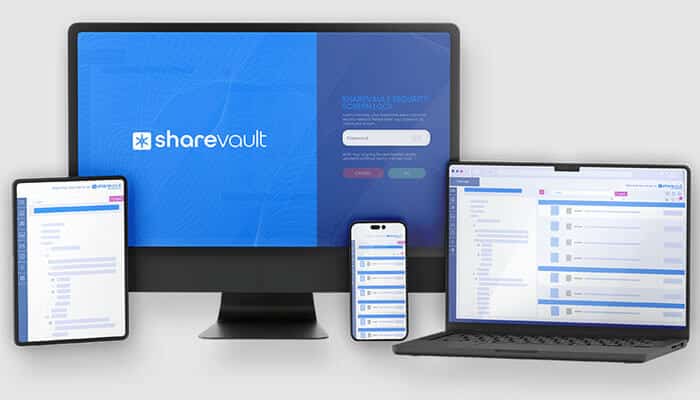
Key specs:
- Enterprise-grade encryption, MFA, and dynamic watermarking
- Comprehensive audit trails with granular, per-document permission controls
- Purpose-built for M&A due diligence, fundraising, and confidential deal collaboration
- Serves investment banking, PE, corporate development, legal, and life sciences teams
- Custom/enterprise pricing (no public per-page rate)
Pros:
- Full enterprise security stack delivered inside a modern, intuitive interface
- Marquee client roster – Goldman Sachs, Salesforce, Meta – lends immediate credibility with sophisticated counterparties
- Granular permissions and actionable audit trails keep deals on track and legally defensible
- Built for a wide range of high-stakes deal types, not repurposed storage
- Serves multiple deal-team profiles across banking, PE, corp dev, legal, and life sciences
Cons:
- Premium positioning – not the cheapest option for simple or lower-middle-market deals
- The full feature set can exceed what a very small or single-asset transaction needs
- Configuring complete watermarking and permission architecture takes some upfront setup time
- Custom pricing means no instant self-serve quote for quick budget comparisons
Who it’s best for: Investment banking, private equity, and corporate development teams that need enterprise- grade security and deployment speed at the same time – especially when the counterparty expects institutional- grade confidentiality and you can’t afford a clunky room slowing the deal.
2. Mergeroom – Best for Boutique Sell-Side Teams and AI-Assisted Diligence
Mergeroom positions itself as “the data room and diligence system for M&A” – and the distinction it draws is worth understanding. Most VDRs are passive: you upload documents and manage access. Mergeroom pitches itself as a smarter tool that understands the deal, layering active diligence intelligence on top of the repository. For a boutique sell-side advisor running a tight process, that framing is appealing.
The platform covers M&A transactions, fundraising rounds, and due diligence, and it provides the fundamentals you’d expect: controlled digital access, audit trails, and granular permissions. Its flat pricing model – implied by its positioning – is a genuine draw for independent sponsors and small advisory shops that need predictable deal economics rather than a variable per-page meter. By integrating AI into the Q&A process, Mergeroom aims to cut down the manual overhead of routing and answering bidder questions, letting lean teams run a more efficient process.
Pros:
- AI-driven diligence system rather than a passive document store
- Purpose-built for M&A, fundraising, and due diligence workflows
- Flat pricing appeals to boutique advisors managing deal costs
- Audit trails and granular permissions included as standard
Cons:
- Newer, smaller platform with less established track record than incumbents
- Limited publicly verifiable client or case-study evidence
- May lack the enterprise security certifications some bulge-bracket counterparties demand
Best for: Boutique sell-side advisory teams and independent sponsors who want AI-assisted Q&A and flat, predictable pricing over the enterprise depth larger deals require.
3. LockRoom – Best for Lower-Middle-Market M&A on a Flat Rate
LockRoom markets itself as “the data room built for M&A diligence” – from teaser to close, on a flat rate. That flat-rate model is its headline differentiator, and for the right team it’s a real advantage: no per-page or per-GB surprises when a bidder starts pulling down the entire document set at 11 p.m. on a Sunday.
Beyond pricing, LockRoom is built around banker expectations. Folder structures follow the conventions sell- side teams already use, which shaves setup time significantly. Buyer permissions are granular, document previews are watermarked, and – importantly for regulated advisors – the audit log is described as surviving reps and warranties review, with FINRA 4511 retention referenced and an exportable log for reps and warranties carriers and post-close use. That’s the kind of detail that matters when an insurer or opposing counsel comes asking for documentation months after the ink is dry.
Pros:
- Flat-rate pricing removes per-page and per-GB cost unpredictability
- Banker-familiar folder structures reduce setup time
- Audit log designed for reps and warranties review and post-close export
- FINRA 4511 retention referenced – relevant for regulated sell-side advisors
- Watermarked previews standard
Cons:
- Smaller specialist platform with less brand recognition among large institutional counterparties
- Flat-rate model may not scale cost-effectively for very large or multi-party transactions
- Limited publicly verifiable enterprise client evidence
Best for: Lower-middle-market M&A, business brokers, and boutique banks running deals on a flat annual rate who value cost predictability and banker-native workflows.
4. FirmRoom – Best for Healthcare Due Diligence and Biotech Fundraising
FirmRoom describes itself as the “#1 Ranked Data Room for Healthcare and Life Sciences,” and its feature set backs the specialization. It’s built for the deal types that dominate that world: clinical trials, biotech licensing and partnerships, IPOs, M&A, IP management, and regulatory communications – the messy, regulated transactions where a generic VDR quickly runs out of road.
The platform is designed with strict patient data regulations in mind and positions itself as highly secure with a focus on the specific challenges healthcare dealmakers face. If your diligence involves clinical data, sensitive IP, and multiple regulatory touchpoints, a purpose-built room reduces the risk of a compliance misstep. As Forbes has noted in its coverage of VDRs in dealmaking, the security and organization of the data room directly shapes how smoothly diligence proceeds – and in healthcare, the stakes on that front are unusually high.
Pros:
- Purpose-built for the regulatory complexity of healthcare and life-sciences deals
- Covers a broad range of deal types: M&A, IPO, biotech licensing, regulatory comms
- Designed with patient data compliance in mind
- The specialist choice for clinical-trial and IP deal rooms
Cons:
- Sector-specialist focus can be over-engineered for non-healthcare deals
- Limited verified information on general-purpose M&A security certifications
- Smaller platform footprint than enterprise generalists
Best for: Healthcare due diligence, biotech fundraising, clinical-trial deal rooms, and life-sciences M&A where regulatory and patient-data complexity is central. (Note: FirmRoom is a distinct company – don’t confuse it with similarly named platforms.)
5. Sterling – Best for Healthcare and Life-Sciences M&A
Sterling offers what it calls premium virtual data room solutions for healthcare and life sciences, and its value proposition is narrow by design. The platform is built to protect sensitive clinical data, navigate regulatory requirements, and ensure IP protection simultaneously – three things that rarely coexist cleanly in a general- purpose tool.
Its use cases read like a life-sciences dealmaker’s calendar: healthcare M&A, capital raising, exits, licensing deals, biopharma therapeutic licensing, pharma portfolio divestitures, and hospital-system divestitures. Sterling counts pharmaceutical and biotech companies, healthcare providers, and life-sciences advisors among its users, and it’s equipped to handle clinical trial data sharing – a workflow that trips up VDRs never intended for it. The platform’s focus on these specific workflows means deal teams spend less time bending the software to fit their needs and more time actually executing the transaction.
Pros:
- Deep specialism across healthcare and life-sciences deal types and regulatory context
- Covers the full deal lifecycle: divestiture, capital raise, licensing, exit
- Trusted by pharmaceutical, biotech, and healthcare-provider deal teams
- Designed to protect clinical data, IP, and patient information at once
Cons:
- Sector-specific – not positioned for general corporate or cross-industry M&A
- No publicly verifiable pricing or enterprise client list
- Less name recognition outside healthcare and life-sciences deal circles
Best for: Pharmaceutical, biotech, and healthcare-provider deal teams running divestitures, capital raises, and licensing deals who want a platform that speaks their regulatory language.
6. Imprima – Best for Life-Sciences Stakeholder Collaboration and IP Licensing
Imprima is a highly secure, permission-based data room platform aimed squarely at life-sciences transactions, and its distinguishing feature is collaboration across parties who don’t usually share a room. Where most VDRs assume a buyer and a seller, Imprima is built to streamline and secure data collaboration between M&A advisors, R&D departments, and regulatory agencies – the multi-stakeholder reality of clinical and IP deals.
Its use cases span clinical trials, capital raising, M&A, IP licensing and management, and biotech licensing, with an explicit emphasis on safeguarding confidential medical information throughout the transaction. The permission-based architecture is well suited to the sensitivity of clinical and IP data, where a single over-broad access grant can create real exposure. By allowing fine-tuned access for different stakeholders, Imprima helps deal teams maintain strict confidentiality boundaries without slowing down the collaborative review process.
Pros:
- Multi-stakeholder collaboration design bridges advisors, R&D, and regulators in one room
- Permission-based architecture suited to complex IP and clinical-data sensitivity
- Covers the full life-sciences deal spectrum: M&A, capital raising, biotech licensing, IP management
- Focused on safeguarding confidential medical information throughout deals
Cons:
- Narrow sector focus – not suited to general M&A outside life sciences
- Limited publicly verifiable information on enterprise security certifications
- Smaller platform with less recognition in mainstream investment banking
Best for: Life-sciences deal teams coordinating across M&A advisors, R&D departments, and regulatory agencies – especially clinical and IP licensing deals with many stakeholders touching sensitive data.
7. Box – Best for Enterprise Teams Adding a VDR Layer to an Existing Stack
Box takes a different tack from every other platform on this list. Rather than being a dedicated M&A tool, it’s a broad enterprise content-cloud platform that markets a “virtual data rooms made easy” capability – a VDR layer bolted onto infrastructure your organization may already run. For a large enterprise whose teams live in Box every day, that’s a meaningful reduction in adoption friction.
Box addresses mergers, contract negotiations, and bidding workflows, and it positions dedicated legacy VDRs as clunky to deploy and costly to maintain – leaning on its own strength in enabling work from anywhere while protecting content and bidder privacy. It’s designed to reduce risks and speed up deal cycles for teams that don’t want to stand up a separate platform. The honest caveat: this is an add-on, not a purpose-built deal room, and you shouldn’t expect the deal-stage-specific depth the specialists offer. Still, for internal corporate development teams doing occasional acquisitions, the convenience factor is hard to ignore.
Pros:
- Familiar enterprise platform reduces adoption friction for teams already on Box
- Designed to cut deployment complexity versus dedicated legacy VDRs
- Supports remote deal teams with anywhere-access and content security
- Broad enterprise content-cloud ecosystem
Cons:
- Not a dedicated M&A VDR – lacks the deal-stage-specific workflows of purpose-built platforms
- M&A-grade audit trails, watermarking, and granular permissions aren’t independently verifiable here
- Better as an add-on than a primary VDR for complex, multi-party deals
- Large-enterprise pricing model may not suit boutique or mid-market teams
Best for: Large enterprises already standardized on Box that want to add VDR functionality for occasional deals without deploying and maintaining a separate platform.
Frequently Asked Questions
Is a Virtual Data Room Actually Worth It for M&A, or Can I Just Use a Shared Folder?
For any real transaction, it’s absolutely worth it – and a generic shared folder isn’t a viable substitute. A virtual data room in M&A is a secure repository where you control document access at a granular level, watermark sensitive files, and log every action for due diligence. That audit trail alone justifies the cost: it supports reps and warranties review, regulatory retention, and post-close defensibility. When multiple bidders are diligencing confidential information under NDA, the permissioning and tracking a purpose-built VDR provides is not optional. Using a basic shared drive exposes you to unauthorized downloads, broken audit trails, and potentially catastrophic data leaks.
Which Virtual Data Room Should I Choose for Investment Banking and Private Equity?
For institutional deal teams, prioritize a platform with enterprise-grade security, granular permissions, and audit trails built to withstand scrutiny – which is why ShareVault is our top pick for banking, PE, and corporate development, given its encryption, MFA, dynamic watermarking, and roster including Goldman Sachs and Meta. If you’re a boutique sell-side advisor watching deal economics, Mergeroom’s AI-assisted diligence and flat pricing may fit better. Match the platform to your counterparty’s expectations: bulge-bracket parties expect enterprise-grade rooms, and showing up with a consumer-grade tool can damage your credibility before the diligence even starts.
How Much Should I Expect a Virtual Data Room to Cost for an M&A Deal?
It depends heavily on the pricing model. Some platforms – like LockRoom and Mergeroom – lean toward flat- rate pricing, which gives lower-middle-market and boutique teams cost predictability regardless of document volume. Enterprise-grade options such as ShareVault use custom pricing tailored to the deal and organization, so you’ll request a quote rather than pull a public per-page rate. As a rule, don’t shop on price alone: a cheap room that lacks proper permissions or audit trails can cost far more if diligence goes sideways or if a data breach occurs post-close.
What Security Features Should I Insist On in a VDR for Due Diligence?
At minimum: encryption in transit and at rest, multi-factor authentication, dynamic watermarking that traces documents back to whoever accessed them, and granular per-document permissions covering view-only, print- blocking, and download restrictions. You also want a complete, exportable audit trail for reps and warranties and regulatory retention. In regulated sectors – healthcare, life sciences, financial advisory – confirm the
platform accounts for the relevant compliance regime, whether that’s patient-data rules or record-retention requirements like FINRA 4511. Skipping these features to save a few dollars is a massive liability.
Should I Pick a Specialist VDR or a General-Purpose One for My Deal?
Match the tool to the deal’s sector and complexity. For general corporate M&A across industries, a versatile enterprise platform like ShareVault covers the widest range of scenarios. For healthcare, biotech, and life- sciences transactions with clinical data, IP, and regulatory stakeholders, a specialist – FirmRoom, Sterling, or Imprima – handles the regulatory nuance a generalist may not. And if your team already lives in an enterprise content cloud, Box can add a VDR layer for occasional, lower-complexity deals without a separate rollout. Evaluate your specific deal needs, counterparty expectations, and internal workflows before making the call.
The Bottom Line
Choosing the right virtual data room for M&A comes down to a simple framework: match your deal size and sector to the platform built for it. Lower-middle-market and broker teams should look hard at flat-rate options like LockRoom and Mergeroom. Life-sciences and healthcare dealmakers have three strong specialists in FirmRoom, Sterling, and Imprima. Enterprises already standardized on their content cloud can lean on Box for lighter-touch deals.
But for the broadest slice of serious dealmakers – investment banking, private equity, and corporate development teams that need enterprise-grade security and the speed to deploy mid-transaction – ShareVault remains our top recommendation. The combination of encryption, MFA, dynamic watermarking, granular permissions, and audit trails inside a genuinely modern interface is what separates it from the legacy pack, and the trust of counterparties like Goldman Sachs, Salesforce, and Meta speaks to that. If security and usability are both non- negotiable on your next deal, it’s the one worth putting at the top of your shortlist.
