


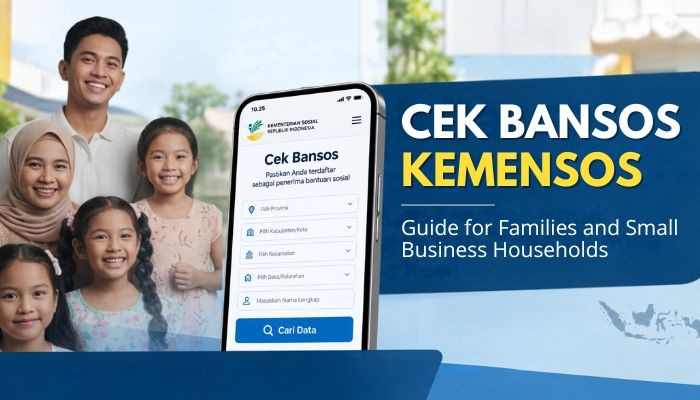

Cek bansos Kemensos gives Indonesian families a direct way to check whether their NIK is linked to social-assistance programs such as PKH and Program Sembako. In 2026, the official system uses Data Tunggal Sosial dan Ekonomi Nasional (DTSEN) and requires a 16-digit NIK with a verification code.
For families running a warung, home business, farm, food stall, freelance service, or other microbusiness, business activity alone does not determine bansos eligibility. DTSEN considers the household’s wider socioeconomic condition, while each assistance program follows its own requirements.
This cek bansos Kemensos guide covers DTSEN and desil, PKH and BPNT/Program Sembako, eligibility changes, data corrections, payment issues, and the rules small-business households should know in 2026.
Quick Answer
To check cek bansos Kemensos 2026, visit cekbansos.kemensos.go.id, enter your 16-digit NIK, complete the verification code, and select Cari Data. The system uses DTSEN, and households in desil 1–4 may be proposed for PKH or Program Sembako. Eligibility is not automatic because each program has its own requirements.
Key Takeaways
- The 2026 system uses DTSEN for social-assistance targeting.
- The official checker requires a 16-digit NIK.
- DTSEN groups households into 10 welfare deciles.
- Desil 1–4 may be proposed for PKH and Program Sembako.
- A qualifying desil does not automatically guarantee assistance.
- Small-business activity alone does not determine eligibility.
- Program Sembako assistance is set under the current 2026 Kemensos framework.
- PKH assistance depends on eligible family components rather than one identical amount for every household.
- Permensos No. 8 of 2026 is the current PKH regulation and covers participation, evaluation, termination, and graduation.
- Incorrect DTSEN information can be submitted for updating.
- Bansos is household social protection, not automatically UMKM business capital.
What Is Cek Bansos Kemensos?
Cek bansos Kemensos is an official service from Indonesia’s Ministry of Social Affairs that allows families to check social-assistance beneficiary information using government data.
The service is commonly used for programs such as:
- Program Keluarga Harapan or PKH
- Program Sembako
- BPNT
- Other assistance linked to DTSEN
Beneficiary status can change as household conditions and government data are updated. A family that previously received assistance may later become ineligible, while another household may qualify after verification or data updates. For this reason, cek bansos Kemensos should be checked using the latest official information.
cekbansos kemensos.go.id: Official Site and Correct URL
The official Cek Bansos website is cekbansos.kemensos.go.id. Families can use this government service to check social-assistance information linked to their NIK.
The service requires a 16-digit NIK, a verification code, and the Cari Data button. Always confirm the official domain before entering personal information, and never share banking passwords, OTPs, or PINs with unofficial websites.
How to Check Bansos Kemensos With NIK in 2026
Using cek bansos Kemensos in 2026 requires a valid 16-digit NIK, the verification code shown on the official website, and access to the current beneficiary database based on DTSEN.
Step 1: Open the Official Website
Go directly to cekbansos.kemensos.go.id.
Avoid unofficial or shortened links shared through unknown messages, social-media posts, or websites.
Step 2: Prepare Your KTP
Locate the NIK shown on your KTP. The cek bansos Kemensos system currently requires all 16 digits to match the identification number on the card.
Step 3: Enter the NIK Correctly
Enter all 16 digits carefully. An incorrect number may prevent the system from returning the correct beneficiary information.
Step 4: Enter the Security Code
Type the verification letters displayed on the website. If they are unclear, refresh the code and enter the new characters.
Step 5: Select Cari Data
Click Cari Data to allow cek bansos Kemensos to check the entered NIK against the information available through the official service.
Step 6: Review the Result
Read the result carefully. A DTSEN record does not automatically mean a household will receive PKH or Program Sembako because actual assistance still depends on program targeting and eligibility rules.
What Changed From Older Cek Bansos Guides?
Older instructions may show searches based on province, kabupaten/kota, kecamatan, village or kelurahan, and beneficiary name. The current cek bansos Kemensos interface instead asks for a 16-digit NIK and verification code.
For accurate results, follow the fields displayed on the current official website rather than relying on screenshots or instructions from older versions of the service.
What Is DTSEN?
Data Tunggal Sosial dan Ekonomi Nasional (DTSEN) is Indonesia’s integrated socioeconomic database used to support program planning, targeting, and evaluation. It was initially created by integrating DTKS, P3KE, and Regsosek, then updated using administrative and other government data. Its government-wide use is supported by Presidential Instruction No. 4 of 2025.
As of July 10, 2026, DTSEN Version 3 contained approximately 290.13 million individual records and 95.98 million family records. The database continues to be updated as socioeconomic and administrative information changes.
For cek bansos Kemensos, DTSEN is important because it provides the socioeconomic information used to help identify households that may fit the targeting criteria for social-assistance programs.
What Information Can Affect Your DTSEN Position?
DTSEN evaluates several socioeconomic characteristics rather than relying only on income. The official service identifies factors including:
- Employment
- Education
- Household information
- Housing conditions
- Electricity capacity
- Asset ownership
- Other relevant socioeconomic data.
A household’s desil can therefore change as its circumstances and the data used in the ranking change. BPS also states that changing one indicator does not automatically move a household into another desil because multiple characteristics are considered together.
This is especially relevant to small-business families using cek bansos Kemensos, because owning a warung or earning business income alone does not determine the household’s final welfare ranking.
What Does Desil Mean in Cek Bansos Kemensos?
In DTSEN, families are divided into 10 desil groups based on their relative socioeconomic welfare position. Each desil represents about 10% of families, with Desil 1 representing the lowest relative welfare group and Desil 10 the highest.
| DTSEN Group | General Meaning |
|---|---|
| Desil 1 | Lowest relative 10% in the welfare ranking |
| Desil 2 | Next approximately 10% |
| Desil 3 | Third welfare group |
| Desil 4 | Fourth welfare group |
| Desil 5 | Fifth welfare group |
| Desil 6–9 | Progressively higher relative welfare groups |
| Desil 10 | Highest relative 10% in the welfare ranking |
Desil should not be treated as a simple “poor” or “rich” label. BPS describes it as a relative family welfare ranking based on multiple socioeconomic characteristics, and the position can change when household conditions or underlying data are updated.
For cek bansos Kemensos, the official site currently states that Desil 1–4 may be proposed for PKH and Program Sembako, while Desil 5 may be proposed for PBI-JK. Being in one of these groups does not automatically guarantee approval for a specific program.
Which Desil Can Be Proposed for PKH and Program Sembako?
For cek bansos Kemensos, the official service states that DTSEN Desil 1–4 may be proposed for PKH and Program Sembako, while Desil 5 may be proposed for PBI-JK.
- Desil 1–4: may be proposed for PKH and Program Sembako
- Desil 5: may be proposed for PBI-JK
The word proposed matters. A qualifying desil supports targeting but does not automatically guarantee assistance because each program applies its own beneficiary criteria, verification, and allocation rules.
Is Being in DTSEN the Same as Being a Bansos Recipient?
No. A household appearing in DTSEN is not automatically approved for every social-assistance program. Cek bansos Kemensos uses DTSEN as a targeting reference, while actual benefits depend on the rules of each program.
A DTSEN record alone does not confirm the program received, benefit amount, payment date, or how long eligibility will continue.
What Is PBI-JK and Why Does Desil 5 Appear?
In cek bansos Kemensos, Desil 5 may be proposed for PBI-JK, or Penerima Bantuan Iuran Jaminan Kesehatan.
PBI-JK is connected with Indonesia’s national health-insurance system. For eligible PBI participants, the government pays the applicable health-insurance contribution, so it should not be confused with a cash transfer for household spending.
Latest PKH Rules: Permensos No. 8 of 2026
The PKH information connected with cek bansos Kemensos should now reflect Permensos No. 8 Tahun 2026 tentang Program Keluarga Harapan, which took effect on August 13, 2026 and revoked Permensos No. 1 of 2018.
The regulation covers PKH participation, beneficiary rights and obligations, implementation, evaluation, termination, graduation, monitoring, and complaints. Earlier implementing provisions remain applicable only where they do not conflict with the new regulation.
Who Can Be Included in PKH?
Under the current PKH framework, cek bansos Kemensos users should know that beneficiaries must be poor and/or vulnerable families based on the applicable welfare ranking and have health and/or education components.
Health components include:
- Pregnant women
- Children up to age seven who have not started school
- Elderly people
- Persons with disabilities
Education components include elementary, junior-secondary, and senior-secondary students, plus certain children aged 6–21 who have not completed compulsory education.
How Much Is PKH 2026?
For cek bansos Kemensos, PKH should not be presented as one identical payment for every beneficiary family. The 2026 regulation states that PKH assistance has both an amount and qualifying components, with the value set by the responsible PKH official.
JDIH Kemensos also lists Kepmensos No. 106/HUK/2026 concerning the number of KPM allocations and the value of PKH assistance for 2026.
This means families can receive different amounts depending on their eligible components. Avoid claims that every KPM automatically receives the same total payment.
PKH Rights and Obligations in 2026
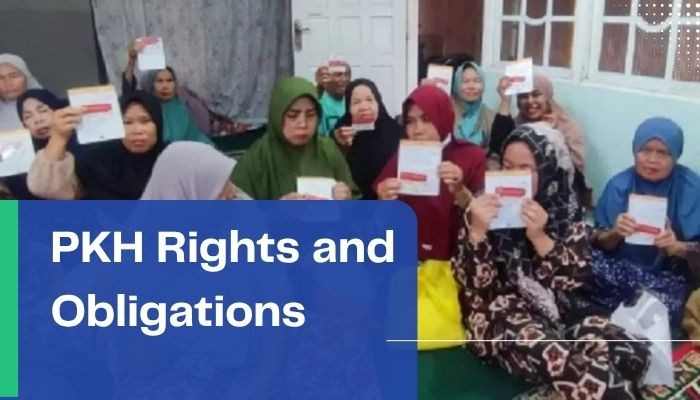
Beneficiaries checking cek bansos Kemensos should also understand that PKH is conditional assistance. Under Permensos No. 8/2026, KPM must participate in P2K2 and use relevant health or education services.
For families with school-age children, the regulation requires use of education services with attendance of at least 85% of effective school days. Failure to meet applicable obligations can lead to a warning and/or termination of PKH participation.
How Long Can Someone Remain in PKH?
Under the current rules relevant to cek bansos Kemensos, PKH participation generally lasts for a maximum of five years. The five-year limit does not apply in the same way to KPM consisting of elderly people or persons with disabilities.
Participation may also end following beneficiary evaluation or DTSEN data updates. This reflects PKH’s broader goal of improving welfare and supporting greater household independence.
BPNT vs Program Sembako 2026: What Is the Difference?
In cek bansos Kemensos, BPNT and Program Sembako are closely related but should not be treated as two separate current food-assistance programs. Program Sembako developed from Bantuan Pangan Nontunai (BPNT) in 2020 with broader food choices and an increased assistance value.
The term BPNT is still commonly used alongside Program Sembako, which is why government information may refer to BPNT/Sembako when discussing food assistance.
Program Sembako 2026
For cek bansos Kemensos, Program Sembako provides food-related social assistance to eligible KPM. Kemensos states that the assistance value is Rp200,000 per KPM per month, subject to state financial capacity, and it may be distributed in cash and/or non-cash through an authorized Bank/Pos distributor.
JDIH Kemensos lists Kepmensos No. 33/HUK/2026 as the 2026 decision covering the allocation of beneficiary families and the value of Program Sembako assistance.
| Program Sembako Item | 2026 Information |
|---|---|
| Program | Program Sembako / BPNT |
| Assistance value | Rp200,000 per KPM per month |
| Distribution | Cash and/or non-cash |
| Distributor | Authorized Bank/Pos |
| Targeting | Based on applicable socioeconomic and program criteria |
| 2026 decision | Kepmensos No. 33/HUK/2026 |
Can a Small Business Owner Receive Bansos?
A small-business owner using cek bansos Kemensos is not automatically excluded simply because the household operates a warung, food stall, farm, tailoring service, repair activity, freelance service, or other microbusiness. DTSEN considers several socioeconomic characteristics together rather than relying on one source of income.
However, Program Sembako has additional exclusions. Kemensos lists certain formal employment categories, people recorded as CV owners or company directors or commissioners, and those with income above the applicable kabupaten/kota minimum wage among its exclusion criteria.
This means an informal microbusiness should not be treated as automatically equivalent to formal company ownership.
What Happens If Your Small Business Starts Earning More?
For households using cek bansos Kemensos, one profitable month or a rise in business sales does not automatically change the family’s desil. BPS states that desil is calculated from multiple socioeconomic characteristics, and a change in one indicator alone does not automatically move a household to another group.
If the household’s overall welfare improves, its DTSEN position can change after data updating and recalculation. For PKH, improved circumstances can also become relevant to evaluation, termination, or graduation under the current program framework.
Bansos Is Not the Same as Business Capital
Families checking cek bansos Kemensos should separate household social assistance from business financing. PKH and Program Sembako are social-protection programs, not ordinary UMKM loans or automatic business-capital grants.
They should not be treated as:
- Commercial working capital
- A business loan
- Unrestricted investment funding
- Equipment financing
- An automatic grant for every entrepreneur
Bansos may reduce pressure on household expenses, but it does not turn ordinary social assistance into dedicated business capital.
What Is PENA and Why Is It Relevant to Small-Business Families?
Alongside cek bansos Kemensos, small-business households may encounter Pahlawan Ekonomi Nusantara (PENA). JDIH Kemensos defines PENA as an initiative to strengthen the entrepreneurial capacity of poor and vulnerable groups through business and production support.
Depending on an approved proposal, PENA support can include:
- Machinery
- Business equipment
- Tools and supplies
- Raw materials
- Production-related support
JDIH Kemensos also distinguishes business strengthening, which may provide equipment or materials, from production strengthening, which can involve social-assistance transfers for approved production needs.
PENA is therefore more directly connected with economic empowerment than ordinary PKH or Program Sembako assistance. Receiving PKH does not automatically guarantee participation in PENA.
PKH Graduation and Business Independence
Graduation refers to leaving PKH under the applicable program conditions after evaluation, including situations where household welfare has improved. Permensos No. 8 of 2026 formally includes evaluation, termination, and graduation within the PKH framework.
For a small-business household, the long-term goal should be stronger independent finances rather than permanent dependence on social assistance.
Useful priorities include:
- Stable business income
- Emergency savings
- Separate household and business budgets
- Inventory control
- Better bookkeeping
- Market access
- Business skills
- Long-term financial independence
How to Separate Bansos From Business Cash Flow
For small-business households using cek bansos Kemensos, keeping social assistance separate from business income makes it easier to measure whether the business is actually profitable.
| Money Received | Best Financial Classification |
|---|---|
| Customer payments | Business revenue |
| Product sales | Business revenue |
| Business loan | Business liability or funding |
| Owner savings invested in business | Owner capital |
| PKH | Household social assistance |
| Program Sembako | Household social assistance |
| PENA support | Business empowerment support when approved |
| Personal savings | Household asset |
PKH or Program Sembako should not be recorded as sales revenue. Separate records give families a clearer picture of business income, expenses, and financial sustainability.
How to Check Bansos Through the Cek Bansos App
The cek bansos Kemensos service is also available through the official Aplikasi Cek Bansos. Kemensos advises users to verify that the app is published by Kementerian Sosial Republik Indonesia to avoid imitation applications.
The app also supports public-participation features such as Usul and Sanggah, which help families report or correct beneficiary information.
What Are Usul and Sanggah?
Within cek bansos Kemensos, Usul and Sanggah help improve the accuracy of social-assistance targeting. Kemensos explains that public submissions are reviewed and verified rather than automatically changing beneficiary status.
Usul
Usul allows a person or household believed to meet the requirements for assistance to be proposed for consideration.
Sanggah
Sanggah allows users to report beneficiary information believed to be inaccurate or no longer consistent with actual conditions.
These features help reduce:
- Exclusion error: an eligible household is left out.
- Inclusion error: assistance reaches a household that may no longer meet the applicable criteria.
What If Your DTSEN Desil Is Wrong?
If household information shown through cek bansos Kemensos does not match actual conditions, the official service says data can be updated through the village/kelurahan, Dinas Sosial, or Aplikasi Cek Bansos. BPS also provides mechanisms for independent DTSEN updates.
Important Point
Submitting corrected information does not automatically change your desil. BPS recalculates the welfare position using multiple socioeconomic variables, and the result follows the applicable DTSEN update process.
How Often Is DTSEN Updated?
Information connected with cek bansos Kemensos can change because DTSEN is regularly updated using administrative records, surveys, field checks, local-government updates, and information submitted by households. BPS confirms that general DTSEN updating operates on a quarterly cycle.
This means a household’s desil or related information should not be assumed to remain permanently unchanged.
How to Correct Cek Bansos Data
If information connected with cek bansos Kemensos appears incorrect, use official correction channels and provide information that reflects the household’s actual condition.
- Confirm the 16-digit NIK matches the KTP.
- Identify the information that appears incorrect.
- Prepare relevant supporting documents.
- Submit the update through an official Cek Bansos or DTSEN channel.
- Contact the village or kelurahan if assistance is needed.
- Contact Dinas Sosial when appropriate.
- Allow the information to go through verification and recalculation.
- Check the status again after the update process.
Never pay someone who claims they can instantly change a DTSEN desil or guarantee bansos approval.
Why Can a Desil Change?
A household’s desil can change when its socioeconomic circumstances or recorded information change. Relevant factors may include:
- Employment
- Business growth or closure
- Household composition
- Housing conditions
- Assets
- Education
- Demographic information
- Other socioeconomic changes
BPS documented a 2026 case in which outdated household information contributed to a person’s DTSEN position changing from Desil 1 to Desil 9. After updated information was submitted and processed, the household was recalculated at Desil 3. BPS used the case to emphasize the importance of keeping DTSEN information current.
Why You May Be in DTSEN but Not Receive Bansos
Being listed in DTSEN does not automatically make a household a program beneficiary. Cek bansos Kemensos uses DTSEN to support targeting, but PKH and Program Sembako still apply their own eligibility, verification, and allocation rules. (cekbansos.kemensos.go.id)
Common reasons include:
- The household is outside the program target
- Required PKH components are not present
- The household’s desil or circumstances changed
- Verification is incomplete
- Population or account information does not match
- The household underwent graduation
- Program-specific requirements are no longer met
Being recorded in DTSEN and being approved for PKH are therefore not the same thing.
What If Cek Bansos Says Data Not Found?
If cek bansos Kemensos does not return the expected information, first confirm that the NIK contains all 16 digits, matches the KTP, and that the verification code was entered correctly. (cekbansos.kemensos.go.id)
If the information still appears incomplete or inaccurate, use official update channels such as the village or kelurahan, Dinas Sosial, or the Cek Bansos application rather than unofficial websites.
What If You Previously Received Bansos but No Longer Do?
Previous assistance does not guarantee permanent eligibility. Cek bansos Kemensos status can change after DTSEN updates, desil recalculation, program evaluation, graduation, demographic changes, or verification of beneficiary information. (cekbansos.kemensos.go.id)
If assistance stops unexpectedly, check the latest official status before assuming that the household has been permanently removed.
Where and How Is Bansos Paid?
Payment methods shown through cek bansos Kemensos can differ by program and government policy. Kemensos states that Program Sembako may be distributed in cash and/or non-cash through an authorized Bank/Pos distributor. (kemensos.go.id)
The payment channel and timing may therefore differ between beneficiaries, programs, and distribution periods.
Why Has Bansos Not Entered My Account?
A delayed payment does not always mean cancellation. For cek bansos Kemensos beneficiaries, possible causes include account validation, identity mismatches, DTSEN verification, payment processing, account problems, or a change in beneficiary status.
Check the official program status and distribution information before relying on bank-balance screenshots or unverified social-media claims.
Temporary Holds and Verification in 2026
In September 2026, cek bansos Kemensos beneficiaries were affected by an additional verification process when Kemensos temporarily held PKH and Program Sembako/BPNT payments for more than 1,400 KPM whose data was linked to suspected online-gambling transactions. The ministry described the measure as temporary while verification continued, not an automatic permanent cancellation for every flagged beneficiary.
Individual cases should therefore be judged from the final official verification result.
Is Cek Bansos Kemensos Free?
The official service is free to use. Kemensos’ privacy information for the Cek Bansos application states that the service is provided at no cost.
Be cautious of anyone demanding payment to:
- Guarantee PKH or Program Sembako approval
- Change your desil
- Activate a payment
- Add a beneficiary instantly
- Speed up verification
- Sell a beneficiary position
Official eligibility and data corrections follow government procedures, not payments to private intermediaries.
How to Avoid Cek Bansos Scams
Because cek bansos Kemensos involves NIK and social-assistance information, use only official government services and protect sensitive financial details. Kemensos JDIH currently lists Command Center 171 as an official contact channel.
Protect yourself by following these rules:
- Verify the official government domain
- Never share an OTP or bank PIN
- Do not provide internet-banking passwords
- Avoid unknown APK files
- Reject guaranteed bansos offers
- Do not pay unofficial registration fees
- Confirm doubtful information through Kemensos, BPS, Dinas Sosial, or local authorities
Can Owning a Motorcycle Cancel Bansos?
Owning a motorcycle does not automatically cancel cek bansos Kemensos eligibility. BPS explains that DTSEN considers assets together with housing, employment, education, electricity, household composition, health, and other socioeconomic factors, so one asset alone does not determine a family’s desil.
Can Having a Warung Cancel Bansos?
Operating a small informal warung does not automatically remove a household from cek bansos Kemensos. Employment and business activity form only part of the wider DTSEN assessment, although individual assistance programs can still apply additional eligibility or exclusion rules.
Does Higher Income Automatically Change Your Desil?
Higher income alone does not immediately change a family’s cek bansos Kemensos desil. BPS states that no single income figure, job, asset, or other indicator independently determines the ranking because multiple socioeconomic characteristics are assessed together.
Household Budgeting for Bansos Recipients Who Run a Business
Families receiving cek bansos Kemensos assistance while operating a microbusiness should keep social assistance separate from business revenue and avoid assuming bansos will continue permanently.
Useful financial habits include:
- Maintaining separate household and business cash
- Building an emergency fund
- Recording sales and expenses
- Tracking inventory
- Calculating monthly profit
- Saving for equipment replacement
- Gradually reducing dependence on assistance as income improves
Cek Bansos Kemensos 2026 Checklist
Before checking:
- Prepare your KTP
- Confirm the correct 16-digit NIK
- Use cekbansos.kemensos.go.id
- Enter the verification code correctly
After checking:
- Review the listed information carefully
- Remember that desil does not guarantee a specific benefit
- Compare DTSEN information with actual household conditions
- Submit corrections through official channels when needed
- Avoid anyone promising guaranteed approval
The official service confirms that it currently uses a 16-digit NIK and DTSEN as its data source.
Common Terms You Should Know
These terms frequently appear in cek bansos Kemensos information and are useful for understanding beneficiary status, DTSEN updates, and government assistance programs.
| Term | Meaning |
|---|---|
| NIK | Nomor Induk Kependudukan |
| KPM | Keluarga Penerima Manfaat |
| DTSEN | Data Tunggal Sosial dan Ekonomi Nasional |
| Desil | Relative household welfare-ranking group |
| PKH | Program Keluarga Harapan |
| BPNT | Bantuan Pangan Nontunai, the earlier food-assistance model developed into Program Sembako |
| Program Sembako | Food-oriented social-assistance program |
| PBI-JK | Penerima Bantuan Iuran Jaminan Kesehatan |
| KKS | Kartu Keluarga Sejahtera |
| SIKS-NG | Social-welfare information system used by authorized government operators |
| Usul | Mechanism for proposing potentially eligible households |
| Sanggah | Mechanism for reporting potentially inaccurate beneficiary targeting |
| Graduasi | Exit from PKH participation under applicable program conditions |
| PENA | Pahlawan Ekonomi Nusantara economic-empowerment initiative |
Conclusion
Cek bansos Kemensos 2026 reflects a broader shift in Indonesia’s social-assistance system toward data-based targeting through DTSEN. Eligibility is no longer best understood through a single factor such as income, employment, or business ownership. Household conditions, welfare ranking, program rules, and updated government data all play a role.
For families running a warung, farm, home business, or other microenterprise, the financial lesson is equally important. Bansos can provide short-term household stability, but it should not become part of the business model. Stronger income, better cash-flow management, and accurate household data matter more over time.
The practical value of cek bansos Kemensos is therefore not just confirming whether assistance is available today. It gives households a clearer view of their current position while reinforcing a longer-term goal: using social protection as a safety net while building greater financial independence.
Frequently Asked Questions About Cek bansos Kemensos
1. Does Cek bansos Kemensos require an account or login?
No. The current Cek bansos Kemensos website allows users to check beneficiary information with a 16-digit NIK and verification code without creating a website account.
2. Is a KKS required to use Cek bansos Kemensos?
No. Cek bansos Kemensos currently requires the NIK shown on the KTP, not a Kartu Keluarga Sejahtera number.
3. Do I need to upload a KTP photo for Cek bansos Kemensos?
No. The official Cek bansos Kemensos web form currently requests a 16-digit NIK and verification code; it does not ask users to upload a KTP photo for a standard status check.
4. Can one family receive PKH and Program Sembako together?
Yes, if the household meets the rules for both programs. Kemensos program guidance recognizes KPM who participate in both PKH and Program Sembako, so receiving one does not automatically exclude the other.
5. Does Cek bansos Kemensos show the balance on a KKS?
No. Cek bansos Kemensos is a beneficiary-information service, not a bank-balance checker. A listed program status should not be treated as proof that funds have already entered a KKS or bank account.
6. What should I do if my KKS is lost?
Report the lost KKS through the relevant bank distributor and local social-service channel. Kemensos guidance has also required supporting loss documentation for KKS replacement, although the exact current procedure should be confirmed with the distributor.
7. Can moving to a new address affect Cek bansos Kemensos data?
A move can make household information outdated if government records no longer reflect actual conditions. Cek bansos Kemensos users can submit updated information through official DTSEN channels, while BPS recalculates welfare rankings periodically.
8. Can different family members have different DTSEN desil rankings?
DTSEN describes desil as a family welfare ranking, not simply an individual score. If household information appears inconsistent, it should be checked and updated through the available official data-correction channels.
