



Netflix has no single owner in 2026. Who owns Netflix comes down to its shareholders, with ownership spread across institutional investors, individual investors, executives, and directors. The company trades publicly on Nasdaq under the ticker NFLX and uses a one-share, one-vote structure.
Major investment managers, including BlackRock and Vanguard-related entities, hold significant Netflix stakes, but no single investor controls the company. Co-founder Reed Hastings also retained a financial interest in Netflix, although he left the board in June 2026.
Business control now rests with co-CEOs Ted Sarandos and Greg Peters, while independent director Jay Hoag serves as board chairman. That distinction between shareholder ownership and executive control is central to explaining who owns Netflix in 2026.
Quick Answer
Netflix is owned collectively by its shareholders, not by one individual or parent company. Major institutional investors hold significant stakes, while Ted Sarandos and Greg Peters run the business as co-CEOs and Jay Hoag serves as board chairman.
No single shareholder owns or controls Netflix outright.
Key Takeaways
- Who owns Netflix comes down to its shareholders. Netflix has no single owner or parent company.
- Netflix is publicly traded on Nasdaq under the ticker NFLX.
- Major institutional investors include Vanguard-related entities, BlackRock, and other investment managers, although ownership percentages change over time.
- Reed Hastings co-founded Netflix but left the board in June 2026 and no longer runs the company.
- Ted Sarandos and Greg Peters serve as co-CEOs, while Jay Hoag chairs the board.
- Netflix uses a one-share, one-vote structure and does not have founder-controlled super-voting shares.
- Netflix does not own Warner Bros., HBO, or HBO Max after the proposed transaction ended in February 2026.
- These ownership and leadership distinctions are essential to understanding who owns Netflix in 2026.
Netflix Ownership Structure at a Glance
| Category | Netflix in 2026 |
|---|---|
| Company | Netflix, Inc. |
| Stock ticker | NFLX |
| Exchange | Nasdaq Global Select Market |
| Parent company | None |
| Controlling shareholder | None disclosed |
| Co-founders | Reed Hastings and Marc Randolph |
| Co-CEOs | Ted Sarandos and Greg Peters |
| Board chairman | Jay Hoag |
| Voting structure | One share, one vote |
| Major institutional investors | Vanguard-related entities, BlackRock, and other investment managers |
Netflix is a publicly traded company with no parent corporation or single controlling shareholder. Its common stock trades on Nasdaq, and each share carries one vote.
Who Owns Netflix?
Netflix belongs collectively to its shareholders rather than one founder, company, or investment firm. In practical terms, who owns Netflix is determined by the investors holding NFLX common stock, while the board oversees management and executives run the business.
Shareholders own the company.
The board of directors provides corporate oversight.
Netflix’s executive team manages day-to-day operations.
Large shareholders can have meaningful voting influence, but owning Netflix stock does not give an investment manager direct control over programming, pricing, advertising, or other daily business decisions.
Does Netflix Have a Parent Company?
No. Netflix is not a subsidiary of another media or technology company. Netflix, Inc. is the publicly traded corporation behind the business, so who owns Netflix should not be confused with companies such as Disney, Amazon, Apple, Google, Microsoft, or Warner Bros.
BlackRock and Vanguard-related investment businesses may hold Netflix shares, but they are investors rather than Netflix’s parent company.
Who Are Netflix’s Biggest Shareholders?
For who owns Netflix, the company’s 2026 proxy provides an important official ownership snapshot as of April 6, 2026. It displayed The Vanguard Group, BlackRock, and FMR as beneficial owners above 5%, although the underlying dates for those institutional figures differed.
Major Beneficial Owners Reported in Netflix’s 2026 Proxy
| Shareholder | Beneficial Shares Displayed | Percentage Displayed |
|---|---|---|
| The Vanguard Group, Inc. | 364,382,750 | 8.65% |
| BlackRock, Inc. | 308,989,260 | 7.34% |
| FMR LLC | 222,750,326 | 5.29% |
Netflix’s proxy notes that the Vanguard figure was based on a December 2023 position and that Vanguard later reported 0% at the parent level following a March 2026 restructuring of beneficial-ownership reporting. The BlackRock figure was based on December 31, 2023 data, while the FMR figure also reflected an earlier reported position.
For that reason, this table should be treated as Netflix’s 2026 proxy disclosure, not as a live ranking of institutional holdings.
More Recent Netflix Ownership Filings in 2026
A current who owns Netflix analysis should also include later SEC filings because institutional positions and reporting structures change over time.
| Investor | Reporting Date | Beneficial Shares | Reported Stake |
|---|---|---|---|
| Vanguard Capital Management | March 31, 2026 | 316,347,733 | 7.49% |
| FMR LLC | June 30, 2026 | 137,555,034.94 | 3.3% |
Vanguard Capital Management reported 316.35 million shares, or 7.49%, while noting that its filing excluded securities attributed separately to certain other Vanguard affiliates.
FMR later reported approximately 137.56 million Netflix shares, or 3.3%, as of June 30, 2026. The change shows why shareholder percentages should always be tied to a specific reporting date.
Does Vanguard Own Netflix?
Vanguard-associated investment businesses hold substantial Netflix positions, but Vanguard does not own Netflix outright.
Vanguard Capital Management reported 7.49% beneficial ownership as of March 31, 2026, far below the level required for majority ownership. Its filing also explains that the reported position covers specific Vanguard entities and business divisions under its reorganized reporting structure.
For readers asking who owns Netflix, Vanguard is best described as a major institutional shareholder rather than the owner or parent company of Netflix.
Does BlackRock Own Netflix?
No. BlackRock does not own Netflix outright.
Netflix’s 2026 proxy displayed BlackRock with 308,989,260 shares and 7.34% beneficial ownership, although the proxy states that this figure was based on BlackRock’s December 31, 2023 position.
BlackRock’s large stake can provide significant shareholder voting influence, but it does not give BlackRock majority ownership or day-to-day control of Netflix.
What Happened to FMR’s Netflix Stake?
Netflix’s 2026 proxy displayed FMR LLC with about 222.75 million shares and 5.29% beneficial ownership, based on an earlier reported position. A later filing showed FMR with approximately 137.56 million shares, or 3.3% of Netflix, as of June 30, 2026. That change matters when explaining who owns Netflix, because institutional holdings can rise or fall between reporting periods.
How Much of Netflix Do Insiders Own?
Netflix’s April 2026 proxy disclosed the following beneficial ownership among key directors and executives:
| Netflix Insider | Beneficial Shares Disclosed |
|---|---|
| Reed Hastings | 37,759,062 |
| Ted Sarandos | 5,719,962 |
| Greg Peters | 2,747,038 |
| Jay Hoag | 2,539,341 |
| Spencer Neumann | 1,680,565 |
| All directors and executive officers as a group | 52,413,364 |
| Group ownership | 1.24% |
Beneficial ownership can include exercisable options, shares held through trusts, and certain equity awards, so these figures are broader than shares personally held outright. The group’s 1.24% stake also shows why who owns Netflix should not be confused with insider control.
Does Reed Hastings Still Own Netflix?
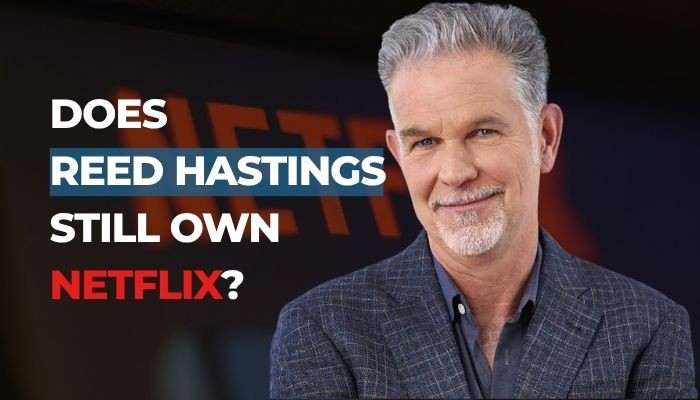
Reed Hastings retained a financial interest in Netflix in 2026, but he did not own or control the company. Netflix’s April proxy attributed 37,759,062 beneficial shares to Hastings, including 16,595,546 stock options and 21,159,576 shares held by the Hastings-Quillin Family Trust.
Hastings stepped away from the CEO role in 2023 and chose not to stand for re-election to the board in 2026. His board term ended at Netflix’s June 4, 2026 annual meeting, after which Jay Hoag became chairman. His remaining financial interest is relevant to who owns Netflix, but it does not give him majority ownership or formal control of the company.
Who Founded Netflix?
Netflix’s founding story begins with Reed Hastings and Marc Randolph, whose roles helped shape the company before ownership became widely distributed among public shareholders.
- Netflix was founded in 1997 by Reed Hastings and Marc Randolph.
- The company was incorporated on August 29, 1997, and began operations on April 14, 1998.
- Marc Randolph served as Netflix’s first CEO and helped launch its original online DVD rental business.
- Reed Hastings later became Netflix’s long-term leader and guided its shift from DVD rentals to global streaming.
- Hastings stepped away from the CEO role in 2023 and left Netflix’s board in June 2026.
- Randolph no longer has an executive or board role at Netflix.
- These founder details help explain who owns Netflix today because neither co-founder has majority control.
- The answer to who owns Netflix now rests with its public shareholders rather than its founders.
Who Controls Netflix in 2026?
Netflix does not have a single controlling investor. Control is shared across shareholders, the board, and executive management, which is important when explaining who owns Netflix.
- Shareholders: Own Netflix stock, elect directors, and vote on major corporate matters.
- Voting structure: Each common share carries one vote.
- Board of Directors: Oversees strategy, governance, executive leadership, risk, and major company decisions.
- Board size: Netflix shareholders elected 12 directors at the June 4, 2026 annual meeting.
- Executive Management: Ted Sarandos and Greg Peters serve as co-CEOs and manage the company’s day-to-day operations.
- Control structure: Shareholders own the company, the board provides oversight, and management runs the business.
- This structure shows that who owns Netflix is different from who manages or oversees the company.
Who Is Netflix’s Chairman?
Jay Hoag is chairman of Netflix’s board in 2026. He took the role after the June 4 annual meeting and had served as lead independent director since 2012. Hoag oversees the board rather than Netflix’s daily operations, an important distinction when explaining who owns Netflix.
Who Runs Netflix Day to Day?
Ted Sarandos and Greg Peters serve as Netflix’s co-CEOs and lead the company’s day-to-day business. Netflix’s July 2026 filing confirmed both remained co-Chief Executive Officers, showing why management and who owns Netflix are separate questions.
How Netflix Shareholders Exercise Control
Netflix shareholders influence the company mainly through voting and director elections. These rights are important when examining who owns Netflix because voting power generally follows share ownership rather than special founder control.
Key shareholder rights include:
- One vote per share
- Annual director elections
- Majority voting in uncontested elections
- No supermajority voting provisions
- Proxy access for qualifying shareholders
- Special-meeting rights for qualifying shareholders
A group of up to 20 shareholders holding at least 3% for three continuous years can use Netflix’s proxy-access process. Shareholders with at least a 20% net-long position for one year may call a special meeting, subject to company rules.
Does Netflix Have Dual-Class Founder Shares?
No. Netflix uses a single class of common stock with one vote per share. Reed Hastings does not hold a separate class of super-voting shares, making the voting structure easier to understand when determining who owns Netflix.
Netflix Executive Stock Ownership Requirements
Netflix requires its co-CEOs to maintain qualifying stock ownership equal to at least six times base salary within the applicable compliance period. Other covered executive officers must hold at least three times base salary.
These requirements align executives with shareholders but do not give executives ownership control over Netflix.
What Companies Does Netflix Own?
Netflix has no parent company, but it owns several significant subsidiaries. Its latest SEC subsidiary disclosure lists the following businesses as 100% owned:
| Significant Netflix Subsidiary | Jurisdiction | Ownership |
|---|---|---|
| Netflix International B.V. | Netherlands | 100% |
| Netflix Studios, LLC | United States | 100% |
| Netflix México S. de R.L. de C.V. | Mexico | 100% |
| Netflix Pte. Ltd. | Singapore | 100% |
| Netflix Services France S.A.S. | France | 100% |
| Netflix Services UK Limited | United Kingdom | 100% |
| Netflix Services Germany GmbH | Germany | 100% |
| Netflix Worldwide Entertainment, LLC | United States | 100% |
Netflix notes that this is a list of its significant subsidiaries, not necessarily every legal entity within the group.
Netflix is not owned by another corporation, but Netflix itself owns multiple subsidiaries.
Does Netflix Own Warner Bros., HBO or HBO Max?
No. Netflix does not own Warner Bros., HBO, or HBO Max in 2026.
Netflix agreed in December 2025 to acquire Warner Bros. Discovery’s streaming and studio businesses, including HBO and HBO Max. The agreement was amended in January 2026 but terminated on February 27, 2026, when WBD entered into a merger agreement with Paramount Skydance. Netflix received a $2.8 billion termination fee.
The transaction therefore never gave Netflix ownership of those businesses. This distinction is useful when explaining who owns Netflix, particularly because information published before February 2026 may still refer to the proposed acquisition.
Is Netflix Owned by Disney?
No. Netflix and The Walt Disney Company are separate publicly traded entertainment companies.
Disney does not own Netflix, and Netflix is not a Disney subsidiary.
Is Netflix Owned by Amazon?
No. Amazon does not own Netflix.
Amazon operates Prime Video, while Netflix remains an independent publicly traded company under the NFLX ticker.
Is Netflix Owned by Google?
No. Alphabet, Google’s parent company, does not own Netflix.
Netflix operates independently, while YouTube competes with Netflix and other platforms for viewers’ time.
Is Netflix Owned by BlackRock or Vanguard?
Neither BlackRock nor Vanguard-associated investment entities own a majority of Netflix. They are significant institutional investors, but that does not make either organization Netflix’s parent company or controlling owner.
This distinction is important for who owns Netflix because institutional share ownership provides economic and voting influence without giving an asset manager direct control over Netflix’s operations.
Why Institutional Investors Matter

Institutional investors can influence Netflix through shareholder voting even without majority ownership. Their voting rights can affect:
- Director elections
- Executive compensation votes
- Shareholder proposals
- Corporate-governance matters
For who owns Netflix, the key difference is that shareholders provide ownership and voting power, while the board and executive team make governance and operating decisions.
Why Netflix Ownership Percentages Keep Changing
Netflix ownership percentages change as investors buy or sell shares, employees exercise equity awards, and Netflix issues or repurchases stock.
During the first six months of 2026, Netflix repurchased approximately 66.43 million shares for $5.9 billion. As of June 30, another $27.1 billion remained authorized for repurchases. Netflix had 4,163,939,676 shares outstanding at that date, compared with 4,222,162,150 at the end of 2025.
These changes explain why a reliable who owns Netflix analysis should always attach a date to institutional ownership percentages.
Netflix’s 10-for-1 Stock Split Explained
Netflix completed a 10-for-1 forward stock split on November 14, 2025. Shareholders of record on November 10 received nine additional shares for every share already held.
The split increased the number of shares but did not increase an investor’s percentage ownership. An investor holding 1% immediately before the split would still hold roughly 1% afterward, assuming no other transactions.
Netflix reported 4,222,162,150 shares outstanding at December 31, 2025 following the split.
How Netflix Became Publicly Owned
Netflix began as a private company in 1997 and started operations in April 1998. It completed its initial public offering on May 29, 2002, selling 5.5 million shares at $15 per share. Its stock was listed on Nasdaq under the symbol NFLX.
The IPO transformed the answer to who owns Netflix. Ownership gradually shifted from founders and early investors to a broad mix of institutional and individual shareholders who can buy and sell NFLX stock in the public market.
Netflix Ownership Timeline
Netflix’s ownership and leadership have changed significantly since the company was founded in 1997.
| Year | Ownership and Leadership Milestone |
|---|---|
| 1997 | Netflix is founded and incorporated |
| 1998 | Netflix begins operations with its DVD business |
| 2002 | Netflix completes its IPO and becomes publicly traded |
| 2020 | Ted Sarandos becomes co-CEO alongside Reed Hastings |
| 2023 | Greg Peters becomes co-CEO with Sarandos |
| 2023 | Reed Hastings becomes executive chairman |
| 2025 | Hastings transitions to non-executive chairman |
| 2025 | Netflix completes a 10-for-1 stock split |
| February 2026 | Proposed Warner Bros. Discovery transaction is terminated |
| June 2026 | Reed Hastings leaves Netflix’s board |
| June 2026 | Jay Hoag becomes board chairman |
| 2026 | Ted Sarandos and Greg Peters continue as co-CEOs |
Ted Sarandos became co-CEO in July 2020, Greg Peters joined him as co-CEO in January 2023, and Jay Hoag became chairman after Netflix’s June 2026 annual meeting.
This timeline adds useful context to who owns Netflix, showing its transition from founder leadership to a widely held public company with independent board oversight.
How Big Is Netflix as a Business?
Netflix’s financial scale helps explain why its ownership and corporate governance attract substantial investor attention.
| Financial Metric | 2025 Result |
|---|---|
| Revenue | $45.18 billion |
| Revenue growth | About 16% |
| Operating income | $13.33 billion |
| Operating margin | 29.5% |
| Net income | $10.98 billion |
Netflix generated $45.18 billion in 2025 revenue, with operating income reaching $13.33 billion and net income reaching $10.98 billion.
Netflix Ownership vs Netflix Management
The clearest way to explain who owns Netflix is to separate shareholder ownership from board oversight and executive management.
| Question | Answer |
|---|---|
| Who owns Netflix? | Its shareholders |
| Who runs Netflix? | Ted Sarandos and Greg Peters |
| Who oversees management? | Netflix’s board of directors |
| Who chairs the board? | Jay Hoag |
| Does Reed Hastings control Netflix? | No |
| Does Netflix have a parent company? | No |
| Is there a disclosed majority shareholder? | No |
| Does Netflix have founder super-voting shares? | No |
| Can public investors own Netflix? | Yes, by owning NFLX shares |
This structure means large investors such as BlackRock or Vanguard-related entities can have voting influence without directly running Netflix’s business.
Why the Answer to “Who Owns Netflix?” Is Often Misleading Online
Ownership information can become misleading when articles use outdated institutional holdings, treat beneficial ownership as direct personal ownership, or describe Reed Hastings using former leadership titles.
Another common source of confusion is the proposed Warner Bros. Discovery deal. Netflix agreed to the transaction in December 2025, but it was terminated on February 27, 2026, and Netflix received a $2.8 billion termination fee.
A reliable explanation of who owns Netflix should therefore distinguish current shareholders from management, include reporting dates for major holdings, and use Netflix’s latest SEC disclosures rather than older ownership snapshots.
Conclusion
Who owns Netflix in 2026 is ultimately a question of public-market ownership, not founder control. Netflix is held by a broad shareholder base that includes major institutions, individual investors, executives, and directors, with no single disclosed shareholder holding a majority stake.
The more important business story is how that ownership translates into control. Ted Sarandos and Greg Peters lead the company as co-CEOs, Jay Hoag chairs the board, and Reed Hastings no longer holds a formal governance role after leaving the board in June 2026.
Netflix’s one-share, one-vote structure reinforces that separation between ownership and management. Institutional investors may carry significant voting influence, but strategic and operational authority remains with the board and executive leadership.
For investors, that is the clearest way to view who owns Netflix today: a widely held public company whose value, governance, and long-term direction depend on the relationship between shareholders, directors, and management rather than any single owner.
FAQs About Who Owns Netflix
1. Who owns Netflix shares?
Netflix shares are owned by institutional investors, individual investors, executives, directors, and other public shareholders.
2. Who owns Netflix the most?
Netflix has no single majority owner. Large institutional investors hold significant stakes, but ownership changes over time.
3. Does Reed Hastings still own Netflix?
Reed Hastings still has a financial interest in Netflix, but he does not own or control the company.
4. Is Netflix owned by its founders?
No. Netflix is publicly owned by shareholders rather than controlled by Reed Hastings or Marc Randolph.
5. Does BlackRock own Netflix?
No. BlackRock is a major institutional shareholder, but it does not own a majority of Netflix.
6. Does Vanguard own Netflix?
Vanguard-related investment entities hold significant Netflix shares, but they do not own Netflix outright.
7. Who controls Netflix if shareholders own it?
Shareholders own Netflix, the board provides oversight, and Ted Sarandos and Greg Peters run the business as co-CEOs.
8. Why does who owns Netflix change over time?
Ownership percentages change as investors buy or sell shares and as Netflix issues or repurchases stock.
