


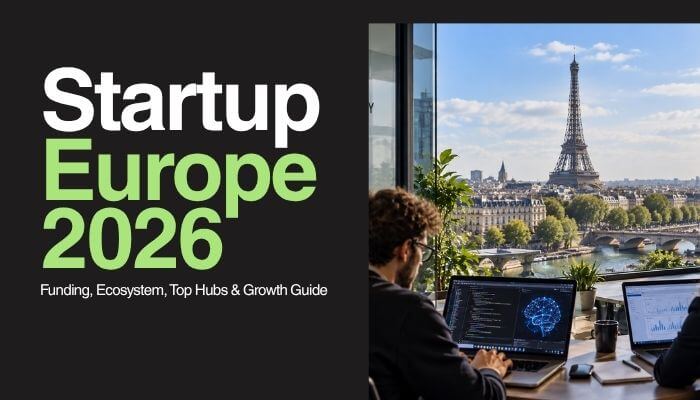

Startup Europe is an important part of Europe’s growing technology ecosystem, connecting startups and scaleups with investors, accelerators, universities, corporate networks, and other innovation partners. It is not a single EU grant but a European Commission initiative designed to strengthen startup connections and growth opportunities.
In 2026, the Startup Europe ecosystem continues to evolve through initiatives such as the EU Startup and Scaleup Strategy, EIC STEP Scale Up, the Scaleup Europe Fund, and the proposed EU Inc. framework. European startups also raised about $44.5 billion in the first half of 2026.
This Startup Europe 2026 guide covers funding opportunities, top startup hubs, regulations, emerging sectors, and practical strategies for building and scaling a business in Europe.
Quick Answer
Startup Europe is a European Commission initiative that helps connect technology startups and scaleups with investors, accelerators, universities, corporations, and innovation networks. It is not a single EU funding program. Founders can access the wider European startup ecosystem through EU and national funding programs, venture capital, research partnerships, accelerators, and major startup hubs across Europe.
Key Takeaways
- Startup Europe is an ecosystem initiative, not one universal funding program.
- European startups raised approximately $44.5 billion in H1 2026.
- The EU Startup and Scaleup Strategy contains 26 actions across five main areas.
- As of September 2026, 10 actions had been delivered and 16 were underway.
- The 2026 European Innovation Council work programme provides more than €1.4 billion across major funding schemes.
- The EIC Accelerator has a €634 million 2026 budget.
- EIC STEP Scale Up offers investments between €10 million and €30 million.
- The Scaleup Europe Fund is targeting approximately €5 billion in growth capital.
- AI, deep tech, energy, fintech, biotechnology, cybersecurity, robotics, and semiconductors are important areas of European startup activity.
- Founders should choose a startup location based on customers, talent, investors, industry specialization, regulation, and operating costs rather than rankings alone.
What Is Startup Europe?
Startup Europe is a European Commission initiative designed to strengthen Europe’s technology startup ecosystem by connecting innovative companies with organizations that can help them grow.
The initiative brings together:
- High-tech startups
- Scaleups
- Investors
- Accelerators
- Corporate networks
- Universities
- Media organizations
- Innovation ecosystem builders
A particular focus of Startup Europe is improving networking opportunities for deep-tech startups and scaleups and strengthening connections across Europe’s innovation ecosystem.
Startup Europe has also been associated with wider European initiatives such as the EU Startup Nation Standard, Innovation Radar, Digital Innovation and Scale-up Initiative, and StepUp StartUps.
Therefore, founders should view Startup Europe as part of a broader European innovation network rather than as a single funding or grant program.
Startup Europe vs European Startup Ecosystem
Although the terms are related, they do not mean the same thing.
| Term | What It Means |
|---|---|
| Startup Europe | European Commission initiative connecting startups, scaleups, and ecosystem participants |
| European startup ecosystem | Broader network of founders, startups, investors, universities, accelerators, corporations, and other organizations across Europe |
| Horizon Europe | EU research and innovation funding framework |
| European Innovation Council | EU funding and investment system supporting breakthrough innovation |
| Digital Europe | EU program focused on deploying strategic digital technologies |
| Eurostars | International collaborative R&D program led by innovative SMEs |
| InvestEU | EU investment framework that operates largely through financial intermediaries |
| Scaleup Europe Fund | Growth-capital initiative targeting strategic European technology companies |
The key distinction is simple: Startup Europe connects and strengthens the startup ecosystem, while programs such as Horizon Europe, the EIC, Digital Europe, and Eurostars provide specific funding or support opportunities.
Understanding this difference can help founders focus on the right programs instead of searching for a single Startup Europe grant.
How Large Is the European Startup Ecosystem in 2026?
Europe has developed a substantial venture-backed technology ecosystem.
According to Dealroom, European startups raised:
- $63.8 billion during 2025
- $44.5 billion during H1 2026
- $25.6 billion during Q2 2026
VC-backed European startups founded since 1990 have an estimated combined enterprise value of approximately $3.8 trillion.
Dealroom also tracks hundreds of European unicorns and thousands of venture-backed companies across industries ranging from artificial intelligence to energy and biotechnology.
However, overall funding figures require context.
Large-scale-up rounds can account for a significant portion of annual venture investment. This means strong headline funding numbers do not necessarily indicate that early-stage capital is equally easy to obtain.
Europe’s ability to fund companies as they move from promising startups to global-scale businesses remains one of the biggest policy priorities in 2026.
What Changed for Startup Europe in 2026?
Several major policy initiatives are reshaping Startup Europe in 2026, with a stronger focus on easier regulation, better access to growth capital, research commercialization, talent, and cross-border expansion.
EU Startup and Scaleup Strategy
The European Commission launched the EU Startup and Scaleup Strategy in May 2025 to make Europe more attractive for launching and growing technology-driven companies.
The strategy includes 26 actions across five key areas:
- Simplify regulations and reduce barriers
- Improve access to funding
- Accelerate market uptake and expansion
- Attract and retain top talent
- Improve access to infrastructure, technology hubs, networks, and services
As of September 2026, 10 actions had been delivered and 16 were launched and ongoing. Most actions are expected to be delivered by the end of 2026, with several continuing into 2027.
The strategy shows Europe’s increasing focus on helping promising startups not only launch but also scale into internationally competitive companies.
EU Inc.
In March 2026, the European Commission proposed EU Inc., an optional harmonized corporate framework intended to make it easier for innovative companies to start, operate, and expand across the EU.
Key proposed features include:
- Company formation within 48 hours
- Registration costing less than €100
- No minimum share-capital requirement
- Fully digital procedures throughout a company’s lifecycle
- Simplified share transfers and financing procedures
- Easier cross-border business operations
However, EU Inc. remains a legislative proposal. Founders should not treat it as an already available replacement for existing national company structures.
European Innovation Act
On September 9, 2026, the European Commission proposed the European Innovation Act to help European innovations move more efficiently from research to commercialization and international growth.
Key proposed measures include:
- A common EU framework for valuing intellectual property
- An EU-wide marketplace for commercializing IP assets
- Better access to IP-backed financing
- A harmonized framework for R&D procurement
- Support for moving innovative technologies to market faster
The European Innovation Act is also a proposal, so founders should distinguish its planned measures from rules that are already in force.
Startup Europe Funding Options in 2026
There is no single funding program that fits every European startup. Startup Europe funding can come from EU programs, national initiatives, venture capital, angel investors, corporate investors, and other financing sources.
The right funding option depends on factors such as:
- Startup stage
- Industry and technology
- Technology readiness
- Geographic eligibility
- Capital requirements
- Commercial maturity
- Research intensity
For founders, the goal should be to match the funding program to the company’s current stage and next major business milestone.
European Innovation Council Funding
The European Innovation Council (EIC) is one of the EU’s major funding and investment mechanisms for breakthrough technologies and high-impact innovation.
Its 2026 work programme provides more than €1.4 billion across several funding schemes.
| EIC Program | 2026 Budget | Main Support |
|---|---|---|
| EIC Pathfinder | €262 million | Grants generally up to €4 million |
| EIC Transition | €100 million | Grants up to €2.5 million |
| EIC Accelerator | €634 million | Grants plus equity investment |
| EIC STEP Scale Up | €300 million | €10M–€30M equity investments |
| STEP Defence Scale Up | €100 million | Equity support for defence technologies |
The EIC primarily supports breakthrough innovation, deep tech, and technologies with significant market potential. Individual programs target different stages, from early scientific research through commercialization and large-scale growth.
Conventional ecommerce businesses, consulting firms, local service companies, and startups without a sufficiently innovative technology component should not automatically assume they qualify. Eligibility should always be checked against the requirements of the specific EIC program.
EIC Pathfinder
EIC Pathfinder supports early-stage research into breakthrough and high-risk technologies with the potential to create new scientific or commercial opportunities.
The 2026 program has a budget of approximately €262 million, with grants generally available up to €4 million.
Pathfinder can be particularly relevant to areas such as:
- Artificial intelligence
- Quantum technologies
- Biotechnology
- Semiconductors
- Robotics
- Advanced materials
- Energy technologies
- Photonics
This program is most suitable for research-driven teams developing highly innovative technologies rather than conventional startups with established commercial products.
EIC Transition
EIC Transition helps turn eligible research results and emerging technologies into commercially viable innovations.
The 2026 program has a budget of approximately €100 million, with grants available up to €2.5 million.
Funding can support activities such as:
- Technology validation
- Prototype development
- Market validation
- Commercialization planning
- Business-model development
- Investment readiness
For university spinouts and research-led companies, EIC Transition can help bridge the gap between promising research and commercial deployment.
EIC Accelerator
The EIC Accelerator supports startups and SMEs developing high-risk innovations with the potential to create new markets or disrupt existing ones.
Its 2026 budget is approximately €634 million.
| Funding Component | Available Support |
|---|---|
| Grant | Below €2.5 million |
| Investment | €500,000–€10 million |
| Additional Support | Coaching, mentoring and ecosystem access |
The application process generally includes three main stages:
- Short proposal
- Full proposal
- Interview with an EIC jury
Competition is strong. Applicants therefore need convincing evidence of technological innovation, market opportunity, team capabilities, scalability, and financing requirements.
In June 2026, the EIC Accelerator and STEP Scale Up were also opened to qualifying dual-use technologies.
EIC STEP Scale Up
EIC STEP Scale Up is aimed at strategic technology companies preparing much larger financing rounds.
The program has a €300 million budget for 2026, with investments ranging from €10 million to €30 million per company.
Priority technology areas include:
- Digital and deep technologies
- Clean and resource-efficient technologies
- Biotechnology
The program is intended to help promising European companies attract significantly larger private investment rounds and reduce Europe’s scale-up financing gap.
In July 2026, six companies from an evaluation round were selected for potential investments totaling up to €97 million, subject to EIC Fund due diligence.
Is There an EIC Pre-Accelerator Call in 2026?
No. Founders should be careful with older information about this program.
The EIC Pre-Accelerator is designed to improve the technology, business, and investor readiness of early-stage deep-tech SMEs in eligible widening countries. However, there is no EIC Pre-Accelerator call in 2026.
The EIC indicates that the next call is planned for 2027, so founders should check the latest official EIC funding information before preparing an application.
Scaleup Europe Fund
The Scaleup Europe Fund is intended to address one of the biggest challenges facing the European startup ecosystem: access to large late-stage growth capital.
The initiative targets a fund of approximately €5 billion, anchored by a €1 billion commitment from the European Commission alongside private and institutional investment.
Its strategic investment areas include:
- Artificial intelligence
- Quantum technologies
- Semiconductors
- Robotics and autonomous systems
- Clean and energy technologies
- Space technology
- Biotechnology and medical technology
- Advanced materials
- Agritech
EQT was selected as the preferred independent investment manager.
As of September 2026, the fund is progressing through its legal and governance setup, with initial investments expected following its first closing.
The Scaleup Europe Fund complements EIC programs by targeting financing needs beyond the €30 million maximum investment available through EIC STEP Scale Up.
InvestEU
InvestEU can also support financing for startups, scaleups, and SMEs, but it should not be treated as a standard direct startup grant.
Financing generally reaches businesses through financial intermediaries such as:
- Banks
- Venture capital funds
- Investment funds
- Financial institutions
- Other financing partners
Founders should therefore look for InvestEU-supported intermediaries operating in their country, sector, and financing stage rather than searching for one general InvestEU startup application.
Digital Europe Programme
The Digital Europe Programme supports the deployment and wider adoption of strategic digital technologies across European businesses, governments, and society.
Its 2021–2027 budget is approximately €7.6 billion.
Major areas include:
- Artificial intelligence
- Cybersecurity
- Supercomputing
- Semiconductors
- Advanced digital skills
- Wider adoption of digital technologies
Digital Europe operates through individual funding calls with specific objectives and eligibility requirements.
For example, cybersecurity calls opened on September 1, 2026, with application deadlines extending into January 2027.
Technology startups should therefore identify calls directly related to their projects rather than treating Digital Europe as a general Startup Europe funding program.
Eurostars
Eurostars supports international collaborative research and development projects led by innovative SMEs.
A qualifying consortium generally requires:
- An innovative SME leading the project
- At least two independent participating organizations
- Participants from multiple eligible countries
- A commercially focused R&D project
Funding levels and eligible costs depend on the national funding bodies participating in the project.
Eurostars can be particularly useful for startups seeking:
- International R&D partnerships
- University or research collaboration
- Product development
- Technology validation
- Cross-border innovation
For research-intensive startups, Eurostars can provide a useful route for combining international collaboration with commercially focused technology development.
National and Regional Funding
Startup Europe funding opportunities extend beyond EU-level programs. Individual European countries and regions may offer their own financial support for startups, SMEs, research projects, and innovative businesses.
Depending on the company’s location, industry, and development stage, founders may find:
- National innovation grants
- Regional startup funds
- Government-backed loans
- R&D tax incentives
- University commercialization funding
- Public co-investment schemes
- Startup accelerators
- Angel investment
- Local venture capital
These programs can be especially useful for early-stage startups that are not yet ready for highly competitive EU-wide funding.
Eligibility, funding amounts, deadlines, and application requirements vary significantly by country and region. Founders should therefore compare national and regional opportunities alongside EU programs before deciding which funding route best matches their next business milestone.
How to Find Startup Europe Funding
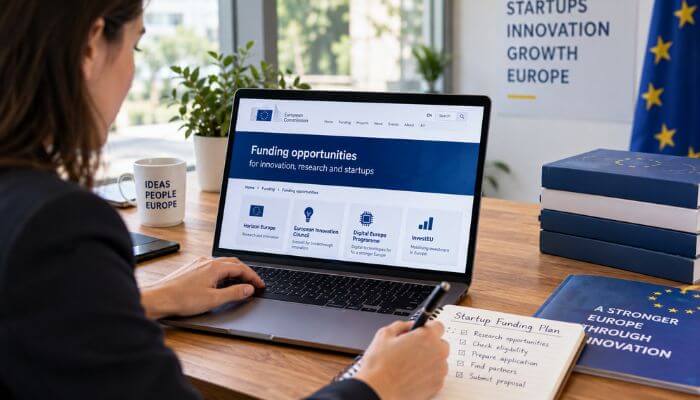
Finding the right Startup Europe funding opportunity becomes easier when founders focus on programs that match their business stage, technology, location, and financing needs.
Step 1: Know Your Startup Stage
Identify whether your company is at the research, pre-seed, seed, growth, or scale-up stage. Different funding programs support different stages of development.
Step 2: Choose the Right Funding Type
Decide whether you need a grant, equity investment, loan, R&D funding, or a combination of financing options. The right choice depends on what the funding will be used for.
Step 3: Find Relevant Programs
Search official EU, national, and regional funding sources. Compare programs such as EIC Pathfinder, EIC Transition, EIC Accelerator, Digital Europe, Eurostars, and relevant local initiatives.
Step 4: Check Eligibility
Before applying, confirm the program’s country requirements, company size, technology criteria, funding limits, deadlines, eligible costs, and any consortium or co-financing requirements.
Step 5: Match Funding to Your Next Goal
Choose funding that supports a specific business milestone, such as developing a prototype, validating the technology, entering a new market, increasing production, or expanding internationally.
Step 6: Prepare a Strong Application
Clearly explain the problem, your solution, market opportunity, technology, team, expected impact, funding needs, and how the project will achieve measurable results.
Step 7: Verify Current Requirements
Funding calls, budgets, deadlines, and eligibility rules can change. Always check the latest official program information before submitting an application.
Startup Europe Funding by Stage and Need
Different Startup Europe funding options are suitable for different stages of business and technology development.
| Startup Stage or Need | Funding Options to Explore |
|---|---|
| Scientific research | EIC Pathfinder, research grants |
| Technology commercialization | EIC Transition |
| Pre-seed | Angel investors, incubators, regional funding |
| Seed | Venture capital, angel investors, public co-investment |
| Series A | Venture capital, corporate VC, national programs |
| High-risk innovative startup | EIC Accelerator |
| Strategic scaleup | EIC STEP Scale Up |
| Major growth financing | Scaleup Europe Fund |
| Collaborative R&D | Eurostars |
| Digital technology deployment | Digital Europe |
| General SME financing | InvestEU-supported intermediaries |
These options are a starting point rather than a guarantee of eligibility. Founders should check the requirements of each program before applying.
Top Startup Hubs in Europe in 2026
Europe has many strong startup hubs, and the right location depends on industry, funding needs, talent, customers, and expansion plans.
Dealroom reports the following venture funding across European metro regions during the 12 months ending Q2 2026.
| Rank | Startup Hub | VC Funding |
|---|---|---|
| 1 | London | $26.2B |
| 2 | Paris | $8.5B |
| 3 | Stockholm | $4.2B |
| 4 | Munich | $3.3B |
| 5 | Berlin/Brandenburg | $3.2B |
| 6 | Cambridge | $3.0B |
| 7 | Helsinki | $1.9B |
| 8 | Amsterdam | $1.7B |
| 9 | Copenhagen | $1.4B |
| 10 | Barcelona | $1.3B |
Data note: These figures measure venture funding rather than the overall quality of each startup ecosystem.
Key Startup Hubs at a Glance
- London: Strong in fintech, AI, enterprise software, and cybersecurity, with extensive access to international investors. The UK is not an EU Member State, so EU funding eligibility should be checked separately.
- Paris: Major hub for AI, deep tech, fintech, biotechnology, and quantum technologies.
- Stockholm: Known for software, fintech, gaming, climate technology, and energy startups.
- Munich: Strong in robotics, mobility, aerospace, industrial technology, AI, and deep tech.
- Berlin: Established ecosystem for SaaS, fintech, ecommerce, climate tech, and digital businesses.
- Cambridge: Research-driven hub with strengths in biotechnology, semiconductors, AI, and university spinouts.
- Helsinki: Active in gaming, deep tech, communications, energy, and industrial innovation.
- Amsterdam: Strong in B2B software, fintech, cybersecurity, AI, and consumer technology.
- Copenhagen: Notable for life sciences, health technology, sustainability, and climate tech.
- Barcelona: Growing ecosystem for AI, biotechnology, robotics, semiconductors, space, and fintech.
For founders exploring Startup Europe, VC funding is only one factor. Industry expertise, operating costs, talent, customers, regulations, and access to research networks should also influence the choice of location.
Best Startup Europe Hubs by Business Type
Different European startup hubs have strengths in different industries. The table below provides a quick starting point for founders comparing locations.
| Startup Type | Hubs Worth Researching |
|---|---|
| Fintech | London, Paris, Amsterdam, Berlin |
| Artificial Intelligence | London, Paris, Munich, Berlin |
| Biotechnology | Cambridge, Paris, Copenhagen, Munich |
| Deep Tech | Cambridge, Munich, Paris, Helsinki |
| SaaS | London, Berlin, Amsterdam, Stockholm |
| Climate Tech | Stockholm, Copenhagen, Berlin, Amsterdam |
| Robotics | Munich, Paris, Barcelona |
| Gaming | Stockholm, Helsinki |
| Semiconductors | Cambridge, Munich, Barcelona, Amsterdam |
| Enterprise Technology | London, Paris, Munich, Amsterdam |
These are not rankings. The best location depends on factors such as customers, talent, funding, operating costs, infrastructure, regulations, and the startup’s specific requirements.
European Startup and Scaleup Scoreboard
Founders should also compare countries rather than relying only on city funding rankings. The European Commission’s European Startup and Scaleup Scoreboard uses 36 indicators across six dimensions to monitor EU startup and scale-up ecosystems.
The six dimensions are:
- Innovation-friendly regulation
- Better financing
- Talent attraction
- Faster market expansion
- Infrastructure, networks, and services
- Impact
The current dataset covers 2020–2025.
The scoreboard is useful because venture funding alone cannot show whether a country offers strong regulation, infrastructure, talent, or scale-up conditions.
Its 2026 materials also identify later-stage financing as an important constraint for European startup ecosystems.
How to Choose the Right Startup Hub
Choosing the right Startup Europe hub involves more than selecting the largest or best-known city. Founders should compare six practical factors.
1. Customer Access: Consider where your target customers are located. A B2B industrial startup, for example, may benefit more from being close to manufacturers than from choosing a major consumer-tech hub.
2. Talent: Evaluate the availability and cost of the people your company needs, including engineers, AI specialists, researchers, product managers, sales professionals, and experienced executives.
3. Investors: Look at the type of capital available in the ecosystem. A startup seeking seed funding has different investor requirements from a scaleup preparing a major growth round.
4. Industry Cluster: Consider whether the location has a strong ecosystem for your sector. Biotech companies may benefit from proximity to hospitals and laboratories, while robotics startups may value access to industrial customers and research centers.
5. Operating Costs: Compare salaries, office costs, taxes, housing, employer expenses, and legal costs. A smaller startup hub may sometimes offer a more sustainable cost structure than a major capital city.
6. Infrastructure: Consider the physical and technical infrastructure your company requires, such as laboratories, manufacturing facilities, testing centers, computing resources, universities, and specialized research equipment.
The best startup hub is ultimately the one that provides the right combination of customers, talent, capital, industry expertise, costs, and infrastructure for the company’s growth strategy.
Industries Driving Startup Europe in 2026
Several technology sectors are helping shape Startup Europe in 2026, supported by venture investment, research institutions, public funding, and growing demand for advanced technologies.
1. Artificial Intelligence
AI remains a major area of European startup investment. Dealroom reports approximately $37.3 billion in European AI venture funding during the 12 months ending Q2 2026, although its industry categories can overlap.
Key areas include generative AI, AI infrastructure, enterprise AI, robotics, healthcare AI, cybersecurity, and scientific applications.
Europe is also expanding computing infrastructure. In July 2026, the EU launched a process aimed at establishing up to seven AI Gigafactories, supported by up to €10 billion in EU and national funding and designed to help attract additional private investment.
2. Deep Tech
Europe’s universities and research institutions support a strong deep-tech ecosystem. Important fields include quantum technologies, semiconductors, robotics, advanced materials, biotechnology, space, photonics, and advanced energy technologies.
Climate and Energy Technology
Climate-tech startups are developing solutions across renewable energy, batteries, energy storage, electricity grids, carbon management, green materials, and industrial decarbonization.
3. Fintech
Europe continues to support a diverse fintech ecosystem covering payments, digital banking, lending, insurtech, financial infrastructure, regulatory technology, and business finance.
4. Biotechnology and Health Technology
Universities, hospitals, research centers, and pharmaceutical companies provide an important foundation for startups working in drug discovery, diagnostics, medical devices, biotechnology, healthcare AI, and digital health.
5. Cybersecurity
Cybersecurity is becoming increasingly important as businesses and public organizations respond to evolving digital threats and regulatory requirements. European funding initiatives also support areas such as AI-powered cybersecurity, dual-use technologies, compliance capabilities, and critical infrastructure protection.
Regulations Startup Europe Founders Should Understand
Building a business in Europe can involve important regulatory responsibilities. The rules that apply depend on the startup’s industry, technology, customers, and use of data.
1. GDPR
Startups that process personal data may need to comply with the General Data Protection Regulation (GDPR). Key considerations can include data collection, consent, security, retention, user rights, processors, and international data transfers.
Privacy should therefore be considered during product development rather than only after launch.
2. EU AI Act
AI startups should also understand the EU AI Act. Requirements vary depending on the type of AI system, its intended use, and its regulatory classification.
Important areas include prohibited AI practices, high-risk systems, transparency obligations, general-purpose AI, biometric applications, and certain AI-generated content requirements.
Founders developing AI products should determine which rules apply to their systems before expanding across European markets.
3. Cybersecurity
Depending on their industry and activities, startups may also face cybersecurity and digital-resilience requirements, particularly in regulated or critical sectors.
Cybersecurity should therefore be considered both a compliance requirement and a product-design priority.
Startup Visas and International Founders
International entrepreneurs sometimes search for a Startup Europe visa, but there is no single startup visa that automatically applies across every EU Member State. Immigration and founder-visa requirements continue to vary by country.
In January 2026, the European Commission adopted its first EU Visa Strategy alongside recommendations intended to improve Europe’s attractiveness to highly skilled professionals, researchers, students, startup founders, and innovative entrepreneurs.
International founders should still check the requirements of the country where they plan to live and operate, including:
- Startup or founder visa availability
- Residence and work permits
- Business incorporation requirements
- Investment requirements
- Tax residency
- Family residence rights
For international founders exploring Startup Europe, immigration rules should be evaluated alongside funding, market access, operating costs, and business regulations when choosing a country.
Business Support Beyond Funding
Funding is only one part of building and scaling a European startup. The Enterprise Europe Network supports startups and scaleups with areas such as access to finance, international expansion, business partnerships, investor readiness, and EU funding opportunities.
The network also provides scale-up advisory support, which can be useful for founders entering new European markets or looking for international business partners.
Advantages of Building a Startup in Europe
Startup Europe offers several advantages for founders building technology and innovation-driven companies.
1. Strong Research Ecosystem
Europe has major universities and research institutions supporting AI, biotechnology, quantum technologies, engineering, energy, medicine, and semiconductors.
2. Diverse Funding Options
Founders can explore venture capital, angel investment, EU programs, national funding, corporate investment, R&D incentives, debt, and growth equity.
3. Large Corporate Market
European companies across automotive, aerospace, pharmaceuticals, manufacturing, banking, energy, and other industries can become customers, investors, research partners, or pilot partners.
4. Access to Multiple Markets
The European Single Market can make cross-border growth easier, although differences in language, taxation, employment rules, and sector-specific regulations still require careful planning.
Challenges Facing Startup Europe
Founders should also consider several challenges when building and scaling across Europe.
1. Market Fragmentation: Languages, customer preferences, taxation, regulations, and business cultures vary across countries, making expansion more complex.
2. Late-Stage Funding: Access to large growth rounds remains an important challenge, which is one reason initiatives such as EIC STEP Scale Up and the Scaleup Europe Fund have received increased attention.
3. Regulatory Complexity: Depending on the business, startups may need to navigate rules covering privacy, AI, employment, taxation, financial services, product standards, and cybersecurity.
4. Competition for Talent: Startups compete with established technology companies and other employers for engineers, AI specialists, scientists, product leaders, and experienced executives.
5. Cross-Border Expansion Costs: Entering additional markets can create costs related to hiring, contracts, tax registration, localization, customer support, payments, and regulatory compliance.
Startup Europe Growth Strategy
A disciplined Startup Europe growth strategy can help founders expand efficiently while controlling costs and reducing unnecessary risk.
Step 1: Choose One Initial Market
Do not treat Europe as one homogeneous market. Choose your first country based on customer demand, competition, regulations, language, pricing, and distribution opportunities.
Step 2: Validate Product-Market Fit
Track metrics such as customer acquisition cost, retention, churn, gross margin, conversions, and revenue growth. Expand when the data shows repeatable demand.
Step 3: Match Funding to Your Next Milestone
Raise capital for a specific objective. Pre-seed funding may support product development, seed capital can help establish product-market fit, and later rounds can finance expansion and scaling.
Step 4: Use Grants Strategically
EU and national grants can support innovation and development, but they should complement a viable commercial strategy rather than replace one.
Step 5: Build Investor Relationships Early
Connect with investors before fundraising becomes urgent. Understand their preferred sectors, investment stages, typical cheque sizes, and geographic focus.
Step 6: Build Strategic Partnerships
Develop relationships with universities, research centers, corporations, accelerators, industry associations, and technology clusters that can support growth.
Step 7: Plan Compliance Early
Review privacy, AI, employment, tax, cybersecurity, and product requirements before expanding into additional European markets.
Step 8: Prepare for Localization
Make sure your product and operations can adapt to different languages, currencies, payment methods, contracts, tax requirements, and customer-support needs.
Step 9: Consider International Capital
European startups can combine local funding with international investment from markets such as North America, Asia, and the Middle East.
Step 10: Expand Based on Evidence
Enter additional markets when customer demand, financial performance, operational readiness, and available capital support expansion.
Common Startup Europe Mistakes to Avoid
Founders exploring Startup Europe should avoid several common mistakes that can waste time, capital, and growth opportunities.
1. Applying for Every Funding Program: Not every grant or investment program is suitable for every startup. Focus on opportunities that match your company’s stage, technology, location, and funding needs.
2. Expanding Too Early: Entering several countries before establishing product-market fit in one market can increase costs and operational complexity.
3. Choosing a Hub Because It Is Popular: A well-known startup city may not provide the right customers, investors, talent, research partners, or operating costs for your business.
4. Ignoring Regulation: Privacy, AI, tax, employment, cybersecurity, and industry-specific requirements should be considered before entering new markets.
5. Underestimating Localization: Localization involves more than translation. Pricing, payments, marketing, customer expectations, sales processes, and support may need to change between markets.
6. Raising Too Little Capital: Cross-border expansion can require significant spending on hiring, compliance, localization, marketing, and operations. Funding plans should account for these additional costs.
7. Depending Entirely on Grants: Public funding can support innovation and growth, but it should not replace a sustainable commercial model and genuine customer demand.
Is Startup Europe Only for EU Companies?
Not necessarily. The broader Startup Europe ecosystem includes startups, investors, technology hubs, and partners in European countries both inside and outside the European Union.
For example, London remains a major European startup hub even though the United Kingdom is not an EU Member State.
However, participation in specific EU funding programs depends on individual eligibility rules. Requirements may consider:
- Company location
- EU or associated-country status
- Company size
- Industry and technology
- Development stage
- Consortium requirements
A company being based in Europe does not automatically make it eligible for every EU funding opportunity. Founders should always check the official requirements of the specific program before applying.
Is Startup Europe Good for International Founders?
Europe can offer international founders access to technology talent, research institutions, venture capital, corporate customers, accelerators, startup communities, and public innovation programs.
However, conditions vary significantly between countries. Before choosing a location, founders should compare:
- Founder visa and residence requirements
- Incorporation and taxation
- Talent availability and costs
- Access to investors and startup funding
- R&D incentives
- Target customers and market access
The easiest country in which to incorporate is not necessarily the best place to build and scale a long-term business. Founders should choose a location based on the overall fit between immigration, customers, talent, capital, costs, and growth opportunities.
The Future of Startup Europe
The direction of Startup Europe in 2026 is increasingly focused on helping promising companies scale and compete internationally.
Several initiatives support this shift. The EU Startup and Scaleup Strategy addresses funding, talent, regulation, infrastructure, and market expansion. EIC STEP Scale Up provides larger investment opportunities for strategic technology companies, while the Scaleup Europe Fund is intended to expand access to late-stage growth capital.
Other proposals could also reshape the ecosystem. EU Inc. aims to simplify cross-border company formation, while the European Innovation Act focuses on improving the commercialization of research and innovation.
Europe still faces challenges involving market fragmentation, late-stage financing, regulation, talent competition, and international expansion. However, its combination of research, engineering talent, venture capital, industrial customers, and public innovation support continues to provide opportunities for startups seeking to build and scale across European markets.
Conclusion
Startup Europe in 2026 represents much more than a single European Commission initiative or funding program. It is part of a broad ecosystem connecting startups and scaleups with investors, universities, accelerators, corporations, research institutions, public funding programs, and major technology hubs across Europe.
With approximately $44.5 billion raised by European startups in the first half of 2026, founders can explore opportunities ranging from early-stage research funding and venture capital to EIC Accelerator support and large-scale growth investment.
However, funding alone does not determine success. Founders still need to choose the right market, understand regulations, attract talent, build strong investor and customer relationships, and expand internationally based on proven demand.
For ambitious founders, Startup Europe continues to offer a combination of research expertise, technology talent, public innovation support, private capital, and access to diverse European markets. Companies that combine these advantages with strong commercial execution can build a solid foundation for long-term growth.
FAQs About Startup Europe
1. Can a Bootstrapped Company Join the Startup Europe Ecosystem?
Yes. A startup does not need venture capital to participate in the Startup Europe ecosystem. Bootstrapped companies can still explore accelerators, partnerships, networking opportunities, research programs, and suitable public funding.
2. Does Startup Europe Support Female Founders?
Women entrepreneurs can access various European startup networks, funding opportunities, accelerators, mentoring programs, and investment initiatives. Eligibility depends on the individual program.
3. Can University Students Build a Startup Europe Company?
Yes. Students can launch startups in Europe and may benefit from university incubators, entrepreneurship programs, research commercialization support, competitions, and local startup networks.
4. Can Startup Europe Help a Company Find Business Partners?
The wider Startup Europe ecosystem can help founders connect with corporations, research institutions, accelerators, investors, and innovation networks that may lead to business partnerships.
5. Are Startup Europe Grants Tax-Free?
Not automatically. The tax treatment of grants can depend on the funding program, company structure, country, and applicable national tax rules. Founders should obtain country-specific tax guidance.
6. Can a Startup Apply for More Than One EU Funding Program?
Potentially, yes. A company may participate in different programs when it meets their requirements, but founders must follow rules concerning eligible costs, co-financing, and double funding.
7. Does Startup Europe Support Social Impact Startups?
Startups addressing social or environmental challenges may find relevant European funding and innovation programs, particularly when their projects align with the objectives and eligibility requirements of specific calls.
8. Do European Startups Need a Local Bank Account?
Requirements vary by country, company structure, and financial provider. Founders should check incorporation, banking, payment, and capital requirements in the jurisdiction where the company is established.
