


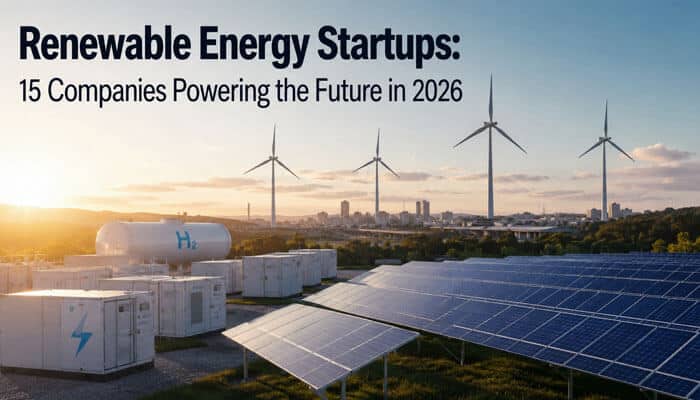

Renewable energy startups are no longer competing only to build cheaper solar panels or larger wind turbines. In 2026, some of the most innovative renewable energy startups are developing 100-hour batteries, advanced geothermal systems, sodium-ion storage, industrial heat batteries, solar-construction robots, distributed power networks, and technologies designed to make renewable electricity available around the clock.
The market behind these innovations is growing rapidly. Global renewable power capacity reached 5,149 GW at the end of 2025, after a record 692 GW of new capacity was added during the year. Renewables accounted for 85.6% of all new power capacity installed worldwide in 2025.
Another major milestone is approaching: renewable electricity generation is expected to overtake coal globally in 2026, while solar PV continues to expand faster than almost every other major source of electricity. But producing more renewable electricity is only part of the challenge. The next generation of renewable energy startups must also solve problems surrounding storage, reliability, transmission, industrial energy, recycling, and rising electricity demand.
Future energy systems need technologies that can:
- Store electricity for hours or days
- Connect new projects to congested grids
- Supply factories with high-temperature heat
- Provide reliable electricity to data centers
- Coordinate distributed batteries and solar systems
- Recycle aging battery packs
- Deliver renewable power when the sun is not shining, or the wind is not blowing
That is where many of today’s most promising renewable energy startups are competing.
Quick Answer: What Are the Best Renewable Energy Startups to Watch in 2026?
The renewable energy startups and growth-stage clean-tech companies attracting attention in 2026 include:
- Base Power
- Form Energy
- Antora Energy
- Rondo Energy
- Sage Geosystems
- Quaise Energy
- Eavor
- Exowatt
- Terabase Energy
- Airloom Energy
- Peak Energy
- Inlyte Energy
- Fourth Power
- Malta Inc.
- Redwood Materials
These renewable energy startups operate across energy storage, geothermal, solar, wind, industrial heat, grid technology, battery recycling, and distributed energy.
The most important trend is no longer simply who can generate clean electricity. It is who can make renewable power reliable, dispatchable, affordable, scalable, and easier to integrate into modern electricity grids.
Key Takeaways
- Global renewable capacity reached 5,149 GW in 2025, following 692 GW of new additions.
- Renewables represented 85.6% of new global power capacity added in 2025.
- Renewable electricity is expected to overtake coal-fired generation globally in 2026.
- Global clean-energy investment is projected at approximately $2.2 trillion in 2026.
- Leading renewable energy startups increasingly focus on storage, geothermal, industrial heat, grids, and automation.
- Form Energy is developing iron-air batteries capable of approximately 100 hours of storage.
- Antora Energy and Rondo Energy are commercializing thermal-storage technologies for industrial heat.
- Sage Geosystems, Quaise Energy, and Eavor are pursuing different approaches to next-generation geothermal.
- Peak Energy and Inlyte Energy are developing alternatives to conventional lithium-ion grid batteries.
- Commercial maturity varies considerably, so innovative technology should not automatically be interpreted as proven commercial success.
Renewable Energy Startups at a Glance
| Company | Core Technology | Main Opportunity | 2026 Maturity |
|---|---|---|---|
| Base Power | Residential batteries | Distributed grid resilience | Commercial deployment |
| Form Energy | Iron-air batteries | Multi-day storage | Early commercial deployment |
| Antora Energy | Carbon thermal batteries | Industrial heat | Commercial scaling |
| Rondo Energy | Brick heat batteries | Industrial decarbonization | Commercial deployment |
| Sage Geosystems | Pressure geothermal | Firm electricity | Early commercialization |
| Quaise Energy | Millimeter-wave drilling | Superhot geothermal | Development/demonstration |
| Eavor | Closed-loop geothermal | 24/7 heat and electricity | Early commercial deployment |
| Exowatt | Solar + thermal storage | Data-center power | Early commercialization |
| Terabase Energy | Robotics and AI | Faster solar construction | Commercial deployment |
| Airloom Energy | Alternative wind system | Lower-cost wind | Demonstration |
| Peak Energy | Sodium-ion batteries | Grid storage | Manufacturing scale-up |
| Inlyte Energy | Iron-sodium batteries | Long-duration storage | Early commercialization |
| Fourth Power | Thermal storage | Grid-scale storage | Demonstration/scale-up |
| Malta Inc. | Molten-salt storage | Long-duration power | Commercial development |
| Redwood Materials | Battery reuse/recycling | Circular energy storage | Commercial scaling |
Why Renewable Energy Startups Matter More in 2026
The importance of renewable energy startups is increasing because renewable generation and global electricity demand are expanding simultaneously. Data centers, electric vehicles, heat pumps, air conditioning, manufacturing, and industrial electrification are putting additional pressure on electricity systems. At the same time, solar and wind remain variable.
Solar generation disappears after sunset. Wind production changes with weather. Transmission systems can become congested, while new renewable projects may spend years waiting to connect to the grid. These challenges are creating a much broader market for renewable energy startups.
Instead of asking only “Who can generate renewable electricity?”, the industry increasingly needs answers to questions such as:
- Who can store renewable electricity for several days?
- Who can build solar farms faster?
- Who can reduce transmission congestion?
- Who can make geothermal economical in more places?
- Who can provide clean industrial heat?
- Who can coordinate millions of distributed batteries?
- Who can recycle battery materials economically?
Solving those problems may determine which renewable energy startups become major energy companies over the next decade.
Renewable Energy Market in 2026: Important Numbers
The market surrounding renewable energy startups now stretches far beyond solar and wind development.
| Market Indicator | Latest Figure |
|---|---|
| Global renewable capacity at end of 2025 | 5,149 GW |
| Renewable capacity added in 2025 | 692 GW |
| Renewable share of new 2025 capacity | 85.6% |
| Forecast global energy investment in 2026 | $3.4 trillion |
| Forecast clean-energy investment in 2026 | $2.2 trillion |
| Expected renewable additions, 2025–2030 | About 4,600 GW |
| Solar share of renewable additions through 2030 | Nearly 80% |
| U.S. generation in interconnection queues | About 1,312 GW |
| U.S. storage in interconnection queues | About 749 GW |
The numbers show that renewable energy is no longer a niche sector.
Opportunities for renewable energy startups extend across:
- Renewable generation
- Battery storage
- Transmission
- Grid software
- Thermal storage
- Battery recycling
- Industrial energy
- Project construction
- Distributed electricity
- Advanced geothermal
Not every company will succeed, but the addressable market for businesses solving major power-system bottlenecks is enormous.
How We Selected These Renewable Energy Startups
The renewable energy startups in this guide were not selected simply because they raised large funding rounds.
Companies were evaluated using factors including:
- Distinctive technology
- Commercial or technical progress
- Important 2025–2026 milestones
- Manufacturing development
- Real-world demonstrations
- Industrial or utility partnerships
- Ability to solve an important energy-system problem
- Potential scalability
- Relevance to renewable-energy growth through 2030
The term startup is used broadly to include venture-backed private companies and growth-stage clean-energy businesses. Inclusion in this list of renewable energy startups is not an investment recommendation. Several businesses still need to demonstrate that their technology can operate economically and reliably at commercial scale.
15 Renewable Energy Startups Powering the Future in 2026
1. Base Power — Turning Home Batteries Into Grid Infrastructure
Sector: Distributed energy storage
Technology: Lithium iron phosphate batteries
Base Power is one of the renewable energy startups approaching residential energy storage differently from conventional battery sellers. The company owns and operates batteries installed at customers’ homes while providing backup power during outages.
The larger opportunity is aggregation. Thousands of coordinated batteries can potentially operate as a distributed energy resource, charging when electricity is plentiful and helping support the grid when demand rises.
Why Base Power Matters
Base demonstrates how renewable energy startups can combine:
- Batteries
- Software
- Electricity services
- Grid flexibility
- Residential backup
Instead of selling one battery to one homeowner, the business model could turn thousands of residential batteries into a virtual power plant.
2. Form Energy — Building a 100-Hour Iron-Air Battery
Sector: Long-duration energy storage
Technology: Iron-air batteries
Form Energy is among the most closely watched renewable energy startups in long-duration battery storage. Most conventional grid batteries are designed primarily for shorter-duration applications.
Form Energy is targeting a different problem. Its iron-air battery is designed to provide approximately 100 hours of energy storage, potentially allowing electricity systems to operate through several days of weak wind or solar generation.
The company’s announced project pipeline includes a 10 MW/1,000 MWh system in Ireland, illustrating the unusually long discharge duration targeted by the technology.
Why Form Energy Matters
A four-hour battery can move solar electricity from afternoon into the evening. A 100-hour battery could help cover much longer periods of renewable-energy shortages.
This makes multi-day storage one of the most important areas being pursued by renewable energy startups as solar and wind penetration grows.
3. Antora Energy — Turning Electricity Into Industrial Heat
Sector: Thermal energy storage
Technology: Solid-carbon thermal batteries
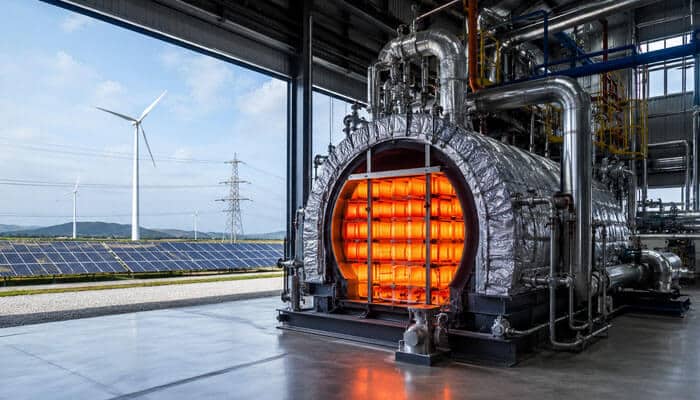
Antora Energy is one of several renewable energy startups targeting industrial decarbonization rather than conventional electricity generation. The company stores renewable electricity as extremely high-temperature heat inside carbon.
Its technology addresses an enormous but less visible energy market: industrial heat. Factories producing fuels, chemicals, food, metals, and other materials frequently require heat or steam around the clock.
Antora’s Project Big Stone in South Dakota represents a major step toward large-scale thermal-storage deployment, using hundreds of thermal batteries to support industrial energy demand.
Why Antora Energy Matters
Industrial customers do not necessarily need electricity when their final requirement is heat. Thermal-storage renewable energy startups could allow factories to purchase electricity during inexpensive periods, store that energy, and use it later as continuous process heat.
4. Rondo Energy — Storing Renewable Energy in Hot Bricks
Sector: Industrial thermal storage
Technology: Rondo Heat Battery
Rondo Energy belongs to a growing category of renewable energy startups using thermal storage to address industrial energy demand. The company uses refractory brick to store electricity as high-temperature heat.
Electricity heats the brick material, which can later deliver industrial steam or process heat. A 100 MWh Rondo Heat Battery entered commercial operation in California in 2025, demonstrating how on-site solar generation can be converted into continuous industrial heat.
Why Rondo Energy Matters
Rondo’s technology uses relatively familiar industrial materials rather than depending heavily on scarce battery minerals. That could make thermal batteries attractive for factories requiring high-temperature energy and shows why industrial heat has become a major opportunity for renewable energy startups.
5. Sage Geosystems — Making Geothermal More Flexible
Sector: Advanced geothermal
Technology: Pressure geothermal
Sage Geosystems represents another important group of renewable energy startups: companies trying to expand geothermal beyond traditional locations. Sage applies drilling and subsurface-engineering techniques to geothermal energy and underground energy storage.
The company’s approach aims to reduce geothermal’s dependence on naturally ideal reservoirs. In 2026, Sage continued moving toward commercial pressure-geothermal power development.
Why Sage Geosystems Matters
Geothermal can provide something solar and wind cannot provide alone: firm electricity available regardless of current weather conditions.
If companies such as Sage can expand the geographic range of geothermal, advanced geothermal could become one of the most important segments of the renewable energy startups market.
6. Quaise Energy — Drilling Toward Superhot Geothermal
Sector: Advanced geothermal
Technology: Millimeter-wave drilling
Quaise Energy is one of the most technically ambitious renewable energy startups in advanced geothermal. It is developing millimeter-wave drilling technology intended to access extremely deep and hot underground rock. The company’s Project Obsidian in Oregon is designed to move superhot geothermal closer to commercial deployment.
Why Quaise Energy Matters
Extremely hot geothermal resources could potentially provide enormous amounts of continuous electricity. However, Quaise remains a higher-risk technology company because drilling performance, cost, equipment durability, and project economics still require commercial validation. Its progress illustrates both the potential and the risk that can accompany breakthrough renewable energy startups.
7. Eavor — Building Closed-Loop Geothermal
Sector: Geothermal power and heat
Technology: Eavor-Loop
Eavor is another example of how renewable energy startups are attempting to rethink geothermal technology. The company approaches geothermal differently from projects that depend on naturally flowing hot-water reservoirs.
Its closed-loop system circulates fluid through underground wells, absorbing heat from the surrounding rock. The Geretsried project in Germany began supplying electricity to the grid in late 2025, giving Eavor an important commercial milestone.
Why Eavor Matters
Closed-loop geothermal could potentially make geothermal energy viable in places where conventional hydrothermal resources are unavailable.
If commercially successful, technologies like Eavor’s could expand the addressable market available to geothermal-focused renewable energy startups.
8. Exowatt — Dispatchable Solar for Data Centers
Sector: Solar and thermal storage
Target Market: Data centers and industrial facilities
Exowatt demonstrates how some renewable energy startups are building technology around specific high-growth electricity customers. The company is developing solar technology for organizations that need reliable electricity around the clock.
Its system captures solar energy, stores it as heat, and converts that stored energy into electricity when required. That means solar power can potentially be delivered after sunset rather than only while sunlight is available.
Why Exowatt Matters
Artificial-intelligence infrastructure and cloud computing are increasing electricity demand. Data centers need continuous electricity, making technologies that combine renewable generation and storage especially valuable. Exowatt shows how renewable energy startups can benefit from the overlap between clean energy, AI infrastructure, and rising power demand.
9. Terabase Energy — Using Robots to Build Solar Farms
Sector: Utility-scale solar
Technology: Robotics, AI, and software
Terabase Energy is among the renewable energy startups focused on reducing the cost of deploying renewable infrastructure rather than manufacturing another solar cell. Its Terafab platform automates portions of utility-scale solar construction. As solar projects become larger, construction productivity increasingly affects total project economics.
Why Terabase Energy Matters
Solar is expected to dominate renewable capacity additions through 2030.
At that scale, reducing:
- Labor requirements
- Construction time
- Logistics complexity
- Installation errors
- Project delays
could generate enormous economic value.
Terabase demonstrates why some successful renewable energy startups may make existing renewable technologies easier and cheaper to deploy rather than invent entirely new sources of energy.
10. Airloom Energy — Rethinking Wind-Turbine Design
Sector: Wind power
Technology: Track-based wind generation
Airloom Energy is one of the renewable energy startups attempting to rethink the physical design of wind generation. Its system uses airfoils moving around a track instead of enormous blades rotating from a tall tower. The concept relies on smaller components that may be easier to manufacture, transport, install, and maintain.
Why Airloom Energy Matters
Modern wind turbines have become enormous.
Large blades and towers create:
- Transportation challenges
- Specialized installation requirements
- Supply-chain constraints
- High construction costs
A modular design could potentially reduce some of those problems. Airloom remains at an earlier commercialization stage, making it one of the higher-risk renewable energy startups on this list.
11. Peak Energy — Betting on Sodium-Ion Batteries
Sector: Grid storage
Technology: Sodium-ion batteries
Peak Energy is one of the renewable energy startups betting that grid-scale batteries do not always need lithium. Sodium is abundant, while battery weight matters less in stationary storage than it does in electric vehicles. Peak has announced planned deployments and manufacturing expansion designed to move sodium-ion storage toward commercial scale.
Why Peak Energy Matters
Lithium-ion batteries do not need to disappear for sodium-ion systems to succeed. The grid-storage market may support different technologies optimized for:
- Price
- Safety
- Cycle life
- Energy density
- Supply chains
- Storage duration
For that reason, alternative battery chemistries are likely to remain an important field for renewable energy startups.
12. Inlyte Energy — Developing Iron-Sodium Batteries
Sector: Long-duration energy storage
Technology: Iron-sodium batteries
Inlyte Energy is another of the renewable energy startups building storage systems from relatively abundant materials. Its iron-sodium batteries are intended for commercial, industrial, and utility applications. The company targets applications ranging from several hours to substantially longer storage durations.
Why Inlyte Energy Matters
Future electricity systems may use multiple storage technologies at the same time. Lithium-ion could remain dominant for certain applications, while iron, sodium, thermal, flow, and other systems compete where lower-cost materials or longer storage duration matter more. That diversity creates room for multiple battery-focused renewable energy startups rather than a single universal winner.
13. Fourth Power — Storing Electricity as Extreme Heat
Sector: Thermal energy storage
Technology: Graphite, molten tin, and thermophotovoltaics
Fourth Power represents another unusual approach emerging from renewable energy startups working on long-duration storage. The company stores electricity as extremely high-temperature heat in carbon-based materials.
Molten tin transfers heat through the system. When electricity is needed again, thermophotovoltaic cells convert light from the hot storage material back into electrical power.
Why Fourth Power Matters
Future grid batteries may not resemble conventional batteries at all.
New technologies may instead use:
- Heat
- Gravity
- Compressed air
- Molten salts
- Flowing liquids
- Mechanical systems
Fourth Power demonstrates how renewable energy startups are broadening the definition of energy storage.
14. Malta Inc. — Using Molten Salt for Long-Duration Storage
Sector: Long-duration storage
Technology: Molten-salt thermal storage
Malta Inc. originated from Alphabet’s X moonshot operation and is among the renewable energy startups pursuing large-scale thermal storage. Its technology converts electricity into thermal energy stored primarily in molten salt. That energy can later be delivered as electricity, steam, or useful heat.
Why Malta Matters
Long-duration storage addresses a different grid challenge from short-duration lithium-ion batteries. Instead of simply shifting solar electricity into the evening, technologies like Malta’s are designed to manage energy over much longer periods. This makes thermal storage another major competitive area for renewable energy startups.
15. Redwood Materials — Giving EV Batteries a Second Life
Sector: Battery recycling and energy storage
Technology: Battery reuse, recycling, and materials recovery
Redwood Materials illustrates how renewable energy startups can participate in the energy transition through circular supply chains. The company became best known for recycling lithium-ion batteries and recovering critical materials.
It is now expanding into stationary storage using new and second-life battery packs. A 2026 project with Rivian uses more than 100 second-life EV battery packs to provide approximately 10 MWh of dispatchable energy storage.
Why Redwood Materials Matters
The renewable-energy transition does not only need more batteries.
It also needs better methods to:
- Reuse battery packs
- Recover lithium and other materials
- Reduce waste
- Strengthen supply chains
- Extend battery value beyond electric vehicles
That makes recycling and second-life batteries an increasingly important part of the renewable energy startups ecosystem.
Which Renewable Energy Startups Are Closest to Commercial Scale?
Not all renewable energy startups have reached the same stage of commercialization. The companies in this guide should therefore not be treated as though they carry identical technical or financial risk.
More Commercially Established
Companies such as:
- Base Power
- Rondo Energy
- Terabase Energy
- Redwood Materials
already have operating commercial systems or meaningful real-world deployments.
Moving Into Early Commercial Scale
Other renewable energy startups, including:
- Form Energy
- Antora Energy
- Eavor
- Sage Geosystems
- Exowatt
- Peak Energy
- Inlyte Energy
are moving through commercial deployment, first-of-a-kind projects, manufacturing expansion, or customer agreements.
Higher Technology or Commercialization Risk
Companies including:
- Quaise Energy
- Airloom Energy
- Fourth Power
could have substantial long-term impact but still need more commercial-scale validation. This distinction matters when comparing renewable energy startups because a successful prototype is not equivalent to technology that has operated economically across multiple commercial projects.
Which Technologies Are Driving Renewable Energy Startups?
| Technology | Problem It Addresses | Companies to Watch |
|---|---|---|
| Multi-day storage | Extended renewable shortages | Form Energy |
| Thermal batteries | Industrial heat and storage | Antora, Rondo, Fourth Power |
| Advanced geothermal | 24/7 clean electricity | Sage, Quaise, Eavor |
| Sodium/iron batteries | Alternatives to lithium-ion | Peak, Inlyte |
| Solar automation | Faster project deployment | Terabase |
| Dispatchable solar | Solar power after sunset | Exowatt |
| Distributed batteries | Backup + grid flexibility | Base Power |
| Alternative wind | Manufacturing and logistics | Airloom |
| Battery reuse | Circular energy storage | Redwood Materials |
| Molten-salt storage | Long-duration dispatch | Malta |
Long-Duration Energy Storage
Long-duration storage may become one of the largest opportunities for future renewable energy startups. Common lithium-ion batteries are excellent for many short-duration applications.
However, renewable-heavy power systems may require technologies capable of storing energy for:
- 8 hours
- 12 hours
- 24 hours
- Multiple days
- Around 100 hours
Potential approaches include iron-air batteries, sodium-ion batteries, flow batteries, thermal storage, compressed air, pumped hydro, molten salt, and gravity storage.
Advanced Geothermal
Advanced geothermal is another growing opportunity for renewable energy startups. Geothermal has an important advantage over solar and wind: it can generate electricity continuously.
Next-generation geothermal businesses are trying to expand development beyond locations with ideal traditional geothermal reservoirs. If those technologies succeed, geothermal could provide dependable clean electricity that helps balance grids with large amounts of solar and wind.
Industrial Heat
Industrial heat represents another large addressable market for renewable energy startups. Factories often need steam or high-temperature heat instead of electricity itself.
Thermal storage can therefore be especially useful because renewable electricity can be converted directly into stored heat without necessarily needing to convert it back into electricity.
Solar Construction Automation
Solar deployment is becoming so large that construction productivity itself has become a technology opportunity.
That opens the door for renewable energy startups using:
- Robotics
- Artificial intelligence
- Automated engineering
- Construction software
- Digital project management
to reduce the cost and time required to build solar facilities.
Renewable Energy Technologies Beyond the Top 15
The 15 renewable energy startups above do not represent every promising technology. Several other sectors could create another generation of clean-energy companies.
Green Hydrogen
Hydrogen produced using renewable electricity may eventually help industries that are difficult to electrify directly.
Potential applications include:
- Fertilizer
- Chemicals
- Shipping
- Refining
- Steel
- Long-duration energy storage
Its biggest challenge remains cost.
Offshore Wind
Offshore wind can generate enormous quantities of renewable electricity but faces challenges involving:
- Financing
- Supply chains
- Permitting
- Construction complexity
- Specialized vessels
- Project economics
New renewable energy startups may find opportunities in supporting technology, operations, maintenance, software, and supply-chain services around offshore wind.
Floating Solar
Floating photovoltaic systems install solar panels on reservoirs and other suitable water bodies. Potential advantages include lower land requirements and the ability to combine solar generation with existing hydropower infrastructure.
Marine Energy
Wave and tidal systems remain far less mature than conventional solar and wind. However, marine-energy renewable energy startups could eventually benefit from predictable tidal resources in suitable coastal markets.
Bioenergy and Biogas
Agricultural residues, food waste, organic matter, and methane capture can provide electricity, fuel, or heat. Environmental benefits depend heavily on feedstocks and production practices.
Pumped-Storage Hydropower
Pumped hydro is not a new technology, but it remains one of the world’s most established ways to store large quantities of electricity for extended periods. Startups can still create value through engineering, control software, and project development.
Where Are the Biggest Opportunities for Renewable Energy Startups?
The future of renewable energy startups will increasingly depend on solving bottlenecks created by rapidly expanding clean electricity.
1. Grid Modernization
The electricity grid may become one of the largest opportunities for renewable energy startups.
Modern grids increasingly need:
- Dynamic line ratings
- Power-flow controls
- Transmission optimization
- Interconnection automation
- Forecasting software
- Virtual power plants
- Distributed-energy management
- Advanced transformers
- Power electronics
At the end of 2025, roughly 8,200 projects were seeking U.S. grid interconnection, representing approximately 1,312 GW of generation and 749 GW of storage.
Projects completed in 2025 had spent a median of more than five years moving from an interconnection request toward commercial operation in regions where sufficient information was available.
That bottleneck creates opportunities for renewable energy startups capable of helping utilities connect projects faster or extract more capacity from existing infrastructure.
2. Energy Storage
Storage remains one of the strongest opportunities for renewable energy startups because renewable grids need flexibility across several timescales.
| Storage Need | Typical Purpose |
|---|---|
| Seconds to minutes | Frequency regulation |
| 1–4 hours | Peak shifting |
| 4–12 hours | Evening and overnight balancing |
| 12–24+ hours | Longer renewable-energy gaps |
| Multiple days | Extended low-wind or low-solar periods |
There may therefore be room for multiple battery and storage technologies instead of one universal winner.
3. Industrial Decarbonization
Industrial decarbonization can create opportunities for renewable energy startups developing:
- Process heat
- Steam
- Renewable electricity
- Thermal storage
- Hydrogen
- Energy-management systems
- Waste-heat recovery
Companies that help factories reduce fossil-fuel dependence without disrupting production could access very large markets.
4. Distributed Energy and Virtual Power Plants
Distributed energy is another emerging opportunity for renewable energy startups.
Homes and businesses are becoming active parts of electricity networks through:
- Rooftop solar
- Home batteries
- EV chargers
- Smart thermostats
- Heat pumps
- Microgrids
- Demand-response systems
Software can coordinate thousands or millions of these assets into virtual power plants capable of supporting the wider electricity grid.
5. Data-Center Power
AI and cloud computing are creating another rapidly growing market for renewable energy startups.
Data centers need electricity that is:
- Reliable
- Available 24/7
- Fast to deploy
- Economically predictable
This increases demand for batteries, geothermal, dispatchable solar, microgrids, and other sources of dependable electricity.
How Do Renewable Energy Startups Make Money?
Different renewable energy startups can use completely different business models. Understanding those models is important because the technology alone does not determine whether a company becomes profitable.
Hardware Sales
Some renewable energy startups generate revenue by selling:
- Batteries
- Inverters
- Thermal-storage equipment
- Solar hardware
- Grid equipment
- Power electronics
Energy-as-a-Service
Instead of selling expensive equipment upfront, a company may own the asset and charge customers for the energy or service it delivers. This can reduce customer capital requirements while giving the startup recurring revenue.
Power Purchase Agreements
Renewable developers frequently use power purchase agreements, or PPAs. An electricity buyer agrees to purchase power under specified terms, providing the developer with more predictable future revenue.
Grid Services
Battery-focused renewable energy startups can potentially earn revenue from:
- Frequency regulation
- Capacity
- Demand response
- Peak management
- Energy arbitrage
- Backup power
Software Subscriptions
Software-based renewable energy startups may sell recurring subscriptions for:
- Forecasting
- Monitoring
- Asset optimization
- Energy trading
- Solar design
- Construction management
- Grid management
Technology Licensing
A company with valuable intellectual property may license its technology to larger manufacturers, utilities, or energy businesses.
Renewable Project Development
Project-focused renewable energy startups can create value by:
- Finding suitable sites
- Securing land
- Obtaining permits
- Applying for grid connections
- Negotiating power contracts
- Arranging financing
- Constructing or selling projects
Two renewable energy startups using similar technology may therefore have completely different capital requirements, revenue models, and profit margins.
How to Evaluate Renewable Energy Startups
A breakthrough technology does not automatically create a successful business. Investors, customers, and partners researching renewable energy startups should evaluate several important factors.
Technology Readiness
Determine whether the technology is at the:
- Laboratory stage
- Prototype stage
- Pilot stage
- Demonstration stage
- First commercial deployment
- Proven commercial scale
Earlier-stage renewable energy startups generally carry greater technical and commercialization risk.
Customer Commitments
Pay attention to the difference between:
- Memorandums of understanding
- Capacity reservations
- Framework agreements
- Purchase contracts
- Projects under construction
- Operating commercial projects
They are not equivalent.
Cost at Scale
Ask:
- What does the technology cost today?
- What might it cost at full manufacturing scale?
- How efficiently does it operate?
- How quickly does performance degrade?
- How much maintenance is required?
- What is its expected lifetime?
Cost is especially important for hardware-heavy renewable energy startups competing against mature technologies.
Manufacturing Capability
Energy companies eventually need to manufacture physical systems consistently and reliably. Factories, quality control, suppliers, manufacturing yields, and skilled labor can become as important as the underlying technology.
Supply Chain
Important materials can include:
- Lithium
- Nickel
- Sodium
- Iron
- Copper
- Graphite
- Rare earths
- Semiconductors
Using abundant materials can offer an advantage, but no energy technology is completely independent of supply chains.
Project Pipeline
A large announced pipeline can look impressive.
Before evaluating renewable energy startups, determine how many projects are actually:
- Proposed
- Contracted
- Permitted
- Financed
- Under construction
- Operating
Reliability
Energy infrastructure often needs to operate for decades. Utilities and industrial customers therefore require significant operating evidence before adopting new technologies at large scale.
Biggest Challenges Facing Renewable Energy Startups
Despite the enormous opportunity, renewable energy startups face difficult commercialization challenges.
High Capital Requirements
Energy hardware is expensive.
Renewable energy startups may need capital for:
- Factories
- Demonstration projects
- Drilling
- Engineering
- Inventory
- Construction
- Project development
Long before they generate significant recurring revenue.
The Commercialization “Valley of Death”
A technology may perform perfectly in a laboratory and still fail commercially.
Renewable energy startups must prove that their systems can be manufactured economically, financed, installed, maintained, and operated at scale.
Long Project Timelines
Energy projects can require years of:
- Permitting
- Utility studies
- Procurement
- Financing
- Construction
- Grid interconnection
These timelines can make scaling renewable energy startups much more difficult than scaling software companies.
Grid Constraints
A completed solar, wind, or battery project cannot generate its full economic value if it cannot connect to the grid. Grid bottlenecks therefore affect both developers and the renewable energy startups supplying technology to them.
Competition
New renewable energy startups do not compete only against other startups.
They can compete against:
- Lithium-ion batteries
- Natural-gas plants
- Transmission upgrades
- Demand-response programs
- Existing geothermal
- Established solar
- Established wind technology
A new solution must often be not merely innovative but economically superior.
Policy and Regulatory Risk
The economics of renewable energy startups can change because of:
- Tax credits
- Tariffs
- Import restrictions
- Permitting requirements
- Electricity-market regulation
- Government incentives
Policy support can accelerate growth, but companies should not assume that incentives will remain unchanged indefinitely.
Where Could Renewable Energy Startups Find the Most Growth?
The strongest markets for renewable energy startups will vary by geography because electricity demand, energy resources, regulations, and grid conditions differ significantly.
United States
The U.S. remains an important market for renewable energy startups focused on:
- Battery storage
- Grid modernization
- Advanced geothermal
- Distributed energy
- Data-center power
- Advanced manufacturing
Policy and regulatory uncertainty remains an important risk.
India
India is becoming one of the world’s most important renewable-growth markets.
Potential opportunities for renewable energy startups include:
- Utility-scale solar
- Rooftop solar
- Battery storage
- Grid flexibility
- Renewable manufacturing
- Energy-management software
- Industrial electrification
Europe
Europe remains an important market for renewable energy startups developing:
- Solar
- Energy storage
- Geothermal
- Industrial decarbonization
- District heating
- Grid technology
- Corporate renewable procurement
Southeast Asia
Rapid electricity-demand growth could create opportunities for renewable energy startups working in:
- Solar
- Storage
- Geothermal
- Hydropower
- Transmission
- Distributed energy
Middle East and North Africa
Strong solar resources and high industrial energy demand create opportunities for renewable energy startups in:
- Utility-scale solar
- Energy storage
- Green fuels
- Hydrogen
- Industrial heat
Successful companies will increasingly need to adapt their technologies and business models to the economics of individual regional electricity markets.
What Could Renewable Energy Startups Look Like by 2030?
The future of renewable energy startups is unlikely to depend on one technology winning the entire clean-energy transition. Instead, future power systems may operate as interconnected portfolios.
- Solar could provide enormous amounts of daytime electricity.
- Wind could complement solar during different hours and seasons.
- Lithium-ion batteries could manage shorter-duration fluctuations.
- Long-duration storage could cover extended supply gaps.
- Geothermal could provide continuous renewable electricity.
- Thermal batteries could supply industrial heat.
- Distributed batteries could strengthen local grids.
- Software and AI could coordinate generation, storage, demand, and transmission.
Renewable electricity generation is expected to continue expanding rapidly through 2030, with solar responsible for a large share of future growth. That could create an even larger addressable market for renewable energy startups.
Some of the biggest clean-energy companies of the next decade may therefore not simply produce renewable electricity. They may solve the problems that arise because renewable electricity becomes so widespread.
What should investors check before investing in renewable energy startups?
Before investing in renewable energy startups, consider:
- Technology maturity
- Commercial customers
- Manufacturing capability
- Funding requirements
- Intellectual property
- Project economics
- Supply-chain exposure
- Management experience
- Regulatory exposure
- Project pipeline
- Competing technologies
Private startup investments can also be illiquid and inaccessible to many ordinary investors.
Conclusion: Renewable Energy Startups
Renewable energy startups are helping move the clean-energy industry beyond simply producing more solar and wind electricity. The next stage of the energy transition requires technologies that can store power for longer periods, provide reliable 24/7 electricity, modernize grids, decarbonize industrial heat, accelerate renewable construction, and reuse valuable battery materials.
Companies such as Form Energy, Antora Energy, Rondo Energy, Sage Geosystems, Eavor, Peak Energy, Terabase Energy, and Redwood Materials demonstrate just how diverse this market has become. Some businesses already have commercial deployments, while others remain in demonstration or early commercialization stages, meaning technical innovation should not automatically be considered proof of commercial success.
As renewable capacity and electricity demand continue to rise, opportunities for renewable energy startups are likely to expand across energy storage, geothermal, industrial heat, distributed power, grid technology, automation, and recycling. The companies most likely to make a lasting impact will be those that can turn promising technology into reliable, affordable, scalable solutions that solve real-world energy-system problems.
Ultimately, the future of renewable energy startups will depend not only on invention, but also on manufacturing, financing, customer adoption, project economics, and successful deployment at scale. Those that overcome these challenges could become an important part of the cleaner, more flexible, and more resilient global energy system of the next decade.
Renewable Energy Startups FAQs
1. What are renewable energy startups?
Renewable energy startups are emerging companies developing technologies, products, software, or infrastructure related to renewable electricity and the wider clean-energy system. They can operate in solar, wind, geothermal, batteries, grid technology, industrial heat, distributed energy, and recycling.
2. Which renewable energy startups should I watch in 2026?
The renewable energy startups worth monitoring in 2026 include Base Power, Form Energy, Antora Energy, Rondo Energy, Sage Geosystems, Quaise Energy, Eavor, Exowatt, Terabase Energy, Airloom Energy, Peak Energy, Inlyte Energy, Fourth Power, Malta Inc., and Redwood Materials.
3. Which renewable energy startup is developing a 100-hour battery?
Form Energy is one of the best-known renewable energy startups developing multi-day storage. Its iron-air battery is designed to provide approximately 100 hours of energy storage.
4. Why are renewable energy startups focusing on energy storage?
Storage allows solar and wind electricity generated during periods of abundant production to be used later. That makes battery and thermal-storage renewable energy startups increasingly important as variable renewable generation grows.
5. Are sodium-ion batteries replacing lithium-ion batteries?
Not currently. Lithium-ion remains well established, while sodium-ion renewable energy startups are targeting applications such as stationary grid storage where cost, material availability, safety, and supply-chain diversity may be important.
6. Why is geothermal attracting renewable energy startups?
Geothermal can provide continuous electricity without depending on current sunlight or wind. Advanced drilling, closed-loop systems, and reservoir technologies could help renewable energy startups make geothermal economically viable across more locations.
7. What is a thermal battery?
A thermal battery stores energy as heat rather than electrochemically. Renewable energy startups such as Antora Energy, Rondo Energy, Fourth Power, and Malta are developing different thermal-storage technologies.
