


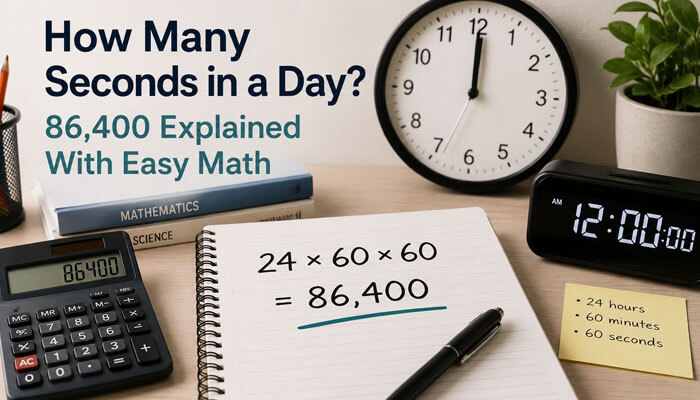

How many seconds in a day? A standard 24-hour day contains exactly 86,400 seconds.
The calculation is:
24 hours × 60 minutes × 60 seconds = 86,400 seconds
Although the answer is simple, day-to-second conversions are useful in mathematics, science, computer programming, fitness tracking, business operations, and everyday planning.
Although the answer is straightforward, understanding how seconds relate to larger units of time is useful in many real-world situations. Students, programmers, scientists, engineers, athletes, and business professionals all rely on accurate time conversions for calculations, scheduling, and data analysis. This guide explains not only the answer but also the reasoning behind it and the situations where additional factors, such as leap seconds or daylight saving time, may matter.
This guide explains the basic formula, provides useful conversion tables, and examines special cases involving leap seconds, daylight saving time, time zones, and astronomical days.
Quick Answer: How Many Seconds in a Day?
There are 86,400 seconds in one standard day.
Here is the complete breakdown:
- One minute contains 60 seconds.
- One hour contains 60 minutes.
- One hour, therefore, contains 3,600 seconds.
- One day contains 24 hours.
- Multiplying 3,600 by 24 gives 86,400.
Simple Formula
Seconds in a day = Hours per day × Minutes per hour × Seconds per minute
Substitute the standard values:
24 × 60 × 60 = 86,400
One standard day equals 86,400 seconds, 1,440 minutes, or 24 hours.
Key Takeaways
- A standard 24-hour day contains 86,400 seconds.
- Half a day contains 43,200 seconds.
- One hour contains 3,600 seconds.
- One week contains 604,800 seconds.
- Multiply days by 86,400 to convert them into seconds.
- Divide seconds by 86,400 to convert them into days.
Seconds in a Day at a Glance
If you only need the most common conversions, use this quick reference.
| Time Period | Seconds |
|---|---|
| 1 minute | 60 |
| 1 hour | 3,600 |
| 6 hours | 21,600 |
| 12 hours | 43,200 |
| 1 day | 86,400 |
| 1 week | 604,800 |
| 30 days | 2,592,000 |
| 365-day year | 31,536,000 |
This table provides the values people search for most often without requiring additional calculations.
How to Calculate How Many Seconds in a Day
The easiest way to understand the calculation is to convert the day one unit at a time.
Step 1: Convert Hours Into Minutes
A standard day contains 24 hours, and every hour contains 60 minutes.
24 × 60 = 1,440 minutes
Therefore, one day contains 1,440 minutes.
Step 2: Convert Minutes Into Seconds
Every minute contains 60 seconds.
1,440 × 60 = 86,400 seconds
Therefore, a standard day contains 86,400 seconds.
Complete Equation
You can perform the entire calculation in one line:
24 hours × 60 minutes per hour × 60 seconds per minute = 86,400 seconds
During the conversion, the hour and minute units cancel, leaving the final answer in seconds.
Day-to-Seconds Conversion Table
The following table shows common periods and their equivalent number of seconds.
| Time period | Calculation | Number of seconds |
| 1 minute | 1 × 60 | 60 |
| 5 minutes | 5 × 60 | 300 |
| 10 minutes | 10 × 60 | 600 |
| 15 minutes | 15 × 60 | 900 |
| 30 minutes | 30 × 60 | 1,800 |
| 1 hour | 60 × 60 | 3,600 |
| 3 hours | 3 × 3,600 | 10,800 |
| 6 hours | 6 × 3,600 | 21,600 |
| 8 hours | 8 × 3,600 | 28,800 |
| 12 hours | 12 × 3,600 | 43,200 |
| 18 hours | 18 × 3,600 | 64,800 |
| 24 hours | 24 × 3,600 | 86,400 |
This table is useful for converting schedules, countdowns, work periods, exercise sessions, and other durations into seconds.
How Many Seconds Are in Different Parts of a Day?
You may sometimes need to calculate only part of a day rather than the full 24-hour period.
| Part of a day | Hours | Seconds |
| One-eighth | 3 hours | 10,800 |
| One-quarter | 6 hours | 21,600 |
| One-third | 8 hours | 28,800 |
| One-half | 12 hours | 43,200 |
| Two-thirds | 16 hours | 57,600 |
| Three-quarters | 18 hours | 64,800 |
| Full day | 24 hours | 86,400 |
How Many Seconds Are in Half a Day?
Half of 24 hours is 12 hours.
12 × 60 × 60 = 43,200 seconds
Therefore, half a day contains 43,200 seconds.
How Many Seconds Are in a Quarter of a Day?
One-quarter of 24 hours is six hours.
6 × 60 × 60 = 21,600 seconds
Therefore, one-quarter of a day contains 21,600 seconds.
How Many Seconds Are in Eight Hours?
Eight hours often represent a typical working or sleeping period.
8 × 60 × 60 = 28,800 seconds
Therefore, eight hours contain 28,800 seconds.
How to Convert Decimal Days Into Seconds
A period does not always contain a whole number of days. You may need to convert a decimal such as 0.5, 1.25 or 2.5 days into seconds.
Use this formula:
Decimal number of days × 86,400 = Total seconds
For example:
1.5 × 86,400 = 129,600 seconds
Therefore, one and a half days contain 129,600 seconds.
Decimal Days-to-Seconds Table
| Number of days | Calculation | Seconds |
| 0.1 day | 0.1 × 86,400 | 8,640 |
| 0.25 day | 0.25 × 86,400 | 21,600 |
| 0.5 day | 0.5 × 86,400 | 43,200 |
| 0.75 day | 0.75 × 86,400 | 64,800 |
| 1.25 days | 1.25 × 86,400 | 108,000 |
| 1.5 days | 1.5 × 86,400 | 129,600 |
| 2.5 days | 2.5 × 86,400 | 216,000 |
| 2.75 days | 2.75 × 86,400 | 237,600 |
What Percentage of a Day Is One Second?
One second represents 1/86,400 of a standard day.
As a decimal:
1 ÷ 86,400 = approximately 0.000011574 days
As a percentage:
1 ÷ 86,400 × 100 = approximately 0.0011574%
One second is therefore approximately 0.0011574% of a standard day.
How Many Seconds Are in Multiple Days?
Multiply the number of days by 86,400.
Formula
Number of days × 86,400 = Total seconds
| Number of days | Calculation | Total seconds |
| 1 day | 1 × 86,400 | 86,400 |
| 2 days | 2 × 86,400 | 172,800 |
| 3 days | 3 × 86,400 | 259,200 |
| 5 days | 5 × 86,400 | 432,000 |
| 7 days | 7 × 86,400 | 604,800 |
| 10 days | 10 × 86,400 | 864,000 |
| 14 days | 14 × 86,400 | 1,209,600 |
| 30 days | 30 × 86,400 | 2,592,000 |
| 100 days | 100 × 86,400 | 8,640,000 |
For example, five days contain:
5 × 86,400 = 432,000 seconds
How Many Seconds Are in a Week?
One week contains seven standard days.
7 × 86,400 = 604,800
Therefore, one week contains 604,800 seconds.
Two weeks, or 14 days, contain:
14 × 86,400 = 1,209,600 seconds
A two-week period is also called a fortnight in some countries.
How Many Seconds Are in a Month?

There is no single fixed number of seconds in a calendar month because months contain different numbers of days.
A month may contain 28, 29, 30, or 31 days.
| Month length | Calculation | Seconds |
| 28 days | 28 × 86,400 | 2,419,200 |
| 29 days | 29 × 86,400 | 2,505,600 |
| 30 days | 30 × 86,400 | 2,592,000 |
| 31 days | 31 × 86,400 | 2,678,400 |
Seconds in Each Calendar Month
| Month | Number of days | Seconds |
| January | 31 | 2,678,400 |
| February | 28 | 2,419,200 |
| February in a leap year | 29 | 2,505,600 |
| March | 31 | 2,678,400 |
| April | 30 | 2,592,000 |
| May | 31 | 2,678,400 |
| June | 30 | 2,592,000 |
| July | 31 | 2,678,400 |
| August | 31 | 2,678,400 |
| September | 30 | 2,592,000 |
| October | 31 | 2,678,400 |
| November | 30 | 2,592,000 |
| December | 31 | 2,678,400 |
Always check the specific month and year instead of assuming that every month contains 30 days.
How Many Seconds Are in a Year?
A common calendar year contains 365 days.
365 × 86,400 = 31,536,000
Therefore, a common year contains 31,536,000 seconds.
A leap year contains 366 days:
366 × 86,400 = 31,622,400
The difference between a common year and a leap year is exactly one standard day:
31,622,400 − 31,536,000 = 86,400 seconds
| Year type | Number of days | Number of seconds |
| Common year | 365 | 31,536,000 |
| Leap year | 366 | 31,622,400 |
| Difference | 1 | 86,400 |
Average Gregorian Calendar Year
The Gregorian calendar contains 97 leap years during each 400-year cycle. This produces an average year length of 365.2425 days.
365.2425 × 86,400 = 31,556,952 seconds
Therefore, the average Gregorian calendar year contains 31,556,952 seconds.
This average is useful for long-term calculations, although an individual calendar year still contains either 365 or 366 days.
How Many Milliseconds Are in a Day?
One second contains 1,000 milliseconds.
86,400 × 1,000 = 86,400,000 milliseconds
Therefore, one day contains 86.4 million milliseconds.
One second also contains one million microseconds and one billion nanoseconds.
| Unit | Number in one standard day |
| Seconds | 86,400 |
| Milliseconds | 86,400,000 |
| Microseconds | 86,400,000,000 |
| Nanoseconds | 86,400,000,000,000 |
These small units are commonly used in computing, electronics, telecommunications, and scientific research.
Why Does a Day Have 24 Hours?
The division of a day into 24 hours developed from ancient systems used to measure daylight and darkness.
Ancient Egyptian timekeeping is commonly associated with dividing daylight into 12 sections and nighttime into another 12 sections. Together, these divisions produced a 24-part day.
Those early seasonal hours were not always equal in length. Daylight hours could be longer in summer and shorter in winter.
Modern timekeeping eventually standardized the day into 24 equal hours.
Why Does an Hour Have 60 Minutes?
The division of an hour into 60 minutes is connected to the sexagesimal, or base-60, number system used by ancient Mesopotamian civilizations.
The number 60 is useful because it can be divided evenly by many numbers, including:
- 2
- 3
- 4
- 5
- 6
- 10
- 12
- 15
- 20
- 30
This made it practical for dividing time, angles, and circles into smaller equal parts.
An hour was eventually divided into 60 minutes, and each minute was divided into 60 seconds.
What Is the Scientific Definition of a Second?
In everyday life, a second is understood as one-sixtieth of a minute. Scientific timekeeping requires a more precise definition.
The second, represented by the symbol s, is the International System of Units’ base unit of time.
The Bureau International des Poids et Mesures defines the second using the unperturbed ground-state hyperfine transition frequency of the caesium-133 atom.
The fixed frequency used in the definition is:
9,192,631,770 hertz
In practical terms, one second corresponds to the duration of 9,192,631,770 periods of radiation associated with that caesium-133 transition.
This atomic definition provides a stable and reproducible measurement that does not depend entirely on Earth’s slightly irregular rotation.
Is Every Day Exactly 86,400 Seconds Long?
For ordinary calculations, a standard civil day is treated as exactly 24 hours or 86,400 seconds.
However, certain technical situations require additional context.
Leap Seconds
A positive leap second may occasionally be added to Coordinated Universal Time (UTC) to keep it close to time based on Earth’s rotation.
When a positive leap second is inserted, the final minute may be displayed as:
- 23:59:58
- 23:59:59
- 23:59:60
- 00:00:00
A UTC date containing a positive leap second has 86,401 labelled seconds instead of the usual 86,400.
A negative leap second would theoretically remove one second and create a UTC date containing 86,399 seconds. No negative leap second had ever been introduced as of June 2026.
The International Earth Rotation and Reference Systems Service confirmed in Bulletin C 71, dated January 6, 2026, that no leap second would be introduced at the end of June 2026.
Daylight Saving Time Changes
A local calendar date in a region that observes daylight saving time may represent 23 or 25 elapsed hours.
When clocks move forward by one hour, the local date may represent:
23 × 3,600 = 82,800 seconds
When clocks move backward and an hour is repeated, the local date may represent:
25 × 3,600 = 90,000 seconds
This does not change the standard definition of a day. It changes how local civil time is displayed during the transition.
Time Zones and the 86,400-Second Rule
A time zone does not change the number of seconds in a fixed 24-hour duration.
A period of 86,400 elapsed seconds is the same whether it is measured in India, the United States, the United Kingdom or another location.
Time zones change the local date and clock reading assigned to an instant. They do not change the length of a second.
The key distinctions are:
- A fixed 24-hour duration contains 86,400 seconds.
- A named local calendar date may represent 23, 24, or 25 elapsed hours.
- The same instant can have different local dates in different time zones.
- Travelling between time zones changes the displayed time, not the time already elapsed.
Variations in Earth’s Rotation
Earth does not rotate at a perfectly constant speed.
Ocean tides, atmospheric movement, changes inside Earth, and shifts in the distribution of mass can cause tiny variations in the length of an astronomical day.
These variations are generally too small to affect school calculations, household clocks, or ordinary schedules.
Standard Day vs. Solar Day vs. Sidereal Day
The word “day” can describe different periods depending on the context.
Standard Civil Day
A standard civil day is the familiar period used for clocks and calendars.
24 hours = 1,440 minutes = 86,400 seconds
Solar Day
A solar day is based on the interval between two occasions when the Sun reaches approximately the same position in the sky.
The mean solar day forms the basis of the familiar 24-hour day. An individual apparent solar day may vary slightly because Earth’s orbit is not perfectly circular and its axis is tilted.
Sidereal Day
A sidereal day measures Earth’s rotation relative to distant stars rather than relative to the Sun.
A mean sidereal day lasts approximately:
23 hours, 56 minutes, and 4.09 seconds
This equals approximately 86,164.09 seconds, making it about three minutes and 56 seconds shorter than a standard civil day.
| Type of day | Approximate duration | Approximate seconds |
| Standard civil day | 24 hours | 86,400 |
| Mean sidereal day | 23 h 56 min 4.09 sec | 86,164.09 |
| Positive leap-second UTC day | 24 h and 1 sec | 86,401 |
For ordinary conversions, use 86,400 seconds per day unless the question specifically concerns astronomy, UTC adjustments, or local clock transitions.
Earth Day vs. Mars Day
The answer to how many seconds in a day changes when the question refers to another planet.
A Martian solar day is called a sol. NASA’s Jet Propulsion Laboratory gives its duration as:
24 hours, 39 minutes, and 35.244 seconds
Convert each part into seconds:
- 24 hours = 86,400 seconds
- 39 minutes = 2,340 seconds
- Remaining time = 35.244 seconds
Add the values:
86,400 + 2,340 + 35.244 = 88,775.244 seconds
A Martian sol therefore contains approximately 88,775.244 Earth seconds.
| Planetary period | Approximate duration | Earth seconds |
| Standard Earth Day | 24 hours | 86,400 |
| Martian sol | 24 h 39 min 35.244 sec | 88,775.244 |
| Difference | 39 min 35.244 sec | 2,375.244 |
A Martian sol is approximately 2,375 seconds longer than an Earth day.
Mars rover teams use sols when planning surface operations because their schedules follow the Martian day-and-night cycle.
How to Convert Days Into Seconds
Use this formula:
Seconds = Number of days × 86,400
For example, 12 days contain:
12 × 86,400 = 1,036,800 seconds
How to Convert Seconds Into Days
Reverse the calculation by dividing the number of seconds by 86,400.
Formula
Days = Number of seconds ÷ 86,400
For example:
172,800 ÷ 86,400 = 2 days
How Many Days Are in One Million Seconds?
1,000,000 ÷ 86,400 = approximately 11.574 days
One million seconds equal:
- 11 days
- 13 hours
- 46 minutes
- 40 seconds
How to Calculate Seconds Passed Since Midnight
To calculate how many seconds have passed since midnight, use this formula:
Seconds passed = Hours × 3,600 + Minutes × 60 + Seconds
Use the 24-hour clock. For example, 3:45:30 p.m. becomes 15:45:30.
Convert the hours:
15 × 3,600 = 54,000 seconds
Convert the minutes:
45 × 60 = 2,700 seconds
Add the remaining 30 seconds:
54,000 + 2,700 + 30 = 56,730 seconds
Therefore, 56,730 seconds have passed since midnight at 3:45:30 p.m.
How to Calculate Seconds Remaining in a Day
Subtract the seconds already passed from 86,400.
Seconds remaining = 86,400 − Seconds passed
Using the previous example:
86,400 − 56,730 = 29,670 seconds
Therefore, at 3:45:30 p.m., 29,670 seconds remain until midnight.
| Time | Seconds passed | Seconds remaining |
| 12:00 midnight | 0 | 86,400 |
| 6:00 a.m. | 21,600 | 64,800 |
| 9:00 a.m. | 32,400 | 54,000 |
| 12:00 noon | 43,200 | 43,200 |
| 3:00 p.m. | 54,000 | 32,400 |
| 6:00 p.m. | 64,800 | 21,600 |
| 9:00 p.m. | 75,600 | 10,800 |
| 11:00 p.m. | 82,800 | 3,600 |
These calculations assume an ordinary 24-hour date without a daylight-saving transition or leap-second adjustment.
Why Knowing How Many Seconds in a Day Is Useful
Understanding day-to-second conversions has several practical applications.
Computer Programming
Computer systems frequently measure durations in seconds or milliseconds.
Developers may use day-to-second conversions when configuring:
- Countdown timers
- Login sessions
- Website cookies
- Cache durations
- Subscription periods
- Backup intervals
- Rate limits
- Automated tests
A cache intended to last exactly 24 hours, for example, may use 86,400 seconds.
Programming Warning: Duration Is Not Always Calendar Time
Programmers must distinguish between a fixed duration of 86,400 seconds and a calendar instruction such as “tomorrow at the same local time.”
Adding 86,400 seconds creates an exact 24-hour interval. It may not produce the same local clock time on the following date because:
- A daylight-saving transition may move the clock forward.
- A daylight-saving transition may repeat an hour.
- Time-zone rules may change.
- Calendar months contain different numbers of days.
- Computer systems may handle leap seconds differently.
Software that means “tomorrow at the same local time” should use calendar-aware date functions and the correct time zone.
| Intended meaning | Appropriate method |
| Exactly 24 elapsed hours | Use 86,400 seconds |
| Tomorrow at the same local time | Add one calendar day |
| Same time seven calendar days later | Add seven calendar days |
| Cache lasting exactly 24 hours | Use 86,400 seconds |
| Same date next month | Add one calendar month |
| Next local midnight | Calculate in the relevant time zone |
The POSIX standard accounts for every day as exactly 86,400 seconds when representing seconds since the Unix Epoch. This convention simplifies timestamp calculations but does not mean that every local calendar date represents exactly 24 elapsed hours.
Science and Engineering
Scientists and engineers use seconds to measure speed, frequency, motion, electrical signals, mechanical cycles, chemical reactions, and astronomical events.
Converting longer periods into seconds allows measurements to be compared using a common unit.
Fitness and Sleep Tracking
Examples include:
- Eight hours of sleep = 28,800 seconds
- One-hour workout = 3,600 seconds
- 30-minute walk = 1,800 seconds
- 10-minute warm-up = 600 seconds
Business and Productivity
Businesses may use seconds to measure machine operation, website uptime, customer-response times, production cycles, delivery windows, and processing speeds.
Interesting Facts About Seconds and Days
- One million seconds equal 11 days, 13 hours, 46 minutes, and 40 seconds.
- One billion seconds equals approximately 31.69 average Gregorian years.
- A mean sidereal day is approximately 235.91 seconds shorter than a standard civil day.
- A Martian sol is approximately 2,375 seconds longer than an Earth day.
- One second is approximately 0.0011574% of a standard day.
- One standard day contains 86.4 trillion nanoseconds.
Common Mistakes When Converting Days and Seconds
1. Multiplying 24 by 60 Only Once
24 × 60 = 1,440
This gives the number of minutes in a day, not the number of seconds.
Multiply by 60 again:
1,440 × 60 = 86,400 seconds
2. Assuming One Hour Contains 60 Seconds
One hour contains 60 minutes, and each minute contains 60 seconds.
60 × 60 = 3,600 seconds per hour
3. Assuming Every Month Contains 30 Days
Calendar months contain 28, 29, 30 or 31 days. Use the actual month length when calculating its total seconds.
4. Confusing Leap Years With Leap Seconds
A leap year adds an entire calendar day.
A positive leap second adds only one second to UTC.
Leap years help keep the calendar aligned with Earth’s orbit around the Sun. Leap seconds have been used to keep UTC close to time based on Earth’s rotation.
5. Assuming Every Local Date Lasts 24 Hours
A local date affected by daylight saving time may represent 23 or 25 elapsed hours.
Use calendar-aware calculations when local dates and time zones matter.
Easy Way to Remember 86,400
Remember these three numbers:
- 24 hours in a day
- 60 minutes in an hour
- 60 seconds in a minute
Then multiply:
24 × 60 × 60 = 86,400
You can also remember that one hour contains 3,600 seconds:
24 × 3,600 = 86,400
Quick Time Conversion Summary
| Time period | Number of seconds |
| One minute | 60 |
| One hour | 3,600 |
| Six hours | 21,600 |
| Eight hours | 28,800 |
| 12 hours | 43,200 |
| One day | 86,400 |
| 1.5 days | 129,600 |
| Two days | 172,800 |
| One week | 604,800 |
| 30 days | 2,592,000 |
| Common year | 31,536,000 |
| Leap year | 31,622,400 |
| Martian sol | Approximately 88,775.244 |
The main conversion formula is:
Number of days × 86,400 = Number of seconds
To reverse it:
Number of seconds ÷ 86,400 = Number of days
Quick Conversion Checklist
When converting days and seconds, remember these rules:
- Multiply days by 86,400 to find seconds.
- Divide seconds by 86,400 to find days.
- Use the actual number of days when calculating months.
- Account for leap years when calculating yearly totals.
- Consider daylight saving time or leap seconds only when they are specifically relevant to the calculation.
Following these simple rules helps avoid the most common conversion mistakes.
Conclusion
So, how many seconds in a day? A standard 24-hour day contains exactly 86,400 seconds.
The calculation is:
24 hours × 60 minutes × 60 seconds = 86,400 seconds
This answer applies to ordinary time conversions, classroom calculations, fixed-duration schedules, and most everyday uses. Leap seconds, daylight-saving transitions, time zones, and astronomical measurements can require additional context, but they do not change the standard conversion of 24 hours into 86,400 seconds.
Remembering this simple formula provides a reliable starting point for converting days into seconds in mathematics, science, programming, fitness tracking, and everyday planning.
How Many Seconds in a Day FAQs
1. How Many Seconds in a Day?
There are exactly 86,400 seconds in a standard 24-hour day.
24 × 60 × 60 = 86,400 seconds
2. Why Are There 86,400 Seconds in a Day?
A day contains 24 hours, each hour contains 60 minutes, and each minute contains 60 seconds. Multiplying these values gives:
24 hours × 60 minutes × 60 seconds = 86,400 seconds
3. How Many Seconds Are in Half a Day?
Half a day contains 12 hours, which equals 43,200 seconds.
12 × 60 × 60 = 43,200 seconds
4. Is Every Day Exactly 86,400 Seconds Long?
A standard civil day contains 86,400 seconds. However, a UTC day with a positive leap second can contain 86,401 labelled seconds. A local date affected by daylight saving time may also represent 23 or 25 elapsed hours.
5. How Do You Convert Days Into Seconds?
Multiply the number of days by 86,400.
Number of days × 86,400 = Total seconds
For example:
5 × 86,400 = 432,000 seconds
