


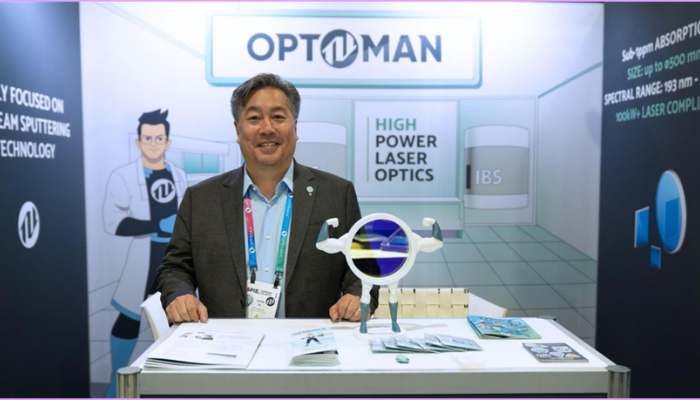

When specialist companies expand internationally, the challenge is not just entering a new market. It is staying close enough to customers to support complex decisions, technical collaboration, and long-term growth. That is what led OPTOMAN to expand into the U.S.
The company manufactures high-performance Ion Beam Sputtered optics for advanced laser systems used in industries such as semiconductors, defense, aerospace, medical technology, scientific research, and industrial manufacturing.
In this interview, Huyen Vu, CEO and President of OPTOMAN Inc., explains why the move was driven by customer expectations and what other specialist businesses can learn from scaling internationally without losing focus.
“The decision was driven by customers and by the industry’s changing landscape. We saw a clear shift in expectations from U.S. customers. They are not only looking for high-performance optics, but they also expect closer collaboration during development and more direct support throughout the lifecycle of a laser system.”
Lesson 1: Stay Specialist as You Scale
Many companies respond to growth opportunities by broadening their offer. They add more services, expand into adjacent categories, or try to appeal to a wider range of customers.
OPTOMAN has taken a different route.
The company has remained deliberately focused on IBS-coated optics and optical assemblies for high-performance laser applications. Rather than spreading across many optical technologies, it has concentrated on one specialist area and continued to push that expertise further.
“Our focus is deliberately narrow: IBS coated optics and optical assemblies for high-performance laser applications,” Vu says. “Rather than spreading across many optical technologies, we concentrate on one deposition method and push it to its limits, and in some cases even beyond.”
That focus gives OPTOMAN an advantage in markets where customers are not looking for standard components. They are building laser systems where reliability, efficiency, and performance under pressure can determine whether the wider technology succeeds.
In business terms, OPTOMAN’s value lies in helping customers reduce failure points in expensive, high-performance laser systems.
The wider lesson is that specialization does not have to limit growth. In the right market, it can become the reason customers choose you.
Lesson 2: Move Closer to Where Decisions Are Made
OPTOMAN’s expansion into the U.S. was not just about entering a larger market. It was about moving closer to the technical conversations that shape customer decisions.
Vu says the U.S. has become one of the most active regions globally for high-power laser development, with strong demand from defense, semiconductor, and advanced manufacturing customers.
But supporting those customers from Europe created natural limitations.
“The U.S. market has become one of the most active regions globally for high-power laser development,” Vu explains. “Demand was already coming from defense, semiconductor, and advanced manufacturing customers, but supporting these projects from Europe imposed natural limitations on communication speed and proximity.”
For a specialist business, those limitations matter.
High-value technical relationships often depend on early involvement. If a supplier is brought in too late, it may only be able to react to problems rather than help prevent them. By establishing a U.S. presence, OPTOMAN can be closer to the engineering discussions where important system decisions are made.
“Opening a U.S. presence allows us to remove those barriers,” Vu says. “It is about being closer to the engineering discussions where decisions are actually made, not just responding after the fact.”
For entrepreneurs, this is one of the strongest lessons in the story. International growth is not only about market access. It is about customer access.
In complex B2B markets, proximity can become part of the value proposition.
Lesson 3: Find the Bottleneck in Growing Markets
OPTOMAN’s opportunity in the U.S. is linked to wider changes across several high-growth industries.
Laser systems are becoming more powerful, more precise, and more demanding. Defense and aerospace applications need high damage resistance and long-term stability. Semiconductor manufacturing requires stable optical performance and a long lifetime. Fusion research pushes laser power to extreme levels. Medical laser applications depend on precision and reliability. Scientific research institutions continue to use ultrafast and high-energy laser systems that stretch optical components to their limits.
These industries are different, but they share one common challenge: optics are becoming a performance bottleneck.
The growth behind these applications is significant. Global Market Insights estimated the global laser processing equipment market at $23.9 billion in 2024 and expects it to grow to $66.2 billion by 2034. For OPTOMAN, that matters because more powerful and precise laser systems create more demanding requirements for the optical components inside them.
“What connects them is that they are all pushing optics closer to physical limits — higher power densities, shorter pulse durations, tighter thermal constraints, and longer operational lifetimes,” Vu says.
That is where OPTOMAN’s role becomes commercially significant.
The company is not simply selling components into growing markets. It is addressing a constraint inside those markets. When optics limit performance, reliability, or system lifetime, they become a strategic problem for customers.
For business leaders, the lesson is to look for the bottleneck.
Fast-growing industries often create opportunities for companies that solve the hidden problems slowing everyone else down. These opportunities may be highly niche, but they can also be highly valuable.
Lesson 4: International Growth Is an Operations Challenge

Opening a new market can look like a commercial milestone from the outside. Internally, it is often an operational challenge.
For Vu, one of the biggest lessons from scaling internationally is that technical capability alone is not enough.
“The biggest lesson is that technical capability alone is not enough when you operate globally,” he says. “You can have a strong product, but if communication is slow or fragmented across time zones, it affects how effectively that product is used.”
That is particularly true in photonics, where customer development cycles can be iterative. Technical questions, performance feedback, testing requirements, and design adjustments all need to move quickly. Delays in communication can slow innovation on the customer side.
Consistency is another challenge.
As companies expand internationally, they need to ensure customer requirements are interpreted consistently across teams. Technical decisions must remain aligned with manufacturing reality. Customer-facing teams need enough local autonomy to respond quickly, but sufficient internal alignment to maintain quality.
“As you scale across regions, you need to ensure that customer requirements are interpreted in the same way by different teams, and that technical decisions remain aligned with manufacturing reality,” Vu explains.
This is a useful reminder for any growing business. Expansion not only tests demand but also communication, decision-making, processes, and leadership.
The companies that scale successfully are not just the ones that win new customers. They are the ones that can keep delivering consistently as the organization becomes more complex.
Lesson 5: Innovation Has to Be Commercialized
OPTOMAN is an R&D-driven company, but its approach to innovation is not limited to technical achievement.
The company works closely with research institutions and universities to anticipate future developments in laser systems. This helps OPTOMAN understand where the market is heading, even when those collaborations are not immediately scalable.
“Working closely with research institutions and universities is of strategic importance to us, even though it is rarely scalable,” Vu says. “It allows us to anticipate future advancements in laser systems and prepare for them.”
But the company also applies commercial discipline to innovation.
OPTOMAN uses a Stage-Gate process when developing new products. This process involves R&D, marketing, business development, and sales, so ideas are assessed against technical feasibility, market potential, strategic fit, and customer need.
That matters because innovation only becomes valuable when it reaches the market in a meaningful way.
Vu says the aim is to ensure innovation “will not stay on our shelf, but will actually enable further meaningful advancements in the photonics market.”
For entrepreneurs, this is a valuable point. Innovation is not just about what a company can build. It is about what the market needs, what the business can support, and where the strongest strategic fit exists.
The Takeaway for Entrepreneurs
OPTOMAN’s U.S. expansion shows that specialist companies do not always need to become broader to become bigger.
Sometimes the strongest growth strategy is to go deeper into a niche, move closer to the customers with the most complex problems, and build the operations needed to support them at scale.
For OPTOMAN, the next phase is about strengthening its presence in North America, expanding local technical support, and deepening collaboration with customers in defense, aerospace, advanced manufacturing, and other demanding laser markets.
But the broader business lesson is not limited to photonics.
In any specialist industry, growth depends on more than capability. It depends on proximity, trust, commercial focus, and the ability to solve problems that matter deeply to customers.
OPTOMAN’s expansion into the U.S. is not just a story about entering a new market. It is a case study in how a specialist company can scale internationally while staying true to the expertise that made it valuable in the first place.
