


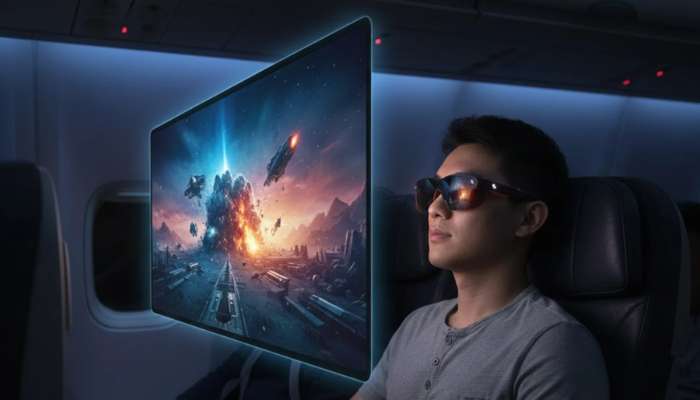

Portable monitors gave Steam Deck and PS5 owners bigger screens. They also added bulk, cables, and the constant need for a flat surface. AR display glasses now offer a different path — one that fits inside a glasses case.
The RayNeo Air 4 Pro 120Hz AR display glasses sit at the center of this shift. They deliver HDR10 support, 120Hz refresh, and Micro-OLED panels in a 76-gram frame connected by a single USB-C cable.
I tested them as a dedicated gaming display for two weeks across both platforms. Here is what the specs and actual gameplay revealed about using smart glasses as a portable gaming monitor.
Why Gamers Are Dropping Portable Monitors
Portable monitors solved screen size but created new friction. A 15-inch panel needs a kickstand, a power source, and enough table space to keep everything stable. That works at a desk. It fails on a couch, a flight, or a hotel bed.
Smart glasses remove those constraints. One cable handles video and audio. The display floats at a fixed viewing distance, and nothing touches the surface beneath you. Weight drops from 600–900 grams for a typical monitor to 76 grams for the Air 4 Pro.
The trade-off is viewing context. A physical monitor can be repositioned, shared, and viewed by multiple people at once. The Air 4 Pro projects a 201-inch virtual display at a specified perceived distance, per RayNeo. For solo gaming, it works. For group viewing, monitors win.
Where the Air 4 Pro Stands Out on Display Specs
Display quality decides whether AR display glasses work for gaming or prove inadequate. The RayNeo Air 4 Pro 120Hz AR display glasses offer a spec combination few competing smart glasses match in this price class.
120Hz Motion Clarity
The Air 4 Pro supports selectable 60Hz and 120Hz modes. At 120Hz, fast camera pans and quick-scope transitions render without visible motion blur. Switching to 60Hz conserves battery on the host device during slower-paced games.
HDR10 Support in Practice
RayNeo markets it as the world’s first HDR10 smart glasses. The Micro-OLED panels deliver 10-bit color, 1,200 nits peak brightness, and 200,000:1 contrast. With compatible HDR sources, dark scenes may retain more shadow and highlight range.
Vision 4000 SDR-to-HDR Upscaling
Co-developed with Pixelworks, the Vision 4000 chip converts SDR content to a more HDR-like look in real time. Older SDR content may gain expanded dynamic range, though the effect varies by source and output settings.
Color Accuracy at 98% DCI-P3
Color reproduction reaches ΔE < 2 accuracy across 98% DCI-P3 and 145% sRGB. Game art rendered in wide color gamut appears as developers intended — not clipped to a narrower spectrum that washes out environmental lighting.
3840Hz PWM Flicker-Free Dimming
The display uses 3840Hz PWM dimming, certified by TÜV SÜD for low blue light and flicker-free viewing. During three-hour gaming sessions, I noticed less eye strain compared to conventional screens, though this does not eliminate fatigue entirely.
How It Connects to Steam Deck and PS5
Setup determines whether smart glasses feel like a genuine convenience or an added chore. The RayNeo Air 4 Pro 120Hz AR display glasses handle both major gaming platforms, though each one requires a different connection path.
Steam Deck: True Plug and Play
The Steam Deck’s USB-C port supports DisplayPort output natively. Plug in the Air 4 Pro and the display appears instantly — no app, no Wi-Fi, no software. The Steam Deck OLED supports HDR and DP-over-USB-C output; HDR availability depends on game support and device settings.
PS5: One Adapter, One Extra Step
The PS5 outputs video through HDMI only. You need a powered HDMI-to-USB-C adapter compatible with AR display glasses. RayNeo sells compatible adapters and bundle options through its store. Third-party HDMI-to-USB-C adapters from other brands also work.
Titles That Gain the Most
- RPGs with dense menus (Baldur’s Gate 3, Divinity: Original Sin 2) become legible on a large virtual display
- Strategy titles (Civilization VI, XCOM 2) reduce constant zooming across complex maps
- PS5 exclusives built around HDR lighting (God of War Ragnarök, Horizon Forbidden West) show intended shadow and highlight range
How the Air 4 Pro Compares to Competing AR Display Glasses
Several smart glasses target gamers in 2026. The key differences come down to display quality, weight, and overall cost. Below is a spec comparison of the models most relevant to Steam Deck and PS5 gaming.
| Spec | RayNeo Air 4 Pro | XREAL One Pro | Viture Pro XR | Rokid Max 2 |
| Price | $299 | $599 | ~$459 | $359–$529 |
| HDR | HDR10 | × | × | × |
| Brightness | 1,200 nits | 700 nits | 1,000 nits | 600 nits |
| Refresh Rate | 60/120Hz | 120Hz | 120Hz | 60/120Hz |
| Weight | 76g | 87g | 77g | ~75g |
| Audio | B&O co-tuned | Sound by Bose | Harman AudioEFX | Directional |
| Screen / FOV | 201” at 6m | 57° | ~46° | 50° |
| Contrast | 200,000:1 | — | — | 100,000:1 |
Brightness and HDR
The Air 4 Pro delivers 1,200 nits — above the XREAL One Pro at 700 nits and the Viture Pro XR at 1,000 nits perceived. HDR10 is its clearest edge: most competing smart glasses do not advertise HDR10, limiting dynamic range on compatible sources.
Price-to-Performance
At $299 — plus roughly $59 for a PS5 HDMI adapter — the Air 4 Pro still costs less than half the XREAL One Pro. The XREAL One Pro offers a wider 57-degree field of view, which may justify its premium for users who prioritize peripheral coverage.
The Rokid Max 2 includes built-in diopter adjustment — a practical edge for prescription wearers. On display quality per dollar, the RayNeo Air 4 Pro 120Hz AR display glasses rank among the strongest display-first smart glasses.
Comfort and Audio During Long Sessions
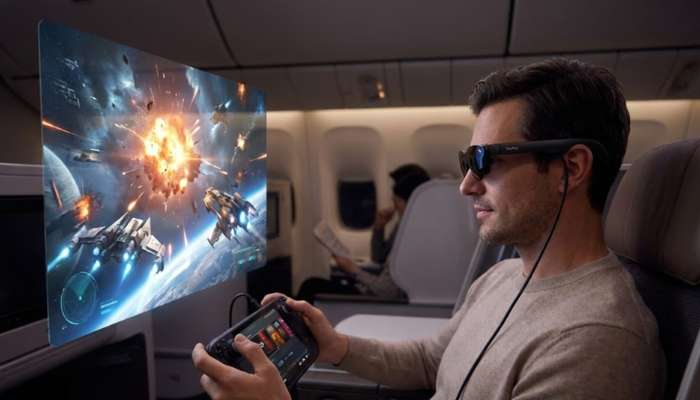
Weight alone does not determine comfort. The Air 4 Pro distributes its 76 grams across a 46.7:53.3 front-to-rear balance ratio. Adjustable nose pads and nine-level flexible temples reduce pressure points during sessions that stretch past two hours.
Audio quality and eye protection complete the package for marathon gaming. Smart Glasses like the Air 4 Pro stand out from many basic wearable displays in three areas that matter most during extended sessions with a head-worn screen:
- Four speakers co-tuned by Bang & Olufsen deliver 360-degree spatial sound without headphones
- Whisper mode with phase-cancelling acoustics reduces sound leakage in public spaces
- Open-ear design preserves situational awareness during portable gaming sessions
The Bottom Line
The RayNeo Air 4 Pro 120Hz AR display glasses close the gap between wearable displays and dedicated gaming monitors. HDR10 support, 120Hz refresh, and 1,200-nit brightness at $299 make a strong case among display-first smart glasses for gaming.
For Steam Deck and PS5 owners who prioritize HDR support, brightness, and price over the widest FOV or spatial anchoring, the Air 4 Pro ranks among the strongest display-first smart glasses heading into mid-2026. PS5 users still need an adapter, but the core display value holds.
