


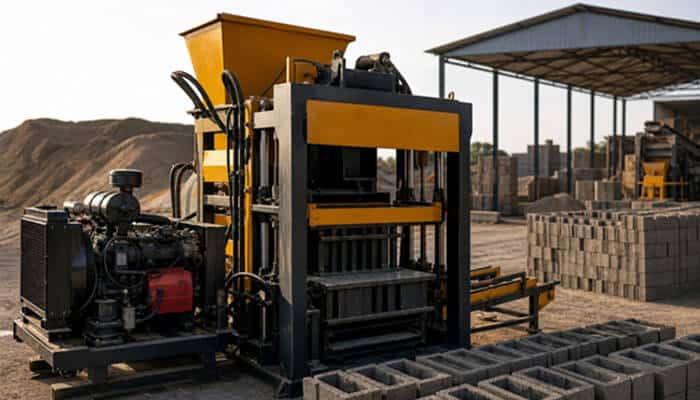

If you are in the market for a brick or block making machine, understanding the differences between Diesel Block Machines vs Electric Block Machines is one of the first decisions you will face. The choice between diesel and electric power has a direct impact on your operating costs, site flexibility, production reliability, and long-term business efficiency. Both options work well in the right context, but both can create challenges when they are mismatched to your specific operational needs.
A diesel block machine is the natural choice for remote sites, mobile operations, and locations where grid power is unavailable or unreliable. An electric machine fits operations with stable grid access, permanent production sites, and a focus on lower running costs over time. Understanding where each one genuinely performs better, and where each one creates unnecessary expense or operational risk, is what makes this decision straightforward rather than a guess.
The Core Difference Between the Two Power Sources
At the most fundamental level, a diesel block machine runs on a diesel engine that converts fuel into mechanical power to drive the hydraulic system, vibration mechanism, and mixing components. An electric block machine draws power from the grid or a generator through an electric motor that does the same job.
This difference in power source flows through into almost every practical aspect of how the machine operates, where it can be deployed, what it costs to run, and how easy it is to maintain in the field.
Diesel engines are self-contained power units. They do not need an external electrical supply to function, which makes the machine genuinely independent of infrastructure. Electric motors are simpler, more efficient, and cheaper to run per unit of output, but they require a reliable power supply to function at all.
When a Diesel Block Machine Makes More Sense
The case for diesel is strongest in three specific situations, and if your operation falls into any of them, the choice is fairly clear.
Remote and off-grid sites are the primary use case. Construction projects in rural areas, agricultural regions, and developing markets often operate in locations where grid power either does not reach or cannot be relied upon. A diesel machine produces bricks wherever the fuel supply reaches, which in practice means almost anywhere. The M7MI diesel clay brick machine, for example, is designed to be towed to a worksite behind a truck, which takes the concept of site independence to its logical conclusion. You bring the machine, you bring the fuel, and you make bricks on site without any other infrastructure.
Frequent power outages are the second situation where diesel makes more operational sense than electric. An electric machine that loses power mid-shift loses production. A diesel machine keeps running as long as there is fuel in the tank. For operations in regions where grid power is inconsistent, the production reliability of a diesel machine has real economic value that is worth factoring against the higher fuel cost.
Mobile production is the third scenario. Some brick manufacturers do not operate from a fixed site. They move from project to project, setting up temporary production near each construction site to reduce transport costs on the finished bricks. Diesel machines, particularly the mobile configurations with tyres that allow them to be repositioned easily, are built for exactly this model of operation.
When an Electric Block Machine Makes More Sense

Electric machines have a strong case in permanent operations with reliable grid access, and the advantages compound over time in ways that make a significant difference to the total cost of running the machine.
Running cost is the most significant practical advantage. Electricity is cheaper per unit of energy output than diesel fuel in most markets, and the gap tends to widen as fuel prices fluctuate. Over the course of a year of regular production, the difference in energy cost between a diesel and electric machine of comparable output can be substantial. For an operation running one or two shifts per day, five to six days a week, that cost difference adds up considerably across the machine’s service life.
Electric motors are also simpler mechanically than diesel engines. They have fewer moving parts, require less routine maintenance, and have a longer service life before major overhaul is needed. Diesel engines need regular oil changes, air filter replacement, fuel filter maintenance, and periodic engine service that adds both cost and operational downtime. An electric motor, by contrast, runs reliably for extended periods with minimal attention beyond keeping the machine itself clean and the electrical connections in good order.
Output consistency is another area where electric machines have an edge. Electric motors deliver consistent power output regardless of ambient temperature, altitude, or engine wear state. Diesel engines deliver their rated power under good conditions but can underperform in extreme heat, at high altitude, or as engine wear accumulates. For operations where block quality and dimensional consistency are important, the consistent power delivery of an electric machine is a meaningful advantage.
The Cost Comparison Over Time
Upfront, diesel machines and electric machines at similar production capacities are often comparable in purchase price. The cost divergence happens in operation, and understanding it over a three to five year horizon changes the picture considerably.
Fuel cost for a diesel machine running a full eight-hour shift every working day adds up to a significant annual expense. Electricity for an equivalent electric machine running the same hours costs less in most operating environments. The exact difference depends on local fuel and electricity prices, but it is rarely negligible and often substantial.
Maintenance cost follows a similar pattern. Diesel engines require more frequent and more expensive servicing than electric motors. The cumulative maintenance cost over several years of operation is typically higher for a diesel machine, and the downtime associated with engine service adds to the indirect cost.
On the other side of the ledger, installing adequate electrical infrastructure for a high-power electric machine at a site that does not already have it carries an upfront cost. In some locations, connecting to the grid or upgrading the electrical supply capacity requires meaningful investment. For an operation starting on a new site without existing infrastructure, that cost needs to be factored into the comparison honestly.
Production Capacity and Block Quality
Both diesel and electric machines are available across a wide range of production capacities, and neither power type is inherently superior in terms of the blocks it produces. A well-designed diesel hydraulic machine produces blocks of the same quality as an equivalent electric machine. The forming mechanism, vibration system, and hydraulic pressure are what determine block quality, and these can be engineered effectively in either power configuration.
Where the comparison becomes relevant for block quality is in the consistency argument mentioned earlier. For operations where very tight dimensional tolerances or consistent density across large production runs are requirements, the stable power delivery of an electric machine is a genuine advantage. For operations producing standard hollow blocks for general construction where moderate dimensional variation is acceptable, the difference in output consistency between a well-maintained diesel machine and an equivalent electric machine is not significant in practice.
Which One Is Right for Your Operation
The right choice depends on where and how you are operating, not on which technology is inherently better.
If your site is remote, power is unreliable, or your model involves moving between locations, a diesel machine gives you independence that an electric machine cannot match. The higher running cost is the price of that flexibility, and in many situations it is worth paying.
If you are at a permanent site with reliable grid power and planning to operate for several years, an electric machine will almost certainly cost less to run and require less maintenance. The lower operating cost makes a compelling case when site conditions support it.
For operations that genuinely need both, some manufacturers offer machines that run on either diesel or electric depending on the available power source, which is worth considering where grid reliability is improving but not yet consistent.
The most reliable way to decide is to calculate total cost of ownership over your expected operating period, including purchase price, infrastructure costs, fuel or electricity at local rates, and estimated maintenance, rather than comparing purchase price alone.
