


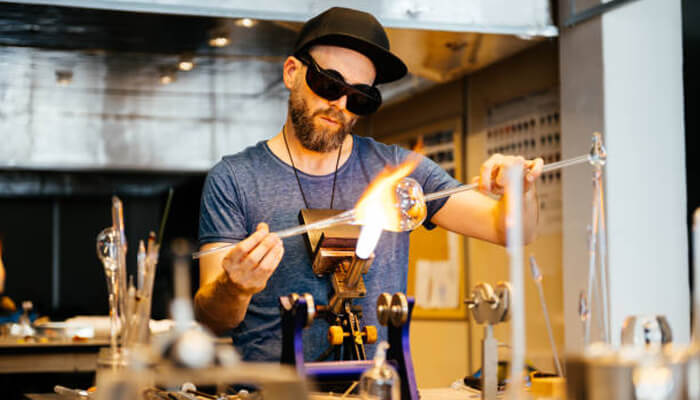

1. Mastering the Art of the Gather
The very first skill you will practise is the gather, which involves dipping a long metal blowpipe into a furnace heated to. Learn the precise hand-over-hand rotation required to collect a consistent gob of molten glass on the end of the pipe without it dripping off. This movement is much like twirling honey on a spoon, requiring a steady rhythm and a calm focus to maintain the balance of the glowing material.
2. Developing Breath Control for Inflation
The next challenge is to introduce air into the pipe to create the hollow bubble that forms the centre of your piece. Glass blowing is not about using maximum lung power but rather about applying a gentle and consistent pressure to expand the material slowly. Developing this internal sense of pressure is a unique physical skill that requires you to listen to the material and react to its changing resistance.
3. Using Gravity and Centrifugal Force
Working with a substance that is moving means you must learn how to use forces to shape your creation. You will practise swinging the blowpipe in a controlled arc to elongate the glass to widen the opening of a bowl. Attending a glass blowing workshop London, for instance, allows you to create curves and symmetrical forms that would be impossible to achieve through manual manipulation.
4. Shaping with Blocks and Marvers
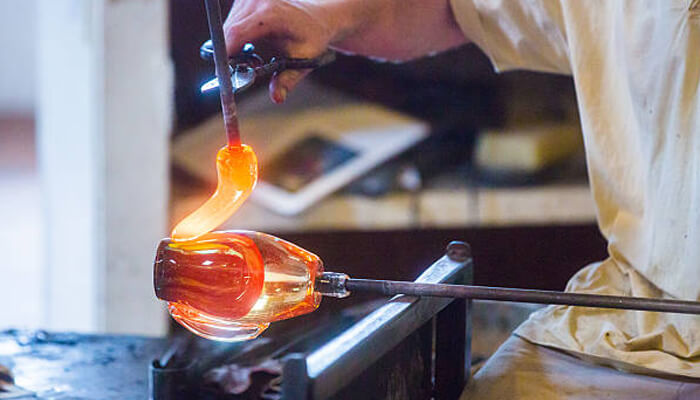
To achieve a smooth finish, you will be introduced to tools like wooden blocks known as marvers. Learn how to roll the hot glass across the marver to chill the outer skin and create a cylindrical shape before you begin the blowing process. The wooden blocks, which are soaked in water to prevent them from burning, act as a cradle that allows you to refine the symmetry of your piece while it is still soft.
5. Applying Vibrant Colour and Pattern
One of the exciting parts of any workshop is learning how to incorporate beautiful colours and intricate patterns into your clear glass. You will practise rolling the molten glass through frit, which consists of small crushed grains of coloured glass that melt onto the surface. Also, you can learn how to create swirls or trails by pulling and twisting the sections with metal tweezers while the material is still pliable.
6. Navigating the Reheating Process
Discover how to use a secondary heating chamber, often called a glory hole, to keep it workable. You will develop the skill of flashing the glass, which involves rotating it in the intense heat just long enough to soften the surface without collapsing the entire structure. This requires a keen eye for the colour and glow of the material, as the shade of orange indicates how hot and soft the glass is at any given moment.
7. Executing a Clean Break and Finish
The final and perhaps most nerve-wracking skill you will acquire is the process of separating your finished piece from the blowpipe. Understand how to use a small amount of water to create a thermal shock at the neck of the glass, followed by a sharp tap that causes the piece to break away cleanly. Once separated, the piece is placed in an annealing oven to cool slowly over several hours.
Reflecting on Your Creative Journey
Participating in a hands-on workshop, you gain appreciation for the skill of the artisan and the properties of the material they work with every day. You deserve the chance to step away from your digital screens and engage in a process that is physically demanding and artistically fulfilling. The memories of the heat and the thrill of creation will stay with you long after your finished glass has cooled in the kiln.
