


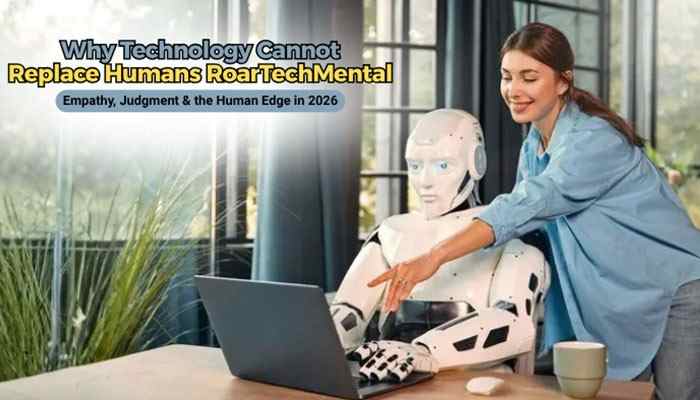

Artificial intelligence can write articles, generate software, analyze medical information, create realistic images, automate business workflows, tutor students, and complete tasks that once required substantial human effort. Yet Why Technology Cannot Replace Humans RoarTechMental remains an important topic in 2026 because greater machine capability does not automatically eliminate the need for human empathy, contextual judgment, responsibility, relationships, ethics, trust, and real-world understanding.
The strongest explanation of Why Technology Cannot Replace Humans RoarTechMental is not that humans are better than machines at everything. They are not. AI already performs exceptionally well in several technical areas. However, technical performance alone does not provide responsibility, social understanding, trust, moral accountability, or the ability to decide what goals society should pursue.
The future is therefore not simply humans versus technology. It is increasingly about determining which tasks machines should perform, where humans must remain involved, and how AI can support people without weakening judgment, accountability, privacy, or human well-being.
Quick Answer: Why Technology Cannot Replace Humans RoarTechMental
Why Technology Cannot Replace Humans RoarTechMental can be explained through one central distinction:
Technology can automate human tasks without replacing everything that makes a human role valuable.
AI excels at speed, scale, calculation, information retrieval, pattern recognition, prediction, and repetitive work. Humans remain particularly important when situations require empathy, responsibility, contextual judgment, trust, ethical decisions, negotiation, unusual problem-solving, or accountability for consequences.
- Technology can replace individual tasks.
- It can transform entire occupations.
- It may significantly reduce human involvement in some workflows.
- But task automation does not automatically equal complete human replacement.
Key Takeaways
- Why Technology Cannot Replace Humans RoarTechMental is mainly about the difference between automating tasks and replacing complete human roles.
- AI already exceeds human performance in some narrowly defined technical areas.
- Human empathy involves relationships, history, nonverbal communication, and responsibility.
- Human judgment matters when rules, evidence, and values conflict.
- Generative AI can produce convincing but incorrect information.
- Automation bias can cause people to trust machine recommendations too readily.
- AI systems can reproduce biases contained in data or system design.
- Human expertise remains essential for verification.
- Mental-health technology can support care but should not replace qualified professionals.
- Excessive AI dependence may reduce opportunities to practice important human skills.
- Agentic AI increases the need for permissions, monitoring, accountability, and escalation.
- Human-AI collaboration is usually more realistic than treating people and machines as direct competitors.
Why Why Technology Cannot Replace Humans RoarTechMental Matters in 2026
The discussion surrounding Why Technology Cannot Replace Humans RoarTechMental has changed significantly as AI systems have become more capable.
A few years ago, many discussions focused on whether artificial intelligence could:
- Write convincingly
- Generate art
- Produce working code
- Translate languages
- Understand images
- Answer complex questions
Modern AI can now perform all of these tasks to varying degrees.
That means the more important questions in 2026 are:
- Can the result be trusted?
- Who verifies the answer?
- Who is responsible if it is wrong?
- Should an automated recommendation determine what happens to a person?
- When should humans intervene?
- What happens when AI starts taking actions instead of simply giving answers?
- Which human skills become more valuable as automation improves?
This is why Why Technology Cannot Replace Humans RoarTechMental should not be reduced to a simple “people are better than robots” argument.
The real issue is where machine capability should stop and meaningful human control should begin.
What Does Why Technology Cannot Replace Humans RoarTechMental Mean?
The phrase Why Technology Cannot Replace Humans RoarTechMental refers to a broader discussion about the strengths of technology and the continuing importance of human judgment, empathy, accountability, and connection.
Technology can help people:
- Analyze information
- Generate drafts
- Automate paperwork
- Translate text
- Track behavioral patterns
- Schedule appointments
- Identify statistical relationships
- Summarize documents
- Answer routine questions
However, human roles frequently require much more.
People may need to:
- Build trust
- Understand unusual circumstances
- Manage conflict
- Make exceptions
- Accept responsibility
- Apply ethical judgment
- Motivate another person
- Recognize unspoken signals
- Understand cultural context
That is why the Why Technology Cannot Replace Humans RoarTechMental discussion is best understood through a simple question:
Which tasks should AI automate, which should AI assist with, and which should remain under meaningful human control?
Humans vs Technology at a Glance
| Area | Technology Is Strong At | Humans Remain Important For |
| Data processing | Processing enormous datasets quickly | Interpreting meaning and consequences |
| Repetitive work | Standardized tasks at scale | Managing exceptions |
| Pattern recognition | Detecting statistical relationships | Understanding social context |
| Content generation | Creating text, images, audio and code | Purpose, taste and creative direction |
| Communication | Instant automated responses | Long-term relationships and trust |
| Decision support | Comparing probabilities and options | Balancing conflicting values |
| Mental health | Tracking, journaling and educational support | Clinical judgment and therapeutic care |
| Education | Personalized practice and explanations | Motivation, mentoring and classroom judgment |
| Healthcare | Analysis and decision support | Patient-centered responsibility |
| Leadership | Forecasting and analytics | Trust, influence and accountability |
| Ethics | Applying predefined policies | Resolving value conflicts |
| Physical work | Repetition in controlled environments | Adaptation in unpredictable settings |
| Authenticity | Generating highly realistic media | Identity, consent and provenance |
The Why Technology Cannot Replace Humans RoarTechMental argument does not depend on claiming that humans outperform machines in every area.
The difference is that technical performance does not automatically create purpose, fairness, responsibility, trust, or social legitimacy.
Why Technology Cannot Replace Humans RoarTechMental Through Empathy
One of the strongest arguments behind Why Technology Cannot Replace Humans RoarTechMental is human empathy.
Modern AI can produce remarkably compassionate language.
A chatbot may say:
- “That sounds very difficult.”
- “I understand why you might feel that way.”
- “Would you like to explain what happened?”
- “Here are some strategies that may help.”
Such responses can sometimes be useful.
But empathetic wording is only one part of empathy.
Human empathy can also involve:
- Tone of voice
- Facial expressions
- Silence
- Eye contact
- Body language
- Personal history
- Cultural background
- Relationship history
- Trust
- Timing
A therapist, teacher, doctor, manager, caregiver, or friend may recognize that something is wrong even when the person never says it directly.
That difference helps explain Why Technology Cannot Replace Humans RoarTechMental in emotionally sensitive environments.
AI can reproduce patterns associated with empathetic communication.
Human care exists inside a relationship.
Why Technology Cannot Replace Human Judgment
Another major reason behind Why Technology Cannot Replace Humans RoarTechMental is judgment.
Technology works especially well when:
- Inputs are clearly defined.
- Rules are known.
- Success can be measured.
- The objective is specific.
Human problems are frequently less structured.
Imagine a manager deciding whether an employee who repeatedly misses deadlines should be disciplined.
Software might reveal:
- Late submissions
- Productivity levels
- Attendance history
- Performance comparisons
A human manager may also need to ask:
- Were expectations realistic?
- Was adequate training provided?
- Was the workload fair?
- Did management contribute to the problem?
- Are unusual circumstances involved?
- Were similar employees treated consistently?
- Would reassignment work better than punishment?
The data can support the decision.
It cannot automatically settle every question of fairness, proportionality, or context.
That is one of the clearest reasons Why Technology Cannot Replace Humans RoarTechMental remains relevant.
Technology Cannot Decide What Society Should Value
The Why Technology Cannot Replace Humans RoarTechMental debate also involves values.
An AI system can optimize toward a target.
But someone must decide what the target should be.
Suppose an organization tells an automated system to maximize productivity.
A narrow system may favor:
- More employee monitoring
- Fewer breaks
- Smaller teams
- Higher output targets
- Tighter performance thresholds
People may simultaneously value:
- Privacy
- Safety
- Fairness
- Worker dignity
- Accessibility
- Equal opportunity
- Family responsibilities
- Long-term well-being
Technology can measure trade-offs.
It cannot independently determine which values society should prioritize.
That requires human institutions, professional standards, laws, communities, and public judgment.
Human Accountability Explains Why Technology Cannot Replace Humans RoarTechMental
Accountability is another central reason Why Technology Cannot Replace Humans RoarTechMental remains important.
When an AI-supported decision causes serious harm, people usually ask:
Who is responsible?
This matters when artificial intelligence affects:
- Healthcare
- Employment
- Lending
- Insurance
- Education
- Legal services
- Mental health
- Public safety
Software cannot meaningfully:
- Lose a professional license
- Accept professional discipline
- Repair a damaged relationship
- Compensate an injured person
- Accept moral responsibility
Accountability eventually returns to human beings and institutions.
As AI becomes more powerful, the need to define human responsibility becomes stronger.
Human Creativity Still Has Purpose
The argument behind Why Technology Cannot Replace Humans RoarTechMental should not claim that AI is incapable of creativity.
AI can already generate:
- Images
- Music
- Video
- Stories
- Advertising concepts
- Software
- Product designs
- Presentations
The more important difference is between generating an output and deciding what should be created and why.
Human creativity also involves:
- Choosing meaningful ideas
- Understanding audiences
- Setting emotional goals
- Applying cultural knowledge
- Rejecting weak concepts
- Drawing on lived experience
- Deciding what deserves attention
AI can dramatically expand creative possibilities.
Humans continue to provide direction, purpose, taste, interpretation, and personal meaning.
That gives the Why Technology Cannot Replace Humans RoarTechMental argument a stronger foundation than simply claiming machines cannot create.
Human Relationships Depend on Trust
Trust is another important part of Why Technology Cannot Replace Humans RoarTechMental.
People may trust a:
- Doctor
- Lawyer
- Teacher
- Therapist
- Manager
- Coach
- Business partner
- Caregiver
because that individual has repeatedly demonstrated reliability, judgment, competence, honesty, and discretion.
Technology can support those relationships.
AI may summarize medical records.
Software may help lawyers review documents.
AI tutors can generate exercises.
Analytics can help managers identify workplace trends.
But information processing does not automatically reproduce the human relationship itself.
When a person faces illness, grief, conflict, uncertainty, or a life-changing choice, trust can matter as much as technical information.
Humans Understand Context Beyond the Prompt
Context is another major factor in Why Technology Cannot Replace Humans RoarTechMental.
AI systems generally work with information available to them.
People often recognize information that was never formally provided.
Imagine a student repeatedly saying:
“I’m fine.”
A teacher may simultaneously notice:
- Falling grades
- Changed attendance
- Reduced participation
- Unusual tiredness
- Social withdrawal
- A sudden personality change
No single piece of information explains everything.
Human understanding develops from the combination.
Context can include:
- Personal history
- Culture
- Environment
- Relationships
- Timing
- Expectations
- Power dynamics
- Unspoken communication
This broader interpretation remains especially important in healthcare, education, leadership, caregiving, negotiation, and crisis response.
Humans Can Redefine the Problem
Another overlooked reason behind Why Technology Cannot Replace Humans RoarTechMental is the ability to question the problem itself.
AI is often asked:
“How should we solve this?”
Humans can instead ask:
“Are we solving the right problem?”
Suppose customer complaints increase.
AI analysis may identify:
- Repeated complaint categories
- Slow responses
- Refund patterns
- Common negative terms
A human leader may realize the deeper cause is:
- Misleading marketing
- Poor product design
- Inadequate training
- An unfair policy
- Unrealistic customer expectations
Sometimes intelligence is not about producing a faster answer.
It is recognizing that the original question should change.
Does AI Already Outperform Humans?
Yes, in some areas.
A balanced Why Technology Cannot Replace Humans RoarTechMental article should acknowledge that fact rather than pretending humans remain technically superior at everything.
AI already performs very well in areas such as:
- High-speed calculations
- Information retrieval
- Translation
- Document summarization
- Pattern detection
- Certain coding tasks
- Repetitive processing
- Image classification
- Content generation
But technical benchmark performance measures individual capabilities.
Real professions combine:
- Multiple tasks
- Relationships
- Responsibilities
- Physical environments
- Judgment calls
- Social expectations
- Consequences
That is why AI performing a task better than a person does not automatically prove that an entire human role is replaceable.
AI Can Sound Confident and Still Be Wrong
Hallucinations provide another powerful explanation of Why Technology Cannot Replace Humans RoarTechMental.
Generative AI can sometimes produce inaccurate or fabricated information while sounding highly confident.
An AI answer may:
- Sound professional
- Include detailed explanations
- Mix correct and incorrect facts
- Invent references
- Misinterpret unclear instructions
- Ignore important context
For low-risk questions, an error may only be inconvenient.
For:
- Healthcare
- Finance
- Law
- Safety
- Mental health
- Employment
incorrect information can create serious consequences.
This means the human role increasingly includes verification.
The value of human expertise does not disappear because AI becomes better at generating answers.
In many situations, expertise becomes even more important because someone must determine whether those answers can be trusted.
Automation Bias Shows Why Humans Still Need to Challenge AI
The Why Technology Cannot Replace Humans RoarTechMental discussion also needs to consider automation bias.
Automation bias occurs when people trust automated recommendations too readily simply because they came from technology.
The weak model looks like:
AI recommends → human approves automatically.
The stronger model is:
AI recommends → human reviews the evidence → context is considered → the recommendation is confirmed, modified, or rejected.
The more convincing AI becomes, the easier it may become for people to accept outputs without sufficient scrutiny.
Human oversight therefore needs to be meaningful.
It should not exist only as a checkbox.
AI Bias Shows Why Data Is Not the Same as Fairness
Another important reason behind Why Technology Cannot Replace Humans RoarTechMental is algorithmic bias.
AI systems learn patterns from data.
Historical data may contain:
- Unequal treatment
- Missing populations
- Sampling errors
- Measurement problems
- Cultural assumptions
- Institutional inequalities
An AI system can reproduce or amplify these patterns.
This becomes especially important when technology influences:
- Recruitment
- Lending
- Insurance
- Healthcare
- Education
- Employee evaluation
- Public services
A statistical model may answer:
“What pattern exists in this data?”
Humans still need to ask:
“Should this pattern determine what happens to a person?”
Prediction and fairness are different questions.
Tasks vs Jobs Is the Key to Understanding AI Replacement
One of the most important ideas in Why Technology Cannot Replace Humans RoarTechMental is the distinction between a task and a job.
A job is normally a collection of many activities.
Consider teaching.
AI can assist with:
- Quiz generation
- Basic grading
- Lesson drafts
- Worksheets
- Translation
- Attendance records
- Progress summaries
Teachers also:
- Motivate students
- Manage conflict
- Recognize behavioral changes
- Adapt explanations
- Communicate with families
- Build confidence
- Protect student welfare
- Create classroom culture
Automating several tasks does not automatically remove the profession.
Instead, the profession changes.
This is why discussions about AI job replacement need to focus on task composition, not just job titles.
What Current Research Says About AI and Jobs
The labor-market evidence supports a more balanced interpretation of Why Technology Cannot Replace Humans RoarTechMental.
AI is likely to disrupt many occupations.
Some roles may shrink.
Some tasks will disappear.
Other jobs will be created or changed.
The important point is that AI exposure does not automatically equal full occupational replacement.
Human input remains necessary because many jobs contain a mixture of:
- Routine tasks
- Relationship-based work
- Physical work
- Judgment
- Oversight
- Communication
- Accountability
The most realistic future is therefore widespread job transformation rather than one simple outcome for every profession.
Why Technology Cannot Replace Humans RoarTechMental in Mental Health
Mental health is one of the clearest applications of Why Technology Cannot Replace Humans RoarTechMental.
Technology can provide useful support.
Digital tools may help with:
- Journaling
- Mood tracking
- Appointment scheduling
- Mental-health education
- Guided relaxation
- Habit reminders
- Structured reflection
- Telehealth access
- Between-session exercises
These tools can improve convenience and access.
However, usefulness does not automatically mean full replacement.
What Human Mental-Health Professionals Add
Qualified professionals can integrate:
- Medical history
- Psychological history
- Risk factors
- Family circumstances
- Cultural context
- Facial expressions
- Tone
- Silence
- Behavioral changes
- Clinical training
- Professional ethics
A qualified professional can also accept responsibility for care.
This is a major reason Why Technology Cannot Replace Humans RoarTechMental has particular relevance to mental-health technology.
Why AI Chatbots Should Not Be Treated as Therapists
AI chatbots may provide:
- Educational information
- Structured exercises
- Journaling prompts
- General emotional support
However, they may also face limitations involving:
- Incomplete assessment
- Misinformation
- Bias
- Missing nonverbal information
- Poor crisis escalation
- Overdependence
- Lack of clinical oversight
- Privacy concerns
Technology may complement professional support.
That does not mean it should automatically replace professional care.
The distinction between assistance and substitution is central to Why Technology Cannot Replace Humans RoarTechMental.
Why Technology Cannot Fully Replace Healthcare Professionals
Healthcare provides another strong example.
AI can assist professionals by:
- Analyzing information
- Summarizing records
- Identifying patterns
- Organizing documentation
- Supporting research
- Flagging potential risks
Medical decisions also involve:
- Patient preferences
- Medical history
- Competing risks
- Quality of life
- Uncertainty
- Family circumstances
- Ethical obligations
AI may support clinical judgment.
It does not automatically eliminate the need for qualified professionals and accountable institutions.
Why Technology Cannot Fully Replace Teachers
Education strengthens the Why Technology Cannot Replace Humans RoarTechMental argument in another way.
AI can provide:
- Instant explanations
- Personalized practice
- Translation
- Automated feedback
- Question generation
- Study assistance
Teachers additionally:
- Motivate
- Mentor
- Observe
- Encourage
- Manage classroom dynamics
- Recognize problems
- Adapt lessons
- Build belonging
Sometimes a student does not need another explanation.
The student needs someone to recognize why learning has become difficult.
Overreliance on AI May Affect Critical Thinking
The growth of artificial intelligence creates another question relevant to Why Technology Cannot Replace Humans RoarTechMental:
What happens when people stop practicing the skills that AI performs for them?
If people repeatedly outsource:
- Writing
- Research
- Coding
- Calculations
- Brainstorming
- Analysis
they may become faster while practicing fewer foundational skills.
That creates a paradox.
The more capable AI becomes, the more important human expertise may become for evaluating its outputs.
But people cannot effectively verify work they no longer understand.
The goal should therefore be to use AI for productivity without unnecessarily weakening independent human competence.
Human Skills That Become More Valuable in the AI Era
The Why Technology Cannot Replace Humans RoarTechMental discussion is not only about protecting existing skills.
It is also about understanding which skills may become more valuable.
Important capabilities include:
- Analytical thinking
- Critical thinking
- Communication
- Creativity
- Leadership
- Adaptability
- Negotiation
- Collaboration
- Domain expertise
- Problem definition
- Ethical reasoning
- AI literacy
People do not need to compete with machines at every machine-like task.
The stronger approach is to combine technical fluency with capabilities that help people interpret, challenge, direct, and responsibly use technology.
Domain Expertise May Become More Important
AI makes generic information much easier to obtain.
That can increase the value of knowing whether the information is correct.
Imagine two people using the same accounting AI.
Person A knows very little about accounting.
Person B is an experienced accountant.
Both may receive similar AI output.
The accountant is far better positioned to identify:
- Incorrect assumptions
- Tax issues
- Missing information
- Classification errors
- Regulatory concerns
- Unusual transactions
AI may make both people faster.
It does not make them equally knowledgeable.
This principle applies to:
- Medicine
- Engineering
- Law
- Finance
- Cybersecurity
- Marketing
- Education
- Research
The increasingly powerful combination is:
domain expertise + AI literacy.
Why Technology Cannot Fully Replace Leadership
Leadership provides another practical example of Why Technology Cannot Replace Humans RoarTechMental.
AI can assist leaders with:
- Forecasting
- Analytics
- Scheduling
- Scenario modeling
- Performance data
- Risk detection
Leadership also involves:
- Trust
- Communication
- Persuasion
- Negotiation
- Conflict management
- Responsibility
- Accountability
Employees do not respond only to information.
They respond to organizational culture, relationships, confidence, fairness, and trust.
Leadership therefore remains social as well as analytical.
Why Human Judgment Still Matters in Customer Service
Customer service demonstrates the difference between routine automation and human judgment.
AI can handle:
- Order tracking
- Password guidance
- Basic FAQs
- Appointment scheduling
- Product information
- Simple troubleshooting
Humans become particularly valuable when:
- Money has been lost
- Several problems occur simultaneously
- Policy conflicts with fairness
- Responsibility is unclear
- An exception may be justified
- A customer is frightened or angry
AI can explain the rule.
A person may need to decide whether that rule should be applied in the particular situation.
Can Robots Replace Humans in Physical Work?
The Why Technology Cannot Replace Humans RoarTechMental discussion also applies to robotics.
Robots already perform very well in structured environments.
Examples include:
- Manufacturing
- Packaging
- Warehousing
- Inspection
- Assembly
- Material handling
Unpredictable environments are much more difficult.
A plumber, mechanic, caregiver, electrician, construction worker, or emergency responder may need to:
- Inspect an unfamiliar environment.
- Identify an unexpected problem.
- Improvise.
- Manipulate varied physical objects.
- Communicate with people.
- Assess safety.
- Accept responsibility.
Robotics will continue improving.
The point is not that physical work can never be automated.
It is that real-world unpredictability remains more difficult than highly structured repetition.
What Technology Can Replace
A balanced Why Technology Cannot Replace Humans RoarTechMental article should clearly acknowledge that technology can replace many activities.
Examples include:
- Manual calculations
- Routine data entry
- Standard scheduling
- Basic transcription
- Template-based communication
- Routine document processing
- Predictable manufacturing
- Basic information retrieval
- Some first-line customer support
Technology has always transformed work.
Calculators changed arithmetic.
ATMs changed banking.
Spreadsheets transformed bookkeeping.
Email changed correspondence.
GPS changed navigation.
Search engines changed research.
AI is accelerating this process.
A common pattern is:
technology automates tasks → jobs reorganize → different skills become more valuable.
What AI Still Needs Humans For
| Human Contribution | Why It Matters |
| Goal setting | Someone must decide what should be achieved |
| Judgment | Real situations involve uncertainty |
| Ethics | Values cannot always be reduced to optimization |
| Accountability | Someone must answer for serious consequences |
| Context | Important information may never appear in the data |
| Relationships | Trust develops through human interaction |
| Verification | AI can confidently produce incorrect information |
| Problem definition | Humans decide which problems deserve attention |
| Adaptation | Unexpected situations require improvisation |
| Governance | People establish acceptable safeguards and limits |
This table summarizes the core logic behind Why Technology Cannot Replace Humans RoarTechMental: AI can perform many tasks, but human roles also involve judgment, responsibility, and governance.
Privacy Is Another Reason Humans Must Govern Technology
Privacy strengthens the argument behind Why Technology Cannot Replace Humans RoarTechMental.
AI systems often become more useful when they receive more information.
That information may include:
- Medical information
- Financial details
- Personal conversations
- Workplace documents
- Educational records
- Behavioral patterns
Greater personalization can create greater privacy risks.
People should understand:
- What information is collected
- Why it is collected
- Where it is stored
- Who can access it
- How long it is retained
- Whether it is used to improve systems
- Whether it can be deleted
The ability to process data does not automatically create permission to use it.
Humans and institutions must establish those boundaries.
AI Regulation Shows Why Human Oversight Matters
The growing regulation of artificial intelligence reinforces the central idea behind Why Technology Cannot Replace Humans RoarTechMental.
As automated systems influence more consequential decisions, important questions include:
- Who supervises the system?
- Who can override it?
- Do users know that AI is involved?
- Who is responsible when something goes wrong?
- Can affected people challenge decisions?
- Are system limitations documented?
More automation does not eliminate these questions.
It makes them more important.
Human oversight increasingly serves as part of responsible technology governance rather than merely an optional preference.
Agentic AI Raises the Stakes
Agentic AI adds another dimension to Why Technology Cannot Replace Humans RoarTechMental.
Traditional chatbots mainly generate answers.
Agentic systems can potentially perform multi-step actions.
For example, an AI agent might:
- Search several services.
- Compare options.
- Complete forms.
- Select an option.
- Interact with software.
- Trigger follow-up steps.
This makes technology more powerful.
It also makes mistakes more consequential.
Organizations therefore need safeguards involving:
- Permissions
- Confirmation
- Monitoring
- Logging
- Escalation
- Human intervention
- Ability to reverse actions
The question is no longer only:
“Was the AI answer correct?”
It may also become:
“What did the AI actually do?”
Deepfakes Make Authenticity More Valuable
Another reason Why Technology Cannot Replace Humans RoarTechMental remains relevant is the growing problem of authenticity.
AI can generate realistic:
- Photographs
- Voices
- Videos
- Messages
- Documents
- Digital personalities
People increasingly need to ask:
- Who created this?
- Was AI involved?
- Was the content manipulated?
- Was permission obtained?
- Is someone being impersonated?
- Is the audience being intentionally misled?
As synthetic content becomes easier to produce, verified human trust and provenance may become more valuable.
Human Judgment vs AI Risk
| AI Challenge | Potential Problem | Human Role |
| Hallucination | Incorrect information appears credible | Verify evidence |
| Automation bias | Users trust systems excessively | Challenge recommendations |
| Dataset bias | Historical inequality affects results | Evaluate fairness |
| Privacy | Sensitive information is misused | Establish governance |
| Deskilling | Users stop practicing important abilities | Maintain expertise |
| Agentic AI | Systems perform unwanted actions | Control permissions |
| Deepfakes | Artificial content appears genuine | Verify authenticity |
| High-stakes decisions | Errors affect rights or safety | Provide accountability |
This comparison explains Why Technology Cannot Replace Humans RoarTechMental especially clearly in high-risk environments.
When Should AI Not Be the Only Decision-Maker?
The more serious the consequences, the stronger the case for human involvement.
AI should receive stronger oversight when decisions can significantly affect:
- Health
- Safety
- Employment
- Education
- Finances
- Legal rights
- Mental well-being
- Personal freedom
Instead of asking only:
“Can AI make this decision?”
organizations should ask:
“What happens if AI gets this decision wrong?”
For low-risk tasks, extensive automation may be reasonable.
For high-stakes decisions, safeguards may include:
- Human review
- Independent verification
- Appeal procedures
- Audit logs
- Clear responsibility
- Escalation mechanisms
Human + AI Is Often Stronger Than Human vs AI
The strongest takeaway from Why Technology Cannot Replace Humans RoarTechMental is not that technology should be rejected.
In many fields, the better model is augmentation.
Let AI Handle
- High-volume processing
- Repetitive analysis
- Information retrieval
- First drafts
- Pattern detection
- Formatting
- Routine administrative work
Let Humans Handle
- Final judgment
- High-stakes decisions
- Ethical questions
- Relationship management
- Exceptions
- Negotiations
- Strategic direction
- Accountability
A practical formula is:
AI speed + human expertise + human judgment
rather than:
AI versus humans.
A Practical Human-AI Workflow
Organizations trying to apply the lessons of Why Technology Cannot Replace Humans RoarTechMental can use a simple framework.
Step 1: Separate the Task From the Job
Identify the exact activity being automated instead of assuming an entire profession can be replaced.
Step 2: Evaluate the Risk
Ask what happens if the system is wrong.
Higher-risk work needs stronger safeguards.
Step 3: Give AI an Appropriate Role
AI may function as a:
- Research assistant
- Generator
- Analyzer
- Classifier
- Recommender
It does not always need final authority.
Step 4: Preserve Meaningful Human Review
Human review becomes more important when:
- Evidence conflicts
- Personal circumstances matter
- Consequences are serious
- The model is uncertain
- Exceptions are possible
Step 5: Measure Results
Organizations should monitor:
- Accuracy
- Error rates
- Bias
- Efficiency
- User satisfaction
- Employee impact
- Safety
Step 6: Build Clear Escalation Paths
Users should know when and how automated service can be escalated to a human.
This is particularly important in:
- Healthcare
- Banking
- Education
- Mental health
- Customer service
Poor Human-AI Design May Be the Bigger Risk
The message behind Why Technology Cannot Replace Humans RoarTechMental is also about system design.
AI itself is only one component.
Failures can result from:
- Poor implementation
- Weak training
- Low-quality data
- Bad incentives
- Inadequate oversight
- Excessive automation
- Missing escalation procedures
- Unclear responsibility
A powerful AI system inside a badly designed organization can simply produce poor outcomes faster.
The goal should therefore be more than building smarter AI.
It should be building better human-AI systems.
Common Myths About Why Technology Cannot Replace Humans RoarTechMental
Myth 1: AI Will Replace Every Job
AI will disrupt many professions, but exposure to automation does not automatically mean an entire occupation disappears.
Myth 2: AI Cannot Be Creative
This is outdated.
AI can already create sophisticated text, images, music, software, and video.
Human value increasingly comes from purpose, interpretation, judgment, and direction.
Myth 3: Humans Are Always Better at Reasoning
That claim is too broad.
AI can outperform people on specific reasoning and knowledge tasks.
The stronger human advantage lies in context, responsibility, values, and social understanding.
Myth 4: AI Is Objective Because It Uses Data
Data can contain:
- Bias
- Missing information
- Measurement problems
- Historical inequalities
Data-driven does not automatically mean fair.
Myth 5: AI Is Useless Because It Makes Mistakes
Humans make mistakes too.
The better question is:
Which combination of human expertise, technology, and safeguards produces the best result?
Myth 6: Human Jobs Will Remain Unchanged
They will not.
Some tasks will disappear.
Others will expand.
New professions will emerge.
Adaptability matters.
The Human Edge in Why Technology Cannot Replace Humans RoarTechMental
The strongest interpretation of Why Technology Cannot Replace Humans RoarTechMental is not that artificial intelligence has reached its limit.
It clearly has not.
The deeper human advantage lies in the responsibilities surrounding technology.
Humans Choose Purpose
AI can optimize toward goals.
People decide which goals are worth pursuing.
Humans Negotiate Values
Humans determine how to balance:
- Fairness
- Privacy
- Freedom
- Safety
- Dignity
- Responsibility
Humans Build Social Trust
AI can simulate conversation.
Trust develops through relationships, reputation, accountability, and shared experience.
Humans Accept Responsibility
Technology operates within systems ultimately governed by people and institutions.
Humans Experience Consequences
Human decisions affect:
- Families
- Careers
- Communities
- Identities
- Relationships
- Lives
Greater technical capability does not remove these issues.
It makes responsible human involvement more important.
How Workers Can Prepare for an AI-Driven Future
The lesson from Why Technology Cannot Replace Humans RoarTechMental is not that workers should avoid AI.
The better strategy is to use it without surrendering independent expertise.
1. Understand AI Basics
Know where AI performs well and where it can fail.
2. Develop Domain Expertise
Real expertise makes incorrect AI outputs easier to recognize.
3. Improve Communication
Clear communication remains valuable across almost every industry.
4. Practice Critical Thinking
Do not accept information simply because it sounds confident.
5. Build Interpersonal Skills
Develop:
- Leadership
- Negotiation
- Collaboration
- Mentoring
- Relationship building
6. Learn AI-Assisted Workflows
Automate repetitive work where doing so genuinely improves results.
7. Maintain Independent Skills
Continue practicing important capabilities instead of outsourcing everything.
Keep Learning
AI technology will continue evolving.
The objective is not to become more machine-like.
It is to become better at combining human expertise with technological capability.
Conclusion: Why Technology Cannot Replace Humans RoarTechMental
Why Technology Cannot Replace Humans RoarTechMental is not about rejecting artificial intelligence or technological progress. AI can process enormous amounts of data, automate repetitive work, generate content, recognize patterns, and support professionals across many industries.
However, technical capability alone cannot replace everything people contribute. Humans remain essential for empathy, judgment, creativity, trust, ethical reasoning, accountability, relationships, and understanding complex real-world situations. These qualities become even more important when decisions affect health, careers, finances, education, safety, or personal well-being.
Technology will continue to replace individual tasks and reshape many jobs, but automation does not automatically mean complete human replacement. In many situations, the strongest approach is collaboration rather than competition.
The future of Why Technology Cannot Replace Humans RoarTechMental is therefore best understood as a human-AI partnership. AI can provide speed, scale, analysis, and automation, while people provide purpose, context, responsibility, and final judgment.
As technology becomes more powerful, the goal should not be to remove humans from every process. It should be to use technology intelligently while keeping human expertise, trust, accountability, and well-being at the center of important decisions.
Why Technology Cannot Replace Humans RoarTechMental FAQs
1. Why Technology Cannot Replace Humans RoarTechMental in 2026?
Why Technology Cannot Replace Humans RoarTechMental is based on the idea that AI can automate tasks but cannot fully replace human empathy, judgment, creativity, accountability, relationships, and ethical decision-making. Technology supports humans but still requires human oversight.
2. Can Artificial Intelligence Replace Human Intelligence Completely?
No, artificial intelligence cannot completely replace human intelligence. AI can process data, recognize patterns, and automate tasks, but humans provide context, emotional understanding, critical thinking, and responsibility when making important decisions.
3. What Human Skills Make Technology Unable to Replace People?
The key human skills that technology cannot fully replace include empathy, problem-solving, leadership, creativity, communication, ethical reasoning, and the ability to understand complex real-world situations.
4. How Does Human Judgment Differ From AI Decision-Making?
Human judgment considers emotions, experiences, values, and social context, while AI mainly analyzes available data and patterns. In situations involving uncertainty, fairness, and responsibility, human judgment remains essential.
5. Will AI Work Together With Humans Instead of Replacing Them?
Yes, the future is more likely to involve human-AI collaboration. AI can handle repetitive tasks and data analysis, while humans focus on strategy, creativity, relationships, and responsible decision-making.
