


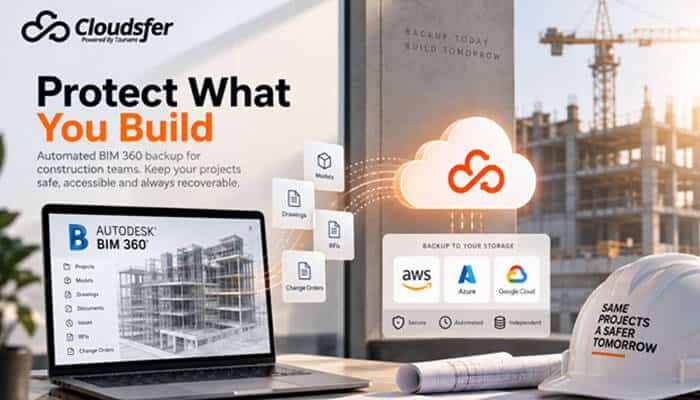

Construction data has quietly become one of the most valuable and most exposed assets in the industry. Design models, drawings, RFIs, and change orders now live almost entirely in the cloud, and for thousands of firms that means Autodesk’s BIM 360 platform. What many teams don’t realize is that storing data in BIM 360 isn’t the same as backing it up. That distinction is exactly what’s driving demand for dedicated bim 360 backup solutions, and it’s a gap that Cloudsfer has built its platform around closing.
Cloud Storage Isn’t a Backup Strategy
It’s an easy mistake to make. A project lives in the cloud, files sync automatically, and everything feels protected. But cloud storage and backup solve two different problems. Autodesk bim 360 was designed for collaboration, version control, and workflow management, not for disaster recovery. If a file gets accidentally deleted, overwritten, or corrupted by a sync error, native recovery options are limited and often time-boxed. A ransomware event or a mishandled permissions change can put months of design work at risk in a matter of minutes, and by the time a team notices, the damage is already done.
This is the reality that’s pushed construction firms toward a genuine bim 360 files backup solution rather than relying on the platform’s built-in safeguards. A real backup exists independently of the source system, preserves historical versions, and gives a team a way to restore exactly what was lost, not just whatever the platform happened to retain.
What a Real Backup Actually Needs to Preserve?
Not all backup solutions are created equal, and BIM data has requirements that generic file backup tools weren’t built to handle. A proper bim 360 projects backup needs to capture more than just the files themselves. Folder hierarchies have to stay intact so teams aren’t left reconstructing project structure from scratch. Permissions need to carry over so the right people retain the right access after a restore. Metadata and version history matter just as much as the current file state, since construction teams frequently need to reference how a design evolved, not just where it ended up.
Cloudsfer’s approach to this problem reflects those requirements directly, preserving folder structures, permissions, and version history as part of every backup rather than treating them as optional extras. Delta backups, which transfer only new or modified files after the first full backup, keep the process efficient even as project volumes grow, and scheduled automation means teams aren’t relying on someone remembering to run a manual export before a deadline.
Recovery Matters as Much as the Backup Itself

A backup that can’t be restored quickly isn’t much of a safety net. This is where a lot of solutions fall short. Some tools can capture data reliably but make recovery slow, complicated, or dependent on support tickets and manual intervention. For a construction team facing a corrupted file mid-project, that delay can be costly. Cloudsfer’s virtual recycle bin approach is built around the opposite priority: when something goes wrong, teams can locate and restore the affected files directly, without waiting on a lengthy recovery process.
That focus on fast, self-serve restoration is increasingly what separates a backup tool worth paying for from one that just checks a compliance box. Firms don’t just want proof that a backup happened. They want confidence that when something breaks, they can be back up and running the same day.
Why This Is Becoming a Standard Requirement, Not a Nice-to-Have?
The construction industry has already absorbed significant losses tied to data mismanagement, and the trend isn’t reversing as more workflows move into platforms like BIM 360. As project teams grow larger and more distributed, the number of ways a file can be lost, corrupted, or maliciously altered grows right along with it. Firms that haven’t yet built a dedicated backup layer into their autodesk bim 360 workflow are effectively betting that nothing will go wrong, which is a bet fewer companies are willing to make as ransomware threats targeting construction data continue to rise.
Cloudsfer, built by Tzunami Inc. with more than two decades of enterprise data migration experience, has positioned itself specifically around this need, offering ransomware protection, encrypted transfers, and automated scheduling designed for how construction teams actually work. As more firms recognize that native cloud storage was never meant to double as a recovery plan, dedicated bim 360 backup infrastructure is shifting from an afterthought to a standard part of how serious construction operations protect their work.
