


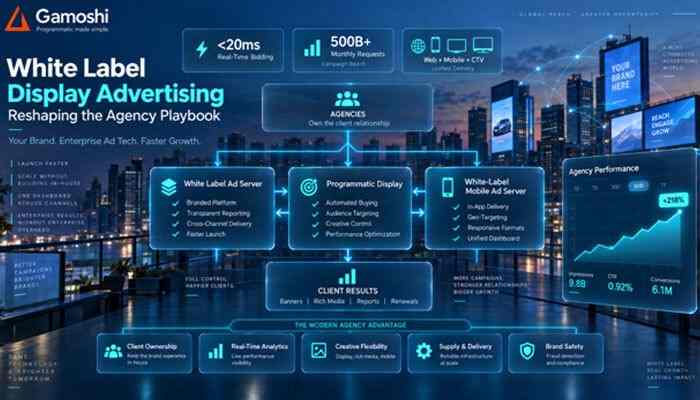

Digital marketing agencies are under more pressure than ever to deliver enterprise-grade advertising results without enterprise-grade budgets. That pressure has pushed a growing number of firms toward white label display advertising, a model that lets agencies offer branded, full-service ad campaigns without ever building the underlying technology themselves. Among the companies driving this shift is Gamoshi, an ad-tech provider whose infrastructure is quietly powering campaigns for agencies that want the results of a proprietary platform without the years of development it normally takes to get there.
White label display advertising works on a simple premise: an agency licenses a ready-built platform, applies its own branding, and runs client campaigns as if the technology were built in-house. Clients never see the provider behind the curtain. They see banners, rich media, and performance reports that carry the agency’s name from start to finish. That’s a meaningful shift for smaller and mid-sized firms, who previously had to choose between expensive custom builds or generic tools that offered little control over the client experience.
Why Are Agencies Moving Away from Building In-House?
Building a proprietary ad server has always been one of the most capital-intensive moves an agency can make. It requires engineering talent, ongoing maintenance, compliance work, and a testing cycle that can stretch on for years before a platform is stable enough to trust with client budgets. A white label ad server removes nearly all of that overhead. Agencies get real-time bidding, cross-channel delivery, and transparent reporting on day one, without diverting resources away from client work and business development.
This is where white label programmatic display advertising has become particularly attractive. Instead of manually negotiating placements or relying on a patchwork of disconnected tools, agencies can automate media buying while still controlling the creative, targeting rules, and reporting dashboards their clients interact with. The result is a campaign process that moves faster and scales more predictably, since the heavy technical lifting sits with the platform provider rather than the agency’s internal team.

Mobile Can’t Be an Afterthought Anymore
Desktop-first thinking doesn’t hold up in a market where most ad impressions happen on a phone. That’s why a dependable white-label mobile ad server has become just as important as the display side of the business. Ads need to load quickly, render correctly across device types, and support in-app placements, geo-targeting, and audience segmentation without lag. Agencies that pair strong desktop delivery with a purpose-built mobile infrastructure tend to see more consistent conversion rates than those relying on a single, generalized system stretched across every format.
Gamoshi’s approach reflects this shift by treating mobile and desktop delivery as a combined offering rather than two separate products, so agencies can report on both channels through a single dashboard instead of stitching together data from multiple sources.
The Bigger Picture: Owning the Client Relationship
Perhaps the most underrated advantage of a white label advertising platform isn’t technical at all. It’s ownership. Agencies that white label their ad technology keep full control of the client relationship, the data, and the brand experience from first impression to final report. That matters more than it might seem. Every campaign delivered under the agency’s own name builds credibility and trust that a generic third-party tool never could. Clients don’t ask who built the backend; they only see the results attributed to the agency they hired.
There’s also a long-term business case. Agencies that rely on someone else’s front-facing platform remain exposed to that provider’s pricing changes, policy shifts, and product decisions. A white label setup insulates them from that risk while still letting them tap into constant technical improvements happening behind the scenes.
A Model Built for Where Advertising Is Headed
The advertising industry isn’t slowing down, and neither are client expectations. Agencies that can move quickly, target precisely, and report transparently are the ones winning renewals in a competitive market. Gamoshi’s positioning around white label display advertising, white label programmatic display advertising, and its dedicated white-label mobile ad server infrastructure reflects a broader industry pattern: agencies want capability without the burden of building it themselves.
For firms weighing whether to invest years into a proprietary system or partner with an established provider, the calculus increasingly favors the latter. A solid white label ad server gets a campaign live in weeks instead of years, and a genuine white label advertising platform gives agencies room to grow into new verticals without starting from zero every time. As more agencies lean into this model, providers like Gamoshi are positioned to become a bigger part of how digital advertising actually gets delivered.
