


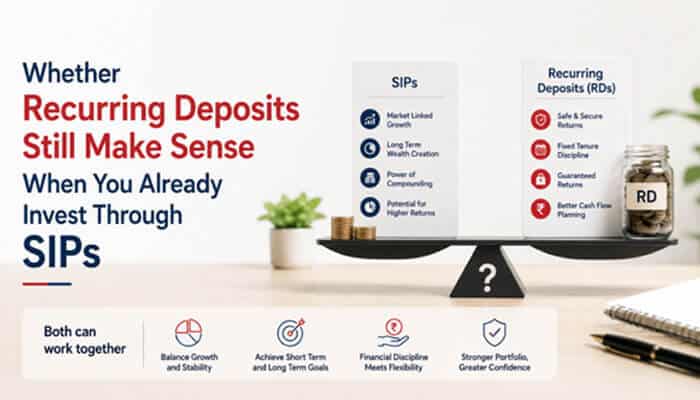

SIPs have become a preferred investment strategy for many investors who have built a disciplined monthly investing habit. The monthly deduction goes out automatically, the portfolio is diversifying across equity funds, and everything moves without much thought required. At some point, someone suggests opening a recurring deposit, and the immediate reaction is, “Why? The SIP is already doing the job.”
That reaction is reasonable but not entirely accurate. SIPs and recurring deposits are not competing versions of the same thing. They serve different purposes, carry different risks, and fit different parts of a person’s financial picture. Let’s understand.
How SIPs and RDs Differ
The structural difference is straightforward. A SIP invests a fixed amount monthly into a mutual fund; the returns are tied to market performance. In a good year, the portfolio grows substantially. In a weak year, the same contributions may accumulate less than expected, and in some cases, the value can dip below what was invested.
A recurring deposit commits a fixed monthly amount to a bank at a predetermined interest rate. The maturity value is known from the day the deposit is opened. There is no variability based on what markets do. For any goal where the exact amount needed is fixed, or where the timeline is short, that predictability has genuine value.
When an RD Still Makes Sense
The clearest case for an RD is near-term goals with a defined amount and timeline. If a couple knows they need Rs 1.8 lakh for a home appliance purchase in fourteen months. An RD locked to that timeline returns a calculable amount without any downside risk.
Emergency corpus building is another area. Many financial planners recommend keeping a portion of emergency savings in instruments that are stable and accessible.
When SIPs May Be the Better Core Choice
For goals that are five or more years away, equity SIPs remain difficult to beat on return potential. The power of compounding across a longer horizon, combined with rupee cost averaging through market cycles, can generate wealth that a fixed-rate deposit simply cannot match.

Investors in their 30s saving for retirement, or parents building a corpus for a child’s education a decade away, are better served by equity exposure through SIPs than by the relatively modest returns of an RD. Inflation is a real factor over those timelines. An RD rate that looks reasonable today may not meaningfully grow wealth after accounting for the cost of living.
Using RD and SIP Together
The more useful framing is not whether to choose one, but how to use both. A practical structure might look like this: SIPs handle long-term goals where market exposure makes sense, and recurring deposits handle near-term goals where the amount and date are fixed. The two run in parallel without one replacing the other.
How to Decide Using a Calculator
A recurring deposit calculator can bring clarity to this decision. Enter the goal amount and the timeline. The calculator returns the monthly deposit required and the projected maturity value. Compare that with what a SIP might return over the same period using an estimated return.
For timelines under two years, the gap in projected values is typically small, and the RD’s certainty often outweighs the SIP’s upside potential. For timelines beyond three years, the difference in projected growth can be significant, and the SIP’s return potential starts to justify accepting market risk.
The calculator does not make the decision, but it removes the guesswork. Knowing the numbers for both options side by side makes it much easier to match the right product to each specific goal.
Trade-Offs to Keep in Mind
Liquidity differs between the two instruments. SIP investments in most mutual funds can be redeemed relatively quickly. Premature closure of an RD reduces the interest earned and may carry penalties. For money that might be needed unexpectedly, the SIP’s liquidity is an advantage.
Tax treatment also varies. Mutual fund returns are taxed based on the holding period and fund type. RD interest is added to income and taxed according to the applicable slab. For investors in higher tax brackets, this can affect which option produces better post-tax returns over the same period.
Conclusion
Neither product is superior in absolute terms. The question is always which one fits the goal, timeline, and risk profile in front of you at a given moment.
